Category: 3. Business

  • The Big New 7-Seater Electric SUV

    The Big New 7-Seater Electric SUV

    • World Premiere on 27th November at Mahindra’s ‘Scream Electric’ event in Bengaluru.
    • Celebrating 1 Year of the launch of the two iconic electric origin SUVs, Mahindra to expand its electric portfolio with the big new 7-seater electric SUV.
    • The first authentic 7-seater electric SUV, built on the INGLO skateboard for unmatched space and performance.

    Mumbai, November 1, 2025: Mahindra has officially unveiled the name of its next all-electric SUV — XEV 9S, the big, bold, and authentic 7-seater electric SUV built on Mahindra’s advanced INGLO platform. Designed to bring together power, presence, and pure electric performance, the XEV 9S marks a new chapter in Mahindra’s all-electric evolution.

    Unlike re-engineered ICE vehicles, the XEV 9S is born electric — purpose-built on Mahindra’s INGLO skateboard architecture. This flat-floor design liberates generous cabin space, enabling clever flexibility like sliding second-row seats, ensuring every passenger enjoys first-class comfort. The skateboard architecture also gives the XEV 9S an inherently low centre of gravity, enhancing both stability and ride comfort — perfect for big families with big plans.

    At its heart, the XEV 9S is about making space for everything you love — your people, your passions, and your life. It’s for those who live large, travel together, and refuse to compromise on electric performance or presence.

    The world will get its first full look at the Mahindra XEV 9S during the ‘Scream Electric’ event in Bengaluru on 27th November 2025 — a grand celebration marking one year of Mahindra’s all-electric journey and its growing INGLO portfolio.

    Because when it comes to going electric — Mahindra believes bigger is better.

    YouTube Link: https://www.youtube.com/watch?v=AyCoOWFmoIc

    Social Media Addresses for Mahindra Electric Origin SUVs

    • Brand website: https://www.mahindraelectricsuv.com/
    • Instagram: @mahindraelectricsuvs
    • Twitter (X): @mahindraeSUVs
    • YouTube: @mahindraelectricsuvs
    • Facebook: @mahindraelectricoriginsuvs
    • Hashtags: #ScreamElectric #XEV9S #MahindraElectricOriginSUVs

    About Mahindra

    Founded in 1945, the Mahindra Group is one of the largest and most admired multinational federation of companies with 3,24,000 employees in over 100 countries. It enjoys a leadership position in farm equipment, utility vehicles, information technology, and financial services in India and is the world’s largest tractor company by volume. It has a strong presence in renewable energy, agriculture, logistics, hospitality, and real estate.

    The Mahindra Group has a clear focus on leading ESG globally, enabling rural prosperity and enhancing urban living, with a goal to drive positive change in the lives of communities and stakeholders to enable them to Rise.

    Learn more about Mahindra on www.mahindra.com / Twitter and Facebook: @MahindraRise / For updates subscribe to https://www.mahindra.com/newsroom

    Media contact information

    Siddharth Saha
    Sr. Manager, Marketing Communications, Mahindra Automotive
    Email – [email protected]
    You can also write to us at: [email protected]
    Continue Reading

  • Failed Crypto Exchange CEO Found Dead in Turkish Jail, TRT Says – Bloomberg

    1. Failed Crypto Exchange CEO Found Dead in Turkish Jail, TRT Says  Bloomberg
    2. Ozer’s Passing Sparks Renewed Demands for Tighter International Cryptocurrency Regulation  Bitget
    3. Cyrpto exchange Thodex founder Fatih Ozer found dead in prison, suicide suspected  Türkiye Today
    4. Crypto exchange boss found dead in Turkish jail, state media confirms  Crypto News
    5. Former CEO of Turkish crypto exchange Thodex dies in prison  Bitget

    Continue Reading

  • Monolithic Power (MPWR) Margin Surge Reinforces Bullish Narrative Despite Cautious Earnings Outlook

    Monolithic Power (MPWR) Margin Surge Reinforces Bullish Narrative Despite Cautious Earnings Outlook

    Monolithic Power Systems (MPWR) posted eye-catching results, with net profit margins surging to 71.2% from 21.3% last year and annual earnings growth averaging 50.4% over the past five years. The most recent figures are particularly striking, as earnings soared 336.4% over the last year, while analysts expect revenue to continue outpacing the broader US market at 14.4% per year. Despite this momentum, the outlook for earnings is more muted, with forecasts calling for a -6.1% annual decline over the next three years. This keeps investors focused on whether strong profit growth can be sustained.

    See our full analysis for Monolithic Power Systems.

    Now, it’s time to put these headline numbers in context by looking at how they match up to the broader narratives circulating around Monolithic Power Systems. This is where the real story is likely to unfold.

    See what the community is saying about Monolithic Power Systems

    NasdaqGS:MPWR Earnings & Revenue History as at Nov 2025
    • Current net profit margin stands at 71.2%, but analysts forecast a steep drop to 26.2% within three years. This highlights a significant reduction in operational efficiency ahead, despite recent outperformance.

    • According to the analysts’ consensus narrative, although recent margin strengths reinforce the company’s status as a margin leader, the anticipated compression puts pressure on Monolithic Power Systems to counteract rising costs and increased investment in innovation.

      • Consensus narrative notes that ongoing investments in manufacturing and technology are seen positively. However, it warns that supply chain and compliance costs could erode profitability faster than many expect.

      • Consensus also emphasizes that margin resilience will be tested by both market saturation risks and the need to deliver steady margin improvement through diversified new solutions.

    What’s driving the split view on Monolithic Power’s high margins? Dive into the full story and see what the consensus narrative signals for the road ahead. 📊 Read the full Monolithic Power Systems Consensus Narrative.

    • Revenue is projected to grow 15.5% annually over the next three years, outstripping the broader US market, and driven by major design wins in AI data centers and automotive electrification.

    • Analysts’ consensus narrative identifies these segments as key growth engines, with significant strength coming from large automotive customers and new AI-powered server architectures.

      • Consensus narrative highlights that expansion into connected vehicles and edge computing creates a larger addressable market. It also underscores expectations that some of these tailwinds could be fully priced in soon.

      • Consensus additionally calls out Monolithic Power’s strategy of providing end-to-end semiconductor solutions, which is increasing customer stickiness and setting the stage for robust long-term growth if current segment momentum holds.

    Continue Reading

  • Electricity Prices Have Grown in Line with Overall CPI

    Electricity Prices Have Grown in Line with Overall CPI

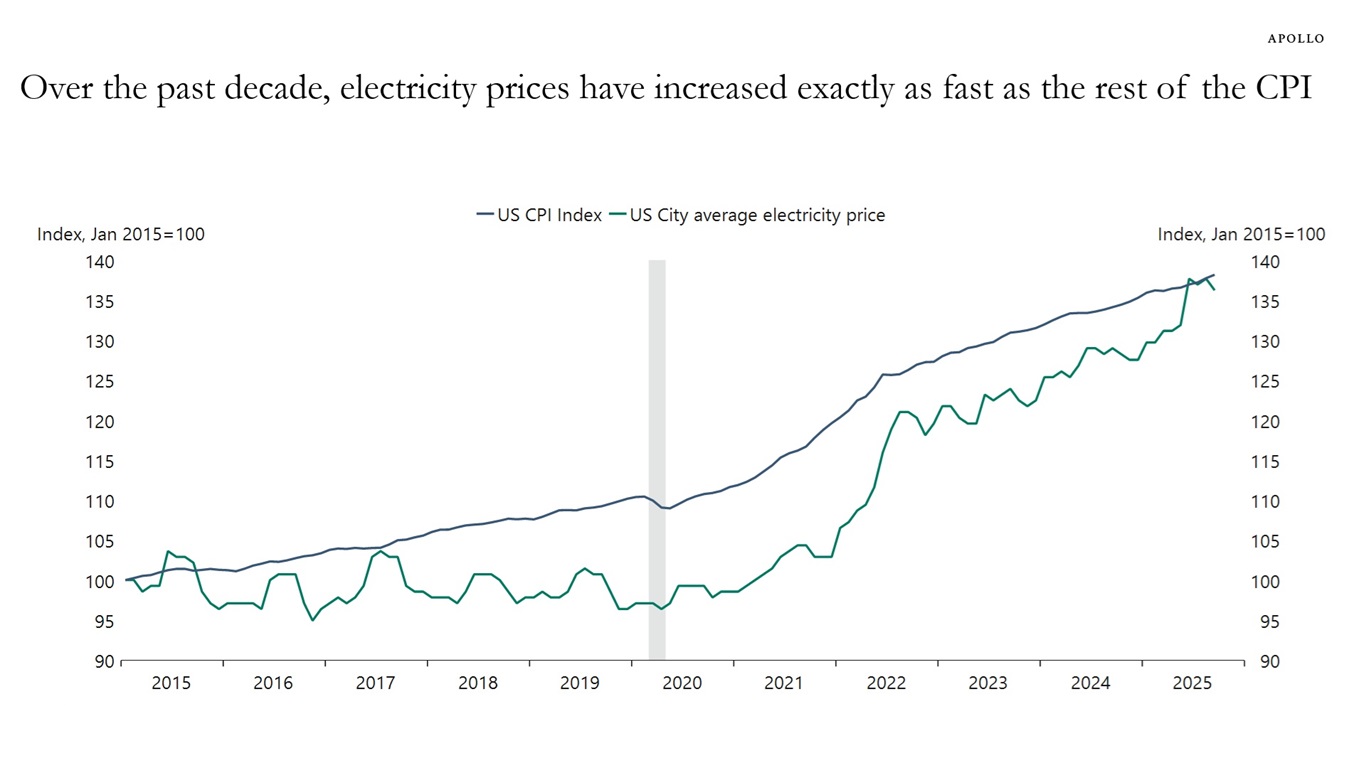
    The current debate about electricity prices is misguided. Inflation in electricity prices needs to be compared with inflation in the overall CPI, and over the past decade, electricity prices have increased exactly as fast as the overall price level in the economy, see chart below.

    Sources: US Bureau of Labor Statistics (BLS), Macrobond, Apollo Chief Economist

    Download high-res chart


    This presentation may not be distributed, transmitted or otherwise communicated to others in whole or in part without the express consent of Apollo Global Management, Inc. (together with its subsidiaries, “Apollo”).  

    Apollo makes no representation or warranty, expressed or implied, with respect to the accuracy, reasonableness, or completeness of any of the statements made during this presentation, including, but not limited to, statements obtained from third parties. Opinions, estimates and projections constitute the current judgment of the speaker as of the date indicated. They do not necessarily reflect the views and opinions of Apollo and are subject to change at any time without notice. Apollo does not have any responsibility to update this presentation to account for such changes. There can be no assurance that any trends discussed during this presentation will continue.   

    Statements made throughout this presentation are not intended to provide, and should not be relied upon for, accounting, legal or tax advice and do not constitute an investment recommendation or investment advice. Investors should make an independent investigation of the information discussed during this presentation, including consulting their tax, legal, accounting or other advisors about such information. Apollo does not act for you and is not responsible for providing you with the protections afforded to its clients. This presentation does not constitute an offer to sell, or the solicitation of an offer to buy, any security, product or service, including interest in any investment product or fund or account managed or advised by Apollo. 

    Certain statements made throughout this presentation may be “forward-looking” in nature. Due to various risks and uncertainties, actual events or results may differ materially from those reflected or contemplated in such forward-looking information. As such, undue reliance should not be placed on such statements. Forward-looking statements may be identified by the use of terminology including, but not limited to, “may”, “will”, “should”, “expect”, “anticipate”, “target”, “project”, “estimate”, “intend”, “continue” or “believe” or the negatives thereof or other variations thereon or comparable terminology.


    Continue Reading

  • Trump’s China deal eases U.S. rare earths plight for now, but dangers linger – The Washington Post

    1. Trump’s China deal eases U.S. rare earths plight for now, but dangers linger  The Washington Post
    2. How Much Control China Has Over the World’s Critical Minerals  Visual Capitalist
    3. Supply Chains: The Achilles Heel of US Military Power?  Geopolitical Monitor
    4. China’s rare earth squeeze reaches a turning point in the global tech standoff  digitimes
    5. ‘Alerted everyone’: US treasury secy Scott Bessent slams China over rare earth controls; calls it a ‘real  The Times of India

    Continue Reading

  • Campari shares worth €1.3bn seized by police over alleged tax evasion

    Campari shares worth €1.3bn seized by police over alleged tax evasion

    Shares worth €1.3bn (£1.1bn; $1.5bn) have been seized from the company that controls the manufacturer of Campari over alleged tax evasion, Italian police have said.

    Officials ordered the confiscation of the Campari Group shares from Luxembourg-based Lagfin as part of a year-long investigation into how it absorbed its Italian arm.

    It is accused of failing to pay a similar figure to that of the shares seized in taxes during that merger. The company previously said it had always fulfilled its tax obligations.

    Campari – which also produces alcohol brands including Aperol, Grand Marnier and Courvoisier – said neither it nor its subsidiaries were involved in the case.

    However, chair Luca Garavoglia is among those under investigation, local media reports.

    The BBC approached Lagfin – which owns more than 50% of Campari shares and has 80% of voting rights – for comment.

    It previously said in a statement issued on the investigation last year that it had “always fulfilled its tax obligations with the utmost scruples in all the jurisdictions where it operates” and considers any claims to the contrary “devoid of any basis”.

    Prosecutors in Milan launched a probe into the company last year. Financial police on Friday said they allegedly found €5.3bn of undeclared capital gains between 2018 and 2020 on which it had not paid a so-called “exit tax”, levied on firms that transfer their headquarters abroad.

    It is also accused of transferring its Italian assets into foreign ownership solely for tax purposes, according to Italian financial newspaper Il Sole 24 Ore.

    Mr Garavoglia, the billionaire who inherited ownership of Campari from his late mother, is implicated alongside Giovanni Berto, the head of Campari’s Italian branch, local media reports.

    One of the largest global producers of spirits, Campari is valued at around €7bn on the Milan Stock Exchange.

    The company has its roots in 1860, when Gaspare Campari’s homemade bitter liqueur became a popular tipple among patrons of his Milan bar.

    It became so successful that, in 1904, his family began manufacturing it commercially, and from the 1990s onwards the firm began acquiring other alcohol brands.

    Continue Reading

  • TP ICAP Group’s (LON:TCAP) investors will be pleased with their notable 85% return over the last three years

    TP ICAP Group’s (LON:TCAP) investors will be pleased with their notable 85% return over the last three years

    It hasn’t been the best quarter for TP ICAP Group PLC (LON:TCAP) shareholders, since the share price has fallen 14% in that time. But over the last three years returns have been decent. It beat the market return of 46% in that time, gaining 50%.

    Now it’s worth having a look at the company’s fundamentals too, because that will help us determine if the long term shareholder return has matched the performance of the underlying business.

    AI is about to change healthcare. These 20 stocks are working on everything from early diagnostics to drug discovery. The best part – they are all under $10bn in marketcap – there is still time to get in early.

    While markets are a powerful pricing mechanism, share prices reflect investor sentiment, not just underlying business performance. One imperfect but simple way to consider how the market perception of a company has shifted is to compare the change in the earnings per share (EPS) with the share price movement.

    During three years of share price growth, TP ICAP Group achieved compound earnings per share growth of 39% per year. The average annual share price increase of 14% is actually lower than the EPS growth. So it seems investors have become more cautious about the company, over time. This cautious sentiment is reflected in its (fairly low) P/E ratio of 11.16.

    The company’s earnings per share (over time) is depicted in the image below (click to see the exact numbers).

    LSE:TCAP Earnings Per Share Growth November 1st 2025

    It is of course excellent to see how TP ICAP Group has grown profits over the years, but the future is more important for shareholders. You can see how its balance sheet has strengthened (or weakened) over time in this free interactive graphic.

    When looking at investment returns, it is important to consider the difference between total shareholder return (TSR) and share price return. The TSR is a return calculation that accounts for the value of cash dividends (assuming that any dividend received was reinvested) and the calculated value of any discounted capital raisings and spin-offs. Arguably, the TSR gives a more comprehensive picture of the return generated by a stock. We note that for TP ICAP Group the TSR over the last 3 years was 85%, which is better than the share price return mentioned above. And there’s no prize for guessing that the dividend payments largely explain the divergence!

    We’re pleased to report that TP ICAP Group shareholders have received a total shareholder return of 25% over one year. And that does include the dividend. That’s better than the annualised return of 15% over half a decade, implying that the company is doing better recently. Someone with an optimistic perspective could view the recent improvement in TSR as indicating that the business itself is getting better with time. While it is well worth considering the different impacts that market conditions can have on the share price, there are other factors that are even more important. For instance, we’ve identified 2 warning signs for TP ICAP Group that you should be aware of.

    Of course TP ICAP Group may not be the best stock to buy. So you may wish to see this free collection of growth stocks.

    Please note, the market returns quoted in this article reflect the market weighted average returns of stocks that currently trade on British exchanges.

    Have feedback on this article? Concerned about the content? Get in touch with us directly. Alternatively, email editorial-team (at) simplywallst.com.

    This article by Simply Wall St is general in nature. We provide commentary based on historical data and analyst forecasts only using an unbiased methodology and our articles are not intended to be financial advice. It does not constitute a recommendation to buy or sell any stock, and does not take account of your objectives, or your financial situation. We aim to bring you long-term focused analysis driven by fundamental data. Note that our analysis may not factor in the latest price-sensitive company announcements or qualitative material. Simply Wall St has no position in any stocks mentioned.

    Continue Reading

  • A Look at Mitsubishi (TSE:8058) Valuation Following Strategic Biotech Deal with Wheeler Bio

    A Look at Mitsubishi (TSE:8058) Valuation Following Strategic Biotech Deal with Wheeler Bio

    Mitsubishi (TSE:8058) has taken another step into the biotech sector by announcing a strategic partnership with Wheeler Bio focused on expanding commercial opportunities across the Asia-Pacific region. The collaboration includes a direct investment in Wheeler’s latest funding round.

    See our latest analysis for Mitsubishi.

    Mitsubishi’s renewed push into biotech comes on the back of strong market momentum. The past three months alone saw a 22.6% rise in share price, with the 2024 year-to-date increase nearing 44%. Over the long term, Mitsubishi’s 1-year total shareholder return clocks in at almost 40%, while the 3-year return sits above 180%. The 5-year total return is a remarkable 454%. These are clear signals that investors see value in both its ongoing diversification and robust fundamentals.

    If Mitsubishi’s growth streak has you thinking about what else is thriving in dynamic sectors, now’s a great time to explore See the full list for free.

    Yet with the stock rallying so sharply this year, the big question is whether Mitsubishi remains undervalued at current levels, or if the market has already factored in the company’s growth and biotech ambitions. Is there still a genuine buying opportunity here?

    Mitsubishi’s most followed narrative currently points to a fair value below the last close of ¥3,712, suggesting the recent price rally has outpaced foundational earnings assumptions in the eyes of analysts and market observers. This sets up a clash between momentum-driven optimism and more cautious, long-term projections.

    Active capital recycling and selective divestitures of lower-margin businesses align the portfolio toward higher-margin and recurring revenue streams. This approach is likely to enhance net margins and improve return on equity over the medium term. Expansion into international food and consumer supply chains (for example, Cermaq and Thai Union Group) utilizes Mitsubishi’s global distribution strength to build stable, recurring revenue. This helps counter cyclical downturns and supports long-term revenue growth.

    Read the complete narrative.

    Want to know the growth blueprint behind this high valuation? The key element of this narrative is a margin transformation and a revenue engine hidden beyond megaproject headlines. What are the bold projections keeping some analysts cautious even as shares soar? Read on to discover which financial forecasts are setting the true ceiling for Mitsubishi’s fair value.

    Result: Fair Value of ¥3,405 (OVERVALUED)

    Have a read of the narrative in full and understand what’s behind the forecasts.

    However, factors such as declining commodity prices and underperformance in legacy business lines could quickly challenge bullish forecasts for Mitsubishi’s future growth.

    Find out about the key risks to this Mitsubishi narrative.

    If you see a different story in Mitsubishi’s fundamentals, or would rather rely on your own research approach, it’s faster than ever to shape your own perspective in just a few minutes. Do it your way.

    A great starting point for your Mitsubishi research is our analysis highlighting 1 key reward and 2 important warning signs that could impact your investment decision.

    Smart investors never settle for today’s headlines alone. Broaden your horizon and unlock new opportunities in tomorrow’s markets with these top stock ideas on Simply Wall Street.

    This article by Simply Wall St is general in nature. We provide commentary based on historical data and analyst forecasts only using an unbiased methodology and our articles are not intended to be financial advice. It does not constitute a recommendation to buy or sell any stock, and does not take account of your objectives, or your financial situation. We aim to bring you long-term focused analysis driven by fundamental data. Note that our analysis may not factor in the latest price-sensitive company announcements or qualitative material. Simply Wall St has no position in any stocks mentioned.

    Companies discussed in this article include 8058.T.

    Have feedback on this article? Concerned about the content? Get in touch with us directly. Alternatively, email editorial-team@simplywallst.com

    Continue Reading

  • A finance chief joined the Trump administration. Then his company unravelled

    A finance chief joined the Trump administration. Then his company unravelled

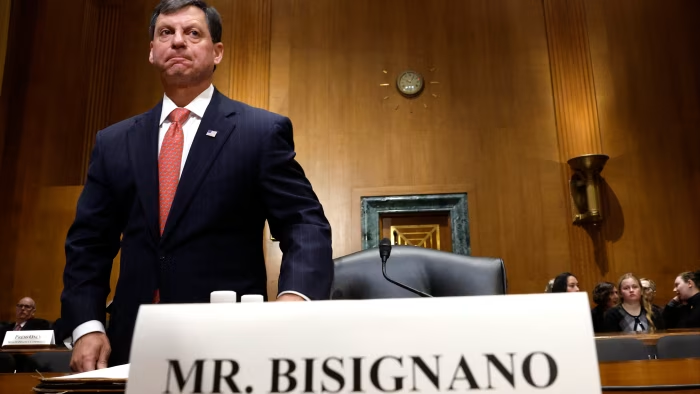
    When Donald Trump nominated Fiserv chief executive Frank Bisignano to serve in his administration 11 months ago, his company was held up as a Wall Street fintech darling alongside the likes of Visa and Mastercard.

    Now the business Bisignano helped build is in freefall.

    Shares of Fiserv, which runs back-end technology for banks and payment networks, fell 44 per cent and lost $30bn in market value after disastrous third-quarter results on Wednesday. The company disclosed several problems that had been festering for years and analysts described the earnings as “shocking” and “impossible to sugarcoat”.

    But Bisignano already cashed out, selling 3.3mn Fiserv shares worth more than $500mn at the time of his Senate confirmation in May, and deferring taxes on the gains. Today, the shares would be worth about $220mn.

    Now questions are being raised about the company’s management under the leadership of Bisignano, who has been tapped by Trump to manage two of the government’s most crucial financial operations — the Internal Revenue Service and the Social Security Administration. One collects more than $5tn in annual tax revenue and the other makes more than $1.6tn in yearly payments to senior citizens.

    “To see a company that 12 months ago had a sterling reputation fall off like this and finish the day down 44 per cent, it is the most shocking earnings print I’ve had in my time covering the space,” Deutsche Bank analyst Nate Svensson said.

    New Fiserv chief executive Mike Lyons, in the job since Bisignano’s resignation in May, said an analysis had revealed ill-fated decisions to defer investments and cut costs, as well as a reliance on short-term initiatives to maximise quarterly results.

    “As a result, we have made the decision to deprioritise the short-term revenue and expense initiatives which, of course, has some near-term impact on our growth and profitability,” Lyons told analysts.

    The company is now facing shareholder lawsuits alleging it misled investors. Fiserv declined to comment. Bisignano did not respond to requests for comment.

    Wisconsin-based Fiserv was founded in 1984. The company as it is today is the result of a merger between Fiserv and First Data, where Bisignano was the CEO.

    The deal brought together Fiserv’s sticky but low growth core banking system business with First Data’s higher-growth merchant solutions business, which provided payment processing systems such as credit card readers for small and large businesses as well as ecommerce services.

    Large orange "fiserv." logo on a dark building facade next to a white, ornate building under a clear blue sky.
    Fiserv headquarters in Milwaukee, Wisconsin, where it was founded in 1984 © Bloomberg

    Before Fiserv and First Data, Bisignano, 66, was a top executive at JPMorgan Chase, reporting to chief executive Jamie Dimon. Internally, he earned a reputation as a savvy operator but also someone who could blur the lines between company matters and his personal life.

    Bisignano was known to invite family and friends to the corporate box at MetLife Stadium to watch the New York Giants NFL team, even when he was not in attendance, and for his frequent use of the company’s private plane, according to executives who worked with him at the time.

    His relationship with Dimon eventually soured, according to people familiar with the matter, and he left JPMorgan to join First Data in 2013. In 2017, his pay there reached $100mn. JPMorgan declined to comment.

    Bisignano took over the combined Fiserv/First Data company in 2020. It emerged as an industry winner, outperforming rivals such as FIS and GPN. Fiserv’s standout business was its Clover point-of-sale payments terminals.

    Bisignano and his wife Tracy were significant donors to Trump’s 2024 and 2020 presidential campaigns before he was recruited to run the social security programme and take the newly created role of IRS chief executive reporting to Treasury secretary Scott Bessent. A Treasury department spokesperson did not respond to requests for comment.

    Donald Trump speaks at the Resolute Desk as Frank Bisignano stands beside him in the Oval Office, with flags in the background.
    President Donald Trump appointed Bisignano, left, as commissioner of the Social Security Administration, and later named him CEO of the Internal Revenue Service © AFP or licensors

    In October 2024, a few weeks before election day, Tracy gave $924,600 to the Trump 47 Committee, the maximum an individual could give to the joint fundraising Pac, and nearly $800,000 split between the Republican National Committee and dozens of local Republican party groups.

    At Fiserv, the image of a stable business with solid growth potential has been shattered. The company on Wednesday widely missed analysts’ estimates in quarterly results and slashed its outlook for organic revenue growth in 2025 from 10 per cent to as low as 3.5 per cent.

    Lyons detailed that its business in Argentina, which has been supported by the country’s high interest rates and hyperinflation, had been a bigger driver of growth than investors previously believed. He talked about reversing price increases that the prior leadership had made and a need to “overhaul” the client experience for its Clover product.

    “At Fiserv there was a lot of restructuring, a lot of cost takeout. I don’t think there was investment in places that needed investment,” said Ali Raza, managing principal at Blue Leviathan, a consulting firm focused on payments. “So we have what we have now.”

    Lyons is now tasked with turning the company around. He has put in place a new chief financial officer, three new board members and new co-presidents.

    He has talked about resetting the company’s culture to one that prioritises integrity, fairness, execution, accountability and client service, changes that will take time to implement.

    “Leaving aside what’s happening with the financials,” said Deutsche’s Svensson, “that is not something you can wave the magic wand and fix overnight”.

    Continue Reading

  • $198 Million One-Off Loss Undermines Margin, Sparks Debate Over Earnings Quality

    $198 Million One-Off Loss Undermines Margin, Sparks Debate Over Earnings Quality

    Lear (LEA) delivered a 14.5% annual earnings growth rate over the past five years, but net profit margin came in at 2.1%, a shade below last year’s 2.3%. The result this period was shaped by a sizeable $198 million one-off loss. Expectations for future earnings growth sit at a robust 31.8% per year, easily outpacing the broader US market’s projected pace. With revenue forecast to grow at 2.7% annually and shares trading well below discounted cash flow estimates, investors have plenty to evaluate, especially with margins and quality of earnings under the spotlight.

    See our full analysis for Lear.

    Next up, we’ll see how these headline numbers either support or challenge the most popular narratives from the community and analysts.

    See what the community is saying about Lear

    NYSE:LEA Earnings & Revenue History as at Nov 2025
    • The latest DCF fair value for Lear comes in at $144.53 per share, notably higher than the current market price of $104.65. This signals a potential undervaluation for long-term-focused investors.

    • According to the analysts’ consensus narrative, confidence in Lear’s advanced EV systems and automation wins is driving expectations for profit margins to double to 4.2% over the next three years.

      • Consensus sees $60 million in recurring efficiency gains already realized this year, with another $90 million expected. This reinforces the margin and valuation case.

      • Analysts also highlight new electronics-rich seating programs and OEM outsourcing as catalysts, offsetting recent temporary profit margin softness.

    • The difference between current price and analyst price target is just 2.7%, with the analyst target at $116.25. This implies that most anticipate only moderate short-term upside rather than a major rally.

    Curious how analysts are weighing Lear’s growth drivers against the fair value gap with the stock trading far below DCF estimates? 📈 Read the full Lear Consensus Narrative.

    • A $198 million one-time loss weighed on Lear’s annual net profit margin, bringing it down from 2.3% to 2.1% even as overall earnings kept climbing.

    • The analysts’ consensus narrative points out that recurring savings from automation and digital manufacturing are helping offset non-recurring costs, and sets expectations for margins to reach 4.2% in three years.

      • Consensus also cautions that continued wind-downs in discontinued E-Systems product lines will be a structural hurdle through at least 2027, limiting margin recovery in those segments short term.

      • Flexibility from buybacks and a $2 billion revolver underpin the view that margin compression from non-recurring hits should be temporary for the broader business.

    Continue Reading