Our portfolio companies are building technology that rearchitects how we build, work, and thrive together. But transformative technology only matters if it reaches the right people and institutions. Our strategic partners offer decades of domain expertise and operational muscle to help our founders deliver on their boldest ambitions and turn their innovations into real-world impact at scale.
Category: 3. Business
-
AbbVie and RemeGen Announce Exclusive Licensing Agreement to Develop A Novel Bispecific Antibody for Advanced Solid Tumors
AbbVie and RemeGen Announce Exclusive Licensing Agreement to Develop A Novel Bispecific Antibody for Advanced Solid Tumors
– RC148 is a novel PD-1/VEGF bispecific antibody being evaluated in multiple advanced solid tumors including certain lung cancers
NORTH CHICAGO, Ill. and YANTAI, China, Jan. 12, 2026 /PRNewswire/ — AbbVie (NYSE: ABBV) and RemeGen today announced an exclusive licensing agreement for the development, manufacturing and commercialization of RC148, a novel investigational Programmed Cell Death-1 (PD-1)/Vascular Endothelial Growth Factor (VEGF)-targeted bispecific antibody. RC148 is currently being developed by RemeGen as a monotherapy and in combination regimens across multiple advanced solid tumors.
PD-1/VEGF-targeted bispecific antibodies represent a new class of cancer therapies that aim to help the immune system fight tumors more effectively and potentially overcome tumor resistance mechanisms by blocking both PD-1 and VEGF simultaneously. Additionally, given their potential to modulate both immune suppression and foster a favorable tumor microenvironment for antibody-drug conjugate (ADC) activity, PD-1/VEGF bispecific antibodies are also being explored in combination with ADCs. In early clinical studies, RC148 has shown initial favorable antitumor activity in combination with an ADC.
RC148 further strengthens AbbVie’s diverse oncology portfolio. In particular, it may offer new opportunities to explore combination regimens with AbbVie’s ADCs such as investigational telisotuzumab adizutecan (Temab-A), across multiple solid tumors with high unmet need including non-small cell lung cancer (NSCLC) and colorectal cancer (CRC).
“Our partnership with RemeGen reflects AbbVie’s commitment to not only advance novel oncology treatments, but also to build strong collaborations with biopharmaceutical innovators globally as an increasingly important source of scientific and clinical progress,” said Daejin Abidoye, M.D., vice president, therapeutic area head, oncology, solid tumor and hematology at AbbVie. “By combining the immune checkpoint inhibition and anti-angiogenic activity of RC148 together with the targeted cytotoxic activity of ADCs, we have the potential to identify meaningful options for patients across a range of solid tumors.”
“This collaboration is a significant milestone for RemeGen, highlighting the innovative potential of RC148 in addressing critical unmet medical needs in cancer treatment,” said Dr. Jianmin Fang, chief executive officer of RemeGen. “The deal further underscores RemeGen’s commitment to bringing cutting-edge therapies to patients worldwide. Working with AbbVie, we look forward to maximizing RC148’s clinical and commercial potential in China and globally.”
Under the terms of the agreement, AbbVie will receive exclusive rights to develop, manufacture, and commercialize RC148 outside of the Greater China territory. RemeGen will receive an upfront payment of USD $650 million and is eligible to receive up to USD $4.95 billion in aggregate development, regulatory, and commercial milestone payments, along with tiered, double-digit royalties on net sales outside the Greater China territory.
About AbbVie
AbbVie’s mission is to discover and deliver innovative medicines and solutions that solve serious health issues today and address the medical challenges of tomorrow. We strive to have a remarkable impact on people’s lives across several key therapeutic areas including immunology, oncology, neuroscience and eye care – and products and services in our Allergan Aesthetics portfolio. For more information about AbbVie, please visit us at www.abbvie.com. Follow @abbvie on LinkedIn, Facebook, Instagram, X (formerly Twitter) and YouTube.About AbbVie in Oncology
AbbVie is committed to elevating standards of care and bringing transformative therapies to patients worldwide living with difficult-to-treat cancers. We are advancing a dynamic pipeline of investigational therapies across a range of cancer types in both blood cancers and solid tumors. We are focusing on creating targeted medicines that either impede the reproduction of cancer cells or enable their elimination. We achieve this through various, targeted treatment modalities and biology interventions, including small molecule therapeutics, antibody-drug conjugates (ADCs), immuno-oncology-based therapeutics, multispecific antibody and novel CAR-T platforms. Our dedicated and experienced team joins forces with innovative partners to accelerate the delivery of potential breakthrough medicines.Today, our expansive oncology portfolio comprises approved and investigational treatments for a wide range of blood cancers and solid tumors. We are evaluating more than 35 investigational medicines in multiple clinical trials across some of the world’s most widespread and debilitating cancers. As we work to have a remarkable impact on people’s lives, we are committed to exploring solutions to help patients obtain access to our cancer medicines. For more information, please visit http://www.abbvie.com/oncology.
About RemeGen
RemeGen Co., Ltd. is a leading innovative biopharmaceutical company in China focused on the discovery, development, manufacturing and commercialization of proprietary biologics. The company is dual-listed on the Hong Kong Stock Exchange and the STAR Market of the Shanghai Stock Exchange.RemeGen has built a highly differentiated pipeline across autoimmune, oncology and ophthalmology, with a proven ability to rapidly translate innovative science into clinically and commercially meaningful medicines. Its two flagship products, telitacicept and disitamab vedotin, have received approvals for a total of six indications in China, underscoring RemeGen’s strong capabilities in first-/best-in-class biologics discovery, efficient clinical execution and successful commercialization. Additional information is available on the company’s website at https://www.remegen.com/
Forward-Looking Statements
Some statements in this news release are, or may be considered, forward-looking statements for purposes of the Private Securities Litigation Reform Act of 1995. The words “believe,” “expect,” “anticipate,” “project” and similar expressions and uses of future or conditional verbs, generally identify forward-looking statements. AbbVie cautions that these forward-looking statements are subject to risks and uncertainties that may cause actual results to differ materially from those expressed or implied in the forward-looking statements. Such risks and uncertainties include, but are not limited to, challenges to intellectual property, competition from other products, difficulties inherent in the research and development process, adverse litigation or government action, changes to laws and regulations applicable to our industry, the impact of global macroeconomic factors, such as economic downturns or uncertainty, international conflict, trade disputes and tariffs, and other uncertainties and risks associated with global business operations. Additional information about the economic, competitive, governmental, technological and other factors that may affect AbbVie’s operations is set forth in Item 1A, “Risk Factors,” of AbbVie’s 2024 Annual Report on Form 10-K, which has been filed with the Securities and Exchange Commission, as updated by its Quarterly Reports on Form 10-Q and in other documents that AbbVie subsequently files with the Securities and Exchange Commission that update, supplement or supersede such information. AbbVie undertakes no obligation, and specifically declines, to release publicly any revisions to forward-looking statements as a result of subsequent events or developments, except as required by law.SOURCE AbbVie
Continue Reading
-

UK set for a ‘booming’ mortgage market, say analysts
Kevin PeacheyCost of living correspondent
 Getty Images
Competition among lenders suggests that mortgage rates could be cut in the coming weeks, according to brokers and analysts.
In a newly-published report, financial information service Moneyfacts said “expectations are high for a booming market in 2026”.
Its data shows the choice of mortgage products has risen to its highest level in 18 years, with first-time buyers now also being helped by looser requirements from lenders.
Mortgage rates fell over the last year, but wider global and economic uncertainty still has the potential to derail any further improvements. Some borrowers also still face a financial hit when their current deal comes to an end.
More than eight in 10 mortgage customers have fixed-rate deals.
The interest rate on this kind of mortgage does not change until the deal expires, usually after two or five years, and a new one is chosen to replace it.
In August last year, the average two-year fixed mortgage rate dipped below 5% for the first time since former Prime Minister Liz Truss’s mini-budget in September 2022.
Rates have fallen further, with some movement in recent days, and Moneyfacts has predicted more declines early this year.
“Expectations are high for a booming market in 2026. Mortgage rates are lower year-on-year, and the choice of deals is abundant,” said Moneyfacts.
“First-time buyers are not being left behind by this progress.”
Buying a property is a huge financial stretch for many first-time buyers, and the number of suitable homes on the market is limited.
But rising wages also mean that mortgage costs as a share of income are at their lowest for a few years for first-time buyers.
Regulators have recently allowed lenders to be more flexible with mortgage affordability so Jo Jingree, director of broker Mortgage Confidence, said more innovative products to help people buy a first home were now available.
“These include allowing borrowing up to six times your income, where affordability allows,” she said.
Some lenders were offering low, or no, deposit mortgages, she added. Family and friends were able to support borrowers through new, so-called joint borrower, sole proprietor mortgages.
Local housing markets differ
In general, mortgage brokers have suggested there is some pent-up demand among potential buyers who were waiting for the Budget and the festive period to be over before making firm plans to move.
However, such a judgement is difficult to make with any certainty. Industry predictions made before Christmas suggested sales could fall over the year as a whole compared with 2025.
Aaron Strutt, from broker Trinity Financial, said 1.8 million borrowers were coming to the end of their fixed rates and competition between the lenders to issue more mortgages was likely to be even stronger this year.
“We can expect to see some more criteria easing and hopefully even cheaper fixed rates,” he said.
Housing commentators have pointed to the relative stability of prices in recent times.
Buying agent Henry Pryor said the UK housing market had moved on from the “red-hot” period for sellers in the aftermath of Covid.
“There are distinct differences as always as you move to higher prices and from parish to parish but in general the UK housing market remains healthy and largely predictable,” he said.
“Interest rates seem to be coming down, [housing] supply remains constrained but people have choice and are more cautious. The biggest problem remains price – sellers think that it’s 2022 while buyers think it’s 2014.”
Continue Reading
-
Sukuk Market: Strong Growth To Continue – S&P Global
- Sukuk Market: Strong Growth To Continue S&P Global
- Global sukuk market enters 2026 on solid footing after $300bn issuance: Fitch Arab News PK
- Global sukuk outstanding surpasses $1 trillion in 2025, led by GCC and ASEAN regions Economy Middle East
- Sukuk market strength carries into 2026 Mettis Global
Continue Reading
-

The United States Welcomes Qatar’s Signing of Pax Silica Declaration
Today, Qatar signed the Pax Silica Declaration, marking a historic milestone in the region’s economic integration. Together, the United States of America and Qatar affirm a new geopolitical consensus that economic security is national security, and national security is economic security. Qatar’s leadership and commitment to investing in secure energy, advanced technology, and critical minerals supply chains make it an indispensable partner in this effort, placing Qatar in the vanguard of nations that will drive the next stage of global economic growth.
Qatar’s accession to Pax Silica was signed by Under Secretary of State for Economic Affairs Jacob Helberg and Minister of State for Foreign Trade Affairs Ahmed bin Mohammed Al-Sayed. The United States and Qatar affirmed their commitment to pursue multilayered partnerships that strengthen supply chain security, address coercive dependencies and single points of failure, and advance the adoption of trusted technology ecosystems. They will explore opportunities to partner on flagship projects across global technology stacks, including connectivity and digital infrastructure, compute and semiconductors, advanced manufacturing, logistics, mineral refining and processing, and energy.
Pax Silica is an economic security coalition built for the AI age. This is the first time countries are organizing around compute, silicon, minerals, and energy as shared strategic assets.
The United States welcomed Qatar as the eighth Pax Silica signatory. They joined signatories from Australia, Israel, Japan, Republic of Korea, Singapore, and the United Kingdom. Additional signatories are expected to follow.
Pax Silica is a positive-sum partnership of nations that want to remain competitive and prosperous.
For media inquiries, please submit questions here, and stay updated by following @UnderSecE on X.
For more information, visit Pax Silica.
Continue Reading
-
The United States Welcomes Qatar’s Signing of Pax Silica Declaration
Today, Qatar signed the Pax Silica Declaration, marking a historic milestone in the region’s economic integration. Together, the United States of America and Qatar affirm a new geopolitical consensus that economic security is national security, and national security is economic security. Qatar’s leadership and commitment to investing in secure energy, advanced technology, and critical minerals supply chains make it an indispensable partner in this effort, placing Qatar in the vanguard of nations that will drive the next stage of global economic growth.
Qatar’s accession to Pax Silica was signed by Under Secretary of State for Economic Affairs Jacob Helberg and Minister of State for Foreign Trade Affairs Ahmed bin Mohammed Al-Sayed. The United States and Qatar affirmed their commitment to pursue multilayered partnerships that strengthen supply chain security, address coercive dependencies and single points of failure, and advance the adoption of trusted technology ecosystems. They will explore opportunities to partner on flagship projects across global technology stacks, including connectivity and digital infrastructure, compute and semiconductors, advanced manufacturing, logistics, mineral refining and processing, and energy.
Pax Silica is an economic security coalition built for the AI age. This is the first time countries are organizing around compute, silicon, minerals, and energy as shared strategic assets.
The United States welcomed Qatar as the eighth Pax Silica signatory. They joined signatories from Australia, Israel, Japan, Republic of Korea, Singapore, and the United Kingdom. Additional signatories are expected to follow.
Pax Silica is a positive-sum partnership of nations that want to remain competitive and prosperous.
For media inquiries, please submit questions here, and stay updated by following @UnderSecE on X.
For more information, visit Pax Silica.
Read Under Secretary Helberg’s Remarks on the Accession of Qatar to the Pax Silica Declaration
Continue Reading
-
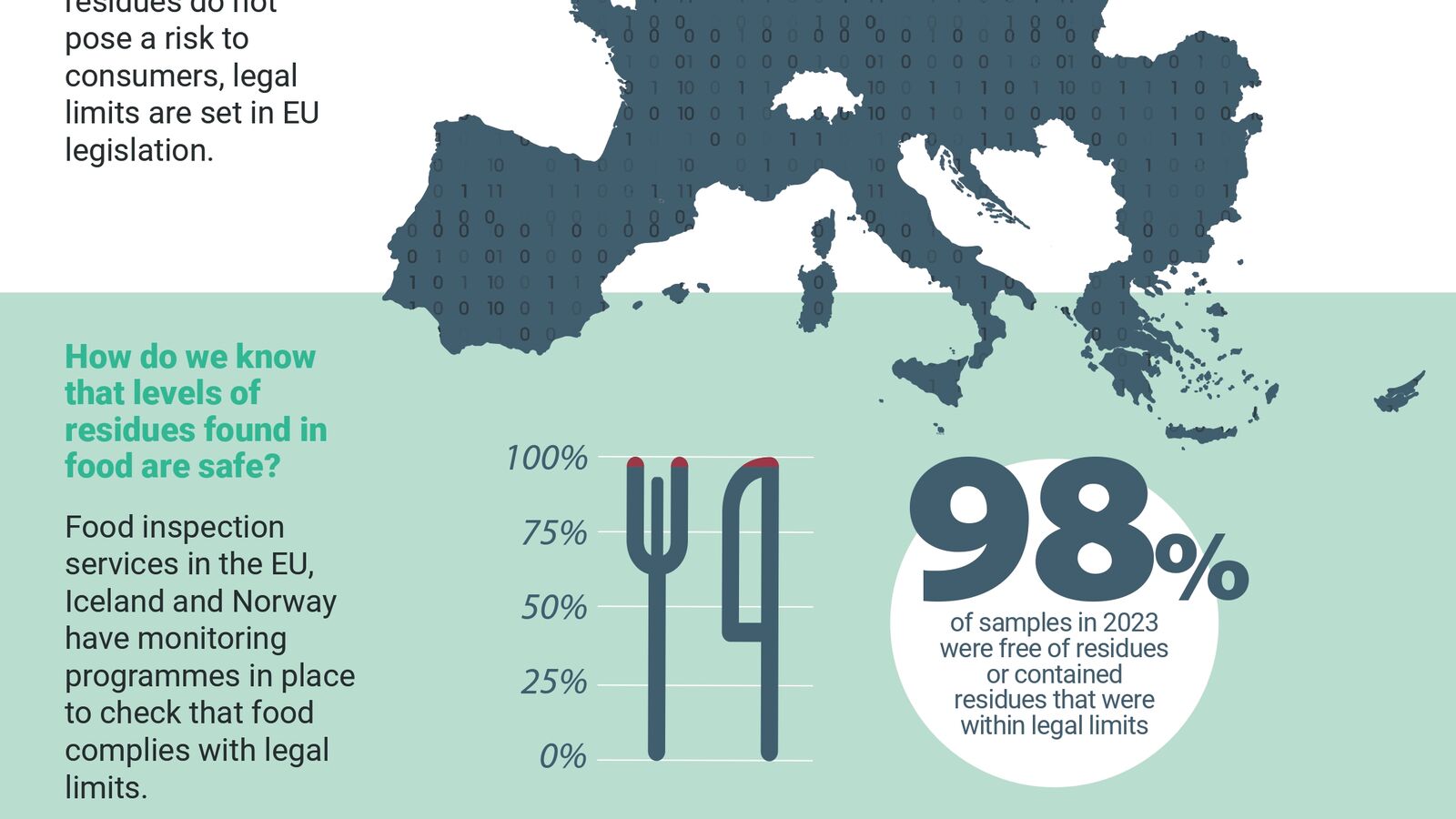
How Europe monitors pesticide residues in food
How Europe monitors pesticide residues in food
133,000 samples collected in 2023
Crops that have been treated with pesticides may contain residues. To ensure that pesticides are used correctly and their residues do not pose a risk to consumers, legal limits are set in EU legislation,
How do we know that levels of residues found in food are safe?
Food inspection services in the EU, Iceland and Norway have monitoring programmes in place to check that food complies with legal limits.
98% of samples in 2023 were free of residues or contained residues that were within legal limits.
ANALYSIS
Official laboratories test the food samples for the presence of more than 740 pesticides.
DATA
Around 26 million individual test results for pesticide residues
are reported to EFSA per year and summarised in an annual report.EU DECISION-MAKERS
EU decision-makers use EFSA’s conclusions and recommendations to
strengthen future monitoring programmes.EFSA is the keystone of EU risk assessment regarding food and feed safety. In close collaboration with national authorities in open consultation with its stakeholders, EFSA provides independent scientific advice and clear communication on existing and emerging risks.
© European Food Safety Authority, 2025. Reproduction is authorised, except for commercial purposes, provided that the source is acknowledged.
Photo credits: Shutterstock
Catalogue Number(*): TM-01-25-015-EN-N | ISBN 978-92-9499-752-4 | DOI: 10.2805/0181725
Continue Reading
-

Critical minerals rise to the surface of the geopolitical plane
White & Case Global Head of Mining & Metals, Rebecca Campbell, and Gabrielle Goodrow, senior associate in White & Case’s Project Development & Finance Group, spoke with IJGlobal as part of its Energy Transition Report 2025, discussing how critical minerals have become a central geopolitical battleground, with countries taking a more active role in the evolution of global supply chains amid ongoing structural and practical challenges.
Many nations today agree they need to take the reins of production, processing and import of these minerals. The US, in particular, has produced a raft of domestic policies that are impacting markets worldwide. Goodrow notes “a growing share of global flows is being directed toward the United States, which is working to position itself as a key anchor market for critical minerals.”
Reproduced with permission from IJGlobal. This article was first published in http://www.ijglobal.com/.
Any views expressed in this publication are strictly those of the authors and should not be attributed in any way to White & Case LLP.
This publication is provided for your convenience and does not constitute legal advice. This publication is protected by copyright.
Continue Reading
-

SOPHiA GENETICS Provides Preliminary Fourth Quarter and Full Year 2025 Financial Results, Initiates 2026 Guidance, and Announces Executive Transition Plan USA – English USA – Deutsch USA – Nederlands USA – Français USA – English
The Company finishes 2025 with strong Q4 performance, expects 20-22% revenue growth in 2026, and promotes Ross Muken to CEO
BOSTON and ROLLE, Switzerland, Jan. 12, 2026 /PRNewswire/ — SOPHiA GENETICS (Nasdaq: SOPH), a global leader in AI-driven precision medicine, today provided preliminary unaudited financial results for the fourth quarter and full year 2025, initiated its financial outlook for 2026, and announced an executive transition plan, including the promotion of Ross Muken to Chief Executive Officer (CEO), effective July 1, 2026, and the transition of co-Founder Jurgi Camblong to Executive Chairman.
Fourth Quarter 2025 Preliminary Unaudited Financial Results
- Revenue of at least $21 million, representing an increase of approximately 20% year-over-year
- Performed over 105,000 analyses on SOPHiA DDM™ in the fourth quarter, representing 16% year-over-year growth
Full Year 2025 Preliminary Unaudited Financial Results
- Revenue of approximately $77 million, representing an increase of approximately 18% year-over-year
- Performed over 391,000 analyses on SOPHiA DDM™ in 2025, a new company record
“2025 was a tremendous year for SOPHiA GENETICS as we reaccelerated revenue growth and materially exceeded our new business bookings target, setting the stage for robust future growth,” said Jurgi Camblong, Chief Executive Officer of SOPHiA GENETICS. “Our strong performance in 2025 positions us well for continued growth in 2026 and beyond. Growth catalysts for the year ahead include our best-in-class Liquid Biopsy application MSK-ACCESS® powered with SOPHiA DDM™, valuable opportunities in the U.S. market, and a reinvigorated BioPharma business. We look forward to continuing to demonstrate operating leverage in 2026 and have high confidence in a material improvement in our financial position.”
Full Year 2026 Guidance
Based on information as of today, SOPHiA GENETICS is providing the following FY 2026 guidance:
- Full year revenue between $92 million and $94 million, representing approximately 20% to 22% year-over-year growth
- Adjusted EBITDA loss between $29 million and $32 million
Executive Transition Plan
SOPHiA GENETICS today announced the promotion of Ross Muken to Chief Executive Officer, effective July 1, 2026. Mr. Muken, who currently serves as President and has been a key executive at the company for five years, will succeed Dr. Jurgi Camblong, co-founder and CEO. Dr. Camblong will transition to Executive Chairman of the Board, subject to election at the company’s Annual General Meeting in June 2026.
Throughout 2025, Dr. Camblong has focused on positioning SOPHiA GENETICS for its next phase of growth. As Executive Chairman, he will continue as a full-time executive, concentrating on strategic initiatives, technology innovation, and long-term strategic direction.
“These executive changes reflect the Board’s and Dr. Camblong’s long-term succession planning,” said Dr. Tomer Berkovitz, SOPHiA GENETICS Board Member and Managing Partner at aMoon Fund. “Jurgi has built a remarkable and unique company that has pioneered the application of AI in precision medicine, and we look forward to continuing our work with him, Ross, and the broader leadership team to transform patient care.”
Ross Muken joined SOPHiA GENETICS in February 2021, prior to the Company’s initial public offering, as Chief Financial Officer (CFO). In March 2023, he expanded his responsibilities to serve as joint CFO and Chief Operating Officer (COO), leading the Company’s go-to-market organization, including Clinical Sales, BioPharma Diagnostics Sales, Sales Support, Marketing, Customer Experience, and Operations. In May 2024, Mr. Muken was promoted to company President, overseeing SOPHiA GENETICS’ global business operations. In this role, he has played a central role in transforming the commercial organization and sales processes, reaccelerating business growth, and strengthening overall commercial execution.
“The last 15 years have been an incredible journey, realizing our vision to democratize data-driven medicine across more than 70 countries and 800 healthcare institutions. Having worked closely with Ross for five years, I’ve seen firsthand his exceptional strategic capabilities and operational leadership. I am confident he is the right person to lead the company through its next phase of growth and significantly expand our global impact,” said Jurgi Camblong, SOPHiA GENETICS co-Founder.
“Jurgi has built something truly remarkable over the past 15 years, a unique company and technology platform that stands apart in the industry,” said Ross Muken. “When I joined in 2021, I immediately recognized this was a category-defining company applying AI and cloud computing at unprecedented scale. Over these five years, working alongside Jurgi has been extraordinary. I’ve gained deep insights into our customers’ needs, our technology’s capabilities, and the exceptional talent of our team. I’m deeply honored to succeed Jurgi as CEO and look forward to continuing our partnership as he transitions to Executive Chairman.”
Kevin Puylaert, the company’s current Managing Director of EMEA, is appointed Chief Sales Officer effective January 2026. Kevin has been with SOPHiA GENETICS for more than 10 years, during which he has held multiple senior leadership roles, and his contributions have been instrumental to the company’s growth.
Important Note Regarding Preliminary Unaudited Financial Results
SOPHiA GENETICS has not completed preparation of its financial statements for the fourth quarter or full year of 2025. The estimates presented in this news release for the fourth quarter and year ended December 31, 2025 are preliminary and unaudited and are thus inherently uncertain and subject to change as we complete our financial results for the fourth quarter of 2025. SOPHiA GENETICS is in the process of completing its customary year-end close and review procedures as of and for the year ended December 31, 2025, and there can be no assurance that final results for this period will not differ from these estimates. During the course of the preparation of SOPHiA GENETICS’ consolidated financial statements and related notes as of and for the year ended December 31, 2025, we may identify items that could cause final reported results to be materially different from the preliminary financial estimates presented herein.
SOPHiA GENETICS plans to report its complete fourth quarter and full year 2025 financial results during its first earnings call of 2026 currently scheduled for March 3, 2026.
About SOPHiA GENETICS
SOPHiA GENETICS (Nasdaq: SOPH) is a cloud-native healthcare technology company on a mission to expand access to data-driven medicine by using AI to deliver world-class care to patients with cancer and rare disorders across the globe. It is the creator of SOPHiA DDM™, a platform that analyzes complex genomic and multimodal data and generates real-time, actionable insights for a broad global network of hospital, laboratory, and biopharma institutions. For more information, visit SOPHiAGENETICS.COM and connect with us on LinkedIn.
Non-IFRS Financial Measures
Other than with respect to revenue, the Company only provides guidance on a non-IFRS basis. The Company does not provide a reconciliation of forward-looking adjusted gross margin (non-IFRS measure) to gross margin (the most comparable IFRS financial measure), due to the inherent difficulty in forecasting and quantifying amortization of capitalized research & development expenses that are necessary for such reconciliation. In addition, the Company does not provide a reconciliation of forward-looking adjusted operating loss (non-IFRS measure) to operating loss (the most comparable IFRS financial measure), due to the inherent difficulty in forecasting and quantifying amortization of capitalized research & development expenses and intangible assets, share-based compensation expenses, non-cash portion of pensions paid in excess of actual contributions, certain transaction costs and litigation expenses that are necessary for such reconciliation.
Forward-Looking Statements
The unaudited financial results for the fourth quarter and full year ended December 31, 2025, in this press release are preliminary and subject to the completion of accounting and annual audit procedures and are therefore subject to adjustment.
This press release contains statements that constitute forward-looking statements. All statements other than statements of historical facts contained in this press release, including 2026 guidance and statements regarding our future results of operations and financial position, business strategy, products and technology, partnerships, and collaborations, as well as plans and objectives of management for future operations, are forward-looking statements. Forward-looking statements are based on our management’s beliefs and assumptions and on information currently available to our management. Such statements are subject to risks and uncertainties, and actual results may differ materially from those expressed or implied in the forward-looking statements due to various factors, including those described in our filings with the U.S. Securities and Exchange Commission. No assurance can be given that such future results will be achieved. Such forward-looking statements contained in this document speak only as of the date of this press release. We expressly disclaim any obligation or undertaking to update these forward-looking statements contained in this press release to reflect any change in our expectations or any change in events, conditions, or circumstances on which such statements are based, unless required to do so by applicable law. No representations or warranties (expressed or implied) are made about the accuracy of any such forward-looking statements.
SOURCE SOPHiA GENETICS
Continue Reading
-

What most corporate carbon reports get wrong, and how to fix them
Expanding access to better data
Together with collaborators including lab member Wesley Ingwersen, who created the U.S. EPA model and led work on it until the agency shuttered it in August 2025, Davis is now working to make a global model freely available and easy to use through an effort called Cornerstone. “The reason companies haven’t been using the global models is they’re not as easy to come by. They are a lot more involved to build, and there hasn’t been an easy, open-source version,” said Davis.
The group is integrating the former government database with the multi-region model analyzed in the study, which was developed by a private company called Watershed, where Davis chairs the science advisory board and previously served as head of climate science.
“When available tools neglect international sources of emissions, companies’ sustainability decisions suffer,” said study co-author Michael Steffen, Watershed’s head of climate analytics.
The team aims to release the merged model in late 2026, with ambitions to account for emissions from land-use changes and deforestation in later research and iterations. “If you’re getting soybeans from Iowa, it has a very different footprint than if you’ve cut down some of the Amazon to grow those soybeans,” Davis said.
Scientists from the World Wildlife Fund and CDP, formerly known as the Carbon Disclosure Project, co-authored the paper. “These are NGOs that are really interested in minimizing greenwashing and making sure that corporate climate actions are as beneficial as possible,” Davis said.
Some critics question whether models based on sector-wide averages and spending like those analyzed in the study are the right approach to estimate upstream emissions at all – regardless of whether global or single-region models are used. “I think we could all agree that if you had perfect data about exactly what was going on in your supply chain, you could make even more accurate estimates and leapfrog all of these models,” Davis said. “The reality is, though, that it’s still really difficult to get a lot of that data, and there’s little prospect of getting it without much more stringent regulations than are even on the table.” As a result, he said, there’s value in improving the modeling approach even if the long-term strategy is to get better data.
Corporations seeking to track and reduce emissions in their supply chains have the potential to make a meaningful difference in global carbon pollution, Davis said. “They are making sizable investments. If those dollars are directed to the right places, it could meaningfully reduce global emissions,” he said.
Continue Reading