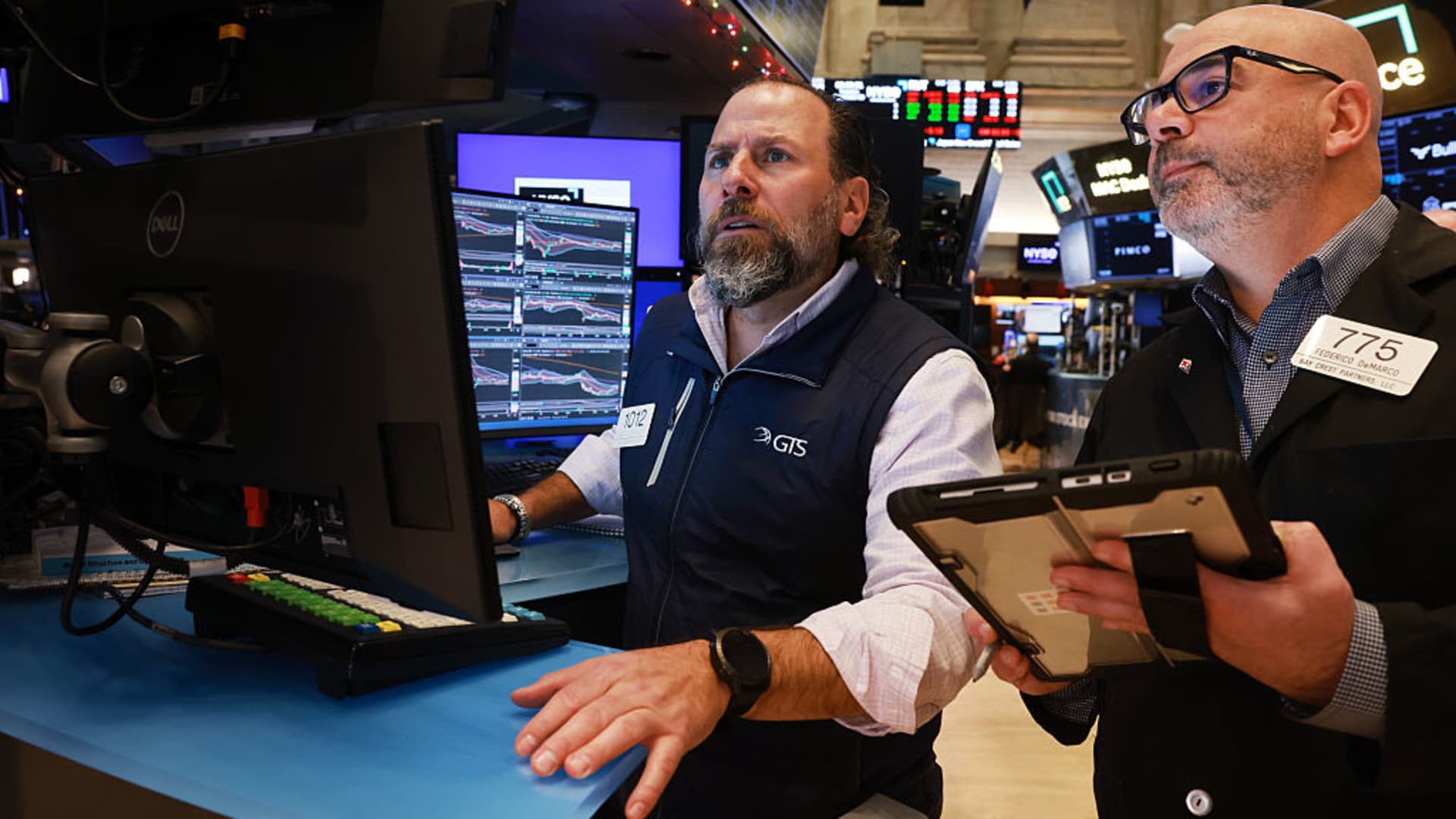
Traders work on the floor of the New York Stock Exchange (NYSE) on Dec. 30, 2025 in New York City.
Spencer Platt | Getty Images
The U.S. 10-year Treasury was slightly lower on Wednesday as investors await economic data and take stock ahead of the New Year.
The yield on the 10-year Treasury dipped by 2 basis points to 4.108%. The yield on the 2-year Treasury was also last seen more than 1 basis point lower at 3.442%.
Yields and prices move in opposite directions. One basis point equals 0.01%.
On the data front, jobless claims for the week through to Dec. 27 will be published at 8:30 a.m. ET.
It marks the final data release of 2025, with investors set to scrutinize the figures for any further clues on the Federal Reserve’s monetary rate path.
The Fed on Tuesday released minutes from its divided Dec. 9-10 meeting, which concluded with a vote to lower interest rates again that appeared to be an even closer call than the final vote indicated.
U.S. stocks held slightly negative following the release. Traders slightly raised bets that the Fed would cut again in April.
ASIC has published a report on its review of whistleblower practices across Australian companies.
The report reveals gaps including poor training, limited feedback and weak reporting channels.
The regulator is urging businesses to improve whistleblower protections and compliance with legal obligations.
Recognising the importance of effective whistleblower policies and programs, the Australian Securities and Investments Commission (ASIC) has undertaken a project to benchmark whistleblower practices of 134 companies across 18 industries in Australia and how well companies have progressed in adopting the practices outlined previously by the regulator.
ASIC’s objectives for the project were to understand the level of compliance with statutory requirements, measure companies’ adoption of practices outlined in previous regulatory guidance, and to understand to what extent practices are scalable.
In December 2025, ASIC published a report on the outcome of its project – Insights from the ASIC Whistleblower Questionnaire. The report finds that the adoption of good practices and the outcomes of whistleblower programs vary significantly. It acknowledges that there is no single approach to implementing a whistleblower program, and what is appropriate and effective will depend on the company. However, ASIC found large differences between companies in investigation timeframes and substantiation rates and that many companies had not adopted best practices such as:
Providing a dedicated whistleblower webpage or hotline to raise concerns.
Providing regular training to staff about the whistleblower programme.
Seeking feedback from employees on their whistleblower program.
The report observes that the absence of best practice likely affects the willingness and ability of people to make whistleblower disclosures. ASIC encourages companies to benchmark themselves against the report findings and to review and improve their whistleblower policies and practices. The report identifies key actions for companies to consider when conducting a review such as offering multiple, accessible whistleblower reporting channels, providing regular training, and ensuring strong governance practices.
Companies are reminded that they are required to provide specific protections for whistleblowers and to manage whistleblower disclosures confidentially. Proper whistleblower policies should reflect these protections and outline how the employers will support and protect whistleblowers.
For its part, the regulator says it will remain focused on supporting businesses to adopt good whistleblower practices. It will engage with companies which have been identified as having non-compliant or less mature practices, encouraging them to improve their whistleblower frameworks and practices.
The Finance Division has drafted amendments to the Payment Systems and Electronic Fund Transfers (PS&EFT) Act, 2007, to mandate at least one digital payment option, such as QR codes, at points of sale and empower local governments to enforce compliance, with the finance secretary having sent the proposal to the Prime Minister’s Office for in-principle approval ahead of its circulation to the cabinet.
As part of the shift toward a cashless public finance ecosystem, the government has also established the Government Payments and Receipts Transformation Unit (GPRTU) under the Ministry of Finance. The unit will coordinate the digital enablement of government entities and oversee integration with Raast.
The GPRTU will lead the digitisation of government-to-person (G2P) payments and person-to-government (P2G) collections, including building a government-facing Raast Connect, supporting onboarding to payment aggregators, re-engineering processes, and coordinating technical support with NITB and provincial IT boards.
Under the Cashless Pakistan initiative, the government has set targets for December 2026 to expand active digital merchants to two million, digital banking users to 120 million, and annual digital transactions to 15 billion. Non-tax P2G payments are targeted for full digitisation, while digital remittances credited directly to bank accounts are expected to exceed 80%.
As of November 2025, Pakistan recorded 3.3 billion digital transactions, with 89% of certain P2G streams digitised. Financial inclusion stood at 67%, with a roadmap to reach 70% by 2026 and a narrowing gender gap in access.
Several federal entities, including the Power Division, Petroleum Division, Pakistan Railways, NADRA and Pakistan Post, are at various stages of transition, with full Raast-based integration planned by 2026.
Major G2P disbursement bodies such as the Benazir Income Support Programme, Pakistan Military Accounts Department and Central Directorate of National Savings have set timelines for full digitisation between March and June 2026.
At the provincial level, departments across Punjab, Sindh, Khyber Pakhtunkhwa, Balochistan and Gilgit-Baltistan are being prioritised for salary, pension, vendor and fee payments. Islamabad Capital Territory has already issued bylaws mandating digital payment solutions at retail outlets, while provinces are reviewing or drafting digital payment laws; all provinces except AJK have issued interim notifications requiring digital payment acceptance.
Recent measures include a fully end-to-end e-stamp solution for ICT integrated with the State Bank of Pakistan’s 1-Link system, removing the need for physical documentation. Digital connectivity has also been expanded in ICT, with internet access provided to schools and basic health units and free public Wi-Fi rolled out at major public locations.
News release from Vestas-American Wind Technology Portland, 31 December 2025
Vestas is proud to have received orders for 574 MW in the USA and Canada for undisclosed projects.
For more information, please contact: Matt Copeman Lead Specialist, Marketing & Communications Mail: mtcoe@vestas.com Tel: +1 (503) 475-6428
About Vestas Vestas is the energy industry’s global partner on sustainable energy solutions. We design, manufacture, install, and service onshore and offshore wind turbines across the globe, and with more than 197 GW of wind turbines in 88 countries, we have installed more wind power than anyone else. Through our industry-leading smart data capabilities and unparalleled more than 159 GW of wind turbines under service, we use data to interpret, forecast, and exploit wind resources and deliver best-in-class wind power solutions. Together with our customers, Vestas’ more than 37,000 employees are bringing the world sustainable energy solutions to power a bright future.
For updated Vestas photographs and videos, please visit our media images page on: https://www.vestas.com/en/media/images.
We invite you to learn more about Vestas by visiting our website at www.vestas.com and following us on our social media channels:
With transit fares on the rise in a number of Canadian cities, some experts say it’s time to rethink how we fund public transportation.
Calgary hiked fares from $3.80 to $4 per ride earlier this month, and Ottawa just approved an increase of 10 cents, to $4.10.
Earlier this year, Edmonton raised cash fares from $3.50 to $3.75 in February, while Victoria jumped from $2.50 to $3 in March and Vancouver went up from $3.20 to $3.35 in July.
The rising fares are a reflection of mounting pressures on transit systems.
Energy, maintenance and labour costs are up, while gas tax revenues that help fund public transit are declining, due in part to more electric and energy-efficient vehicles.
Meanwhile, transit organizations are still recovering from the COVID-19 pandemic, when ridership and fare revenues plummeted. Emergency government funds have dried up and ridership hasn’t fully returned to pre-pandemic rates — in April, it had rebounded to 84.2 per cent of April 2019 numbers, according to Statistics Canada.
While this is a global problem, experts say Canada has additional challenges with urban sprawl and generally low population densities making it hard to keep routes in the black.
But while transit operators are feeling the pinch, Canadians are also struggling with rising costs of living, and the more fares go up, the more people can’t afford to get around their own cities.
“The easiest thing to do is to raise your fares to increase your revenue, but what that does structurally to society is really bad,” said Lawrence Frank, urban studies and planning professor at the University of California, San Diego, and president of Urban Design 4 Health, a research and consulting firm that works with government agencies.
Frank says some transit operators in Canada don’t really have a choice under current funding models, because they have to fund a certain percentage of their operations through fares. Passenger fares cover an average of 59 per cent of public transit costs in Canada.
But he says hiking fares threatens to reduce ridership and “price people off the system,” which predominantly impacts people who are low income and have no other options.
Frank, who studied the links between transit use and health at the University of British Columbia, says it’s time to change the framework we use to assess the value of transit, so it factors in health and social benefits that come from greater equity, reduced sedentary behaviour and less air pollution.
A commuter boards a public transit vehicle amid heavy snowfall in St. John’s earlier in December. (Paul Daly/The Canadian Press)
His research has found that using transit instead of driving reduces likelihood of obesity and other health concerns.
“We simply can’t have and create sustainable, healthy communities without transit,” he said.
“If we just isolate its economic value to what the fare box generates, you’ve completely eliminated the major economic benefits that come from a healthier workforce.”
More funding could be tough sell
Advocacy organizations have been pushing for governments to reframe how they view public transit, arguing it’s an essential service and requires more stable funding.
A 2024 Leading Mobility Canada report found Canada’s major cities are struggling to keep their transit systems running, and “a downward spiral” in service is “inevitable” without major new streams of operating revenue.
But in practice, making that shift is not likely to be politically popular.
Jeff Casello, a professor with the University of Waterloo’s school of public planning, says public transit needs stable, dedicated funding. (Submitted by Jeff Casello)
“What I’ve long been arguing is we need a dedicated revenue source for public transportation systems,” said Jeff Casello, a professor with the University of Waterloo’s school of public planning.
Casello notes that public transit currently competes against other essential services for property tax dollars, which makes it hard to argue for increased spending through taxes.
Internationally, he says places like London, New York City and Singapore have implemented road tolls to raise funds for improving public transportation systems.
Citing successes from some of these programs, including a measurable decrease in pollution and congestion in New York, he suggests Canadian cities could similarly impose tolls for driving into downtown areas — though he acknowledges this would also be a tough sell.
“It’s politically unpopular, for sure,” he said.
WATCH | Edmontonians on their transit priorities:
What do you want from your transit system? Here’s what Edmontonians told us
Safety. Affordability. Trains and buses that run on time. Heading into the municipal election, here are some things voters say they want from their transportation system.
To ensure transit users aren’t priced out of the system in the meantime, Casello says it’s important to focus on subsidizing costs for the lowest-income riders. This is something Canadian cities do in various ways, but he suggests something akin to the food stamp system in the U.S. He also cites a Philadelphia pilot program that gives key cards for free transit to people living near or below the poverty line.
Canada’s federal government used to offer a tax credit for public transit passes, but eliminated it in 2017, which Casello says was a “mistake.”
Some cities cap fares, so people who spend a certain amount on single fares ride free after hitting a monthly limit. Toronto Mayor Olivia Chow recently floated a 47-rides-a-month cap in Canada’s biggest city — amounting to about $156, or the cost of a monthly pass. A global study from 2023 found Toronto’s monthly pass is the fourth most expensive among major cities as a percentage of average net wage, behind only Sao Paolo, Istanbul and London.
How about $0 fares?
In Durham, Ont., and starting Jan. 1 in Gatineau, Que., riders pay $4.75 cash to take the bus. Halifax has the cheapest single-fare price among Canada’s major cities at $3.
But some smaller municipalities have made public transit free entirely, deciding the extra municipal spending is a net benefit for residents.
Orangeville, Ont., saw ridership jump by 150 to 160 per cent in 2024 in the first year of eliminating fees, and the town’s mayor previously told CBC News the move had a positive impact on the whole community. Lisa Post said some residents in the town of 30,000 said free fares made “the difference of being able to get bread and milk.”
Canmore, Alta., a mountain town of 17,000, has offered free transit since 2022.
But while this could be harder to scale up for a city the size of Toronto or Vancouver, American cities as big as Albuquerque, New Mexico (population roughly 560,000) offer free municipal public transit.
New York City’s mayor-elect Zohran Mamdani has pledged free bus service for the city of 8.5 million, saying he would fund it in part by raising taxes on the wealthiest corporations and individuals.
Sprawl strains the system
Thiago Carvalho, a PhD student in McGill University’s school of urban planning, says rising transit costs are a global issue — very few public transit systems actually turn a profit — but the urban sprawl and lower density of most Canadian cities makes it especially hard to keep costs down.
“The more sparse your transit system is, usually the more expensive it is … because you need to provide more service,” he said.
Thiago Carvalho, a PhD student in McGill University’s school of urban planning, says rising transit costs are a global issue. (Submitted by Thiago Carvalho)
In extremely dense Tokyo, Carvalho says developers have essentially constructed an entire “downtown” around most metro stations. Private companies often own the line and the land around their stations, so revenue from real estate, retail and other commercial properties helps sustain and expand the routes.
Carvalho says Canadian cities could do this on a smaller scale, and cities do typically factor in transit-oriented development when building out new rail routes, which can help keep transit costs down in the long term.
Ultimately, experts who spoke with CBC News say fares are likely to keep increasing and funding is likely to remain unstable without a shift in the way we view the role of public transit in Canadian society.
Calgary’s CTrain at night in November. (Zazak Bouarab/CBC/Radio-Canada)
“Transit’s not supposed to be for profit. It is an essential service. It has a very important social function of bringing people to work and bringing people to their desired destination,” Carvalho said.
“We need to define the secure streams of funding that are going to allow this service to be sustainable and going to allow service to thrive. And the better the service, more people are going to be using transit.”
1. What are the aims, objectives and impacts of the Fund?
The Islands Business Resilience Fund (IBRF) was launched in July 2025 in response to previous disruption to ferry services as a result of a combination of constrained vessel capacity, breakdowns, vessel repairs and delays in replacement vessels. These issues have led to an increase in cancellations over the past three years.
The majority of Scotland’s islands rely upon ferries for access, but not all have experienced the same level of disruption.
The objective of the IBRF is to provide targeted financial support to businesses on islands that have been most disproportionately impacted by ongoing ferry service disruptions. It aims to support resilience, by way of a one-off financial award, to those businesses on the most affected islands to help them maintain operations.
The targeted nature of the IBRF meant that not all islands were eligible for funding. This reflected an evidence-based assessment of the varying levels of disruption experienced across different ferry routes and the way those ferry routes serve islands, with funding prioritised for islands where the cumulative impact on businesses has been most severe and sustained.
Following the conclusion of a first round of funding, this Island Communities Impact Assessment (ICIA) has been reviewed to support considerations for a second cohort of eligible islands recognising that, whilst the first round was targeted at those in most severe need of support, disruption has also affected other islands.
To ensure effective use of the limited funding available, work will continue to be carried out in collaboration with Highland and Islands Enterprise (HIE), who delivered round one and have expertise in supporting island businesses and delivering funding across island communities. HIE’s input has informed the development of the IBRF to ensure it is targeted in the most impactful way to reach those most in need with the funding available.
It’s been a long time since many Canadians have felt the burn. That familiar aromatic, spicy and sometimes smoky flavour of a smooth, Kentucky bourbon has been but a memory for consumers in this country for much of the past year.
Ever since U.S. President Donald Trump launched his tariff war and began threatening to make Canada the “51st state,” angry consumers and lawmakers have united behind a “Buy Canadian” movement and bourbon was caught in the crossfire.
“People didn’t want to to lose their bourbon and neither did I,” said Ottawa-based whisky expert Davin de Kergommeaux. But he, like so many other consumers, supports the boycotts of American products in favour of Canadian alternatives.
Canada had been a key market for the bourbon industry and major brands like Jim Beam and Maker’s Mark for quite some time. But despite his desire to see bourbon back on shelves and behind the bar, de Kergommeaux — who literally wrote the book of Canadian Whisky — believes the liquor landscape here may have changed for good.
WATCH | Kentucky bourbon makers caught in the crossfire after Trump’s 51st state jabs:
Kentucky bourbon makers getting hate mail from Canada
Retaliatory tariffs are hitting Kentucky bourbon hard, and the governor has implored Canadian leaders to reconsider. CBC’s Katie Simpson meets a bourbon maker who shows her hate mail he’s getting from Canadians.
Souring on American whiskey
Bourbon really began to boom in Canada a little over a decade ago, de Kergommeaux says, thanks to aggressive marketing campaigns and consumers looking for something a little different from what they were used to.
“It doesn’t taste like traditional Canadian whisky at all,” de Kergomeaux said. “It’s a big, bold whisky, and quite bright, quite sweet.”
Davin de Kergommeaux, author of the book Canadian Whisky, says bourbon’s surge in popularity came to an abrupt halt over the past year, thanks largely to Canada’s distaste for U.S. President Donald Trump’s tariffs and rhetoric. But he thinks it’s a golden opportunity for Canadian craft whisky makers. (Nick Wons)
Craig Peters, founder and CEO of Maverick Distillery in Oakville, Ont., says what makes bourbon unique is that it’s distilled and aged in new oak barrels that are only used once, which is what gives the liquor its darker colour and rich caramel and vanilla flavours.
In addition to the oak barrels, for bourbon to be called that, it has to be made using at least 51 per cent corn mash and, most importantly, experts say, it has to be produced in the U.S.
But Peters says it still “holds its own special place with consumers” in Canada, either sipped neat or on the rocks, or mixed into cocktails like Manhattans, paper planes and the classic old fashioned.
But as a result of the cross-border animosity, exports of bourbon to Canada from January to September dropped about 60 per cent compared with a year earlier, going from 41.3 million to 16.4 million units according to the Distilled Spirits Council of the United States.
Bourbon producers have been pleading with provinces to resume stocking U.S. booze — Saskatchewan and Alberta have done so, while Nova Scotia and Manitoba are selling off existing stock — and with the Trump administration to ease trade tensions. However, that’s not the only challenge the industry is facing.
Whisky sales globally were already slumping and Peters says there’s been a glut of bourbon as a result of overproduction in the past few years.
But he says all of this has created the perfect opportunity for distilleries like his to stir things up in the Canadian whisky world.
WATCH | Bourbon back on store shelves in Nova Scotia:
Bourbon whisky among top-selling U.S. alcohol back on N.S. shelves | Hanomansing Tonight
Canadians are rushing to buy stockpiles of boycotted U.S. liquor. Davin De Kergommeaux, author of Canadian Whisky: The Essential Portable Expert, discusses the impact U.S. products are having on Canadian whisky.
Bourbon by any other name
Maverick Distillery had already been importing barrels of bourbon from the U.S. to produce a line of its own blended whisky, but Peters says the company is now also bottling “straight up 100 per cent bourbon.”
“Although we can’t call this baby bourbon,” he said, holding up a bottle, which is labelled Kentucky whisky, “it is actually a five-year Kentucky bourbon bottled here in Canada.”
The federal Spirit Drinks Trade Act of 2006 restricts the use of names of alcohol produced in specific geographic areas in foreign countries.
Aside from bourbon, other examples of such spirits include scotch (Scotland), cognac (France) and tequila (Mexico).
Craig Peters, the founder and CEO of Maverick Distillery in Oakville, Ont., says customer demand for bourbon substitutes was high enough that his company is now bottling the Kentucky whisky in Ontario. (Jack Curran)
Peters says consumer demand for bourbon was high enough that he didn’t feel it was contrary to the “Buy Canadian” sentiment to have staff at his Ontario distillery bottle what is truly an American product.
De Kergommeaux says what Maverick is doing is “kind of out of step” with efforts to prioritize Canadian products over U.S. imports.
“This is not anti-American, this is buy Canadian,” he said.
But that doesn’t mean he’s not looking forward to cracking open his own bottle of Maverick’s Kentucky whisky at some point soon.
De Kergommeaux says he’s not aware of any producer in Canada that is bottling actual bourbon other than Maverick, and he’s not expecting many others to start.
That Canadian spirit
Although he notes some other distillers across the country have begun blending bourbon-style whisky variations, with names like BRBN and Berbon, to cater to those still craving that taste of Kentucky, where the majority of U.S. bourbon is produced.
While he says these kinds of subsititutes don’t taste quite the same, he suggests many are quality whiskies that can be used in a Manhattan or sipped straight up with a couple drops of water, as he does.
And it’s not just U.S. tariffs contributing to what industry watchers say is a global downturn in whisky and liquor sales overall — in general, more people are eschewing alcohol, while sales of cannabis beverages are also rising.
Which is why de Kergommeaux is excited to see a Canadian product back in the spotlight and thriving.
He says that rather than worrying about a downturn, Canadian producers big and small are having trouble keeping up with demand.
“I think that people have been trying to find bourbon and trying to find Canadian whisky that tastes like bourbon,” he said, “and in the process, they have been tasting a lot of Canadian whiskies and wishing they had given them a chance sooner.”
WATCH | Is the boycott of U.S. alcohol really helping Canadian distillers:
Canadian retailers accused of favouring local liquor by U.S. distilleries
The Distilled Spirits Council of the United States claims in a submission to the office of U.S. Trade Representative Jamieson Greer that Canadian retailers are giving unfair advantage to local spirits. Meanwhile, some Canadian distilleries say pulling U.S. booze off shelves has only add a small increase to their sales.
DALIAN, Dec. 31 (Xinhua) — Iron ore futures closed lower on Wednesday in daytime trading at the Dalian Commodity Exchange (DCE).
The most active iron ore contract for May 2026 delivery dipped 4.5 yuan (about 64 U.S. cents) to close at 789.5 yuan per tonne.
On Wednesday, the total trading volume of 12 listed iron ore futures contracts on the exchange was 322,789 lots, with a turnover of about 25.49 billion yuan.
As the world’s largest importer of iron ore, China opened the DCE iron ore futures to international investors in May 2018. ■
Oil and Gas Development Company (OGDC) is planning to explore hydrocarbon resources overseas through joint ventures with Russian and Turkish energy companies as part of efforts to diversify supply sources and reduce Pakistan’s energy import burden, The Express Tribune reported, citing sources.
Partnership talks between Pakistan’s largest Exploration and Production (E&P) company, with Russia’s Gazprom and Turkey’s state-owned Turkish Petroleum, are reported to be at an advanced stage for onshore and offshore exploration projects in Libya and Vietnam.
The move is aimed at securing overseas energy assets, mirroring the strategy adopted by regional peers that have expanded beyond domestic markets. Indian exploration companies have pursued a similar approach through joint ventures in overseas markets, including the United States. Pakistan is seeking to reduce reliance on imported fuels by acquiring equity oil and gas from foreign fields.
Sources said OGDC, along with other Pakistani firms, is already engaged in offshore exploration activities in the United Arab Emirates. At home, Turkish Petroleum has entered Pakistan’s offshore sector after receiving approval from the Economic Coordination Committee to acquire a stake in the Eastern Offshore Indus Block-C.
Officials believe the partnership will bring international offshore operating experience into Pakistan’s exploration sector, improving technical capacity and project execution. Success at the block could unlock further exploration opportunities and attract foreign investment into offshore drilling.
Sources added that OGDC plans to replicate the joint venture model used with Turkish Petroleum for both onshore and offshore exploration in foreign jurisdictions. Gazprom has also shown interest in partnering with OGDC, including potential participation in local offshore blocks where OGDC has secured acreage.
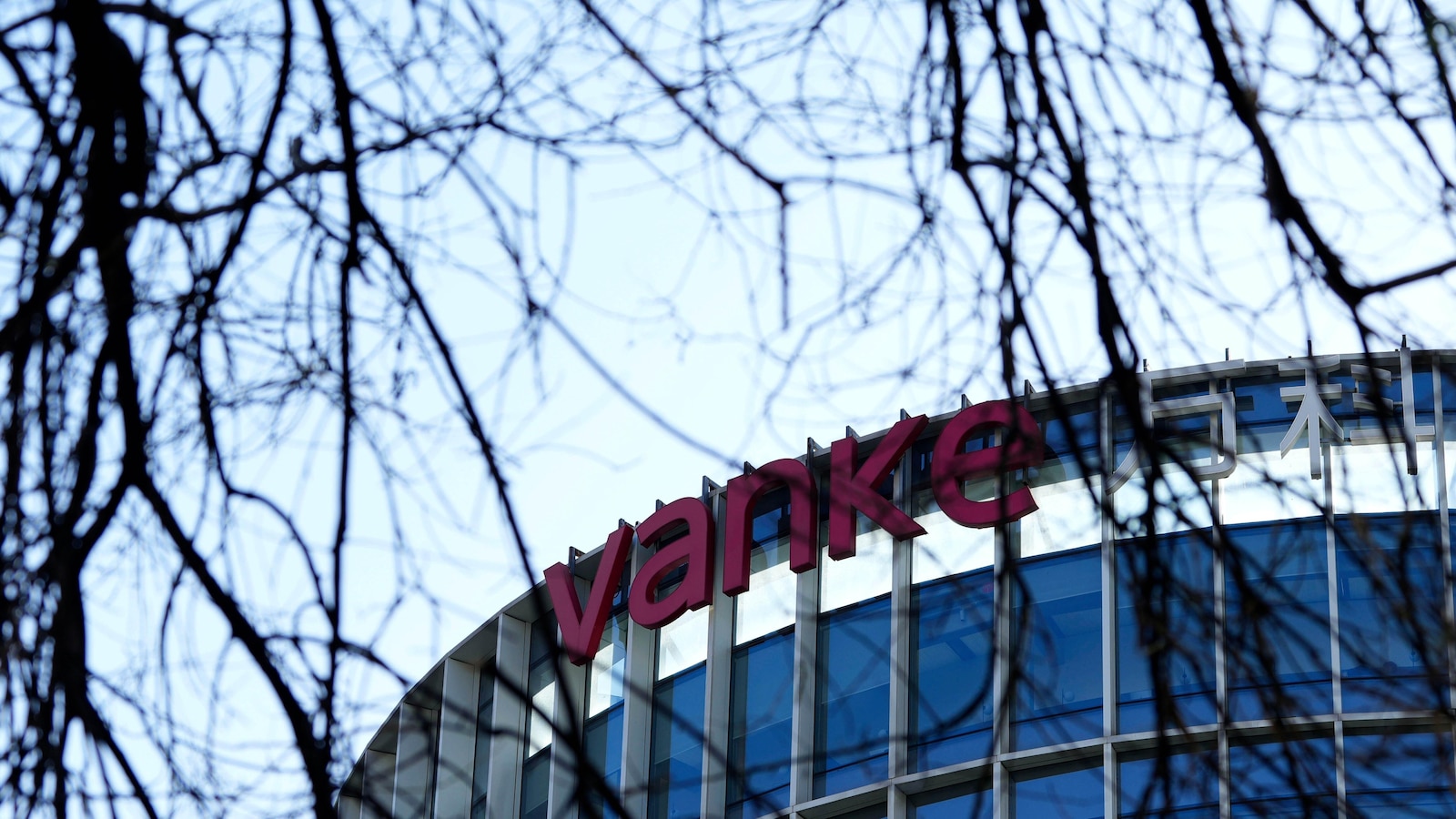
HONG KONG — State-backed property developer China Vanke, once the country’s largest homebuilder by sales, narrowly avoided defaulting on a 2 billion yuan ($284 million) bond last week as the painfully slow recovery in China’s property market drags on.
The Chinese developer also was seeking to delay repayment of another 3.7 billion yuan ($530 million) of onshore debt due on Dec. 28, with bondholders agreeing to extend the deadline to February.
Years after the downturn in the housing market began, Chinese developers are still struggling to regain their footing, despite a slew of government policies meant to revive the industry. Weak investment and housing prices have shaken investor confidence, spilling into the broader economy since millions of homeowners are stuck with apartments worth far less than what they paid for them.
Instead of the huge driver of prosperity that it once was, the property market is weighing on the economy.
Although Vanke’s bondholders have approved extensions for repayments of its debt, the risk of a default remains.
About a third-owned by Shenzhen Metro, a state-owned railway, publicly listed Vanke’s finances are a mess. Its revenue fell 27% from a year earlier in the latest July-September quarter, and several of its onshore bonds were suspended from trading after prices plunged.
The developer owes more than $50 billion, less than the more than $300 billion in debt racked up by China Evergrande, one of the first property dominos to fall when it defaulted in 2021 after the government cracked down on excessive borrowing in the industry.
Analysts say Vanke, founded in the 1980s in the southern boomtown of Shenzhen, may be testing the limits of state support for property developers in reviving the industry, which once accounted for more than a quarter of total economic activities in China.
More than four years after the downturn began, China’s property sector has yet to recover. The situation varies from city to city, but overall home prices have fallen by 20% or more from their peak in 2021.
The decline has continued, with new home sales falling 11.2% by value year-on-year in the first 11 months of 2025, according to official statistics. Property investments fell nearly 16% from a year earlier.
The slump has caused massive layoffs, hurting overall consumer confidence and spending.
“The continued slide in the property market remains one of the most significant risks to China’s efforts to shift to a domestically demand-driven growth model,” wrote Lynn Song, chief economist for Greater China at ING Bank, in a recent commentary.
China Evergrande, once deemed “too big to fail” as one of the country’s largest developers, ran into trouble in 2021 and eventually was forced into liquidation. Many other Chinese developers also defaulted and in some cases were restructured. Tough measures to fight Covid-19 during the pandemic took a toll as construction projects were suspended.
Restoring confidence in the property sector may take years, economists at Morgan Stanley say, and Vanke’s woes will only further weigh on its real estate market outlook. Economists at Morningstar say home prices are unlikely to rebound until 2027 due to excess supply, despite repeated pledges by regulators to stabilize the real estate market.
While Vanke’s debt is way smaller than Evergrande’s was, a default would sting: It had been considered one of the financially sounder real estate developers in China.
Shenzhen Metro Group, which is controlled by the Shenzhen government, has provided more than 29 billion yuan ($4 billion) in shareholder loans to Vanke so far this year to help with its debt repayments, according to S&P Global.
That’s not enough to repay its full obligations. Vanke reported 60 billion yuan ($8 billion) of cash by the end of September 2025, against short-term debts of about 151 billion yuan ($21 billion), Fitch Ratings said.
“This is one of the most significant, quasi state-backed developers that may be defaulting (on) their repayment,” said Foreky Wong, a founding partner at Fortune Ark Restructuring.
S&P Global, one of the world’s main rating agencies, recently downgraded Vanke to “selective default,” saying it viewed the extension of its bond repayment period as a distressed debt restructuring “tantamount to a default.” Fitch Ratings also downgraded Vanke’s rating to “restricted default”.
Vanke — which employed more than 120,000 people as of last year — still faces hundreds of millions of dollars more of debt repayments in 2026. S&P said it faces more than 9.4 billion yuan of bonds maturing over the next six months.
A default by Vanke could spill over into the wider real estate sector, making it more difficult for non-state owned developers to get help, said Jeff Zhang, an analyst at Morningstar.
“Without a strong commitment by the Shenzhen government on the bailout, we think Vanke’s liquidity profile should remain fragile,” Zhang said.