Category: 3. Business

  • Phase 2a Trial Shows GRI-0621 Improves Biomarkers and Lung Repair in IPF

    Phase 2a Trial Shows GRI-0621 Improves Biomarkers and Lung Repair in IPF

    A phase 2a clinical trial evaluating the oral therapy GR-0621 for treating idiopathic pulmonary fibrosis (IPF) demonstrated positive flow cytometry data, marking a significant step forward in addressing the unmet needs of the disease.1

    GRI-0621 is an experimental oral therapy manufactured by GRI Bio, a clinical-stage biopharmaceutical company focused on innovations to treat inflammatory, fibrotic, and autoimmune diseases. Its therapies are designed to target the activity of natural killer T cells (NKT). GRI-0621 is an RARβy agonist that inhibits the activity of the type I invariant NKT (iNKT), which plays a critical role in propagating the injury, inflammatory response, and fibrosis observed in inflammatory and fibrotic indications. Earlier data from the clinical trial (NCT06331624) evaluating GRI-0621 showed that it met its primary and secondary end points, demonstrating that GRI-0621 was safe and efficacious over the 12-week treatment period.2 The additional data released this month showed that the agent was associated with iNKT inhibition and may also help reduce inflammation and fibrotic activity in the lungs.1

    “There remains a tremendous unmet need for safe, tolerable, and truly effective treatments for patients suffering from IPF,” Marc Hertz, PhD, CEO of GRI Bio, said in a press release.

    The randomized, double-blind, multicenter study enrolled 35 participants with IPF and randomized them 2:1 to receive GRI-0621 or a placebo. There were no safety or tolerability concerns observed at 12 weeks or during treatment. The most common adverse events reported were dry skin, dry lips, and muscle and joint pain. The GRI-0621 arm outperformed the placebo control arm with no increase in cough (0% in the GRI-0621–treated arm vs 25% in the placebo arm).2 Furthermore, there were significantly fewer reports of gastrointestinal disorders in the GRI-0621 arm compared with the placebo arm (diarrhea reported in 13% vs 33%, respectively).

    The secondary end points showed improvements in the serum biomarkers of collagen turnover. Researchers said these findings suggest this treatment may reverse fibrosis and repair damaged lung tissue. Patients in the GRI-0621 arm saw a 3% decrease in Pro-C6—a biomarker of collagen synthesis—and a 12% increase in C6M—a biomarker of collagen degradation—compared with the placebo arm.

    Furthermore, the study observed an increase in biomarkers suggesting GRI-0621 was helping to rebuild the alveolar basement membrane in patients with IPF—a common adverse event associated with the disease. Patients randomized to the GRI-0621 arm experienced a mean increase of PRO-C4—a biomarker of type IV collagen synthesis—of 9% whereas patients in the placebo arm experienced a decrease of 2%.

    Patients in the GRI-0621 arm also experienced a decrease in C4Ma3—a biomarker of type IV collagen degradation—whereas those in the placebo arm experienced an increase (10% vs 24%, respectively). Thus, GRI-0621–treated patients’ collagen remodeling status shifted from fibrolytic to neutral, meaning there was no continued destruction of the basement membrane.

    Overall, 39% of GRI-0621–treated participants experienced an increase in forced vital capacity (FVC) at 12 weeks, whereas 80% of participants in the placebo-treated arm experienced a decline in FVC at 12 weeks.

    “The positive Phase 2a results represent an important milestone for our IPF program and a compelling early signal of GRI-0621’s disease-modifying potential,” Hertz said in the December press release. “IPF remains one of the most devastating respiratory diseases, with limited treatment options and a significant need for therapies that can do more than slow decline and address the underlying biology of the disease.”

    References:

    1. Gri Bio announces additional positive data from phase 2A study in idiopathic pulmonary fibrosis, strengthening clinical proof-of-concept for GRI-0621. News release. GRIbio. January 8, 2026. Accessed January 20, 2026. https://gribio.com/gri-bio-announces-additional-positive-data-from-phase-2a-study-in-idiopathic-pulmonary-fibrosis-strengthening-clinical-proof-of-concept-for-gri-0621/

    2. Gri Bio announces positive topline data from its phase 2A study in idiopathic pulmonary fibrosis (“IPF”). News release. GRIbio. December 10, 2025. Accessed January 20, 2026. https://gribio.com/gri-bio-announces-positive-topline-data-from-its-phase-2a-study-in-idiopathic-pulmonary-fibrosis-ipf/

    Continue Reading

  • Google sees CO2 batteries as large-scale way to store renewable energy

    Google sees CO2 batteries as large-scale way to store renewable energy

    This audio is auto-generated. Please let us know if you have feedback.

    Google is commissioning construction of what are being called CO2 batteries to provide green, reliable backup power for its major data centers in the United States, Europe and in parts of Asia, the company announced

    “We’ve been scanning the globe seeking different solutions,” Ainhoa Anda, Google’s senior lead for energy strategy in Paris, said in an IEEE Spectrum report on the project. 

    CO2 batteries are intended to play a role similar to that of lithium-ion battery units to store excess renewable energy to help ensure data centers have clean, reliable power when needed. But they would have greater capacity and scalability than lithium-ion batteries, and can be easily standardized to be used anywhere. 

    “The challenge the tech giant has encountered is not only finding a long-duration storage option, but also one that works with the unique specs of every region,” the IEEE Spectrum report says. 

    “Standardization is … one of the aspects that we really like,” Anda told IEEE Spectrum. 

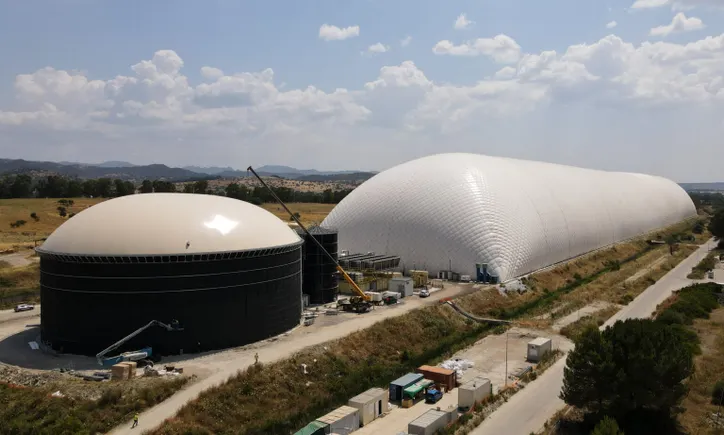
    Google is working with a Milan-based company called Energy Dome, which has built a model facility in Ottana, Sardinia, Italy, that is storing 2,000 tons of carbon dioxide generated from a gas supplier. As part of the partnership, Google has made an equity investment in Energy Dome. 

    The facility stores the CO2 daily in an expandable dome. When energy is needed, it compresses and expands the CO2 to turn a turbine that generates 200 megawatt-hours of electricity, or 20 MW over 10 hours. Google is hoping to build similar units near its data centers to supply renewable power around the clock even when the sun isn’t shining or the wind isn’t blowing, according to IEEE Spectrum’s report.

    Lithium-ion batteries mostly play this role for data centers now, but they typically can only cost effectively supply back-up power for 4-8 hours at a time — not long enough to power through a whole night, multiple cloudy and windless days or the hottest week of the year, when energy demand hits its peak. 

    “CO2 Batteries check a lot of boxes that other approaches don’t,” the report says. “Their expected lifetime stretches nearly three times as long as lithium-ion batteries. And adding size and storage capacity to them significantly decreases cost per kilowatt-hour. Energy Dome expects its [CO2 battery] to be 30% cheaper than lithium-ion.”

    CO2 batteries also have advantages over other types of large-scale power storage units, like pumped-hydro, because they can be built relatively quickly and with comparatively small footprints, needing only about 5 acres of flat land.

    The Sardinia facility took less than two years to construct and the expandable dome took less than half a day to inflate, according to the article. A pumped-hydro facility, which creates energy by pumping water between reservoirs at different elevations, can take a decade to build. It also needs a lot of land with a very specific type of topography. 

    Google can expect to face some pushback from neighbors. The expandable dome reaches a height comparable to that of a sports stadium, which could spur opposition. And if the dome is damaged, it could release CO2 into the air. But Energy Dome says the amount of gas that’s released won’t be much more than what’s released by airlines that make multiple flights across the Atlantic Ocean and is negligible compared to what’s released by coal plants, Energy Dome founder and CEO Claudio Spadacini told Spectrum IEEE.

    Google isn’t the only company interested in the technology. In Wisconsin, the public utility Alliant Energy has been given the go-ahead from authorities to begin construction of a CO2 battery this year to supply power to 18,000 homes.

    Continue Reading

  • Syngene International extends long-term research collaboration with Bristol Myers Squibb until 2035

    Syngene International extends long-term research collaboration with Bristol Myers Squibb until 2035

    BENGALURU, India, Jan. 20, 2026 /PRNewswire/ — Syngene International, a global contract research, development, and manufacturing organization (CRDMO), today announced the extension of its long-standing strategic collaboration with Bristol Myers Squibb through 2035. The expanded agreement broadens the scope of integrated services across the drug development lifecycle spanning discovery (chemistry, biology, drug metabolism and pharmacokinetics), translational sciences, pharmaceutical development and manufacturing, clinical trials, data and information technology services to enable seamless progression from research to commercialization. The expansion of this collaboration marks the next phase of growth, reinforcing Syngene’s position as a strategic partner delivering integrated, end-to-end scientific and manufacturing solutions.

    Peter Bains, Managing Director and CEO, Syngene International Ltd., said, “Our collaboration with Bristol Myers Squibb, which now spans more than 25 years, is anchored in scientific excellence, operational reliability, and a shared commitment to advancing innovative therapies. The agreement to extend this partnership through 2035 enables us to plan together for the future in terms of building new capabilities and infrastructure with a decade long horizon. Taking a long-term perspective is a key feature of our partnership which adds strategic value to both companies. We look forward to supporting BMS with their next wave of discovery, development, and manufacturing programs that have the potential to improve patient outcomes worldwide.”

    Payal Sheth, Senior Vice President, Therapeutic Discovery Sciences, Bristol Myers Squibb, said, “At Bristol Myers Squibb, everything we do begins with patients. We greatly value our long-standing partnership with Syngene, which has been instrumental in advancing our scientific ambitions. This expanded collaboration reflects our commitment to advancing innovative science by effective integration of our research, development, and manufacturing capabilities to accelerate the delivery of transformative medicines and bring hope to patients around the world who are waiting for new treatment options.”

    The collaboration between Syngene and Bristol Myers Squibb began in 1998, culminating in the establishment of the Biocon Bristol Myers Squibb Research and Development Center (BBRC), Syngene’s first dedicated R&D Center, which was fully commissioned in 2009. Over the years, the BBRC has evolved into a major strategic R&D site for Bristol Myers Squibb, supporting integrated capabilities across target identification, lead discovery, lead optimization, pharmaceutical development, molecular and cell biology, protein sciences, assay biology and clinical biomarkers. The center, which today houses around 700 Syngene scientists working as an extension of Bristol Myers Squibb’s global research organization, contributes to discovery, preclinical development, and patent filings across therapeutic areas including cardiovascular, fibrosis, immunology, and oncology.

    Since its inception, BBRC has played a pivotal role in accelerating the progression of novel compounds from early discovery to first-in-human studies, thereby helping reduce development timelines and overall costs for Bristol Myers Squibb.

    About Syngene

    Syngene International Ltd. (BSE: 539268, NSE: SYNGENE, ISIN: INE 398R01022) is an integrated research, development, and manufacturing services company serving the global pharmaceutical, biotechnology, nutrition, animal health, consumer goods, and specialty chemical sectors. Syngene’s team of over 8,200 employees including 5,600 scientists, brings both deep expertise and the capacity to deliver scientific excellence, robust data security, and world class manufacturing, at speed, to improve time-to-market and lower the cost of innovation.

    With over 2.5 mn sq. ft of specialized discovery, development, and manufacturing facilities across India and the U.S., Syngene works with 400 global customers across industry segments, including biotech companies pursuing leading-edge science and multinationals such as BMS, GSK, Zoetis, and Merck KGaA. For more details, visit www.syngeneintl.com. For the Company’s latest Environmental, Social, and Governance (ESG) report, visit Syngene ESG Report.

    Media Contacts:

    Vijay Jeevanandham
    Syngene International Limited
    M: +91 8310914552
    E: [email protected]

    Alex Heeley / Abdul Khalifeh
    De Facto Communications
    T: +44 (0) 203 735 8165 / +44 (0) 7834784764
    E: [email protected]
    E: [email protected]

    Logo – https://mma.prnewswire.com/media/2637918/5725919/Syngene_Logo.jpg

    SOURCE Syngene International

    Continue Reading

  • FDA Grants Priority Review to Gedatolisib for HR+, HER2-Negative Advanced Breast Cancer – OncLive

    1. FDA Grants Priority Review to Gedatolisib for HR+, HER2-Negative Advanced Breast Cancer  OncLive
    2. Celcuity wins FDA review for breast cancer drug (CELC:NASDAQ)  Seeking Alpha
    3. Celcuity Announces FDA Acceptance of New Drug Application for Gedatolisib in HR+/HER2-/PIK3CA Wild-Type Advanced Breast Cancer  The Manila Times
    4. FDA accepts Celcuity’s NDA for gedatolisib with priority review  Investing.com
    5. Wells Fargo Initiates Coverage On Celcuity Inc. (CELC)  Yahoo Finance

    Continue Reading

  • EU Energy and Raw Materials Platform – Hydrogen Mechanism: Phase launched for EU buyers to consult supply offers and express interest

    EU Energy and Raw Materials Platform – Hydrogen Mechanism: Phase launched for EU buyers to consult supply offers and express interest

    Following the successful collection of supply offers under the Hydrogen Mechanism, the Commission is inviting European off-takers to express interest in these supply offers.

    The new phase for off-takers, has started on 19 January 2026 and will last until 20 March 2026. 

    As part of the EU Energy and Raw Materials Platform, the Hydrogen Mechanism connects potential off-takers in Europe with suppliers of renewable and low-carbon hydrogen or derivatives, including ammonia, methanol, eMethane and electro-sustainable aviation fuel (eSAF).

    European and international companies showed significant interest in the matching opportunity. From 12 November 2025 to 2 January 2026, they placed supply offers from more than 260 projects. The Commission will present more details about the ongoing phase at an online webinar on 27 January.

    Hydrogen plays an important role in decarbonising industrial processes and industries for which reducing carbon emissions is both urgent and hard to achieve. At the same time, it can strengthen the competitiveness of Europe’s industry and leverage the EU market towards more security of supply, diversification and decarbonisation.

    Commissioner for Energy and Housing, Dan Jørgensen said:

    “The EU’s Hydrogen Mechanism is a new, innovative tool to help develop the market. With strong interest shown from suppliers across Europe and beyond, the initiative is off to a very promising start. I invite European buyers to now seize this opportunity and connect with potential suppliers. The Hydrogen Mechanism is one of the instruments which will help us to make our energy system cleaner, more secure and more affordable.”

    Background

    The Regulation on the internal markets for renewable gas, natural gas and hydrogen (EU/2024/1789) mandates the Commission to set up and operate a mechanism under the European Hydrogen Bank to develop the hydrogen market for a limited period until the end of 2029. 

    On 2 July 2025, the Commission launched the new EU Energy and Raw Materials Platform to empower European companies to procure energy-related products in a coordinated and effective way. 

    It offers solutions to collect demand and supply offers from companies and provide aggregation and match-making services, connecting suppliers with buyers. It can result in joint purchasing for a wide range of energy-related products as well as strategic raw materials. 

    The Hydrogen Mechanism is the first mechanism launched under the EU Energy and Raw Materials Platform. 

    Related links

    Continue Reading

  • National Restaurant Association Welcomes Keri Stockland as Chief Financial Officer

    National Restaurant Association Welcomes Keri Stockland as Chief Financial Officer

    Seasoned executive will drive financial strategy for Association’s next era

    WASHINGTON, Jan. 20, 2026 /PRNewswire/ — The National Restaurant Association is pleased to announce Keri Stockland as its new Chief Financial Officer (CFO). In this role, she will lead the financial strategy and budget for both the National Restaurant Association and the National Restaurant Association Educational Foundation.

    “Keri Stockland brings exceptional financial and strategic leadership to the National Restaurant Association at a pivotal moment for our industry and our Association,” said Michelle Korsmo, President & CEO of the National Restaurant Association and CEO of the National Restaurant Association Educational Foundation. “Keri’s disciplined approach to modernization and financial agility further strengthens our leadership team and positions the Association and Foundation to execute with clarity and confidence. With Keri helping to guide our financial strategy, we are advancing our priorities for the next era of modernization, indispensability, and growth – ensuring we deliver greater value to our members and strengthen the industry’s long‑term momentum.”

    An accomplished corporate and non-profit executive, Stockland brings more than 25 years of experience to the Association. With a track record of driving growth and transformation and modernizing finance functions, her leadership has built IPO readiness, M&A finance integration, and process optimization across roles at KPMG Advisory, Independence Air, Computer Sciences Corporation, Grant Thornton, and – most recently – as CFO of DKT International. Stockland holds a B.S. in Accounting from the University of Maryland, College Park and an active CPA license.

    “I am humbled by the confidence that Michelle and the Association’s leadership and Board have placed in me,” said Stockland. “It is a privilege to serve this community and the Association’s members, and I look forward to supporting restaurant industry professionals nationwide with the financial stewardship and strategic partnership that empowers their future success.”

    About the National Restaurant Association

    Founded in 1919, the National Restaurant Association is the leading business association for the restaurant industry, which comprises more than 1 million restaurant and foodservice outlets and a workforce of 15.7 million employees. Together with 52 State Associations, we are a network of professional organizations dedicated to serving every restaurant through advocacy, education, and food safety. We sponsor the industry’s largest trade show (National Restaurant Association Show); leading food safety training and certification program (ServSafe); unique career-building high school program (the NRAEF’s ProStart). For more information, visit Restaurant.org and find @WeRRestaurants on Twitter, Facebook and YouTube.

    SOURCE National Restaurant Association


    Continue Reading

  • To Compete in the Global Economy, Europe Needs to Boost Its VC Ecosystem

    To Compete in the Global Economy, Europe Needs to Boost Its VC Ecosystem

    Governments worldwide recognize the importance of promoting high-potential start-ups and the institutions that fund them. Europe is no exception. In 2024, Mario Draghi, a former President of the European Central Bank and one-time Italian Prime Minister lamented in an influential report on European competitiveness that “no EU company with a market capitalization over EUR 100 billion…has been set up from scratch in the last fifty years, while all six U.S. companies with a valuation above EUR 1 trillion have been created in this period.”


    Continue Reading

  • Boeing and Ethiopian Airlines Announce Order for Nine 787 Dreamliners

    Boeing and Ethiopian Airlines Announce Order for Nine 787 Dreamliners

    • East African airline will leverage more 787-9 jets to expand international network
    • Ethiopian also completes purchase of 11 more 737 MAX jets

    ADDIS ABABA, Ethiopia, Jan. 20, 2026 /PRNewswire/ — Boeing (NYSE: BA) and Ethiopian Airlines announced today Africa’s largest carrier ordered nine 787 Dreamliner airplanes as demand for long-haul travel continues to rise. Ethiopian Airlines will leverage the 787-9 jets to grow its route network, which currently serves 145 international destinations.

    The airline’s latest 787 purchase follows its commitment for 11 737 MAX jets announced at the Dubai Airshow. Both orders were finalized in December 2025 and boosts Ethiopian Airlines’ order book by a total of 20 fuel-efficient Boeing airplanes.

    “We are pleased to confirm the order for nine Boeing 787 Dreamliner aircraft to further expand our existing fleet. This order underscores our continued commitment to enhancing our fleet with modern, fuel-efficient aircraft, thereby further strengthening our customer service,” said Mesfin Tasew, Ethiopian Airlines Group CEO. “We will continue to acquire more aircraft and adopt the latest technologies as part of our strategic vision to advance sustainable aviation.”

    Ethiopian Airlines operates Africa’s largest 787 Dreamliner fleet, flying its 787-8 and 787-9 jets on intercontinental routes from Addis Ababa to high-demand destinations across Europe, Asia and North America as well as key intra-African routes spanning the world’s second-largest continent.

    “The 787 Dreamliner family has proven to be a game-changer for airlines around the world, and we are proud to support Ethiopian Airlines in their mission to connect Africa with the global community,” said Anbessie Yitbarek, Boeing vice president of Commercial Sales and Marketing for Africa. “Together, we look forward to shaping the future of air travel with advanced, efficient and comfortable airplanes to serve their passengers.”

    The capacity and efficiency of the 787 Dreamliner, which reduces fuel use and emissions by 25% compared to the airplanes it replaces, enables Ethiopian Airlines to transport passengers point-to-point across Africa while accommodating cargo in the belly of the airplane for high-demand trade lanes.

    Since 2011, the 787 Dreamliner family has helped airlines open more than 520 new nonstop routes between city pairs that were never previously served and carried more than 1 billion passengers.

    Ethiopian Airlines operates the largest Boeing airplane fleet in Africa and has the continent’s largest backlog of 737 MAXs, 777X and 787 Dreamliner airplanes.

    A leading global aerospace company and top U.S. exporter, Boeing develops, manufactures and services commercial airplanes, defense products and space systems for customers in more than 150 countries. Our U.S. and global workforce and supplier base drive innovation, economic opportunity, sustainability and community impact. Boeing is committed to fostering a culture based on our core values of safety, quality and integrity.

    Contact
    Boeing Media Relations
    media@boeing.com


    SOURCE Boeing

    Continue Reading

  • BofA Awards $1 Billion in Stock through Sharing Success Program to Non-Executive Employees

    BofA Awards $1 Billion in Stock through Sharing Success Program to Non-Executive Employees

    Marks 9th Consecutive Year of Awards for Teammates, Totaling Nearly $6.8 Billion

    CHARLOTTE, N.C., Jan. 20, 2026 /PRNewswire/ — Bank of America today announced it will award $1 billion to employees through its Sharing Success Program, a broad-based equity program for all employees excluding senior management. Awards this year will equate to nearly 19 million shares of BAC common stock.

    This marks the ninth consecutive year that the company will deliver Sharing Success awards for employees, bringing the total value of awards since the program’s inception in 2017 to nearly $6.8 billion. The move follows another strong year of growth and financial performance at the company.

    Ninety-six percent of employees are eligible for Sharing Success awards, which are provided in addition to regular compensation and incentives that employees may receive. Most Sharing Success awards will be delivered as stock, enabling employees to share in Bank of America’s long‑term performance and align with shareholders’ interests.

    “These awards demonstrate our belief that when our teammates share in our company’s success, it strengthens our business and the communities we serve,” said Brian Moynihan, Chair and CEO of Bank of America. “We are proud to continue investing in our people and reinforcing a culture of shared growth and achievement.”

    Commitment to Employees and Driving Economic Growth

    The Sharing Success program is one of many ways Bank of America invests in its teammates and reflects the company’s commitment to being a Great Place to Work. The company continues to provide industry-leading benefits and resources to support physical, emotional, and financial wellness, including among other things its paid sabbatical program, Life Event Services support, confidential counseling through the Employee Assistance Program, and initiatives to strengthen its culture of caring.

    In addition to Sharing Success awards, Bank of America has taken further steps to invest in employees and strengthen the health of the U.S. economy:

    • Raised its U.S. minimum hourly wage to $25 per hour, effective early October, increasing the minimum annualized salary for full-time employees to more than $50,000.
    • Engaged with the Administration and looking at the best way to implement Trump Accounts for its employees and clients.
    • Expanded skills-based hiring and career opportunities, including commitments to increase military hiring by 10,000, grow community college recruitment, and add jobs in new financial centers in high growth markets across the country.

    Along with the company’s internal mobility programs, professional development resources, and wide-ranging opportunities for employees to take on new challenges, these initiatives reflect Bank of America’s goal to empower individuals to grow and thrive, support their families, and strengthen the communities in which they live and work. Bank of America continues to build a strong, sustainable business that contributes to economic growth.

    Bank of America

    Bank of America Bank of America is one of the world’s leading financial institutions, serving individual consumers, small and middle-market businesses, and large corporations with a full range of banking, investing, asset management and other financial and risk management products and services. The company provides unmatched convenience in the United States, serving nearly 70 million clients with approximately 3,600 retail financial centers, approximately 15,000 ATMs (automated teller machines) and award-winning digital banking with approximately 59 million verified digital users. Bank of America is a global leader in wealth management, corporate and investment banking and trading across a broad range of asset classes, serving corporations, governments, institutions, and individuals around the world. Bank of America offers industry-leading support to approximately 4 million small business households through a suite of innovative, easy-to-use online products and services. The company serves clients through operations across the United States, its territories and more than 35 countries. Bank of America Corporation stock (NYSE: BAC) is listed on the New York Stock Exchange.

    For more Bank of America news, including dividend announcements and other important information, visit the Bank of America newsroom and register for news email alerts.

    Reporters may contact

    John Yiannacopoulos, Bank of America         
    Phone: 1.646-855-2314
    [email protected]

    SOURCE Bank of America Corporation

    Continue Reading

  • nuovo quadro per SIF, SICAR e UCIs

    nuovo quadro per SIF, SICAR e UCIs

    Stricter borrowing limits for targeted unsophisticated retail investors

    SIFs and Part II UCIs may borrow to invest or to meet fees, expenses or redemptions; SICARs may borrow only to invest in risk capital. Borrowing may be secured by fund assets.

    For funds that may be marketed to unsophisticated retail investors, borrowing for investment purposes should not exceed 70% of assets or commitments. For funds reserved to well-informed or professional investors, no hard cap applies provided the maximum borrowing limit is disclosed in the Offering Document.

    Temporary borrowings fully covered by capital commitments, and debt securities issued by the fund that are linked to asset performance, are generally not treated as “borrowing” for these purposes. Calculations under other applicable leverage regimes remain unaffected.

    General principles for EPM techniques

    The Circular consolidates expectations on repos, reverse repos, securities lending and borrowing or other types of arrangement. Efficient portfolio management (EPM) techniques must be in investors’ interests, economically appropriate to generate capital/income or reduce risks/costs, and must not alter investment objectives or the fund’s risk profile. Uncleared or non-collateralized counterparty risk must be limited by reference to counterparty quality and qualification, and collateral must be diversified to deliver risk-spreading comparable to that applicable to the fund’s investments.

    Modernization of the risk capital concept for SICARs

    The Circular modernizes the definition and assessment of “securities representing risk capital.” Investments may be made directly or indirectly and can encompass equity, loan origination, bonds, bridge and mezzanine financing, including secondary acquisitions of risk capital securities.

    The CSSF emphasizes three cumulative elements:

    • An intention to actively develop the value of the target entity (through launch, growth, restructuring or listing)
    • The presence of specific risks exceeding general market risk considering the target’s profile, maturity, development project and expected holding periodthe geographical location alone generally being insufficient to prove a risk
    • A time-limited investment with a credible exit strategy, whether through IPO or private sale

    While active involvement in value creation is commonly expected, the CSSF may accept risk-capital qualification where, viewed holistically, factors such as financing mode, instruments and remuneration of involved parties demonstrate genuine development risk. Active involvement is assessed for instance through board representation, value-creation measures like structuring, restructuring launch, modernization research or prospection.

    SICAR authorization files should explain how the policy satisfies the risk-capital criteria. The Offering Document should describe the exit strategy, a non-exhaustive range of divestment options, expected holding periods, and where investing via target funds, confirm that such target funds apply comparable risk-capital and exit criteria than the fund.

    Specific clarifications include the following:

    • Listed securities may be eligible, for example where the listing venue is not an eligible UCITS regulated market, where the issuer itself qualifies as risk capital, where the investment supports a development project, or where a delisting is contemplated; small caps may be suitable. ABS/CDOs and similar instruments are in principle not eligible.
    • Cash may be (i) held to meet liabilities or (ii) placed temporarily in low-risk liquid instruments as a management method for liquidities pending investment subject to prudent person principles and due care diligence to preserve capital.
    • Mezzanine financing is eligible where the borrower constitutes risk capital; acquisitions of existing mezzanine or distressed debt are permissible when targeting value creation through restructuring.
    • Derivatives may be used for hedging or where necessary to implement the policy but cannot be the object of the strategy.
    • Real estate and infrastructure exposure is permissible only via intermediary vehicles or funds whose underlying assets meet risk-capital criteria.
    • Commodities cannot be held directly, though indirect exposure via operating companies may be acceptable case-by-case if the risk and development criteria are satisfied at portfolio-company level.
    • Indirect investments (e.g. through PE/VC/real estate funds) or intermediary vehicles are acceptable if their objectives restrict them to risk capital consistent with the SICAR’s policy; hedge funds are generally not eligible as they do not primarily create value at target-entity level. Incoming cash must be deployed into eligible risk-capital assets.

    Enhanced investor disclosures in the Offering Document

    Transparency expectations are reinforced, without prejudice to Article 23 AIFMD disclosures.

    Where a prospectus under Prospectus Regulation is required, Chapter 8 content must in principle be included.

    The Offering Document must be correct, clear and not misleading.

    Investments

    The Offering Document should set out the investment objective and strategy, eligible asset classes and portfolio composition, any use of intermediary vehicles, the calculation bases for investment limits, specific risks and conflict of interests, as well as the approach to temporary investments of significant cash for less liquid strategies.

    They should specify whether investments in UCIs/vehicles are permitted; for funds that may be marketed to unsophisticated retail investors and intend to invest more than 25% in UCIs/vehicles, they should confirm that target-level risk-spreading is comparable to or stricter than the fund’s own. Where target UCIs/vehicles are not supervised by, or registered with, an authority with which the CSSF has a cooperation agreement, this must be disclosed and reflected in risk factors. Fees or charges applicable to investments in UCIs/vehicles of the same initiator or manager must be disclosed.

    If efficient portfolio management techniques are contemplated, the documents should describe transaction types, conditions and limits, cash-collateral reinvestment conditions, and the inherent risks incurred, without prejudice to SFTR Annex Scheme B disclosures for AIFs managed by an authorized AIFM. The manner in which proceeds from asset sales or disposals are distributed should be explained where applicable.

    Subscriptions and redemptions

    The Offering Document should disclose subscription terms as well as redemption rights and all relevant conditions, including frequency, notice and settlement periods, other applicable conditions, available liquidity management tools with concise but appropriate descriptions of mechanics and activation conditions, execution processes, and redemption gate process. In respect of the latter, they should state whether unexecuted portions are cancelled or carried forward, and if carried forward, whether such orders receive priority over new orders and which NAV applies. Alternative treatments are permissible if AIFMD requirements are met (as applicable) and are justified to and approved by the CSSF. The determination date for issue/redemption prices must align with the issuance/redemption frequency of securities. Redemption frequency must be appropriate to the policy; for private assets strategies, lower than monthly frequency may be justified. Subscription and redemption frequencies need not match. NAV must be calculated in accordance with applicable law and regulation.

    Borrowing

    Borrowing disclosures must include the maximum borrowing limit, where applicable.

    Additional disclosures for funds marketed to unsophisticated retail investors

    For funds that may be marketed to unsophisticated retail investors and that invest primarily in private assets, a prominent risk warning is required to highlight that such investments may entail a high level of risk, are suitable only for investors able to bear that risk, and that the average subscriber should allocate only a portion of long-term capital.

    If a fund’s life, or its no-exit period, exceeds or may exceed ten years, an additional warning is required on potential unsuitability for investors unable to maintain commitments over that horizon.

    Offering document’s amendments

    The Offering Document should describe procedures for modifying the investment policy or making other material changes, in compliance with applicable law. A notice period with a free redemption right may be required.

    One-year life extensions are permitted up to three times where necessary to allow investments to reach their full potential, provided this possibility is set out in the constitutive documents or the Offering Document. In exceptional cases, the CSSF may grant derogations on duly justified grounds.

    Immediate application and transitional provisions

    The Circular enters into force on December 19, 2025. Open-ended funds authorized before that date may continue to apply their existing rules.

    Continue Reading