If you like a lot of chocolate on your biscuit you can no longer join our Club or pick up a Penguin, as the lunchbox favourites have reduced the amount of cocoa in their recipe so much they are now only “chocolate flavour”.
The two snacks, both made by McVitie’s, changed their recipes earlier this year amid soaring cocoa prices – which have prompted manufacturers to try a number of different tactics to keep prices down.
Club and Penguin can no longer be described as chocolate biscuits as they contain more palm oil and shea oil than cocoa, as first reported by the trade journal The Grocer.
“We made some changes to McVitie’s Penguin and Club earlier this year, where we are using a chocolate flavour coating with cocoa mass, rather than a chocolate coating. Sensory testing with consumers shows the new coatings deliver the same great taste as the originals,” the McVitie’s owner, Pladis, said in a statement.
Club’s classic advertising slogan citing its chocolate content is no longer in use, replaced by: “If you like a lot of biscuit in your break, join our Club.”
The company already had other snacks that can only be described as “chocolate flavour”, including flavours of Mini BN and BN Mini Rolls.
“We’re committed to delivering great-tasting snacks while minimising the impact of rising costs on consumers, adjusting formulations only when necessary,” Pladis said.
Cocoa prices have soared after poor harvests in the key growing regions of Ghana and Ivory Coast over the past three years, amid extreme temperatures and unusual rainfall patterns driven by the climate crisis.
The added cost has prompted manufacturers to use a number of tactics, from making bars and biscuits smaller to reducing cocoa content in an effort to keep the prices paid by shoppers down.
Last year prices more than doubled and went on to hit a record of close to $11 (£8.20) a kilogram in January. However, in recent months they have eased back amid positive news about this year’s harvest and reports of lower demand as manufacturers and shoppers switch to alternatives or reduce consumption.
KitKat White and McVitie’s white digestives can no longer be marketed as “white chocolate” products as they do not contain a minimum of 20% cocoa butter – although these recipes changed before this year.
skip past newsletter promotion
after newsletter promotion
The old favourite Wagon Wheel has long been described as “chocolate flavour” as its coating does not meet the level of cocoa to be described as chocolate.
A spokesperson for Nestlé, which makes KitKat, said: “We regularly review our recipes to balance quality, affordability, and sustainability. Like every manufacturer, we’ve seen significant increases in the cost of cocoa over the past years, making it much more expensive to manufacture our products.
“As always, we continue to be more efficient and absorb increasing costs where possible. To continue to offer shoppers great value, it is sometimes necessary to adjust recipes of some of our products. Retail pricing is at the discretion of individual retailers.
“The ‘coating’ description on KitKat White is accurate and compliant to describe the ingredients used in the recipe. There are currently no planned changes to KitKat product descriptors given existing recipes.”
A man setting up a kitchen showroom using products from a company that has gone into administration said the situation had been handled “terribly” because of a “lack of communication”.
One-hundred-and-five people have been made redundant at Waterline Limited, one of the UK’s largest independent wholesale distributors of kitchens and bathrooms, based in Newport Pagnell, Buckinghamshire.
Administrator Alex Cadwallader said the directors had been “forward thinking… proactive and took all the correct steps”.
But kitchen fitter Dean Bridgen said he was left in “panic” after spending around £20,000 on a new showroom in Redruth, Cornwall – using products purchased through Waterline.
He said he had a call from his rep four days before opening Dutchy Kitchens saying there were “difficulties” and it was about to get “turbulent”.
“That was about the only news we got for weeks.
“Everyday you are hoping that the phone rings and it is new information or they’ve been saved.”
He had already placed two customer orders with the company, although not paid, and is sourcing stock through other businesses.
“The first thing we did was panic,” he said.
“We just didn’t have any communication.”
Mr Bridgen said his Waterline rep had been “absolutely fantastic” but did not have any information.
The company was founded in 1947 and had more than 5,000 customers, according to its website.
Mr Cadwallader, from the firm Leonard Curtis, was one of two administrators appointed on 9 October, after which orders have not been fulfilled.
He said the business had seen increased orders during the Covid pandemic, but the number had then decreased.
This was one of a number of pressures including increased interest rates, the cost-of-living crisis and higher national insurance costs, he added.
He said the company had been relying on support from its shareholders which became “no longer viable” and a planned sale fell through.
Mr Cadwallader said, based on current information, he did “anticipate there will be a material return” to all groups of creditors, including staff and suppliers.
He said directors had taken appropriate advice and followed it, but when businesses were struggling it was often not possible to alert clients.
“Openly telling all your customers about the financial position of the business generally leads to it falling away relatively quickly, so it would not be a route directors would be advised to take.”
“[Directors] were forward thinking, they were proactive and took all the correct steps you would expect them to,” he said.
Around 15 staff members were still at work to help implement a “wind down plan”, where stock owned by suppliers is being returned.
Mercialys SA recently announced that Deputy CEO Elizabeth Blaise will leave her position at the end of 2025, following more than 10 years with the company, while also reaffirming its upgraded 2025 financial guidance and positive operational performance through September.
The continuation of leadership stability until year-end, alongside confirmed increases in footfall and tenant sales, highlights management’s confidence in Mercialys’ current strategy and outlook.
With the reaffirmed full-year guidance and reported growth in key operating metrics, we’ll examine how these developments impact Mercialys’ investment narrative.
Trump’s oil boom is here – pipelines are primed to profit. Discover the 22 US stocks riding the wave.
To believe in Mercialys as a shareholder, one needs conviction in the resilience of French shopping centers and the company’s ability to drive earnings despite sector headwinds. The recent announcement about Deputy CEO Elizabeth Blaise’s planned departure at year-end 2025 does not materially affect the most important near-term catalyst, continued operational gains and the execution of retenanting strategies; the main risk remains exposure to regional economic shifts and the evolving retail environment.
Among recent company developments, Mercialys’ reaffirmation of its upgraded 2025 financial guidance stands out. With reported increases in both footfall and tenant sales, management has underscored its short-term confidence in the business, even as leadership transitions are on the horizon, highlighting the operational focus behind earnings stability.
By contrast, investors should be aware that persistent regional demographic changes could…
Read the full narrative on Mercialys (it’s free!)
Mercialys’ narrative projects €206.6 million revenue and €134.6 million earnings by 2028. This requires 5.4% yearly revenue growth and a €103.2 million increase in earnings from €31.4 million today.
Uncover how Mercialys’ forecasts yield a €13.20 fair value, a 22% upside to its current price.
ENXTPA:MERY Earnings & Revenue Growth as at Oct 2025
Simply Wall St Community members provided two fair value estimates ranging from €13.20 to €15.97 per share. While forecasts vary, the reaffirmed 2025 guidance and continued operational momentum remain key to the evolving performance outlook for Mercialys.
Explore 2 other fair value estimates on Mercialys – why the stock might be worth just €13.20!
Disagree with existing narratives? Create your own in under 3 minutes – extraordinary investment returns rarely come from following the herd.
Our free Mercialys research report provides a comprehensive fundamental analysis summarized in a single visual – the Snowflake – making it easy to evaluate Mercialys’ overall financial health at a glance.
Our daily scans reveal stocks with breakout potential. Don’t miss this chance:
This article by Simply Wall St is general in nature. We provide commentary based on historical data and analyst forecasts only using an unbiased methodology and our articles are not intended to be financial advice. It does not constitute a recommendation to buy or sell any stock, and does not take account of your objectives, or your financial situation. We aim to bring you long-term focused analysis driven by fundamental data. Note that our analysis may not factor in the latest price-sensitive company announcements or qualitative material. Simply Wall St has no position in any stocks mentioned.
Companies discussed in this article include MERY.enxtpa.
Have feedback on this article? Concerned about the content? Get in touch with us directly. Alternatively, email editorial-team@simplywallst.com
The age-old question from the back of the car feels just as pertinent as a new era of autonomy threatens to dawn: are we nearly there yet? For Britons, long-promised fully driverless cars, the answer is as ever – yes, nearly. But not quite.
A landmark moment on the journey to autonomous driving is, again, just around the corner. This week, Waymo, which successfully runs robotaxis in San Francisco and four other US cities, announced it was bringing its cars to London.
The detail remains scant, but the promise eye-catching: the pioneering Silicon Valley company said it was bringing its fully autonomous service “across the pond, where we intend to offer rides – with no human behind the wheel – in 2026 … We can’t wait to serve Londoners and the city’s millions of visitors next year.”
Those millions may want an Oyster card for the London Underground, just in case. The UK government, intent on luring big tech, in the summer set out plans to speed up the introduction of driverless cars, meaning robotaxis could start operating in regulated public trials as early as spring 2026. But the rules are yet to be fully established, and testing may include a safety driver for some time.
British firm Wayve, in partnership with Uber, has issued the slightly more sober “plan to develop and launch public-road trials of level 4 fully autonomous vehicles in London.”
While Americans sit back and enjoy the autonomous ride, Britain’s winding road to driverless cars has been marked by pledges that vanished like pedestrians in the rain. In 2018, Addison Lee – once the future – was promising, along with Oxford University scientists, to be launching robotaxis by 2021.
Waymo, which successfully runs robotaxis in San Francisco and four other US cities, announced it was bringing its cars to London. Photograph: ZUMA Press, Inc./Alamy
A year earlier, Nissan almost managed to get one of its Leaf cars to drive itself around Beckton in east London without crashing. Chris Grayling, then transport secretary, said self-driving cars would be on the market in four years, as little pods tootled autonomously around the O2 in Greenwich. A British invention, a union jack-liveried Sinclair C5-Tardis love child, appeared in a Milton Keynes car park in 2015; then business secretary Vince Cable said 100 of them would soon be carrying passengers round town for £2 a pop.
Yet abroad, particularly in America and parts of China, autonomous taxi services are now very much a reality – meaning Waymo’s arrival appears more significant than previous hype or hope.
In San Francisco, Waymo’s home town, its driverless cars have become a routine part of urban life, humming along the hilly grid of streets at a cautious yet purposeful pace.
Since their full launch in June 2024 they have taken their place alongside the city’s electric scooters and municipal buses. Taking a Waymo has become as much of a must-do tourist experience as riding one of the city’s historic trolley cars.
The Democrat mayor, Daniel Lurie, has encouraged expansion to revitalise downtown areas, where the streets remain inhabited by many homeless people – leading to the jarring juxtaposition of cutting-edge AI-controlled robocars rolling past those in extreme poverty.
With fast spinning cameras on each wing and one on the roof like a police siren, the converted white Jaguar iPace vehicles look like surveillance infrastructure. They are hailed like Uber or Lyft rides from smartphone apps – but the absence of a human in the driver’s seat, and the steering wheel turning under the control of an invisible algorithm, are reminders of the economic ructions they are causing.
In 2010 Uber launched in San Francisco, upending the way taxi drivers were employed and ushering in precarious gig work. Now those Uber drivers are facing a second wave of technological disruption.
In 2010 Uber launched in San Francisco, upending the way taxi drivers were employed and ushering in precarious gig work. Photograph: Justin Sullivan/Getty Images
According to data cited by the Economist, the number of people employed in San Francisco in taxi firms grew by 7% in 2024; and pay rose by 14%. It quoted David Risher, the chief executive of Lyft, predicted that self-driving taxis “will actually expand the market”.
But not all necessarily feel that way on the frontline. In the Mission district of San Francisco, asked about Waymo, one Uber driver from Venezuela replied: “I think I’ve got about a year left in this job.”
For a customer, to ride in a Waymo is to feel abandoned to the control and power of artificial intelligence. Once hailed via the app, the car pulls up gently, showing the customer’s initials on a digital display on the roof hub. A tap on the app unlocks the car doors; a welcoming voice reminds riders to buckle up. A screen offers a wide menu of music to cruise along to behind the tinted rear windows, in a truly private space.
Tap the “start ride” button on the touch screen and the car pulls confidently away into the streaming traffic. The steering wheel, with its “please keep your hands off” sign, spins like a funfair ghost train ride.
It doesn’t take long to feel comfortable, as it swerves hazards, errs on the side of caution. Screens with scrolling street maps track progress and update the arrival time while the “pull over now” button is a welcome reminder that it is possible to override the original destination instruction, although it will only pull over when safe.
For a customer, to ride in a Waymo is to feel abandoned to the control and power of artificial intelligence. Photograph: Mario Tama/Getty Images
Waymos have prompted a multitude of social reactions. When three stalled in an intersection of a busy nightlife zone in the Marina area last month – apparently confused, lights flashing – revellers whooped with delight and one man executed multiple backflips from the roof of one of them.
In July, a prankster organised people to a dead end street to all order Waymos at the same time simply to create the spectacle of a cluster of 50 of the robocars. In early 2024, when Waymos were in use in more limited numbers, one was smashed, daubed with graffiti and torched during lunar new year celebrations in the Chinatown area.
A similar reception could await driverless taxis here – even if not personally at the hands of black cab drivers. General secretary of the Licensed Taxi Drivers Association, Steve McNamara, said: “You see kids hacking Lime bikes – how long before it becomes the latest TikTok craze to surf on the roof of a Waymo?”
McNamara claims to be relaxed: “It’s a solution to a problem we don’t have. These vehicles, that work so well allegedly in San Francisco and LA – London is like nowhere else. I want someone to explain to me how this driverless car is going to go somewhere like Charing Cross Road at 11pmt, where everybody’s just walking across the road. As soon as you see the Lidar dome [sensor] on the top of the Waymo car, you’re just going to step out, or pull out in a car, because you know it’s going to stop.”
Christian Wolmar, the author of Driverless Cars: On a Road to Nowhere, concurs: “We do not have jaywalking rules here – and if Google expects that we’re going to introduce jaywalking rules for the sake of their cars …”
Despite the US experience, he remains resolutely sceptical that fully driverless taxis will appear here next year: “Without a human operator, absolutely zero chance.”
‘London is like nowhere else’: can driverless cars adapt to a non-US traffic system by 2026? Photograph: Paolo Paradiso/Alamy
Waymo, which announced its London plans partly to pre-empt sightings of test cars on the streets beginning the long mapping process, is feeling confident after some 100m miles of autonomous journeys in San Francisco – a city far from flat and orderly – and trials in a dozen more.
Operators have long maintained that regulation, rather than technology, is the challenge. Even fast-tracking has its limits: the results of a consultation that closed last month should – although not confirmed – allow the pilots to go ahead.
That may have been the trigger for Waymo, but it still needs to jump through a number of Department for Transport and Transport for London hoops to get the test scheme motoring – and the wider legislation will not be in place for at least two more years. Insurers, in particular, say many questions remain about liability.
Similar pre-legislative pilot schemes have left other novel transport forms in limbo: e-scooter “trials” are now set to last eight years. Tony Travers, the LSE professor of government, believes driverless cars have a better chance: “They have to obey the rules. They could lead to congestion – but not the near-anarchy that the e-scooters have caused.”
But even if driverless taxis appear, the wider question, Wolmar says, is, “so what?”
According to the Waymo co-CEO Tekedra Mawakana, the answer is in the cars “reliability, safety and magic”, with a big emphasis on safety. Waymo cars to date have been involved in a fraction of the incidents of human-driven cars over the same distance.
It also hopes to bring a different form of autonomy to those who may have lacked it: the Royal National Institute of Blind People welcomed Waymo’s news as a dawn of “technology that can safely enable spontaneous autonomous travel”.
Waymo said its entry into the UK market would mean investing in depots, charging infrastructure, and cleaning and support teams, and “human specialists” in the driving seat for now.
Heidi Alexander, the transport secretary, has said the impending autonomous vehicle revolution could create 38,000 UK jobs.
But more evidently at risk are professional drivers: 300,000 or so who are licensed for private hire – and, further down the line, another million in HGVs and delivery. Many of Britain’s 82,000 bus drivers have recently won significant pay rises; and the 27,000 train drivers are famously well heeled.
Little wonder that polling suggests public opinion in the UK is barely positive about driverless cars, in a backdrop of general anxiety over the potential for artificial intelligence to eliminate human jobs, if not yet humans.
The licensing and legislation awaits. McNamara is upbeat: “Who’s going to sign it off? If I was looking for a successful career in politics I wouldn’t be putting my name on that piece of paper.”
Chinese officials tried to ease concerns over its shock escalation of rare earth curbs while traveling in Washington, attempting to soften an international backlash while trade negotiations with the US proceed.
Chinese delegates told their global counterparts that tightened export controls will not harm normal trade flows, in discussions on the sidelines of the International Monetary Fund’s annual meetings this week, according to people familiar with the matter.
Roula Khalaf, Editor of the FT, selects her favourite stories in this weekly newsletter.
The problem with a pensions crisis is that you might not know you’re in one until it’s too late to do anything meaningful about it.
Take Gen Z. The average 18 to 28-year-old hopes to retire at 60, according to new research from Standard Life. It’s an ambitious aspiration that’s well ahead of their state pension age of at least 68 (who knows what it will be by the time they come to retire — if it exists at all).
But there’s a bigger problem. Wealth manager Rathbones put out an alarming study recently saying that when they come to retire, Gen Z will need a pension of at least £3.1mn to afford a comfortable retirement. It arrived at that figure by taking the £1.4mn pot it thinks you need today and applying inflation to it for 65 years, spanning working life and 25 years of retirement, at 2 per cent a year.
Whether that figure works out to be accurate — I happen to be sceptical myself — or it’s £2mn, £1.8mn or less, younger workers can’t take it for granted that they’ll be able to afford a long, comfortable retirement.
Many “Zoomers” have portfolio careers, sometimes relying on gig work or holding down multiple part-time jobs — not ideal conditions to start building a nest egg. Add in high student debt and unaffordable housing, and it’s no surprise that Standard Life found this week that only 13 per cent are prioritising pension saving.
The big mistake is believing that minimum contributions via auto-enrolment to a workplace scheme will deliver. Standard Life found that 59 per cent of Gen Z think this.
If a 25-year-old earns £35,000 a year, the minimum level auto-enrolment saving level is £2,300 per year. Government figures show the average additional savings at this salary level amount to only an extra £560 per year — that’s never going to get you anywhere near £3.1mn. Assuming wage growth in line with inflation and a 5 per cent return on your pot every year, wealth manager Rathbones calculates that a 25-year-old needs to put away £1,600 a month.
That may seem like an unrealistic figure, but deferring until a time in the future when your pay is much higher is also not the most sensible tactic. If you want to turbocharge your pension, the time to act is now.
Take it from me, those early days are the most powerful force you can harness in your financial life due to the power of compounding. My pension from six years in my 20s — when I was a low earner — is now, in my 50s, worth easily more than the one in my 40s when I earned significantly more.
The first thing to do, if you’ve had frequent job changes, is consolidate any small deferred pension pots you may have accumulated from working in different jobs. I consolidated the ones from my 30s and 40s (alongside some little stray pots) but left that one from my 20s on its own as it had low fees. Moving them into a self-invested personal pension (Sipp) can stop you losing track and might even lower the cost. Independent website Money to the Masses says the cheapest Sipp is Vanguard’s up to £100,000 and then Interactive Investor for larger portfolios.
Then check what you’re invested in. If your workplace pension is in the default fund, equity exposure is likely to be low — perhaps as low as 50 per cent. Analysis of default funds by PensionBee found that average returns are below the 5 per cent level that many would consider to be “good”.
If you’ve got three decades until retirement, your capacity for risk is as high as it’s ever going to be, so you might want to consider being all in equities.
It’s also the time to put in as much extra money as you can. In your 20s or 30s, maximising your pension funding up to £60,000 a year or your earned income — whichever is the lower — only for a few years can have a massive impact. Wealth manager Tideway Wealth calculates that £180,000 added to your fund in your early 30s, which might cost only £100,000 after tax relief, could add £580,000 in today’s money to your fund by the time you hit your early 60s.
Another tactic — admittedly only open to the luckiest — is to ask for assistance. Wealthy parents and grandparents are increasingly providing a helping hand, financial advisers report, since they will have to pay inheritance tax on any unspent pension passed on from April 2027.
Gifts from spare income will immediately reduce an estate for IHT purposes. Plus, donors will see some money recouped via tax relief on pension contributions — satisfying for those peeved by paying extra income tax in an attempt to run down their pensions faster. Since the child or grandchild won’t be able to access the money until they are at least 57, it at least reduces the fear the money will be squandered on fast living.
“It’s a win-win from a tax perspective on both sides of the generational equation,” says Charlotte Ransom, chief executive of Netwealth, a wealth manager. “It can generate very meaningful, long-term value with efficient compounded returns and avoids the risk of the money being spent unwisely during younger years.”
James Baxter, founder of Tideway Wealth, says: “We have several early 30-year-olds who already have around £100,000 in both an Isa and a Sipp funded entirely by their parents. These were accumulated in their early careers when they were not earning that much and it would have been impossible to save much on their own.”
So, with just under 10 weeks to go until Christmas, Gen Z know what to say when they get asked what present they’d like under the tree: a slug of money in their pension.
Moira O’Neill is a freelance money and investment writer. Email: moira.o’neill@ft.com, X: @MoiraONeill, Instagram @MoiraOnMoney
Roula Khalaf, Editor of the FT, selects her favourite stories in this weekly newsletter.
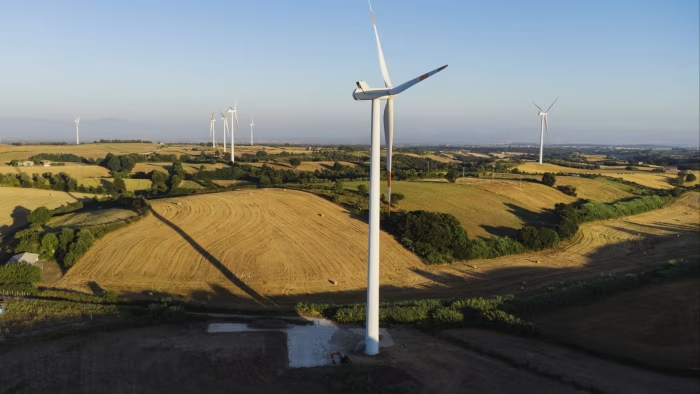
Europe’s leading wind turbine manufacturer, Vestas, has shelved plans to open its biggest factory in Poland, citing sluggish demand in its core European market.
Vestas announced last year that it would build the plant outside Szczecin, close to the Baltic Sea coast, to make blades used in powerful wind turbines.
However, the Danish group has now decided to suspend its investment in a facility that was initially expected to open in 2026 and employ more than 1,000 people.
The company told the Financial Times that the plans had been “paused due to lower than projected demand for offshore wind in Europe”.
It declined to say whether any of its other operations had been affected by the difficult market conditions in Europe, its key market.
The decision underlines the challenges faced by Europe’s offshore wind sector as it navigates higher costs, supply chain bottlenecks and political opposition in the US.
It is also a setback for Prime Minister Donald Tusk’s government and its efforts to cut Poland’s dependence on polluting coal by expanding in green energy and building domestic manufacturing for renewables.
The EU, UK and Norway have a combined offshore wind target of at least 129GW either operating or under construction by the end of the decade.
However, consultancy TGS 4C has said they are on track for only about 84GW, with Denmark and Germany both failing to find bidders for projects in separate auctions over the past 12 months.
European governments are trying to offer attractive terms and support to developers to help the industry, given its strategic importance as a source of low-carbon and domestically generated power.
But, outside China, the sector has struggled to generate returns, while attracting the ire of US President Donald Trump, who has a personal animosity towards the technology.
Ørsted, the world’s largest wind developer, recently outlined plans to retreat from the US and refocus investment in Europe and parts of Asia.
Turbine makers such as Vestas are generally keen to be certain of demand before investing heavily.
Yet any retreat by European manufacturers from their core market could open the door for Chinese competitors to move in and take market share.
Vestas said it “continues to invest in a local manufacturing footprint where offshore wind market volume and certainty allow”.
Offshore wind is central to Poland’s green efforts, with several projects under way that seek to turn the waters off Poland’s north coast into one of Europe’s largest hubs for wind farms.
Warsaw also hoped these can spur the creation of a domestic manufacturing sector capable of supplying turbines to a range of European markets.
Vestas has already invested in Poland by building an assembly plant for the nacelles that hold a turbine’s critical components and by buying a facility that makes blades for onshore turbines.
The planned Szczecin factory, however, was to be its largest Polish project to date, located on land bought in 2023. It was intended to manufacture blades for Vestas’s flagship offshore turbines, each capable of generating 15MW.
Poland’s first offshore turbines are expected to begin operating next year as part of the €4.7bn Baltic Power joint venture between state-controlled Orlen and Canada’s Northland Power, using Vestas as a supplier.
Warsaw wants Baltic Power and other large-scale projects to deliver 18GW of offshore capacity by 2040, roughly half of Europe’s current total.
Roula Khalaf, Editor of the FT, selects her favourite stories in this weekly newsletter.
People who buy expensive cars do so because they are keen on roaring engines, buttery-soft interiors and iconic logos. What doesn’t play into their purchasing decisions, apparently, is how environmentally friendly the vehicles are.
Responding to customer preferences, Ferrari said last week that it only expects 20 per cent of its models to be fully electric by 2030, down from 40 per cent previously. Porsche last month delayed a new range of high-end EVs, with chief executive Oliver Blume — who may be on the off ramp at the sports-car maker — citing a drop in demand for exclusive battery-electric cars. Mercedes has also seen weak EV sales, although third-quarter numbers improved.
That’s somewhat of a contrast to the mood in the broader EV market, which — amid ups and downs — sold a record 2.1mn vehicles in September. There are lots of reasons why luxury EVs are failing to get traction. One is that China is the biggest market in the world, accounting for 65 per cent of overall EVs sold last year. And in China, the cars that do a roaring trade tend to be cheap little runarounds. On top of that, consumers who do want the convenience of the high-end electric car have homegrown models to choose from: buffs reckon the Xiaomi SU7 is not entirely dissimilar to the Porsche Taycan, at a fraction of the price.
Some content could not load. Check your internet connection or browser settings.
Price is also a factor in Europe, where luxury and premium EVs carry a relatively high premium compared to the equivalent internal combustion engine (ICE) model. Plus, the rapid pace at which EV technology is developing means that resale values are relatively low.
In the near term, sluggish demand for luxury EVs is only really a problem for western manufacturers who raced down that road. Porsche, for instance, has had to write down some of its investment. For those who have been keeping their options open, the slower than expected decline of the old technology means they can carry on selling the more profitable ICE cars for longer.
Still, it potentially stores up problems later on. For one thing, electrification may shrink the pool of customers that are willing to pay top dollar for a car: electric engines are less differentiated than the traditional kind, so manufacturers will have to figure out how to justify the extra expense via design and gizmos. And, for another, Chinese manufacturers are rapidly moving up the value chain. When the market for luxury EVs does ignite, western carmakers may find that rivals have raced ahead.
Simply sign up to the Exchange traded funds myFT Digest — delivered directly to your inbox.
Royal London Asset Management and M&G are planning to enter Europe’s active exchange traded fund (ETF) market, as the sector expands rapidly and traditional mutual funds come under fee pressure.
Hans Georgeson, chief executive of RLAM, told the Financial Times that the firm plans to open an office in Dublin within 18 months to support the £184bn group’s international expansion and entry into the active ETF market.
“The active ETF market is moving very fast,” Georgeson said. “We plan to enter in the top 10. We are very ambitious in the active ETF space. We will probably launch with both equity and fixed income.
“ETFs are more accessible internationally. It’s a key plank for passporting internationally.”
Active ETFs allow fund managers to try to beat a market index, such as the FTSE 100, but within a product that is cheaper to run and easier for investors to buy and sell than their older mutual fund equivalents.
By comparison, traditional “passive” ETFs provide the returns of an index — rather than trying to beat it.
According to a recent report by Goldman Sachs’ fund arm, assets under management in Europe’s active ETF industry have grown nearly sevenfold since 2019 to €68.6bn. The report added that the number of funds and providers has “followed a similar trajectory, with launches of active ETFs outpacing passive launches for the first time”.
M&G is preparing to unveil its first active ETFs within weeks, with the first products investing in UK government bonds and US Treasuries.
Neil Godfrey, global head of client group at M&G Investments, said: “[These] ETFs will open up possible new investor audiences and potentially expand our partnerships with our existing investor base. “Given many clients already use and have familiarity with ETFs, we see a natural evolution towards active solutions, which will provide new opportunities to engage with capital allocators and their advisers across the UK, Europe and Asia.”
Other traditional fund groups have entered the market this year. Last month, Schroders unveiled its first active ETFs in Europe, investing in global equities and high-quality corporate bonds.
Johanna Kyrklund, Schroders group chief investment officer, said the products bring the “flexibility and accessibility” of an ETF wrapper in combination with the group’s fund managers, who bring the potential to generate higher returns.
Jupiter also entered the sector at the start of the year with a global government bond active ETF.
Matthew Beesley, chief executive of Jupiter, said at the time that “the risk is that if you sit there and don’t do anything, ETFs will continue to cannibalise the assets held in traditional funds”.
While traditional mutual funds are priced once a day, based on the value of its investments, ETFs trade on an exchange and are priced throughout the trading day.