
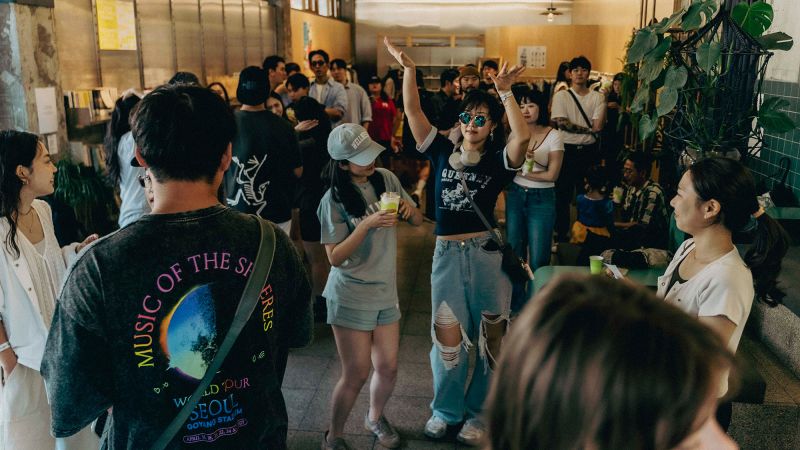
On a Saturday morning in October, Park Jihyun woke up at 5:30 a.m. to go raving in Seoul.
And much about her prep routine was counterintuitive.
Instead of shimmying into a miniskirt, the 29-year-old pulled on a pair of running tights. Instead of slipping her feet into a set of precarious heels, she slipped into running shoes. And in lieu of hailing a cab to the party, she ran from her apartment to the venue in Yongsan-gu, arriving after an hour-long, 5-mile jog, ready to hit the dance floor.
“It’s just random people who meet for the first time. But as we start dancing together, it becomes crazier as time flies,” Park says.
Since launching in May, the Seoul Morning Coffee Club’s Coffee Rave has become a viral success, drawing hundreds of like-minded Seoulites from the comfort of their beds to dance at daybreak.
Attendees, who have paid 20,000 won (about $14) for their ticket, start trickling in at 7 a.m., and line up for their drink of choice, often an iced Americano or a matcha. By 8 a.m., the DJ is pumping out hypnotic bass beats for an enthusiastic crowd of revelers who are jumping in unison in the clear, bright light of day, with nothing but caffeine to fuel their booze-free rave.
“It’s a fresh start to the day,” founder Park Jae-hyun (no relation to Park Jihyun) tells CNN. “Even though it’s very early in the morning, everyone looks excited and happy, even without alcohol.”
The concept of sober raves is not new. New York-based outfit Daybreaker and Morning Gloryville in London have been throwing these kinds of raves for more than a decade.
But in recent years, the latest sub-genre of booze-free events has moved into community spaces like coffee shops and bakeries in major cities around the world, flipping the script on the traditional clubbing scene.
From Brisbane to Mumbai, and Paris to Toronto, the movement has quickly gained traction among a segment of Gen Z-ers and younger Millennials who are drinking less and prioritizing sleep, health and wellness in their lives.
Interestingly, however, one of the pioneers of the concept in France says this wasn’t his goal when he launched his first bakery rave in Paris back in 2019.
While living and working in cities like Miami and Los Angeles as a French DJ and music producer, Alexis Duvivier, better known as Aazar, said one of the things he missed most about home was French boulangeries, or bakeries.
“It was such a big part of my culture in my everyday life here in France,” Duvivier said during an interview at a coffee shop in Paris. “It was the first thing I wanted to do when I went back or when I was there. I was always on the lookout for the best baguette or the best pain au chocolat. It’s always been my personal little quest.”
So when it came time to celebrate the release of his single “Diva” in 2019, Duvivier, 36, wanted to create a free event for his fans, merging his two passions — music and baked goods. He hosted his first early evening rave at The French Bastards in the 11th arrondissement, which had opened a year earlier and quickly distinguished itself from other bakeries for its irreverent and innovative menu.

As Aazar spun for the crowds against a backdrop of baguettes, trays of free pastries were distributed to the revelers, making for fun, unusual visuals on social media.
This year, clips of DJs Bob Sinclair and Peggy Gou playing for excited crowds also went viral, making The French Bastards one of the most unlikely rave hot spots in the French capital.
But Duvivier says the concept was highly personal and was never intended to become a gimmicky social media trend.
“I didn’t choose a bakery because I was looking for an unusual location, but because for me it represents France and represents what I love,” said Duvivier, who also hosts events across Europe as Bakery Session.

However, in the years since, the movement has grown bigger than Duvivier’s initial intent, circling the globe and gaining momentum, as it reflects shifting global trends and responds to a set of unmet needs.
“In Korea, there’s a lot of competition and mental illness in society,” says Park, the Seoul Morning Coffee Club (SMCC) founder. “I want to help Koreans have a freer life … tell them to calm down, relax, take it easy and that everything is going to be fine.”
While South Korea is not unique in dealing with the issue of deteriorating mental health, burnout and a loneliness epidemic in this fragmented, digital age, suffering is particularly acute in this country.
The suicide rate in South Korea is highest among the countries tracked by the Organisation for Economic Co-operation and Development (OECD) at 23 suicides per 100,000 people in 2023 – more than double the OECD average. And it’s a troubling title the country has held for more than a decade.
In a country notorious for its hyper-competitive, status-centered social structure, work-life balance in South Korea can be difficult to manage, with long work hours and a cutthroat job market.
But in recent years, younger generations have been increasingly rejecting the status quo, prioritizing their wellness and seeking community in offline events like those organized by the Seoul Morning Coffee Club (the group also hosts morning runs, book clubs and coffee chats) that allow them to blow off steam and boost their mental health.
“Compared to other countries, a lot of Korean people are very self-conscious,” says Park Jihyun, who also volunteers as a coffee chat host. “But the coffee rave lets you be yourself and helps introverts and those who are self-conscious grow out of their shell.”

While Seoul is known for its thrumming nightlife, the raves also cater to an underserved demographic in the city: morning people. And within this group, many tend to lead healthy, booze-free lifestyles, which can be isolating in a drinking culture where professional and personal relationships are often forged over a night of heavy drinking.
For British content creator Freya Hawksley, 23, who has been living in Seoul for the past five years, the event is a win-win, both as a morning person and non-drinker.
“When you’re partying and drinking, your energy levels start really high and then deplete throughout the night,” Hawksley says. “But when you go to these morning parties, you actually gain energy. So you turn up to these raves at 7 a.m., you finish at 10 a.m., and you feel completely energized and ready for the day.”
Seoul raves are also safe spaces: wholesome, family-friendly and multi-generational raves with babies and tots bopping to EDM alongside older adults.
“As a woman, I feel so much safer,” she added.
Hawksley was invited to the launch event as a friend of the organizers but has since returned on her own.
It’s a similar story in London, where DJs Manpal Bhullar (Mezz B), 32, and Vishal Kamle (Chndra), 31, brought sober, daytime raves to coffee shops earlier this year.
“I’m at that age where I don’t want to be out until the early morning, drinking and clubbing,” Kamle says. “It’s built around us in a way, reflecting our era.”
It’s a surprising admission for the duo, who are used to playing late-night clubs as Lost in Kaydnce. But the founders of Coffee Gen say that London nightlife has changed over the years, becoming too commercialized, impersonal and prohibitively expensive.
That disillusionment is shared by many young Britons. According to a 2025 consumer report from Night Time Industries Association UK published in February, 61% of the 2,000 respondents aged 18-30 reported going out less frequently in the last year, citing financial pressures, safety concerns and transportation barriers.
The group has also warned that 40% of the UK’s nightlife businesses faced closures without government intervention.
Matthew Campoli, co-founder of The Coffee Party in Toronto, also points out that the new genre of sober raves has succeeded in shaking up a stale and stagnant nightlife scene that lost part of its luster after the pandemic.
“I think there’s a need for genuine connection again. Since the pandemic, there’s been a gap. Social anxieties have developed and routines were crushed, and a lot of people started to prioritize themselves during that time which is why interests have shifted.”
For Franklin Vaz, 33, the arrival of sober coffee raves in Toronto earlier this year aligned with his own lifestyle changes, as he had decided to quit alcohol altogether.
But he still loved music. When one of his DJ friends who was spinning at a Coffee Party event told him about the gathering, Vaz jumped at the idea of joining like-minded people. He had no expectations, he says, and went to support his friend.
While waiting to get his drink, however, Vaz became instantly smitten by the “radiant” face of a woman who was also waiting in line and struck up conversation. Turned out that both were avid runners and led clean lifestyles: two days later, they went on their first date where they ran the distance of a half marathon, 13 miles, together.
“The conversation just flowed, so it was very exciting and very organic,” he says of meeting his now girlfriend.
After attending the events as a guest, Vaz now works as an event helper at The Coffee Party.
“The events are very motivating,” he adds. “The people there want to be the best versions of themselves. So it’s pushed me to be the best version of myself too.”

Kai Grünitz, Volkswagen Brand Board Member for Technical Development, says: “Our new interior architecture, starting with the all-new ID. Polo, elevates the customer experience to a new level: with clean lines, high-quality materials, and an intuitive operating environment with physical buttons and newly structured screens. In addition, from the ID. Polo onwards, our next software generation will deliver noticeably more comfort and functions for our customers. This includes, for example, the third generation of Travel Assist, which will soon recognise red traffic lights and stop signs, as well as comfortable one-pedal-driving.”
This story was first published in KCUR’s Adventure newsletter. You can sign up to receive stories like this in your inbox every Tuesday.
What’s in your tea leaves for the next year? Hopefully some cozy, warm beverages!
Tea has six major categories: white, green, yellow, oolong, black and pu-erh. From that, thousands of variations exist, but all come from the tea plant, Camellia sinesis.
From traditional Chinese and French teas to your grandma’s Southern sun tea, you’ll find it all represented here in Kansas City. Come on this tour through local loose-leaf tea shops, which will help you find your flavor, discover your vibe and sip away your stress.
Located on the first floor of Crown Center, Shang Tea is a great place to start for those beginning to explore the tea scene. Shang, the owner, is an amazing resource who is dedicated to his craft.
Originally from China, Shang opened up his shop in 2005 and moved to his Crown Center location in 2007. Shang Tea specializes in varieties of white teas, which contain the least amount of caffeine among the major categories. They’re also high in antioxidants.
Shang sources his tea leaves from China, and knows where they all come from. For example, his Aged Wu-Long tea, with its subtle sweetness, is a blend of Fujian Da Bai and Da Hao white tea leaves that were harvested in 2012 and aged for 18 months.
Another popular flavor this holiday season is Shang’s Honeysuckle White Tea. It has a very slight floral scent that tastes very lightly of fruit. It’s smooth, without any bitterness.
Shang Tea is also a great source to begin building your brewing equipment. They have starter gift packs for new tea drinkers that contain different teaware, such as cups and pots. You’ll notice that some of the tea cups are smaller, and there’s a reason: they cool the tea faster for you to drink.
Finally, Shang Tea sells absolutely wonderful mooncakes, made from his family’s recipe, with an elegant laced design on top. For the holidays, Shang has added ginger to it.
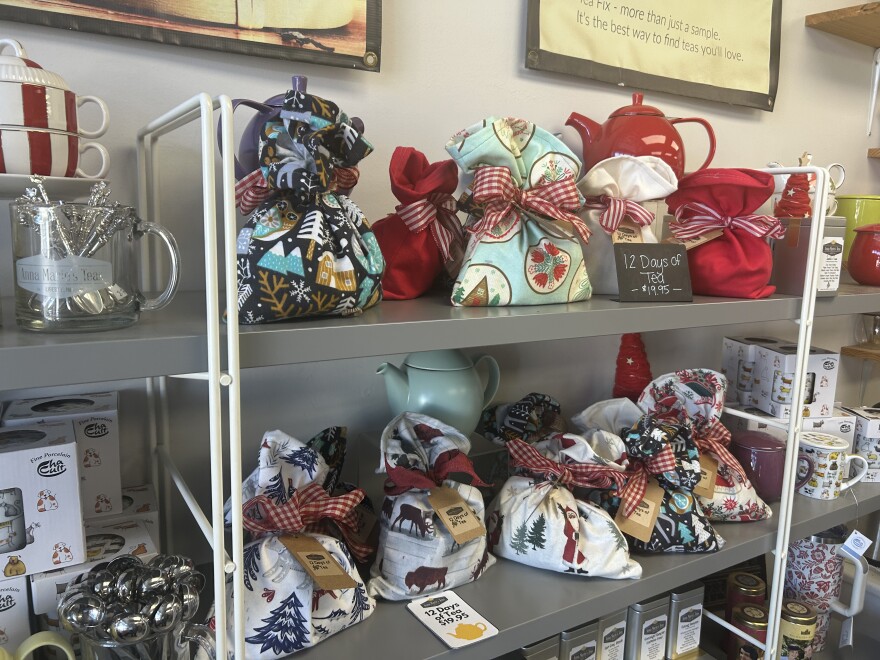
Walking into Anna Marie’s Teas, in historic downtown Liberty, is like walking into your grandmother’s quaint and cozy home.
Owned by Brenda Hedrick, Anna Marie’s Teas also sells an assortment of tea gifts, such as infusers for loose-leaf brewing — allowing you to get the whole leaf and exert greater control over your brew. While most casual tea drinkers are used to the bagged variety, those may not be of the highest quality and may contain “dust” from the manufacturing process.
There are plenty of blends to recommend, but their Cherry Green is a stand-out that has a slight fruity taste that doesn’t overpower the drink. Green tea has more caffeine than white tea but less than oolong, and can have an earthy taste. And for the Southerners among us, Anna Maria’s also carries an iced tea sampler.
The store has monthly events held at the owner’s historic home. The next one, an Epiphany Celebration Tea Time, is on Jan. 10 from 10:30 a.m. to 12:30 p.m. Tickets are $45 and come with more tea than you can possibly drink.
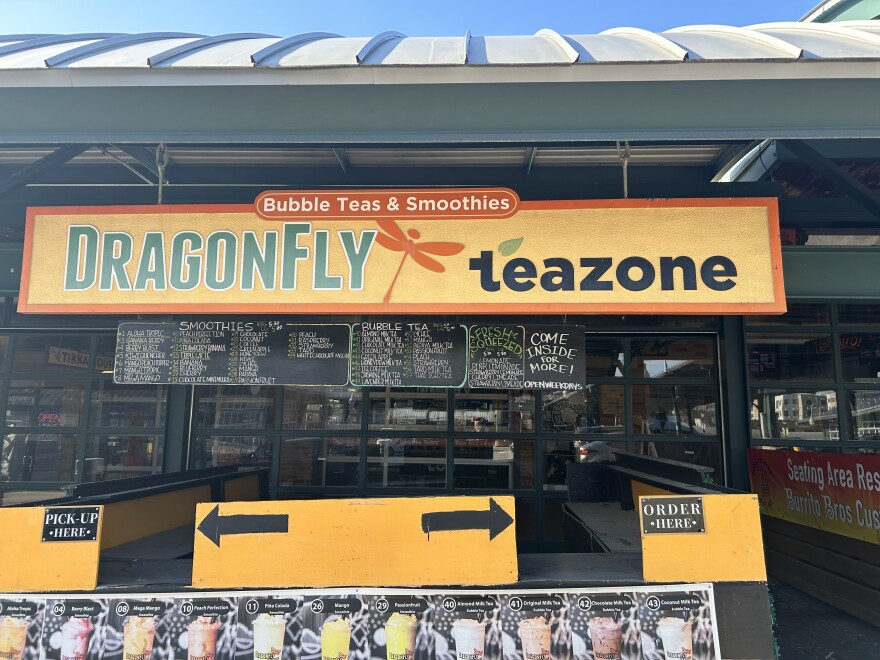
Loose-leaf tea fans will be happy to know that Dragonfly Teazone has four different locations across the Kansas City metro. What began as a kiosk in City Market in 2005 has expanded to serve the whole city.
Their list of teas is expansive, and includes herbal teas and tisanes, which are made by steeping herbs, roots, fruits, or flowers instead of a tea plant’s leaves. Herbal teas are recommended for their soothing qualities and stress reduction because they are caffeine-free and often aromatic. Common ingredients include lavender, chamomile and ginger.
Dragonfly also sells an assortment of smoothies, specialty drinks and bubble tea. Bubble tea comes from Taiwan and mixes tea, milk, fruit and fruit juices, and then tapioca pearls or jellies that add more flavor and texture.
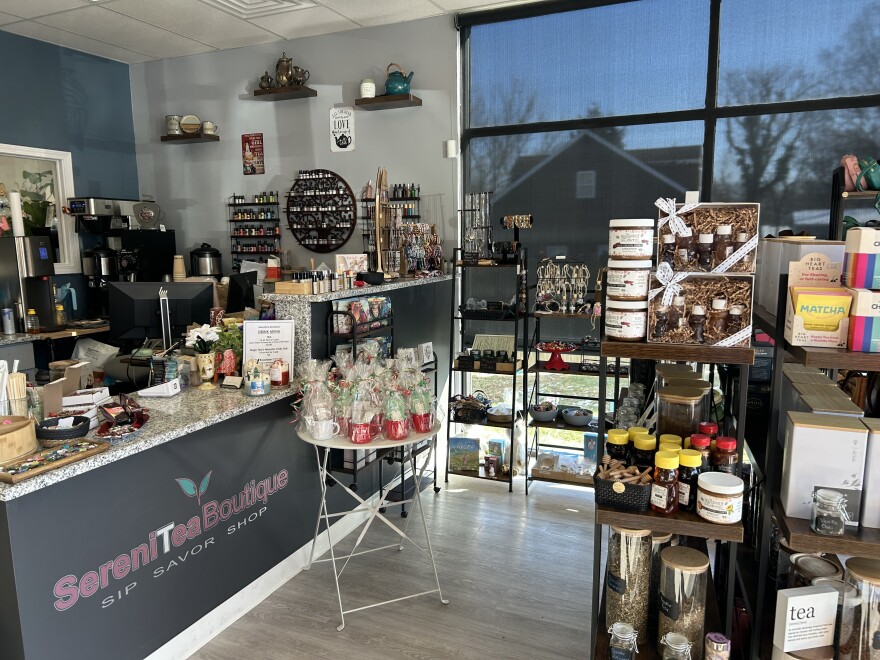
SereniTea Boutique in Lee’s Summit shares space with The Paperback Bakery.
Angela Byer opened the shop last year, and she uses two sources for her tea. Local favorite Hugo Tea is well known in Kansas City — they sell direct to consumers and through shops like SereniTea, and they’re passionate about where their tea comes from, down to the specific region and farm.
In addition to tea, SereniTea also features locally made products such as honey. If you want to unwind, sit in their book nook and enjoy the aroma of brewed tea and freshly made bakery treats. They often host events such as book clubs or cookies with Santa. Check their Facebook page to stay up to date.
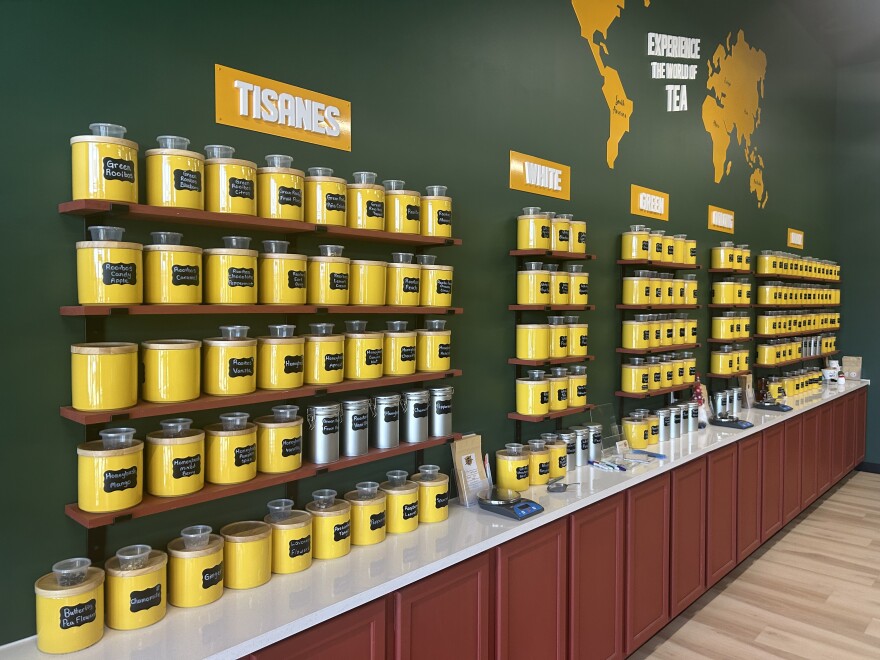
Lauren Farmer opened Socially Tea KC in Olathe in 2021. After college at the University of Minnesota, she made the great choice of turning her passion for tea into this business, where you’ll find a relaxing atmosphere complete with couches and a lending library.
Farmer also sells assorted teaware, and it’s a great place to learn about brewing. Each tea requires specific water temperature and steeping time to get the best cup. Socially Tea has a chart on its website.
One of their bestsellers is the Oolong Spiced Chai. Oolong is right in the middle of the oxidation chart of teas — not as sharp as black and not as subtle as a white. Chai often refers to Indian spices such as cinnamon, cardamom, and cloves, to name a few.
For newcomers, Socially Tea offers tea flights so that you can taste an assortment, or enjoy a preselected sampler pack. With over 100 tea varieties to choose from, you’re sure to find your blend.
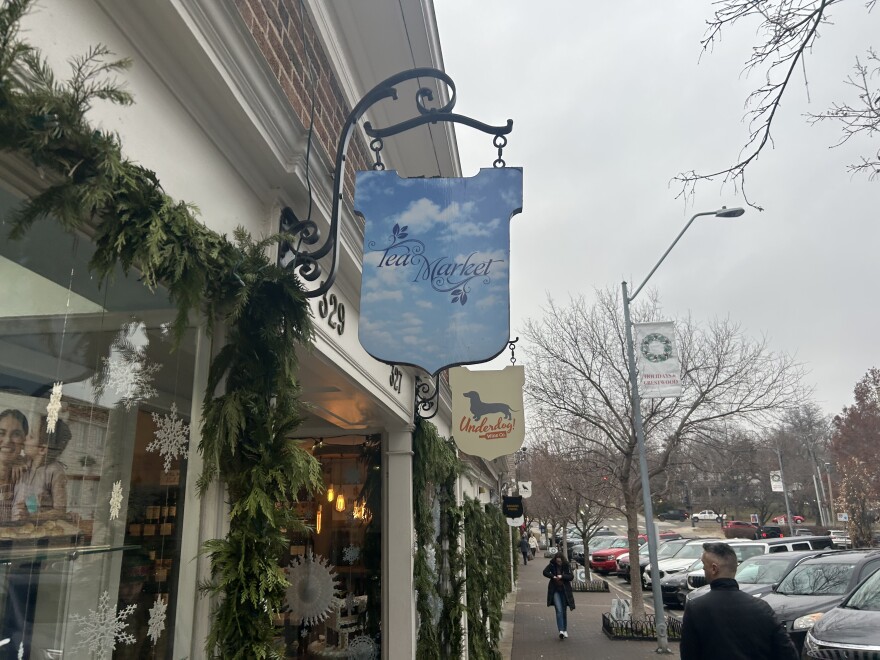
Tea Market was founded in 2002 by Stacie Robertson, and co-owner Jess Azar joined in 2024. The shop has an entire wall filled with more than 100 tea tins, containing just about every blend you could imagine — which can be intimidating. That’s where Robertson’s experience as a master blender comes in, like a wine sommelier but for tea, complete with rigorous training and experience.
Tea Market offers seasonal blends such as White Christmas (a white tea) and Sencha Claus (a green tea that contains orange slices, vanilla and other ingredients). Or find a variation of black tea that gets you up and going.
Black tea has the highest amount of caffeine, and has a strong, dry taste, almost like roasted nuts. Black tea is ideally not bitter and people often add milk or creamer to it. Try this variety out as a London Fog, which begins as Earl Grey black tea with milk added. It can be served either hot or iced.
Tea Market also offers consultations, a membership to connect with other tea lovers and events. If you want to find your tea community, this is it.

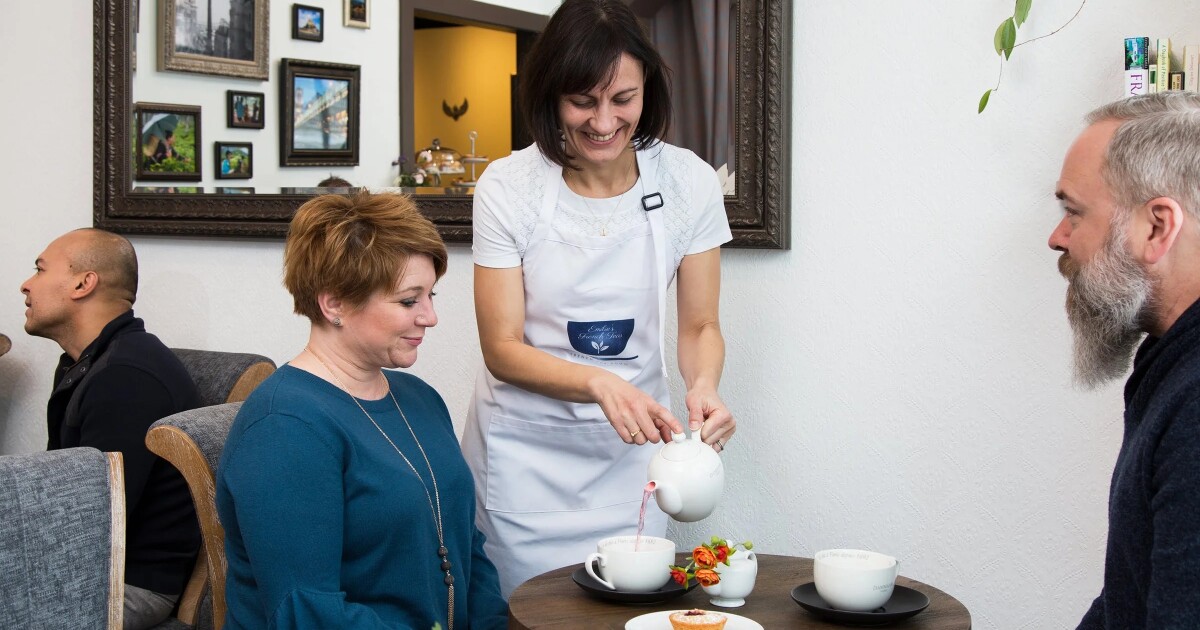
Emilie’s French Teas, owned by Emilie Jackson, stands out with its dark wood shelves and a sign that reminds customers that quiet is a virtue.
Jackson brings a bit of her homeland to Kansas City in this space. French teas have their own distinct blends, flavors, and brewing traditions that are captured elegantly here.
Jackson is also a master blender, and is there to guide you to the perfect cup of tea based on your health goals, stress levels or even your mood. Bring a friend and sit at one of the several two-person tables, or just sit back and read a book.
Jackson is happy to answer all your tea questions, including any about Pu-erh, a unique tea that is fermented like cheese or yogurt. If you want something more low-key, their Take It Easy tisane combines lemongrass, lemon balm, verbena, chamomile and lavender. It promotes relaxation and sleep.
If you’re looking for even more relaxation, try Emilie’s Tea Sauna, which uses heat from charcoal filters embedded into the walls. The warmth of the room along with the right tea helps you steep away your stress.
They also host events, classes and afternoon teas. Check their website to find the right event for you.

Listen to this article
Estimated 5 minutes
The audio version of this article is generated by AI-based technology. Mispronunciations can occur. We are working with our partners to continually review and improve the results.
2025 was a big year for Rooted, a non-profit housing organization in Dartmouth, N.S., that bought 10 buildings with close to 300 units of housing.
“And we’re not just acquiring the units, acquiring the buildings,” said Dylan Ward, Rooted’s director of real estate development.
“We’re looking to continue to invest in that sense of community as well as just improve livability — HVAC systems, things that have been maybe forgotten about or are not prioritized over the decades that those buildings have been in existence.”
The cost of purchasing and repairing the buildings topped $36 million. Often, when for-profit housing providers acquire buildings, renovations spur tenant evictions and rents are exponentially higher on the other side. But Rooted is employing a different model.

It maintains existing tenants and keeps rents below market rates for at least 30 per cent of the units. That’s part of the deal the group struck with the provincial government to get low-cost loans and capital grants which helped make the acquisitions possible.
In three years, the province says it’s helped non-profit groups, including Rooted, buy and fix up 727 units of housing to preserve affordability.
Ward called it a “new era of investment in community housing and community development,” and one that Rooted has been making the best of. To date, it’s the largest beneficiary of provincial loans and grants for low-cost, non-profit housing.
But Ward said he’s cognizant the government’s help might not last forever, noting the province’s “fiscal reality,” which includes a $1.3-billion deficit.
Housing Minister John White recently told reporters that he’d like to maintain a “suite of programs to continue to make progress,” but that will hinge, partly, on budget deliberations.
Speaking specifically about the Community Housing Acquisition Fund, which was introduced as a pilot in 2024, White said it’s been “extremely successful,” and he’s hoping there will be money in the spring budget to keep it going beyond its March 2026 end date.
But, he added, “I can’t say what’s going to happen with it just yet.”

Ward said continued provincial support is the best-case scenario, but Rooted is working on contingency plans. He said partnerships with the private sector, and new federal housing programs — which he anticipates will come online in 2026 — could pick up some of the slack.
Additionally, Ward said Rooted’s “mixed model” of tenancy, wherein some people pay market rates to help subsidize lower-rent units, is helping to make non-profit housing more sustainable. He said he hopes the model will enable more new builds, such as the 18-unit building Rooted opened in the summer.
Eventually, he said he hopes the group won’t have to rely on government participation for every new project.
Stephan Richard said Rooted is not alone in planning for more independence from the government.
Richard is director of development for the Community Housing Transformation Centre, a national non-profit that administers grants on behalf of the Nova Scotia government as well as other jurisdictions. It’s in charge of the programs that enabled Rooted’s acquisitions and new build this year.
“The mindset is shifting so that organizations in Nova Scotia, but also across the country, will be more based on a social enterprise model,” Richard said. “So despite cyclical funding, that puts the non-profit sector in a much better position moving forward.”

Cyclical funding is one challenge; Catherine Leviten-Reid said another challenge is that affordable housing is being lost at a faster pace than non-profits can preserve or build it.
Leviten-Reid, an associate professor of community economic development at Cape Breton University, said in recent years Nova Scotia has lost thousands of units of affordable housing annually. In comparison, she said the 727 units preserved through provincial programs is insufficient.
“These programs aren’t addressing the issue at scale,” she said.
“Considering how many Nova Scotians are really struggling with housing affordability and how much our rental housing stock is actually provided by the private, for-profit sector, they’re really not ambitious enough to address the problems faced by Nova Scotians.”
Richard agreed that halting the net loss of affordable housing is difficult, but he said he’s optimistic.
“The only way to do that is to empower non-profits and build the capacity so more non-profits can participate and protect those assets right across the province.”
MORE TOP STORIES

Listen to this article
Estimated 3 minutes
The audio version of this article is generated by AI-based technology. Mispronunciations can occur. We are working with our partners to continually review and improve the results.
Mowi Canada East’s managing director says 2025 was a “dreadful” year for Atlantic salmon farming.
“I’ve been in this industry 40 years, and 2025 has been my worst experience ever,” Gideon Pringle told CBC News in a telephone interview on Friday.
He said the year’s environmental conditions made aquaculture a difficult business. Although not a direct link, Pringle pointed to the wildfires experienced in Newfoundland and Labrador as an example.
“It’s just the environment we live in. We have good years and bad years, and I think that probably goes back, in farming terms, to the dawn of time.”
In August, the company reported that about 400,000 salmon died at three Mowi sites in the province.
And in July, thousands of fish died at their Little Burdock Cove site, due to increased water temperatures.

Meanwhile, Mowi reported on Dec. 20 that 24,696 salmon died at its Friar Cove site, near Francois on the south coast of Newfoundland. That number makes up more than 10 per cent of the farm’s population, which is why the company was required to report it publicly.
In the report, the company said there was no single cause for the deaths, and that it was “likely due to the residual effects from a sea lice infestation experienced during Fall 2025.”
Mowi said sea lice are naturally occurring parasites that live on many fish species, and do not pose human health or food safety risks.
Pringle noted that this report was a result of a culmination of deaths that added up over multiple weeks.
The company said prolonged storm conditions over three weeks at the end of November caused the number of deaths to accumulate.
“Really what’s happened here is the numbers have added up…[over] four weeks of not being able to harvest and empty that [pen],” said Pringle.
So despite the high number of salmon mortalities this year, Pringle said the recently-reported deaths are still normal.
“There’s no issue here for us. There’s no die-off,” he said.
“We’ve just really had a combination of slightly higher than normal farming mortality combined with bad weather.”
Pringle said the company had to report the deaths in December due to what he called “very inefficient” provincial regulations.
He said the government requires that anytime a unit reaches 10 percent mortality, the company must make a public report.
Pringle said this reporting system is “sometimes distressing” as it “portrays Newfoundland as a very poor place to farm salmon.”
“[It] takes away all sorts of investment opportunities,” he said. “The reporting systems that we have is doing a lot of harm for our industry.”
Download our free CBC News app to sign up for push alerts for CBC Newfoundland and Labrador. Sign up for our daily headlines newsletter here. Click here to visit our landing page.

January 03, 2026 (MLN): The Competition Commission of Pakistan (CCP) has taken a major enforcement action against deceptive marketing practices.
The Commission found that Mezan’s “Storm” energy drink
imitated the packaging and trade dress of PepsiCo’s Sting energy drink.
It noted that the overall look, colour scheme, bottle
design, and branding elements were closely replicated, creating a strong
likelihood of consumer confusion at the point of sale.
The CCP concluded that the conduct amounted to parasitic
copying and constituted deceptive marketing under Pakistan’s competition law,
according to the press release.
The case dates back to 2018, when PepsiCo Inc. filed a
complaint alleging that Mezan had deliberately designed Storm to benefit from
the established goodwill of Sting in Pakistan’s energy drink market.
Instead of responding to the allegations on merit, Mezan
repeatedly challenged the CCP’s jurisdiction and pursued prolonged litigation,
obtaining stay orders from the Lahore High Court in 2018 and again in 2021.
These legal challenges delayed the inquiry for several years
and prevented the Commission from concluding the matter in a timely manner.
In June 2024, the Lahore High Court dismissed Mezan’s
petition, upheld the CCP’s authority to proceed with the case, and ruled that
early challenges to show-cause notices were not maintainable.
The Court also clarified that regulatory proceedings are
independent of trademark disputes and observed that Mezan had used litigation
tactics to delay the process, allowing the inquiry to resume after years of
suspension.
In its detailed order, the CCP held that Mezan’s Storm
energy drink adopted a red-dominant colour scheme, bold slanted white
lettering, aggressive visual motifs, and a bottle shape and presentation
closely resembling Sting.
The Commission emphasized that deception is assessed based
on the overall commercial impression rather than minor differences examined
side by side.
It noted that an ordinary consumer with imperfect
recollection was likely to be misled.
The Commission further ruled that Mezan’s registered
trademark for “Storm” did not grant immunity from regulatory action.
It stated that trademark registration cannot shield conduct
that results in consumer deception or passing-off.
While imposing the Rs150 million fine, the CCP reiterated
that copycat branding and misleading packaging will not be tolerated.
Such practices would face strict action regardless of the
size or local status of the company, reinforcing its commitment to protecting
consumers and ensuring fair competition in Pakistan’s market.
Copyright Mettis Link News
UN-Water. United Nations World Water Development Report 2023: Partnerships and cooperation for water (2023). https://www.unwater.org/publications/un-world-water-development-report-2023. Accessed July 2025.
Fang, X., Liu, J., Zhang, M., Zhang, H. & Zhao, J. Review of the mechanism and methodology of water demand forecasting in the socio-economic system. Water 16, 1631 (2024).
Ristow, D. C. M., Henning, E., Kalbusch, A. & Petersen, C. E. Models for forecasting water demand using time series analysis: A case study in Southern Brazil. J. Water Sanit. Hygiene Dev. 11, 231–240. https://doi.org/10.2166/washdev.2021.208 (2021).
Almanjahie, I. M., Elmezouar, Z. C., Baig, M. B. & Ahmad, I. Modeling of water consumption in Saudi Arabia using classical and modern time series methods. Arab. J.Geosci. 14, 522 (2021).
Stefaniak, A. K., Jaskowiak, P. A. & Weihmann, L. A case study on water demand forecasting in a coastal tourist city. In Intelligent Systems (eds Paes, A. & Verri, F. A. N.) (Springer Nature Switzerland, Cham, 2025).
Shuang, Q. & Zhao, R. T. Water demand prediction using machine learning methods: A case study of the Beijing-Tianjin-Hebei region in China. Water 13, 310 (2021).
Banda, P. C., Bhuiyan, M. A. R., Zhang, K. & Song, A. Multivariate monthly water demand prediction using ensemble and gradient boosting machine learning techniques. In Proceedings of the International Conference on Evolving Cities (ICEC2021), 29–36 (2021), Southampton, UK. https://publications.evolvingcities.org/proc-icec/article/download/14/7.
Görenekli, K. & Gülbaug, A. Comparative analysis of machine learning techniques for water consumption prediction: A case study from Kocaeli Province. Sensors 24, 5846 (2024).
Jiang, Q. et al. Forecasting regional water demand using multi-fidelity data and Harris Hawks Optimization of generalized regression neural network models – A case study of Heilongjiang Province China. J. Hydrol. 634, 131084 (2024).
Shu, J. et al. Long-term water demand forecasting using artificial intelligence models in the Tuojiang River Basin, China. PLOS ONE 19 (2024). https://journals.plos.org/plosone/article/file?id=10.1371/journal.pone.0302558&type=printable.
Liu, G., Savic, D. & Fu, G. Short-term water demand forecasting using data-centric machine learning approaches. Journal of Hydroinformatics 25, 895 – 911 (2023). https://iwaponline.com/jh/article-pdf/doi/10.2166/hydro.2023.163/1186085/jh2023163.pdf.
Niazkar, M. et al. Applications of XGBoost in water resources engineering: A systematic literature review Dec 2018-May 2023. Environ. Model. Softw. 174, 105971 (2024).
Papacharalampous, G. & Langousis, A. Probabilistic water demand forecasting using quantile regression algorithms. Water Resources Research 58, e2021WR030216 (2022). https://doi.org/10.1029/2021WR030216.https://agupubs.onlinelibrary.wiley.com/doi/10.1029/2021WR030216.
Shan, S., Ni, H., Chen, G., Lin, X. & Li, J. A machine learning framework for enhancing short-term water demand forecasting using attention-BiLSTM networks integrated with XGBoost residual correction. Water 15(20), 3605 (2023).
Du, B., Zhou, Q., Guo, J., Guo, S. & Wang, L. Deep learning with long short-term memory neural networks combining wavelet transform and principal component analysis for daily urban water demand forecasting. Expert Syst. Appl. 171, 114571. https://doi.org/10.1016/j.eswa.2021.114571 (2021).
Wang, K., Ye, Z., Wang, Z., Liu, B. & Feng, T. MACLA-LSTM: A novel approach for forecasting water demand. Sustainability 15, 3628 (2023).
Gil-Gamboa, A., Paneque, P., Trull, O. & Troncoso, A. Medium-term water consumption forecasting based on deep neural networks. Expert Syst. Appl. 247, 123234 (2024).
Que, Q., Gao, J. & Qian, Y. Water demand forecasting in multiple district metered areas based on a multi-scale correction module neural network architecture. Water Res. X 25, 100269 (2024).
Zanfei, A. Graph convolutional recurrent neural networks for water demand forecasting. Water Resour. Res. 58, e2022WR032299 (2022).
Wang, K., Xie, X., Liu, B., Yu, J. & Wang, Z. Reliable multi-horizon water demand forecasting model: A temporal deep learning approach. Sustain. Cities Soc. 112, 105595 (2024).
Xu, J. Forecasting water demand with the long short-term memory deep learning mode. Int. J. Inform. Technol. Syst. Approach 17(1), 1–18. https://doi.org/10.4018/IJITSA.338910 (2024).
Liu, J., Zhou, X., Zhang, L. & Xu, Y.-P. Forecasting short-term water demands with an ensemble deep learning model for a water supply system. Water Resour. Manag. 37, 1–22. https://doi.org/10.1007/s11269-022-03409-0 (2023).
Liu, C., Liu, Z., Yuan, J., Wang, D. & Liu, X. Urban water demand prediction based on attention mechanism graph convolutional network-long short-term memory. Water 16(6), 831. https://doi.org/10.3390/w16060831 (2024).
Taylor, S. J. & Letham, B. Forecasting at scale. Am. Stat. 72(1), 37–45 (2018).
Guo, L., Fang, W., Zhao, Q. & Wang, X. The hybrid PROPHET-SVR approach for forecasting product time series demand with seasonality. Comput. Ind. Eng. 161, 107598 (2021).
Liu, H., Xing, R. & Davies, E. G. R. Forecasting municipal water demands: Evaluating the impacts of population growth, climate change, and conservation policies on water end-use. Sustain. Cities Soc. 130, 106581 (2025).
Zhou, S., Guo, S., Du, B., Huang, S. & Guo, J. A hybrid framework for multivariate time series forecasting of daily urban water demand using attention-based convolutional neural network and long short-term memory network. Sustainability 14, 11086 (2022).
Ghannam, S. & Hussain, F. Comparison of deep learning approaches for forecasting urban short-term water demand: A Greater Sydney Region case study. Knowl. Based Syst. 275, 110660. https://doi.org/10.1016/j.knosys.2023.110660 (2023).
Al-Ghamdi, A.-B., Kamel, S. & Khayyat, M. A hybrid neural network-based approach for forecasting water demand. Comput. Mater. Continua 73, 1365–1383 (2022).
Akiba, T., Sano, S., Yanase, T., Ohta, T. & Koyama, M. Optuna: A next-generation hyperparameter optimization framework. In: Proceedings of the 25th ACM SIGKDD International Conference on Knowledge Discovery & Data Mining 2623–2631 (2019).
Kutner, M. H., Nachtsheim, C. J., Neter, J. & Li, W. Applied Linear Statistical Models 5th edn. (McGraw-Hill/Irwin, New York, NY, 2005).
James, G., Witten, D., Hastie, T. & Tibshirani, R. An Introduction to Statistical Learning: With Applications in R (Springer, New York, NY, 2013).