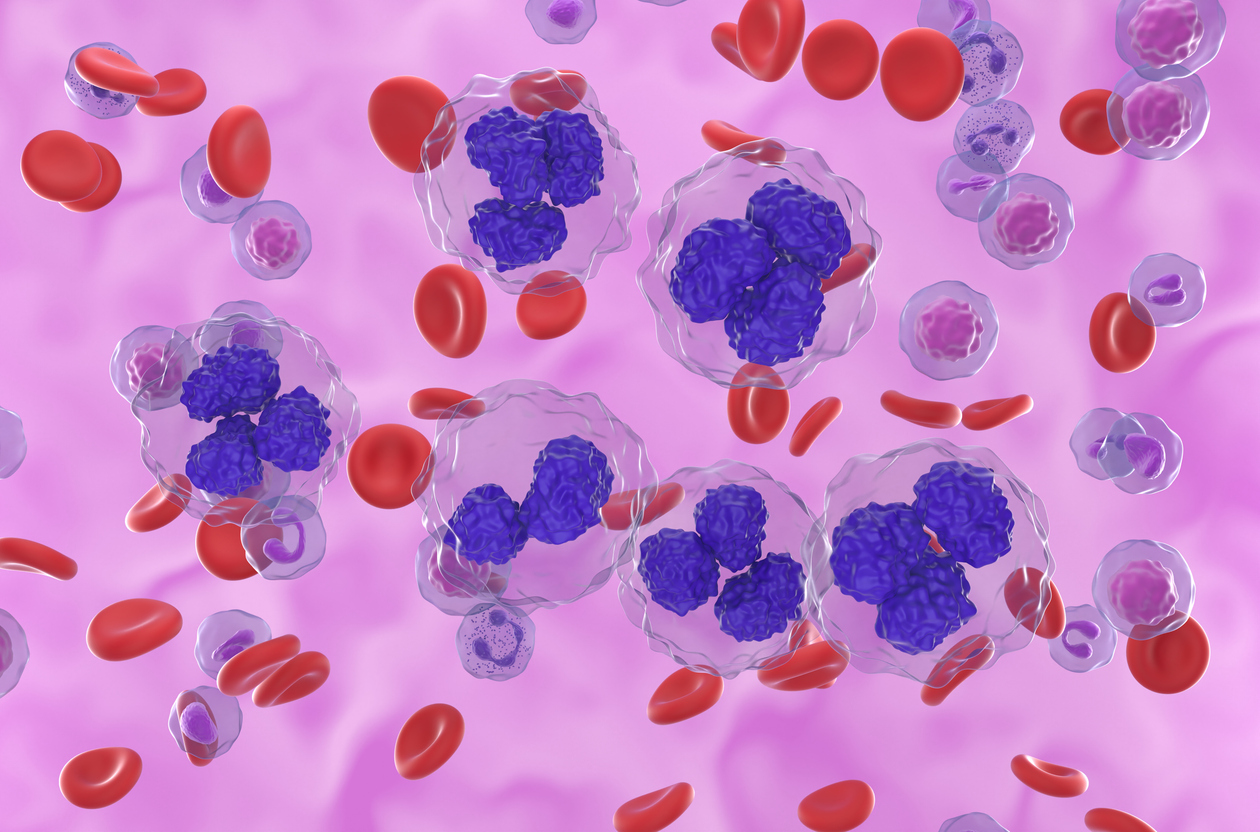
In a phase III trial (inMIND) reported in The Lancet, Sehn et al found that the addition of the CD19-targeted Fc-enhanced monoclonal antibody tafasitamab to lenalidomide plus rituximab improved progression-free survival in patients with relapsed or refractory follicular lymphoma.
Study Details
In the global double-blind trial, 548 patients from sites in North America, Europe, and the Asia-Pacific region were randomly assigned between April 2021 and August 2023 to receive up to twelve 28-day cycles of tafasitamab at 12 mg/kg on days 1, 8, 15, and 22 of cycles 1 to 3 and days 1 and 15 of cycles 4 to 12 (n = 273) or placebo (n = 275), with both groups receiving lenalidomide at 20 mg/day on days 1 to 21 of cycles 1 to 12 and rituximab at 375 mg/m² on days 1, 8, 15, and 22 of cycle 1 and day 1 of cycles 2 to 5. In total, 80% of patients were White. The primary endpoint was investigator-assessed progression-free survival in the intention-to-treat population.
Key Findings
Median follow-up was 14.3 months (95% confidence interval [CI] = 11.8–15.0 months) in the tafasitamab group and 14.1 months (95% CI = 11.5–15.0 months) in the control group. Median progression-free survival on investigator assessment was 22.4 months (95% CI = 19.2 months to not evaluable) in the tafasitamab group vs 13.9 months (95% CI = 11.5–16.4 months) in the control group (hazard ratio [HR] = 0.43, 95% CI = 0.32–0.58, P < .0001).
On independent review committee assessment, median progression-free survival was not reached (95% CI = 19.3 months to not evaluable) in the tafasitamab group vs 16.0 months (95% CI = 13.9–21.1 months) in the control group (HR = 0.41, 95% CI = 0.29–0.56, P < .0001).
Death occurred in 15 patients in the tafasitamab group and 23 patients in the control group. Full analysis of overall survival is planned at 5 years of follow-up.
Grade 3 to 4 adverse events occurred in 71% of the tafasitamab group vs 69% of the control group. The most common were neutropenia (40%), pneumonia (8%), COVID-19 (6%), and thrombocytopenia (6%) in the tafasitamab group, and neutropenia (38%), thrombocytopenia (7%), anemia (6%), and pneumonia (5%) in the control group. Serious adverse events occurred in 36% vs 32% of patients, most commonly pneumonia in both groups (8% vs 5%). Adverse events led to the discontinuation of treatment in 11% vs 7% of patients.
The investigators concluded: “The addition of tafasitamab to lenalidomide and rituximab resulted in a statistically significant and clinically meaningful improvement in progression-free survival, with an acceptable safety profile in patients with relapsed or refractory follicular lymphoma. This combination represents a potential new standard-of-care treatment.”
Laurie H. Sehn, MD, of BC Cancer Centre for Lymphoid Cancer and The University of British Columbia, Vancouver, Canada, is the corresponding author for The Lancet article.
Disclosure: The study was funded by Incyte. For full disclosures of the study authors, visit thelancet.com.
Students from Scott City Middle School in Kansas sit in the front trunk of Wheatland Electric Cooperative’s Ford F-150 Lightning during the co-op’s EVs & Espressos event on Sept. 24, 2025. The free public event, hosted in the school’s parking lot, sparked curiosity among students and gave co-op members a chance to enjoy a cup of coffee while learning more about EVs during National Drive Electric Month. (Photo Courtesy: WEC)
Wheatland Electric Cooperative has won a national award for educating its communities about electric vehicles and installing public chargers to help close a 100-mile gap between stations in southwest and central Kansas.
The 21,000-member, Scott City-based co-op beat out three large investor-owned utilities in Michigan, New York and New Jersey in the final round to win top honors in the utilities category of the 2025 Drive Electric Awards. The awards are given by Plug In America, a national, nonprofit organization that advocates for affordable, accessible EVs and charging stations.
“Though small, Wheatland Electric Cooperative leads with innovation—bridging the gap in rural America and proving no community is too small, too rural, or too remote to be part of the clean transportation future,” the group said in announcing the award.
Since 2021, WEC has installed three ChargePoint® Level 2 public charging stations—with two charging ports each—across an area where no chargers existed within a 100-mile radius. As of October, the stations have supported more than 1,500 charging sessions by nearly 670 different drivers. The co-op created them at its own expense.
“We’re in a part of the country that’s often overlooked, simply because we’re so rural,” said Shajia Donecker, the co-op’s multimedia specialist. “We are always striving to put our region on the EV maps, and I think Plug In America recognized that.”
The co-op also invites community members to test drive EVs at special events, which included a “Dine and Drive” lunch in 2024 in Great Bend that attracted 150 people for a free lunch and a chance to get behind the wheel of three different types of EVs.
The co-op brought its own two electric vehicles—a Hyundai Kona and a Ford F-150 Lightning—and an employe shared his Tesla Model Y. The co-op’s member services team won NRECA’s 2025 Service Excellence Gold Award for creating the “best external event.”
Mary Hoisington, member services and key accounts manager at Wheatland Electric Cooperative, discusses EV performance with Derek Caldwell, WEC journeyman lineman, at the co-op’s EVs & Espressos event in Caldwell, Kansas, on Oct. 1, 2025, during National Drive Electric Month. (Photo Courtesy: WEC)
This year, the co-op held “EVs & Espressos” events at or near several local coffee shops, providing free coffee to help entice people to explore EVs as part of National Drive Electric Month.
“Our whole goal is to make EVs more approachable,” said Alli Conine, WEC’s director of member services and corporate communications. “When we give people those hands-on experiences, their perspectives change. We want them to have fun while learning more about EVs.”
EVs are still relatively scarce in the area and no local car dealers display them, making the co-op events the only chance many residents have to test drive an EV, Donecker said.
“We try to meet people where they are,” she said. “You get all kinds of reactions. Some people will say, ‘no, absolutely not, I don’t want anything to do with an EV.’ But you also get, ‘wow, I had no idea how much power an EV has.” About 99% of the time, the reaction is good after they get a chance to drive.”
WEC’s grassroots efforts have focused on EV “accessibility, reliability, and cost savings to resonate locally,” Plug In America said.
“Beyond consumers, Wheatland has provided training and education to first responders, chambers of commerce, and civic leaders. The co-op is also electrifying its fleet, mentoring cooperatives in Kansas and Oklahoma, and providing a replicable playbook for other rural coops across the U.S.”
Researchers have proposed a new mechanism of acute kidney injury to account for patients with renal cell carcinoma (RCC) who have an inferior vena cava (IVC) tumor thrombus, according to findings presented at the 26th Annual Meeting of the Society of Urologic Oncology (SUO).1 By analyzing perioperative renal function in these patients, the researchers identified a distinct, reversible pattern of kidney injury linked to venous congestion—suggesting that timely thrombectomy may be critical to preserve renal function.
“The mechanism reframes how we think about renal failure in IVC thrombus. The injury is hemodynamic, not structural. Congestive nephropathy offers a unifying explanation, and it supports timely thrombectomy to relieve venous pressure,” said presenting author LorraineScanlon, MD, of London Health Sciences Centre Research Institute in Canada. “Ultimately, it introduces a fourth mechanism of renal dysfunction, and it may change how we counsel patients and design perioperative studies.”
The Clinical Issue
Patients with RCC and IVC thrombus often present with a poor baseline renal function in terms of estimated glomerular filtration rate. This has traditionally been attributed to tumor burden, chronic kidney disease, or comorbidities. But many patients recover their renal function after thrombectomy, which does not fit with structural or irreversible chronic kidney disease.
“This suggests a gap in how we conceptualize renal dysfunction in these patients,” Dr. Scanlon explained.
Acute kidney injury is classified as prerenal with lower perfusion rates, intrinsic with nephron injury, or as postrenal with obstruction leading to hydronephrosis. “This framework is incredibly useful, but none of these mechanisms explain what we see in IVC tumor thrombus,” she commented.
Instead, patients with IVC tumor thrombus have normal arterial inflow, no parenchymal injury, and no ureteric obstruction, so they cannot fall into any one of the three existing acute kidney injury classifications.
Hypothesis and Study Design
Dr. Scanlon suggested that there was a fourth possible mechanism of renal dysfunction: renal venous outflow obstruction, whereby IVC thrombus elevates the venous pressure, increases the interstitial pressure, and lowers the filtration gradient. This leads to a reversible injury that she called a congestive nephropathy.
“It reframes renal dysfunction as venous, not as arterial or as intrinsic,” she commented. “Our hypothesis was simple: if venous congestion is the driver, then relieving it via thrombectomy should preserve renal function, even in patients with worse baseline function.”
Researchers conducted a retrospective cohort study using data collected from 2002 to 2023 with three groups of patients: patients who underwent radical nephrectomy and IVC thrombectomy (n = 23), open radical nephrectomy alone (n = 35), and those who had a laparoscopic radical nephrectomy (n = 23). The primary outcome measurement was the change in the estimated glomerular filtration rate after more than 90 days.
Findings and Clinical Conclusion
The patients with IVC tumor thrombus had larger tumors, higher American Society of Anesthesiologists grades, and worse baseline estimated glomerular filtration rates. However, these patients also showed the best renal preservation.
Across all three groups, all patients experienced a decrease in their estimated glomerular filtration rate for the first day or two after surgery, but the rates recovered and converged at more than 90 days only for the patients with IVC tumor thrombus. “This cannot be explained by nephron loss. It’s most consistent with the reversible and venous congestion,” Dr. Scanlon stated.
At 90 days, the absolute change in estimated glomerular filtration rates were –10 for the patients with IVC tumor thrombus who underwent radical nephrectomy and IVC thrombectomy, –25 for patients who underwent radical nephrectomy alone, and –25 for those who underwent laparoscopic radical nephrectomy. The percentage decline in estimated glomerular filtration rate in the IVC tumor thrombus group was –21%, compared with –38% in the other two groups, even though these patients had worse function at baseline.
Additionally, the researchers found that prior to surgery, venous obstruction led to increasing pressure in the patients with tumor thrombus, which caused filtration rates to fall. But after thrombectomy, the outflow rate was restored and the filtration gradient normalized, leading to a recovery in the patients’ renal function, confirming the expected signature of reversibility.
Disclosure: Dr. Scanlon reported no conflicts of interest.
REFERENCE
1. Scanlon L, Cendejas J, Kailavasan M, et al. Relief of venous congestion as a modifiable cause of renal dysfunction in RCC with IVC tumor thrombus. 2025 SUO Annual Meeting. Presented December 4, 2025.
China’s BYD overtook Tesla as the world’s largest electric carmaker in 2025, after the US company run by Elon Musk reported a slump in deliveries at the end of the year.
BYD sold 2.26m battery electric cars during the year, easily outstripping the 1.63m deliveries reported on Friday by Tesla for the same period.
The switch is a symbolic moment in the rise of China’s car companies, which have used the transition to electric cars to try to dominate the global automotive industry. Chinese car exports have risen in recent years, led by BYD and rivals such as the state-owned SAIC and Chery, which runs the Omoda and Jaecoo brands.
Electric car sales have continued to grow in the past two years, but the rate of growth has been slower than expected. Electric carmakers have been forced to cut prices aggressively, and governments around the world have rolled back targets on the shift away from petrol.
Tesla’s sales appear to have suffered in large part because of the withdrawal of electric vehicle (EV) subsidies by Donald Trump. The US president has also removed emissions regulations that incentivised electric car production. And Tesla also faced a backlash from some consumers after Musk’s embrace of far-right politics at the end of 2024.
Tesla’s sales last year were down by 9% compared with 2024. Photograph: Rafiq Maqbool/AP
Tesla’s deliveries slumped to 418,200 in the final quarter of the year, below the average forecasts of analysts. Sales for 2025 were down by 9% compared with 2024.
An average compiled by Bloomberg had suggested that Tesla would deliver 441,000 vehicles during the quarter, but Tesla took the unusual step before the new year of publishing its own consensus estimate for the first time, apparently in an effort to guide investors that sales were expected to be lower.
Tesla’s share price was down 1% on Friday, although they were down by 8% since Christmas Eve.
Trump’s anti-EV policies came despite Musk donating more money than anyone else to the victorious 2024 presidential election campaign and briefly running an effort to cut government costs. Musk at first seemed to win support for EVs from Trump – and even an awkward photoshoot in a Tesla in front of the White House – but they fell out dramatically in the summer.
It was the second consecutive decline in annual sales for Tesla. Yet even as sales have fallen it remains by far the world’s most valuable carmaker, with shares valued at $1.4tn – more than the next 30 carmakers combined. Investors appear to be betting that Musk will lead Tesla to be a leading force in robotics and artificial intelligence.
Musk has consistently claimed that autonomous capabilities will set Tesla apart from rivals, and it has started operating a limited robotaxi service in Austin, Texas. However, it will still face competition on that front. Several Chinese carmakers and tech companies already have comparable technology, including an offering from BYD called “God’s Eye” that is now included even on its cheapest cars.
BYD’s electric car sales rose by 28% during the year despite a weaker performance in December.
BYD was founded in 1995 as a battery company by Wang Chuanfu, who is often described as China’s equivalent to Musk. Its business already produced more cars overall than Tesla when counting hybrids.
The Shenzhen-headquartered manufacturer has overtaken Tesla during single quarters before. However, its battery electric production pulled away from its US rival in 2025, even as it faced intense competition from Chinese rivals.
BYD recorded 4.55m car sales overall during 2025, although its sales of plug-in hybrids fell by 8% year on year to 2.29m. That came despite an uptick in sales of plug-in hybrids, combining a smaller battery with a petrol or diesel engine, in some markets from consumers worried about their ability to charge. BYD also more than doubled its sales of commercial vehicles, including electric buses and lorries, to 57,000.
WASHINGTON – The Federal Deposit Insurance Corporation (FDIC) today issued its list of state nonmember banks recently evaluated for compliance with the Community Reinvestment Act (CRA). The list covers evaluation ratings that the FDIC assigned to institutions in October 2025.
The CRA is a 1977 law that requires the FDIC to assess a bank’s record of meeting the credit needs of its entire community, including those of low- and moderate-income neighborhoods, consistent with safe and sound operations. As part of the Financial Institutions Reform, Recovery, and Enforcement Act of 1989 (FIRREA), Congress mandated the public disclosure of an evaluation and rating for each bank or thrift that undergoes a CRA examination on or after July 1, 1990.
You may obtain a consolidated list of all state nonmember banks whose evaluations have been made publicly available since July 1, 1990, including the rating for each bank, or obtain a hard copy from FDIC’s Public Information Center, 3501 Fairfax Drive, Room E-1002, Arlington, VA 22226 (877-275-3342 or 703-562-2200).
A copy of an individual bank’s CRA evaluation is available directly from the bank, which is required by law to make the material available upon request, or from the FDIC’s Public Information Center.
FDIC Public Information Center 3501 Fairfax Drive Room E-1002 Arlington, VA 22226
Simply sign up to the Hedge funds myFT Digest — delivered directly to your inbox.
Hedge fund giants Millennium and Citadel delivered a double-digit return to investors in 2025, recovering after a lacklustre first half but lagging behind many smaller firms in the “multi-manager” sector.
Izzy Englander’s Millennium and Ken Griffin’s Citadel were both briefly in the red in the first few months of last year, as markets were rocked by US President Donald Trump’s trade war.
But the firms recovered to gain 10.5 per cent and 10.2 per cent, respectively, by the end of 2025, following months of steady returns in the second half of the year, said people who had seen the numbers.
The recoveries partly reflect a return to more normal market conditions after Trump backed away from many of his most aggressive tariffs, allowing equity indices to chalk up strong gains by the end of the year. The S&P 500 finished 16.5 per cent higher while the UK’s FTSE 100 gained 21.5 per cent.
Millennium and Citadel were outshone by many of their smaller rivals in the multi-manager sector, including ExodusPoint, which gained 18 per cent, and Schonfeld’s flagship fund, which gained 12.5, said people who had seen the numbers.
Multi-manager firms have risen to the top of the hedge fund industry over the past several years by operating hundreds of trading teams known as “pods” across multiple asset classes such as equities, bonds and commodities. These hedge funds are known for heavy use of borrowing to juice their returns but also strict central risk management that often forces traders to quickly exit losing positions.
In addition, they charge investors higher fees than traditional hedge funds by passing through a host of costs, such as bonuses and client entertainment, directly to investors.
Their model has generally delivered consistent returns over the past decade, satisfying a desire from large investors such as pensions for steady profits.
These firms do not benchmark themselves against equity indices such as the S&P 500, instead trying to make their investors money whether stocks rise or fall. For instance, many multi-manager firms were up in 2022 when equity markets sustained big losses.
Elsewhere, macro hedge funds had their best year since 2008, with Bridgewater’s Pure Alpha hedge fund up 33 per cent to December 29, the most profitable year for the firm since it was founded 50 years ago.
Millennium, ExodusPoint, Schonfeld, Bridgewater and Citadel declined to comment.
Winnipeg, MB January 2, 2026 — Great-West Lifeco Inc. (“Lifeco”) announced today that it has received approval from the Toronto Stock Exchange (“TSX”) to renew its Normal Course Issuer Bid (“NCIB”).
Under the renewed NCIB, Lifeco may purchase for cancellation up to 20,000,000 common shares (“Shares”), representing approximately 2.2% of its 907,158,831 issued and outstanding Shares on December 23, 2025. The NCIB will commence on January 6, 2026 and continue until the earlier of January 5, 2027 and the date Lifeco completes its purchases pursuant to the notice of intention filed with the TSX. Based on the average daily trading volume on the TSX of 1,989,988 for the six months preceding November 30, 2025 (net of repurchases by Lifeco during that period), daily purchases will be limited to 497,497 Shares, other than block purchase exceptions. Purchases under the NCIB will be made at prevailing market prices through the facilities of the TSX, other designated exchanges and/or other alternative Canadian trading systems or by other means permitted by applicable law. Any Shares purchased by Lifeco pursuant to the NCIB will be cancelled. The actual number of Shares which may be purchased and the timing of any purchases will be determined by Lifeco management, subject to TSX rules and applicable law.
Lifeco’s Board of Directors (the “Board”) has authorized the renewed NCIB because, in the Board’s opinion, such purchases constitute an appropriate use of funds which will benefit both Lifeco and its shareholders. Lifeco will use the renewed NCIB to mitigate the dilutive effect of issuing securities under Lifeco’s Stock Option Plan and for other capital management purposes.
Under its prior NCIB (as amended on September 5, 2025), Lifeco received approval from the TSX to purchase up to 40,000,000 Shares from January 6, 2025 to January 5, 2026. As of December 23, 2025, Lifeco purchased 28,091,279 Shares at the weighted average price of $57.01 under its prior NCIB, including 12,443,866 Shares purchased from PFC (as defined below). As of December 23, 2025, a non-independent trustee purchased 75,457 Shares which were required to be counted against the NCIB limits in accordance with the TSX Company Manual, with no impact on the number of Shares outstanding. Those Shares were bought at the weighted average price of $53.45.
Automatic Purchase Plan
Lifeco also announced that it intends to enter into an automatic purchase plan (“APP”) with a designated broker to facilitate repurchases under the NCIB, including at times when Lifeco would ordinarily not be permitted to make purchases due to regulatory restrictions or self-imposed blackout periods. Purchases will be made by Lifeco’s broker at its sole discretion based on pre-set parameters in accordance with TSX rules, applicable law and the parties’ agreement. Purchases under the APP will be included in determining the total number of Shares purchased under the NCIB.
Purchases from Power
In addition, the TSX has granted an exemption that will permit Lifeco to purchase its Shares from Power Financial Corporation and its wholly-owned subsidiaries (collectively, “PFC”) in connection with the NCIB, in order for PFC to approximately maintain its proportionate percentage ownership (unadjusted for Share issuances pursuant to Lifeco’s stock option plan and other long-term incentive plans). PFC is a wholly-owned subsidiary of Power Corporation of Canada and is the majority shareholder of Lifeco, holding approximately 68.677% of the issued and outstanding Shares (which does not include the approximately 2.44% of Shares held by IGM Financial Inc.). Purchases from PFC will be made during the TSX’s Special Trading Session pursuant to an automatic disposition plan agreement expected to be entered into between Lifeco, Lifeco’s broker and Power Financial Corporation and certain of its wholly-owned subsidiaries. Purchases from PFC will be made on any trading day that Lifeco makes a purchase from other shareholders pursuant to the NCIB. In the event that PFC does not sell Shares on any trading day as required (other than as a result of a market disruption event), the TSX exemption will cease to apply and Lifeco will not be permitted to make any further purchases from PFC pursuant to the NCIB. The maximum number of Shares that may be purchased pursuant to the NCIB will be reduced by the number of Shares purchased from PFC.
About Great-West Lifeco Inc.
Great-West Lifeco is a financial services holding company focused on building stronger, more inclusive and financially secure futures. We operate in Canada, the United States and Europe under the brands Canada Life, Empower and Irish Life. Together we provide wealth, retirement, group benefits and insurance and risk solutions to our over 40 million customer relationships. As of September 30, 2025, Great-West Lifeco’s total client assets exceeded $3.3 trillion.
Great-West Lifeco trades on the Toronto Stock Exchange (TSX) under the ticker symbol GWO and is a member of the Power Corporation group of companies. To learn more, visit greatwestlifeco.comOpens in a new windowOpens in a new window.
For more information:
Media Relations Tim Oracheski 204-946-8961 media.relations@canadalife.com
Great-West Lifeco reports results of conversion election for Non-Cumulative 5-Year Rate Reset First Preferred Shares, Series N
Great-West Lifeco announces dividend rates on Non-Cumulative 5-Year Rate Reset First Preferred Shares, Series N and Non-Cumulative Floating Rate First Preferred Shares, Series O
Great-West Lifeco announces conversion right of Non-Cumulative 5-Year Rate Reset First Preferred Shares, Series N
MANITOWOC, Wis., Jan. 2, 2026 /PRNewswire/ — Bank First Corporation (Nasdaq: BFC) (“Bank First”) today announced it has completed its acquisition of Centre 1 Bancorp, Inc. (“Centre”), parent company of The First National Bank and Trust Company (“First National Bank and Trust”).
The closing marks an important milestone in bringing together two relationship-driven organizations. Effective immediately, Bank First is expanding its services to include trust and wealth management, integrating a skilled team from First National Bank and Trust. Customers now have access to a comprehensive suite of wealth planning, trust administration, and investment management services, provided by a team of professionals with deep expertise and a strong commitment to delivering personalized solutions.
First National Bank and Trust will continue to operate as a division of Bank First until the planned system conversion in May 2026. At that time, all locations will transition to the unified Bank First brand and digital banking platform. Throughout this process, customers will continue to work with familiar local teams, ensuring personalized service and a smooth transition as we move forward together.
The combined organization will operate 38 branch locations across Wisconsin and the Stateline area of Illinois, with approximately $6 billion in assets, strengthening its ability to serve individuals, businesses, and communities throughout the region.
Mike Molepske, Chairman and Chief Executive Officer of Bank First, stated, “This partnership brings together two long-standing, community-focused institutions committed to responsive, relationship-based banking. Together, we strengthen our ability to serve customers across Wisconsin and the Stateline area of Illinois with greater capabilities and expanded services.”
Following the closing, Steve Eldred, Chairman and Chief Executive Officer of Centre, will join the Board of Directors of Bank First and its banking subsidiary, Bank First, N.A.
Piper Sandler & Co. served as financial advisor to Bank First, and Alston & Bird LLP served as legal counsel. Hovde Group, LLC served as financial advisor to Centre, and Barack Ferrazzano Kirschbaum & Nagelberg LLP served as legal counsel.
Contact: Bank First: Mike Molepske, Chairman & CEO, [email protected], (920) 652-3202
Washington, D.C. — Heading into 2026, more than one in three Americans (38%) say they plan to make a mental health-related New Year’s resolution, according to new findings from the American Psychiatric Association’s Healthy Minds Poll. This is up 5% from last year. Younger adults are leading this trend, with those ages 18–34 (58%) significantly more likely to report planning a mental health resolution compared with older adults (32% of 45-64-year-olds; 11% of those 65 and over).
A strong majority (82%) of Americans say they plan to make at least one New Year’s resolution for 2026. Physical fitness (44%) and financial goals (42%) remain the top areas of focus, followed closely by mental health (38%), which continues to rise in priority. Other common goals include diet (29%), social or relationship resolutions (29%), and spiritual goals (28%).
“It is encouraging to see more individuals planning to prioritize their mental health in 2026, particularly younger adults,” said APA President Theresa Miskimen Rivera, M.D. “The strategies people are embracing — such as regular physical activity, mindfulness practices, adequate sleep, time in nature and engaging in therapy — reflect a growing recognition that mental health is deeply connected to daily habits. Even small, intentional changes can have a meaningful and lasting impact on overall well-being.”
Looking back on 2025, 63% of Americans rated their mental health as excellent or good, while 28% said it was fair and 8% said it was poor.
Anxiety Heading into the New Year
Heading into 2026, anxiety remains common. Americans report feeling anxious about personal finances (59%), uncertainty about the next year (53%), and current events (49%), with concerns about physical and mental health close behind.
Issues Americans are Anxious About
Issue
Percent anxious
(somewhat or very)
Personal finances
59%
Uncertainty of the next year
53%
Current events
49%
Physical health
46%
Mental health
42%
Job security
33%
Relationships with friends and family
32%
Keeping New Year’s resolutions
30%
Romantic relationships
29%
“A new year can bring change, possibility, and uncertainty,” said APA CEO and Medical Director Marketa M. Wills, M.D., M.B.A. “Feelings of anxiousness underscore the importance of paying attention to how we’re doing and taking practical steps, large or small, to support our mental health.”
These results are from the APA’s Healthy Minds Poll, conducted by Morning Consult, Dec. 2–3, 2025, among 2,208 adults. For a copy of the survey results, contact [email protected]. See past Healthy Minds Polls.
American Psychiatric Association
The American Psychiatric Association, founded in 1844, is the oldest medical association in the country. The APA is also the largest psychiatric association in the world with more than 39,200 physician members specializing in the diagnosis, treatment, prevention, and research of mental illnesses. APA’s vision is to ensure access to quality psychiatric diagnosis and treatment. For more information, please visit www.psychiatry.org.
Some key parts of Kennesaw State University’s mission are to advance knowledge, foster innovation, and serve the community. Through the HatchBridge Incubator, those facets are coming to life.
In just two years, the incubator has become a launchpad for companies that are attracting
millions of dollars in investment, translating faculty research into real-world solutions,
and giving KSU alumni and the surrounding community a place to turn bold ideas into
thriving businesses.
HatchBridge is building an ecosystem that connects the University with the region
around it. Located on Chastain Road just across from the Kennesaw Campus, the incubator
welcomes alumni, faculty researchers, and community entrepreneurs who are ready to
take their ideas to the marketplace.
HatchBridge is just one of several ways KSU supports entrepreneurship. Undergraduates often begin their entrepreneurial journey through the Robin and Doug Shore Entrepreneurship and Innovation Center in the Michael J. Coles College of Business. HatchBridge serves a different purpose: supporting ventures further along the path, whether they’re backed by faculty research, alumni experience, or community expertise.
“At HatchBridge, we’re building a culture where founders can learn from each other, avoid repeating the same mistakes, and grow faster together,” said Colin Ake, director of incubation and commercialization. “We’re serving KSU researchers – but we are also serving the wider community of entrepreneurs in the region who want to build something meaningful.”
“The reality of startups is that most of the journey is hard, unglamorous work,” said Graham Gintz, associate director of the incubator. “What we do at HatchBridge is give founders the structure, mentorship, and accountability they need to keep moving forward – whether they’re raising capital, refining a product, or making their first sale.”
A clear example of HatchBridge’s impact is Chowder Financial, led by KSU alumnus Daniel Collier ’06, ’13. Chowder provides lease-purchase financing for homeowners and contractors needing to replace essential systems such as heating and air conditioning. Collier’s company has already raised more than $8 million in venture capital and is growing rapidly.
“As a Kennesaw State University graduate, joining the HatchBridge Incubator was an invaluable step in Chowder’s early journey,” Collier said. “The guidance, resources, and continued support we receive, especially in building a strong business foundation, has helped shape Chowder into the company we are today.”
Another HatchBridge standout is MycoLogic, a faculty-led venture commercializing a sustainable mushroom growing system. Created by Kyle Gabriel, KSU senior research associate and Chris Cornelison associate vice president of innovation and strategic partnerships in KSU’s Office of Research, MycoLogic has climate-controlled grow units. Through years of iteration and frontline work with farmers in the region, the units are now available commercially nationwide, with growers able to recoup their investment within just a few years.
“The impact of research can in many cases be realized through commercialization, which typically involves taking new information created through academic scholarship, and making that into a product or service,” said Cornelison, who is also an associate professor of microbiology. Entrepreneurship isn’t limited to faculty research. Alumni like Emerson Smith ’18 are using HatchBridge as a launchpad, too. Smith founded HappyDoc, an AI assistant for veterinary clinics, entrusted by veterinarians to auto-generate SOAP medical notes, integrate with practice systems, and streamline workflows. What started as an early idea with grant funding from the Mookerji Innovation Fund in KSU’s Shore Entrepreneurship Center has evolved into a growing venture that blossomed after HatchBridge’s Chasing Venture Program. In just a few years, HappyDoc has raised over $5 million in venture dollars and is helping hundreds of veterinarians run more efficient practices.
“During the most stressful stage of building HappyDoc, the personal coaching I received through the Chasing Venture Program made all the difference. I’m grateful to have graduated from KSU, a school that pairs resources with the kind of personal mentorship every founder needs,” Smith said.
The Next Wave of Research Commercialization
Several faculty members are preparing to follow in these footsteps.
Maria Valero, associate professor in the College of Computing and Software Engineering,
is developing GlucoCheck, a device to measure blood sugar levels using light instead
of a blood sample. Laying the groundwork for future commercialization, she has incorporated
under the name Predicor.
Tiffany Roman, from the Clarice C. and Leland H. Bagwell College of Education, is developing an app to support music education for K-12 students.
Both Valero and Roman have completed the Innovation Launchpad, the incubator’s multiple-session program where faculty and entrepreneurs refine their business models, conduct customer discovery interviews, and receive hands-on coaching – with up to $3,000 to support customer discovery.
Student Fellows: Learning by Building
HatchBridge’s impact extends beyond founders and faculty. Through HatchBridge Fellows, 14 students from interactive design and engineering backgrounds have worked side-by-side with startups in the incubator. Fellows contribute to landing pages, prototypes, and user experience design – gaining real-world experience while adding immediate value to early-stage companies.
Two Fellows have even gone on to work full time with HatchBridge portfolio companies:
one at Chowder Financial, another at MycoLogic, evidence that the incubator is not
only helping companies grow but also creating a talent pipeline for the region.
Looking Ahead
In only two years, HatchBridge has grown into a cornerstone of KSU’s innovation ecosystem. With alumni raising capital, faculty spinning out companies, and researchers preparing to launch their own ventures, the incubator is already proving its value to both the university and the region it serves.
“This is just the beginning,” Ake said. “Our goal is to make HatchBridge the first call for anyone in the region with an idea worth building. Through ventures like Chowder, MycoLogic, and HappyDoc – and the promising research of faculty innovators – HatchBridge is demonstrating that entrepreneurial success at KSU is not a dream for the future, but a reality happening right now.”
By the Numbers: HatchBridge since July 2023
• 187 startups served across 20 cohorts of programs • $18M+ raised by HatchBridge founders
This article also appears in the current issue of Summit Magazine.
– Story by Gary Tanner Photos by Matt Yung
Related Stories
A leader in innovative teaching and learning, Kennesaw State University offers undergraduate, graduate, and doctoral degrees to its more than 51,000 students. Kennesaw State is a member of the University System of Georgia with 11 academic colleges. The university’s vibrant campus culture, diverse population, strong global ties, and entrepreneurial spirit draw students from throughout the country and the world. Kennesaw State is a Carnegie-designated doctoral research institution (R2), placing it among an elite group of only 8 percent of U.S. colleges and universities with an R1 or R2 status. For more information, visit kennesaw.edu.