A farewell event for commuter trains being phased out has raised more than £45,000 for three charities.
South West Railway’s (SWR) red Class 455 fleet has been in service for 42 years and is being replaced by new Arterio trains.
Tickets for the event, which took place on 21 December and saw two Class 455s run through places including Guildford and Epsom, sold out in 15 seconds, SWR said previously.
Originally scheduled to involve one train, “unprecedented demand” for the event led SWR and the Branch Line Society to add a second train for “hundreds of excited enthusiasts”, it said.
With the new year approaching, TUI MAGIC LIFE is set to launch a new, high-impact marketing campaign. The campaign’s slogan is “Wie Urlaub, nur geiler!” – or “Like holidays, but epic!” internationally. The club brand will focus on an emotional presentation that builds on the previous campaign of the same name. This will emphasise the variety of experiences on offer and the strong sense of community that the brand offers.
The campaign will have an immediate strong presence on connected TV and across social media, supported by additional online and out-of-home placements. “Like holidays, but epic! perfectly embodies the essence of a club holiday with TUI MAGIC LIFE: experiences that offer more — more fun, more adventure, and more entertainment,” says Nils Sarbok, Head of Marketing at TUI MAGIC LIFE. “Our ambition is not just to offer guests a holiday, but an extraordinary experience, with everything included in the price.”
The campaign will be rolled out in two phases, each targeting key audiences: couples and families. In addition to digital formats and social media clips, the mix includes influencer activations. The goal is to strengthen brand awareness and consideration in the core markets of Germany, Austria and the United Kingdom further, and to engage communities more strongly.
The successful campaign is now entering its third round. “Like holidays, but epic! perfectly captures the essence of our clubs, strengthening the emotional connection with our guests,” says Nils Sarbok, Head of Marketing at TUI MAGIC LIFE.
Nils Sarbok has been Head of Marketing at TUI MAGIC LIFE since October 2025, responsible for the strategic development of the brand. Previously, he held senior digital marketing roles at TUI Germany.
When the year began, I was a listening ear to Your Problems, my column for the Observer. Now I’m a Guardian consumer champion. Reinvention is always bracing. My old life was spent wrestling airlines, insurance firms and energy providers intent on plundering readers’ piggy banks. My new life? Wrestling airlines, insurance firms and energy providers intent on plundering readers’ piggy banks.
It is a comfort in this era of seismic shifts to know some things remain constant. You can bank on energy firms to chill your marrow with billing psychodramas and phantom accounts. Meanwhile, certainty is still the business model of insurers: many would say you can be certain that if you damage your car, or yourself, your provider will look for a reason to stall over your claim.
It is an age-old tradition for airlines and accommodation providers to take your cash for a booking, but actual flights and actual beds sometimes appear to be considered an optional extra.
This year, I have discovered where you can buy a takeaway coffee for £100; the mysterious reasons why guests at Travelodge can be shunted by night to motorway service stations; and what “for ever” means in the banking sector (about two decades in Santander’s lexicon, apparently).
I have investigated how long HM Revenue and Customs reckons it needs to make an agreed bank transfer – 33 weeks – and why some retired teachers have to prove each year they are not dead.
An elderly couple was at least expecting a refund after finding evidence that strangers had sex in their Premier Inn room while they were out. Photograph: Javier Zayas Photography/Getty Images
At this time of year I like to acknowledge those organisations that have worked so hard to keep their customers at arm’s length, and to keep me in a job.
Applause, please, for the winners of Anna’s dishonours awards 2025.
Sensitivity ambassadorDead customers are so much easier to deal with than live ones. Perhaps that is why Three (slogan: “Live your best phone life”) suggested CF “kill off” her sick father when she wanted to change the ownership of her mobile phone contract. CF’s account had been set up with him as the principal account holder because she was then a teenager at the time. Three’s customer service team does not have a process for this, but its bereavement service does. Helpfully, it suggested it mark her father down as deceased so it could oblige her request to make her the primary account holder for her own mobile phone. That could, Three warned, affect his credit rating, but it promised to tell credit agencies that he was still alive after the deed was done. Three later said it would review its processes a goodwill payment.
Good hygieneSex has bedevilled Guardian-reading holidaymakers. An elderly couple discovered that strangers had been at it in their hotel room while they were at a Christmas gathering. The evidence? Condoms, knickers and a paper party hat in the bedroom. Premier Inn (slogan: “Force for Good”) apologised for “any inconvenience” and declared the case closed, before delicate questioning from the Guardian prompted a refund. Then there is Vrbo (“Where families travel better together”), which told a young family who found their holiday rental was a bloodstained sex den that their complaint was “minor” and refused compensation until the Guardian stepped in.
The housing association L&Q left residents, without warning, with no running water for 12 days at it belatedly fixed a leak. Photograph: RichardBaker/Alamy
Good SamaritanEveryone knows Ryanair has a heart of … solid granite. FB, a doctor, reached her departure gate late because she had stopped to help an injured passenger. Ryanair (“Great Care”) refused to let her board the waiting plane and charged her a £100 admin fee to rebook. Could it not waive the fee as a goodwill gesture, given the circumstances? No it could not, it insisted, since it is its passengers’ responsibility to be punctual (even if it means not helping bleeding pensioners, it seems).
Nurture prize A close race, this one. London’s Southwark council (“United to Serve”) deserves a shoutout for leaving a 91-year-old cancer patient with damp, mould and insects for a year while it pondered how to address a leak elsewhere in the block. But the housing association L&Q (“Our vision is that everyone deserves a quality home that gives them the chance to live a better life”) went one step further when, with no warning, it left residents without running water for 12 days while it belatedly fixed a leak.
Airbnb eventually paid a full refund and a £500 voucher to customers after Guardian Money intervened. Photograph: Dado Ruvić/Reuters
Philosopher’s prize Airbnb (“Belong Anywhere”) must share this with one of its hosts. When a 100-year-old oak tree fell on to a French gite, narrowly missing the occupants (who’d been having breakfast on the terrace minutes earlier), damaging the property’s roof and smashing their hire car windscreen, the host refused to refund their aborted stay. “You have chosen to remember the worry and trauma instead of celebrating a unique memory,” she told them. Airbnb was similarly sanguine. “We understand this may have caused some inconvenience to you,” it said, then closed their complaint – minus refund – and told them: “Keep safe. Stay healthy.” (It eventually issued a full refund along with a £500 voucher after our intervention).
Social justice warrior Where do you potentially face a court for confusing an “O” with a zero? The London borough of Ealing, which shields its residents from harmful forces without fear or favour. When a visiting driver confused an O on his car number plate with a zero and entered the wrong digit into a parking app, the council gave him the option of an £80 fine or legal action. Os and 0s are identical on car number plates and the driver had paid for his parking. That did not wash with Ealing, nor did government guidance on parking penalty enforcement, which requires councils to exercise discretion “sensibly and reasonably”. It insisted he cough up out of “fair consideration … to motorists who comply with all the parking regulations”.
Applause, perhaps for the AA, over its treatment of one member’s car? Photograph: Caiaimage/Martin Barraud/Getty Images/iStockphoto
Corporate contritionNo one feels your pain like big business. In fact, it has adopted a platitude to encapsulate its empathy when it realises it has let you down. “We’re sorry for any inconvenience” can be rolled out when the civil service pension scheme managed by the outsourcing company Capita demands a retiree refund £25,000 worth of overpayments it had accidentally made over 11 years, or Virgin Atlantic fails to refund the cost of a honeymoon it cancelled. It meets the need when TSB confuses a victim of ID fraud with the fraudster, applies fraud markers to his name and causes the closure of his bank accounts. Inconvenient it is indeed when Airbnb bans you because it has seemingly decided you are associated with the criminal underworld; or when Sky fails to cancel the package of a family whose house was wrecked by a gas explosion next door.
AA intrepid travel
This award is for the AA itself. “Join us on our journey” it invites. But one woman’s car made the journey without her for six months after the AA towed it to an approved garage for repair. It was returned – only after she reported it as stolen – with a coating of bird dirt, a £70 penalty charge notice for a parking breach, and 15,000 extra miles on the clock. Reassuringly for other AA members, the association told me its relationship with the garage in question was now “under review”.
Bereavement support
Insurers have collectively earned this prize. Their response, when informed of a policyholder’s death, can be to hit the bereaved partner with a huge hike in premiums for home and car cover. Why? One provider was disarmingly frank with a new widow: now she lives alone, it explained, her home is more at risk of break-ins.
Families urged to take simple security steps when setting up new accounts for Christmas gifts like tablets, smart watches and connected toys
Quick 5 minute checks including enabling 2-step verification and automatic updates will protect homes from cyber criminals
Taking these steps will help keep personal data and home networks safe from unwanted access
As Christmas celebrations are wrapping up and excited children (and adults!) are playing with their new smart watches, talking toys, and tablets, the government is reminding families to give these high-tech gifts a quick security check before the festive fun begins.
Smart technology has topped wish lists across the country, bringing entertainment and connection to homes. Research found that 45% of UK adults planned to buy electronic devices for Christmas in 2024, highlighting how popular smart technology has become as a festive purchase. From voice-activated assistants answering questions about reindeer, to fitness trackers logging Boxing Day walks, and robot toys becoming new best friends, connected devices can spread joy nationwide.
But just like checking if batteries are included, a few simple security steps will keep Christmas magic safe from cyber-Scrooges. Taking 5 minutes to set up 2-step verification (2SV) on new accounts or enable automatic updates means families can enjoy new technology without worrying about hackers. Think of it as part of the Christmas routine, alongside the turkey and festive films.
Festive security checklist
Set up 2 -step verification
When creating new accounts for devices and apps this Christmas, turn on 2-step verification (also called 2SV). This adds an extra layer of protection to accounts like email, making it much harder for criminals to access them, even if they know your password.
Create strong passwords for new accounts
Many Christmas gifts will need new accounts set up. Use strong, unique passwords – combining 3 random words works brilliantly, for example SantasMarmaladeHat.
Enable automatic updates
Keeps devices protected while families enjoy mince pies and tins of chocolates.
Set up parental controls
Helps to protect children’s devices with child accounts.
Check privacy settings
Turn off remote access and unnecessary data collection.
Cyber Security Minister Baroness Lloyd said:
Smart devices can bring families closer at Christmas, whether it’s video calls with relatives or enjoying festive films and new gadgets.
Taking a moment to follow simple setup steps gives families peace of mind and lets them focus on making amazing Christmas memories.
NCSC Director for National Resilience, Jonathon Ellison said:
As you set up a smart device you received this Christmas, make sure it’s wrapped up in the essential security layers. Keeping your home and your information safe is the best present you can give yourself this year.
We recommend following the NCSC’s guidance for using smart devices, and remember to switch on 2‑step verification for all your important accounts.
The average UK household owns nine connected devices, making Christmas a prime time for hackers. According to analysis of millions of connected homes, devices see an average of 10 attacks every 24 hours, with security solutions blocking roughly 1,736 threats per minute. Poorly secured gadgets and accounts can give criminals access to personal data, audio or video from toys and monitors, or home networks.
The UK is leading the world in protecting families from cyber threats. World-first Product Security and Telecommunications Infrastructure (PSTI) regulations, which came into force in April 2024, mean that every smart device sold in the UK must meet basic security standards including no default or easily guessable passwords. Combined with these simple festive security tips – particularly setting up 2-step verification on new accounts – families can unwrap their presents with confidence and enjoy a worry-free Christmas.
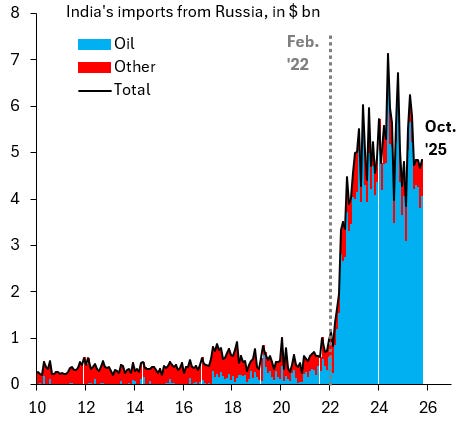
We’ve all heard the stories about how India starting importing lots of Russian oil right after the invasion. I hadn’t actually looked at the numbers until yesterday and they’re staggering. India’s imports from Russia in the first 10 months of 2025 were up almost 900 percent from the same period in 2019, which is a good baseline for where “normal” trade was prior to all the noise from COVID and then the run-up to the invasion.
The chart above shows monthly data on imports from Russia by India’s Ministry of Commerce and Industry. The rise in imports from Russia began immediately after the invasion in February 2022 and was massive. The US in August 2025 put an additional 25 percent punitive tariff on India, on top of the 25 percent reciprocal tariff that had been imposed earlier in the year. In data through October 2025, there’s no indication that this punitive tariff produced any kind of fall in imports of Russian oil. Instead, it looks like it was business as usual, which may be why the US then sanctioned Russia’s two largest oil producers – Rosneft and Lukoil – in November. We don’t yet have data on India’s oil imports through the end of the year, but the sharp fall in Urals oil price suggests that the stigma of buying Russian oil rose sharply after those sanctions, so it’s likely they scared off Indian buyers to a significant degree.
How significant were imports from Russia in terms of India’s overall imports? The chart above shows total imports, which in the first 10 months of 2025 averaged $12.5 bn per month. Imports from Russia during this period were $4.4 bn, i.e. imports from Russia accounted for around 35 percent of India’s total oil import bill. US sanctions on Rosneft and Lukoil will have put a very substantial dent in this, which the Trump administration deserves genuine kudos for because this – via the fall in Urals oil price – is materially disrupting the flow of hard currency into Putin’s war economy.
The audio version of this article is generated by AI-based technology. Mispronunciations can occur. We are working with our partners to continually review and improve the results.
The Ontario government is introducing new rules for publicly advertised job postings in the new year, but questions remain over whether the changes will result in tangible benefits for jobseekers.
Changes under the Employment Standards Act come into effect on Jan, 1, 2026, and will apply to employers with more than 25 workers.
Among the changes, employers will be required to post information about compensation for any advertised position. If a salary range is posted, it must be within $50,000 a year or less.
Employers will be required to disclose whether artificial intelligence is used during the hiring process.
They’ll also be prohibited from asking for Canadian work experience in any job posting and will be required to inform applicants whether a hiring decision has been made within 45 days of the last interview.
Kathryn Tremblay is the owner of Altis Recruitment, a staffing firm working across Canada. She applauded the Ontario government for seeking to increase transparency and equity in the hiring process but questioned whether the changes would have the desired impact.
British Columbia introduced a requirement to include wage details on all public job ads in 2023 with a view toward improving pay equity.
Since then, B.C. has reported “modest” success in closing the gender wage gap, with a report this year showing a two-per-cent decrease in pay inequality between men and women.
“So there’s a little bit of a gain, but we haven’t seen it really close the pay gap there,” said Tremblay, who predicted similar “marginal gains” from Ontario’s new rule on posting expected compensation.
“I really am happy that the government is seeking to cause more pay transparency. I just don’t know if it’s going to have the desired effect,” she said.
In particular, allowing a band of up to $50,000 could diminish the information value of a posted salary. “It worries me that it’s such a broad range,” she said.
Similarly, she doubted whether the notification about the use of artificial intelligence in recruiting will allay concerns about whether the new technology could introduce hidden bias into the recruitment process.
“The problem is that all the employers are all going to say the same thing: ‘We are using AI in some format to screen a select candidates and a human will call you to do an interview,’” she explained.
With unemployment rising in Ontario, Tremblay worries the new regulations could be onerous for employers.
“I’m seeing all employers scrambling to get this in place,” she said. “I think it would have been great if this would have been implemented a few years ago, but right now, at a time when we all need to be focused on increasing revenue and maximizing our high performance and upskilling our candidates and our our employees on AI…the timing isn’t great.”
More information about the changes is available here.
Meta adjusting teen-focused policies to draw young users back to Instagram
In a bid to recapture its lost young user segment on Instagram, tech giant Meta is reportedly adjusting its teen policies
The renewed strategy to draw young social media users comes after signs of a deadline in growth and weaker engagement in key markets.
Internal planning documents pointed to a long-term strategy focused on reversing declines in teen sign-ups, particularly in wealthier regions where TikTok and YouTube are now dominating.
Teen growth has always been considered as a top priority, with teams encouraged to fine-tune recommendation systems and revamp youth-oriented features to make Instagram feel relevant rather than routine, as per TechJuice.
Another factor behind this move is mounting pressure from regulators. More than 40 US states have sued Meta, accusing the company of harming young users.
Lawmakers are also advancing youth safety rules that are expected to transform how minors access social media. New York, for example, now requires mental health warnings on platforms that rely on features such as infinite scroll, autoplay and algorithmic ranking.
Meta has highlighted stronger protections for teenagers. These include default “teen account” settings that make profiles more private, restrict direct messages, and reduce exposure to sensitive content.
The company has also strengthened its crackdown on harmful behaviour. At the same time, reports are hinting Meta tried to frame its teen content approach using a “PG-13” style analogy, a move that drew criticism for borrowing established rating language.
Researchers at Lomonosov Moscow State University have developed and tested a 72-qubit atom-based quantum computing prototype using neutral rubidium atoms, according to TASS.
The system introduces a new three-zone architecture separating computation, quantum state storage, and readout, with current experiments using two of the three zones.
Tests show two-qubit gate accuracy of 94%, with researchers aiming to scale toward hundreds of high-fidelity qubits by 2030 to enable error-corrected quantum operations.
Photo from Pexels by Сергей Велов.
According to TASS reporting, researchers from the Physics Department at Lomonosov Moscow State University have developed and tested a prototype quantum computer based on single neutral rubidium atoms, reaching 72 qubits. Rosatom Quantum Technologies said this marks the third Russian quantum computer to surpass the 70-qubit threshold.
As TASS reports, Yekaterina Solntseva, Director of Quantum Technologies at Rosatom State Corporation, said: “Reaching the 72-qubit mark on an atom-based platform confirms the systematic development of the domestic quantum project and our strong position in quantum research and the creation of quantum computer prototypes. It is especially important that the scientists have taken another step toward progressively improving the reliability of operations.”
Solntseva emphasized that lowering error rates in quantum logic operations is essential for expanding quantum computing capabilities to levels required for solving complex problems in areas such as industry and finance. She also noted that this progress supports Russia’s technological sovereignty and the competitiveness of its economy.
TASS further reports that the new atom-based quantum prototype uses a new architecture that divides quantum registers into three zones. Stanislav Straupe, head of the quantum computing sector at the Quantum Technology Center at Moscow State University, said one zone is dedicated to computations, while the other two are designed for long-term quantum state storage and information readout.
According to TASS, only the computing and storage zones were used in the current experiments, with development of the third zone planned for the next stage. Straupe stated that reaching several hundred high-fidelity qubits by 2030 would enable logical operations with error correction and allow algorithms that are no longer solvable using classical computers.
Experiments show the prototype can perform two-qubit logical operations with 94% accuracy, TASS reports. Vladimir Belokurov, Dean of the Physics Department at Moscow State University, said the project involves not only senior researchers but also young scientists, graduate students, and undergraduates, helping engage the next generation in one of Russia’s major scientific initiatives.
This reporting is based on statements and data published by TASS, Russia’s state-owned news agency, and affiliated institutions. The reported qubit count, system design, and performance metrics have not been independently verified through peer-reviewed scientific publication or third-party validation.
Simply sign up to the Chinese economy myFT Digest — delivered directly to your inbox.
China’s industrial profits fell at their fastest pace in more than a year last month, as Xi Jinping’s economic planners struggled to contain the fallout from industrial overcapacity and lacklustre consumer confidence.
Profits at industrial companies with annual revenues of more than Rmb20mn ($2.8mn) fell 13.1 per cent in November compared with a year earlier, data from the National Bureau of Statistics showed on Saturday, deepening from a 5.5 per cent decline in October.
The November slump brought profit growth for the year to date down to 0.1 per cent above the same period in 2024, down from 1.9 per cent growth in the January-to-October period.
China’s economy has struggled to find long-term drivers of strong growth in the wake of the collapse of the debt-fuelled property sector, which is now entering its fifth year of crisis.
While China has relied on exports of low-cost goods to boost headline growth, the world’s second-biggest economy has been wracked by deflationary pressure, weak domestic demand and falling investment. The producer price index has been mired in negative territory for three years.
The latest factory data highlights the challenge for Chinese policymakers to boost confidence among the country’s companies and consumers, despite a truce in the US-China trade war and a boom in high-tech manufacturing exports.
Yu Weining, NBS chief statistician, said China’s economy faced “structural adjustment pressures” as it transitioned from “old to new” growth drivers, adding that the international environment was also marked by “many unstable and uncertain factors”.
The central government in Beijing has long resisted calls from economists — both inside and outside China — to unleash broad-based stimulus and roll out deep social security reforms to boost sentiment and kick-start the economy.
It has also increasingly taken aim at what authorities call neijuan, or “involution” — excessive industrial competition that they blame in part for overproduction that is driving down prices.
In an article published in Qiushi, the flagship magazine of the Communist party’s central committee, Xi this month urged officials to work more urgently to address the problem of insufficient domestic demand.
“Expanding domestic demand is related to both economic stability and economic security; it is not an expedient measure but a strategic move,” he said.
Xi also reiterated calls for officials and companies to exercise more discipline over investments, following earlier criticism of industrial over-investment, which has resulted in brutal price wars and unfair supplier treatment.
Earlier this month, the NBS reported that fixed asset investment declined 2.6 per cent for the January-November period on a year earlier. Retail sales, seen as an indicator of household demand, expanded 1.3 per cent in November on a year earlier, the slowest pace of growth since December 2022. Both data points were below analysts’ expectations.
The latest NBS data highlighted some bright spots in China’s manufacturing industries. High-tech manufacturing and the auto industry posted year-on-year improvements of 10 per cent and 7.5 per cent, respectively.
The University of the Philippines joins the nation in mourning the passing of Diosdado Banatao (1946–2025).
A towering figure of Filipino excellence, Dado Banatao’s life and work made a lasting impact on the nation. Through his remarkable achievements in technology and his steadfast commitment to education and innovation, he inspired generations of Filipinos to pursue excellence with purpose.
His support for the University of the Philippines reflected a deep belief in the power of knowledge to uplift lives and strengthen the country. We honor Dado Banatao for his enduring contributions, his generosity of spirit, and his dedication to nation-building.