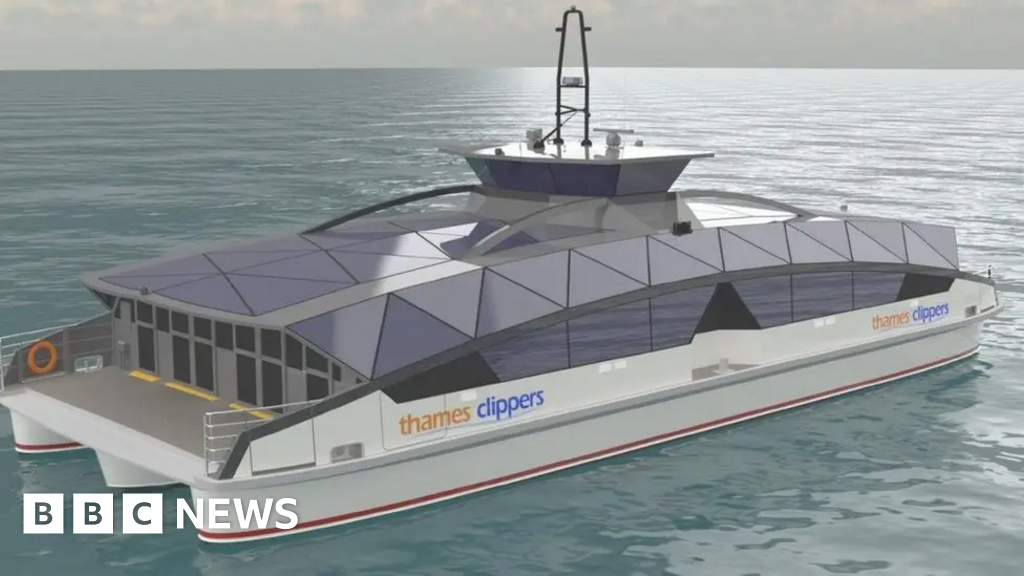
A fully electric passenger ferry has been launched on the River Thames.
The Orbit Clipper, which will will plug in and charge overnight, will carry passengers between Canary Wharf and Rotherhithe every 10 minutes.
After being progressively phased into operation, the 150-passenger boat, with capacity for 100 bicycles, will cross the river every 10 minutes from each side on weekdays and every 15 minutes on weekends.
Project leaders said the ferry went towards the target of reducing carbon emissions by 50% by 2035 and achieving net zero by 2050.
Mayor of London Sir Sadiq Khan said: “This is a fantastic new transport option for Londoners – not only cleaner and greener than its predecessor, but providing quicker and more accessible journeys across the river for far more people.
“Innovation and investment in travel infrastructure like this will help us navigate the challenges facing our environment and our economy as we continue building a fairer, greener, better London for everyone.”
The new vessel comes ahead of London hosting the World Triathlon Championship Series next July.
Ruth Daniels, CEO at British Triathlon, said the new boat would offer “a unique and efficient route to the start line” for competitors.
She added: “With space for up to 100 bikes, the Orbit Clipper gives triathletes, commuters, tourists and anyone traveling across London a greener, more convenient way to get around.”
Elon Musk’s social media platform, X, has been fined €120m (£105m) after it was found in breach of new EU digital laws, in a ruling likely to put the European Commission on a collision course with the US billionaire and potentially Donald Trump.
The breaches, under consideration for two years, included what the EU said was a “deceptive” blue tick verification badge given to users and the lack of transparency of the platform’s advertising.
The commission rules require tech companies to provide a public list of advertisers to ensure the company’s structures guard against illegal scams, fake advertisements and coordinated campaigns in the context of political elections.
In a third breach, the EU also concluded that X had failed to provide the required access to public data available to researchers, who typically keep tabs on contentious issues such as political content.
The ruling by the European Commission brings to a close part of an investigation that started two years ago.
The commission said on Friday it had found X in breach of transparency obligations under the Digital Services Act (DSA), in the first ruling against the company since the laws regulating the content of social media and large tech platforms came into force in 2023.
In December 2023, the commission opened formal proceedings to assess whether X may have breached the DSA in areas linked to the dissemination of illegal content and the effectiveness of the measures taken to combat information manipulation, for which the investigation continues.
Under the DSA, X can be fined up to 6% of its worldwide revenue, which was estimated to be between $2.5bn (£1.9bn) and $2.7bn in 2024.
Three other investigations remain, two of which relate to the content and the algorithms promoting content that changed after Musk bought Twitter in October 2022 and rebranded it X.
The commission continues to investigate whether there have been breaches of laws prohibiting incitement to violence or terrorism.
It is also looking into the mechanism for users to flag and report what they believe is illegal content.
Senior officials said the fine broke down into three sections: €45m for introducing a “verification” blue tick that users could buy, leaving others unable to determine the authenticity of account holders; €35m for breaches of ad regulations; and €40m for data access breaches in relation to research.
Before Musk took over Twitter, blue ticks were only awarded to verifiable account holders, including politicians, celebrities, public bodies and verified journalists in mainstream media and established new media, such as bloggers and YouTubers. After the takeover, users who subscribed to X Premium were then eligible for blue tick status.
Henna Virkkunen, who is the executive vice-president at the European Commission responsible for tech regulation, said: “With the DSA’s first non-compliance decision, we are holding X responsible for undermining users’ rights and evading accountability.
“Deceiving users with blue checkmarks, obscuring information on ads and shutting out researchers have no place online in the EU.”
The ruling risks enraging Trump’s administration. Last week the US commerce secretary, Howard Lutnick, said the EU must consider its tech regulations in order to get 50% tariffs on steel reduced.
skip past newsletter promotion
after newsletter promotion
His threats were branded “blackmail” by Teresa Ribera, the EU commissioner in charge of Europe’s green transition and antitrust enforcement.
Senior EU officials said the ruling was independent of any pleadings by the US delegation in Brussels last week to meet trade ministers. They said the EU retained its “sovereign right” to regulate US tech companies, with 25 businesses including non-US companies such as TikTok coming under the DSA.
Musk – who is on a path to become the world’s first trillionaire – has 90 days to come up with an “action plan” to respond to the fine but ultimately he is also free to appeal against any EU ruling, as others, such as Apple, have done in the past, taking their case to the European court of justice.
At the same time, the EU has announced it has secured commitments from TikTok to provide advertising repositories to address the commission concerns raised in May about transparency.
The DSA requires platforms to maintain an accessible and searchable repository of the ads running on their services to allow researchers and representatives of civil society “to detect scams, advertisements for illegal or age-inappropriate”.
Senior officials said the phenomenon of fake political adverts or ads with fake celebrities cannot be studied unless the social media companies stick to the rules.
X has been approached for comment. The EU said the company had been informed of the decision.
Getting safety ‘right’ before automated vehicles (AVs), and their operating systems, are approved for road use and ensuring ongoing in-use safety are key goals in defining the necessary regulatory framework for AV deployment.
Both are at the heart of the latest development from the government, this being a call for evidence issued on 4 December 2025 and open for responses until 5 March 2026. The new document is divided into two chapters covering each of these key goals and a series of associated technical matters summarised (non-exhaustively) below.
All are significant and important issues. The description, at a recent motor insurance market meeting, of the call for evidence as a “mega-consultation” is far from an understatement. This “mega-consultation” label is reinforced by the government’s document running to 79 pages and asking 125 questions.
Chapter 1: “Getting AVs on the Road”
Type Approval: AVs will be required to meet technical and safety standards aligned with international (UNECE) regulations.
Authorisation requirements: These will ensure AVs can operate safely and legally without a driver. Each AV must be backed by an Authorised Self-Driving Entity (ASDE) responsible for safety and regulatory compliance throughout its lifecycle. ASDEs will be subject to authorisation requirements.
User-in-Charge (UIC): This refers to the ‘disengaged driver’ while the AV is driving itself. The requirements here will define the UIC’s responsibilities, including transition demands and training requirements.
No-User-in-Charge (NUIC) Licensing: Conditions will regulate operators running passenger services using vehicles without onboard safety ‘drivers’. Fully autonomous buses and smaller pod-style vehicles are typical use cases.
Insurance and data access: Existing legislation requires motor insurers to cover both conventional and automated driving. The call for evidence focuses on key questions around access to data stored in the vehicle’s Automated Driving System (ADS) to enable claims adjusting and subrogated actions by motor insurers.
Chapter 2: “Once AVs Are on the Road”
In-Use Regulatory Scheme (IURS): Requirements here will provide ongoing oversight and compliance monitoring – in respect of the ADS, with the keeper remaining responsible for general roadworthiness – and allow for enforcement via civil and regulatory sanctions.
Incident Investigation: Independent statutory inspectors will investigate AV-related incidents under a no-blame framework to improve road safety. This activity could be closely modelled on that of the existing rail and maritime investigation branches.
Cyber Security: Requirements will be developed to align with UN Regulations 155 and 156, addressing risks from connectivity and remote operations. Given that thousands of connected vehicles are already on the roads – although they are all conventional vehicles – it follows that some of the potentially systemic cyber risks arising from vehicle connectivity are already present in the current driving eco-system. Whether these are fully understood / evaluated is another matter.
Accessibility & Environment: Seeks evidence on inclusive design and environmental impacts, including end-of-life considerations.
What happens next?
The call for evidence runs (following consultations in the summer as analysed here) until 5 March 2026, inviting responses from industry stakeholders – which will of course include insurers and vehicle manufacturers – academics, road users, and accessibility groups. The responses received will inform future regulations to ensure the regulatory regime legal governing AV deployment is safe, equitable, and sustainable.
The government has already referred to the necessary secondary regulations on matters set out in chapters 1 & 2 as the “main regs” for automated driving. All these “main regs” will be made under powers set out in the Automated Vehicle Act 2024.
An AV timetable released by government earlier in the year envisaged the call for evidence on these “main regs” concluding by the end of 2025, with the next step towards implementing the “main regs” being a consultation on draft provisions in the second half of next year. This still feels like a realistic timetable despite the call for evidence emerging perhaps later than initially planned.
Initial concluding thoughts
The issues covered here are important for insurers interested in the development of AVs. That is not just all motor insurers – because cover for automated driving will be compulsory – but also casualty carriers offering product liability and cyber-related policies to manufacturers and software developers who will potentially be the ASDEs in the new regulatory framework.
The approach to access to data by insurers could be among the most controversial points. The way forward, whether mandatory or otherwise, will require a careful balance of the interests of insurers and the importance to manufacturers of commercial confidentiality as well as respecting data protection principles.
The purpose of this article is only to provide a high-level summary and we propose to address the detail of the chapters in further articles and events. Please contact any of the authors or your usual Clyde & Co contacts if you would like further information.
The first project in a council scheme to convert derelict hotels into rental homes has been completed.
Brampton Court in the seaside resort of Torquay has been redeveloped into 14 energy-efficient one and two-bedroom apartments.
Torbay Council, which came up with the scheme, said the apartments would be “let at social rents to local households” with the first tenants expected to move in before Christmas.
The council has acquired a second site in Torquay at the Seabury Hotel and said construction there was due to start in the middle of 2026.
There are about 1,600 people on the housing waiting list in the Torbay area of Torquay, Paignton and Brixham.
The council said it wanted to convert “small, prominent and under-used brownfield sites” in the area “such as unviable former hotels, guesthouses and bed and breakfasts”.
Torbay Council said it believed its scheme was the “first of its kind in England” to specifically convert former hotel accommodation to be let as council homes.
Alan Tyerman, Torbay Council’s cabinet member for housing and finance, said: “What has been achieved is excellent and proves that we can deliver the homes we need and protect our precious green spaces.”
Tyerman said the new homes would be “a wonderful Christmas present” for new residents and marked “a significant milestone as we deliver on our ambition to provide more affordable homes in Torbay”.
The new homes at Brampton House are being allocated through Devon Home Choice to households that can prove a local connection to Torbay.
Maersk to trial 50/50 ethanol-methanol blend on the vessel Laura Mærsk
Initial E10 test confirmed safe integration and strong performance
Ethanol offers another scalable, lower emission fuel option for decarbonisation
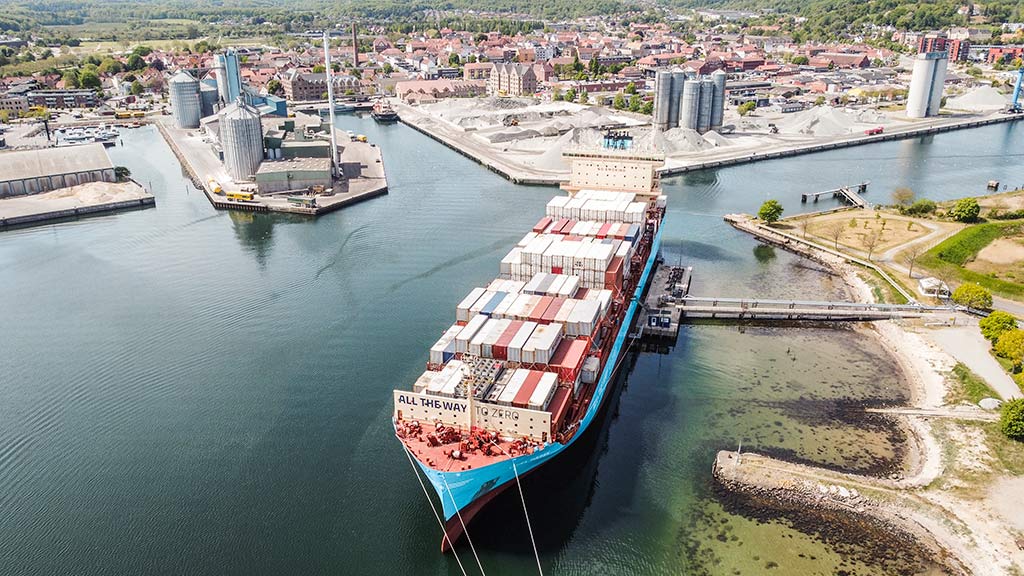
Copenhagen, Denmark – Maersk continues to explore options to diversify its low-emission fuel portfolio by testing ethanol in a dual-fuel methanol engine. Building on a successful initial trial, the company will now blend 50% ethanol with 50% methanol in a test onboard the vessel Laura Mærsk.
The first trial, conducted in October and November, involved a 10% ethanol / 90% e-methanol blend and confirmed that ethanol can be safely and effectively integrated into the fuel mix. The test underscores the potential to create greater optionality for Maersk’s dual-fuel methanol fleet, essentially enabling dual fuel alcohol vessels.
At Maersk, we believe multiple fuel pathways are essential for the shipping industry to meet its climate ambitions. That means consciously exploring different options and technologies.
Laura Mærsk, the world’s first dual-fuel container vessel operating on methanol, was designed for methanol as the alternative fuel. Because ethanol and methanol are both alcohols, they share similar properties. The initial trial tested whether an E10 blend would ignite and burn as efficiently as pure methanol while maintaining comparable lubricity and corrosiveness.
The results confirm that ethanol can be blended with methanol without compromising engine performance, paving the way for higher ethanol blends. Beyond the upcoming E50 test, Maersk plans to conduct a trial using 100% ethanol.
Ethanol has a proven track record with an established market and existing infrastructure and offers an additional pathway for decarbonisation. By gradually increasing ethanol content, we gain valuable insights into engine performance and combustion impacts, informing fuel sourcing potential.
About ethanol:
The ethanol applied for the tests is so-called anhydrous ethanol, the same type of ethanol currently applied for blending into gasoline in several countries around the globe.
The US is the largest ethanol producer in the world, followed by Brazil. The two comprise 80% of the World market.
Collaboration with stakeholders and partners like engine manufacturers is key to supporting the exploration of ethanol as a fuel for dual fuel vessels.
As there already is a strong ethanol market, it offers optionality towards delivering on Maersk’s climate targets.
Ethanol is produced from biomass such as corn or sugar cane.
It is important to ensure that the specific type of ethanol used does not directly or indirectly contribute to land conversion and deforestation and does not compete with food and feed.
Maersk is in the process of assessing the potential role of selecting first-generation, crop-based fuels such as ethanol in our transitional fuel mix. This review is being conducted under robust sustainability criteria covering lifecycle greenhouse gas emissions, traceability, certification standards, and responsible sourcing practices.
To future-proof its fleet, Maersk in 2021 decided to exclusively order vessels with dual fuel capabilities. By 2025, 19 dual fuel vessels will be operating in the Maersk fleet. The current low-emission fuel portfolio includes bio- and e-methanol, biodiesel, and from 2027, liquefied biomethane, and LNG as the fossil alternative, will be added with the arrival of time-chartered dual fuel LNG vessels.
See this video below explaining our first test, the 10% ethanol trial:
Gates Cambridge is seeking a Community Platform Officer to strengthen connections across our global community.
The Gates Cambridge mission is to build a global network of future leaders committed to improving the lives of others. We achieve this mission by selecting outstanding scholars from countries outside the UK and providing them with full-cost scholarships to pursue postgraduate degrees in any subject available at the University of Cambridge.
Gates Cambridge Scholars become part of a lifelong global community defined by its core value of commitment to improving the lives of others through leadership. Alongside the 250 or so Scholars who are studying in Cambridge at any point in time, there are over 2000 Scholars in the alumni section of the community, and this number grows every year.
The Gates Cambridge Trust, which was established in 2000 with a generous gift from the Gates Foundation, manages the Gates Cambridge Scholarship and a programme of events and activities for Scholars. The endowment has grown to almost £350 million (2024).
At the Trust, we are a small, friendly and diverse group of colleagues who are dedicated to delivering the Gates Cambridge mission while creating a welcoming and enjoyable working environment.
Purpose of the role
To strengthen connections across the global community of Gates Cambridge Scholars, the Gates Cambridge Trust is developing a digital community platform that enables Scholars to engage with one another and stay connected to Trust. The Trust seeks someone who enjoys working with technology and people; someone curious, adaptable, and excited about helping build a thriving global online community.
The Community Platform Officer will play a central role in supporting the daily operation, development, and engagement of this platform. The postholder will work closely with the Global Engagement Manager, Communications Officer, and the platform vendor to ensure the platform remains relevant and continues to facilitate connections across the global Gates Cambridge Scholar community.
The postholder will provide day-to-day support for the digital community platform, help deliver digital engagement activities that connect Scholars, ensure that content is accurate and engaging and that user queries are resolved promptly, and data remains accurate and up-to-date.
This position offers an excellent opportunity to gain hands-on experience in digital engagement, communications, and community management within a small, diverse and supportive team.
Main Responsibilities
Platform management and support
Approve new member registrations and maintain accurate user data.
Monitor and help moderate online discussions, groups, and events to ensure a positive user experience and adherence to community guidelines.
Upload and update resources, announcements, and other materials on the platform.
Troubleshoot user and technical issues, liaising with the supplier and the Global Engagement Manager where required.
Test and review new platform features and updates, providing timely feedback and suggestions for improvement.
Produce regular analytics and engagement reports for internal review.
Content and communications
Support the preparation and scheduling of digital content, including posts, and newsletters for the platform.
Assist with the creation of campaigns that highlight community initiatives and opportunities.
Ensure that communications are accessible, accurate, and consistent with the organisation’s tone and branding.
Collaborate with colleagues to align platform content with broader engagement and communications strategies.
Community engagement
Help to establish and maintain groups, mentoring schemes, and regional or thematic initiatives within the platform.
Respond to user enquiries and provide timely, helpful guidance.
Encourage participation and explore creative approaches to building online engagement.
Continuous improvement
Identify opportunities to enhance user experience, streamline processes, and increase engagement.
Stay informed about trends and best practice in digital community building and alumni relations.
Contribute to wider team projects and initiatives as required.
The Trust actively supports equality, diversity and inclusion and encourages applications from all sections of society.
To apply for this role, you must submit a cover letter, CV, and names of two references. The deadline for applications is 9:00 a.m. on Monday 5January 2026.
For full details about the role, including how to apply, please see the candidate pack.
The paper discusses Bulgaria’s public investment needs and its efficiency and assesses prospects for accelerating economic growth and income convergence through scaling up quality public investment. Utilizing substantial EU grants to fund public investment offers Bulgaria a unique opportunity to finance important infrastructure projects without relying on debt. However, slow absorption of these grant funds and inefficiencies in public investment management remain significant challenges. The analysis highlights the critical role of efficient public investment in boosting productivity and fostering sustainable growth. Using the DIGNAR model calibrated to Bulgaria’s economy, simulations suggest that full EU funds absorption and improved public investment efficiency could boost GDP by 2.3 percent in 2030. The findings underscore the importance of steadfast reforms to accelerate EU fund absorption and improve efficiency, including through enhanced investment planning and procurement processes, to boost growth.
Subject: Econometric analysis, Expenditure, General equilibrium models, Income, Infrastructure, National accounts, Public investment spending
Keywords: Bulgaria, DIGNAR model, dynamic general equilibrium modelling, economic growth, EU funds, General equilibrium models, Income, Infrastructure, public investment, Public investment spending