Category: 3. Business

  • Morning Mail: water challenge for AI revolution, Labor weighs gas reserve options, Starc sublime but England have edge | Australia news

    Morning Mail: water challenge for AI revolution, Labor weighs gas reserve options, Starc sublime but England have edge | Australia news

    Morning everyone. The challenges of the AI revolution are highlighted by our lead story this morning as experts warn about the huge amount of water needed to cool datacentres crucial to the new tech.

    The Albanese government is being urged to take on the big gas producers and secure a better deal for Australians for east coast reserves, we have the intriguing tale of “Bitcoin Rodney” and an alleged Ponzi scheme, and England actually manage to bat all day at the Gabba despite another six wickets for Mitchell Starc.

    Australia

    A computerised image of the proposed Hobart stadium. Illustration: PR IMAGE
    • Deal for the Devils | A contentious $1.13bn AFL stadium has been given the official tick of approval by Tasmania’s parliament to pave the way for the Devils to enter the AFL and AFLW.

    • Thirsty work | Australia is riding the AI boom with dozens of new investments in datacentres in Sydney and Melbourne, but experts warn the massive projects will put new demands on strained water resources. Sydney’s facilities alone will need more than Canberra’s entire drinking water supply.

    • Gas plea | Unions and manufacturers want the Albanese government to stare down the gas giants as it designs a new gas reservation scheme.

    • Nauru hunger | Asylum seekers sent to Nauru by Australia say they are going hungry on the island because they are banned from working and receive only $115 a week for food despite very high prices.

    • ‘Bitcoin Rodney’ | An American promoter of an alleged global $3bn Ponzi scheme claims in newly filed US court documents he was trapped by an “elaborate” fraud orchestrated by an Australian, Sam Lee, and should be released from custody.

    World

    Protesters call for the ouster of RFK Jr. Photograph: Andrew Caballero-Reynolds/AFP/Getty Images
    • ‘Killed more than it saved’ | America’s top vaccines official has promised to revamp regulation after claiming without evidence that it had “killed more than it saved”. It comes after turmoil at US health agencies under the leadership of Robert F Kennedy Jr.

    • Song contest | Four countries say they will boycott the Eurovision song competition next year after organisers gave Israel the all-clear to compete.

    • Ukraine ‘betrayal’ | Emmanuel Macron has warned European leaders that “there is a chance that the US will betray Ukraine on territory”, according to German magazine Der Spiegel, quoting a leaked note from a recent call. US envoy Steve Witkoff meets Ukraine’s security chief in Miami.

    • Fortunes fuelled | Two fossil-fuel billionaires with close ties to Donald Trump bought millions of shares in the company they co-founded just days after a meeting with senior White House officials.

    • ‘Woke bubble’ | A restrictive sex education bill backed by Giorgia Meloni’s far-right government and intended to crack down on “gender ideology and the woke bubble” has provoked fury in Italy.

    Full Story

    Illustration: Guardian Design

    Newsroom edition: the dangers of automated governance

    As NDIS executives confirm most claimants will no longer be able to appeal against their plans, Bridie Jabour speaks to the editor, Lenore Taylor, the head of newsroom, Mike Ticher, and deputy editor Patrick Keneally about what happens when you take the human out of human services, and if the government has learned any lessons from robodebt.

    Full Story

    Newsroom edition: the dangers of automated governance

    In-depth

    Sunset in Adelaide, where a total fire ban is in place. Photograph: Amer Ghazzal/Shutterstock

    The warnings about a heatwave this weekend and bushfires ripping through parts of Tasmania might not sit with forecasters’ predictions that Australia is in the grip of a La Niña cycle this summer. This pattern brings typically wetter and cooler weather, so why is it tracking to be hotter than expected over the coming months? Graham Readfearn, our environment and climate correspondent, explains what’s going on.

    Not the news

    Toni Lamond died aged 93 this week. Photograph: Gaye Gerard/Getty Images

    Toni Lamond, who died this week aged 93, was a giant of the Australian stage as a vaudevillian of the Tivoli circuit, star of musicals such as Anything Goes, and a TV and variety show regular. Cassie Tongue remembers how, after seeing an old VHS tape of Lamond in The Pirates of Penzance, she “fell in instant, dizzying love”.

    skip past newsletter promotion

    Sport

    Joe Root and Jofra Archer leave the field after day one of the Second Test. Photograph: Philip Brown/Getty Images

    A Gold Coast school principal has told the Bulletin that he fears for children’s safety when they are riding e-bikes. Fire crews in Tasmania are battling 12 out of control fires wreaking havoc in the state’s south and east, the Mercury reports. The death of business tycoon Richard Collins has sparked a battle over his Jarvis Group fortune between his widow and his children, the Adelaide Advertiser claims.

    What’s happening today

    • Politics | Mention at supreme court over legal challenge of Victorian Liberals’ $1.55m loan to former leader.

    • Melbourne | Federal court family violence prevention forum.

    • Northern Territory | Inquest into death of disabled inmate who had seizure.

    Sign up

    If you would like to receive this Morning Mail update to your email inbox every weekday, sign up here, or finish your day with our Afternoon Update newsletter. You can follow the latest in US politics by signing up for This Week in Trumpland.

    Brain teaser

    And finally, here are the Guardian’s crosswords to keep you entertained throughout the day. Until tomorrow.


    Continue Reading

  • NTT DATA Named a Leader in Everest Group’s Application Development Services for AI Applications PEAK Matrix® Assessment 2025 Report

    NTT DATA Named a Leader in Everest Group’s Application Development Services for AI Applications PEAK Matrix® Assessment 2025 Report

    December 5, 2025

    NTT DATA Group Corporation

    TOKYO – December 5, 2025 – NTT DATA, a global leader in AI, digital business and technology services, today announced it has been named a Leader by Everest Group in its Application Development Services for AI Applications PEAK Matrix® Assessment 2025 report (PDF : 743KB).

    The report recognizes NTT DATA as a leading AI applications service provider, assessed based on its capabilities, investments and demonstrated success in building and scaling AI-infused applications. Specifically, it highlighted the company’s robust portfolio of AI-infused development services across major industries such as healthcare, insurance, manufacturing and financial services.

    “We are driven by a bold vision to harness the transformative power of AI and deliver impactful business outcomes that propel our clients toward their most ambitious goals. This recognition reaffirms our dedication in empowering businesses to thrive in an AI-driven future” said Amir Durrani, Global Head of Applications and Business Process Services, NTT DATA, Inc.

    “The recognition from Everest Group validates our ability to deliver AI-powered application development at scale across key industries, leveraging our proprietary solutions like the aXet platform and advanced AI-integrated assets. The report highlights our strengths in end-to-end development, global delivery, and the One NTT initiative, enhancing our position as a trusted partner for enterprise transformation. This achievement reinforces NTT DATA’s reputation for innovation and operational excellence, positioning us for new growth opportunities as clients accelerate their adoption of intelligent, business-aligned AI solutions.”

    Everest Group identified NTT DATA’s AI-first approach to software design and development as a strength, leveraging its aXet platform to support GenAI and agentic workforce which is now used by 40% of its engineers. The platform integrates advanced AI assets to support the full lifecycle of application development, positioning it as a key differentiator in the market.

    The report also highlighted NTT DATA’s One NTT initiative, which enhances its global delivery capabilities and technical depth, allowing it to serve as a trusted, end-to-end development and operations partner. This has allowed clients to accelerate innovation and reduce operational complexity. Its leadership position is further strengthened by its comprehensive AI engineering and consulting expertise, deep industry integration and sustained investments in reusable intellectual property, partner ecosystems and scalable development frameworks.

    “NTT DATA has been positioned as a Leader in Everest Group’s Application Development Services for AI Applications PEAK Matrix® Assessment 2025 for its strong technical capabilities and mature AI solutions portfolio,” said Manukrishnan SR, Practice Director at Everest Group. “The firm brings proven experience in delivering AI-powered application development services across key industries such as healthcare, insurance, manufacturing, and financial services. It’s portfolio of proprietary tools and solutions, including its aXet platform, embed advanced AI capabilities to support the entire application development cycle —from design to deployment— enabling faster, more scalable outcomes for clients looking to operationalize AI within their core systems.”

    The Application Development Services for AI Applications PEAK Matrix® Assessment 2025 assessed 35 application development services providers against four pillars of strengths to create actionable and insightful research for the industry. Leaders stood out for their robust partner ecosystems, including hyperscalers, large language models (LLM) providers and enterprise software providers, as well as their ability to deliver complex AI applications at scale across geographies.

    For more information, find the full report here.

    About NTT DATA

    NTT DATA is a $30+ billion business and technology services leader, serving 75% of the Fortune Global 100. We are committed to accelerating client success and positively impacting society through responsible innovation. We are one of the world’s leading AI and digital infrastructure providers, with unmatched capabilities in enterprise-scale AI, cloud, security, connectivity, data centers and application services. Our consulting and industry solutions help organizations and society move confidently and sustainably into the digital future. As a Global Top Employer, we have experts in more than 70 countries. We also offer clients access to a robust ecosystem of innovation centers as well as established and start-up partners. NTT DATA is part of NTT Group, which invests over $3 billion each year in R&D.
    Visit us at nttdata.com

    About Everest Group

    Everest Group is a leading global research firm helping business leaders make confident decisions. Everest Group’s PEAK Matrix® assessments provide the analysis and insights enterprises need to make critical selection decisions about global services providers, locations, and products and solutions within various market segments. Likewise, providers of these services, products, and solutions, look to the PEAK Matrix® to gauge and calibrate their offerings against others in the industry or market. Find further details and in-depth content at www.everestgrp.com

    Disclaimer

    Licensed extracts taken from Everest Group’s PEAK Matrix® Reports, may be used by licensed third parties for use in their own marketing and promotional activities and collateral. Selected extracts from Everest Group’s PEAK Matrix® reports do not necessarily provide the full context of our research and analysis. All research and analysis conducted by Everest Group’s analysts and included in Everest Group’s PEAK Matrix® reports is independent and no organization has paid a fee to be featured or to influence their ranking. To access the complete research and to learn more about our methodology, please visit Everest Group PEAK Matrix® Reports.

    Continue Reading

  • Steelmaking decarbonisation: Transition to new pathways, progress and industry insights – BHP

    1. Steelmaking decarbonisation: Transition to new pathways, progress and industry insights  BHP
    2. Smart resource processing  Australian Research Council
    3. How Australia can lead the global transition to green iron  The World Economic Forum
    4. The green steel revolution is cancelled  MacroBusiness
    5. Routes to reducing emissions from steel production  Nature

    Continue Reading

  • China’s Nvidia Moore Threads surges over 400% on trading debut

    China’s Nvidia Moore Threads surges over 400% on trading debut

    An illustration photo shows Moore Threads logo in a smartphone in Suqian, Jiangsu Province, China on October 30, 2025.

    Cfoto | Future Publishing | Getty Images

    Shares of Moore Threads, a Beijing-based graphics processing unit (GPU) manufacturer often referred to as “China’s Nvidia,” soared by more than 400% on its debut in Shanghai following its $1.1 billion listing.

    The stock is currently trading at 584.98 yuan, over five times its IPO price of 114.28 yuan.

    As U.S. curbs tighten, an increasing number of Chinese chipmakers are pushing into the AI processor space.

    Newer players like Enflame Technology and Biren Technology have stepped in, aiming to capture a share of the billions in GPU demand no longer served by Nvidia. China has also been clearing more semiconductor IPOs in its drive for tech independence.

    This is a developing story, please refresh for updates.

    Continue Reading

  • Toyota Gazoo Racing Reveals New GR GT and GR GT3 – IMSA

    1. Toyota Gazoo Racing Reveals New GR GT and GR GT3  IMSA
    2. Toyota Unveils Concept LFA Supercar and It’s an Electric Vehicle  Bloomberg.com
    3. GR GT3 | GT3  TOYOTA GAZOO Racing
    4. Toyota GR GT Unveiled With 641-HP Twin-Turbo V8, And It Could Get Even More Powerful  Autoblog
    5. View Photos of the Lexus LFA Concept  Car and Driver

    Continue Reading

  • Mitigating Seasonal Impact of Agricultural Exports on Lao PDR Exchange Rate – ASEAN+3 Macroeconomic Research Office

    Mitigating Seasonal Impact of Agricultural Exports on Lao PDR Exchange Rate – ASEAN+3 Macroeconomic Research Office

    Agriculture exports play a significant role in the Lao PDR economy, and their seasonal cycles have inadvertently complicated the foreign exchange (FX) management of this small, landlocked nation of the ASEAN.

    Agricultural exports of Lao PDR have exhibited a seasonal cycle shaped by the country’s monsoon weather pattern — rising sharply during the dry season and harvest months from December to March, while slowing down during the rainy off-season from July to October. In recent years, this pattern has become more pronounced with growing exports of perishable products such as vegetables, cassava, and bananas (Figure 1).

    Strengthening kip during harvest season

    These seasonal export flows directly affect the exchange rate. At harvest time, limited storage and processing facilities prompt farmers to sell their produce quickly, leading to a surge in export receipts. Much of these earnings are converted into kip to meet domestic liquidity needs, boosting FX supply and strengthening the kip.

    In contrast, in the off-season, agricultural export receipts and FX inflows decline, exerting downward pressure on the kip. In recent years, while export earnings fall during the rainy months, import demand and external debt repayments remain high, intensifying FX pressures. A recent AMRO report shows that this co-movement is especially visible since 2021 for both the commercial bank rate and the parallel market rate of the kip (Figure 2).

    For the Bank of the Lao PDR (BOL), the seasonal cycles complicate its FX management. FX interventions were used in an attempt to smooth fluctuations, though their effectiveness has been constrained by the country’s limited reserves (Figure 3). Since 2022, the BOL has mandated FX conversion by exporters, while allowing a more flexible reference rate and launching the Lao Foreign Exchange platform to enable market-based trading among individuals and small businesses. These measures have helped stabilize the kip and narrow the gap between official and parallel market rates (Figure 4).

    Calibrating FX policy, diversifying exports

    While these measures have helped in stabilizing the kip, a more comprehensive policy package is needed to mitigate seasonal pressures from agricultural exports on the exchange rate.

    In the short term, the BOL should continue to calibrate its FX interventions carefully while prioritizing reserve buildup through effective enforcement of conversion requirements. The central bank is encouraged to maintain reference rate flexibility, hence allowing the commercial bank rate to be aligned with market conditions and avoiding the accumulation of imbalances and FX market pressures. Clear communication about seasonal FX patterns could also help anchor public expectations.

    Ongoing efforts to deepen the domestic money market—particularly the interbank market—through the issuance of BOL bills with different maturities to absorb excess kip liquidity and improve liquidity management are in the right direction. These measures can support exchange rate stability and smooth seasonal FX fluctuations.

    In the longer term, export diversification and agro-processing development are essential. Expanding storage and developing processing facilities would help spread agricultural export earnings more evenly throughout the year. Over time, diversifying the export base toward less seasonal exports such as manufacturing will generate more stable FX inflows and reduce external vulnerabilities.


    Continue Reading

  • Asian Stock Rally Falters Ahead of US PCE Data: Markets Wrap

    Asian Stock Rally Falters Ahead of US PCE Data: Markets Wrap

    (Bloomberg) — Asian equities fell following a lackluster session on Wall Street that weighed on tech stocks and bonds, with investors keenly awaiting the release of key US inflation data later on Friday.

    MSCI Inc.’s gauge of Asian shares fell as much as 0.7%, but was still on track for a second straight weekly gain. Japanese indexes led losses in the region after a strong rally in the previous session. US futures edged slightly higher after the S&P 500 climbed 0.1% on Thursday. The yield on 10-year Treasuries steadied after rising three basis points in the previous session.

    Federal Reserve officials will get a dated reading on their preferred inflation gauge, the personal consumption expenditures price index, on Friday. The September income and spending report — also delayed because of a government shutdown — is due to be released as well.

    The moves in markets underscore how risk sentiment remains fragile even as global stocks have rebounded in the past two weeks to be within 1% of a record closing high reached in late October. Those gains partly reflected easing concerns over tech valuations and confidence among traders that the Fed will deliver a 25-basis point interest-rate cut next week in its last meeting of the year.

    “Participants are consciously reducing risk exposure before a key data window,” said Dilin Wu, a strategist at Pepperstone Group. “Even with high odds, PCE still has the power to shift the market’s timing and confidence in the path of rate cuts.”

    Friday’s figures will include the PCE index and a core measure that excludes food and energy. Economists project a third-straight 0.2% increase in the core index. That would keep the year-over-year figure hovering a little below 3%, a sign that inflationary pressures are stable, yet sticky.

    In Asia, focus today will be on an interest-rate decision in India, where policymakers are having to weigh record low inflation against a plunging currency and 8%-plus economic growth. A majority of the 44 economists surveyed by Bloomberg expect the central bank to cut its benchmark repurchase rate by a quarter point to 5.25%.

    Meanwhile, shares of Moore Threads Technology Co., a Chinese artificial intelligence chipmaker, surged more than 450% in its Shanghai trading debut after raising 8 billion yuan ($1.1 billion) in the year’s second-largest onshore initial public offering.

    US Treasuries

    A measure of the dollar edged lower in Asia on Friday and was on course for its fourth weekly decline in five. Elsewhere, Bitcoin traded below $93,000 while silver extended its retreat from an all-time high seen earlier in the week. Gold also fell.

    US government bonds were sold off on Thursday as data showed signs of resilience in the jobs market. Applications for US unemployment benefits fell last week to the lowest in more than three years, indicating that employers are still largely holding onto workers despite a wave of recent layoffs.

    Separate data from Challenger, Gray & Christmas showed announced layoffs at US companies fell last month after surging in October, but were still the highest for any November in three years. Even so, bets on a Fed reduction remained intact.

    “There remain some negative payroll employment readings. But the US labor market is not collapsing based on timely data and reports that have leading indicator properties,” said Don Rissmiller at Strategas. “We continue to believe the Fed will cut the fed funds rate again by 25 basis points in December.”

    Policymakers will not yet have the government’s November jobs report in hand for their meeting next week. The report, originally due Dec. 5, was delayed until Dec. 16 as a result of the record-long government shutdown. That release will also include October payrolls figures.

    “We continue to expect two rate cuts by the end of the first quarter of 2026, with Friday’s personal consumption expenditure index likely to show price pressures under control,” said Ulrike Hoffmann-Burchardi at UBS Global Wealth Management.

    Corporate News

    Meta Platforms Inc. shares jumped 3.4% after people familiar with the matter said executives are considering budget cuts for the metaverse group. Australian data center group NextDC Ltd. and ChatGPT-developer OpenAI agreed to partner on the development of a large-scale data center in Sydney. NextDC’s shares jumped. The cloud-computing startup Fluidstack is in talks to raise roughly $700 million in a funding round that would value the company at $7 billion, according to a person familiar with the situation. Mitsubishi UFJ Financial Group Inc. plans to team up with Morgan Stanley in asset management, deepening their 17-year partnership. Jane Street Group’s record haul this year has been boosted by savvy bets on the artificial intelligence boom that are showing up as big gains in its trading results, according to people familiar with the matter. China’s crackdown on borrowing by local governments is forcing state-run entities in even some of the wealthiest provinces to tap costly credit from non-bank lenders, a stopgap that’s building up risks in an opaque corner of the financial system. Nvidia Corp. would be barred from shipping advanced artificial intelligence chips to China under bipartisan legislation unveiled Thursday in a bid to codify existing US restrictions on exports of advanced semiconductors to the Chinese market. Some of the main moves in markets:

    Stocks

    S&P 500 futures rose 0.1% as of 11:14 a.m. Tokyo time Japan’s Topix fell 1.3% Australia’s S&P/ASX 200 was little changed Hong Kong’s Hang Seng fell 0.5% The Shanghai Composite fell 0.1% Euro Stoxx 50 futures were little changed Currencies

    The Bloomberg Dollar Spot Index was little changed The euro was little changed at $1.1652 The Japanese yen was little changed at 155.05 per dollar The offshore yuan was little changed at 7.0669 per dollar Cryptocurrencies

    Bitcoin rose 0.2% to $92,387.29 Ether rose 1.2% to $3,161.63 Bonds

    The yield on 10-year Treasuries was little changed at 4.09% Australia’s 10-year yield declined three basis points to 4.67% Commodities

    West Texas Intermediate crude fell 0.2% to $59.53 a barrel Spot gold fell 0.1% to $4,202.68 an ounce This story was produced with the assistance of Bloomberg Automation.

    –With assistance from Richard Henderson and Winnie Hsu.

    ©2025 Bloomberg L.P.

    Continue Reading

  • TOYOTA GAZOO Racing World Premieres GR GT & GR GT3 | PRESS RELEASE

    TOYOTA GAZOO Racing World Premieres GR GT & GR GT3 | PRESS RELEASE

    The GR GT and GR GT3 are flagship models that embody TGR’s philosophy of building ever-better motorsports-bred cars. Their development—starting with the vehicle concept formulation stage—was advanced under a one-team approach centered on TMC Chairman Akio Toyoda, aka Master Driver Morizo, in which professional drivers Tatsuya Kataoka, Hiroaki Ishiura, and Naoya Gamou, gentleman driver Daisuke Toyoda, and in-house evaluation drivers worked in unison with engineers. The GR GT is defined by a driver-first approach to development that involves listening to, understanding, and fulfilling the needs of the person behind the wheel. The GR GT3—a race car based on the GR GT—was also developed in line with this methodology.

    Positioned as flagships in the footsteps of the Toyota 2000GT of yesteryear and the Lexus LFA, one of the aims of the development of the GR GT and GR GT3 was to preserve and pass on “the secret sauce of car-making” to the next generation as “Toyota’s Shikinen Sengu*”. The two models are the result of veterans of development of the Lexus LFA transferring skills and techniques to younger members, the active adoption of new, Toyota-first technologies for enhanced vehicle performance, and the taking on of numerous unprecedented challenges.

    ■ Main features

    The GR GT was conceptualized and developed as a road-legal race car. As a manifestation of insistence on pursuing a driver-first approach, development strived to not only endow the GR GT with a high level of dynamic performance but also to achieve a sense of car-driver unity, enabling the driver to interact with the vehicle at all times. The GR GT is equipped with a hybrid system that pairs a newly developed 4.0-liter, V8 twin-turbo engine and a single electric motor. In addition to maximum system output of 650 PS or greater and maximum system torque of 850 Nm or greater (development target values) for overwhelming performance, unrelenting focus was given to the three key elements of: a low center of gravity, low weight with high rigidity, and the pursuit of aerodynamic performance.

    Vehicle packaging for an ultimate low center of gravity

    Development of the GR GT, which is continuing, started with an aim to achieve a thoroughly low center of gravity by considering how to lower both overall vehicle height and the driver’s position as much as possible. Attention was then paid to adopting a front-engine, rear-wheel-drive powertrain layout for ease of handling when driving the vehicle to its limit. The center of gravity of heavy components, such as the 4-liter, V8 twin-turbo engine with dry-sump lubrication, rear-mounted transaxle, and other major mechanisms, has been significantly lowered through optimized positioning. Both the driver’s and car’s centers of gravity have been made roughly identical by pursuing an ideal driving position aimed at enhancing the sense of car-driver unity and handling ease.

    Adoption of Toyota’s first all-aluminum body frame

    As for low weight with high rigidity, which constitutes the second key element, the GR GT features Toyota’s first all-aluminum body frame. Additionally, the appropriate use of carbon fiber reinforced plastic (CFRP), plastic, and other materials in the body panels has resulted in a strong yet light body.

    Use of a reverse approach to create styling that pursues aerodynamic performance

    Exterior styling, in pursuit of aerodynamic performance, was also born from a process distinct from that of hitherto Toyota car-making. Although attention has conventionally been turned toward aerodynamics only after finalization of exterior styling, in the case of the GR GT, the ideal aerodynamic performance was established first, followed by consideration of exterior styling. Aerodynamics engineers and exterior designers worked together to achieve styling that pursues aerodynamic and cooling performance.

    Interior styling, as well, was meticulously crafted without compromise, based on ergonomics aimed at achieving the optimal driving position from a professional driver’s perspective and visibility needed for at-the-limit driving. Naturally, in addition to circuit driving, care has been taken to ensure suitability for everyday use.

    Aimed at being an FIA GT3-spec race car chosen by people who want to win

    The GR GT3 features the same three elements of a low center of gravity, low weight with high rigidity, and the pursuit of aerodynamic performance found in the GR GT, on which it is based. It meets the specifications of the Federation Internationale d’Automobile (FIA) GT3, which is the top category of production vehicle-based customer motorsports, and aims to be a car that is chosen by people who want to win yet be easy to drive for anyone.

    TGR believes that its driver-first principle, just as it is important in the GR GT, is equally important in the GT3 race car category, which can find both professional drivers and gentleman drivers behind the wheel. At the same time, in addition to heightening the competitiveness of the GR GT3 as a car, TGR is also preparing to establish an optimal support system for customers who race to help them fully enjoy motorsports.

    For making ever-better cars
    The TGR flagship models GR GT and GR GT3 are defined not only by their adoption of new technologies but also by their having been created through the taking up of the challenge of using new development and manufacturing methods. In developing the GR GT and GR GT3, TGR employed multiple methodologies that leverage insights gained from competing in motorsports. The use of driving simulator-assisted vehicle research and development, which is now common in race car development, is an example of such. Introducing driving simulator use early in the development process enabled efficient refinement of fundamental vehicle characteristics from the outset. In addition to using simulators in the creation of each component, extensive real-world testing was done not only on test courses, such as the one at Toyota Technical Center Shimoyama, but also at circuits around the world, including Fuji Speedway and the Nürburgring, enabling verification of at-the-limit driving performance and durability. GT GR testing also took place on public roads to give the model the ability to provide exhilaration, ease of handling, and peace of mind in everyday use.

    Like other GR models, the GR GT and GR GT3 have been repeatedly honed, driven to failure, and repaired to make them into models that will live up to all drivers’ expectations. As it accelerates its efforts to make ever-better cars, TGR is continuing development of the GR GT and GR GT3 toward launching them around 2027. Further details are to be released as they become available.

    ■ Technologies incorporated into the GR GT

    ● Exterior styling that pursues aerodynamic and cooling performance

    The GR GT’s styling was developed under an “aerodynamics first” concept in which aerodynamics engineers and exterior designers worked as a single team. With the GR GT boasting a top speed in excess of 320 kilometers per hour, aerodynamic performance was one of the most vital concerns. Whereas in conventional production vehicle development exterior styling is set before consideration of aerodynamic efficiency and cooling performance, the GR GT’s being envisioned as a road-legal race car required a rethinking of the process. Aerodynamics engineers experienced in FIA WEC competition vehicle development joined the GR GT development team and engaged in thorough discussions with vehicle designers, leading to the establishment of overall vehicle packaging based on an “aerodynamic model”, which represented the aerodynamic design team’s proposal for the ideal form. It was only after such that exterior designers prepared design sketches with mass production in mind, eventually leading to finalization of vehicle styling in a process that was the reverse of the normal approach.

    ● Interior styling that prioritizes functionality and operability

    The GR GT’s interior styling centered on prioritizing driving position and visibility above all else in an effort to achieve an optimal design that would be suitable for both professional and gentleman drivers, as well as for both circuit and daily use.

    Pursuit of the ideal driving position, coupled with consideration of interior styling, renewed awareness of the importance of ensuring sufficient visibility, as well as a sense of being protected. Particular attention was paid to excellent operability, with driving-related switches placed near the steering wheel and positioned and shaped for intuitive operation.

    For ease of visual recognition even during circuit driving, substantial focus was also given to the gauges, for which the width, height, and position of information displays, such as the shift-up and gear selection indicators, were determined through a process of trial and error.

    ● Newly developed 4-liter, V8 twin-turbo engine + rear transaxle

    The GR GT’s 4-liter, V8 twin-turbo engine, which is TMC’s first to be fitted in a production vehicle, was developed based on a “thoroughly compact and light” design concept toward achieving the GR GT’s “packaging of low overall height and a low center of gravity”. With a bore and stroke of 87.5 x 83.1, the engine’s short stroke reduces overall engine height, while its hot V configuration positions one of its two turbos in each engine bank. The engine also features dry-sump lubrication and an oil pan that has been made thinner than usual.

    The engine’s power is transmitted to the rear transaxle via a CFRP torque tube. In addition to a motor-generator, the transaxle integrates a newly developed 8-speed automatic transmission, which uses a wet-start clutch in place of a torque converter, and a mechanical limited-slip differential.

    For overwhelming performance, the development target for maximum system output is 650 PS or greater, and the development target for maximum system torque is 850 Nm or greater. Also, the adoption of a rear transaxle and the optimal placement of the drive battery, fuel tank, and other heavy components have resulted in a 45:55 front-to-rear weight distribution, contributing to ease of vehicle handling.

    Development of the powertrain involved advancing studies through the use of race development driving simulators and system benches onto which entire powertrain systems could be mounted, while consideration was also given to thermal management, mounting position, and serviceability. To ensure continued sales, development is being undertaken to comply with increasingly stringent emissions regulations. The GR GT3 also features a 4-liter, V8 twin-turbo engine—many of the structural components of which are shared with those of the engine in the GR GT.

    ● An enjoyable sound at all times, from engine start to acceleration and decelerationエ

    The GR GT delivers not only high-level performance but also the distinctive racing sound of a V8 twin-turbo engine. Sound development was centered on two pillars: creating sound that enables interaction with the car and creating sound that conveys changes in thermal energy. The structure of the exhaust pipe has been meticulously crafted to produce sound that synchronizes with the state of the vehicle.

    ● An all-aluminum body frame and a chassis that prioritizes ease of at-the-limit handling

    The mainstay of the GR GT’s low weight with high rigidity is Toyota’s first all-aluminum body frame. A high level of rigidity has been achieved by positioning large aluminum castings in the frame’s main structure, as well as through the optimal placement of aluminum extrusions and other components, along with the use of advanced joining technologies. Additionally, the model’s body panels are made of aluminum and CFRP.

    The suspension features a newly designed, low-mounted double-wishbone system with forged aluminum arms at both the front and rear. Its characteristics were developed from scratch, with a focus on linear response and a high level of controllability, from everyday use to at-the-limit driving. The tires are Michelin Pilot Sport Cup 2 tires developed exclusively for the GR GT. Since the early stages of development, the design of both the suspension and the tires has involved working with professional drivers in the use of simulators and agilely conducting test runs and simulator evaluations in pursuit of optimal performance for the GR GT that will enable the driver to seamlessly interact with the car on circuits, as well as on winding and other public roads.

    Brembo carbon discs are used in the brakes, and vehicle behavior control during braking was developed together with professional drivers. The GR GT’s Vehicle Stability Control system allows multi-stage adjustment of driving force and braking control, enabling driver selection of the vehicle control difficulty level based on driving skill and encountered weather conditions for an enjoyable and secure driving experience. This setup is also used in TGR’s Nürburgring 24-hour endurance race vehicles and is an example of technology honed through competing in motorsports.

    Additionally, the basic structures of the aluminum space-frame chassis and front-and-rear double-wishbone suspension system have been developed so that many of their components can be shared with the GR GT3.

    *A ritual in which a Shinto shrine is periodically rebuilt

    Continue Reading

  • World’s First General Design Approval (GDA) for Developed Steel and Post-Weld Heat Treatment (PWHT) Exemption based on ECA for Low-pressure Liquefied CO₂ Tank made of KF460 steel

    World’s First General Design Approval (GDA) for Developed Steel and Post-Weld Heat Treatment (PWHT) Exemption based on ECA for Low-pressure Liquefied CO₂ Tank made of KF460 steel

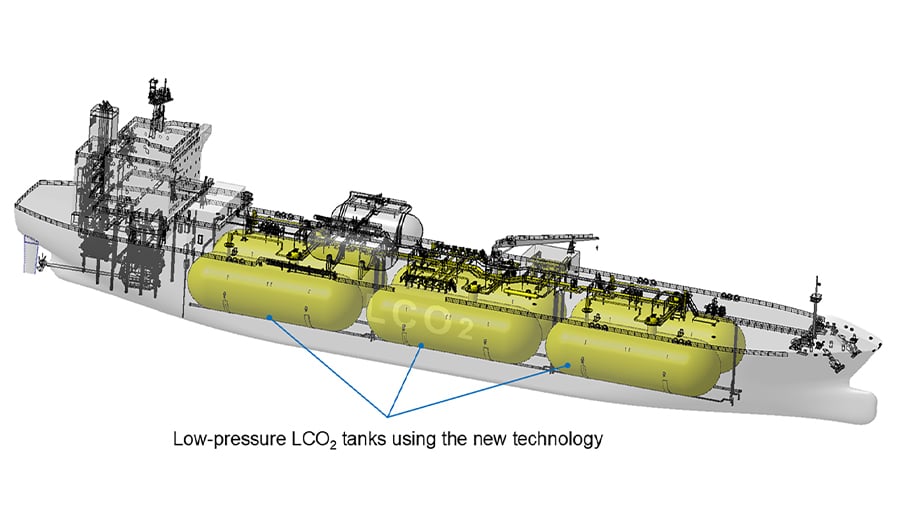
    Illustration of a Ship with Low-pressure LCO2 Tanks

    As part of Mitsubishi Shipbuilding’s cross-industry initiatives to standardize large LCO2 carriers, both companies are collaborating to develop the steel for large LCO2 tanks and establish a PWHT-exempt manufacturing process based on ECA to achieve both economic viability and productivity.

    When an economical high-strength carbon-manganese steel is used in large LCO2 tank manufacturing, PWHT is generally required for tank welds as per IGC code(Note4). However, heat-treatment furnaces capable of annealing large LCO2 tanks are extremely limited, and this manufacturing process has become a significant obstacle to tank enlargement and a stable supply.
    To address this issue, Mitsubishi Shipbuilding evaluated the integrity of tank welds through an ECA based on the steel plate properties developed by Nippon Steel. The results of ECA demonstrated the validity of manufacturing process without PWHT and received GDA.

    Nippon Steel developed the steel that conforms to NK standard of KF460(Note5) —with high strength, excellent low-temperature toughness, and economic viability—to enable the PWHT-exemption technology for large low-pressure LCO2 tanks developed by Mitsubishi Shipbuilding.

    The acquisition of this GDA represents a remarkable breakthrough achieved by the technical cooperation between the two companies, and it will contribute greatly to reducing LCO2 transportation costs by ensuring the safety of low-pressure LCO2 tanks while delivering both economic viability and productivity. Mitsubishi Shipbuilding and Nippon Steel will build on this joint success and work with supply-chain partners involved in LCO2 tank manufacturing to commercialize the developed steel and low-pressure LCO2 tanks.

    MHI Group is currently pursuing strategic measures to strengthen its business for the energy transition. In conjunction with this initiative, Mitsubishi Shipbuilding is making efforts to contribute to the advancement of the maritime industries in Japan and around the world by utilizing its shipbuilding-based marine engineering technologies in addition to conventional shipbuilding. The development of this low-pressure LCO2 tank technology is one example of these efforts. Collaboration with Nippon Steel also demonstrates MHI Group’s commitment to partnerships. Moving forward, Mitsubishi Shipbuilding will continue to build strategic global partnerships both to incorporate external expertise and actively advance the development of a CCUS value chain. Through these efforts, the company aims to provide its technologies, products and services to ever more customers.

    Nippon Steel has set out the Nippon Steel Carbon Neutral Vision 2050 to support the aim of realizing a carbon neutral society in 2050. In addition to reducing CO2 emissions in its own manufacturing processes, by delivering advanced products and solution technologies under the NSCarbolex™ Solution(Note6) brand, it also aims to contribute to the reduction of CO2 emissions in society. The developed steel among this joint development project with Mitsubishi Shipbuilding corresponds to the Thermo-Mechanical Control Process (TMCP) steel of NSCarbolex Solution, enhances the economic performance of entire CCUS value chains, and makes a significant contribution to their realization. CO2 reduction is an urgent issue across all industries, and Nippon Steel will continue to advance products and solution technologies to support its customers’ decarbonization and competitiveness, contributing to the realization of a carbon neutral society.

    GDA Certification

    GDA Certification

    • 1In post-weld heat treatment (PWHT), welded structural materials are reheated to a specified temperature and held at that temperature for a defined period. This process aims to relieve residual stress generated during welding and improve the quality of welding joints. PWHT is generally performed in a dedicated furnace. When the products are of large size, furnace size may cause bottlenecks in the manufacturing process.
    • 2Engineering Critical Assessment (ECA) is an evaluation method that uses assumed micro initial defects in the welds and the estimated stress history together with material and welding properties, to confirm that no major failures will occur in the welds during the product’s service life.
    • 3General Design Approval (GDA) indicates that a certification body has reviewed design documents equivalent to a product’s final documents and confirmed that the subject equipment meets technical requirements and relevant safety standards. In this case, the review was conducted based on the IGC Code and ClassNK classification rules applicable to ships transporting liquefied gases in bulk.
    • 4IGC Code (The International Code for the Construction and Equipment of Ships Carrying Liquefied Gases in Bulk) is an international regulation stipulating conditions to ensure the safety of vessels that transport liquefied gases (LCO2, LNG, etc.) in bulk.
    • 5KF460 steel is a carbon-manganese steel with excellent low-temperature properties, as specified under ClassNK classification rules for ships. According to the rules, these high-tensile strength rolled steel plates must have a yield strength of at least 460N/mm2 and a tensile strength of at least 540N/mm2.
    • 6NSCarbolex Solution is a Nippon Steel brand encompassing advanced products and solution technologies that contribute to the reduction of CO2 emissions in society. For an overview of NSCarbolex Solution, see the following website:
      https://www.nipponsteel.com/en/product/nscarbolex/solution/

    Continue Reading

  • Court releases audio of 911 call that led to Luigi Mangione’s arrest | New York

    Court releases audio of 911 call that led to Luigi Mangione’s arrest | New York

    An audio recording of a 911 call that led to Luigi Mangione’s arrest has been made public after the press advocated for its release.

    The audio recording was played in Manhattan state court this week during a proceeding about evidence gathered during Mangione’s arrest over the murder of senior United HealthCare executive Brian Thompson a year ago. Mangione was arrested at a McDonald’s in Altoona, Pennsylvania in December last year after the restaurant’s manager called 911.

    “I have a customer here that some other customers were suspicious of, that he looks like the CEO shooter from New York,” the manager could be heard saying in audio of the call that was played in court on Monday.“They’re just really upset and they’re like coming to me, and I was like, ‘Well, I can’t approach him.’”

    Audio recording of 911 call that led to Luigi Mangione’s arrest released by court – video

    She told the 911 operator that the man who drew suspicion was wearing a black jacket, medical mask, and a khaki-colored beanie.

    “He has his beanie pulled down, so the only thing you can see is his eyebrows,” the manager said when pressed on more details about his description. The manager told the operator that she “tried to Google it” in an effort “to calm them down a little bit, and I’m like, ‘Guys, it’s kind of hard to tell with his eyes and his eyebrows … ”

    The 911 call played a pivotal role in police interdicting Mangione, who is facing state and federal charges in Thompson’s murder. Mangione has pleaded not guilty to all counts.

    Joseph Detwiler, the Altoona police officer who first approached Mangione and arrested him, testified on Tuesday that he knew who the manager referred to in her 911 call, on account of the mask.

    “We don’t wear masks,” Detwiler said when asked about mask culture in Altoona. “We have antibodies.”

    As “no one wears masks” in Altoona, Detwiler said, it was clear that the man spurred suspicion.

    “He had a mask on,” Detwiler also said. “So he had to be the person we were called there for.”

    This release of evidence marked a shift from Tuesday, when Judge Gregory Carro sided with Mangione’s defense in sealing materials until the trial. A reporter was ejected from the courtroom after she stood, requesting to be heard on sealing.

    Members of the press in New York routinely stand and request to be heard in state and federal courts. Legal precedent makes clear that journalists have the right to be heard on access matters.

    One New York state court decision, for example, states: “The court must adhere strictly to the procedures set forth in the controlling case law including affording a full opportunity by any interested members of the press to be heard, and making specific findings to support its determination without revealing the subject or issue, before closing the courtroom or sealing exhibits.”

    At least one member of the press, Matthew Lee, of Inner City Press, wrote to Carro requesting that exhibits be unsealed. In announcing that some documents would be unsealed on Thursday, Carro reportedly said: “For those of you who are interested … a number of the exhibits will be made available on the DA’s Dropbox shortly.”

    Carro did not make any mention of the journalist’s ejection from court, according to Molly Crane-Newman of the New York Daily News. The evidence released does not include everything that was played in court.

    Continue Reading