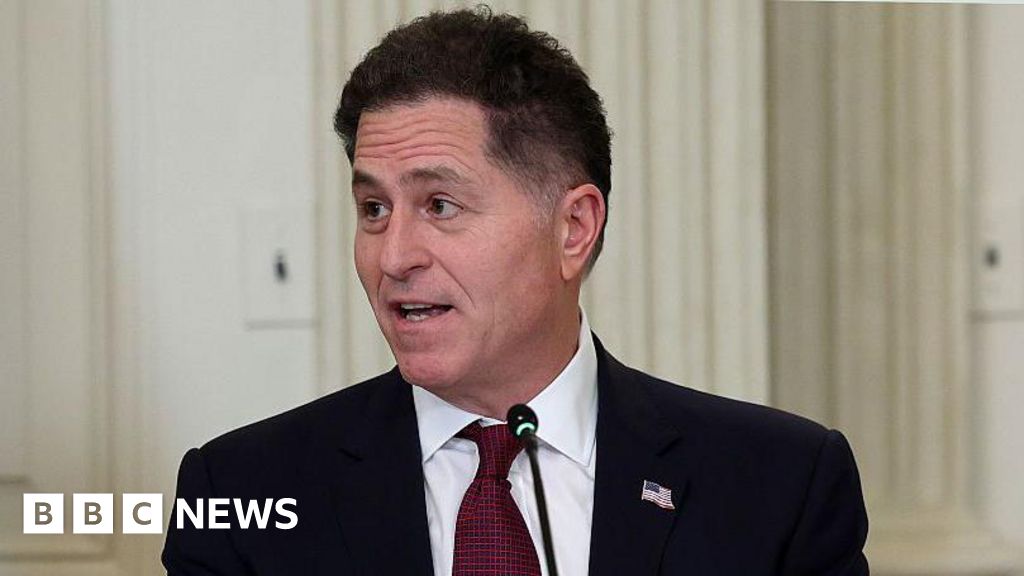
Tech billionaire Michael Dell and his wife, Susan, have announced plans to donate $250 to 25 million children across the US.
The $6.25bn (£4.72bn) gift will bolster Trump-branded investment accounts, which were authorised by Congress as part of its tax and spending bill earlier this year with the aim of encouraging families save for retirement.
As part of that scheme, babies born between 2025 and 2028 are also eligible to receive $1,000 from the government.
The Dells said their gift, which targets children age 10 and under, was intended to help seed those accounts and expand the savings opportunity to even more children.
“We’ve seen what happens when a child gets even a small financial headstart – their world expands,” Michael Dell said in a video on social media announcing the donation.
Unlike the government plan, the Dells said children age 10 and under, who were born before 1 January 2025 were eligible for their gift, provided they live in areas where the median income is below $150,000.
The Dells said they expected the gift to reach almost 80% of children age 10 and under in the US. It is among the largest ever private donations to go directly to Americans.
Dell, the chief executive of Dell Technologies with a fortune that Forbes estimates at almost $150bn, also urged other philanthropists and employers to make similar commitments.
“Two great people. I love Dell!!!” President Donald Trump wrote in all capital letters on social media in response to the announcement.
How Trump accounts work
The money will be routed through the new Trump-branded accounts, which by law must be invested in an index fund that reflects the wider stock market.
It is not currently possible to set up a Trump account. The government has said that process will launch next year, with more details available at that time.
Parents are eligible to contribute up to $5,000 in after-tax funds to the accounts, a figure that will be adjusted for inflation, with employers, charitable organisations and others also able to donate.
The child can access the money at age 18 at which point the account converts into a retirement account. While the money grows tax free, withdrawals are subject to taxes and possibly a penalty if made before the age of 59 and a half.
The White House Council of Economic Advisers earlier this year estimated that $1,000 could grow to more than $5,800 over the course of 18 years, assuming a 10.3% rate of return.
When they were created earlier this year, the Trump accounts met with significant scepticism from critics, who argued that the accounts would primarily benefit better off families, who have extra money to set aside, while being less flexible than other, existing savings vehicles.
The Tax Foundation, a think tank focused on tax policy, on Tuesday said that Trump accounts were “well intentioned” but would “add another layer to an already overcomplicated savings account system in the United States”.
“Trump Accounts do not offer much of an additional incentive to save,” it added. “Rather, the main benefit is in the form of the $1,000 initial deposit from the federal government and whatever employers choose to contribute.”
Treasury Secretary Scott Bessent also drew criticism from Democrats after promoting the scheme as a way to support alternatives to government-funded retirement benefits, calling it a “backdoor to privatizing Social Security”.
San Francisco will file the nation’s first government lawsuit against food manufacturers over ultra-processed foods (UPFs) on Tuesday, arguing that local governments have been shouldering the costs of treating diseases that stem from public consumption of the companies’ products.
The city’s attorney, David Chiu, told the New York Times they will sue 10 corporations that create some of the country’s most popular food and drinks, from chicken nuggets and frozen pizzas to potato chips and sugary breakfast cereals – but also foods like breads and granola bars that are marketed as “healthy”.
UPFs are industrially manufactured food products and contain ingredients not found in the average home kitchen, such as preservatives, flavor enhancers, artificial colors and emulsifiers, with little to no whole food content. It is estimated that more than 70% of the US food supply is composed of foods commonly considered ultra-processed, and that children get over 60% of their calories from such foods.
The world’s largest review, published last month, found that UPFs are linked to harm in every major organ system of the human body and pose a seismic threat to global health. They are associated with an increased risk of a dozen health conditions, including cancer, obesity, type 2 diabetes, depression, heart disease and cognitive decline.
That review also found that global corporations, not individual choices, are driving the rise of UPFs. UPFs are a leading cause of the “chronic disease pandemic” linked to diet, with food companies putting profit above all else, the authors said.
Chiu’s lawsuit, which will be filed in the San Francisco superior court on behalf of the state of California, will seek unspecified damages for the costs that cities and counties bear for treating residents whose health has been harmed by ultra-processed food.
San Francisco accuses the companies of “unfair and deceptive acts” in how they market and sell their foods, arguing that such practices violate the state’s unfair competition law and public nuisance statute. It also argues the companies knew that their food made people sick but sold it anyway.
“It makes me sick that generations of kids and parents are being deceived and buying food that’s not food,” Chiu told the Times.
It marks a rare moment of alignment between liberal San Francisco and the Trump administration. Donald Trump’s health and human services secretary, Robert F Kennedy Jr, has railed against UPFs – one of his least polarizing stances – as part of his Make America Healthy Again mission, urging Americans to limit their consumption of foods with added sugar, salt, fat, dyes and preservatives.
Chiu stressed to the NYT that he did not agree with Kennedy on other health topics, including vaccine skepticism. But he said that the science was indisputable when it comes to ultra-processed foods. “Many of the perspectives of this administration are not backed by science, but this is different,” Chiu said. “Even a broken clock is right twice a day.”
The defendants in the lawsuit include the Coca-Cola Company, PepsiCo, Kraft Heinz Company, Post Holdings and Mondelez International. It also names General Mills; Nestlé USA; Kellogg; Mars Incorporated; and ConAgra Brands.
Earlier this year, California passed a bipartisan bill that became the first in the US to provide a statutory definition of UPFs, and laid a foundation for banning them from schools. California has also banned several additives, including food dyes, linked to behavioral difficulties in children, in schools. In 2010, San Francisco banned fast-food restaurants from giving free toys.
The city attorney’s office also has a track record of winning against big corporations on public health matters, including tobacco companies, lead paint manufacturers and opioid manufacturers, distributors and dispensers.
Dec 2 (Reuters) – Nvidia’s (NVDA.O), opens new tab agreement with ChatGPT parent OpenAI to invest up to $100 billion in the startup is still not finalized, the chipmaker’s chief financial officer Colette Kress said on Tuesday at the UBS Global Technology and AI Conference in Arizona.
Kress’ comments add to intensifying discussion around a partnership that ties two of the most significant players in the artificial intelligence race and is at the center of rising concerns around circular deals in the AI ecosystem.
Sign up here.
The world’s most valuable company in September unveiled a letter of intent to invest in OpenAI, under an agreement that would involve deploying at least 10 gigawatts of Nvidia systems for the startup, enough capacity to power more than 8 million U.S. homes.
“We still haven’t completed a definitive agreement, but we’re working with them,” Kress said, addressing questions about the framework of Nvidia’s agreement with OpenAI.
OpenAI, the startup at the heart of the generative AI boom that kicked off with the launch of ChatGPT in late 2022, is a major customer for Nvidia’s chips, alongside large cloud providers which make up a large portion of the chipmaker’s sales.
Nvidia CEO Jensen Huang has said the company has $500 billion in bookings, opens new tab for its advanced chips through 2026.
The chips Nvidia could provide to OpenAI after its agreement is finalized are not included in these bookings and would add to the number, Kress said on Tuesday.
“That half a trillion doesn’t include any of the work that we’re doing right now on the next part of the agreement with OpenAI,” she said.
Nvidia shares were up 2.6%.
Over the past year, Nvidia has struck a series of deals with AI startups and invested in firms that are also major customers, stoking Wall Street concerns about an AI bubble and so‑called circular deals.
Nvidia last month announced plans to commit up to $10 billion to OpenAI rival Anthropic. Kress said the Anthropic deal could also add to Nvidia’s $500 billion in chip bookings.
Reporting by Arsheeya Bajwa in Bengaluru; Editing by Tasim Zahid
Our Standards: The Thomson Reuters Trust Principles., opens new tab
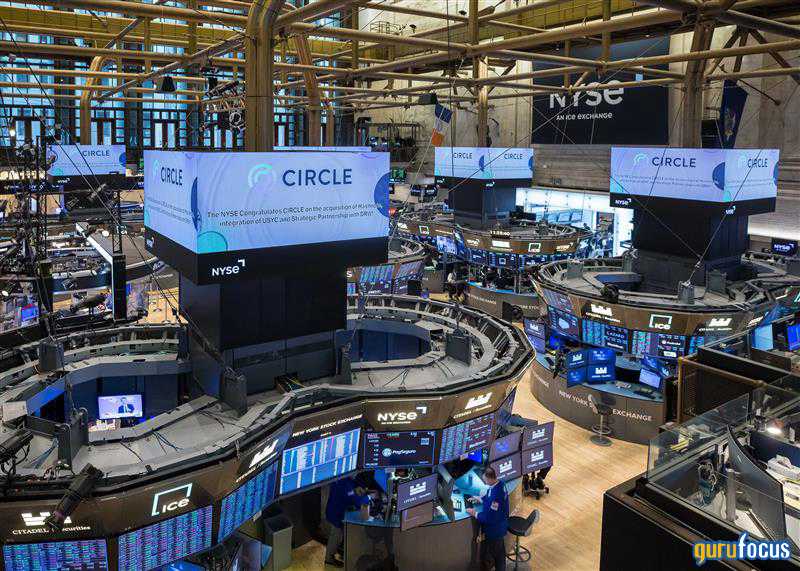
U.S. stocks rose Tuesday as investors regained footing after a slow start to December, buoyed by gains in bitcoin and technology shares.
The Dow Jones Industrial Average climbed 188 points, or 0.4%, while the S&P 500 advanced about 0.5%. The Nasdaq Composite rose 0.8%, led by strength in AI-related technology names.
Bitcoin surged roughly 6%, recovering losses from the prior day, providing a boost to market sentiment. Shares of Nvidia (NASDAQ:NVDA) increased nearly 2% as investors focused on AI-driven growth opportunities.
Smaller AI and semiconductor companies also saw sharp gains. Credo Technology jumped 17% to an all-time high following better-than-expected earnings, while Astera Labs rose about 6%.
Analysts said optimism is also fueled by expectations that the Federal Reserve may cut interest rates at its Dec. 10 policy meeting. Markets are pricing in more than an 87% chance of a reduction, up from mid-November levels.
December tends to show seasonal strength, and technical indicators have improved, said Mark Hackett, chief market strategist at Nationwide. Yet concerns over AI spending and high valuations remain.
(Bloomberg) — Wall Street resumed its advance after a brief pause, with dip buyers lifting stocks as cryptocurrencies staged a rebound in the wake of a rough start to December. Bonds and the dollar stabilized.
Equities snapped back, with the S&P 500 rising for the sixth time in seven trading days. The Nasdaq 100 climbed 1%. Riskier corners of the market — which bore the brunt of the recent selling — from small caps to the most-shorted companies and unprofitable tech bounced back.
Subscribe to the Stock Movers Podcast on Apple, Spotify and other Podcast Platforms.
Following a plunge of as much as 8% on Monday, Bitcoin reclaimed its $90,000 mark. The largest token has fallen almost 30% since hitting a record in early October. The downturn accelerated when roughly $19 billion in leveraged bets were wiped out.
“There was a sense of calm across markets today, with cryptos finding some love after what has been a brutal last couple of weeks,” said Fawad Razaqzada at Forex.com. “The lack of any major news certainly played a part in the calmer tone.”
The S&P 500 rose to around 6,845. Breadth wasn’t amazing, with 280 shares actually falling. Nvidia Corp. led gains in tech megacaps. Boeing Co. rallied as the planemaker expects to generate cash again in 2026.
Short-dated Treasuries outperformed the rest of the curve, with two-year yields down one basis point to 3.52%. The dollar wavered.
Read: SEC Chief Wants to Boost IPOs by Easing Rules for Small Firms
Anyone looking to bet against US stocks this month would be wise to consider the strength of the American economy and ongoing enthusiasm around artificial intelligence.
That’s the view at 22V Research, where strategists say an increase in consumer spending and investments in AI are likely to support productivity, allowing firms to deliver the profits needed to power stocks higher.
“Being short here requires high confidence in a much weaker economic backdrop or a significant change in the outlook for AI capex,” according to strategists led by Dennis Debusschere.
Meantime, Barclays Plc strategists noted that S&P 500 implied moves ahead of Federal Reserve meetings have declined since early 2023, with realized moves hovering near zero recently. It’s a trend that underscores the fading influence of monetary policy, they said.
After cutting interest rates by more than a percentage point, Fed officials are now wondering where to stop – and finding there’s more disagreement than ever.
In the past year or so, prescriptions for where rates should end up have diverged by the most since at least 2012, when US central bankers started publishing their estimates. That’s feeding into an unusually public split over whether to deliver another cut next week, and what comes after that.
“Nothing is going to change our view that the Fed eases next week, but it is looking more like a hawkish cut,” said Andrew Brenner at NatAlliance Securities. “We can see at least three dissents next week.”
Corporate Highlights:
Michael Burry called Tesla Inc. shares “ridiculously overvalued” and said shareholder dilution is set to continue after the proposed $1 trillion pay package for co-founder Elon Musk, according to a Substack post. Cloud-computing provider Vultr is building a 50-megawatt cluster of Advanced Micro Devices Inc. artificial intelligence processors at a data center in Ohio, a move aimed at offering AI infrastructure at a lower cost. Boeing Co. expects to generate cash again in 2026, a significant reversal in the planemaker’s finances as it prepares to boost monthly production rates and pushes ahead with certification for the much-delayed 777X jetliner. Warner Bros. Discovery Inc. was fielding a second round of bids on Monday, including a mostly cash offer from Netflix Inc., in an auction that could wrap up in the coming days or weeks, according to people familiar with the discussions. Crypto exchange Kraken is acquiring a tokenized assets platform in a vote of confidence for stock trading tied to blockchains. Cloudflare Inc. climbed after Barclays launched coverage on the infrastructure software company with an overweight rating and a $235 price target. MongoDB Inc., a database software company, reported stronger-than-expected results. It also raised its full-year forecast. Six Flags Entertainment Corp. rallied after Truist Securities upgraded the theme park operator’s stock to buy from hold. Analog chipmaker SiTime Corp., which specializes in chips that keep circuits in sync inside data centers, is in talks to acquire Renesas Electronics Corp.’s timing unit, according to people familiar with the matter. Bank of Nova Scotia topped estimates on better-than-expected results at its capital-markets unit while forecasting faster growth next year in its core Canadian banking division. Laurentian Bank of Canada is set to become the latest small Canadian bank to exit the market after reaching an agreement to sell itself to Fairstone Bank for C$1.9 billion ($1.4 billion) while hiving off its retail banking unit to focus on commercial lending. Novo Nordisk A/S is planning a large study of its next-generation obesity shot CagriSema in children, a sign the drugmaker is pressing forward with the compound despite disappointing results in other trials. ISS A/S slumped in Copenhagen amid concerns over the Danish company’s role in the renovation of a Hong Kong apartment fire where a deadly fire broke out on Nov. 26. TotalEnergies SE has emerged as the leading bidder to buy a stake in Galp Energia SGPS SA’s major oil discovery offshore Namibia, according to people familiar with the matter. Vale SA and Glencore Plc are considering a joint copper project in Canada as the two companies look to increase their exposure to a metal projected to be in short supply as the world electrifies. Samsung Electronics Co. unveiled its first so-called trifold smartphone, flaunting its engineering prowess in foldable devices even as the broader category has yet to catch on with mainstream consumers. Taiwanese prosecutors charged Tokyo Electron Ltd. for failing to prevent staff from allegedly stealing Taiwan Semiconductor Manufacturing Co. trade secrets, escalating a dispute involving two Asian linchpins of a chip industry increasingly vital to national and economic security. Some of the main moves in markets:
Stocks
The S&P 500 rose 0.5% as of 11 a.m. New York time The Nasdaq 100 rose 1% The Dow Jones Industrial Average rose 0.5% The Stoxx Europe 600 rose 0.2% The MSCI World Index rose 0.4% Bloomberg Magnificent 7 Total Return Index rose 1% The Russell 2000 Index rose 0.4% Most Short Rolling rose 0.8% GS Non Profitable Tech rose 1.7% Currencies
The Bloomberg Dollar Spot Index was little changed The euro was little changed at $1.1606 The British pound was little changed at $1.3203 The Japanese yen fell 0.3% to 155.90 per dollar Cryptocurrencies
Bitcoin rose 5.2% to $90,921.17 Ether rose 7.7% to $3,007.09 Bonds
The yield on 10-year Treasuries advanced one basis point to 4.10% Germany’s 10-year yield was little changed at 2.75% Britain’s 10-year yield was little changed at 4.49% The yield on 2-year Treasuries declined one basis point to 3.52% The yield on 30-year Treasuries advanced two basis points to 4.76% Commodities
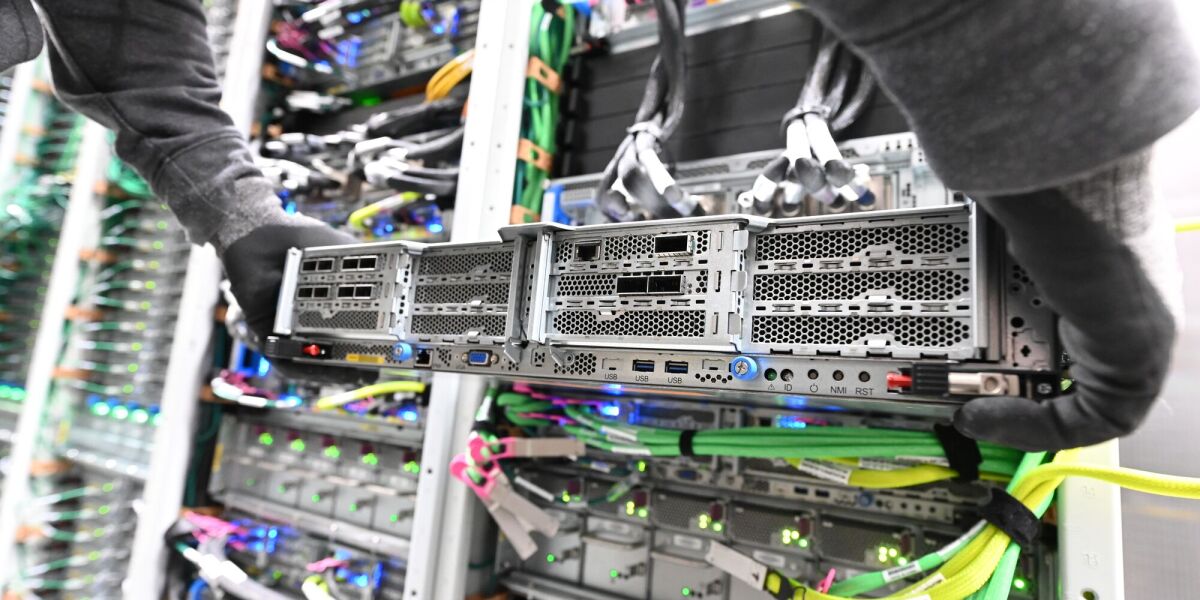
AWS and NVIDIA are collaborating on a strategic partnership with HUMAIN, the global company based in Saudi Arabia building full-stack AI capabilities, with AWS building a first-of-its-kind “AI Zone” in Saudi Arabia featuring up to 150,000 AI chips, including GB300 GPUs, dedicated AWS AI infrastructure, and AWS AI services, all within a HUMAIN purpose-built data center. “The AI factory AWS is building in our new AI Zone represents the beginning of a multi-gigawatt journey for HUMAIN and AWS. From inception, this infrastructure has been engineered to serve both the accelerating local and global demand for AI compute,” said Tareq Amin, CEO of HUMAIN. “What truly sets this partnership apart is the scale of our ambition and the innovation in how we work together. We chose AWS because of their experience building infrastructure at scale, enterprise-grade reliability, breadth of AI capabilities, and depth of commitment to the region. Through a shared commitment to global market expansion, we are creating an ecosystem that will shape the future of how AI ideas can be built, deployed, and scaled for the whole world.”
 Getty Images