Category: 3. Business

  • Restaurants say big chains pretend to be independents on apps

    Restaurants say big chains pretend to be independents on apps

    BBC Photograph of Justina John, owner of Onja restaurant. She wears a black polo top which reads "Onja, taste of Tanzania" on the yellow circle logo. Her hair is tied up into a black fishnet and she smiles at the camera. She holds a plate of food up to the camera.BBC

    Small restaurant owner Justina John, from Cardiff, says it is “impossible” to compete with the chain restaurants on delivery apps

    Independent restaurants have accused global corporations of being “sneaky” and “a killer” to family businesses by masquerading as indies on delivery apps.

    Chain restaurants including Pizza Hut, TGI Fridays, Frankie & Benny’s, Las Iguanas and Barburrito have brands on apps such as Deliveroo and Just Eat, giving them different names and the appearance of being small or independent businesses.

    Justina John, owner of ONJA Taste of Tanzania in Cardiff, said trying to survive was “like small fish trying to swim with the sharks”.

    Peter Backman, CEO of theDelivery.World, said the practice was only misleading if customers were purposely trying to support independent restaurants and takeaways.

    Justina, 45, from Cardiff, opened her restaurant about a year ago and said she had noticed an “overwhelming presence of chain restaurants, sometimes masquerading as independents” on delivery apps.

    “Very sneaky, it’s not fair on the small businesses,” she added.

    “The only thing that’s keeping us alive is authenticity, there’s certain things you can’t fake.”

    Photograph of Justina John stood outside of her store, Onja. She has long black curled hair, brushed around the side, on her left shoulder. She has brown eyes and smiles at the camera. The restaurant window reads: "Taste of Tanzania" alongside vibrant tribal prints.

    Justina described the chain restaurants as being “very sneaky”

    Justina wants delivery platforms to take greater responsibility, to verify listings and help genuine independent businesses by separating them on the apps so customers can easily support them if they choose.

    Just Eat, Deliveroo and Uber Eats all said virtual brands could be utilised by any business, including independents.

    Just Eat said it supported independent businesses to reach new customers and virtual brands gave partners “the opportunity to expand their food offerings and diversify their revenue streams”.

    It added that it was transparent with customers as they could see the address of where they were ordering from, “to help them make informed choices”.

    Deliveroo said its “core mission is to champion local businesses” and that virtual brands allowed restaurants to “leverage existing kitchen facilities and capacity to create a delivery-only brand, giving them the opportunity to reach new customers and drive additional revenue in an increasingly digital world”.

    Uber Eats said it was committed to “levelling the playing field” for the merchants on its platform, adding: “We have a growing team of dedicated account managers working to build bespoke solutions and equal exposure opportunities on the app and we accelerate rather than compete with our partners’ sales.”

    Fowl and Fury Jamie Rees standing in front of Fowl and Fury in Cathays. The red lettering on the black building. Jamie is wearing a beanie, black hoodie. Fowl and fury lettering on the hoodie. Fowl and Fury

    Jamie Rees says he is worried for the future of the city if independents cannot survive

    Jamie Rees, 36, is co-owner of Cardiff’s Fowl and Fury and said he first noticed chains creating digital brands three years ago, but now it is “literally everywhere”.

    He singled out Frankie & Benny’s as “the worst offender, recently,” with TGI Fridays being “quite a big one”.

    Logging on to Deliveroo while in Cardiff, the BBC checked some of these takeaways by pressing the “allergens and info” option, which gives you the registered address of the company providing your food.

    Bird Box and Stacks were from Frankie & Benny’s, Mother Clucker was TGI Fridays, Wing Street was Pizza Hut, Hot Chick was Coyote Ugly and Badass Burritos was Barburrito.

    Jamie understood why companies do it and that you cannot stop it, but was frustrated because he said apps – in theory – created a more equal playing field.

    “But then when they bring out five different restaurants under the same roof, now I’m not equal,” he added.

    “They have more money for advertising, promos, photographers.”

    He wants to see legislation about transparency around what kitchen people’s food comes from and the parent company behind it.

    “What I fear is eventually the smaller guys are going to go out of business because they’re a lot less visible on these platforms.

    “It feels a little bit unethical, because nine times out of 10 the people that are ordering from these ghost kitchens are doing it because of the branding.”

    For Fowl and Fury, this is a very real problem, he said, because most consumers order online.

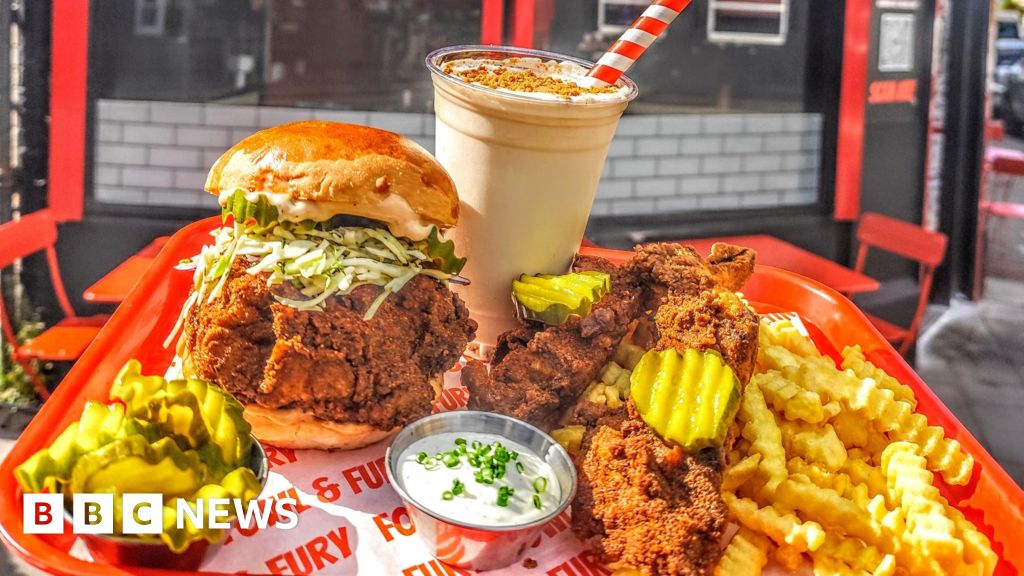
    Fowl and Fury Fowl and Fury sign, red letters on a black building. Someone is holding up a tray stacked with a chicken burger, chips, gherkins and a milkshake. Fowl and Fury

    Fowl and Fury began in Jamie and his wife Natalie’s garden

    Friends suggested creating an independent-only delivery service, but he said it could not compete with Uber Eats, Just Eat and Deliveroo.

    Rajendra Vikram Kupperi, 45, director of Vivo Amigo, which opened in Cardiff in 2020, said ghost kitchens were diluting the takeaway industry and were unfair to independent businesses.

    “During Covid, the number of ghost kitchens that opened was endless. It’s a killer,” he said.

    “The bigger brands can undercut the prices, they can have good offers.”

    Rajendra Vikram Kupperi Rajendra Vikram Kupperi wearing a black short-sleeved shirt is holding a large white plate with three vibrant tacos. Each taco is filled with colorful ingredients, including shredded lettuce, diced tomatoes, and possibly meat, topped with bright pink pickled onions. The background features a bold, colorful mural with swirling patterns and large orange letters spelling “VIVO AMIGO” against a mix of blue, yellow, and pink designs.Rajendra Vikram Kupperi

    Rajendra Vikram Kupperi says ghost kitchens on delivery apps are “a killer”

    Vivo Amigo uses Deliveroo, Uber Eats and Just Eat but Rajendra feels his business has been directly affected by the practice of using ghost kitchens.

    Mexican food brands have sub-brands online. For example, Kick-Ass Burrito is from Las Iguanas and Barburrito serves on Deliveroo as itself, but also as Death Valley Burrito, Badass Burritos and Twisted Health Kitchen.

    He said he would like ghost kitchens and big brands separated from independent restaurants so consumers are not mislead.

    “That would encourage customers who want to support independent brands, but at the moment it’s all mixed up,” he said.

    “Customers can’t really differentiate.”

    A screenshot of 'Bird Box Cardiff St Davids' from Deliveroo. It is a banner poster for a chicken restaurant with a picture of a fried chicken burger topped with cheese and sitting on gherkins and lettuce. The backdrop is pink with a stylised green cartoon chicken. Underneath are sub menus for allergens and delivery times. On the right of the picture is another screenshot - it is a Google Map showing the address of the restaurant to be Frankie and Benny's 18 Bridge Street Arcade, St. Davids Dewi Sant, Cardiff, CF10 2EF

    At first glimpse, many of these ghost kitchens look like independent restaurants – only if you scroll down to the address can you tell where your food is made

    Barburrito said virtual brands were “one way restaurants can make better use of existing kitchens, reduce waste and respond to customer demand”.

    In a statement, it said the model “is not exclusive to large chains and many independent operators are equally able to create virtual brands on delivery platforms”.

    Coyote Ugly said: “The problem isn’t competition, but whether businesses can remain viable at all.

    “Ultimately, this is about keeping doors open, protecting jobs and giving hospitality a fighting chance to thrive.”

    Peter Backman of theDelivery.World said big chain restaurants created ghost restaurants “for extra revenue, they’ve got the capacity – why not?”

    He said he was unsure if customers cared, but if they “really believe they’re supporting their local business, it’s deceiving”.

    “But if the consumer is just saying, ‘oh, I want some wings’, what the hell does it matter?”

    He said he always favoured transparency and thought delivery apps having a page for independent businesses was a good idea, but questioned the practicality.

    Frankie & Benny’s, TGI Fridays, Pizza Hut and Las Iguanas have been asked to comment.

    Continue Reading

  • An Intrinsic Calculation For Phoenix Mecano AG (VTX:PMN) Suggests It’s 44% Undervalued

    An Intrinsic Calculation For Phoenix Mecano AG (VTX:PMN) Suggests It’s 44% Undervalued

    • The projected fair value for Phoenix Mecano is CHF769 based on 2 Stage Free Cash Flow to Equity

    • Phoenix Mecano is estimated to be 44% undervalued based on current share price of CHF434

    • Our fair value estimate is 56% higher than Phoenix Mecano’s analyst price target of €493

    In this article we are going to estimate the intrinsic value of Phoenix Mecano AG (VTX:PMN) by taking the expected future cash flows and discounting them to their present value. The Discounted Cash Flow (DCF) model is the tool we will apply to do this. Before you think you won’t be able to understand it, just read on! It’s actually much less complex than you’d imagine.

    Remember though, that there are many ways to estimate a company’s value, and a DCF is just one method. If you want to learn more about discounted cash flow, the rationale behind this calculation can be read in detail in the Simply Wall St analysis model.

    Trump has pledged to “unleash” American oil and gas and these 15 US stocks have developments that are poised to benefit.

    We use what is known as a 2-stage model, which simply means we have two different periods of growth rates for the company’s cash flows. Generally the first stage is higher growth, and the second stage is a lower growth phase. In the first stage we need to estimate the cash flows to the business over the next ten years. Where possible we use analyst estimates, but when these aren’t available we extrapolate the previous free cash flow (FCF) from the last estimate or reported value. We assume companies with shrinking free cash flow will slow their rate of shrinkage, and that companies with growing free cash flow will see their growth rate slow, over this period. We do this to reflect that growth tends to slow more in the early years than it does in later years.

    Generally we assume that a dollar today is more valuable than a dollar in the future, so we discount the value of these future cash flows to their estimated value in today’s dollars:

    2026

    2027

    2028

    2029

    2030

    2031

    2032

    2033

    2034

    2035

    Levered FCF (€, Millions)

    €28.3m

    €23.8m

    €35.8m

    €48.5m

    €51.2m

    €53.1m

    €54.5m

    €55.6m

    €56.5m

    €57.2m

    Growth Rate Estimate Source

    Analyst x2

    Analyst x1

    Analyst x1

    Analyst x1

    Analyst x1

    Est @ 3.64%

    Est @ 2.69%

    Est @ 2.03%

    Est @ 1.57%

    Est @ 1.25%

    Present Value (€, Millions) Discounted @ 7.0%

    €26.4

    €20.8

    €29.3

    €37.0

    €36.6

    €35.4

    €34.0

    €32.4

    €30.8

    €29.2

    (“Est” = FCF growth rate estimated by Simply Wall St)
    Present Value of 10-year Cash Flow (PVCF) = €312m

    Continue Reading

  • January blues? Longing for an escape to the sun? Perfect timing for criminals to cash in | Money

    January blues? Longing for an escape to the sun? Perfect timing for criminals to cash in | Money

    You are battling the January blues and see a cheap deal on one of your socials for a two-week break in Spain during August. Better still, the price is £200 cheaper than elsewhere, possibly because the holiday is almost sold out.

    When you text to confirm the details after making the payment, you are talked through the booking by a convincing contact.

    Unfortunately, that will be the last you hear from the travel agent as they are criminals, and the advertisement was a fake set up to lure you in.

    January is one of three months during the year – June and July being the others – when scammers ramp up their efforts to defraud people planning summer and winter breaks. This time of year is traditionally when holiday companies see a rush of bookings as people crave something to look forward to after Christmas.

    Jim Winters, head of economic crime at Nationwide, says the building society sees a pick up in holiday scams at this time of year. Typically, people are drawn in by a social media ad, which is either a direct copy of a legitimate one from a reputable company, or created by AI.

    “They’ll look at where the popular holiday destinations are, and if there’s one that is up and coming they’ll tailor the scam,” he says.

    Nationwide said the average loss to people is about £3,500.

    What it looks like

    The hook is a credible-looking ad on social media for two weeks in the sun, or a winter break skiing. The reason it looks like the real thing is that it has probably been copied from a genuine travel site, however the price quoted will be significantly less than you might expect to pay.

    Too good to be true holidays deals are just that. Most often they will take your hard-earned cash and leave you high and dry. Photograph: peangdao/Getty Images/iStockphoto

    After clicking on the ad, you will be asked to fill in your details and then be contacted on a chat app, such as WhatsApp, later. Or you may be able to click through directly to the chat from the ad.

    Winters explains: “The offer will look like a bargain, an incredibly good value holiday. They might even give you some time pressure – as in ‘this is a one-time only deal’ or ‘you’ve got to sign up to it in the next 24 hours to qualify for this price’, and ‘we’ve only got x amount of tickets at this amount’.”

    The fraudsters will ask for payment through bank transfer, and then, typically, cease contact, although some will still answer inquiries to lend some sort of legitimacy to the fraud. But, ultimately, the holiday does not exist.

    What to do

    When booking a holiday, make sure that you start the process on a reputable website, and not via a chat app. A good tip is to check the URL of the site in your browser. Be aware of the tactics of criminals. Urgency, and the fear of missing out on a deal, are big ploys to make victims act quickly and without thinking through decisions.

    “Fraudsters know when peak periods are,” says Winters. “They know when people will be shopping for holidays. And, crucially, they know when they’ll be vulnerable to ‘too good to be true’ offers.”

    Being asked to pay via bank transfer is a significant red flag as you will not have the section 75 protections that come with using a credit card.

    If you think you have been defrauded, contact your bank immediately. After that, contact Action Fraud, the central hub for fraud and online crime.

    Continue Reading

  • BlackRock says ‘new regime’ of volatility is pushing clients to private markets

    BlackRock says ‘new regime’ of volatility is pushing clients to private markets

    Unlock the White House Watch newsletter for free

    European institutions are increasingly pushing into private markets to help mitigate “a new regime of higher volatility”, BlackRock has said, as it rapidly expands its own activity in the sector.

    Dominik Rohé, deputy head of international business at the world’s largest fund manager, said clients in Europe, the Middle East and Africa accounted for about 35 per cent of its private asset fundraising last year.

    The amount raised from institutions in this region increased by more than 50 per cent in absolute terms from 2024, in a sign of the fast-growing adoption of private assets in this market.

    Rohé said institutions in Europe such as pension funds have been shifting away from public equities and bonds towards private assets, partly to manage market turbulence and to find investments whose returns were not correlated with movements in stock or bond markets.

    “European institutions are allocating more to private markets as they recognise that we are in a new regime with higher volatility and different correlations between bonds and equities,” he told the FT.

    BlackRock’s Dominik Rohé said private markets ‘can be more opaque to evaluate’ and warned investors to be mindful

    BlackRock has bought three firms — infrastructure investment group Global Infrastructure Partners, private investment firm HPS Investment Partners and data provider Preqin — to fuel its expansion in the sector over the past two years. It is targeting $400bn in private market fundraising by 2030.

    The private markets sector has grown rapidly as investors have been attracted to an asset class that is viewed as less volatile because it is priced less frequently than public markets. But private markets can be more opaque and the less frequent valuation process can pose a risk for investors.

    Geopolitical tensions and policy uncertainty pushed up volatility last year, including a sharp sell-off in equity markets in the wake of US President Donald Trump’s “liberation day” tariffs, even as equities reached all-time highs.

    Institutions “also see the opportunity to achieve early and diversified access through private markets into areas that are driving the economy, such as the infrastructure that will support the growth of AI as well as cash flowing businesses that have chosen to stay private for longer”, Rohé said.

    BlackRock this week reported strong inflows into its fast-growing private markets unit, with the private credit business attracting $7.2bn and its infrastructure investment unit drawing in close to $5bn in three months.

    BlackRock has amassed $322.6bn of assets under management in private markets. Total assets under management climbed to a record of $14tn, driven by its equity and fixed-income business.

    Rohé said that private markets “can be more opaque to evaluate” and warned investors to be mindful of some of the liquidity challenges posed by private assets that can be harder to value and sell.

    He added that across the EU and UK, more than 90 per cent of companies with annual revenue of over $100mn are privately held.

    Continue Reading

  • China blocks Nvidia H200 AI chips that US government cleared for export – report | Nvidia

    China blocks Nvidia H200 AI chips that US government cleared for export – report | Nvidia

    Suppliers of parts for Nvidia’s H200 have paused production after Chinese customs officials blocked shipments of the newly approved artificial intelligence processors from entering China, according to a report.

    Reuters could not immediately verify the report, which appeared in the Financial Times citing two people with knowledge of the matter. Nvidia did not immediately respond to a Reuters request for comment made outside regular business hours.

    Nvidia had expected more than one million orders from Chinese clients, the report said, adding that its suppliers had been operating around the clock to prepare for shipping as early as March.

    Chinese customs authorities this week told customs agents that Nvidia’s H200 chips were not permitted to enter the country, Reuters reported.

    Sources have also said government officials summoned domestic tech firms to warn them against buying the chips unless it was necessary.

    The sources, who spoke on condition of anonymity due to the sensitivity of the matter, said authorities had not provided any reasons for their directives and had not given any indication if this was a formal ban or a temporary measure.

    The H200, Nvidia’s second most powerful AI chip, is one of the biggest flashpoints in US-Sino relations. There is strong demand from Chinese firms, but it remains unclear if Beijing wants to ban the chips outright to encourage domestic chip companies to develop their own; whether the Chinese government is still mulling restrictions; or if it is all a bargaining tactic.

    If the import ban is confirmed, it adds to a convoluted situation that includes the Trump administration allowing the US-designed, Taiwanese-manufactured H200 chips to be exported to China, with the US government reportedly to take a share of the profits.

    The US government then decreed that instead of the completed chips being sent directly to China from Taiwan, they instead first go to a US laboratory for testing, allowing a 25% tariff to be imposed as they pass through the US. The tariff was also applied to chipmaker AMD’s MI325X processor.

    Experts and analysts are split on whether selling the H200 to China is strategically a good idea. Those in favour say its availability might slow China’s progress developing similar chips and keep Chinese companies dependent on US technology; those against say the H200 is, for example, powerful enough to be used in weapons systems that China’s military might one day deploy against the US or its allies.

    With Reuters

    Continue Reading

  • A Look At The Fair Value Of AirAsia X Berhad (KLSE:AAX)

    A Look At The Fair Value Of AirAsia X Berhad (KLSE:AAX)

    • Using the 2 Stage Free Cash Flow to Equity, AirAsia X Berhad fair value estimate is RM1.64

    • With RM1.67 share price, AirAsia X Berhad appears to be trading close to its estimated fair value

    • Industry average of 58% suggests AirAsia X Berhad’s peers are currently trading at a higher premium to fair value

    Does the January share price for AirAsia X Berhad (KLSE:AAX) reflect what it’s really worth? Today, we will estimate the stock’s intrinsic value by taking the forecast future cash flows of the company and discounting them back to today’s value. We will use the Discounted Cash Flow (DCF) model on this occasion. Before you think you won’t be able to understand it, just read on! It’s actually much less complex than you’d imagine.

    Remember though, that there are many ways to estimate a company’s value, and a DCF is just one method. For those who are keen learners of equity analysis, the Simply Wall St analysis model here may be something of interest to you.

    This technology could replace computers: discover the 20 stocks are working to make quantum computing a reality.

    We use what is known as a 2-stage model, which simply means we have two different periods of growth rates for the company’s cash flows. Generally the first stage is higher growth, and the second stage is a lower growth phase. To start off with, we need to estimate the next ten years of cash flows. Where possible we use analyst estimates, but when these aren’t available we extrapolate the previous free cash flow (FCF) from the last estimate or reported value. We assume companies with shrinking free cash flow will slow their rate of shrinkage, and that companies with growing free cash flow will see their growth rate slow, over this period. We do this to reflect that growth tends to slow more in the early years than it does in later years.

    Generally we assume that a dollar today is more valuable than a dollar in the future, so we need to discount the sum of these future cash flows to arrive at a present value estimate:

    2026

    2027

    2028

    2029

    2030

    2031

    2032

    2033

    2034

    2035

    Levered FCF (MYR, Millions)

    RM464.8m

    RM444.8m

    RM437.1m

    RM436.7m

    RM441.3m

    RM449.5m

    RM460.3m

    RM473.2m

    RM487.7m

    RM503.6m

    Growth Rate Estimate Source

    Analyst x1

    Analyst x1

    Est @ -1.72%

    Est @ -0.09%

    Est @ 1.05%

    Est @ 1.85%

    Est @ 2.41%

    Est @ 2.80%

    Est @ 3.07%

    Est @ 3.26%

    Present Value (MYR, Millions) Discounted @ 11%

    RM420

    RM364

    RM323

    RM292

    RM267

    RM246

    RM228

    RM212

    RM197

    RM184

    (“Est” = FCF growth rate estimated by Simply Wall St)
    Present Value of 10-year Cash Flow (PVCF) = RM2.7b

    Continue Reading

  • Has The Rebound In Compass Minerals (CMP) Gone Too Far For Current Valuation Metrics

    Has The Rebound In Compass Minerals (CMP) Gone Too Far For Current Valuation Metrics

    Never miss an important update on your stock portfolio and cut through the noise. Over 7 million investors trust Simply Wall St to stay informed where it matters for FREE.

    • If you are wondering whether Compass Minerals International’s recent share price makes sense, you are not alone. This article is here to help you size up what that price might be offering you.

    • The stock last closed at US$23.29, with returns of 2.5% over 7 days, 22.9% over 30 days, 17.3% year to date, 63.9% over 1 year, compared with declines of 47.0% over 3 years and 59.7% over 5 years.

    • Recent coverage has focused on how the share price and long term return profile compare with the company’s fundamentals and peers. This helps frame whether the current level lines up with its underlying business. This context is useful as we assess whether the recent rebound sits on solid footing or still leaves questions about longer term value.

    • Compass Minerals International currently has a valuation score of 2 out of 6, based on how many of our checks suggest the stock looks undervalued. We will look at what different valuation methods say about that score and finish by considering a more complete way to think about value beyond the headline metrics.

    Compass Minerals International scores just 2/6 on our valuation checks. See what other red flags we found in the full valuation breakdown.

    A Discounted Cash Flow, or DCF, model estimates what a company might be worth today by projecting its future cash flows and then discounting those back to a present value.

    For Compass Minerals International, the model uses a 2 Stage Free Cash Flow to Equity approach based on cash flow projections. The company’s last twelve month free cash flow is about $79.7 million. Analysts provide estimates for the next few years, and Simply Wall St then extends those to a 10 year view. Within those projections, free cash flow for 2026 is set at $55.5 million and for 2027 at $47.7 million, with further years extrapolated, reaching $42.1 million by 2035 on a discounted basis of $15.6 million.

    Combining all projected and discounted cash flows, the model arrives at an estimated intrinsic value of about $11.78 per share. Compared with the recent share price of US$23.29, this implies the stock is 97.7% overvalued according to this specific DCF framework.

    Result: OVERVALUED

    Our Discounted Cash Flow (DCF) analysis suggests Compass Minerals International may be overvalued by 97.7%. Discover 871 undervalued stocks or create your own screener to find better value opportunities.

    Continue Reading

  • Amway (Malaysia) Holdings Berhad’s (KLSE:AMWAY) top owners are private companies with 52% stake, while 33% is held by institutions

    Amway (Malaysia) Holdings Berhad’s (KLSE:AMWAY) top owners are private companies with 52% stake, while 33% is held by institutions

    • Significant control over Amway (Malaysia) Holdings Berhad by private companies implies that the general public has more power to influence management and governance-related decisions

    • The largest shareholder of the company is Alticor Global Holdings Inc. with a 52% stake

    • Institutional ownership in Amway (Malaysia) Holdings Berhad is 33%

    AI is about to change healthcare. These 20 stocks are working on everything from early diagnostics to drug discovery. The best part – they are all under $10bn in marketcap – there is still time to get in early.

    If you want to know who really controls Amway (Malaysia) Holdings Berhad (KLSE:AMWAY), then you’ll have to look at the makeup of its share registry. The group holding the most number of shares in the company, around 52% to be precise, is private companies. In other words, the group stands to gain the most (or lose the most) from their investment into the company.

    And institutions on the other hand have a 33% ownership in the company. Generally speaking, as a company grows, institutions will increase their ownership. Conversely, insiders often decrease their ownership over time.

    Let’s delve deeper into each type of owner of Amway (Malaysia) Holdings Berhad, beginning with the chart below.

    See our latest analysis for Amway (Malaysia) Holdings Berhad

    KLSE:AMWAY Ownership Breakdown January 18th 2026

    Institutional investors commonly compare their own returns to the returns of a commonly followed index. So they generally do consider buying larger companies that are included in the relevant benchmark index.

    We can see that Amway (Malaysia) Holdings Berhad does have institutional investors; and they hold a good portion of the company’s stock. This can indicate that the company has a certain degree of credibility in the investment community. However, it is best to be wary of relying on the supposed validation that comes with institutional investors. They too, get it wrong sometimes. It is not uncommon to see a big share price drop if two large institutional investors try to sell out of a stock at the same time. So it is worth checking the past earnings trajectory of Amway (Malaysia) Holdings Berhad, (below). Of course, keep in mind that there are other factors to consider, too.

    earnings-and-revenue-growth
    KLSE:AMWAY Earnings and Revenue Growth January 18th 2026

    Amway (Malaysia) Holdings Berhad is not owned by hedge funds. Alticor Global Holdings Inc. is currently the company’s largest shareholder with 52% of shares outstanding. With such a huge stake in the ownership, we infer that they have significant control of the future of the company. In comparison, the second and third largest shareholders hold about 19% and 8.6% of the stock.

    Continue Reading

  • TOTO (TSE:5332) Valuation Check After Recent Share Price Momentum And DCF Fair Value Gap

    TOTO (TSE:5332) Valuation Check After Recent Share Price Momentum And DCF Fair Value Gap

    Never miss an important update on your stock portfolio and cut through the noise. Over 7 million investors trust Simply Wall St to stay informed where it matters for FREE.

    TOTO (TSE:5332) has been drawing attention after its recent share performance, with returns over the month and past 3 months outpacing its longer term 5 year record and prompting fresh interest in its plumbing fixtures business.

    See our latest analysis for TOTO.

    With the share price at ¥4,724 and a 30 day share price return of 11.60% feeding into a 7.71% year to date gain, recent momentum contrasts with a weaker 5 year total shareholder return of a 12.53% decline. This hints that sentiment around TOTO’s prospects has shifted more positively in the nearer term.

    If this kind of renewed interest in established industrial names has your attention, it could be a good moment to see what else is moving through fast growing stocks with high insider ownership.

    With the stock at ¥4,724, a value score of 1 and trading above an average analyst price target of ¥4,309, the key question is whether TOTO is still undervalued or if the market is already pricing in future growth.

    TOTO is trading on a P/S of 1.1x, which sits above both its peer group and the broader Japan building industry despite the recent share price recovery.

    The P/S ratio compares the company’s market value with its annual revenue, so it tells you how much investors are paying for each ¥ of sales in TOTO’s plumbing fixtures and related products business.

    In TOTO’s case, the current 1.1x P/S is described as expensive compared to both the peer average of 1x and the Japan building industry average of 0.6x. At the same time, that 1.1x level is flagged as good value against an estimated fair P/S of 1.6x, a level the market could move toward if sentiment and fundamentals stay aligned.

    Relative to the sector, the current P/S suggests investors are already paying a premium versus many building names, even though TOTO’s earnings profile has recently included a large one off loss and low return on equity.

    Explore the SWS fair ratio for TOTO

    Result: Price-to-Sales of 1.1x (ABOUT RIGHT)

    However, you still need to weigh risks like TOTO’s recent large one off loss and low return on equity, which could potentially limit how much investors are willing to pay.

    Find out about the key risks to this TOTO narrative.

    While the 1.1x P/S ratio looks roughly in line with a fair ratio of 1.6x, our DCF model points in a different direction. On that basis, TOTO at ¥4,724 is described as trading above an estimated fair value of ¥3,460.5, which suggests less room for error if expectations slip.

    Look into how the SWS DCF model arrives at its fair value.

    5332 Discounted Cash Flow as at Jan 2026

    Simply Wall St performs a discounted cash flow (DCF) on every stock in the world every day (check out TOTO for example). We show the entire calculation in full. You can track the result in your watchlist or portfolio and be alerted when this changes, or use our stock screener to discover 100+ undervalued stocks based on their cash flows. If you save a screener we even alert you when new companies match – so you never miss a potential opportunity.

    If you see the story differently or prefer to lean on your own work, you can shape a fresh view in just a few minutes: Do it your way.

    A great starting point for your TOTO research is our analysis highlighting 1 key reward and 3 important warning signs that could impact your investment decision.

    If TOTO has sharpened your focus, do not stop here. The Screener can quickly surface other angles that might suit your watchlist and research style.

    This article by Simply Wall St is general in nature. We provide commentary based on historical data and analyst forecasts only using an unbiased methodology and our articles are not intended to be financial advice. It does not constitute a recommendation to buy or sell any stock, and does not take account of your objectives, or your financial situation. We aim to bring you long-term focused analysis driven by fundamental data. Note that our analysis may not factor in the latest price-sensitive company announcements or qualitative material. Simply Wall St has no position in any stocks mentioned.

    Companies discussed in this article include 5332.T.

    Have feedback on this article? Concerned about the content? Get in touch with us directly. Alternatively, email editorial-team@simplywallst.com

    Continue Reading

  • The South Korean millennials mocked for ‘trying too hard’

    The South Korean millennials mocked for ‘trying too hard’

    Instagram/@detailance A man in a black beret and colourful scarf taking a photo in the mirror with his iPhoneInstagram/@detailance

    Ji Seung-ryeol is being roasted online for his fashion

    Ji Seung-ryeol, 41, prides himself on his sense of fashion.

    He diligently shares mirror selfies on Instagram, where everyone knows the more likes you get, the cooler you are.

    So he was bewildered to find out that men his age have become the subject of ridicule online, mocked for shoehorning their way into styles associated with Gen Z and younger millennials.

    AI-generated caricatures of this demographic have gone viral on social media: a middle-aged man decked out in street wear and clutching an iPhone. The kids call them “Young 40s”.

    The memes have made Ji’s beloved Nike Air Jordans and Stüssy T-shirts the butt of jokes—and the source of much indignation.

    “I’m just buying and wearing things I’ve liked for a long time, now that I can afford them,” he tells the BBC. “Why is this something to be attacked for?”

    The iPhone that started it all

    Once celebrated as pioneers of taste in the 1990s, the tide of public opinion on 40-year-olds turned after the release of the iPhone 17 last September.

    The smartphone, long considered the preserve of the youth, was suddenly recast as a tacky trademark of Young 40s. These are, in the words of Gen Z Jeong Ju-eun, people “trying too hard to look young”, who “refuse to accept that time has passed”.

    The figures seem to reflect this shift. While the majority of young South Koreans still prefer the iPhone to the Samsung Galaxy, over the past year Apple’s market share fell by 4% among Gen Z consumers and rose 12% for people in their 40s, according to research by Gallup.

    Something similar played out a few years back with Geriatric Millennials, born in the early ’80s, whose brand of humour—the crying-laughing emoji, finger moustaches and the word “adulting”—was derided as cringey.

    Back then, debate over Geriatric Millennials sparked self-deprecating jokes, think pieces and quizzes dictating if you’re meant to pile on the ribbing or be subjected to it.

    The same trends have taken hold in South Korea with Young 40s.

    News1 People examining iPhones at an Apple storeNews1

    The iPhone, long considered the preserve of young people, is now seen as a trademark of Young 40s

    In Korea, age difference, even by a year, forms the basis of social hierarchy. Age is one of the first things strangers ask each other, setting the tone for future interactions: how they address one another, who gets to open the bottle of soju at parties (it’s usually the oldest person) and which way to tip your shot glass (the correct answer: away from your seniors).

    But the Young 40 memes also represent Korean youth’s growing scepticism of this almost forced reverence for elders.

    Just a few years ago, the term “kkondae” was another buzzword among young South Korean to describe an annoying breed of rigid, condescending elders.

    Such friction has been exacerbated by social media, where “multiple generations mix within the same space”, says Lee Jae-in, a sociology professor at Korea University’s Sejong campus.

    “The old pattern where different generations consumed separate cultural spaces has largely disappeared,” he adds.

    A self-conscious sandwich generation

    Popularised in marketing circles in the 2010s, the term “Young 40” originally referred to consumers with youthful sensibilities. They were health-conscious, active and comfortable with technology—an important target demographic for companies.

    “In the past, people in their 40s were seen as already old,” says Kim Yong-Sup, a trend analyst widely credited with coining the term “Young 40”.

    As the median age of South Korea’s society rose, however, these people were “no longer on the verge of old age but at the centre of society”, he says.

    But the marketing term has since taken a viral, sardonic turn. Over the past year, “Young 40” was mentioned online more than 100,000 times – more than half the references were used in a negative context, according to analytics platform SomeTrend. Many of them appeared alongside words like “old” and “disgusting”.

    An offshoot of the meme is Sweet Young 40, a sarcastic label for middle-aged men who like to hit on young women.

    Getty Images People eat barbecue on tables and stools outside a restaurant.Getty Images

    Many South Korean youth face soaring house prices and cut-throat competition in the job market

    Some see the jokes about Young 40s as a form of punching up: these are people at the peak of their careers, who amassed wealth in a time of economic stability and a property boom.

    On the other side are Gen Z and young millennials, born a couple of decades later, who face soaring house prices and cut-throat competition in the job market. In their eyes, Young 40s represent “the generation that made it through just before the door of opportunity closed”, according to psychologist Oh Eun-kyung.

    “They are seen not simply as individuals with personal tastes, but as symbols of privilege and power,” she says. “That’s why the energy of mockery is focused on them.”

    But Ji, the 41-year-old fashion enthusiast who lived through the so-called golden era, tells a different version of that story.

    As a young graduate entering the job market during the Asian financial crisis in the late 1990s, he remembers submitting around 70 applications to land a job. His generation is one that “had very little to enjoy growing up, and only began to enjoy things later, as adults”, he says.

    Instagram/@detailance Ji smiles at the camera with his hands in his pockets. He is wearing an orange sweater and orange beanie.Instagram/@detailance

    Ji says he feels “caught in between” two generations

    Now at the workplace, he often finds himself sandwiched between two worlds. The generation above him ran a “strict, top-down system where you did what you were told”, while below him is “a generation that asks ‘why””.

    “We’re a generation that has experienced both cultures. We feel caught in between.”

    While the ability to straddle two generations was once a badge of honour, Ji says he has become self-conscious about interacting with younger colleagues for fear of being labelled a kkondae or Young 40.

    “These days, I hardly organise drinking gatherings,” he says. “I try to keep conversations focused on work or career concerns, and only share personal stories when discussions naturally deepen.”

    According to Kang, another fashionable 41-year-old, sitting at the heart of the Young 40 meme is a deeply human desire.

    “As you get older, longing for youth becomes completely natural. Wanting to look young is something every generation shares.”

    Continue Reading