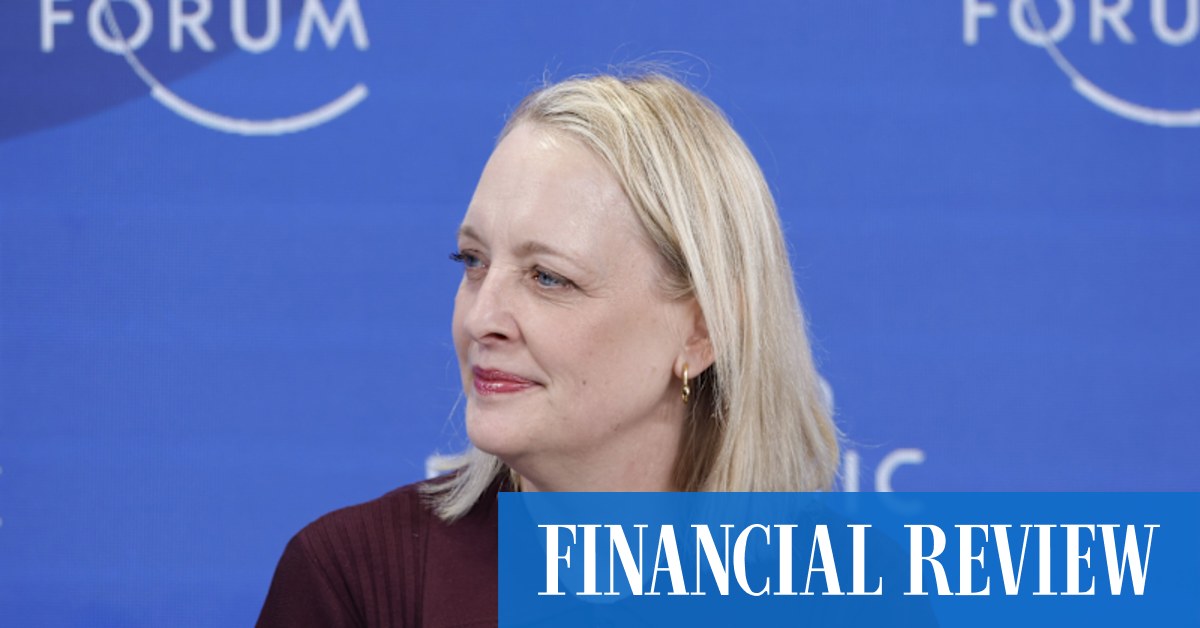
London | Accenture has started calling its nearly 800,000 employees “reinventors”, as the consultancy overhauls itself to adapt to the explosion of artificial intelligence and advises companies adopting the technology.
The label has already been used by chief executive Julie Sweet and the New York-listed group is pushing to have the term adopted more widely, according to people at the firm.
SoundHound uses AI to interpret human speech, applying its technology for commercial applications such as taking verbal orders from customers.
Astera Labs provides hardware products that are the nuts and bolts for powering AI systems.
10 stocks we like better than SoundHound AI ›
The rise of artificial intelligence (AI) has unleashed a tidal wave of related businesses to consider investing in. Among these are SoundHound AI(NASDAQ: SOUN) and Astera Labs(NASDAQ: ALAB).
The former delivers voice-enabled AI that companies can make use of in customer interactions, such as taking orders at restaurant drive-thrus. The latter acts behind the scenes, providing components used in data centers.
Both are seeing strong sales growth thanks to the demand for AI-related technologies. But which looks likely to be the better long-term investment?
Image source: Getty Images.
Buying SoundHound shares means accepting plenty of volatility, given its beta of nearly 3. For example, last December, the stock skyrocketed to a 52-week high of $24.98, but fell back to earth in 2025, hitting a 52-week low of $6.52 on April 7 after President Donald Trump’s tariff policies caused the stock market to crash.
SoundHound’s share price resurgence occurred in October after investment bank H.C. Wainwright raised its price target on the stock to $26. The average target among Wall Street analysts is now $16.94.
This wild ride illustrates how AI’s popularity among investors has impacted the stock, as well as the fact that the company has both strengths and shortcomings.
For instance, the AI voice expert has achieved a number of notable wins this year. In October, it announced an expanded agreement with French insurance provider Apivia Courtage, a deal that came about thanks to the impressive results delivered by SoundHound’s agentic AI. In the third quarter, SoundHound’s sales soared to record revenue of $42 million, a 68% year-over-year increase.
However, the company made a number of acquisitions that, while turbocharging sales, dramatically boosted its costs. Consequently, it booked a net loss of $109.3 million in the third quarter, an increase of more than 400% from its loss of $21.8 million in the prior-year period. That substantial sum, against revenue of $42 million, is concerning, although the company indicated it is working to reduce expenses.
Astera Labs’ share price moves were more favorable for shareholders. The stock went from a 52-week low of $47.13 during the April crash to a high of $262.90 on Sept. 18.
Shares surged in September in the wake of Wall Street analyst upgrades, such as Deutsche Bank setting a price target of $200. But Astera’s strong business performance justified those analyst moves.
The company generated record third-quarter revenue of $230.6 million, an impressive 104% year-over-year increase. This helped Astera achieve quarterly net income of $91.1 million, a vast improvement over its net loss of $7.6 million in the prior-year period.
That success was driven by demand for its data center components, which enable AI systems to operate with greater speed and efficiency. To further strengthen its offerings, the company is acquiring aiXscale Photonics, a German specialist in optical-glass coupling technology. That will give Astera the ability to provide the high-bandwidth, low-power solutions needed by customers as AI tech infrastructure expands to data centers the size of small cities.
Both SoundHound and Astera Labs have benefited from the AI megatrend. But while both companies delivered revenue increases in the third quarter, looking out over a longer time frame provides an important insight for comparing them: Astera has experienced the stronger sales growth over time.
Data by YCharts. TTM = trailing 12 months.
Adding to this is the fact that Astera is profitable. SoundHound is not: In the third quarter, it booked an adjusted EBITDA (earnings before interest, taxes, depreciation, and amortization) loss of $14.5 million. However, management believes it can reach profitability on an adjusted EBITDA basis in the near future.
In terms of valuation, both companies are at about the same level when viewed through the lens of their price-to-sales ratios. This metric measures how much investors are willing to pay for every dollar of revenue produced over the trailing 12 months, and is commonly used to gauge the values of companies that are unprofitable, such as SoundHound.
Data by YCharts.
SoundHound’s valuation soared early in 2025, and that contributed to its share price drop as the year progressed. Now, its valuation is more reasonable.
However, considering Astera has about the same sales multiple, yet is a profitable business with stronger revenue growth over time, it is the superior AI stock to invest in today.
Before you buy stock in SoundHound AI, consider this:
The Motley Fool Stock Advisor analyst team just identified what they believe are the 10 best stocks for investors to buy now… and SoundHound AI wasn’t one of them. The 10 stocks that made the cut could produce monster returns in the coming years.
Consider when Netflix made this list on December 17, 2004… if you invested $1,000 at the time of our recommendation, you’d have $580,171!* Or when Nvidia made this list on April 15, 2005… if you invested $1,000 at the time of our recommendation, you’d have $1,084,986!*
Now, it’s worth noting Stock Advisor’s total average return is 1,004% — a market-crushing outperformance compared to 194% for the S&P 500. Don’t miss the latest top 10 list, available with Stock Advisor, and join an investing community built by individual investors for individual investors.
See the 10 stocks »
*Stock Advisor returns as of November 24, 2025
Robert Izquierdo has positions in SoundHound AI. The Motley Fool recommends Astera Labs. The Motley Fool has a disclosure policy.
Better Artificial Intelligence Stock: SoundHound AI vs. Astera Labs was originally published by The Motley Fool
Sergey Brin gave away more than $1.1 billion worth of Alphabet Inc. stock this week, with most of the money going to a nonprofit the Google co-founder created.
The donation was disclosed Friday in a regulatory filing, which didn’t specify who had received the more than 3.5 million shares. According to a spokesperson for Brin’s family office, roughly $1 billion in stock is going to Catalyst4, which the billionaire started in 2021 with the dual purpose of supporting research into central nervous system diseases and climate-change solutions.
Brin is also giving about $90 million to his family foundation, the spokesperson said, as well as $45 million to the Michael J. Fox Foundation, which supports research into Parkinson’s disease. In May, Brin had previously doled out Alphabet shares worth $700 million to the same three charities.
Brin, 52, is the world’s fourth richest person, with a $255.5 billion fortune, according to the Bloomberg Billionaires Index. His net worth has soared this year thanks to a rally in Alphabet shares, which hit a high of $323 on Tuesday boosted by company’s artificial intelligence gains. Brin owns a roughly 6% aggregate stake of the business and has seen his fortune gain $97.3 billion this year so far.
The consensus analyst price target for Infosys has increased slightly from ₹1,706 to ₹1,719, which signals a shift in sentiment among market watchers. This uptick comes as analysts weigh a mix of robust client demand and cautious optimism about the company’s potential for steady growth. Stay tuned to discover how you can keep track of ongoing shifts in the Infosys stock narrative going forward.
Analyst Price Targets don’t always capture the full story. Head over to our Company Report to find new ways to value Infosys.
Analyst commentary continues to shape the outlook on Infosys, with perspectives split between cautious optimism and calls for vigilance on valuation and competitive pressures. Here is a breakdown of the latest sentiment from the Street:
🐂 Bullish Takeaways
Recent analyst price targets reflect supportive sentiment. An upward revision indicates a degree of renewed confidence around client demand and delivery execution.
The increased consensus target highlights analyst belief in steady growth momentum and a positive assessment of Infosys’s operational execution.
While few specifics were provided, the trend of modest price target hikes suggests analysts are rewarding the company’s focus on cost control and steady performance in a competitive market.
🐻 Bearish Takeaways
Some analysts remain cautious, referencing reservations about near-term risks to growth and whether recent valuation increases have already priced in much of the upside.
Concerns around broader sector pressures and conservative forecasting continue to temper expectations for outperformance.
Do your thoughts align with the Bull or Bear Analysts? Perhaps you think there’s more to the story. Head to the Simply Wall St Community to discover more perspectives or begin writing your own Narrative!
NSEI:INFY Community Fair Values as at Nov 2025
US President Trump is planning to introduce a $100,000 fee for H-1B visa applications. This policy could significantly impact Infosys’s ability to deploy talent in the US and may shift dynamics across the broader technology outsourcing sector.
Infosys has unveiled a new AI Agent designed for the energy sector. Leveraging generative AI, cloud infrastructure, and Microsoft Copilot, the solution is expected to enhance operational efficiency and workplace safety for clients in this field.
The company has launched Infosys Topaz Fabric, a comprehensive AI-led platform for data and IT service delivery. The aim is to accelerate digital transformation for enterprises and provide enhanced support for evolving technology needs.
Infosys has entered a strategic partnership with Metro Bank and Workday to overhaul and centralize Metro Bank’s finance operations, utilizing cloud-native platforms and advanced Workday solutions.
Consensus Analyst Price Target has risen slightly from ₹1,706 to ₹1,719, reflecting updated valuation estimates.
Discount Rate has increased marginally from 15.88% to 15.99%.
Revenue Growth projection has declined modestly, moving from 5.55% to 5.45%.
Net Profit Margin is up slightly from 16.55% to 16.57%.
Future P/E multiple has edged higher from 32.45x to 32.59x.
Narratives are a smarter, story-driven way to make sense of investing. They connect the numbers, such as fair value and future forecasts, to the real story behind a company and make it easy for everyone to understand. On Simply Wall St’s Community page, millions of investors use Narratives to track how a company’s fair value changes compared to its price. Narratives update automatically when new news or data is released, helping you stay informed.
Read the original Infosys Narrative for the full story, and follow along to discover:
This article by Simply Wall St is general in nature. We provide commentary based on historical data and analyst forecasts only using an unbiased methodology and our articles are not intended to be financial advice. It does not constitute a recommendation to buy or sell any stock, and does not take account of your objectives, or your financial situation. We aim to bring you long-term focused analysis driven by fundamental data. Note that our analysis may not factor in the latest price-sensitive company announcements or qualitative material. Simply Wall St has no position in any stocks mentioned.
Companies discussed in this article include INFY.nsei.
Have feedback on this article? Concerned about the content? Get in touch with us directly. Alternatively, email editorial-team@simplywallst.com
More than $250 billiion are parked in donor advised funds and nonprofits need better strategies for moving fundholders to grant them quickly.
Getty Images/iStockphoto
The biggest problem with donor advised funds (DAFs) is that once people establish them – and enjoy a big tax break – they are often slow to donate the contents to charity. Americans have an estimated $251 billion stashed in these charitable accounts that could be put to work attacking problems like hunger, disease and poverty.
Hard work is needed to move more DAF holders to stop procrastinating and donate more of that money now.
It’s not that DAF-holders are gaming the system in some way. There is no way for them to use the money in these accounts for their personal gain. But there is nothing in the laws that regulate DAFs – a minimum required annual distribution, for example – that pushes people to quickly give the money to charity.
This week on Giving Tuesday one will see numerous efforts to inspire DAF holders to “liberate” funds to promote social good.
More nonprofits are including information for giving from DAFs in their Giving Tuesday programs.
Getty Images/iStockphoto
This is part of a trend in which more online fundraising platforms and advisors are encouraging nonprofits to be explicit about asking potential contributors to “recommend a grant from your donor advised fund” and providing them with detailed information on how to do so.
The American Cancer Society handles it this way, for example. And here is McMurry University’s DAF “How To Give” page.
With hundreds of billions in potential contributions socked away in DAFS it is uncontestable that serious fundraising organizations need to make it easier for DAF owners to give. But that sort of work should not be considered heroic. Those are simply table stakes for being a serious player in the nonprofit development world. Moving the dial even more will require greater creativity.
I recently came across an example of such “DAF-ativity” in the form of a program called #HalfMyDAF that was created, on a personal philanthropic level, by David Risher, the CEO of Lyft, and his wife Jennifer.
The power of this program was one of the reasons the couple was recently honored by Worth for “redefining success through purpose, creativity and impact.”
Each year since the Rishers created #HalfMyDAF in 2020, it has offered up a pool of matching funds as an incentive for DAF owners to commit to spend down at least half of the money parked in their accounts.
“Over the last five years, #HalfMyDAF partners and hundreds of DAF donors have made thousands of grants and moved over $70 million from DAFs to nonprofits.”
According to the program, “Over the last five years, #HalfMyDAF partners and hundreds of DAF donors have made thousands of grants and moved over $70 million from DAFs to nonprofits.” This year the matching pool hit $2.25 million thanks to the generosity of the Rishers and three other donors. Nearly 1,700 matching donations were made to groups ranging from A Place For All Animal Rescue to Zero Prostate Cancer.
That’s impressive progress, but the people behind #HalfMyDAF recognize that they have not turned the tide. “Way more money is being put into DAFs than is moving out,” #HalfMyDAF explains on its website. The amount of money sitting in DAFs has more than doubled from $120 billion to $251 billion since the program was started in 2020.
One high potential accelerant, according to #HalfMyDAF: greater action by sponsors of DAF programs (e.g. Fidelity, Vanguard and Schwab) to encourage DAF holders to more rapidly pay out funds. As #HalfMyDAF puts it: “DAF sponsors should be recommending that donors do a lot more, with the goal of spending down DAFs rather than growing them.”
The Philippines’s headline CPI likely eased slightly to 1.6% on year in November, ANZ Research economists wrote. Continued rice price deflation should keep food inflation contained, while a modest rise in electricity tariffs is expected to lift utilities inflation marginally, they said.
Taiwan
Taiwan is scheduled to release consumer inflation data for November, which will be watched for signs that price pressures on the island remain subdued.
Though inflation picked up in October, it touched a four-year low in September and has been on a general downward trend over the past months, staying below the 2% level closely watched by the central bank.
The central bank expects full-year inflation to come in at 1.75%, down from 2.18% in 2024.
The government expects a cooler print too, having recently revised its 2025 CPI forecast to 1.67% from 1.76%. At the same time, it raised growth forecasts for the year amid easing trade tensions and strong export growth in the face of tariffs.
If November's CPI print signals a benign backdrop, that could shape market expectations of when the central bank will decide to start lowering interest rates.
Economists at ING expect CPI to moderate to 1.3% on year. But though inflation has remained below 2% since May, they reckon the central bank will remain on hold at its last meeting of the year in December amid stronger-than-expected economic growth.
South Korea
South Korea is scheduled to release trade and inflation data on Monday and Tuesday.
Export growth from Asia's fourth largest economy likely picked up in November amid brisk semiconductor demand. A Wall Street Journal poll of seven economists forecasts a 6.7% on-year increase in overseas shipments, up from a revised 3.5% rise in October.
Imports likely rose 2.9% on year, resulting in an estimated $8 billion trade surplus in November, compared with October's revised $6 billion surplus, the poll showed.
Semiconductors likely led export growth, with shipments of autos and car parts to the U.S. also rebounding after a U.S. tariff cut to 15% from 25% on most Korean goods, including vehicles, said Citi Research economist Jin-Wook Kim.
Headline inflation in November likely stayed above the central bank's 2.0% target for a third consecutive month. A WSJ poll of nine economists forecasts a 2.4% on-year CPI increase, unchanged from October.
Higher fuel costs likely added to inflationary pressure, amid rising oil-import prices and a weaker won, the economists say. On a monthly basis, CPI likely edged down 0.2% in November after a 0.3% gain in October, the poll showed. The Bank of Korea recently raised its 2025 inflation forecast to 2.1% from 2.0%.
Hong Kong
Hong Kong is set to release October retail data on Monday. Investors will be watching for clues about consumer demand in Asia's financial hub.
Retail sales returned to growth in September after a prolonged slump, though sentiment is expected to be dented after a fire this week that killed at least 94 people in Hong Kong.
Any references to days are in local times.
Write to Jessica Fleetham at jessica.fleetham@wsj.com and Jihye Lee at jihye.lee@wsj.com
Ever wondered if Andritz is actually trading below what it’s worth? Let’s break down where the value may be hiding, and what savvy investors are watching for right now.
Andritz shares have delivered strong long-term gains, up 106.6% over five years and 26.1% year-to-date, despite a recent 5.1% dip in the last month.
It’s not just price moves making headlines. Industry partnerships and major contract wins have put a spotlight on Andritz recently, fueling optimism about future prospects. Investors are closely following these developments, as they could impact both the company’s growth story and how the market views its risk profile.
On our 6-point valuation checklist, Andritz scores a 5, signaling that it passes nearly every key test for being undervalued. We’ll dig into each valuation approach in a moment, but stick around. By the end, you’ll see how a holistic view can reveal even more than traditional models.
Andritz delivered 23.4% returns over the last year. See how this stacks up to the rest of the Machinery industry.
A Discounted Cash Flow (DCF) model estimates a company’s intrinsic value by projecting its future cash flows and discounting them back to their present value. For Andritz, the model uses current free cash flow figures and analyst growth forecasts, then extrapolates future performance over the next decade.
Andritz’s most recent free cash flow stands at €374.5 million. According to analysts, this is expected to grow steadily, reaching €673.4 million by 2027. After that, Simply Wall St extrapolates these projections and estimates that annual free cash flow could rise as high as €906.5 million by 2035. Each cash flow estimate is discounted to reflect value in today’s euros, ensuring future expectations are not overstated.
Based on this model, the DCF intrinsic value for Andritz is calculated at €140.57 per share. This suggests the stock is trading at a significant 55.7% discount to its estimated fair value, highlighting substantial potential upside.
Result: UNDERVALUED
Our Discounted Cash Flow (DCF) analysis suggests Andritz is undervalued by 55.7%. Track this in your watchlist or portfolio, or discover 913 more undervalued stocks based on cash flows.
ANDR Discounted Cash Flow as at Nov 2025
Head to the Valuation section of our Company Report for more details on how we arrive at this Fair Value for Andritz.
For profitable companies like Andritz, the Price-to-Earnings (PE) ratio is a time-tested valuation multiple. It gives investors a snapshot of how much the market is willing to pay for each euro of current profit. Because it incorporates both market sentiment and recent performance, PE is widely used for companies with steady, positive earnings.
However, not all PE ratios are created equal. Growth expectations and risk play a crucial role in setting a “normal” or “fair” PE. Fast-growing or lower-risk firms typically trade at a higher PE, while slower-growth or riskier companies usually have lower ratios.
Currently, Andritz trades on a PE ratio of 13.3x. For context, the Machinery industry trades at an average PE of 23.7x, and Andritz’s immediate peers average 15.7x. At first glance, this suggests Andritz might be undervalued compared to the broader sector.
That is where Simply Wall St’s “Fair Ratio” comes in. Unlike a simple peer or industry comparison, the Fair Ratio goes further. It analyzes the company’s earnings growth, profit margins, industry profile, company size, and unique risk factors. For Andritz, the Fair Ratio is 15.6x, reflecting what investors might reasonably pay after accounting for all those variables.
Comparing the Fair Ratio (15.6x) to the current PE (13.3x) shows Andritz is trading modestly below this fair value. So, after quantifying both its strengths and risks, Andritz’s PE suggests it is potentially undervalued based on Simply Wall St’s comprehensive approach.
Result: UNDERVALUED
WBAG:ANDR PE Ratio as at Nov 2025
PE ratios tell one story, but what if the real opportunity lies elsewhere? Discover 1437 companies where insiders are betting big on explosive growth.
Earlier we mentioned that there is an even better way to understand valuation, so let’s introduce you to Narratives. A Narrative is simply your investment story, your perspective on where Andritz is headed, turning your views about future revenue, earnings, and margins into clear numbers and a fair value estimate. Narratives bridge the gap between a company’s story, the financial forecast it implies, and what you should pay for the shares today.
With Narratives on Simply Wall St’s Community page, used by millions of investors worldwide, you can easily create, update, or follow real-time investment stories. Narratives let you compare your Fair Value to the current share price so you can decide if it’s time to buy, hold, or sell. They stay up to date as new information like earnings or news comes in.
For example, one Andritz Narrative assumes robust hydropower growth, margin expansion, and a price target of €80, while another more cautious viewpoint focuses on exposure to cyclical downturns and values the stock at only €43. Narratives make it simple to test your own assumptions and see how they stack up against others.
Do you think there’s more to the story for Andritz? Head over to our Community to see what others are saying!
WBAG:ANDR Community Fair Values as at Nov 2025
This article by Simply Wall St is general in nature. We provide commentary based on historical data and analyst forecasts only using an unbiased methodology and our articles are not intended to be financial advice. It does not constitute a recommendation to buy or sell any stock, and does not take account of your objectives, or your financial situation. We aim to bring you long-term focused analysis driven by fundamental data. Note that our analysis may not factor in the latest price-sensitive company announcements or qualitative material. Simply Wall St has no position in any stocks mentioned.
Companies discussed in this article include ANDR.VI.
Have feedback on this article? Concerned about the content? Get in touch with us directly. Alternatively, email editorial-team@simplywallst.com
BERLIN, Nov 30 (Reuters) – Deutsche Telekom (DTEGn.DE), opens new tab and the Schwarz Group are planning to jointly build a gigafactory for artificial intelligence, German newspaper Handelsblatt reported on Sunday.
An “AI gigafactory” is a facility designed specifically to support the massive computing needs of AI.
Sign up here.
The Germany-based telecoms giant and unlisted retailer Schwarz are in talks to apply for the large data centres funded by the European Union, the newspaper said, citing six people familiar with the matter.
The European Commission this year unveiled plans to provide $20 billion in funding to construct AI data centres to catch up with the U.S. and China.
The negotiations are said to be well advanced, but a formal agreement has not yet been reached, three people familiar with the matter told Handelsblatt.
Reporting by Maria Martinez; editing by Diane Craft
Our Standards: The Thomson Reuters Trust Principles., opens new tab
Michael Burry (Trades, Portfolio), of Big Short fame, has made some waves for calling out AI companies, alleging that they are understating depreciation by extending the useful life of assets artificially boosts earnings. In case you’re unfamiliar, Burry was one of the first to spot the housing crisis that set off the Great Recession. I have a lot of respect for Mr. Burry, so I wouldn’t write his comments off. That said, there are some important caveats worth discussing.
Separately, I’ve been lightly researching AI chip obsolescence because it’s been a popular topic on Reddit and other places. Burry’s comments immediately piqued my attention. A common argument is that AI chips become obsolete after just a few years because newer chips offer stronger computing power and/or energy efficiency. This specific argument, I believe, is misplaced because older AI chips will still have many relevant uses running older and/or lighter AI models rather than the bleeding-edge models. These lighter models represent a hot potential growth area, making older chips not just viable but valuable. I can’t say for certain that Burry is worried about obsolescence, but he has mentioned useful lifespan.
Another concern: How long will the chips last before physically breaking down? I have not found a conclusive answer, but so far, my impression is that they typically last longer than 3 years. If the lifespan average falls under three years, Burry’s argument gains a lot of strength. If the chips can last significantly longer, however, that’d create headwinds for his thesis.
So far, Burry has been rather vague concerning the matter, so it’s hard (impossible?) to evaluate his argument. Details are forthcoming, but for now, we can consider possible angles and perhaps more importantly, critique common arguments and popular beliefs. With that in mind, I believe it’s important to take a deeper look at the potential lifecycle for AI chips. Until I see Burry’s argument, I can’t really refute it, but I believe the discussion below is important, and if nothing else, will provide readers with useful food for thought. It should also act as a primer for when Burry makes his November 25th release.
Michael Burry Stirs Up Chip Depreciation Controversy: Important Context To Consider
All of this is important for investors owing to concerns over the AI race and potential bubble. Stock markets and the economy have, in many ways, been propped up by AI investments. Valuations have been pushed high with AI companies leading the charge. Outside of AI investments, the American economy seems to be teetering on the verge of recession. If Burry is correct, it’ll inject a lot of skepticism into the markets, potentially causing corrections. It could also call into question the viability of current strategies and use cases around AI.
Twenty years ago, basic home computers often started to become quite sluggish (and perhaps short on storage) within just a few years. Upgrades were common as chips advanced at a rapid pace and the advances greatly improved the home computing experience. Often, obsolescence happened quicker for laptops rather than desktops, but still, useful lifecycles could be quite short. These days, it’s pretty common to see people hold onto laptops for substantially longer because the computer still meets their needs.
I mention this anecdotal experience simply to illustrate that hardware can remain quite useful past optimal lifespans. Bleeding-edge chips will lose their bleeding-edge much more quickly, but that doesn’t mean they’re useless even when pulled from the frontier. On a roughly annual basis, new gaming GPUs come out that offer better performance than the last model, and if you want the best graphics, you’ll need to upgrade pretty quickly. The same will prove true for data center chips: the next generation will typically perform substantially better.
For developers working on bleeding-edge frontier AI models, even seemingly minor boosts in performance, energy efficiency, and other metrics can make a big difference. Those developers working on the biggest and most cutting-edge AI models will probably move to upgrade as quickly as possible. The race to develop AI right now is white hot, with multiple massive competitors pouring vast resources into development. With so much poured in and the potential upside so high, quick upgrades are not just viable but logical.
Yet while a lot of public attention and media emphasis is on bleeding-edge frontier models, lighter (and older) models still remain relevant for a variety of tasks, and when it comes to leveraging AI for use in daily life, these lighter models can be just as effective, if not more so, than the bleeding-edge models. For example, many AI models can be run on a scaled-down model version locally. This is useful for smaller developers, and also businesses that, for security needs or otherwise, want to keep their data locally hosted and perhaps completely offline.
Many AI tools, including chatbots and various agents, simply don’t need all of the power of the frontier models. Cost concerns with frontier AI models, including how expensive they are to run, are prominent. The most advanced models consume the most energy and need the most chips, making them especially expensive to run. Some sources report that a six-month training run with GPT-5 costs $500 million. To be clear, training runs are especially intensive, but the point is: running the latest models is very expensive.
Michael Burry Stirs Up Chip Depreciation Controversy: Important Context To Consider
If you look at GPT-5’s pricing (shown above), on the surface, it actually looks substantially cheaper than GPT-4 (shown below). My initial thought was that OpenAI was simply trying to encourage people to use the latest model and thus set up their price structure to encourage that. However, a very insightful post by Zack Saadioui, which I recommend you check out, offers some crucial insights. The short of it is, when you use GPT-5, the request is sent to a central router, which from there, decides which model to use based on the difficulty of your request. As shown below, there are a variety of GPT-5 models of increasing sophistication, and the lightest models are much cheaper.
Michael Burry Stirs Up Chip Depreciation Controversy: Important Context To Consider
Further, GPT-5 uses so-called reasoning tokens. These tokens basically align with the internal thought process of the model, and the more thought processes you use to process your request, the more tokens you use. Further, these tokens are counted as output tokens, which are more expensive than input. Long’ish story short: the more complex your request, the more it’s going to cost. If you need the most fully powered model and thus compute power, you’re going to pay quite a bit more. If your request is relatively simple, it’ll be directed to the lighter-weight, cheaper GPT-5 models.
Going forward, I believe we’ll see this broken down at the hardware level with the most advanced models processing the most complex requests using the most reasoning tokens to run the most cutting-edge hardware. Yet ChatGPT (and other providers) should be able to use older hardware to run lighter nano models to process simpler requests. We talk about planned obsolescence with consumer goods, but for AI companies, we’re more likely to see planned downscaling with lighter and older models simply using older chips.
Another point worth mentioning, by the way, is that Chinese developers have made major breakthroughs on limited hardware, showing how lighter models and slower GPUs can be used to produce results. I suspect the current efforts of developers in China show (at least in part) the future of older GPUs being taken off frontier development.
My general thesis that chips have a substantially longer lifespan than 3 years could quickly be disproven if we find out that chips are failing at a high rate after just a few years. The chips might have remained useful if they were still functioning, but a burned-out chip is probably little more than recycling material at this point. This is a question I’ve been trying to answer definitively with light research over the past few weeks. So far, I’m finding mixed messages.
This study found that the last time a specific AI chip is used to train a frontier model (bleeding edge) is about 2.7 years. But I’m not as concerned about frontier models as outlined above. A commenter on this forum notes that general data center chips last 4 to 6 years (I’ve seen this mentioned elsewhere for standard data centers), but suspects that AI chips will last longer. That said, a Google employee has claimed that with high utilization, chips may last only 1 to 3 years, but potentially up to 5 with more moderate use. If this is true, Burry’s worries about short lifespans may be accurate even outside of useful lifespans.
CoreWeave, so far, may offer the most conclusive evidence. In a study with a 1024 GPU cluster in operation, the Mean Time to Failure was 3.66 days, which as I understand, means that when running a cluster, the first GPU will burn out after 3.66 days. This means that over the course of a year, about 100 GPUs will burn out. Thus at a constant rate, by year three, around a third of GPUs will have burned out. This number is pretty high, but it should also be noted that researchers are finding ways to extend chip life and mitigate physical damage. Further, it’s unlikely that any cluster will actually run 24/7 365 days a year.
There is one last point I want to quickly touch on. Newer chips may prove more energy efficient than previous chips, thus lowering operating costs. At some point, the calculus could shift to newer chips being cheaper overall due to energy savings. However, computing power rather than energy efficiency seems to be the chief concern, for now, since major players are racing to build the most powerful models. Energy, while limited, simply isn’t as crucial a concern at the moment as compute is. Further, demand for compute is so high that it would likely take many years for more energy-efficient chips to satisfy demand overall, which means older chips will likely remain in use.
We’ll find out more on November 25th when Burry releases more details. I suspect there will be a lot of buzz and likely industry leaders will push back rather quickly. Hopefully, they bring forward hard evidence, including the lifespan of their chips and how they justify the depreciation, financially speaking. Markets may suffer some turbulence, but even if there is an AI bubble, I’d be surprised if this were the pin to pop it. That said, if Burry’s argument is convincing, investors heavily exposed to AI should, at the very least, take time to evaluate their positions and risks.
The Leica M-A owned by the late pontiff is one of the most valuable models ever sold at auction.
Pope Francis’s Leica M-A film camera sold for more than $7M. (photo by Christoph Welkovits, all courtesy Leitz Photographica Auction)
Say formaggio!
A blindingly white-and-silver Leica camera owned by the late Pope Francis sold at a European auction this weekend for about $7.5 million, nearly 100 times its estimate.
It was one of the most expensive Leica models ever sold, according to Leitz Photographica Auction, which announced it would auction the Pope’s mechanical camera for charity in September. The record is still held by a 100-year-old prototype that sold for $16.7 million in 2022.
The camera company presented a personalized Leica M-A film camera and its Noctilus-M 50 mm lens to his holiness last year. In a statement, the auction house said Pope Francis had decided to auction the Leica and donate the proceeds “in keeping with his commitment to charity and social causes.”
The camera was gifted to the pontiff before he passed away last year.
The camera kit features several unique elements that distinguish it from its base model, which retails for about $6,300 for the body and another $8,500 for the lens, before taxes. It carries a distinctive serial number of 5000000, which is valuable to collectors, and its white-painted top plate includes an engraving with Pope Francis’s motto miserando atque eligendo (which translates to “by having mercy and choosing,” drawn from a homily on the call of Saint Matthew by Saint Bede the Venerable). The flash cover is engraved with the keys of Peter.
Both the body and lens caps are engraved with the Coat of Arms of the State of Vatican City, and the camera and lens include an etching that reads “AD MMXXIV,” the year Leica presented the Pope with the gift in Roman numerals.
The white-painted top plate is engraved with Pope Francis’s motto.
It’s unclear whether Pope Francis got to use his camera much, but he didn’t own it very long. He passed away this spring at the age of 88, several months after receiving the gift.
Though the pontiff did not specifically express his views on photography, he was a vocal supporter of art and artists. “Architects and painters, sculptors and musicians, filmmakers and writers, photographers and poets, artists of every discipline, are called to make beauty shine,” he said during a 2016 address to the Pontifical Academies, “especially where darkness and greyness dominate everyday life.”