Category: 3. Business

  • The Bull Case For Keppel REIT (SGX:K71U) Could Change Following S$100 Million Perpetual Securities Issue

    The Bull Case For Keppel REIT (SGX:K71U) Could Change Following S$100 Million Perpetual Securities Issue

    • Keppel REIT recently issued S$100 million in subordinated perpetual securities under its multicurrency debt programme, having received approval-in-principle for listing on the Singapore Exchange.

    • This move is set to provide Keppel REIT with greater financial flexibility and supports its plans for future portfolio growth.

    • We will assess how the increased capital flexibility from this perpetual securities issuance could shift Keppel REIT’s investment narrative.

    Uncover the next big thing with financially sound penny stocks that balance risk and reward.

    To be a shareholder in Keppel REIT, you need confidence in the continued strong demand for premium Grade A office space in Singapore and regional gateway cities, as well as the trust’s ability to manage sector and geographic concentration risks. The recent S$100 million perpetual securities issuance boosts Keppel REIT’s capital flexibility, but does not materially change the main short-term catalyst of rental growth in key markets or the cyclical risks tied to office occupancy and portfolio concentration.

    Among recent developments, the acquisition of a 75% interest in Top Ryde City Shopping Centre in Sydney stands out. This move is relevant as it increases portfolio diversification beyond the office sector and into retail, potentially balancing the risks posed by Keppel REIT’s office-heavy exposure while positioning the trust to benefit from stable, non-discretionary retail income streams.

    Yet, while recent expansion points to greater diversification, investors should still keep an eye on the persistent risks from concentrated exposure to Singapore’s office market if…

    Read the full narrative on Keppel REIT (it’s free!)

    Keppel REIT’s narrative projects SGD319.1 million in revenue and SGD188.0 million in earnings by 2028. This requires a 6.4% annual revenue decline and an earnings increase of about 19% from today’s earnings of SGD157.8 million.

    Uncover how Keppel REIT’s forecasts yield a SGD1.06 fair value, in line with its current price.

    SGX:K71U Community Fair Values as at Nov 2025

    Simply Wall St Community members provided 2 fair value estimates for Keppel REIT, ranging from S$1.06 to S$1.72 per unit. Ongoing concerns about sector-specific downturns and portfolio concentration continue to shape differing outlooks on future performance, explore these varied perspectives to better understand your options.

    Explore 2 other fair value estimates on Keppel REIT – why the stock might be worth just SGD1.06!

    Disagree with existing narratives? Create your own in under 3 minutes – extraordinary investment returns rarely come from following the herd.

    Early movers are already taking notice. See the stocks they’re targeting before they’ve flown the coop:

    This article by Simply Wall St is general in nature. We provide commentary based on historical data and analyst forecasts only using an unbiased methodology and our articles are not intended to be financial advice. It does not constitute a recommendation to buy or sell any stock, and does not take account of your objectives, or your financial situation. We aim to bring you long-term focused analysis driven by fundamental data. Note that our analysis may not factor in the latest price-sensitive company announcements or qualitative material. Simply Wall St has no position in any stocks mentioned.

    Companies discussed in this article include K71U.SI.

    Have feedback on this article? Concerned about the content? Get in touch with us directly. Alternatively, email editorial-team@simplywallst.com

    Continue Reading

  • Does the Recent NuScale Partnership News Signal a Fresh Opportunity After a 53% Share Price Fall?

    Does the Recent NuScale Partnership News Signal a Fresh Opportunity After a 53% Share Price Fall?

    • Thinking about investing in NuScale Power? You might be wondering whether the recent ups and downs in the share price have created a new value opportunity, or if the risk profile has just shifted.

    • NuScale’s stock has moved a lot lately, climbing 7.5% over the past week, but still down 52.7% across the last month and 32.5% over the last year. This reflects a volatile period, despite a notable 12.9% gain year to date.

    • News of new project partnerships, as well as ongoing discussions about U.S. energy policy and small modular reactor adoption, have been fueling trading sentiment recently. Investors are weighing both the growth potential of NuScale’s nuclear technology and the challenges facing the broader clean energy sector.

    • With a valuation score of 1 out of 6, there is a lot to uncover about how NuScale Power stacks up on different valuation metrics. Stay tuned as we break those down and reveal a smarter way to interpret valuation at the end.

    NuScale Power scores just 1/6 on our valuation checks. See what other red flags we found in the full valuation breakdown.

    A Discounted Cash Flow (DCF) model estimates a company’s intrinsic value by forecasting its future cash flows and discounting them back to today. This approach attempts to answer what NuScale Power is fundamentally worth based on current and expected financial performance.

    Currently, NuScale Power’s latest twelve-month Free Cash Flow (FCF) sits at a negative $284.0 million, and analysts expect the company to remain cash flow negative for the next several years. According to projections, NuScale’s FCF is only expected to turn positive by 2029, reaching $27.4 million, with continued growth beyond that point driven by anticipated deployment of its modular nuclear technology. Notably, the longer-term FCF forecasts, extending out to 2035, are largely extrapolated from analyst consensus.

    Plugging these estimates into the DCF model yields a “fair value” of $3.20 per share. Compared to the current market price, this implies the stock is 525% above its calculated intrinsic value, suggesting significant overvaluation at present.

    The DCF model, therefore, paints a challenging picture for value seekers. NuScale’s growth narrative is not yet reflected in its cash flows, and the stock trades with a large premium to its estimated worth.

    Result: OVERVALUED

    Our Discounted Cash Flow (DCF) analysis suggests NuScale Power may be overvalued by 525.0%. Discover 917 undervalued stocks or create your own screener to find better value opportunities.

    SMR Discounted Cash Flow as at Nov 2025

    Head to the Valuation section of our Company Report for more details on how we arrive at this Fair Value for NuScale Power.

    The Price-to-Book (P/B) ratio is a widely used valuation metric, especially for companies where traditional earnings or cash flow metrics may not yet reflect future potential. This often includes innovative but unprofitable businesses like NuScale Power. The P/B ratio captures the relationship between a company’s market value and its net assets, making it relevant when investor focus is on the value of assets and future growth prospects rather than current profits.

    Growth expectations and risks both play a crucial role in determining what an appropriate or “fair” P/B ratio should be. High growth prospects can justify a premium, while greater risk or asset uncertainty typically means a lower fair multiple. For NuScale Power, the current P/B sits at 6.72x, which is significantly above the electrical industry average of 2.38x and the peer group average of 18.32x. This signals that the market expects substantial future value creation from NuScale’s assets compared to most competitors.

    Simply Wall St’s proprietary “Fair Ratio” is designed to refine this comparison. Unlike raw peer or industry averages, the Fair Ratio blends factors like NuScale’s earnings growth outlook, profit margins, market cap, sector trends, and risk profile. This offers a more tailored assessment of what multiple is justifiable for the company now, factoring in its distinct position and prospects in the market.

    Comparing NuScale Power’s current P/B of 6.72x to its Fair Ratio, the difference is meaningful. This suggests the stock is OVERVALUED on a price-to-book basis at the moment and may not yet offer an attractive entry point for value-seeking investors.

    Result: OVERVALUED

    NYSE:SMR PB Ratio as at Nov 2025
    NYSE:SMR PB Ratio as at Nov 2025

    PB ratios tell one story, but what if the real opportunity lies elsewhere? Discover 1439 companies where insiders are betting big on explosive growth.

    Earlier we mentioned that there is an even better way to understand valuation, so let’s introduce you to Narratives, a dynamic, story-driven approach to investing used by millions of investors on Simply Wall St’s Community page.

    A Narrative is your personal way of connecting the company’s story and your perspective to informed numbers. You explain what you believe will drive NuScale Power’s future, estimate upcoming revenues, earnings, and margins, and see how that translates to a fair value for the stock.

    With Narratives, you can easily compare your fair value estimate to NuScale’s current price, helping decide if now is the right time to buy or sell based on your outlook rather than just traditional metrics.

    What makes Narratives especially powerful is that they update automatically when new information comes in, such as earnings results or major news, so your view stays current without extra work on your part.

    For example, some NuScale Power Narratives are much more bullish, forecasting a fair value as high as $40.50 per share based on rapid deployment and major utility deals, while others are more cautious, seeing risks and setting fair values as low as $17.00 per share. This shows how quickly perspectives and valuations can change as the story unfolds.

    Do you think there’s more to the story for NuScale Power? Head over to our Community to see what others are saying!

    NYSE:SMR Community Fair Values as at Nov 2025
    NYSE:SMR Community Fair Values as at Nov 2025

    This article by Simply Wall St is general in nature. We provide commentary based on historical data and analyst forecasts only using an unbiased methodology and our articles are not intended to be financial advice. It does not constitute a recommendation to buy or sell any stock, and does not take account of your objectives, or your financial situation. We aim to bring you long-term focused analysis driven by fundamental data. Note that our analysis may not factor in the latest price-sensitive company announcements or qualitative material. Simply Wall St has no position in any stocks mentioned.

    Companies discussed in this article include SMR.

    Have feedback on this article? Concerned about the content? Get in touch with us directly. Alternatively, email editorial-team@simplywallst.com

    Continue Reading

  • China's factory activity shrinks again in November, services activity cools – Reuters

    1. China’s factory activity shrinks again in November, services activity cools  Reuters
    2. Chinese Factory Activity Slump Reaches Longest Stretch on Record  Bloomberg.com
    3. China November non-manufacturing activity contracts for first time in nearly three years  Deccan Herald
    4. China’s factory activity shrinks again in November, services activity cools By Reuters  Investing.com
    5. China’s manufacturing activity improves, as PMI ticks up to reach 49.2 in November  Global Times

    Continue Reading

  • Brazil Just Closed A Major Crypto Loophole—And Stablecoin Users Should Pay Attention

    Brazil Just Closed A Major Crypto Loophole—And Stablecoin Users Should Pay Attention

    Benzinga and Yahoo Finance LLC may earn commission or revenue on some items through the links below.

    Brazil’s central bank just tightened the screws on cryptocurrency trading with new regulations that could reshape how millions of Latin Americans use digital assets—particularly stablecoins that have become a popular workaround for traditional banking systems.

    The long-awaited rules, announced on Nov. 11, will extend existing anti-money laundering and terrorism financing regulations to virtual-asset service providers starting in February. For a country where crypto adoption has exploded in recent years, this is the most significant regulatory shift since Brazil approved its cryptocurrency legal framework in 2022.

    Don’t Miss:

    The timing isn’t coincidental. Brazilian Central Bank Governor Gabriel Galipolo has raised concerns about the growing use of stablecoins—digital currencies pegged to real-world assets like the U.S. dollar—that are often associated with illicit activity

    “New rules will reduce the scope for scams, fraud, and the use of virtual asset markets for money laundering,” central bank Director of Regulation Gilneu Vivan said at a press conference, Reuters reported.

    Here’s what makes stablecoins particularly tricky from a regulatory standpoint: they’re less volatile than cryptocurrencies like Bitcoin, making them more useful for payments than investments. Many users have gravitated toward them specifically to bypass more heavily supervised and taxed traditional payment systems—which is exactly what policymakers want to prevent.

    Trending: Buffett’s Secret to Wealth? Private Real Estate—Get Institutional Access Yourself

    The updated regulations will treat stablecoin transactions similarly to traditional currency exchanges. Buying, selling or swapping virtual assets tied to government-issued currencies will fall under foreign exchange rules, according to Reuters. Cross-border payments using digital assets—including card purchases and other electronic payment methods—will receive the same regulatory treatment.

    This isn’t just semantic hairsplitting. By reclassifying these transactions as foreign exchange operations, Brazil’s central bank is bringing them under the same regulatory umbrella as traditional currency exchanges—complete with customer protection requirements, transparency standards, and compliance obligations.

    The new framework will require virtual-asset service providers to meet standards around corporate oversight, security protocols, internal monitoring systems, and mandatory disclosures to regulators, according to Reuters. Authorization processes will now cover foreign-exchange and securities brokers, distributors, and virtual-asset service providers.

    See Also: Wall Street’s $12B Real Estate Manager Is Opening Its Doors to Individual Investors — Without the Crowdfunding Middlemen

    Brazil’s moves matter beyond its borders. As Latin America’s largest economy, regulatory decisions made in Brasilia often influence policy discussions throughout the region. The country held four public consultations before finalizing these rules, suggesting authorities were trying to strike a balance between innovation and oversight.

    The central bank’s statement emphasized that the framework includes customer protection requirements and transparency standards that previously didn’t apply to virtual-asset service providers. For legitimate crypto users, these protections could actually increase confidence in the ecosystem by weeding out bad actors.

    But for those who turned to stablecoins specifically to avoid traditional banking oversight, February marks the end of that regulatory arbitrage. The new rules are a clear signal that Brazilian authorities view unregulated crypto activity as a systemic risk worth addressing—even if it means slowing down an industry that has seen explosive growth.

    The question now is whether other Latin American countries follow Brazil’s lead in closing what has become a significant regulatory gap in the global financial system.

    Read Next: $100k+ in investable assets? Match with a fiduciary advisor for free to learn how you can maximize your retirement and save on taxes – no cost, no obligation.

    Image: Shutterstock

    This article Brazil Just Closed A Major Crypto Loophole—And Stablecoin Users Should Pay Attention originally appeared on Benzinga.com

    Continue Reading

  • China's factory activity shrinks for eighth month in November, PMI shows – Reuters

    1. China’s factory activity shrinks for eighth month in November, PMI shows  Reuters
    2. China’s factory activity shrinks for eighth month in November, PMI shows By Reuters  Investing.com
    3. Chinese Factory Activity Slump Reaches Longest Stretch on Record  Bloomberg.com
    4. China’s Manufacturing Struggles Expected to Continue as Policymakers Weigh Reform Versus Stimulus  Tekedia
    5. China’s Factory Activity Set to Shrink for Eighth Month – Reuters Poll  US News Money

    Continue Reading

  • PSX up 2.8% WoW, extends monthly rally

    PSX up 2.8% WoW, extends monthly rally

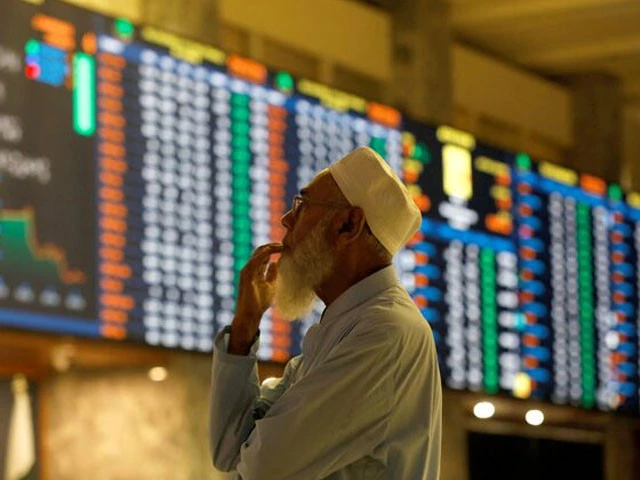
    A stock broker reacts while monitoring the market on the electronic board displaying share prices during trading session at the Pakistan Stock Exchange, in Karachi on July 3, 2023. Photo: Reuters/ File


    KARACHI:

    The KSE-100 index closed the week on a strong note, rising 2.8% to settle at 166,678 points as broad-based buying in fertiliser, banks, technology, cement and exploration & production (E&P) sectors lifted sentiment despite a sharp drop in trading volumes.

    The latest advance reinforced the market’s upward trajectory in November, during which the benchmark index added 5,046 points month-on-month (MoM), supported by sector-specific catalysts and improving macro indicators.

    On a day-on-day basis, the PSX experienced a neutral Monday, marked by muted volatility and limited movement as investors awaited clearer signals on the first day of the rollover week. The KSE-100 index settled at 161,984, down 119 points, or 0.07%.

    Tuesday was another lacklustre day as the index closed at 161,693, down 292 points, or 0.18%. Finally, as the rollover week progressed, the bourse began to show signs of recovery on Wednesday, with the KSE-100 closing at 163,189, up 1,496 points, or 0.93%.

    On Thursday, bulls gained firm control as concerns surrounding the rollover week subsided. The index posted strong gains, closing at 165,373, up 2,185 points, or 1.34%. Notably, the index reclaimed the 165k level at close after 25 days, which was last seen on October 22.

    On Friday, the PSX closed November 2025 on a strong note as the KSE-100 extended its upward momentum to settle at 166,678, gaining 1,304 points, or 0.99%.

    Arif Habib Limited (AHL) noted that the KSE-100 index gained momentum in Nov’25 and closed at 166,678, posting a MoM increase of 5,046 points. The market’s bullish shift was driven by positive sector catalysts. The fertiliser sector gained pace after getting the government’s approval to shift from costly re-gasified liquefied natural gas (RLNG) to Mari gas, which would ease subsidy pressure and support stable urea prices.

    Fauji Fertiliser Company (FFC) outperformed on its KMI-30 inclusion, Pakistan Petroleum Ltd (PPL) benefited from interest in the upcoming offshore exploration activity and progress on Reko Diq’s financial close while Pioneer Cement rallied on potential M&A developments, AHL said.

    In Nov’25, the KSE-100 depicted a return of 3.1% and 3.3% in rupee and dollar terms, respectively. During the week, Pakistan recorded a trade deficit of $3.28 billion in Oct’25. Cumulatively, the 4MFY26 trade deficit widened 38.9% year-on-year (YoY) to $12.6 billion.

    The large-scale manufacturing (LSM) output grew 2.7% YoY in Sept’25, accompanied by a 2% uptick on a MoM basis. Remittances by overseas Pakistanis rose 12% YoY to $3.42 billion in Oct’25 versus $3.05 billion in Oct’24, while cumulative inflows during 4MFY26 stood at $12.96 billion, up 9% YoY, AHL added.

    “KSE-100 closed the week on a strong note,” commented Muhammad Waqas Ghani, Research Head at JS Global. The index opened the week at 162,103 and closed at 166,678, up 4,575 points (+2.8%). The rally was broad-based, with fertiliser (+4.9%), banking (+2.9%), tech & communication (+2.8%), cement (+2.6%) and E&P (+2.5%) sectors driving the sentiment.

    However, average daily traded volumes slipped 47% WoW, reflecting a more selective trading environment, Ghani said. The government raised over Rs1 trillion through auctions of T-bills, PIBs and Government Ijara Sukuk. Notably, during the T-bill auction held during the week, the government raised Rs749 billion against the target of Rs650 billion, with yields easing 4-10 basis points across different tenors.

    On the IMF front, the lender flagged a lack of internal audits and weak parliamentary oversight as major risks to public funds. In the energy sector, Ogra recommended an increase in gas tariffs for SSGC and SNGPL in its tariff determination. In other news, despite media speculation about potential divestments or restructuring, Barrick’s interim CEO Mark Hill reaffirmed the company’s commitment to the Reko Diq copper and gold mining project, the JS research head said. Lastly, the State Bank’s forex reserves stood stable at $14.6 billion.

    Continue Reading

  • Data Centers Are a ‘Gold Rush’ for Construction Workers – The Wall Street Journal

    1. Data Centers Are a ‘Gold Rush’ for Construction Workers  The Wall Street Journal
    2. As AI Data Centers Face Delays, the Blame Game Begins  The Information
    3. Mandel in the Wyoming Star: EXCLUSIVE: The Great Build-Out. Part 3. Economics of Data Center Construction.  Progressive Policy Institute
    4. BCC Research Announces Fourth Webinar in AI Series: AI and the Future of Data Centres  GlobeNewswire
    5. 2025 U.S. Data Center Construction Market Forecast: Growth to 2033 Driven by AI & Cloud  Construction Owners Club

    Continue Reading

  • While institutions invested in Reece Limited (ASX:REH) benefited from last week’s 16% gain, private companies stood to gain the most

    While institutions invested in Reece Limited (ASX:REH) benefited from last week’s 16% gain, private companies stood to gain the most

    • The considerable ownership by private companies in Reece indicates that they collectively have a greater say in management and business strategy

    • The top 4 shareholders own 51% of the company

    • 13% of Reece is held by insiders

    Trump has pledged to “unleash” American oil and gas and these 15 US stocks have developments that are poised to benefit.

    If you want to know who really controls Reece Limited (ASX:REH), then you’ll have to look at the makeup of its share registry. And the group that holds the biggest piece of the pie are private companies with 58% ownership. That is, the group stands to benefit the most if the stock rises (or lose the most if there is a downturn).

    While private companies were the group that benefitted the most from last week’s AU$1.1b market cap gain, institutions too had a 15% share in those profits.

    Let’s take a closer look to see what the different types of shareholders can tell us about Reece.

    View our latest analysis for Reece

    ASX:REH Ownership Breakdown November 30th 2025

    Institutions typically measure themselves against a benchmark when reporting to their own investors, so they often become more enthusiastic about a stock once it’s included in a major index. We would expect most companies to have some institutions on the register, especially if they are growing.

    We can see that Reece does have institutional investors; and they hold a good portion of the company’s stock. This implies the analysts working for those institutions have looked at the stock and they like it. But just like anyone else, they could be wrong. When multiple institutions own a stock, there’s always a risk that they are in a ‘crowded trade’. When such a trade goes wrong, multiple parties may compete to sell stock fast. This risk is higher in a company without a history of growth. You can see Reece’s historic earnings and revenue below, but keep in mind there’s always more to the story.

    earnings-and-revenue-growth
    ASX:REH Earnings and Revenue Growth November 30th 2025

    Hedge funds don’t have many shares in Reece. The company’s largest shareholder is L.T. Wilson Pty Ltd., with ownership of 25%. Meanwhile, the second and third largest shareholders, hold 9.7% and 7.9%, of the shares outstanding, respectively.

    To make our study more interesting, we found that the top 4 shareholders control more than half of the company which implies that this group has considerable sway over the company’s decision-making.

    While studying institutional ownership for a company can add value to your research, it is also a good practice to research analyst recommendations to get a deeper understand of a stock’s expected performance. There are a reasonable number of analysts covering the stock, so it might be useful to find out their aggregate view on the future.

    Continue Reading

  • Consistency key to startup success

    Consistency key to startup success


    KARACHI:

    Consistency is emerging as the defining currency of startup success, overshadowing capital, connections and even innovative ideas. This was the dominant message at Build Up 2025, an annual entrepreneurship forum hosted by Invest2Innovate (i2i) in Karachi.

    Across high-impact panel discussions, founders and investors agreed that persistence, clarity of purpose, and disciplined financial behaviour are the pillars that determine which startups break through Pakistan’s challenging market environment.

    The panel, “The Art of Selling: Convincing Customers, Partners & Investors,” moderated by Qist Bazaar’s Arif Lakhani, spotlighted the emotional and practical exhaustion that accompanies early-stage sales. Speakers stressed that rejection is not an obstacle but an unavoidable phase that founders must survive to get their product accepted.

    One of the day’s most powerful illustrations came from Haball’s Omar bin Ahsan, who recalled meeting the same potential clients up to 40 times before finally closing a major deal, and being rejected an equal number of times along the way. “You must not give up,” he said, calling persistence the only reliable predictor of sales success in Pakistan’s B2B landscape.

    Panellists explained that before a product can be sold, the founder must “sell themselves.” Building trust, they said, is the make-or-break factor in an ecosystem where clients often refuse a pitch simply because they “have not heard your name.”

    For BusCaro’s Maha Shahzad and others on the panel, trust building begins with the founder’s credibility, image and consistency in fulfilling commitments. “You must deliver every promise you make about your product,” one speaker said, emphasising that quality and reliability form the foundation of customer acceptance.

    Contrary to the instinct of many new entrepreneurs, some panellists strongly discouraged placing products directly in large supermarkets. Launching in big retail chains too early, they warned, destroys margins due to high listing fees, tight payment cycles and promotional costs. Instead, founders were advised to first sell through neighbourhood stores and street-level retail to build organic demand.

    The panel also tackled the sensitive question of whether references to father or uncle could accelerate sales. Speakers acknowledged that powerful references may help secure an introductory meeting. A large retailer may entertain a pitch if a senior official recommends it. But beyond that initial opening, they agreed, influence has no power. Poor-quality products pushed through influence may see early traction, but cannot achieve long-term success.

    Another discussion, “The Pressure to Raise & What Happens After,” moderated by i2i Ventures’ Misbah Naqvi, shifted focus from sales to funding, a topic that brought equally candid reflections. Panellists included Salesflo’s Sharoon Saleem, Myco’s Somair Rizvi and Sehat Kahani’s Dr Sara Saeed.

    If consistency defines sales, the speakers argued, then clarity defines fundraising. Founders must be able to state the problem they are solving and the solution in a single sentence. Pitching, they added, is not an inherent skill but an art that must be practised repeatedly. Speakers agreed that funding comes with responsibilities.

    The fundraising panel, moderated by Misbah Naqvi, Co-founder of i2i Ventures, highlighted a fundamental debate: is external funding necessary?

    Panellist Sharoon Saleem of Salesflo emphasised bootstrapping, noting, “We don’t go to fundraising.” This perspective contrasts with the traditional view, acknowledging that capital infusion brings added responsibilities. Dr Sara Saeed of Sehat Kahani and other panellists agreed that funding is a continuous process that presents new tasks and challenges, as founders are liable to deliver on their promises to investors.

    The key takeaway was that capital deployment demands rigour. Founders must be clear on where the money will be used and be flexible with their plans. If funds are wasted, the next investor will know, making prudent capital deployment as crucial as the pitch itself.

    Omar bin Ahsan of Haball advised founders to take market risks to gauge where and why rejection is occurring. “You must assess the reasons for rejection, then effectively sell yourself and your product. Ultimately, you need to establish and earn client trust as the trust factor is critical for sales.”

    Continue Reading

  • With 46% ownership in Sims Limited (ASX:SGM), institutional investors have a lot riding on the business

    With 46% ownership in Sims Limited (ASX:SGM), institutional investors have a lot riding on the business

    • Significantly high institutional ownership implies Sims’ stock price is sensitive to their trading actions

    • A total of 6 investors have a majority stake in the company with 51% ownership

    • Recent sales by insiders

    We’ve found 21 US stocks that are forecast to pay a dividend yield of over 6% next year. See the full list for free.

    A look at the shareholders of Sims Limited (ASX:SGM) can tell us which group is most powerful. And the group that holds the biggest piece of the pie are institutions with 46% ownership. That is, the group stands to benefit the most if the stock rises (or lose the most if there is a downturn).

    And things are looking up for institutional investors after the company gained AU$390m in market cap last week. The one-year return on investment is currently 33% and last week’s gain would have been more than welcomed.

    Let’s take a closer look to see what the different types of shareholders can tell us about Sims.

    Check out our latest analysis for Sims

    ASX:SGM Ownership Breakdown November 30th 2025

    Institutional investors commonly compare their own returns to the returns of a commonly followed index. So they generally do consider buying larger companies that are included in the relevant benchmark index.

    As you can see, institutional investors have a fair amount of stake in Sims. This suggests some credibility amongst professional investors. But we can’t rely on that fact alone since institutions make bad investments sometimes, just like everyone does. It is not uncommon to see a big share price drop if two large institutional investors try to sell out of a stock at the same time. So it is worth checking the past earnings trajectory of Sims, (below). Of course, keep in mind that there are other factors to consider, too.

    earnings-and-revenue-growth
    ASX:SGM Earnings and Revenue Growth November 30th 2025

    Sims is not owned by hedge funds. Looking at our data, we can see that the largest shareholder is Mitsui & Co., Ltd. with 17% of shares outstanding. Meanwhile, the second and third largest shareholders, hold 13% and 6.2%, of the shares outstanding, respectively.

    We did some more digging and found that 6 of the top shareholders account for roughly 51% of the register, implying that along with larger shareholders, there are a few smaller shareholders, thereby balancing out each others interests somewhat.

    While it makes sense to study institutional ownership data for a company, it also makes sense to study analyst sentiments to know which way the wind is blowing. There are a reasonable number of analysts covering the stock, so it might be useful to find out their aggregate view on the future.

    Continue Reading