Category: 3. Business

  • Why The Narrative Around ITV Is Shifting Amidst Media Sale Talks and Analyst Revisions

    Why The Narrative Around ITV Is Shifting Amidst Media Sale Talks and Analyst Revisions

    ITV’s stock narrative has shifted recently, as the company’s price target remains steady at £0.80 per share while several key assumptions have adjusted. A slightly lower discount rate and slower revenue growth reflect both persistent caution and underlying confidence among analysts. Read on to see what is driving these changes and how you can stay informed as ITV’s story continues to unfold.

    Analyst Price Targets don’t always capture the full story. Head over to our Company Report to find new ways to value ITV.

    🐂 Bullish Takeaways

    • JPMorgan maintained its Overweight rating on ITV shares, indicating continued confidence in the company’s longer-term value proposition.

    • Analysts highlight ITV’s ability to navigate market conditions, pointing out its steady execution and efforts to maintain operational transparency.

    🐻 Bearish Takeaways

    • JPMorgan lowered its price target for ITV to 105 GBp from 112 GBp. This reflects some reservations around near-term growth prospects and challenges ahead.

    • Concerns persist that ITV’s current valuation may already reflect much of the anticipated upside. Ongoing market caution continues to influence target adjustments.

    Do your thoughts align with the Bull or Bear Analysts? Perhaps you think there’s more to the story. Head to the Simply Wall St Community to discover more perspectives or begin writing your own Narrative!

    LSE:ITV Community Fair Values as at Nov 2025
    • Comcast is reportedly in discussions to acquire ITV’s media and entertainment division, which could lead to significant changes within the UK’s broadcasting landscape.

    • ITV has confirmed that it is engaged in early-stage talks with Sky Limited for a possible sale of its media and entertainment business, with a reported enterprise value of £1.6 billion. No agreement has been finalized.

    • If a sale proceeds, it would include ITV’s terrestrial channels and streaming service ITVX, while ITV Studios, the production arm, would remain under ITV’s ownership.

    • Negotiations are ongoing with several interested parties, including Comcast, but there is no certainty that any deal will ultimately be reached.

    • Fair Value remains unchanged at £0.80 per share.

    • The Discount Rate has decreased slightly from 7.25% to 7.15%.

    • Revenue Growth has fallen modestly from 2.69% to 2.63%.

    • Net Profit Margin has edged down from 6.27% to 6.15%.

    • The future P/E ratio has risen slightly from 15.76x to 16.06x.

    A Narrative is a simple, powerful tool that lets investors connect the story behind a company to the numbers, such as future revenue, earnings, and fair value. Available on Simply Wall St’s Community page, Narratives make it easy to see how a company’s outlook changes with new news or results. By tracking Fair Value versus Price, investors can decide when to buy or sell while updates flow in dynamically.

    Ready for the full story? Read the original ITV Narrative to see why investors are following along for:

    • Real-time updates as ITV’s digital transformation and media sale talks reshape market expectations

    • Insights into how cost controls, global content growth, and digital partnerships impact future earnings and margins

    • Key risks from advertising shifts, increased competition, and regulatory changes, plus how these affect ITV’s valuation and your next decision

    This article by Simply Wall St is general in nature. We provide commentary based on historical data and analyst forecasts only using an unbiased methodology and our articles are not intended to be financial advice. It does not constitute a recommendation to buy or sell any stock, and does not take account of your objectives, or your financial situation. We aim to bring you long-term focused analysis driven by fundamental data. Note that our analysis may not factor in the latest price-sensitive company announcements or qualitative material. Simply Wall St has no position in any stocks mentioned.

    Companies discussed in this article include ITV.L.

    Have feedback on this article? Concerned about the content? Get in touch with us directly. Alternatively, email editorial-team@simplywallst.com

    Continue Reading

  • Evaluating Valuation Following a 69% Three-Month Share Price Surge

    Evaluating Valuation Following a 69% Three-Month Share Price Surge

    Victoria’s Secret (VSCO) has caught the attention of investors following recent moves in its stock price. The past month has delivered a gain of 11%, while the past three months show a 69% jump. This reflects strong market interest.

    See our latest analysis for Victoria’s Secret.

    Victoria’s Secret has surged into the spotlight with momentum building over the past quarter. While the 90-day share price return stands out at nearly 69%, the stock still posts a negative total shareholder return of just over 1% in the past year. That recent burst of optimism suggests investors may be betting on a turnaround or re-rating of the brand as sentiment shifts from last year’s sluggish run.

    If you’re watching this strong move and keen to see what else is unfolding across the market, now is a great time to broaden your search with fast growing stocks with high insider ownership

    But with shares now well above most analyst targets and only a modest lift in annual revenue, the key question is whether Victoria’s Secret is now trading at a bargain or if the market has already factored in stronger future growth.

    Compared to Victoria’s Secret’s last close price, the most widely followed narrative places fair value much lower, signaling the recent rally has pushed shares well above what consensus numbers support. The narrative sets a clear calculation for why this is the case.

    The analysts have a consensus price target of $22.7 for Victoria’s Secret based on their expectations of its future earnings growth, profit margins, and other risk factors. However, there is a degree of disagreement amongst analysts, with the most bullish reporting a price target of $27.0, and the most bearish reporting a price target of just $17.0.

    Read the complete narrative.

    Could a slowdown in earnings and a high projected profit multiple really justify the gap between narrative value and market price? The assumptions driving this calculation center on how the company will balance modest revenue growth with tighter margins in the coming years. See what’s behind the numbers.

    Result: Fair Value of $22.7 (OVERVALUED)

    Have a read of the narrative in full and understand what’s behind the forecasts.

    However, persistent tariff pressures and ongoing declines in mall traffic could still threaten Victoria’s Secret’s ability to sustain recent gains and margin improvements.

    Find out about the key risks to this Victoria’s Secret narrative.

    Our SWS DCF model puts Victoria’s Secret’s fair value at $48.49, which is well above the current share price. This suggests shares could be undervalued if the underlying cash flow assumptions play out. The key question is whether these longer-term projections can offset concerns about slower earnings growth.

    Look into how the SWS DCF model arrives at its fair value.

    VSCO Discounted Cash Flow as at Nov 2025

    Simply Wall St performs a discounted cash flow (DCF) on every stock in the world every day (check out Victoria’s Secret for example). We show the entire calculation in full. You can track the result in your watchlist or portfolio and be alerted when this changes, or use our stock screener to discover 925 undervalued stocks based on their cash flows. If you save a screener we even alert you when new companies match – so you never miss a potential opportunity.

    If you want to test these numbers for yourself or craft your own perspective, building a personal narrative takes just a few minutes. Do it your way

    A great starting point for your Victoria’s Secret research is our analysis highlighting 2 key rewards and 2 important warning signs that could impact your investment decision.

    Don’t settle for one idea when there’s a world of growth stocks and fresh trends waiting for you. Use the Simply Wall Street Screener to uncover unique opportunities that could boost your portfolio’s potential.

    This article by Simply Wall St is general in nature. We provide commentary based on historical data and analyst forecasts only using an unbiased methodology and our articles are not intended to be financial advice. It does not constitute a recommendation to buy or sell any stock, and does not take account of your objectives, or your financial situation. We aim to bring you long-term focused analysis driven by fundamental data. Note that our analysis may not factor in the latest price-sensitive company announcements or qualitative material. Simply Wall St has no position in any stocks mentioned.

    Companies discussed in this article include VSCO.

    Have feedback on this article? Concerned about the content? Get in touch with us directly. Alternatively, email editorial-team@simplywallst.com

    Continue Reading

  • AI Investors Want More Making It and Less Faking It – The Wall Street Journal

    1. AI Investors Want More Making It and Less Faking It  The Wall Street Journal
    2. The world’s biggest company just told everyone to chill out  CNN
    3. Hyperliquid News Today: Doubts from Investors Cause Sharp Drop in AI Shares as Profits Fall Short of Justifying High Valuations  Bitget
    4. Friday charts: Elements of a bubble  Blockworks
    5. Uneasy Acceleration  The Statesman

    Continue Reading

  • Global banks pour into India as regulators open up to foreign money

    Global banks pour into India as regulators open up to foreign money

    Stay informed with free updates

    Global banks are buying up stakes in Indian lenders as the country’s government and regulators become increasingly relaxed about foreign entities acquiring significant holdings.

    Since the start of the year, India’s financial sector has had $8bn worth of deals from foreign companies, up from $2.3bn last year and $1.4bn in 2023, according to Dealogic data.

    The transactions reflected growing investor confidence in India’s economy and had “opened up a new chapter” in Indian banking, said analysts at Mumbai-based Motilal Oswal Financial Services in a note.

    They come as officials have laid out ambitions to consolidate the sector, with finance minister Nirmala Sitharaman this month saying the government wanted to create more “big banks”.

    The central bank has said it is reviewing whether to relax a 15 per cent shareholding cap by any single foreign investor in a non-government-owned lender, although it has already been approving large sales on a case-by-case basis.

    The sector’s biggest cross-border deal this year was the $3bn acquisition of a 60 per cent stake in mid-sized bank RBL by Dubai’s largest lender, Emirates NBD. Japan’s Sumitomo Mitsui Financial Group bought a 24.2 per cent stake in Yes Bank for about $1.7bn, becoming its biggest shareholder.

    Mitsubishi UFJ Financial Group, Japan’s largest lender by assets, is in advanced talks with multiple non-banking financial groups for the purchase of a large stake, according to people familiar with the matter.

    Although there have been reports of negotiations between MUFG and Chennai-based Shriram Finance for a 20 per cent stake worth $2.6bn, the people said the deal was yet to be finalised and MUFG was still exploring other options. “The situation is still fluid,” said one of the people.

    MUFG declined to comment. Shriram said it was “not aware of any developments on this front”.

    Foreign banks are casting a keener eye on India’s financial groups because of the country’s robust economic growth, according to Yatin Singh, chief executive of investment banking at Emkay Global Financial Services in Mumbai. He noted that likely targets included a handful of public sector banks that the government would like to privatise.

    “For mature economies like Japan, which now have an ageing population and have capital, they need to find a way to deploy that capital in a way where the risk-adjusted return makes sense,” he said. “India is in that way an attractive option.”

    Some content could not load. Check your internet connection or browser settings.

    Vikram Raghani, senior partner at JSA, an Indian law firm that has been involved in recent banking deals, said previous mergers and acquisitions might have involved lenders that were “in some kind of stress”.

    “Now the mindset of the regulator and the government appears to be changing to allow banks to tap into global capital for growth and expansion,” he said. “If our banks have to go to the next level, they will need capital and international expertise.”

    A person familiar with the Reserve Bank of India’s thinking said it was coming around to more foreign participation, calling the recent spate of deals a “vote of confidence” in India’s economy and banking sector.

    The person added that overseas investors were targeting mid-sized banks that were easier to acquire and had more room to grow.

    A partner at one of India’s leading venture capital firms said shadow banks were also garnering interest after the RBI eased restrictions put in place in 2023 in response to a post-pandemic credit binge that left many households in debt.

    Since the industry’s recovery, the RBI has been telling shadow banks “you can go ahead and expand your books and grow faster”, the partner said.

    One of the biggest deals this year involved Indian shadow bank Sammaan Capital, in which International Holding Company, the Middle East’s second-largest company by market value, purchased a controlling 43.5 per cent stake for $1bn.

    India Business Briefing

    The Indian professional’s must-read on business and policy in the world’s fastest-growing big economy. Sign up for the newsletter here

    Kunal Shroff, managing partner at private equity firm ChrysCapital, said valuations in India’s financial services sector looked attractive compared with the rest of the country’s market.

    Indian equities trade at 23 times 12-month forward earnings, making it the world’s most expensive emerging market, while the country’s financial companies trade at 17 times, according to Goldman Sachs analysts.

    “There’s enough credit demand,” said Singh at Emkay. “Whichever [lending] segment you pick up, you’d find a very, very large opportunity over the next 15, 20, 25 years. Anyone who’s buying a bank in India is taking, I’m sure, a 50-year view.”

    Continue Reading

  • Investors in Fraser & Neave Holdings Bhd (KLSE:F&N) have seen favorable returns of 68% over the past three years

    Investors in Fraser & Neave Holdings Bhd (KLSE:F&N) have seen favorable returns of 68% over the past three years

    One simple way to benefit from the stock market is to buy an index fund. But if you choose individual stocks with prowess, you can make superior returns. For example, the Fraser & Neave Holdings Bhd (KLSE:F&N) share price is up 55% in the last three years, clearly besting the market return of around 11% (not including dividends). However, more recent returns haven’t been as impressive as that, with the stock returning just 18% in the last year, including dividends.

    Let’s take a look at the underlying fundamentals over the longer term, and see if they’ve been consistent with shareholders returns.

    AI is about to change healthcare. These 20 stocks are working on everything from early diagnostics to drug discovery. The best part – they are all under $10bn in marketcap – there is still time to get in early.

    While the efficient markets hypothesis continues to be taught by some, it has been proven that markets are over-reactive dynamic systems, and investors are not always rational. One imperfect but simple way to consider how the market perception of a company has shifted is to compare the change in the earnings per share (EPS) with the share price movement.

    During three years of share price growth, Fraser & Neave Holdings Bhd achieved compound earnings per share growth of 9.9% per year. This EPS growth is lower than the 16% average annual increase in the share price. This suggests that, as the business progressed over the last few years, it gained the confidence of market participants. It is quite common to see investors become enamoured with a business, after a few years of solid progress.

    The company’s earnings per share (over time) is depicted in the image below (click to see the exact numbers).

    KLSE:F&N Earnings Per Share Growth November 23rd 2025

    This free interactive report on Fraser & Neave Holdings Bhd’s earnings, revenue and cash flow is a great place to start, if you want to investigate the stock further.

    As well as measuring the share price return, investors should also consider the total shareholder return (TSR). The TSR is a return calculation that accounts for the value of cash dividends (assuming that any dividend received was reinvested) and the calculated value of any discounted capital raisings and spin-offs. It’s fair to say that the TSR gives a more complete picture for stocks that pay a dividend. As it happens, Fraser & Neave Holdings Bhd’s TSR for the last 3 years was 68%, which exceeds the share price return mentioned earlier. This is largely a result of its dividend payments!

    We’re pleased to report that Fraser & Neave Holdings Bhd shareholders have received a total shareholder return of 18% over one year. And that does include the dividend. That gain is better than the annual TSR over five years, which is 3%. Therefore it seems like sentiment around the company has been positive lately. In the best case scenario, this may hint at some real business momentum, implying that now could be a great time to delve deeper. It’s always interesting to track share price performance over the longer term. But to understand Fraser & Neave Holdings Bhd better, we need to consider many other factors. Consider risks, for instance. Every company has them, and we’ve spotted 1 warning sign for Fraser & Neave Holdings Bhd you should know about.

    Of course Fraser & Neave Holdings Bhd may not be the best stock to buy. So you may wish to see this free collection of growth stocks.

    Please note, the market returns quoted in this article reflect the market weighted average returns of stocks that currently trade on Malaysian exchanges.

    Have feedback on this article? Concerned about the content? Get in touch with us directly. Alternatively, email editorial-team (at) simplywallst.com.

    This article by Simply Wall St is general in nature. We provide commentary based on historical data and analyst forecasts only using an unbiased methodology and our articles are not intended to be financial advice. It does not constitute a recommendation to buy or sell any stock, and does not take account of your objectives, or your financial situation. We aim to bring you long-term focused analysis driven by fundamental data. Note that our analysis may not factor in the latest price-sensitive company announcements or qualitative material. Simply Wall St has no position in any stocks mentioned.

    Continue Reading

  • Walmart makes African debut with South African store launch

    Walmart makes African debut with South African store launch

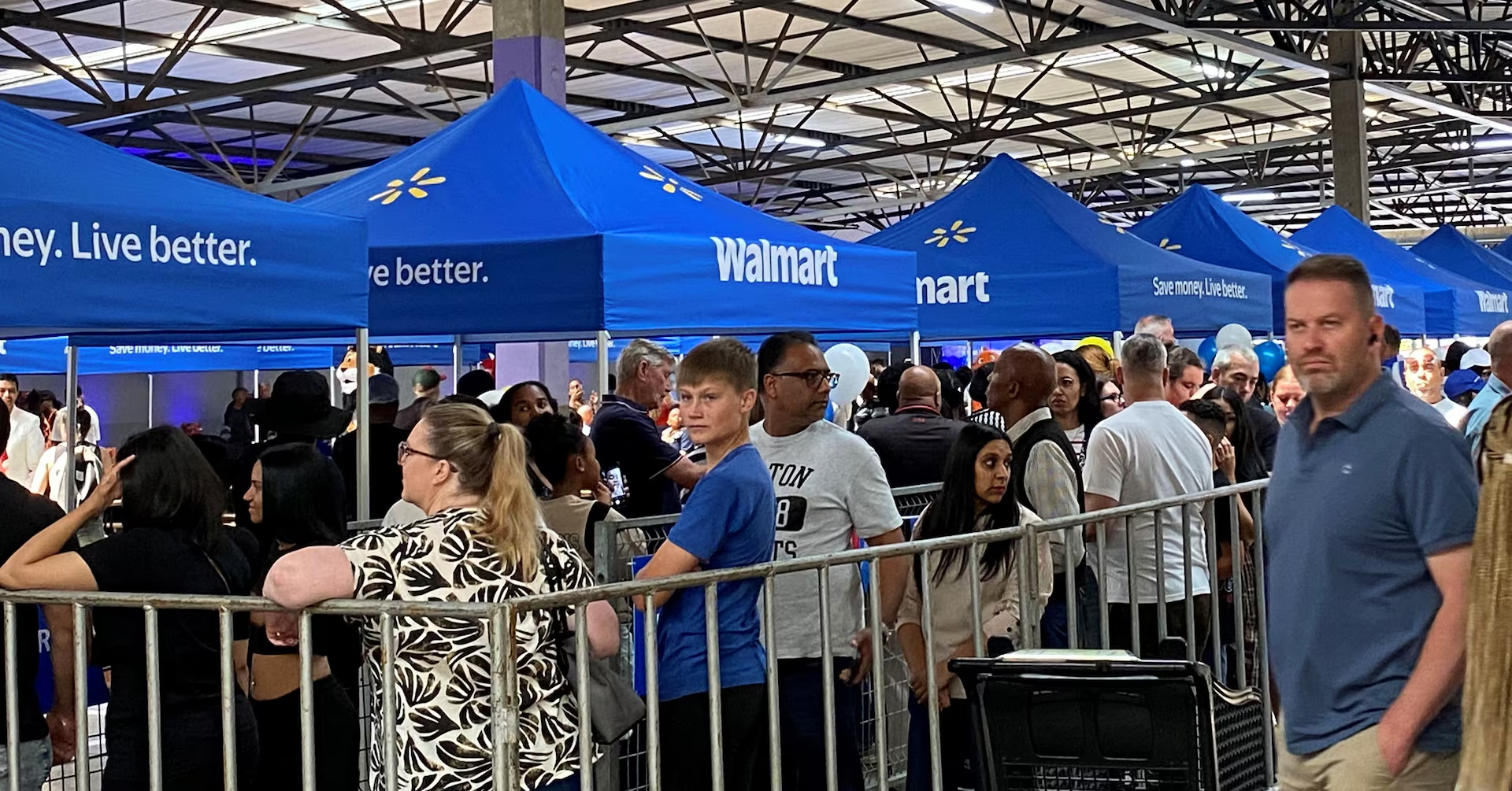
    JOHANNESBURG, Nov 22 (Reuters) – Walmart (WMT.N), opens new tab opened its first store in South Africa on Saturday, marking the U.S. retail giant’s debut on the African continent as it seeks a stake in a competitive market.

    More than a hundred shoppers queued for hours outside the store to take advantage of Walmart’s “Everyday Low Prices” and shop international products that are not easily available in South Africa such as designer counter-top air fryers by Drew Barrymore, Labubu dolls and Dr.Pepper sodas.

    Sign up here.

    “I’m actually here for a specific product that you can’t really get in South Africa….it’s a children’s toy, Labubu,” Refilwe Mabale, told Reuters.

    Some, like Tshepo Rambau, were hoping to snap up deals during Black Friday weekend. The 44-year-old told Reuters while standing in the queue that he was eyeing tech products like WIFI extenders.

    “Hopefully I’ll get them cheaper here,” he said.

    The retailer will also be offering a sixty-minute online delivery service. This places it in direct competition with Checkers’ Sixty60 on-demand delivery service owned by South Africa’s largest grocery retailer Shoprite (SHPJ.J), opens new tab.

    “Opening the first Walmart store in South Africa is about much more than a business milestone, it is a commitment to helping customers save money and live better by consistently delivering the lowest total cost for the basket of products they need,” Andrea Albright, executive vice president of Walmart, said in a statement.

    The store, located in Roodepoort, west of Johannesburg, has has created 80 new jobs and has collaborated with 15 local small- and medium-enterprises, the retailer said.

    Reporting by Siyanda Mthethwa, Editing by William Maclean

    Our Standards: The Thomson Reuters Trust Principles., opens new tab

    Continue Reading

  • X’s new country-of-origin feature shakes MAGA and Democrat circles as many ‘US’ accounts revealed to be foreign-run

    X’s new country-of-origin feature shakes MAGA and Democrat circles as many ‘US’ accounts revealed to be foreign-run

    Elon Musk’s X, formerly Twitter, has introduced the country of origin feature that seems to have thrown both the MAGA and Democrats’ worlds online into chaos. Several profiles online, that had pushed certain narratives are now being found to have been operating from outside the US.

    X has introduced a feature that lets people see where an account is based out of. (REUTERS)

    The social media platform introduced a feature where one can see the country the account is based in. One has to head to an account and click on the date joined tab, which opens up onto a new page. This shows the country where that particular account is being operated from. While the feature was briefly removed after its introduction, it has now been added again, and both sides of the political spectrum are having a field day, calling out each other online.

    What to know about ‘American’ accounts based out of US

    The accounts being discussed here have pushed agendas within the US, and commented on US politics regularly. Many are also named to echo political movements, like some MAGA accounts.

    However, these ‘political influencers’ have been found to be based outside the US, raising questions about the motives.

    One profile going by ‘MAGA NATION’ with a follower count of over 392,000, is based out of eastern Europe. Similarly, ‘Dark Maga’ a page with over 15,000 followers is based out of Thailand. ‘MAGA Scope’ which boasts over 51,000 followers is actually operated out of Nigeria, and ‘America First’, an account with over 67,000 followers is based out of Bangladesh.

    “At this time thousands of MAGA-aligned influencer accounts and large political pages that claim to be based in the U.S. are now being investigated and exposed with many of them traced to India, Nigeria, and other countries,” a news aggregator page on X noted.

    It wasn’t just on the MAGA side. An account going by ‘Ron Smith’ whose bio claims he’s a ‘Proud Democrat’ and ‘Professional MAGA hunter’ is operated out of Kenya. The account has over 52,000 followers.

    ‘Republicans against Trump’ an anti-Donald Trump page on X, which tries to push politics against MAGA, was reportedly operating out of Austria. While the location now shows US, X notes that the account location might not be accurate due to use of VPN. “The Anti-Trump account “Republicans Against Trump” which 1M followed has been identified as a non-American from Austria and is currently using a VPN to hide their location,” a page said, making note of this.

    ‘Republicans against Trump’ has over 978,000 followers.

    On a side note, an account going by ‘Mariana Times’, with over 78,000 followers, which posts pro-Israel content has been found to be based out of India.

    People within the MAGA orbit have also reacted to this new feature. Congresswoman Anna Paulina Luna wrote on X from her personal account, “All of these pretend “pro-America” accounts that were pushing infighting within Maga are literally foreign grifters. I’m telling you, the foreign opp is real and so are the bot accounts.”

    Alexis Wilkins, FBI director Kash Patel’s girlfriend, also added, “I hope that everyone sees, regardless of their specific reason, that the enemy is outside of the house. The people posing as Americans with big American opinions but are actually operating from a basement across the world have one common goal – to destroy the United States. We have our issues, but we really can’t allow them to succeed.”

    Continue Reading

  • Private companies among PropNex Limited’s (SGX:OYY) largest stockholders and were hit after last week’s 5.7% price drop

    Private companies among PropNex Limited’s (SGX:OYY) largest stockholders and were hit after last week’s 5.7% price drop

    • Significant control over PropNex by private companies implies that the general public has more power to influence management and governance-related decisions

    • 56% of the company is held by a single shareholder (P&N Holdings Pte. Ltd.)

    • 23% of PropNex is held by insiders

    This technology could replace computers: discover the 20 stocks are working to make quantum computing a reality.

    To get a sense of who is truly in control of PropNex Limited (SGX:OYY), it is important to understand the ownership structure of the business. We can see that private companies own the lion’s share in the company with 56% ownership. Put another way, the group faces the maximum upside potential (or downside risk).

    Following a 5.7% decrease in the stock price last week, private companies suffered the most losses, but insiders who own 23% stock also took a hit.

    Let’s delve deeper into each type of owner of PropNex, beginning with the chart below.

    View our latest analysis for PropNex

    SGX:OYY Ownership Breakdown November 23rd 2025

    Many institutions measure their performance against an index that approximates the local market. So they usually pay more attention to companies that are included in major indices.

    Institutions have a very small stake in PropNex. That indicates that the company is on the radar of some funds, but it isn’t particularly popular with professional investors at the moment. If the company is growing earnings, that may indicate that it is just beginning to catch the attention of these deep-pocketed investors. It is not uncommon to see a big share price rise if multiple institutional investors are trying to buy into a stock at the same time. So check out the historic earnings trajectory, below, but keep in mind it’s the future that counts most.

    earnings-and-revenue-growth
    SGX:OYY Earnings and Revenue Growth November 23rd 2025

    PropNex is not owned by hedge funds. Our data shows that P&N Holdings Pte. Ltd. is the largest shareholder with 56% of shares outstanding. This implies that they have majority interest control of the future of the company. In comparison, the second and third largest shareholders hold about 10% and 8.6% of the stock. Two of the top three shareholders happen to be Chief Executive Officer and Chairman of the Board, respectively. That is, insiders feature higher up in the heirarchy of the company’s top shareholders.

    While studying institutional ownership for a company can add value to your research, it is also a good practice to research analyst recommendations to get a deeper understand of a stock’s expected performance. Quite a few analysts cover the stock, so you could look into forecast growth quite easily.

    Continue Reading

  • Temozolomide Plus Radiotherapy Yields Survival Benefit in IDH-Mutant LGG

    Temozolomide Plus Radiotherapy Yields Survival Benefit in IDH-Mutant LGG

    The addition of temozolomide (Temodar) to radiotherapy improved overall survival (OS) and progression-free survival (PFS) vs radiotherapy alone in patients with IDH-mutant, symptomatic or progressive low-grade glioma (LGG) without codeletions of 1q and 19q, as well as patients with codeletions, according to findings from a molecular analysis of the phase 3 ECOG-ACRIN E3F05 trial (NCT00978458), which were presented at the 2025 Society for Neuro-Oncology (SNO) Annual Meeting.1

    A statistically significant OS benefit with the addition of temozolomide to radiotherapy vs radiotherapy alone was seen among patients with IDH-mutated disease without codeletions (n = 38; HR, 0.15; 95% CI, 0.03-0.74; stratified log-rank P = .02). An OS benefit was also seen among patients with codeletions (n = 74; HR, 0.51; 95% CI, 0.19-1.42). Numerical PFS benefits were also seen among patients without codeletions (HR, 0.50; 95% CI, 0.16-1.54) and those with codeletions (HR, 0.57; 95% CI, 0.24-1.35).

    “These numbers were too small to allow us to declare statistical significance,” lead study author David Schiff, MD, said of the findings in the population of patients with codeletions during the presentation.

    Schiff is the Harrison Distinguished Professor of Neurology, Neurological Surgery and Medicine in the Department of Neurology, Division of Neurology at the University of Virginia (UVA), as well as the codirector of the UVA Neuro-Oncology Center in Charlottesville.

    ECOG-ACRIN E3F05 Trial Key Highlights

    • The ECOG-ACRIN E3F05 trial investigators performed methylation profiling to determine IDH mutational status in enrolled patients following trial closure.
    • The addition of temozolomide to radiotherapy provided a statistically significant OS benefit compared with radiotherapy alone for patients with IDH-mutant LGG who did not have codeletions of 1q and 19q (HR, 0.15; 95% CI, 0.03-0.74; stratified log-rank P = .02).
    • Among patients with IDH-mutated, non-codeleted disease, the 10-year OS rate was higher in the temozolomide plus radiotherapy arm (80%) compared with the radiotherapy alone arm (39%).

    What was the design of the ECOG-ACRIN E3F05 trial?

    E3F05 enrolled patients at least 18 years of age with grade II glioma who had receive no prior radiotherapy or chemotherapy. Patients also needed to be younger than 40 years of age or have radiographic progression or have uncontrolled symptoms/seizures. Following surgery, patients were randomly assigned to receive radiotherapy at 50.4 Gy alone or with concomitant temozolomide followed by 12 cycles of temozolomide on days 1-5 of each 28-day cycle. After study treatment, patients underwent follow-up.

    Patients were stratified by age, deletion 1q/19q status, Karnofsky performance score, tumor diameter, and contrast enhancement.

    How has the E3F05 trial evolved as glioma classification systems have changed over time?

    The E3F05 trial was activated in September 2009, which Schiff noted was prior to the advent of IDH testing in glioma. In January 2014, updated findings from the phase 2 RTOG 9802 trial (NCT00003375) of radiation with or without procarbazine/lomustine/vincristine chemotherapy in patients with LGG showed a benefit with the addition of chemotherapy, making the control arm of E3F05 unethical. At that point, accrual to E3F05 was stopped with 172 of the planned 540 patients enrolled.

    “These non-codeleted tumors were agnostic as to their IDH [mutation] status and were 2 World Health Organization classification systems past what we started with when the study was conceived,” Schiff explained. “To try to ascertain IDH mutational status to characterize…patients according to contemporary neuropathology, we reached an agreement with the National Cancer Institute…database group to perform methylation profiling on our patients.”

    Among the 172 enrolled patients, 74 had codeletions. Additionally, 97 patients had adequate samples for methylation profiling, 52 of whom did not have codeletions. Among those 52 patients, Heidelberg v12 classification was used to determine that 13 had IDH wild-type disease (diffuse high-grade subtype F, n = 3; glioblastoma, n = 2; ganglioglioma, n = 2), and 38 had IDH-mutant diffuse glioma (IDH-mutant low-grade astrocytoma, n = 36; IDH-mutant high-grade astrocytoma, n = 2).

    What efficacy data from E3F05 have been previously reported?

    Efficacy findings that were previously reported at SNO 2024 showed that the addition of temozolomide to radiotherapy significantly improved OS vs radiotherapy alone (HR, 0.54; 95% CI, 0.31-0.95).2 OS benefits were also seen among patients with codeletions of 1q and 19q (HR, 0.56; 95% CI, 0.20-1.60) and those with 1 or both of these intact (HR, 0.53; 95% CI, 0.27-1.04). Numerical PFS benefits were also seen in the overall population (HR, 0.76; 95% CI, 0.44-1.28), those with codeletions (HR, 0.63; 95% CI, 0.24-1.64), and those with 1 or both intact (HR, 0.82; 95% CI, 0.43-1.56).

    What additional updated efficacy data from E3F05 were presented at SNO 2025?

    Among the patients with IDH-mutated, non-codeleted disease, the 5-year PFS rate was 76% in the temozolomide arm vs 53% in the radiotherapy alone arm.1 The 10-year PFS rate with temozolomide was 59%. At 5 years, the OS rates were 94% with temozolomide plus radiotherapy and 71% with radiotherapy alone. These respective rates at 10 years were 80% and 39%.

    “The benefit of adding temozolomide in the IDH-mutant astrocytomas is particularly evident when you look at 10-year OS with radiation alone,” Schiff added.

    Among the patients with codeletions, the 5-year PFS rate was 79% in the temozolomide arm vs 64% in the radiotherapy alone arm. The 10-year PFS rates in these respective arms were 47% and 69%. At 5 years, the OS rates were 97% with temozolomide plus radiotherapy and 92% with radiotherapy alone. These respective rates at 10 years were 90% and 68%.

    “In summary, we’ve shown a statistically significant OS benefit with the addition of temozolomide to radiation in grade 2 IDH-mutant astrocytomas, and we still see a trend toward [an] OS benefit in the oligodendrogliomas as well,” Schiff concluded. “We [also] see suggestive HRs for PFS in both the astrocytomas and oligodendrogliomas.”

    References

    1. O’Neill A, Brown P, et al. Molecular analysis of outcomes in ECOG-ACRIN E3F05: phase III study of radiation therapy with or without temozolomide of symptomatic or progressive low-grade gliomas. Presented at: 2025 SNO Annual Meeting; November 19-23, 2025; Honolulu, Hawaii. Abstract CTNI-29.
    2. Schiff D, O’Neill A, Brown P, et al. LTBK-07. Progression-free and overall survival results of ECOG-ACRIN E3F05: a phase 3 intergroup trial of radiation ± temozolomide for grade II gliomas.Neuro Oncol. 2024;26(suppl 8):viii1-viii2. doi:10.1093/neuonc/noae165.1303


    Continue Reading

  • Conservative Young Women Flip the Script: Kids First, Then Career

    Conservative Young Women Flip the Script: Kids First, Then Career

    For generations of women, the logic has seemed airtight: Focus on a career in your 20s, and worry about starting a family once you are established in a job.

    This mindset has catapulted women into higher-earning positions, and into traditionally male-dominated fields. The share of women in their prime working years who are in the workforce is around a record high. And women are having babies later, if they have them at all. The answer to fertility constraints, they’re told, is egg freezing.

    Copyright ©2025 Dow Jones & Company, Inc. All Rights Reserved. 87990cbe856818d5eddac44c7b1cdeb8

    Continue Reading