Category: 3. Business

  • Our perspective regarding the situation in Venezuela as shared with President Trump

    Our perspective regarding the situation in Venezuela as shared with President Trump

    Darren delivered the following remarks at the White House:


    Thank you, Mr. President, I appreciate the invitation and the opportunity for the entire industry to show up and provide perspective.

    Frankly, we’ve been kind of unresponsive to the press regarding Venezuela. I guess today’s the opportunity to address the press directly with respect to a number of questions that have been asked of ExxonMobil. First and foremost, obviously, is the interest that we have in Venezuela. I think one of the reasons why we see many industry players here is we’re in a depletion business for a product that is in great demand and will be in demand for many, many, many decades to come.

    And as a depletion business, the biggest challenge we have is finding resources. There’s an opportunity in Venezuela with all the resources there. We don’t have that challenge of finding; we have the challenge of developing those resources. So I think it’s in the best interest of these companies and, frankly, society as a whole for the industry to be interested in understanding what the opportunity here represents.

    I’ll just share a philosophy that ExxonMobil has when we enter countries—because we do business all around the world, in a number of different regimes—we take a very long‑term perspective. The investments that we make span decades and decades. So, we do not go into any opportunity with a short-term mindset.

    There’s a value proposition that we have to meet. It has to be a win‑win‑win proposition. Obviously, it has to be a win for the company and our shareholders, generating a return for the investments that we make. It has to be a win for the government. The resources are an important source of revenue that help support the people of the places that we do business. And it has to be a win for the people. We have to be wanted there— and to be a good neighbor. And those three things ensure a stable, long‑term platform for the large investments that we make for the long term.

    With respect to Venezuela in particular, we have a very long history in Venezuela. In fact, we first got into Venezuela back in the 1940s. We’ve had our assets seized there twice. And so, you can imagine to re‑enter a third time would require some pretty significant changes from what we’ve historically seen here and what is currently the state.

    If we look at the legal and commercial constructs—frameworks—in place today in Venezuela, today it’s uninvestable. And so significant changes have to be made to those commercial frameworks, the legal system, there has to be durable investment protections, and there has to be a change to the hydrocarbon laws in the country.

    We’re confident that with this Administration and President Trump working hand‑in‑hand with the Venezuelan government that those changes can be put in place. And with respect to the Venezuelan government—that perspective—we don’t have a view on. We haven’t talked to the Venezuelan government, and obviously we have yet to assess the people’s perspective with respect to ExxonMobil entering the country.

    In the short term, there are things that can be done while these longer‑term issues are being worked. For us, we haven’t been in the country for almost 20 years. We think it’s absolutely critical in the short term that we get a technical team in place to assess the current state of the industry and the assets to understand what would be involved to help the people of Venezuela get production back on the market.

    With the invitation of the Venezuelan government and with appropriate security guarantees, we are ready to put a team on the ground there. We also have an integrated set of capabilities—from production to refining to trading—and I think we can be of assistance to getting Venezuelan crude to market and realizing market price to help again with the financial situation in Venezuela.

    So that’s the short‑term perspective that I have. Thank you, Mr. President, for the work that you’ve done to secure not only the national security, but the energy security of the region. And thank you Secretary Rubio, Secretary Wright, Secretary Burgum, for your leadership in this matter. Thank you.

    Continue Reading

  • Stay warm, save money with energy efficiency tips

    Stay warm, save money with energy efficiency tips

    JACKSON, Mississippi – As winter brings bouts of colder temperatures, customers will begin using their heating systems more and this could lead to an increase in electricity usage. However, staying warm and comfortable does not have to come at the cost of high electric bills. By making a few simple changes around your home, you can improve its energy efficiency and keep costs down throughout the colder months.

    According to the U.S. Energy Information Administration, home heating and cooling costs can make up more than 52% of an average customer’s electric bill. In some cases, poor insulation, air leaks and inefficient HVAC systems can lead to even greater energy costs each year. To keep your home warm without significantly raising the thermostat and save money on your bill at the same time, try these low-to-no-costs tips.

    Improving energy efficiency with low-to-no-cost tips

    • Use solar energy: Open curtains on the south-facing windows during the day to allow sunlight to naturally heat the home and close them at night to reduce the chill from cold windows.
    • Insulate drafty windows: Use a heavy-duty, clear plastic sheet on a frame or tape clear plastic film to the inside of window frames and make sure the plastic is sealed tightly to the frame to help reduce infiltration.
    • Adjust the thermostat: When you are home and awake, set the thermostat as low as is comfortable, but when you are asleep or out of the house, turn the thermostat back to save on your heating and cooling bills.
    • Find and seal leaks: Seal air leaks around utility cut-throughs for pipes and recessed lights in insulated ceilings, and unfinished spaces behind cupboards and closets.
    • Maintain heating systems: Schedule routine service for home heating systems and replace furnace and heat pump filters once a month or as needed.
    • Reduce heat loss from the fireplace: Keep the fireplace damper closed unless a fire is burning and check the seal on the fireplace flue damper and make it as snug as possible.

    By following these simple steps, you can stay warm and comfortable all winter long while keeping your bills under control. We also offer free comprehensive residential energy audits and rebates to help reduce the upfront cost of installing energy-efficient equipment.

    Exploring resources through Bill Toolkit

    To make sure customers have quick access to energy efficiency, bill management and financial assistance resources, Entergy created an online platform called Bill Toolkit. The platform consolidates helpful resources for customers interested in exploring ways to lower their electric use and costs and learn more about different payment options the company offers. It also provides information on our energy efficiency programs and incentives and rebates associated with these programs.

    Tracking energy use through myAdvisor

    Entergy customers can set electric usage alerts and monitor how much energy they use each day through bill management tools like myAdvisor, which is available through their myEntergy account online. Tracking usage over time can help customers identify trends that contribute to higher usage and budget their monthly expenses. With the myAdvisor dashboard, customers have access to not only usage and cost details, but also bill history and projections, analyzer tools and more. On the Entergy mobile app this information can be found by tapping the “usage” tab.

    Managing bills through payment and assistance options

    Entergy offers several flexible payment options so customers can choose when, where and how they receive their bills.

    • Pick-A-Date allows customers to pay their bills when it works best for them.
    • Level Billing allows customers to “level out” seasonal energy use fluctuations, making their bills more consistent every month.
    • PaperFREE billing allows customers to get their bills emailed as soon as they post and instant access to two years of billing history.
    • AutoPay allows customers to avoid late fees, writing checks and paying for postage by having bills automatically deduct from their bank accounts.

    We also offer flexible payment options such as deferred payment arrangements or payment extensions. Customers can find out if they qualify for these options through our mobile app or myEntergy online.

    About Entergy Mississippi

    Entergy Mississippi provides electricity to approximately 459,000 customers in 45 counties. Entergy Mississippi is a subsidiary of Entergy Corporation. Entergy produces, transmits and distributes electricity to power life for 3 million customers through our operating companies in Arkansas, Louisiana, Mississippi and Texas. We’re investing for growth and improved reliability and resilience of our energy system while working to keep energy rates affordable for our customers. We’re also investing in cleaner energy generation like modern natural gas, nuclear and renewable energy. A nationally recognized leader in sustainability and corporate citizenship, we deliver more than $100 million in economic benefits each year to the communities we serve through philanthropy, volunteerism and advocacy. Entergy is a Fortune 500 company headquartered in New Orleans, Louisiana, and has approximately 12,000 employees. Learn more at EntergyMississippi.com and connect with @EntergyMS on social media.

    Media inquiries:
    [email protected]

    Continue Reading

  • Online Plans Display | Department of Transportation

    Online Plans Display | Department of Transportation

    Harrisburg, PA – The Pennsylvania Department of Transportation (PennDOT) invites the public to an online plans display regarding the Route 17 (Raccoon Valley Road) bridge replacement project over Raccoon Creek in Tuscarora Township, Perry County, approximately eight miles southwest of Millerstown.

    The purpose of this project is to replace the existing bridge and provide continued safe and efficient crossing of Route 17 over Raccoon Creek.

    The existing single span reinforced concrete slab bridge was built in 1930.

    The project involves the replacement of the single span reinforced concrete slab bridge with a precast reinforced concrete box culvert. In addition to the replacement of the stream crossing, minor approach roadway reconstruction, along with guide rail, pavement marking and signing updates will also be completed as part of the project. A temporary stream diversion (cofferdam setup) will be required. The proposed roadway shoulder to shoulder width will provide two 11-foot lanes and 6-foot shoulders.

    This section of Raccoon Valley Road has an average daily traffic volume of 871 vehicles per day (vpd).

    The bridge will be closed to all traffic for approximately six months during construction. The detour will be approximately 17 miles using Veterans Way, Waggoners Gap Road, Buffalo Trace Road, Buckwheat Road, and Creek Road.

    Overhead utilities are present at the site and de-energization, or temporary relocation may be required to place the precast concrete box culverts sections.

    The project is currently in design, and construction work is anticipated to begin in Spring 2028 and last approximately six months.

    A digital version of the project plans and information are available to view online with public comments accepted through February 12, 2026.

    Information, including bridge plans and an interactive comment form, can be found by visiting the PennDOT District 8 website, PennDOT District 8, clicking Projects Near You listed on the left side of the page, then the District 8 Projects, and choosing Racoon Valley Road Bridge over Raccoon Creek.

    The purpose of the plans display is to introduce the project and receive public input regarding any questions or concerns with the project. It is also an opportunity for the public to review and comment on the project.

    Also available for viewing and public comment is the plans display for the nearby Raccoon Valley Road Bridge over Unnamed Tributary of Raccoon Creek bridge rehabilitation project.

    The project documents can be made available in alternative languages or formats if requested. If you need translation/interpretation services or have special needs or have special concerns that require individual attention, please contact Gail Farley, Project Manager at (717) 885-9662 or c-gaifarle@pa.gov.

    Pursuant to Title VI of the Civil Rights Act of 1964, PennDOT does not discriminate on the basis of race, color, national origin, gender, age, or disability. If you feel that you have been denied the benefits of, or participation in a PennDOT program or activity, you may contact the Pennsylvania Department of Transportation, Bureau of Equal Opportunity, DBE/Title VI Division at 717-787-5891 or 800-468-4201.

    Motorists can check conditions on major roadways by visiting www.511PA.com. 511PA, which is free and available 24 hours a day, provides traffic delay warnings, weather forecasts, traffic speed information and access to more than 1,200 traffic cameras. 511PA is also available through a smartphone application for iPhone and Android devices, by calling 5-1-1, or by following regional X alerts.

    Find PennDOT’s planned and active construction projects at www.pa.gov/DOTprojects. Subscribe to PennDOT news and find transportation results in Adams, Cumberland, Dauphin, Franklin, Lancaster, Lebanon, Perry and York counties at www.pa.gov/DOTdistrict8. 

    Find PennDOT news on X, Facebook, Instagram and LinkedIn.

    MEDIA CONTACT: Dave Thompson, 717-418-5018, or at dmthompson@pa.gov

    ###

    Please refer to the project location map below:


    Continue Reading

  • Lane and Sidewalk Closure – East 14th Street

    Lane and Sidewalk Closure – East 14th Street

    Published on January 09, 2026

    Beginning on Monday, January 12, 2026, at 8:30 a.m. the westbound outside lane of East 14th Street between South Cliff Avenue and South Seventh Avenue will be closed. The north sidewalk will be closed, and pedestrian traffic will be detoured to the south sidewalk.

    Xcel Energy will be doing utility work.

    The work is expected to be completed and traffic control removed by the end of the day on January 23, 2026.

    Drivers are urged to use caution and reduced speeds while travelling near the construction area and may want to consider alternate routes.

    Continue Reading

  • ChatGPT Health’s pros and cons from an AI-in-medicine expert: For Journalists

    ChatGPT Health’s pros and cons from an AI-in-medicine expert: For Journalists

    CHICAGO — OpenAI this week introduced ChatGPT Health, “a dedicated experience in ChatGPT designed for health and wellness,” as a response to the more than 40 million people who ask ChatGPT a health care-related question every day, the company said.

    Northwestern University AI-in-clinical-medicine expert Dr. David Liebovitz can speak to media about the pros and cons of the new platform, including how it is “a significant step forward from patients showing up with Google searches” but also how “patients must understand that health data shared with ChatGPT is not protected by HIPAA,” unlike in conversations with physicians or therapists. He also can speak to what true democratization of health AI looks like, and what Northwestern University research is driving to make these advances practical for patients.

    Contact Kristin Samuelson at ksamuelson@northwestern.edu to schedule an interview. 

    Liebovitz is the co-director of the Institute for Artificial Intelligence in Medicine’s Center for Medical Education in Data Science and Digital Health at Northwestern University Feinberg School of Medicine. He has been teaching clinical informatics for several decades, incorporating new methods for education and applications of AI within clinical patient care. Liebovitz has been a chief medical information officer at two organizations where he actively implemented AI in clinical medicine.

    On the opportunity:

    Liebovitz: “The 21st Century Cures Act now requires health care systems to provide patients complete access to their medical records through standardized application programming interfaces (APIs) that electronic health record vendors like Epic are now required to provide. AI tools like ChatGPT Health can help patients make sense of that data. For essentially zero incremental cost, a patient can get help understanding lab results, preparing questions for appointments and identifying gaps in their care that might otherwise be missed.”

    ‘A significant step forward’

    “More than 25 years after the Institute of Medicine report ‘To Err is Human: Building a Safer Health System’ documented tens of thousands of preventable deaths from diagnostic errors and care gaps, we still haven’t solved this problem. AI assistants that can review a patient’s full history and flag potential concerns represent a significant step forward from patients showing up with Google searches. These tools synthesize information in context rather than generating alarm from isolated symptoms.”

    On concerns:

    “Patients should understand that health data shared with ChatGPT is not protected by HIPAA. Unlike conversations with physicians or therapists, there’s no legal privilege. This data could potentially be subpoenaed in litigation or accessed through other legal processes. For sensitive health matters, particularly reproductive or mental health concerns, that’s a real consideration.”

    On the bigger picture:

    “The question isn’t whether patients will use AI for health information, 40 million people already ask ChatGPT health questions daily. The question is whether we can help them do so more effectively and safely, with appropriate guardrails and realistic expectations about what these tools can and cannot do.”

    On local/on-device models:

    “There’s an alternative approach that sidesteps the privacy concerns entirely: running AI models locally on a patient’s own device. Modern smartphones now have sufficient processing power to run capable language models without any data ever leaving the phone. No cloud storage, no corporate servers, no subpoena risk.”

    On the technical trajectory:

    “On-device AI capabilities, which run AI directly on local hardware such as phones and wearables instead of sending data to the cloud, are advancing rapidly. Apple’s own approach with Apple Intelligence validates that sophisticated AI can run locally. Open-source models optimized for mobile hardware are improving month over month. Within a year or two, a patient could have a highly capable health assistant running entirely on their phone, analyzing their downloaded medical records with complete privacy.”

    On the democratization angle:

    “Here is what true democratization of health AI looks like: A patient downloads their records using the APIs health care systems are now required to provide, runs them through an AI model on their own phone and gets personalized insights without their data ever touching a third-party server. No subscription fees, no privacy tradeoffs, no dependence on any company’s policies or terms of service.”

    On what Northwestern is exploring:

    “Our research group is actively exploring how to make this practical for the public. The technical pieces are falling into place: access to standardized health records, powerful mobile hardware and increasingly capable open-source models. The goal is giving everyone access to meaningful second opinions on their health data while keeping that data entirely under their control.”

    Continue Reading

  • FMLA Leave Calculation When Employers Close for Weather

    FMLA Leave Calculation When Employers Close for Weather

    Takeaways

    • The DOL stated in a 01.05.26 opinion letter that if an employee is scheduled to use less than a full workweek of FMLA leave, the time when the employer (a school) is closed for inclement weather will not be deducted from the employee’s FMLA entitlement unless the employee was expected to work during the school closure. 
    • Conversely, however, the opinion letter states if an employee is scheduled to take a full workweek of FMLA during a week when the school is closed for part of the week, the entire week is counted against an employee’s FMLA entitlement. 
    • The DOL announced in June 2025 that it would launch an expanded opinion letter program.

    Related link

    Article

    The Department of Labor (DOL) Wage and Hour Division issued an opinion letter on Jan. 5, 2026, analyzing how a school closure of less than one full week affects the Family and Medical Leave Act (FMLA) entitlement of an employee on scheduled FMLA leave. The DOL analyzed key differences between calculation of FMLA leave entitlement when the leave is scheduled for less than a full workweek versus a full workweek. The opinion letter was in response to an inquiry on the calculation of an employee’s leave entitlement when a school closes for less than a full week due to inclement weather.

    DOL Analysis

    In its analysis, the DOL confirmed an established principle that leave entitlement may not be reduced “beyond the amount of leave actually taken” when the leave is taken on an intermittent or reduced schedule basis. Further, the DOL clarified leave taken for less than a full workweek is considered a “proportion of the employee’s actual workweek.”

    Holidays, the DOL then explained, do not count against FMLA leave entitlement if the employee is scheduled for FMLA leave of less than a full workweek and is not otherwise expected to work on the holiday. On the other hand, however, the DOL stated the holiday will count against an employee’s FMLA leave entitlement if it falls during a week in which the employee was scheduled to take a full workweek of leave.

    Based upon these principles, the DOL opined that if an employee is scheduled to take FMLA leave for less than a full workweek, the school is closed for at least one day during that workweek due to inclement weather, and the employee was not otherwise expected to work during the closure, the employee’s leave entitlement should not be reduced by the number of days the school was closed.

    As an example, the DOL explained, if an employee was scheduled to take FMLA for physical therapy on Tuesday afternoon, but the school was closed on Tuesday due to inclement weather, the employee’s FMLA leave entitlement will not be reduced for the period of time the school was closed.

    If an employee was scheduled to take FMLA for a full workweek and the school was closed for at least one day during that workweek, the DOL explained the employee’s FMLA leave entitlement would still be reduced for the entire workweek despite the school closure during the week.

    Planned Closure; Makeup

    Finally, whether a closure is planned or unplanned and the reasons for any closure are immaterial to this analysis, the DOL noted. Similarly, the DOL opined that whether an employer requires an employee to report on a “makeup” day on a later date does not affect the analysis.

    * * *

    The DOL announced in June 2025 that it would launch an expanded opinion letter program, consistent with the agency’s renewed focus on compliance assistance.

    Reach out to your Jackson Lewis attorney with any questions about complying with the laws enforced by the DOL (such as the FMLA and the Fair Labor Standards Act) or for assistance in preparing an opinion letter request.

    Continue Reading

  • Ontario power company calls N.S. solar program a ‘win-win’ for customers, province

    Ontario power company calls N.S. solar program a ‘win-win’ for customers, province

    Listen to this article

    Estimated 3 minutes

    The audio version of this article is generated by AI-based technology. Mispronunciations can occur. We are working with our partners to continually review and improve the results.

    A Toronto-based renewable energy company says it sees a lot of potential in Nova Scotia’s initiative to incentivize the construction of community “solar gardens.”

    PowerBank, which specializes in solar energy and battery storage systems, has had one project approved in Nova Scotia and proposed two others under the province’s community solar program.

    The program, which launched in 2024, helps community groups and organizations set up large fields of solar panels, known as solar gardens, to sell subscriptions for the clean electricity they produce.

    “We like this program because I think it’s a win-win for all the parties,” said Tracy Zheng, chief commercial officer for PowerBank.

    PowerBank’s solar projects will help Nova Scotia meet its goal of producing 80 per cent of its electricity through renewable energy, Zheng said, while also reducing power bills for customers who subscribe.

    The provincial program allows the power generated from the solar gardens to be fed into the Nova Scotia Power grid.

    Customers can sign up to receive power from a solar garden without paying an additional fee or physically being connected to the source.

    The company says subscribers will save two cents per kilowatt hour on their electricity bill or 10 to 15 per cent.

    Potential benefits for communities

    PowerBank is expected to start construction on a 4.8-megawatt project in Brooklyn, Annapolis County, in the spring, which it says will power up to 630 homes a year.

    Two smaller projects are proposed near Antigonish and Bridgetown.

    The project near Bridgetown is still going through the approval process. It must get letters of support from municipal governments where the projects are proposed.

    “When the opportunity arose through public consultation as well as a presentation to our council, we were very receptive to it,” said Dustin Enslow, deputy warden for the Municipality of Annapolis County.

    Zheng made a presentation about the project to the municipality in November. She said it would power up to 250 homes in the surrounding area.

    A screenshot of livestream of the meeting.
    PowerBank’s Tracy Zheng made a presentation to the Municipality of Annapolis County’s council in November last year. (Municipality of Annapolis County/YouTube)

    The company also held two public consultations meetings in the area last summer.

    Enslow said the municipality sees several benefits from a project like this.

    “This particular organization and particular project works quite well because it actually aligns with the joint climate change action plans we have between us — Annapolis Royal and the Town of Middleton,” Enslow said.

    He said the municipality also finds PowerBank’s promise to use local contractors to build and maintain the solar garden over the 25-year contract very encouraging.

    Stabilizes power source

    In addition to reducing power bills, Enslow said an additional energy source in the community will provide more stability for residents.

    “We have a very unique power grid here where we actually steal from neighbouring municipalities,” he said.

    The municipality gets its power from Yarmouth, Bridgewater and other parts of the Annapolis Valley, Enslow said, and power outages are a common problem.

    The municipality’s support of the PowerBank’s proposed solar project is conditional, but council sees a lot of potential in it, Enslow said.

    “This is just one way that our municipality can continue to thrive and move forward in a positive direction.”

    MORE TOP STORIES

    Continue Reading

  • Malaysian palm rises for the week on strong rival oils, Indonesia levy plan

    Malaysian palm rises for the week on strong rival oils, Indonesia levy plan

    Malaysian palm oil futures fell on Friday on profit taking, but posted a weekly gain on strength in rival edible oils on the Dalian and Chicago exchanges and Indonesia’s plan to raise its palm oil export levy.

    The benchmark palm oil contract FCPO1! for March delivery on the Bursa Malaysia Derivatives Exchange lost 5 ringgit, or 0.12%, to 4,038 ringgit ($992.14) a metric ton at closing.

    The contract gained 1.18% for the week.

    “Lots of profit-taking activities going on (today) after the sudden rally on Indonesia levy increase rumours. The profit taking starts after Dalian close firm drawing a selloff at the high of the week,” said a Kuala Lumpur-based trader.

    Indonesia will likely increase its palm oil export levy to support the country’s biodiesel mandate, energy ministry official Eniya Listiani Dewi told reporters, citing tightening funds.

    Dalian’s most-active soyoil contract (DBYcv1) rose 0.33%, while its palm oil contract CPO1! was up 0.6%. Soyoil prices on the Chicago Board of Trade (BOc2) gained 0.51%.

    Palm oil tracks the price movements of rival edible oils, as it competes for a share of the global vegetable oils market.

    Palm oil FCPO1! is biased to retest support at 4,024 ringgit per metric ton, as it failed to break resistance at 4,074 ringgit, Reuters technical analyst Wang Tao said.
    Source: Reuters


    Continue Reading

  • The Nuanced Role of Government Credit in Monetary Policy Transmission

    The Nuanced Role of Government Credit in Monetary Policy Transmission

    Summary

    We investigate the role of government credit in monetary policy transmission, using detailed credit registry data from Brazil. We find that government direct credit can effectively support small and medium-sized enterprises (SMEs) in a tight monetary policy environment, aligning with developmental objectives. But it comes at the cost of diminishing the overall effectiveness of monetary policy transmission. We also uncover complexities introduced by government-subsidized lending, where the impact of monetary policy transmission is influenced by factors such as credit market segments, lending relationships, and prevailing monetary policy conditions. These insights provide valuable guidance for policymakers on the transmission of monetary policy and the trade-offs involved in government credit programs.

    Subject: Bank credit, Central bank policy rate, Collateral, Credit, Financial institutions, Financial services, Loans, Money

    Keywords: Bank credit, Brazil, Central bank policy rate, Collateral, Credit, earmarked credit, emerging market, government banks, government direct credit, Loans, Monetary policy, SME

    Continue Reading

  • Vendor Applications and Sponsorship Opportunities Now Open for 2026 Sonoma’s Tuesday Night Market!

    Vendor Applications and Sponsorship Opportunities Now Open for 2026 Sonoma’s Tuesday Night Market!

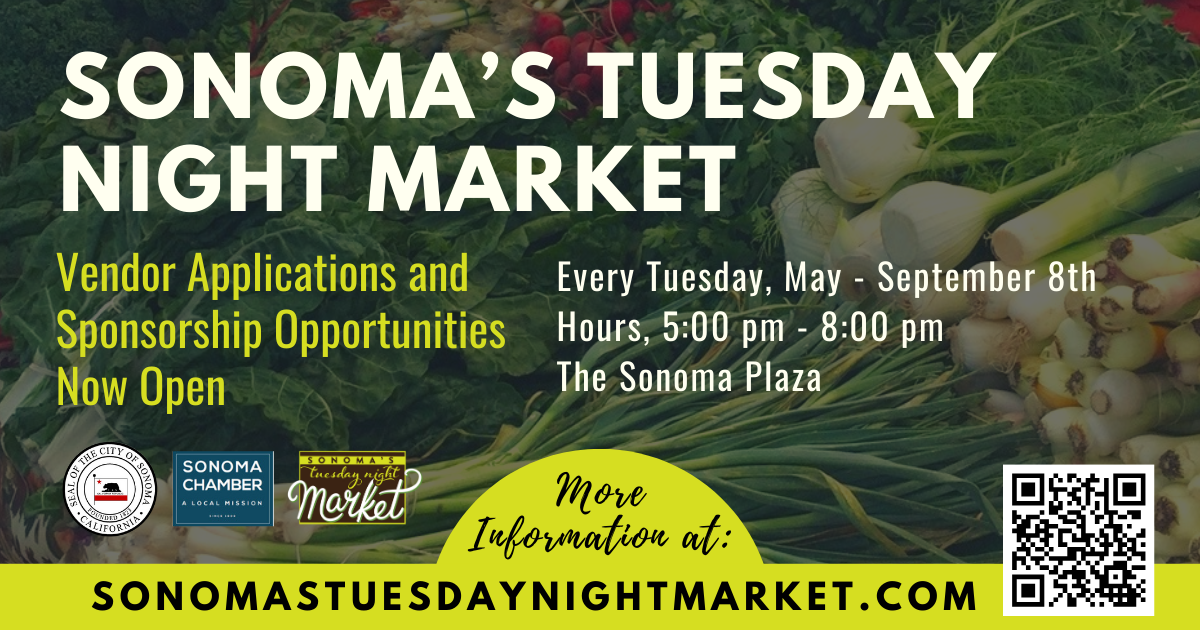
    The City of Sonoma is excited to announce that vendor applications and sponsorship opportunities for the 2026 Sonoma’s Tuesday Night Market season are now open! The market, held in the historic Sonoma Plaza, is a beloved weekly tradition bringing together thousands of visitors to shop, dine, and connect with local farmers, artisans, and businesses.

    Vendor Applications:
    Join the vibrant community of farmers, food purveyors, artisans, and non-profit organizations that make Sonoma’s Tuesday Night Market a highlight of the season. Applications are now available for:

    The market runs every Tuesday from May through September 8th, 5:00 p.m. – 8:00 p.m.

    For more information, contact Market Manager Jerry Wheeler at manager@sonomastuesdaynightmarket.com or call 707-974-0216. Don’t miss your chance to showcase your products and connect with the community!

    Sponsorship Opportunities:
    Support Sonoma’s Tuesday Night Market while gaining visibility for your brand! Choose from exciting sponsorship packages, including:

    • Bicycle Valet Sponsorship ($3,500): Promote sustainable transportation and connect directly with market attendees.
    • Stainless Steel Wine Cup Sponsorship ($15,000): Provide reusable drinkware and enjoy extensive promotional benefits.
    • Music Sponsorship ($1,300): Sponsor live music and have your brand featured on signage and during announcements.
    • Stage Power Sponsorship ($3,000): Keep the performances going while showcasing your support.
    • Green Sponsor ($4,000): Champion eco-friendly initiatives with prominent recognition.
    • EBT Market Match Sponsorship ($3,000): Help make fresh produce accessible to everyone while supporting local agriculture.
    • Zucchini Race Sponsor ($3,000): Be part of this fun, creative community event.
    • Reusable Water Bottle Sponsorship ($11,500): Align your brand with sustainability through high-quality branded water bottles.
    • Stainless Steel Wine Cup Sponsor ($15,000)Outfit the community with commemorative stainless-steel reusable wine or beer cups that will last for years to come (to be distributed at the beverage booth).

    Each sponsorship offers pre-market, event, and post-market promotional opportunities, as well as the first right of refusal for the 2027 market season.

    About Sonoma’s Tuesday Night Market:
    Experience the best of Sonoma every Tuesday evening at the historic Sonoma Plaza. From fresh fruits and vegetables to local honey, baked goods, and artisan crafts, the market celebrates everything grown, raised, and made locally. Enjoy live music, a variety of food stands, and the company of friends and neighbors in a beautiful outdoor setting.

    Act now to secure your spot or sponsorship! Visit Sonoma’s Tuesday Night Market website for detailed information, applications, and more. Let’s make the 2026 season one to remember!


    Continue Reading