Category: 3. Business

  • BNP Paribas shares fall after US jury’s Sudan verdict | Sudan war News

    BNP Paribas shares fall after US jury’s Sudan verdict | Sudan war News

    The French bank will pay more than $20m to three plaintiffs amid allegations of human rights abuses.

    BNP Paribas shares have tumbled as much as 10 percent after a United States jury found the French bank helped Sudan’s government commit genocide by providing banking services that violated American sanctions, raising questions about whether the lender will be exposed to further legal claims.

    The bank’s shares were down on Monday morning in New York.

    Recommended Stories

    list of 4 itemsend of list

    The federal jury in Manhattan on Friday ordered BNP Paribas to pay a combined $20.5m to three Sudanese plaintiffs who testified about human rights abuses perpetrated under former President Omar al-Bashir’s rule.

    The Paris, France-based bank said it will appeal the verdict.

    “This result is clearly wrong and ignores important evidence the bank was not permitted to introduce,” the company said in a statement on Monday.

    Uncertainty about whether BNP Paribas could face further claims or penalties weighed on the bank’s shares on Monday, and would likely continue to do so, traders and analysts said.

    The shares dropped as much as 10 percent at one point, and were last down 8.7 percent – set for their biggest daily fall since March 2023.

    Lawyers for the three plaintiffs, who now reside in the US, said the verdict opens the door for more than 20,000 Sudanese refugees in the US to seek billions of dollars in damages from the French bank.

    BNP said, “this verdict is specific to these three plaintiffs and should not have broader application. Any attempt to extrapolate is necessarily wrong as is any speculation regarding a potential settlement.”

    Nonetheless, analysts say the news will likely drag on the bank’s shares in the coming months.

    “A combination of a lack of visibility on the potential financial impact and next legal steps, a reminder of 2014 share price performance as well as a capital path that leaves relatively little room for error, is likely to hang over the shares until more visibility is provided,” analysts at RBC Capital Markets said in a note.

    BNP Paribas in 2014 agreed to plead guilty and pay an $8.97bn penalty to settle US charges that it transferred billions of dollars for Sudanese, Iranian and Cuban entities subject to economic sanctions.

    RBC said the bank’s shares underperformed the sector by 10 percent from the first litigation provision booked in early 2014 to the settlement in June 2014.

    Continue Reading

  • Brent oil structure, physical markets reflect fears of supply glut – Reuters

    1. Brent oil structure, physical markets reflect fears of supply glut  Reuters
    2. Technical Analysis Report for October 20: Spot Gold, WTI Crude Oil Futures  富途牛牛
    3. Evening update for crude oil -20-10-2025  Economies.com
    4. WTI Crude Oil Wave Analysis  Action Forex
    5. Forecast update for crude oil -20-10-2025  Economies.com

    Continue Reading

  • Correction to rationale of aluminium 6063 & 6060 extrusion billet premium, cif Brazilian main ports

    Correction to rationale of aluminium 6063 & 6060 extrusion billet premium, cif Brazilian main ports

    The rationale for MB-AL-0287 aluminium 6063 & 6060 extrusion billet premium, cif Brazilian main ports had erroneously stated that “One indication was collected at 310 c/lb and four indications at $310-350/t.” This has been corrected to: “One indication was collected at $310/t and four indications at $310-350/t.”

    The published price is unaffected by this change.

    This price is part of the Fastmarkets base metals package.

    For more information or to provide feedback on this correction notice or if you would like to provide price information by becoming a data submitter to this price, please contact Pedro Conterno Rodrigues by email at: pricing@fastmarkets.com and basemetals@fastmarkets.com. Please add the subject heading “FAO: Pedro Conterno Rodrigues, re: Aluminium 6063 & 6060 extrusion billet premium, cif Brazilian main ports.”

    Please indicate if comments are confidential. Fastmarkets will consider all comments received and will make comments not marked as confidential available upon request.

    To see all Fastmarkets pricing methodology and specification documents, go to the Fastmarkets methodology page.

    Continue Reading

  • Valeo is awarded contracts to supply its new generation Dual Inverter solution to two leading Chinese automakers

    Valeo is awarded contracts to supply its new generation Dual Inverter solution to two leading Chinese automakers

    Valeo Group | 20 Oct, 2025
    | 2 min

    Valeo’s Dual Inverter scalable platform combines compact design and record efficiency to extend electric driving range and support multiple powertrain architectures.


    October 20, 2025-Paris, France-Valeo, a world leader in high and low-voltage electric powertrain solutions, announced that its new generation Dual Inverter solution has secured serial production contracts with two major Chinese automakers. Through deep integration and architectural optimization, Valeo’s innovation sets a new benchmark for efficiency and compactness in automotive electrification. Mass production is scheduled to start in 2026, with the solution being deployed on the customers’ Plug-in Hybrid Electric Vehicles (PHEVs).

    Xavier Dupont, CEO of Valeo Power Division, said: “We are honored by these two contracts that validate Valeo’s platform strategy, which gives us the agility to adapt quickly to the diverse needs of customers worldwide. With our new dual inverter platform, we will rapidly meet the strong demand in China for efficient and compact powertrain systems and are looking forward to delivering this advanced technology to our other global clients.“

    A key component for elevating hybrid system performance

    In electric and hybrid vehicles, inverters convert battery power to drive the electric motors. Plug-in hybrids and extended-range EVs require two motors—one for traction and one for generation—traditionally managed by separate units. A dual inverter combines both into a single compact system, with only one shared control board, reducing energy losses and costs while increasing efficiency, driving range and design flexibility for automakers.

    Thanks to its scalable 400–800V design, Valeo’s Dual Inverter can be used in today’s 400V electric vehicles as well as in the new generation of 800V models that enable ultra-fast charging. For automakers, this flexibility reduces development costs and allows them to cover multiple vehicle ranges with a single platform. The inverter can also be configured with traditional silicon modules for cost-sensitive models, silicon carbide for higher performance vehicles requiring maximum efficiency, or a hybrid Si/SiC option that balances performance and cost—giving OEMs the freedom to adapt the technology to each market segment. For drivers, this means faster charging on 800V vehicles, more driving range thanks to record energy efficiency of up to 99%, and a longer-lasting “full tank” with every charge.

    Valeo’s next-generation Dual Inverter: compact, efficient and scalable to extend EV range and performance.
    
    Valeo’s next-generation Dual Inverter: compact, efficient and scalable to extend EV range and performance.

    Designed for maximum safety and reliability

    Valeo’s Dual Inverter features a modular design that meets the industry’s highest functional safety standard, ASIL D (Automotive Safety Integrity Level D). This means the component meets the strictest requirements for reliability, fault tolerance and safety. For OEMs, it simplifies vehicle certification and ensures maximum reliability in system integration..
    Building on a proven track record of over 500,000 units already delivered on the first generation, Valeo’s new-generation Dual Inverter sets a new standard for EV range and performance

    Continue Reading

  • BBVA appoints Franco Cinquegrana as country manager in Uruguay

    BBVA appoints Franco Cinquegrana as country manager in Uruguay

    Franco Cinquegrana joined BBVA more than 15 years ago and has since held a series of senior roles. He has served as director of innovation and business models and of business development, and most recently led Client Solutions in Uruguay. In that role, he helped drive the bank’s digital transformation and growth.

    “We thank Alberto for his outstanding contribution to BBVA’s growth and consolidation in Uruguay and wish Franco Cinquegrana every success in his new role,” said Jorge Sáenz-Azcúnaga, BBVA’s Global Head of Country Monitoring.

    BBVA in Uruguay is the country’s third-largest private-sector bank by investment and resources. It operates 31 branches, employs more than 500 people and serves more than 300,000 customers. In 2024, the unit contributed €76 million to the BBVA Group’s attributable profit.

    Continue Reading

  • ESMO 2025: IMvigor011: A Phase 3 Trial of ctDNA-Guided Adjuvant Atezolizumab versus Placebo in MIBC – UroToday

    1. ESMO 2025: IMvigor011: A Phase 3 Trial of ctDNA-Guided Adjuvant Atezolizumab versus Placebo in MIBC  UroToday
    2. Chugai Pharmaceutical : Roche’s Announcement Regarding Tecentriq (Presentation of Latest Data as an Adjuvant Treatment in Muscle-Invasive Bladder Cancer at ESMO)  MarketScreener
    3. IMvigor011: ctDNA-Guided Adjuvant Atezo in Bladder Cancer  Oncodaily
    4. Genentech’s Tecentriq Showed Significant Overall and Disease-Free Survival Benefits in Bladder Cancer With ctDNA-Guided Treatment  Yahoo Finance
    5. Blood Test Directs Post-Surgery Immunotherapy for Bladder Cancer  Mirage News

    Continue Reading

  • FDA Issues CRL for Dasatinib in CML/ALL

    FDA Issues CRL for Dasatinib in CML/ALL

    The FDA has given a complete response letter (CRL) to dasatinib (Dasynoc) for patients with chronic myeloid leukemia (CML) and acute lymphoblastic leukemia (ALL), according to a press release from Xspray Pharma, the drug’s developer.1

    Based on Good Manufacturing Practice observations at the manufacturer for the drug, the FDA elected to provide a CRL. Although no direct observations were made for the production of dasatinib, the FDA is pausing all approvals at the facility until corrective actions are taken. Currently, an action plan on steps to remediate these observations is underway. An additional meeting is scheduled with the FDA for December.

    “It is unfortunate that manufacturing-related issues beyond our control are delaying our launch. We have made significant progress in the regulatory review and maintained discussions with the FDA regarding the product information for [dasatinib] up to the [Prescription Drug User Fee Act] date,” Per Andersson, chief executive officer of of Xspray Pharma, said in the press release.1 “We will now work closely with both the manufacturer and the FDA to expedite the process and enable a resubmission as soon as the corrective actions have been completed.”

    Dasatinib was designed using Xspray’s patented HyNap technology, which has been leveraged for proven safety and efficacy outcomes.2 This amorphous formulation of dasatinib is dosed 30% lower. The bioequivalence allows for patients to be given doses more accurately to get a higher benefit from treatment. Amorphous dasatinib can be prescribed with any acid-reducing agent like proton pump inhibitors, H2 antagonists, or antacids.

    What Was the Path to Approval?

    In July 2024, dasatinib received a CRL from the FDA.2 This CRL was based on an updated new drug application (NDA) submitted in February 2024.3 The CRL outlined a need for additional information regarding the labeling comprehension and pre-approval inspection at the third-party manufacturing site. Inspection occurred from June 10 to 19, 2024. However, the FDA did not request additional clinical studies and did not question any submitted clinical data.

    In April 2025, an updated NDA was submitted addressing all the FDA’s previous concerns.4

    “Manufacturing and quality review of new tablet batches, which were required to address the FDA’s questions, have gone according to plan at Xspray’s US contract manufacturer, and live up to all the set quality requirements,” Andersson said in the press release regarding the resubmitted NDA.4 “We are well prepared to launch [dasatinib] on the US market upon approval later this year,” he concluded.

    According to the prescribing information for dasatinib tablets (Sprycel), the agent is currently indicated for the treatment of patients with newly diagnosed Philadelphia chromosome (Ph)–positive CML in chronic phase; chronic, accelerated, or myeloid or lymphoid blast phase Ph-positive CML with resistance or intolerance to prior therapy, including imatinib (Gleevec); and Ph-positive ALL with resistance or intolerance to prior treatment.5 The agent is also indicated for use in pediatric patients who are 1 year and older with Ph-positive CML in chronic phase and newly diagnosed Ph-positive ALL in combination with chemotherapy.

    The prescribing information for dasatinib tablets includes warnings for myelosuppression and bleeding events, fluid retention, cardiovascular toxicity, pulmonary arterial hypertension, severe dermatologic reactions, and tumor lysis syndrome. Additionally, the most common adverse effects associated with the agent in pediatric patients include mucositis, febrile neutropenia, pyrexia, diarrhea, nausea, vomiting, abdominal pain, cough, headache, rash, fatigue, constipation, edema, hypertension, and infections.

    References

    1. Xspray Pharma provides update on the FDA process for Dasynoc-observations at contract manufacturer delay approval. News release. Xspray Pharma. October 8, 2025. Accessed October 20, 2025. https://tinyurl.com/yc366ske
    2. Xspray Pharma shares new information on Dasynoc, a novel CML treatment in development. News release. Xspray Pharma. July 24, 2024. Accessed September 30, 2025. https://tinyurl.com/mvmr48de
    3. FDA Accepts Xspray Pharma’s NDA-resubmission for Dasynoc® – PDUFA Date set to 31 July 2024. News release. Xspray Pharma. February 12, 2024. Accessed September 30, 2025. https://tinyurl.com/9spn57dh
    4. Xspray Pharma re-submits its FDA application. News release. Xspray Pharma. April 8, 2025. Accessed September 30, 2025. https://tinyurl.com/42v75swu
    5. SPRYCEL® (dasatinib) tablets, for oral use. Prescribing information. FDA; Revised July 2024. Accessed October 20, 2025. https://tinyurl.com/mwcbnmf9

    Continue Reading

  • K&L Gates Advises Commercial Bancgroup, Inc. on US$172 Million IPO | News & Events

    K&L Gates Advises Commercial Bancgroup, Inc. on US$172 Million IPO | News & Events

    Global law firm K&L Gates LLP served as legal counsel to Commercial Bancgroup, Inc. (Commercial), a Tennessee corporation and the bank holding company for Commercial Bank, a Tennessee state-chartered commercial bank, in connection with Commercial’s initial public offering (IPO) of its common stock and the listing of its common stock on the Nasdaq Capital Market under the ticker symbol “CBK.”

    Commercial and certain selling shareholders of Commercial sold 7,173,092 shares of common stock in the IPO at an initial public offering price of US$24.00 per share, resulting in gross proceeds from the IPO of more than US$172 million. Commercial’s common stock now trades on the Nasdaq Capital Market under the ticker symbol “CBK.”

    The Corporate deal team was led by Nashville partners Adam Smith and David Bartz, with support from San Francisco partners Ali Nardali and Rikki Sapolich-Krol, Raleigh partner Leann Walsh, and Nashville associates Lauren Ammons, Mary Blomquist, Justin Kleckner, Brad Kilborn, Alexandra Lynn, and Hutton Baker.

    Smith stated: “It was a privilege to partner with Commercial on one of the largest bank IPOs in Tennessee history. Our team of Financial Services professionals worked seamlessly across offices and practice disciplines to support Commercial on what will be a transformative transaction for the company. We admire the Commercial team and look forward to what the future holds for Commercial as a public company.”

    K&L Gates’ Corporate practice is one of the most substantial in the legal industry, with hundreds of lawyers in offices on five continents, providing clients with practical legal solutions in the structuring, financing, and completion of domestic, international, and cross-border transactions.

    K&L Gates is a fully integrated global law firm with lawyers located across five continents. The firm represents leading multinational corporations, growth and middle-market companies, capital markets participants and entrepreneurs in every major industry group as well as public sector entities, educational institutions, philanthropic organizations and individuals.

    Continue Reading

  • A high dose of uncertainty: Navigating pharmaceutical tariffs

    A high dose of uncertainty: Navigating pharmaceutical tariffs

    The information contained in this post is believed to be reliable as of  October 20, 2025.

    Because of sourcing, production environment, and transportation sensitivities, tariff uncertainties can present complex financial and operational challenges to pharmaceutical companies. Reported tariffs of 100% on brand-name or patented pharmaceutical products imported into the United States have been paused pending ongoing negotiations to secure pricing agreements. While details are unclear, any policy shift could disrupt the global pharmaceutical supply chain, which has historically prioritized efficiency and accessibility.

    The stated aim of the new tariff is to bring pharmaceutical prices down through encouraging domestic production. However, unintended consequences may include rising costs, increased complexity, and heightened regulatory risks for pharmaceutical companies and others involved in the testing, manufacturing, packaging, and distribution of products.

    Overview of recent changes to global pharmaceutical trade

    Historically, countries including the US, the UK, the EU, Canada, and China have adhered to the World Trade Organization’s (WTO’s) Pharma Agreement, which imposes no tariffs on pharmaceutical products to promote the affordability and accessibility of medicines.

    However, in April 2025, the US implemented a 10% global tariff on nearly all imported goods, impacting pharmaceutical and healthcare sectors by increasing costs for critical inputs such as active pharmaceutical ingredients (APIs), specialized reagents, manufacturing equipment, and medical devices. Concurrently, a Section 232 investigation was launched to assess whether pharmaceutical imports and their ingredients pose a national security risk, especially as the US imports APIs from producers in China and India.

    Affected medications may include widely used asthma treatments, cancer therapies, and weight loss drugs, as well as select vaccines. Pharmaceutical products from the EU and Japan are believed to be limited to 15% tariffs given their specific trade agreements, which is still significant but much lower than the proposed global 100%.

    A potential sign of ongoing deal-making is the launch of TrumpRx, a direct-to-consumer website offering drugs at government-negotiated prices. Pfizer was the first pharmaceutical company to participate, reducing drug costs and committing US$70 billion to US manufacturing, in exchange for a three-year tariff waiver on its products. A deal with a British-based drugmaker will also see it sell some medicines at a discounted price in exchange for tariff relief. However, the impact of all these developments on pricing for future drug releases, both overseas and in the US, remains uncertain.

    Adding to a complex landscape, another Section 232 investigation was launched in September 2025 to assess the national security implications of imports of personal protective equipment (PPE), medical consumables, and medical devices. Given that 75% of US medical devices are manufactured abroad — primarily China, Mexico, and Canada — further tariffs risk increasing costs and causing shortages of critical equipment. Additionally, tariffs on steel and aluminum could disrupt the production of hospital tools and equipment, further straining supply chains.

    Tariffs’ side effects on pharmaceutical supply chains

    Tariffs have created a more complex, restrictive, unpredictable, and evolving trade environment for pharmaceutical organizations operating globally. Like many other industries, the stability and security of trade and supply chains for pharmaceuticals are increasingly being challenged.

    Generally, trade disruptions can raise the risk of supply interruptions, manufacturing delays, and cost volatility. For the pharmaceutical sector, the effects can potentially extend beyond operational inefficiencies, potentially delaying patient access to critical medicines. In the longer term, while tariffs may incentivize local investment, they also risk hindering innovation and research, as companies might reduce their research efforts and budgets to offset any additional expenses.

    Even before the tariff announcements, US imports of pharmaceutical products surged in the first quarter of 2025. As companies anticipated tariffs, there was a 70% increase in medicine imports and a 493% increase in basic pharmaceutical product imports.

    However, several large manufacturers have said that their future exposure to tariffs may be limited. Many are already manufacturing drugs or constructing facilities in the US over the coming years, thereby qualifying for tariff exemptions. This includes European companies GlaxoSmithKline and Roche, who signalled their intent to expand US research and production. Nonetheless, given that global pharmaceutical companies operate across multiple countries, the additional tariffs could disrupt various parts of their complex supply chains.

    Four prescriptions to strategically mitigate pharmaceutical tariff risks

    Given the growing complexity of tariff impacts, pharmaceutical developers and manufacturers should evaluate their operations with the aim of protecting continuity, controlling costs, and maintaining patient access.

    To more effectively navigate the challenges posed by pharmaceutical tariffs, businesses should consider:

    1. Implementing cost-reduction strategies: Tariffs may increase drug development costs both directly, such as raising the cost of inputs, as well as indirectly by adding hidden costs such as higher customs fees, increased administrative burdens, and more complex import logistics. Conducting comprehensive reviews of your operations can help identify where costs can be reduced. Actions could include optimizing production processes, shifting toward domestically focused supply models, or investing in US-based manufacturing capabilities to reduce reliance on international suppliers. Bear in mind that any trade-offs could affect sustainability initiatives, product quality, skills availability, supplier concentration risks, and overall sourcing strategies.
    2. Diversifying supply chains: For some products, where specific raw materials, components, and technologies may have only a limited number of global sources, geographic concentration can create critical vulnerabilities. Reducing reliance on specific countries or suppliers subject to higher tariffs can help mitigate risks associated with geopolitical tensions and supply chain disruptions. Diversifying your supply chains may include adopting a multi-region supply strategy, partnering with suppliers in different geographies, and nearshoring or reshoring production to reduce dependence on single sources or regions.
    3. Assessing risks: Given the unpredictability of global trade policy, tariff-related disruptions could be considered as part of a trend of persistent disruption. For pharmaceutical companies, operational risks are particularly acute due to their supply chain complexity, often limited sourcing flexibility, specialized handling needs, long processes, and regulatory requirements. With the help of our specialists and using insights from Marsh McLennan’s Sentrisk supply chain visibility platform, pharmaceutical companies can analyze their exposure to tariff impacts and identify critical vulnerabilities. Furthermore, scenario modeling with our Tariff Simulator enables companies to quantify potential impacts on inventory, lead times, and production schedules, facilitating better-informed decision-making.
    4. Implementing risk management solutions: Pursuing insurance solutions — for example, ones that include coverage for forms of business interruption risk resulting from physical loss or damage — can potentially mitigate the associated impacts of trade- and tariff-related risks. Using a risk management framework can also help organizations better anticipate, prepare for, and respond to changes.

    Immunizing your business

    Tariffs pose a complex and evolving challenge for the pharmaceutical and healthcare industries, with significant potential implications for costs, supply chains, and patient health. Successfully navigating this landscape requires strategic foresight, collaboration, and resilience.

    Marsh is ready to support pharmaceutical companies in understanding and mitigating tariff risks through advanced analytics, specialized risk advisory, and tailored insurance solutions. By understanding the risks and implementing proactive mitigation strategies, stakeholders can better help safeguard the integrity and safety of healthcare in an uncertain global environment.

    Continue Reading

  • Brazil Begins Planting with Expected Record Acreage Driven by High Demand but Low Margins

    Brazil Begins Planting with Expected Record Acreage Driven by High Demand but Low Margins

    Farmers across Brazil have begun planting the 2025/26 crop season, with expectations for another record in corn and soybean acreage. The first outlook for the new cycle, released by the National Supply Company (Conab), Brazil’s food supply and statistics agency, projects an increase in planted area. The expansion is driven by growing domestic demand for biofuels and strong export performance, which continues to push shipments to record levels. Despite the expected acreage growth, gross margins for both crops are likely to decline significantly due to rising production costs and lower prices. This article reviews the first official Brazilian government estimates for soybeans and corn, analyzes financial trends, and explores their implications for the global soybean and corn trade.

    Soybean Acreage Expected to Hit Historical Highs

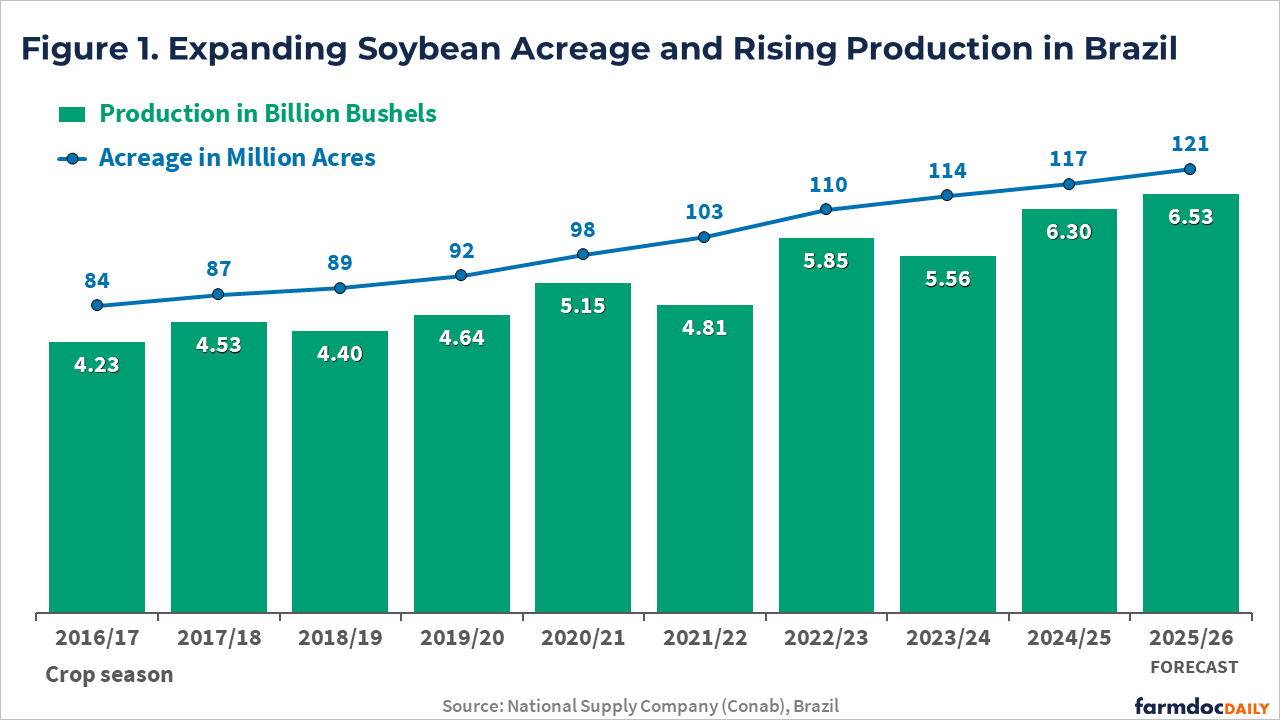
    In its preliminary estimate released on October 14, Conab projected that Brazil’s soybean acreage will increase by 3.5%, reaching 121 million acres – the largest area on record. For comparison, U.S. farmers planted 81 million acres of soybeans in the current crop season. If weather conditions cooperate, Brazilian production is expected to reach a new record of 6.5 billion bushels, up 3.6% from last season (see Figure 1). As of October 11, approximately 11% of the soybean area had been planted, below the five-year average of 17%, according to Conab.

    The expansion in soybean acreage is being driven by strong domestic and international demand. On the domestic side, growth is supported by Brazil’s biodiesel mandate, with soybean oil being the main raw ingredient. As of August 1, 2025, the country raised its required biodiesel blend from B14 to B15. Basically, diesel fuel must now contain 15% biodiesel, up from 14%, which represents about a 7% increase in total biodiesel use, given Brazil’s large diesel market. The change is part of the government’s Fuel of the Future program, aimed at boosting domestic biofuel production, creating jobs, and reducing dependence on imported fossil fuels.

    On the international side, demand remains strong, particularly from China. From January through September this year, Brazil exported 3.45 billion bushels of soybeans, with 77% of that volume shipped to China, according to the Foreign Trade Secretariat (Secex/Brazil). The total is 5% higher than in the same period last year. Brazil is projected to reach a record 3.9 billion bushels in soybean exports by the end of 2025, with shipments expected to surpass 4 billion bushels next year (see Figure 2).

    Bar chart displaying Brazilian soybean exports in billion bushels from 2016/17 to 2025/26 forecast.

    A significant share of Brazil’s export growth to China reflects the gap left by the United States, as Chinese buyers have largely suspended purchases of U.S. soybeans since May following the imposition of U.S. tariffs. Historically, China has been the top buyer of U.S. soybeans by a large margin. In 2024, the United States shipped nearly 985 million bushels to China, accounting for 51% of the nation’s total soybean exports that year (Colussi & Langemeier, 2025). China’s current share of Brazil’s soybean exports is historically high – comparable only to 2018, when President Trump launched the first trade war with China (see farmdoc daily, May 15, 2025).

    Despite the optimistic outlook for exports, Brazilian farmers are planting a soybean crop that is expected to be financially challenging, with 4% higher production costs and lower international prices. Projections from the Center for Advanced Studies on Applied Economics (Cepea) at the University of São Paulo (USP) indicate a decline in producers’ gross margins for the upcoming season. Compared with last year, average gross margins (gross revenue minus direct production costs) are estimated to fall from $165 per acre to $105 per acre. However, when interest rates, land rent, and depreciation are considered, margins are projected to turn negative (i.e., -$90 per acre).

    Corn Acreage to Expand Despite Lower Output

    Like soybeans, Brazilian corn acreage is also expected to expand by 4% in the 2025/26 season, reaching 56 million acres, according to Conab’s initial estimates. For comparison, U.S. farmers planted 99 million acres this season. Brazil’s total corn production is projected at 5.46 billion bushels across the country’s three crop cycles – 2% lower than last year and roughly one-third of total U.S. production (see Figure 3). The projected decline reflects an expected reduction in yields, following last season’s record-high production and productivity.

    Combined bar and line chart showing growth of Brazilian corn acreage and production from 2016/17 to 2025/26 forecast. Orange bars represent production in billion bushels, and green line with dots shows acreage in million acres.

    The first corn crop – planted beginning in September across southern Brazil and some irrigated areas of the Southeast – is expected to expand by 6% compared with last year. The second crop, planted right after the soybean harvest in January and February across the Center-West region and now accounting for nearly 80% of Brazil’s total corn production, is projected to see a 4% increase in acreage from last season. The expansion is driven mainly by rising domestic corn consumption, which Conab projects will grow from 3.58 billion bushels to 3.74 billion bushels – supported by stronger demand from the livestock feed and corn ethanol industries. Historically known for its sugarcane-based ethanol, Brazil has been rapidly expanding corn-based ethanol production, which today represents about 20% of the country’s total biofuel output (see farmdoc daily, April 14, 2025).

    In addition to stronger domestic demand, corn production is also expected to benefit from higher export projections for next year. While exports for the 2024/25 season are estimated at 1.58 billion bushels, the Brazilian government forecasts shipments of 1.83 billion bushels for the upcoming season – a 16% increase compared with the previous year, though still below the record set in 2022 when China opened its market to Brazilian corn (see Figure 4).

    Bar chart showing Brazilian corn exports in billion bushels from 2016/17 to 2025/26 forecast. Yellow/gold bars display volatile export patterns, starting at 0.87 billion bushels in 2016/17, reaching peaks of 2.20 billion in 2023/24, dropping to 1.58 billion in 2024/25, then recovering to a forecasted 1.83 billion bushels in 2025/26.

    In terms of production costs, Brazilian corn farmers are expected to see a 6% decrease in the next season, according to data from Cepea/USP. Even so, the projected gross margin (gross revenue minus direct production costs) is expected to fall from $75 per acre in the last crop season to just $6 per acre in the 2025/26 cycle. When other expenses, such as land rent and interest, are included, profits turn into losses, estimated at $135 per acre. The projected reduction is based mainly on the historical average yield of 90 bushels per acre, compared with 109 bushels per acre in last season’s record crop.

    Final Considerations

    Brazil is beginning its summer crop season with expectations of record planted area for both soybeans and corn, driven primarily by rising domestic demand for biofuels and favorable conditions in international markets. In the case of soybeans, higher exports to China – following the suspension of Chinese purchases of U.S. soybeans – have kept prices firm in Brazil, even after a record harvest. For corn, which also reached record output last season, the expansion in planted area is largely supported by the rapid growth of the corn ethanol industry in the Center-West states, a new and quickly expanding sector in Brazil.

    However, shrinking profit margins and higher financial costs could slow the pace of expansion ahead. While Brazil’s farmers continue to gain ground in global markets, their profitability is being squeezed by rising input costs, lower commodity prices, and high interest rates – a scenario similar to that faced by U.S. agriculture (see Langemeier et al., 2025), though with some regional differences. If margins remain tight, Brazilian future production growth should rely more on efficiency gains – such as higher yields and investments in logistics and storage – than on further area expansion.

    Data and References

    Colussi, J., M. Langemeier. “U.S. Soybean Harvest Starts with No Sign of Chinese Buying as Brazil Sets Export Record.” Center for Commercial Agriculture, Purdue University, September 22, 2025.

    Colussi, J., J. Coppess, N. Paulson and G. Schnitkey. “Trade Conflicts and Long-Term Consequences: Are Soybeans Doomed to Repeat History?” farmdoc daily (15):90, Department of Agricultural and Consumer Economics, University of Illinois at Urbana-Champaign, May 15, 2025.

    Colussi, J., G. Schnitkey and N. Paulson. “Ethanol Boom Drives Sharp Rise in Brazil’s Corn Consumption.” farmdoc daily (15):69, Department of Agricultural and Consumer Economics, University of Illinois at Urbana-Champaign, April 14, 2025.

    Conab, National Supply Company. Crops Time Series. Soybean and Corn Production. Brasília, Brasil. October 2025.

    Langemeier, M., M. Boehlje, and J. Colussi. “Financial Stress on Crop Farms: Who Is Most at Risk in the 2024–26 Downturn?” Center for Commercial Agriculture, Purdue University, September 3, 2024.

    Secex, Brazilian Secretariat of Foreign Trade. Brazil’s Ministry of Development, Industry, and Trade. Exports Report. October 2025. http://comexstat.mdic.gov.br/en/geral

    Continue Reading