Category: 3. Business

  • Like Jeff Bezos and Howard Schultz, Chess.com’s cofounder says people doubted his vision—with a 225 million-user empire, he’s now having the last laugh

    Like Jeff Bezos and Howard Schultz, Chess.com’s cofounder says people doubted his vision—with a 225 million-user empire, he’s now having the last laugh

    In any entrepreneur’s journey, there are bound to be naysayers and doors slammed in their face. 

    When Jeff Bezos was drumming up his early visions of Amazon while working as a hedge fund manager, his Wall Street boss questioned if he could achieve success and financial security by selling books on the internet. And when Howard Schultz was looking for money to back his coffee business, called Starbucks, more than 200 investors believed no one would pay $3 for a cup of joe. 

    The same goes for two of Chess.com’s founders, Danny Rensch and Erik Allebest, when they were shopping out their platform to potential investors. Rensch tells Fortune they were routinely overlooked and disregarded.

    “We were laughed out of VC rooms who said that chess would never be anything. Nobody invested early on, and it became the biggest blessing in disguise,” Rensch recalls. 

    No investor, no problem: Chess.com founder had his own back

    Instead of relying on the pockets of investors, the Chess.com founders dipped into their own. They bootstrapped the online business in 2009 with money from Allebest’s former chess ventures, also borrowing $70,000 from a mother’s friend, which Rensch says they paid back very quickly. Soon, the entrepreneurs proved that VC investors missed out on a huge win; today, Chess.com is one of the largest online chess platforms in the world with more than 225 million registered members and 40 million active monthly users. Chess.com says it even surpassed a $1 billion valuation back in 2023.

    Despite having to keep his day job for years while his bootstrapped company was clawing its way to profitability, Rensch says he wouldn’t have it any other way. It’s a part of Chess.com’s underdog story as the platform concept was not only mocked by venture capitalists, but also by the chess community at large. Now, the website has become essential for anyone who’s interested in, or serious about, chess—from novices to grandmasters. 

    “That is a really important part of the story—there was no money raised. We were completely bootstrapped,” Rensch continues. “And given where chess went, I think it’s funny and adds to the magic of ‘Wow, what happened here?”

    It was the ‘laughingstock’ of the chess community before amassing 225 million users

    When Chess.com was still on its business bambi legs, it not only had to take heat from the VC world, but also from its own community. Players were doubtful; the internet was still in its relative infancy in 2009. Plus, there were other niche chess gaming sites like ChessPark (which became a part of Chess.com), Chess Tempo, and Red Hot Pawn. 

    “Chess.com was the laughingstock of the online chess community,” Rensch says. “It sounds so funny to say now, but it really is important to reflect and understand that the internet—at its earliest inception—was not web two or let alone web three. Your website was just a place with a phone number for a lot of people.”

    “There were niche communities and there were the main ones, but Chess.com itself, and the idea that it would become such an amazing home for every level of the chess playing community…was kind of ridiculous for most,” Rensch continues. 

    Rensch says he sees his website as a skill-sharpener that enriches people’s lives. In looking at Chess.com like a subscription service—like a Duolingo, Strava, or Spotify—the platform is a “lifestyle” ritual that users feel adds value to their well-being. And in the 16 years since the website’s inception, more than 225 million chess lovers have flocked to the platform to sharpen their gameplay and be in community. 

    Continue Reading

  • Sam Altman wants to ‘treat adults like adults’—but can OpenAI keep ChatGPT safe after opening the door to erotica?

    Sam Altman wants to ‘treat adults like adults’—but can OpenAI keep ChatGPT safe after opening the door to erotica?

    OpenAI chief executive Sam Altman has announced that ChatGPT will soon be able to generate erotica for verified adult users. The move, framed by Altman as an effort to “treat adult users like adults,” comes as the company faces scrutiny over the way its AI bot can affect users’ mental health amid the rise of so-called “AI psychosis” cases. It also follows in the footsteps of rival companies, including Elon Musk’s xAI, which have already introduced more sexually explicit chatbot “companions” to their platforms.

    There is clearly a large demand for AI chatbots that are capable of behaving in romantic or sexual ways. An April survey of 6,000 regular AI users by the Harvard Business Review found that “companionship and therapy” was the most common use case. Another study from Ark Invest found that adult-focused AI platforms made significant gains last year, capturing 14.5% of the market previously dominated by OnlyFans, up from just 1.5% the year before.

    Popular alternatives that market themselves as companion AI chatbots, such as Character.ai and Replika, also speak to this growing demand from users. Earlier this year, xAI introduced “companion mode” for its chatbot Grok, a feature that lets users engage with various characters, including a highly sexualized anime persona called “Ani.”

    “OpenAI is stuck between a bit of a rock and a hard place, because I think they have seen a strong demand signal from users,” Jessica Li, a senior research analyst at Georgetown’s Center for Security and Emerging Technology, told Fortune. “In terms of the relationships that people are having with models…erotic content or adult content would also fall under this bucket of emotional engagement with the models.”

    The move could be an attempt by OpenAI to “straddle the line” between keeping the market share they already have by promising opt-in content moderation for NSFW content, Li said, while also seeing if they can capture other users from more specialized or niche services like Replika.

    “Despite some of the narratives around building artificial general intelligence that will supercharge the economy, OpenAI is still trying to operate as a technology platform, and somewhat like a social media company,” Li said. “There’s an interesting tension between the narratives that are being sold to investors and politicians… versus the things that are actually happening in the market.”

    OpenAI’s foray into adult content has drawn criticism from child safety advocates and notable industry figures concerned about erotica reaching younger users, despite age verifications.

    Earlier this week, the entrepreneur and TV personality Mark Cuban said OpenAI’s plan could “backfire hard,” and argued that parents will not trust OpenAI’s age filters to keep children away from explicit material. In the US, the Federal Trade Commission has already opened an inquiry into how AI chatbots interact with minors, and state lawmakers are considering tighter rules around digital companions and sexualized AI content. Jenny Kim, a partner at the law firm Boies Schiller Flexner, told the BBC that OpenAI is “using people like guinea pigs,” and questioned how the company would prevent children from accessing adult material on the platform.

    Reached for comment, OpenAI said that the company was building an age prediction system to understand whether someone is over or under 18. They added that if a user’s age could not be confidently confirmed, the chatbot would take the safer route and default to the under-18 experience, while giving adults ways to prove their age to unlock adult capabilities.

    Reacting to some of the backlash on X, Altman said that the announcement had blown “up on the erotica point much more than I thought it was going to.” He emphasized that the change was “just one example of us allowing more user freedom for adults,” not a retreat from safety measures or guardrails around mental health.

    “We are not the elected moral police of the world,” he said, adding that ChatGPT would continue to “prioritize safety over privacy and freedom for teenagers” while giving adults more autonomy.

    The GPT-4o backlash

    OpenAI has also been reckoning with an unexpected wave of backlash following its decision to replace the version of ChatGPT powered by GPT-4o with its newer GPT-5 model. Users revolted against the change, citing lost AI friendships and romantic relationships with the earlier iteration of the bot. One petition to keep the earlier version of the bot gathered almost six thousand signatories.

    “For many of us, GPT-4o offers a unique and irreplaceable user experience, combining qualities and capabilities that we value, regardless of performance benchmarks,” the petitioners wrote in the change.org campaign to keep GPT-4o. “We continue to benefit from GPT-4o in ways that are distinct and meaningful.”

    While OpenAI eventually restored the earlier version, those in the #keep4o movement have since told Fortune they were worried about the company routing users to GPT-5, “without consent or notification.”

    According to Li, the announcement from OpenAI could be trying to signal something to these users: “The very public announcement of it does make me think that they’re trying to signal something to users who are demanding this thing—like, ‘We hear you. We’re responding to your desires.’”

    The shift is also not entirely new; it builds upon a quieter update to OpenAI’s Model Spec earlier this year. In February, OpenAI updated the document to relax the rules around sexual and violent content in what it called a move away from “AI paternalism.” Updated guidelines at the time permitted the generation of written erotica and other sensitive material in appropriate contexts. OpenAI also told Fortune that the announcement was part of its plan to build on the latest release of the Model Spec, while maintaining boundaries against harmful uses like deepfakes.

    Continue Reading

  • Dutch minister says he will meet with China official about seizure of chipmaker Nexperia – Reuters

    1. Dutch minister says he will meet with China official about seizure of chipmaker Nexperia  Reuters
    2. In rare move, Dutch government takes control of China-owned chipmaker Nexperia  Reuters
    3. New Threat to Auto Sector; AI’s DIY Power; IKEA Prices  富途牛牛
    4. Dutch government in talks with China over crucial automotive chip supplier Nexperia  Automotive News
    5. Nexperia crisis: Semiconductor supply shock threatens global auto production  Automotive Manufacturing Solutions

    Continue Reading

  • Does Cognizant’s New AI Coding Blueprint Expand the Long-Term Growth Story for CTSH?

    Does Cognizant’s New AI Coding Blueprint Expand the Long-Term Growth Story for CTSH?

    • Cognizant Technology Solutions recently announced the launch of its Enterprise Vibe Coding Blueprint, a suite of services and reusable intellectual property that enables large enterprises to securely and efficiently operationalize AI-assisted coding across both technical and non-technical teams.

    • This move builds on the company’s record-setting Vibe Coding Week and highlights a shift toward fostering broad-based AI literacy and practical application within client organizations, reaching beyond traditional developer roles.

    • We’ll explore how the introduction of the Enterprise Vibe Coding Blueprint could reshape Cognizant’s investment case and growth outlook.

    Uncover the next big thing with financially sound penny stocks that balance risk and reward.

    To be a Cognizant Technology Solutions shareholder, one must believe in the company’s ability to lead enterprise adoption of AI-driven services, leveraging its proprietary platforms and deep consulting expertise to accelerate clients’ digital transformation. While the launch of Enterprise Vibe Coding Blueprint amplifies Cognizant’s differentiation in enterprise AI, it does not materially shift the immediate catalyst, clients scaling GenAI/automation projects, nor does it reduce the key risk of margin pressure from heightened competition and evolving client demands.

    Among recent developments, Cognizant’s July rollout of Agent Foundry stands out as it directly relates to the company’s focus on proprietary AI offerings, further supporting the current catalyst of large-scale AI implementation deals. Both the Blueprint and Agent Foundry signal Cognizant’s commitment to capturing new automation-led revenue streams, but risks remain if the company cannot continue scaling these platforms to offset potential headwinds from traditional outsourcing erosion.

    However, investors should also be aware that if technological progress outpaces demand for Cognizant’s labor-intensive services…

    Read the full narrative on Cognizant Technology Solutions (it’s free!)

    Cognizant Technology Solutions’ latest forecasts project $23.5 billion in revenue and $2.9 billion in earnings by 2028. This outlook is based on analysts’ expectations for 4.7% annual revenue growth and a $0.5 billion increase in earnings from the current level of $2.4 billion.

    Uncover how Cognizant Technology Solutions’ forecasts yield a $85.80 fair value, a 30% upside to its current price.

    CTSH Community Fair Values as at Oct 2025

    Eight community-generated fair value estimates for Cognizant range from US$66.06 to US$117.06 per share, reflecting wide variation in expectations. While many see upside, ongoing competition from established technology vendors could impact future earnings and project wins, consider multiple viewpoints to make a more informed decision.

    Explore 8 other fair value estimates on Cognizant Technology Solutions – why the stock might be worth just $66.06!

    Disagree with existing narratives? Create your own in under 3 minutes – extraordinary investment returns rarely come from following the herd.

    Right now could be the best entry point. These picks are fresh from our daily scans. Don’t delay:

    This article by Simply Wall St is general in nature. We provide commentary based on historical data and analyst forecasts only using an unbiased methodology and our articles are not intended to be financial advice. It does not constitute a recommendation to buy or sell any stock, and does not take account of your objectives, or your financial situation. We aim to bring you long-term focused analysis driven by fundamental data. Note that our analysis may not factor in the latest price-sensitive company announcements or qualitative material. Simply Wall St has no position in any stocks mentioned.

    Companies discussed in this article include CTSH.

    Have feedback on this article? Concerned about the content? Get in touch with us directly. Alternatively, email editorial-team@simplywallst.com

    Continue Reading

  • Does the Sports Contracts Launch Signal a New Era or Risk for CME Stock in 2025?

    Does the Sports Contracts Launch Signal a New Era or Risk for CME Stock in 2025?

    If you are eyeing CME Group stock and wondering whether now is the right time to buy, hold, or maybe wait on the sidelines, you are not alone. Over the past few years, CME has treated its long-term shareholders to a remarkable journey, boasting a 100.4% return over the past five years. Even zooming in, the ride has stayed exciting, with a 15.1% return so far this year and 22.6% over the last twelve months. Some investors might notice the dip of 1.3% in the past week, raising questions about whether new developments such as the company’s plan to launch sports contracts by the end of the year are already baked into the price or are hinting at shifting risk perceptions in the market.

    Of course, price action is only half the story. Analysts have recently adjusted their expectations; UBS even trimmed its price target slightly, despite raising estimates, reflecting a bit more caution about future outlook. Meanwhile, CME’s latest venture into sports contracts could open fresh revenue streams, especially as it wades deeper into prediction markets alongside big names in the industry. With competitors watching closely and industry partnerships evolving, the question is not just whether CME Group’s stock can keep climbing, but whether its current valuation really stacks up against its prospects.

    When we run CME Group through our 6-factor valuation check, it scores a 1 out of 6 for being undervalued, so not a screaming bargain at first glance. But before jumping to conclusions, let’s break down what those valuation measures really mean and see if there is a more insightful way to judge what CME is worth in today’s market.

    CME Group scores just 1/6 on our valuation checks. See what other red flags we found in the full valuation breakdown.

    The Excess Returns valuation approach examines how well a company generates returns above its cost of equity. Instead of focusing simply on earnings or cash flows, it measures the value created over and above what shareholders expect as a return for their capital. For CME Group, recent analyst estimates suggest its book value stands at $77.13 per share, while its expected stable earnings per share are $12.28, based on a weighted average of future Return on Equity projections from eight analysts.

    With a cost of equity set at $6.41 per share, CME achieves an excess return of $5.87 per share. This translates to an impressive average Return on Equity of 15.56%. The model also references a stable book value projection of $78.88 per share, built from assessments by five different analysts. These figures together inform a valuation model designed to capture the company’s ability to unlock value well into the future, rather than reflecting just short-term profits.

    Continue Reading

  • Negative Effects of the Trade War Offset by the AI Boom and the Industrial Renaissance

    Negative Effects of the Trade War Offset by the AI Boom and the Industrial Renaissance

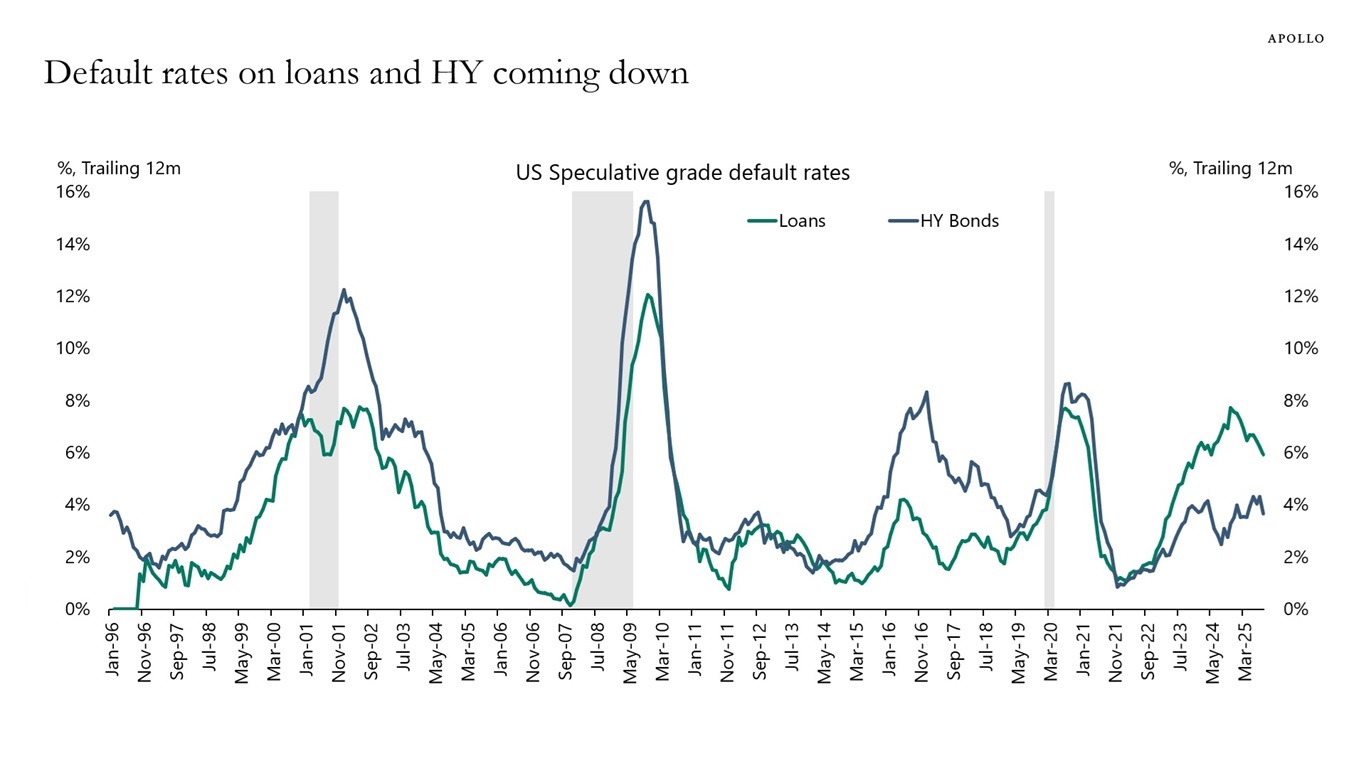
    Contrary to widespread fears about the economic outlook, key credit indicators are turning more bullish. Default rates for high yield debt and loans have peaked, along with delinquency rates for auto loans and credit cards, see charts below.

    Three factors explain why corporate default and consumer delinquency rates are moving lower:

    1) Uncertainty related to the trade war is significantly lower than its peak during Liberation Day.

    2) The ongoing AI boom is boosting the buildout of data centers and related energy infrastructure. Simultaneously, higher stock prices are supporting consumer spending.

    3) Investors are increasingly recognizing that we are in the early stages of an industrial renaissance across sectors like aerospace, defense, manufacturing, biotech and technology/automation.

    In summary, while the trade war remains a mild drag on growth, its impact is being more than offset by the tailwinds from the AI boom and the industrial renaissance. Consequently, there is a growing upside risk that economic growth will reaccelerate over the coming quarters.

    Sources: Moody’s Analytics, Apollo Chief Economist
    Auto loan delinquency rates peaking
    Sources: Federal Reserve Bank of New York, Macrobond, Apollo Chief Economist
    Credit card delinquency rates have peaked
    Sources: Federal Reserve Bank of New York, Macrobond, Apollo Chief Economist

    Download high-res charts


    This presentation may not be distributed, transmitted or otherwise communicated to others in whole or in part without the express consent of Apollo Global Management, Inc. (together with its subsidiaries, “Apollo”).  

    Apollo makes no representation or warranty, expressed or implied, with respect to the accuracy, reasonableness, or completeness of any of the statements made during this presentation, including, but not limited to, statements obtained from third parties. Opinions, estimates and projections constitute the current judgment of the speaker as of the date indicated. They do not necessarily reflect the views and opinions of Apollo and are subject to change at any time without notice. Apollo does not have any responsibility to update this presentation to account for such changes. There can be no assurance that any trends discussed during this presentation will continue.   

    Statements made throughout this presentation are not intended to provide, and should not be relied upon for, accounting, legal or tax advice and do not constitute an investment recommendation or investment advice. Investors should make an independent investigation of the information discussed during this presentation, including consulting their tax, legal, accounting or other advisors about such information. Apollo does not act for you and is not responsible for providing you with the protections afforded to its clients. This presentation does not constitute an offer to sell, or the solicitation of an offer to buy, any security, product or service, including interest in any investment product or fund or account managed or advised by Apollo. 

    Certain statements made throughout this presentation may be “forward-looking” in nature. Due to various risks and uncertainties, actual events or results may differ materially from those reflected or contemplated in such forward-looking information. As such, undue reliance should not be placed on such statements. Forward-looking statements may be identified by the use of terminology including, but not limited to, “may”, “will”, “should”, “expect”, “anticipate”, “target”, “project”, “estimate”, “intend”, “continue” or “believe” or the negatives thereof or other variations thereon or comparable terminology.


    Continue Reading

  • Government vows to create 400,000 jobs in clean energy sector

    Government vows to create 400,000 jobs in clean energy sector

    Pritti MistryBusiness reporter

    PA Media A spacious industrial workshop where several workers in dark clothing are assembling or inspecting large white objects. Yellow overhead cranes and lifting equipment are visible above. The workspace is clean and organized, with various tools and machinery around.PA Media

    The Siemens wind turbine factory in Hull, where thousands are employed, is “booming”, a minister has said

    The government has announced plans to train and recruit more workers for the UK’s clean energy sector, promising to create 400,000 extra jobs by 2030.

    Plumbers, electricians and welders are among 31 priority occupations that are “particularly in demand”, with employment in renewable, wind, solar and nuclear expected to double to 860,000 in five years, ministers have said.

    Speaking on the BBC’s Sunday with Laura Kuenssberg programme, Energy Secretary Ed Miliband said thousands of jobs were needed to develop Britain’s clean energy sector to “get bills down for good”.

    Welcoming the proposals, Unite the union said: “Well-paid, secure work must be at the heart of any green transition.”

    As part of the government’s strategy, five “technical excellence colleges” will be set up to train workers with clean energy skills, with £2.5m in funding going towards pilot schemes in Cheshire, Lincolnshire, and Pembrokeshire, according to the Department for Energy Security and Net Zero (DESNZ).

    A new programme is to be launched to match veterans with careers in solar panel installation, wind turbine factories and nuclear power stations, while oil and gas workers could benefit from up to £20m from the UK and Scottish governments for bespoke careers training in clean energy roles.

    There would be also be tailored schemes for ex-offenders, school leavers and the unemployed.

    He said 10,000 extra jobs would be needed to support the construction of the Sizewell C nuclear power station in Suffolk and described how the Siemen’s wind turbine factory in Hull was “booming”.

    Miliband also told the BBC he stood by his pledge to reduce energy bills by £300 by 2030, after bills went up by 2% for millions across the UK under Ofgem’s latest price cap.

    In a statement, Miliband said the plan would bring “a new generation of good industrial jobs” to communities across the UK.

    “Our plans will help create an economy in which there is no need to leave your hometown just to find a decent job.

    “Thanks to this government’s commitment to clean energy, a generation of young people in our industrial heartlands can have well-paid, secure jobs, from plumbers to electricians and welders.”

    According to DESNZ, jobs in the clean energy sector command average salaries of more than £50,000, compared to the UK average of £37,000.

    Work and Pensions Secretary Pat McFadden said: “We’re giving workers the skills needed to switch to clean energy, which is good for them, good for industry, and will drive growth across the nation.

    “Our new jobs plan will unlock real opportunities and ensure everyone has access to the training and support to secure the well-paid jobs that will power our country’s future.”

    Christina McAnea, general secretary of Unison, said the government’s strategy could “help create a UK workforce with highly skilled, fairly paid and secure jobs”.

    “Additional funding for apprenticeships and opportunities for young people are crucial too if the UK is to have a bright and clean energy future,” she added.

    Continue Reading

  • Fintech can be catalyst to make Hong Kong a next-level financial hub: Broadridge CEO

    Fintech can be catalyst to make Hong Kong a next-level financial hub: Broadridge CEO

    Embracing technology platforms for applications such as electronic proxy voting, private debt underwriting and trading of repurchase (repo) agreements can help Hong Kong elevate its standing as Asia’s top financial hub, according to a leading US fintech firm.

    Technologies that simplified investor engagement had been a catalyst for growth in other markets, said Tim Gokey, CEO of New York-listed Broadridge Financial Solutions, adding that fintech could enhance corporate governance and product innovation to help the city strengthen its connections with mainland China and the wider world.

    “We’re investing in the region and are excited to be part of the rapidly growing Hong Kong market, which is emerging as a leading financial hub in Asia and the primary point of connectivity between the mainland and global markets,” Gokey said in an interview during a trip to the city last month.

    Do you have questions about the biggest topics and trends from around the world? Get the answers with SCMP Knowledge, our new platform of curated content with explainers, FAQs, analyses and infographics brought to you by our award-winning team.

    His comments came before financial regulators in Hong Kong and mainland China unveiled a series of measures last month to allow cross-boundary bond repo business and to strengthen the city’s fixed income and currency markets – all initiatives that had been discussed and anticipated among market participants for a number of years.

    “We see a strong opportunity to support that growth by enhancing trust and transparency in corporate governance,” added Gokey, whose firm doubled its Asian team to nearly 500 over the past five years, with Hong Kong accounting for more than 80 people.

    As companies increasingly turned to capital markets, beyond banks, for fundraising, the transparency and trust of corporate governance became essential, he said, pointing to the US as an example.

    Tim Gokey, CEO of New York-listed Broadridge Financial Solutions. Photo: Handout alt=Tim Gokey, CEO of New York-listed Broadridge Financial Solutions. Photo: Handout>

    “Strong corporate governance is one of the key drivers behind the success and confidence in US capital markets,” he said. “It’s not the sole answer, but a crucial contributing factor.”

    Broadridge’s corporate-governance offerings, including proxy-voting platforms, have a global reach, processing shares held in street names at more than 1,000 broker-dealers and custodian banks. Its proxy services covered about 80 per cent of outstanding shares of US publicly listed companies in 2023.

    “Leveraging technology to simplify investor engagement has fuelled growth in markets like Japan, and building similar trust and transparency in Hong Kong is vital for its ambition to enhance connectivity between the mainland and the rest of the globe and become Asia’s leading financial hub,” Gokey said.

    A pain point that Broadridge aims to address is improving the distribution of information on corporate-governance processes, which was often well documented but not effectively shared.

    Digitising materials and enabling convenient access and voting through an app or broker platform would make it easier for retail investors to engage with the companies they invested in, he said.

    “Our platform brings transparency and enables retail investors – particularly those using digital brokers in Hong Kong who may hold shares across China, the US and Europe – to conveniently vote their shares globally under different regulatory regimes,” he said.

    For institutional investors, the firm was developing a data-driven voting platform that used artificial intelligence to apply preset rules to votes, moving beyond traditional recommendation-based systems to make proxy voting more efficient and customised, Gokey said.

    Another focus area for Broadridge in Asia is private debt – a growing asset class in the region. The firm’s cloud-based platform aimed to help asset managers with tasks from underwriting and working through deals to keeping deals on their books and record-keeping, reducing risks associated with managing collateralised loan obligations.

    Gokey said the fintech company also saw opportunities in tokenised assets and their clearing and settlement in Hong Kong, as market conditions and regulatory initiatives increasingly aligned with participants’ needs.

    Hong Kong authorities have launched several plans to future-proof the city’s financial infrastructure in recent years, including initiatives like stablecoins, electronic trading platforms and tokenised products.

    “We believe [our solution] is well-suited for this market due to clients’ need for liquidity, financing and risk management, as well as regulators’ push for digital assets,” Gokey said. “By leveraging existing infrastructure, we can help jump-start repos on the distributed ledger in Hong Kong and build confidence around these instruments.”

    This article originally appeared in the South China Morning Post (SCMP), the most authoritative voice reporting on China and Asia for more than a century. For more SCMP stories, please explore the SCMP app or visit the SCMP’s Facebook and Twitter pages. Copyright © 2025 South China Morning Post Publishers Ltd. All rights reserved.

    Copyright (c) 2025. South China Morning Post Publishers Ltd. All rights reserved.


    Continue Reading

  • Meet AMIES, China’s new hope in breaking reliance on ASML’s chipmaking machines

    Meet AMIES, China’s new hope in breaking reliance on ASML’s chipmaking machines

    AMIES Technology, a new Chinese lithography equipment manufacturer that showcased its latest chipmaking products at an industry event in Shenzhen last week, is offering renewed optimism in the nation’s drive to reduce its dependence on Dutch giant ASML.

    The company presented a wide range of products – including compound-semiconductor lithography machines, laser-annealing systems, advanced inspection tools and solutions for packaging and wafer bonding – at the WeSemiBay Semiconductor Ecosystem Expo 2025, which featured more than 600 exhibitors, such as Huawei Technologies partner SiCarrier.

    Advanced lithography remains a significant bottleneck in China’s chipmaking ambitions. The country still trails far behind global leaders in the technology and is restricted from acquiring ASML’s top deep ultraviolet (DUV) and extreme ultraviolet (EUV) systems due to US export controls.

    Do you have questions about the biggest topics and trends from around the world? Get the answers with SCMP Knowledge, our new platform of curated content with explainers, FAQs, analyses and infographics brought to you by our award-winning team.

    Founded in February, AMIES is a spin-off from China’s leading lithography company, the state-owned Shanghai Micro Electronics Equipment (SMEE). While SMEE focuses on developing essential front-end tools, AMIES aims to commercialise equipment more swiftly, according to Chinese media reports, citing company representatives.

    US-sanctioned SMEE excels in back-end semiconductor processes like packaging, which often require less advanced lithography technology. When it comes to front-end wafer fabrication, however, it is still trying to catch up with Western leaders such as ASML.

    AMIES was spun off from SMEE in February. Photo: Handout alt=AMIES was spun off from SMEE in February. Photo: Handout>

    The Chinese company’s most reliable production-grade lithography tools are believed to support processes around 90-nanometre node and above. In late 2023, its shareholder Zhangjiang Group briefly claimed on social media that SMEE had “successfully developed a 28-nm lithography machine”, but later retracted the reference.

    In contrast, ASML’s EUV systems are used by leading chipmakers for processes at 2-nm nodes and below.

    For now, AMIES said its flagship product is its advanced packaging lithography machine, which held a global market share of 35 per cent and a 90 per cent share in China.

    On its website, AMIES lists four product lines: integrated circuits, advanced packaging, compound semiconductors and flat-panel displays. These encompass various types of annealing, inspection, chip manufacturing and packaging tools.

    In August, the company said it shipped its 500th stepper lithography machine. Steppers expose chip patterns on wafers one section at a time, unlike scanners, which continuously move the mask and wafer for faster, more precise exposures.

    AMIES received an award at the China International Industry Fair in September for its “next-generation fan-out packaging lithography system”.

    The company has received solid state support. AMIES’s nearly 30 shareholders include local government-backed funds such as Shanghai Information Investment, Spinnotec, the venture arms of Zhangjiang Hi-Tech Park and Citic Group, alongside a number of private equity investors, according to the Chinese corporate database Tianyancha.

    AMIES said it had a technical team of 600 people, with an average age of 33, and 65 per cent holding master’s or doctoral degrees.

    As part of China’s broader push for chip self-reliance across the supply chain, various players are racing to develop domestic DUV and EUV tools. Shenzhen-backed chip equipment firm SiCarrier, for example, is reportedly working on advanced-node lithography machines, although it has not publicly unveiled such products.

    Zetop Technologies – partially owned by SiCarrier and the US-sanctioned Changchun Institute of Optics, Fine Mechanics and Physics under the Chinese Academy of Sciences – counts key EUV optics researchers among its shareholders.

    Shanghai-based Yuliangsheng, in which SiCarrier also has a stake, supplied a 28-nm DUV system to Semiconductor Manufacturing International Corporation, China’s largest semiconductor foundry, for testing in 7-nm chip production, according to a Financial Times report in September.

    In the third quarter, ASML reported total net sales of €7.5 billion (US$8.8 billion), with China accounting for 42 per cent of system orders.

    However, ASML expected a sharp decline in demand from China next year, as tensions between the US and China, coupled with Beijing’s recent export controls on rare earth materials essential for ASML’s machines, have further complicated the global semiconductor supply chain.

    This article originally appeared in the South China Morning Post (SCMP), the most authoritative voice reporting on China and Asia for more than a century. For more SCMP stories, please explore the SCMP app or visit the SCMP’s Facebook and Twitter pages. Copyright © 2025 South China Morning Post Publishers Ltd. All rights reserved.

    Copyright (c) 2025. South China Morning Post Publishers Ltd. All rights reserved.


    Continue Reading

  • How Investors May Respond To Aeluma (ALMU) Boosting Growth Funds With $25 Million Capital Raise

    How Investors May Respond To Aeluma (ALMU) Boosting Growth Funds With $25 Million Capital Raise

    • Aeluma, Inc. recently completed its underwritten public offering, raising approximately US$25.4 million in gross proceeds and boosting its cash position to about US$38 million to invest in manufacturing partnerships and engineering talent.

    • This significant cash increase could further position Aeluma for operational expansion through new hires and enhanced manufacturing capabilities.

    • To assess how these developments affect Aeluma’s investment narrative, we’ll focus on the company’s increased capacity to invest in growth initiatives.

    Uncover the next big thing with financially sound penny stocks that balance risk and reward.

    To own shares in Aeluma today is to believe the company can turn rapid revenue growth and cutting-edge photonics into lasting profitability, even in a competitive and volatile sector. The recent US$25.4 million public offering lifts Aeluma’s cash reserves to around US$38 million, giving the company more room to pursue manufacturing partnerships and attract engineering talent. This extra cash could accelerate key short-term catalysts like new product launches and customer wins, while potentially reducing worries about near-term funding pressures. Still, with a recent uptick in insider selling and a history of substantial shareholder dilution, questions remain about how quickly the business can transition from high growth to sustainable profit. The fresh cash raises the company’s ceiling for expansion, but does not remove risks around execution, dilution, or path to profitability. In contrast, investors should keep an eye on the ongoing dilution risk and shifting capital needs.

    Our valuation report unveils the possibility Aeluma’s shares may be trading at a premium.

    ALMU Community Fair Values as at Oct 2025

    Opinions from 4 Simply Wall St Community members peg Aeluma’s fair value anywhere from US$1.58 to US$25.50 per share. With such a wide range of estimates and the company recently strengthening its cash reserves, views on Aeluma’s future profitability and dilution risk continue to divide market participants. Explore these different viewpoints to better understand both the opportunity and the uncertainty.

    Explore 4 other fair value estimates on Aeluma – why the stock might be worth as much as 53% more than the current price!

    Disagree with this assessment? Create your own narrative in under 3 minutes – extraordinary investment returns rarely come from following the herd.

    Don’t miss your shot at the next 10-bagger. Our latest stock picks just dropped:

    This article by Simply Wall St is general in nature. We provide commentary based on historical data and analyst forecasts only using an unbiased methodology and our articles are not intended to be financial advice. It does not constitute a recommendation to buy or sell any stock, and does not take account of your objectives, or your financial situation. We aim to bring you long-term focused analysis driven by fundamental data. Note that our analysis may not factor in the latest price-sensitive company announcements or qualitative material. Simply Wall St has no position in any stocks mentioned.

    Companies discussed in this article include ALMU.

    Have feedback on this article? Concerned about the content? Get in touch with us directly. Alternatively, email editorial-team@simplywallst.com

    Continue Reading