Category: 3. Business

  • UK future crypto framework: the countdown begins

    The final legislation largely carries forward the core architecture consulted on in April, with the list of newly regulated activities remaining fundamentally intact. However, there have been a number of significant changes, including clarification around definitions, and the inclusion of new provisions governing cryptoasset public offers, disclosures and market abuse.

    At the same time, the Financial Conduct Authority (FCA) published three consultation papers on regulating cryptoasset activities, the admissions and disclosures and market abuse regime for cryptoassets, and a prudential regime for cryptoasset firms which we will cover in separate blog posts.

    Overview of the new regime

    The draft Financial Services and Markets Act 2000 (Cryptoassets) Regulations 2025 (the CRAO) set out the legal basis for the FCA to regulate a range of activities in the UK in respect of ‘qualifying cryptoassets’ and ‘qualifying stablecoins’.

    Regulated activities and exclusions

    The CRAO amends the existing Financial Services and Markets Act (Regulated Activities) Order 2001 to specify new regulated activities including: issuing qualifying stablecoin; safeguarding of qualifying cryptoassets and relevant specified investment cryptoassets; operating a qualifying cryptoasset trading platform; dealing in qualifying cryptoassets as principal or agent; arranging deals in qualifying cryptoassets; and qualifying cryptoasset staking.

    The definition of ‘issuing qualifying stablecoin’ has been amended. It now requires a firm to carry on all of the following activities from a UK establishment: (i) the offer (or arrangements for the offer) of a qualifying stablecoin, which was created by (or on behalf of) the offeror or a member of its group; (ii) redemption of such qualifying stablecoins; and (iii) maintenance of the qualifying stablecoins value (e.g. by holding fiat or other assets). Minting alone is expressly excluded from issuance.

    The final legislation also introduces new exclusions, including for activities carried on ‘for the sale of goods or supply of services’, as well as making amendments to existing exclusions. Additional activity-specific exclusions apply, for example to dealing/arranging where cryptoassets are acquired or transferred for no consideration, or where distribution arises as a protocol reward.

    Territorial scope

    The CRAO amends section 418 FSMA to set clear UK nexus tests for cryptoasset activities; it is designed to capture material UK-facing activity even where a firm has an overseas base. Firms which offer cryptoasset or stablecoin related services to UK customers will be caught by the new rules even if they are based overseas. However, carve-outs will apply to some firms which, for example, deal exclusively with institutional clients or act through licensed intermediaries.

    Cryptoassets admissions and disclosures regime

    New provisions included in the final legislation create designated activities for public offers of qualifying cryptoassets and the admission of qualifying cryptoassets to trading. Rules will also apply to any related disclosures. Exemptions apply in limited circumstances.

    A new designated activity regime shall govern public offers of qualifying cryptoassets and admissions to trading on qualifying cryptoasset trading platforms, replacing the prior Financial Promotion Order (FPO) cryptoasset exemption with a purpose-built framework. Public offers to the UK are generally prohibited unless an exemption applies (e.g. small offers up to £1,000,000; offers solely to qualified investors; fewer than 150 offerees; minimum £100,000 per investor; or offers of qualifying stablecoin by authorised issuers). The FCA may make designated activity rules for disclosures and liability. Where offerors rely on an exemption, material information provided to prospective buyers must be incorporated into the applicable disclosure document or otherwise disclosed to the audience of the offer.

    The FCA may set content, responsibility and form requirements for disclosure documents via designated activity rules, and persons responsible for such documents face civil liability for untrue or misleading statements or required omissions, subject to comprehensive exemptions and a protected forward‑looking statements safe harbour defined by FCA rules. Purchasers may be granted withdrawal rights through FCA rules, with consequences for non‑compliance.

    Market abuse regime for cryptoassets

    A crypto-specific market abuse regime will apply to relevant qualifying cryptoassets admitted or seeking admission to trading, and to related instruments, mirroring familiar MAR concepts: inside information, insider dealing, unlawful disclosure and market manipulation. Firms within scope must implement systems and procedures to prevent, detect and disrupt abuse; notify trading platforms of suspicious orders/transactions; maintain insider lists; and comply with information-sharing provisions under FCA rules. The FCA may designate legitimate cryptoasset market practices and set detailed rule requirements.

    Consequential changes

    The CRAO makes consequential amendments to existing anti-money laundering and financial promotions requirements for cryptoasset firms to reflect the new regulatory perimeter.

    Beyond the changes the FPO to recognise crypto disclosure documents (see above), these consequential amendments include: (i) exclusion of the regulated issuance of a qualifying stablecoin from being a payment service under the Payment Services Regulations 2017; (ii) amendment to the definition of “monetary value” in the Electronic Money Regulations 2011 to exclude stablecoins and their backing assets; (iii) amendments to the funds legislation to exclude specified qualifying stablecoin “backing” arrangements from constituting alternative investment funds or collective investment schemes, subject to conditions (e.g. no interest or yield to holders); and (iv) amendments to the Money Laundering Regulations to dovetail with the new authorisation perimeter and to require authorised firms and specified investment cryptoasset firms to notify the FCA if acting as cryptoasset exchange or custodian wallet providers.

    Transitional and savings provisions

    Transitional measures will allow firms to apply to the FCA for a licence ahead of the regime’s start date and to continue providing services while their applications are being considered, though applications may be made outside that window. A savings provision applies for applicants who file within the relevant application period and remain undetermined at the CRAO go-live date; an applicant will be able to continue their activities under the pre-go-live position for up to two years.

    Next steps

    The timeline is now fixed. Parliamentary approval is expected in 2026, and the regime will then go live on 25 October 2027.

    The FCA and Prudential Regulation Authority is empowered under the CRAO to consult and make designated activity rules and general rules ahead of the go-live date.

    Watch out in the coming days for our blog posts on the recently published FCA consultation papers. Please also join us in January for a series of webinars, as we delve deeper into the detail of the UK’s new crypto regime.


    Continue Reading

  • The request could not be satisfied


    ERROR: The request could not be satisfied

    The request could not be satisfied.


    Request blocked.
    We can’t connect to the server for this app or website at this time. There might be too much traffic or a configuration error. Try again later, or contact the app or website owner.


    If you provide content to customers through CloudFront, you can find steps to troubleshoot and help prevent this error by reviewing the CloudFront documentation.


    Generated by cloudfront (CloudFront)
    Request ID: 6pNKM_mRrL_jtkqEB6fOLK40y8YLHsn6VazgXxIddKNMv9cpPFPKvA==
    

    Continue Reading

  • IRS increases 2026 business mileage rate by 2.5 cents

    IRS increases 2026 business mileage rate by 2.5 cents

    WASHINGTON — The standard mileage rate for the business use of a car, truck, van or other vehicle will increase by 2.5 cents in 2026.

    The IRS announced Monday that beginning Jan. 1, the standard mileage rate for a qualifying vehicle will be 72.5 cents per mile, up 2.5 cents from 2025.

    The rate will be 20.5 cents per mile driven for medical purposes, down a half cent from 2025 and will be 20.5 cents per mile driven for moving purposes for certain active-duty members of the Armed Forces and certain members of the intelligence community, which is reduced by a half cent from last year.

    The change, meant to reflect updated cost data and annual inflation adjustments, applies to fully-electric and hybrid automobiles, and gas and diesel-powered vehicles.

    Use of the standard mileage rates is optional. People who use a their car for work may instead choose to calculate the actual costs of using their vehicle.

    Continue Reading

  • Wu, A. M. et al. Global, regional, and national burden of bone fractures in 204 countries and territories, 1990–2019: a systematic analysis from the Global Burden of Disease Study 2019. Lancet Healthy Longevity 2(9), e580–e592. https://doi.org/10.1016/s2666-7568(21)00172-0 (2021).

    Google Scholar 

  • Amin, S., Achenbach, S. J., Atkinson, E. J., Khosla, S. & Melton, L. J. Trends in fracture incidence: a population-based study over 20 years. J. Bone Min. Res. 29 (3), 581–589. https://doi.org/10.1002/jbmr.2072 (2014). 3rd.

    Google Scholar 

  • Wennergren, D. et al. Epidemiology and incidence of tibia fractures in the Swedish fracture register. Injury 49 (11), 2068–2074. https://doi.org/10.1016/j.injury.2018.09.008 (2018).

    Google Scholar 

  • Padilla-Eguiluz, N. G. & Gómez-Barrena, E. Epidemiology of long bone non-unions in Spain. Injury, 52 Suppl 4, S3-s7. (2021). https://doi.org/10.1016/j.injury.2021.02.053

  • Mills, L. A., Aitken, S. A. & Simpson, A. The risk of non-union per fracture: current Myths and revised figures from a population of over 4 million adults. Acta Orthop. 88 (4), 434–439. https://doi.org/10.1080/17453674.2017.1321351 (2017).

    Google Scholar 

  • Mills, L. A. & Simpson, A. H. The relative incidence of fracture non-union in the Scottish population (5.17 million): a 5-year epidemiological study. BMJ Open. 3 (2). https://doi.org/10.1136/bmjopen-2012-002276 (2013).

  • Zura, R. et al. Epidemiology of fracture nonunion in 18 human bones. JAMA Surg. 151 (11), e162775. https://doi.org/10.1001/jamasurg.2016.2775 (2016).

    Google Scholar 

  • Calori, G. M., Mazza, E., Colombo, M., Ripamonti, C. & Tagliabue, L. Treatment of long bone non-unions with polytherapy: indications and clinical results. Injury 42 (6), 587–590. https://doi.org/10.1016/j.injury.2011.03.046 (2011).

    Google Scholar 

  • Ekegren, C. L., Edwards, E. R., de Steiger, R. & Gabbe, B. J. Incidence costs and predictors of non-Union, delayed union and mal-union following long bone fracture. Int. J. Environ. Res. PublicHealth https://doi.org/10.3390/ijerph15122845 (2018).

    Google Scholar 

  • Busse, J. W., Bhandari, M., Sprague, S., Johnson-Masotti, A. P. & Gafni, A. An economic analysis of management strategies for closed and open grade I tibial shaft fractures. Acta Orthop. 76 (5), 705–712. https://doi.org/10.1080/17453670510041808 (2005).

    Google Scholar 

  • Hak, D. J. et al. Delayed union and nonunions: epidemiology, clinical issues, and financial aspects. Injury 45 (Suppl 2), 3–7. https://doi.org/10.1016/j.injury.2014.04.002 (2014).

    Google Scholar 

  • Nicholson, J. A., Yapp, L. Z., Keating, J. F. & Simpson, A. Monitoring of fracture healing. Update on current and future imaging modalities to predict union. Injury 52 Suppl 2, S29–s34. https://doi.org/10.1016/j.injury.2020.08.016 (2021).

    Google Scholar 

  • Bhandari, M. et al. Assessment of radiographic fracture healing in patients with operatively treated femoral neck fractures. J. Orthop. Trauma. 27 (9), e213–219. https://doi.org/10.1097/BOT.0b013e318282e692 (2013).

    Google Scholar 

  • Litrenta, J. et al. Determination of radiographic healing: an assessment of consistency using RUST and modified RUST in metadiaphyseal fractures. J. Orthop. Trauma. 29 (11), 516–520. https://doi.org/10.1097/bot.0000000000000390 (2015).

    Google Scholar 

  • Bhandari, M. et al. Radiographic union score for hip substantially improves agreement between surgeons and radiologists. BMC Musculoskelet. Disord. 14, 70. https://doi.org/10.1186/1471-2474-14-70 (2013).

    Google Scholar 

  • Kienast, B. et al. An electronically instrumented internal fixator for the assessment of bone healing. Bone Joint Res. 5 (5), 191–197. https://doi.org/10.1302/2046-3758.55.2000611 (2016).

    Google Scholar 

  • Windolf, M. et al. Continuous implant load monitoring to assess bone healing Status-Evidence from animal testing. Med. (Kaunas). 58 (7). https://doi.org/10.3390/medicina58070858 (2022).

  • Pelham, H. et al. Implantable strain sensor to monitor fracture healing with standard radiography. Sci. Rep. 7 (1), 1489. https://doi.org/10.1038/s41598-017-01009-7 (2017).

    Google Scholar 

  • Umbrecht, F. et al. Wireless implantable passive strain sensor: design, fabrication and characterization. J. Micromech. Microeng. 20 (8). https://doi.org/10.1088/0960-1317/20/8/085005 (2010).

  • Rajamanthrilage, A. et al. Measuring orthopedic plate strain to track bone healing using a fluidic sensor read via plain radiography. IEEE Trans. Biomed. Eng. 69 (1), 278–285. https://doi.org/10.1109/tbme.2021.3092291 (2022).

    Google Scholar 

  • Borchani, W., Aono, K., Lajnef, N. & Chakrabartty, S. Monitoring of postoperative bone healing using smart Trauma-Fixation device with integrated Self-Powered Piezo-Floating-Gate sensors. IEEE Trans. Biomed. Eng. 63 (7), 1463–1472. https://doi.org/10.1109/tbme.2015.2496237 (2016).

    Google Scholar 

  • Najafzadeh, A. et al. Application of fibre Bragg grating sensors in strain monitoring and fracture recovery of human femur bone. Bioeng. (Basel). 7 (3). https://doi.org/10.3390/bioengineering7030098 (2020).

  • McGilvray, K. C. et al. Implantable microelectromechanical sensors for diagnostic monitoring and post-surgical prediction of bone fracture healing. J. Orthop. Res. 33 (10), 1439–1446. https://doi.org/10.1002/jor.22918 (2015).

    Google Scholar 

  • Ledet, E. H. et al. Smart fracture plate for quantifying fracture healing: preliminary efficacy in a Biomechanical model. J. Orthop. Res. 40 (10), 2414–2420. https://doi.org/10.1002/jor.25254 (2022).

    Google Scholar 

  • Chancharoen, P., Tangpornprasert, P., Amarase, C., Tantavisut, S. & Virulsri, C. Design of osteosynthesis plate for detecting bone union using wire natural frequency. Sci. Rep. 14 (1), 12569. https://doi.org/10.1038/s41598-024-63530-w (2024).

    Google Scholar 

Continue Reading

  • Gold and silver see rollercoaster end to blockbuster year – BBC

    Gold and silver see rollercoaster end to blockbuster year – BBC

    1. Gold and silver see rollercoaster end to blockbuster year  BBC
    2. Precious metals on track for blockbuster annual gains  Reuters
    3. Gold and silver prices retreat as traders lock in gains  Investing.com
    4. Silver may break $125/oz in 2026, Shanghai shortages could cause ‘force majeure’ price shock – SilverStockInvestor’s Krauth  KITCO
    5. ‘We’re in a metals war’: Gold, silver rebound after sharp sell-off  Yahoo Finance

    Continue Reading

  • Gold prices dip despite big jump in 2025 – Pakistan

    Gold prices dip despite big jump in 2025 – Pakistan

    Local and international gold prices declined on Wednesday, with 10 grams becoming cheaper by Rs2,143 and a tola by Rs2,500, while the 10-gram price settled at Rs391,771 and the per-tola price at Rs456,962.

    The global price fell by 25 dollars to 4,346 dollars per ounce.

    During 2025, however, gold became expensive by Rs158,060 per 10 grams and Rs184,362 per tola, while the global price rose by 1,732 dollars per ounce.

    Continue Reading

  • SAP announced final transition period for compatibility packs

    SAP announced final transition period for compatibility packs

    SAP has announced a final five months transition period for the usage rights of its Compatibility Packs for SAP S/4HANA on premise, moving the expiration date from December 31, 2025, to the end of May 2026.

    Compatibility Packs provide temporary usage rights, allowing certain classical SAP ERP functionalities to operate within SAP S/4HANA, aiming to ease the migration and maintain business continuity for customers moving from SAP ERP to SAP S/4HANA.

    For most of the Compatibility Packs, the usage rights end on December 31, 2025, which has been extensively communicated to customers, partners, and user groups and is documented in SAP Note 2269324.

    To counter for the fact that despite the extensive communication several customers still need some more time to manage this transition, SAP is offering this final transition period in an effort to provide customers with greater choice and flexibility.

    Accompanying this extension, SAP will offer tailored programs for customers that are moving to the respective SAP cloud solutions that replace the compatibility pack functionalities. We encourage affected customers to contact their SAP representative.


    Stefan Steinle is EVP and head of Customer Support & Cloud Lifecycle Management at SAP.

    Receive weekly news highlights from the SAP News Center in our newsletter

    Continue Reading

  • US stock market ends 2025 on a high note after volatile year

    US stock market ends 2025 on a high note after volatile year

    The technology-heavy Nasdaq Composite index is poised for a 21% gain this year, while the Russell 2000 index of smaller companies is roughly 12% higher year-to-date.

    In early April, when Trump announced sweeping tariffs on US trading partners, the S&P 500 fell to the brink of bear market territory – Wall Street’s term for a drop of 20% from the latest high. Both the Nasdaq Composite and Russell 2000 indexes did briefly tumble into bear markets.

    But major indexes quickly bounced back after Trump walked back his steepest tariffs, easing Wall Street’s fears about a tariff-driven economic slowdown.

    Stocks have since surged to new highs.

    That’s been in spite of persistent jitters about the economy, Robert Edwards, chief investment officer at Edwards Asset Management, said in a note.

    “The market continues to climb the wall of worry into next year,” he said.

    He added that 2026 “should be another year of record setting for stocks”, pointing in part to expectations for lower borrowing costs, which could boost corporate earnings and drive stock prices higher.

    Strong earnings growth in corporate America has been a key driver of the stock market rally since the tariff-driven whiplash in the spring, said Parag Thatte, an equity strategist at Deutsche Bank.

    At the same time, geopolitical tensions, Trump’s tariffs and expectations of interest rate cuts added to investor demand this year for safe haven assets, such as gold and other commodities. The price of gold is on track for a nearly 70% yearly increase.

    Bitcoin, on the other hand, has struggled to keep up with strong returns across stocks and gold.

    Despite getting a boost earlier in the year from the Trump administration’s support for digital assets, the world’s largest cryptocurrency is poised to end 2025 slightly lower, after a sharp decline from its record highs in October.

    Continue Reading

  • Cross-border rail passengers warned of new year disruption

    Cross-border rail passengers warned of new year disruption

    Getty Images A man in a checked shirt, woolly hat and gloves, stands on a rail station platform. He has his back to the camera and is facing an Avanti West Coast train. Getty Images

    The line closures will affect passengers travelling on Avanti West Coast trains

    Train passengers are being warned of disruption to cross-border services in the first week of the new year due to major engineering work.

    Network Rail says the West Coast Mainline between Lockerbie and Carlisle will be closed from New Year’s Day for six days.

    Replacement bus services transport passengers between the two stations.

    Buses will also replace trains between Carlisle and Dumfries when the line is shut from Friday until 6 January.

    The cross-border closure is part of a wider shutdown of the line to allow the installation of a new bridge at Clifton, near Penrith.

    The 426ft (130m) bridge, which weighs 4,200 tonnes, will carry trains on the West Coast Main Line over the M6.

    The removal of the previous bridge and the installation of the new structure begins on Hogmanay and will affect services on the line until 15 January.

    Part of the M6 motorway will also be closed and Network Rail says it will use that opportunity to also replace more than 50 miles (80km) of overhead cables.

    And it added that “significant work” will also take place on an ongoing £61m upgrade to signalling systems north of Carlisle.

    Rail passengers are being warned that the West Coast Main Line will be closed:

    • From 1-4 January through Preston, between Oxenholme and Carlisle, and Carlisle to Dumfries and Lockerbie
    • From 5-6 January between Oxenholme and Carlisle, and Carlisle to Dumfries and Lockerbie. The line through Preston will be open.
    • From 7-14 January the line north of Carlisle will be open. The line between Oxenholme and Carlisle will be closed until the early hours of 15 January.
    Network Rail An aerial view of a railway bridge crossing a motorway. Network Rail

    Engineers will replace the bridge over the M6 near Clifton

    The M6 will be shut between junctions 39 at Shap and 40 near Penrith on two consecutive weekends.

    The closures will take place between 20:00 on Friday 2 January and 05:00 on Monday 5 January, and between 20:00 on Friday 9 January and 05:00 on Monday 12 January.

    William Brandon, Network Rail’s project manager, said: “This is a vital project which will improve journeys for passengers for decades to come.

    He added: “We appreciate passengers’ patience while this work is completed, and I would urge anyone planning to travel in this period to check National Rail Enquiries in advance.”

    Chris Liptrot, operations director at Avanti West Coast, said it would operate an amended timetable.

    “Some journeys between the north-west, Carlisle, and Scotland will involve changes onto a shuttle service as well as rail replacement buses,” he added.

    “We strongly advise customers to plan ahead and check their journey before travelling.”

    Continue Reading

  • Revived Siemens Energy fends off activist call for wind spin-off

    Revived Siemens Energy fends off activist call for wind spin-off

    Stay informed with free updates

    Siemens Energy has been the second-best performing German blue-chip stock in 2025, with its shares more than doubling, but the dramatic recovery has been too slow for some investors who see its struggling wind business weighing down its valuation.

    The German producer of gas turbines and power grid equipment, which was forced to turn to a government-backed €15bn rescue package in 2023, has been buoyed by surging energy demand driven by artificial intelligence data centres and electrification.

    Shares in Siemens Energy, which fell below €7 in late 2023 amid problems at its wind business, are now trading around €120.

    “Even 12 months ago, we would not have imagined that the momentum, in all areas, is as strong as it is today,” Siemens Energy finance chief Maria Ferraro told the Financial Times.

    The share surge has allowed it to so far shrug off calls in December from activist investor Ananym Capital to consider a spin-off of its Siemens Gamesa wind business, which it says competes with other units for investment.

    Ferraro said the company’s leadership had the “proven track record” to turn around the wind unit, after guiding the gas and grid businesses to growth.

    The company wanted Siemens Gamesa to “be a contributor . . . and not dilutive to our business, but that takes time”.

    The group’s management had discussed a potential spin-off of Siemens Gamesa before receiving the letter from Ananym. Chief executive Christian Bruch said in November that Gamesa needed to be a “double-digit margin business, otherwise we’re not the right owner”.

    Ferraro said Siemens Energy was currently “committed” to its target for the wind unit to break even and reach an operating margin of between 3 and 5 per cent in 2028 as a “minimum”.

    Siemens Energy finance chief Maria Ferraro
    Siemens Energy finance chief Maria Ferraro

    Jefferies analyst Lucas Ferhani noted that the energy business was marked by cyclical changes. “Not too long ago people were telling us that [Siemens Energy’s] gas business was not great. And now look at where they are,” he said, pointing to soaring demand.

    Management would hope that the market for wind turbines would turn out to be “on their side” in years to come, he added.

    Siemens Energy’s order backlog stood at a record €138bn as of September, with the next available delivery slot for one of its large gas turbines in 2029. The group, which made a net loss of €4.6bn at the depth of its crisis in 2023, turned a profit of €1.7bn in the year to September.

    The energy company, which had been at the core of the Siemens conglomerate, was spun out in 2020 inheriting a majority stake in the wind power business, Siemens Gamesa.

    The stake in the wind engineering and turbine unit was seen at the time as a counterweight to Siemens Energy’s fossil fuel divisions.

    However, beset with technical problems, Siemens Gamesa suffered from steep losses. After Siemens Energy delisted the wind unit in 2023 to gain more control over the business, it was forced to fall back on a rescue package owing to a funding crunch.

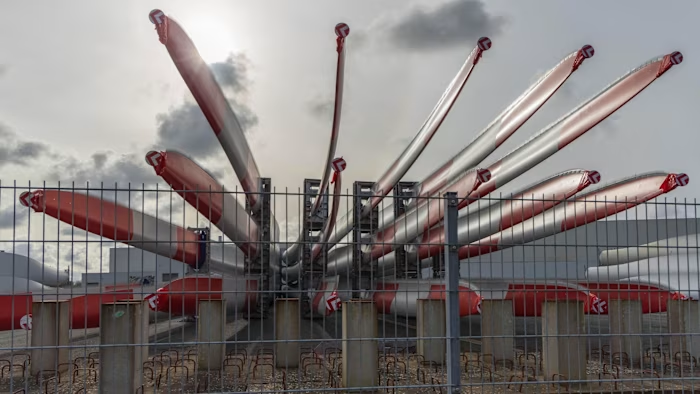
    Workers in safety gear inspect large wind turbine blade sections at the Siemens Gamesa factory, with equipment and crates nearby.
    Workers inspect wind turbine blades at the Siemens Gamesa factory in Hull, UK, in 2023 © Darren Staples/Bloomberg

    Siemens Gamesa recorded an operating loss of €1.3bn before special items in the past financial year and is finally expected to break in 2025 after it restarted sales for onshore turbines.

    Despite the share rally, Ananym’s letter argued that Siemens Energy still traded at a significant discount to its sum-of-the-parts value as well as its industry peers such as GE Vernova and Mitsubishi Heavy Industries.

    Other investors and analysts have said that simply separating out the wind business would not close the valuation gap.

    A factor behind the difference was that the concentration of AI data centre investment in the US meant an American company such as GE Vernova had been “quicker to benefit” from the boom, according to one banker.

    Ferraro also said that a German company might be perceived differently by investors. “When you look at European companies versus American companies and valuations, you see that there’s a different evaluation,” the finance chief said.

    A Siemens Gamesa engineer stands on a lift inspecting the tip of a large wind turbine blade inside a factory.
    The Siemens Gamesa plant in Hull. The company is finally expected to break even in 2025 © Craig Brough/Reuters

    The calls for Siemens Energy to sell the wind unit were understandable while the rest of the business was booming, some analysts said. Jefferies’ Ferhani said that without a path to an operating margin of at least 10 per cent for Siemens Gamesa, “you’re going to get continued pressure to sell the business”.

    The banker said the wind industry had a “good future” but the question for investors was “do I want to stay and keep that exposure, or am I too scared about the volatility and Chinese competition?”

    Ferraro said that beyond 2028, Siemens Gamesa would need to be “evaluated to ensure it has double-digit potential” in terms of profitability.

    However, she showed confidence in Siemens Energy and the wind business to deliver on its targets, saying: “We’re going to continue to execute on this plan as fast as possible.”

    Continue Reading