Category: 3. Business

  • Retail payments hit 2.8 billion transactions worth Rs166 trillion in Q1 FY26: SBP

    Retail payment activity in Pakistan expanded further in the first quarter of FY2025-26, with transaction volumes rising to 2.8 billion, up 10% quarter-on-quarter, and total value increasing 6% to Rs166 trillion, according to the Quarterly Report on Payment Systems released by the State Bank of Pakistan.

    The SBP said the growth was driven mainly by rising adoption of digital channels. Digital payments accounted for 2.5 billion transactions, or 90% of total retail payments, compared with 87% in the same quarter last year. The value of transactions conducted through digital channels reached Rs55 trillion.

    Mobile app-based banking dominated digital payments, recording 2.0 billion transactions worth Rs33.7 trillion, representing 81% of all digital payments. These transactions covered person-to-person transfers, bill payments and merchant payments across both online platforms and physical outlets.

    Internet banking also showed steady growth, while the number of payment cards in circulation increased to 61.3 million. Of these, debit cards accounted for 90%, while credit cards made up 4%.

    The Raast Instant Payment System maintained strong momentum during the quarter. Person-to-person transactions rose 31% to 535 million, with a value of Rs11.3 trillion, while person-to-merchant transactions doubled to 4.3 million, amounting to Rs17 billion. Overall, Raast processed 544 million transactions valued at Rs12.8 trillion.

    Card-based payments at point-of-sale terminals and through e-commerce platforms averaged 1.5 million transactions per day. A network of 20,527 ATMs facilitated 267 million transactions worth Rs4.5 trillion, with each ATM handling an average of 142 transactions per day and an average ticket size of Rs16,800.

    Physical channels continued to support retail payments alongside digital platforms. A total of 19,852 bank branches processed 137 million transactions amounting to Rs110 trillion, while 756,480 branchless banking agents facilitated 129 million over-the-counter transactions worth Rs0.9 trillion.

    The SBP said the figures point to continued progress toward a more efficient and digitally enabled payments ecosystem, with growing reliance on mobile and instant payment platforms while physical channels remain relevant.


    Continue Reading

  • LTA | Joint News Release by the Land Transport Authority (LTA), SMRT & SBS Transit

               The Rail Reliability Taskforce has submitted its recommendations on enhancing the reliability of our rail system to the Acting Minister for Transport.

    2.        The Taskforce was formed on 19 September 2025 to develop and implement immediate solutions to improve rail reliability and joint responses to train service disruptions. The Taskforce is chaired by LTA Chief Executive Ng Lang, and includes SMRT Group Chief Executive Officer Ngien Hoon Ping, SBST Group Chief Executive Officer Jeffrey Sim, as well as technical specialists across the rail sector.

    3.        A five-member Independent Advisory Panel was also appointed to provide strategic advice and technical expertise to the Taskforce. The Panel comprises seasoned leaders who have held key engineering and management roles in the rail sector around the world, with deep experience in the operations, management and maintenance of core rail systems.

    4.        The Taskforce commenced its review with joint technical audits of systems related to the incidents from July to September 2025. It also undertook a comprehensive and in-depth review of rail operations and maintenance – specifically asset management, workforce capabilities, as well as rail service recovery and commuter management.

    5.         As part of its work, the Taskforce conducted detailed technical workshops, site visits, direct ground observations, and interviews with operational and technical staff on the ground. The Independent Advisory Panel visited Singapore from 17 to 21 November 2025, where they reviewed the Taskforce’s preliminary findings, and assessed our operators’ practices, capabilities and incident response strategies. A summary of the Taskforce’s recommendations follows.

    Addressing Recent Service Disruptions

    6.        The train service disruptions from July to September 2025 occurred across different MRT and LRT lines, and involved different systems such as signalling, power and rolling stock. The Taskforce found that while the underlying causes of the incidents were unrelated, there were several areas for improvement. For example, the Taskforce recommends introducing additional backup or bypass systems and procedures to allow train operations to continue or resume more quickly after a minor fault, once the safety of passengers has been ensured.

    Enhancing Asset Management

    7.        The Taskforce recommends prioritising the renewal of three core systems (trains, signalling, and power) and to shorten the time taken to renew these systems. To achieve this, more engineering hours should be set aside, including through full day service closures, to carry out such works expeditiously, efficiently and safely.

    8.        The Taskforce also recommends leveraging technology and data to implement more comprehensive and standardised condition monitoring across our rail network, to allow for more timely interventions on pre-emptive maintenance and replacement of critical components. This complements the Taskforce’s recommendation to improve the management of spare components and parts to ensure that they are available when needed. Robotics and automation could also be deployed more extensively to augment our rail workforce in carrying out maintenance tasks more efficiently.

    Deepening Workforce Capabilities

    9.        The Taskforce recognises that the rail sector needs to continually upgrade its workforce and sustain a pipeline of engineering talent to operate and manage an ageing and expanding network. The Taskforce recommends that LTA and the rail operators work together to strengthen the role of the Singapore Rail Academy in harmonising and raising standards across the board to prepare the rail workforce for future challenges. This would include enhancing the professional certification framework for rail engineers and technicians, by expanding certification coverage to more rail systems and workers. The Taskforce also recommends more structured and frequent staff rotations between LTA and the rail operators to build common perspectives and capabilities.

    Improving Rail Service Recovery and Commuter Management

    10.      Maintaining a high level of rail reliability reduces, but does not eliminate, delays and disruptions, which will still happen from time to time. To improve rail service recovery and commuter management, the Taskforce recommends enhancing standard operating procedures to manage service disruptions on the ground, which will enable quicker and more effective resumption of service after faults. The Taskforce also recommends improving alternative travel options for commuters, as well as adopting a more commuter-centric mindset to guide affected commuters. This includes providing more precise, tailored and real time information on system status and alternative travel routes, as well as better wayfinding on the ground. Beyond the centralised webpage providing the real-time operating status across all rail lines which LTA launched on 13 Dec 2025, the Taskforce recommends developing more tools to provide real-time, journey-specific information to help commuters plan what to do when a disruption occurs.

    11.      Mr Ng Lang, Chairman of the Rail Reliability Taskforce and Chief Executive of LTA said: “The Taskforce’s work comes at an important time as Singapore juggles ageing existing rail lines alongside rapid network expansion. The challenge of operating and maintaining the rail system will only increase as its size and complexity grow. These recommendations will help guide the next steps to be taken to continue strengthening the reliability of our rail network.”

    Continue Reading

  • Meta buys China-founded AI agent Manus – Dawn

    1. Meta buys China-founded AI agent Manus  Dawn
    2. Exclusive | Meta Buys AI Startup Manus for More Than $2 Billion  The Wall Street Journal
    3. Meta to buy Chinese founded startup Manus to boost advanced AI  Reuters
    4. Meta says AI startup Manus to cut China ties after acquisition  Nikkei Asia
    5. Meta just bought Manus, an AI startup everyone has been talking about  TechCrunch

    Continue Reading

  • Q&A: Outgoing Cal State Dominguez Hills President Thomas A. Parham

    Q&A: Outgoing Cal State Dominguez Hills President Thomas A. Parham

    Thomas A. Parham, left, the outgoing president of California State University, Dominguez Hills, chats with students on campus.

    Matt Brown/CSUDH

    Thomas A. Parham’s seven-year stint as president of California State University, Dominguez Hills, is coming to an end.

    During his tenure, the campus made progress in graduating and retaining students, though it fell short of some goals and remained below the average across Cal State. Dominguez Hills established a place on national college rankings for social mobility and student diversity, though enrollment has declined from roughly 18,000 to 15,000 students since 2020. And while new construction and accreditations on campus are a point of pride for Parham, 71, Dominguez Hills is also among Cal State campuses that have enacted difficult budget cuts in recent years, prompting protests from some students and faculty.

    In an interview during his last month leading the university, Parham defended the campus’s achievements. “I don’t have any regret about the job we did, the difference we made, the transformation that we helped engineer on this campus and the lives that we transformed as a result of the work that we put in place,” he said. Dominguez Hills’ performance on measures like graduation rates should be understood in the context of its student body, which includes many first-generation, low-income and historically underrepresented students, Parham said. And he called on California lawmakers to invest more in campuses like his. 

    This interview has been edited for length and clarity.

    Your campus, Dominguez Hills, is among the CSUs where enrollment has taken a dip since the pandemic. Why should students go to college?

    It’s a good question, because if you look at the downturn in enrollments, there’s no single variable that ever accounts for 100% of the variance of explaining any equation.

    One of them is the pipeline in (the Los Angeles Unified School District), which surrounds us, is going down, as are a lot of school districts. People didn’t have as many kids. 

    Second is, in a post-Covid reality, people are rethinking, ‘Do I want to invest my time, given how short life is?’ when they got reminded with all the friends and family that they lost. 

    If you think about employment, the minimum wage jumped to $20 (for fast food and some other workers) and in some places $25-an-hour. You’re paying a kid $25-an-hour – that’s $50,000 a year at a full-time clip. And someone’s got to think, ‘Why do I need to go to school when I can earn $50,000 doing whatever?’ 

    The UCs couldn’t get their international (students) back. So now they’re taking students we used to be able to keep. Now we’re having to compete for students. 

    What’s the value to a student? Number one, we educate students that are much more culturally diverse than normal. And I still believe that education, much like Malcolm X said, is the passport to the future, for tomorrow belongs to those who prepare for today.

    To me, a university education should never be to get a job. Education, for me, is about the cultivation of the human spirit and the human potential. How do I come to explore and understand what I’m really good at? What are my values? What are my interests? 

    CSU has recently unveiled a Student Success Framework to measure the university system’s progress. And that yardstick has to do with things like job placement and your career earnings. Do you feel that that’s appropriate or misguided?

    It’s not at all misguided, because it’s one of the things that the public has an appetite for. The public is looking for the (return on investment, or ROI) question. If you’re in a corporation, your ROI is, what’s my return on investment?

    Well, we have one of the cheapest games in town. Our biggest cost, in fact, is not even tuition and fees. It’s probably the housing supports — what I would encourage folk to look at. 

    But we have the public and our families who look at this as ‘How much is it going to cost me?’ rather than looking at it as ‘What am I prepared to invest in my future?’ Because we know that for a college graduate, their salary differential exponentially is higher across a lifetime, but also the benefits that they get pay off almost immediately in those particular spaces. 

    You co-chaired CSU’s Black Student Success Workgroup, which released a host of recommendations in June 2023. Do you feel that the current federal environment (and the Trump administration’s crackdown on diversity, equity and inclusion) has at all caused CSU to stall in these efforts?

    We are acutely aware of the federal government’s hostility toward anything that looks like it wants to be diverse. Not a surprise to us, but we try to delicately dance, not to skirt the law, but really to be in tune with the law as it is written, and separate out what is someone’s opinion and perspective about what they like and don’t like, versus technically what is legal. 

    For example, they claim, somehow we’re discriminating because we run DEI centers, because we have an affinity center for Black students or women, because we have an LGBT center, or for disabled students, because we have a Latino Center or an Asian-Pacific Islander center.

    Well, discrimination assumes — big assumption — that if you are anything other than connected to that affinity group, that you somehow can’t take advantage of that resource. You can be a white student and walk into a Black resource center. You can be a Latino student and male, and walk into a women’s center. You can be a woman and walk into the Male Success Alliance. There’s nothing that we have that restricts anybody’s engagement in that.

    If we made any modification at all, it is about the language, because sometimes our language might have been more passive, which is ‘We don’t discriminate,’ as opposed to more active, which is ‘We actually invite others to come, take advantage of what it is that we offer.’

    You often quote civil rights leaders and Black intellectuals. You quote Audre Lorde, Frantz Fanon, Fannie Lou Hamer, Martin Luther King, Jr., Carter G. Woodson. Does memorizing those words make them more meaningful to your life’s work?

    They become mantras and symbols of possibility. When I see Fannie Lou Hamer talking about — I’m sick and tired of being sick and tired — it sometimes creates the mood and the ambiance that allows me to kind of move forward. When I see Fanon, which is kind of my daily mantra, say that Each generation, out of relative obscurity, must reach out and seek to fulfill its legacy or betray it — I go to work every day and go to bed every night deciding, have I fulfilled or betrayed the legacy that I’ve been blessed to inherit by my ancestors and my elders? 

    Do you worry that a student today, living in a world where it’s so easy to Google or to go to ChatGPT, will not build that muscle of having the words from the generations who came before them echoing in their head?

    (Martin Luther King, Jr. said) Be careful that the means by which we live does not outpace the ends for which we live. And I always remember that. How prophetic was he to talk about that? And if you look at all the innovations that have happened since then — even in this AI generation and new innovations — we have to be careful that the means by which we live do not outpace the ends for which we live.

    And every strategy has a plus and a minus. Life is always the synthesis of opposites in fruitful harmony. Sometimes your best friend can be your greatest weakness, if it’s used in an inappropriate context, or if the context changes. Our job is to maximize the ability of that new innovative technology to do good and minimize the destructive elements of it that people will use to manipulate and do things that are inappropriate.

    Continue Reading

  • Chinese shares close higher Tuesday – Xinhua

    1. Chinese shares close higher Tuesday  Xinhua
    2. Shanghai stock benchmark dips after nine-day rally  Business Recorder
    3. China Stocks Close Mixed as Investors Assess Military Drill Close to Taiwan; Two Shenzhen Debutants Surge  marketscreener.com
    4. Chinese shares close mixed Monday  Xinhua
    5. A-Share Market Review: The Shanghai Composite Index Achieves a 10-Day Winning Streak! Robotic Concepts Dominate with Widespread Limit-Up Surges.  富途牛牛

    Continue Reading

  • Eurasia Mining agrees to sell West Kytlim operations for $9 million

    Eurasia Mining PLC late Monday said it has agreed to sell its West Kytlim mining operations in the Urals to a Russian company for $9 million, saying the decision reduces the risk the mine will be nationalised by Russia without compensation in response to the freeze of Russian assets in Europe.

    Eurasia said the sale of the producing, but loss-making, operations also will allow the company to concentrate on its more resource-rich, and better legally protected, Arctic assets in Russia. It explained that the Arctic assets, including the ‘cornerstone’ Monchetundra-NKT cluster, benefit from an agreement signed in 2021 with state-owned Far East & Arctic Region Development Corp.

    Eurasia called a general meeting of shareholders for January 15 to approve the deal, saying company directors and management will vote in favour for their aggregate 19% stake.

    Eurasia Mining shares closed up 2.0% to 4.75 pence in London on Monday before the announcement was made. The stock has more than doubled from 2.20p over the past year. The company has a market capitalisation of £140.0 million.

    Eurasia said it will sell the West Kytlim assets to LLC KS Logistics, ‘a non-sanctioned infrastructure company in Russia working in transportation, infra-structure development, retail sales and information technology development and management.’

    Eurasia will receive 671.2₽ million, about $9 million, saying the price reflects the Russian regulatory framework, put in place in response to sanctions imposed by the US and Europe following Russia’s invasion of Ukraine. This imposes mandatory discounts and tax levies on any asset sale.

    Of the total price, 546.2₽ million will be received prior to completion and the remaining 125.0₽ million within 12 months, subject to licences remaining in place.

    Copyright 2025 Alliance News Ltd. All Rights Reserved.

    Continue Reading

  • Japan’s Topix Closes at Record Year-End High, Surpassing 1989 – Bloomberg.com

    1. Japan’s Topix Closes at Record Year-End High, Surpassing 1989  Bloomberg.com
    2. Nikkei trims 2025 surge as tech stocks take a breather  Business Recorder
    3. Japan shares lower at close of trade; Nikkei 225 down 0.36%  Investing.com India
    4. Stock Market Today: Nikkei Eases, Futures Mixed Globally  Eudaimonia and Co
    5. Japan Stocks Slip As Central Banks Steer The Mood  Finimize

    Continue Reading

  • Debt Crisis in Japan – Robin J Brooks

    Debt Crisis in Japan – Robin J Brooks

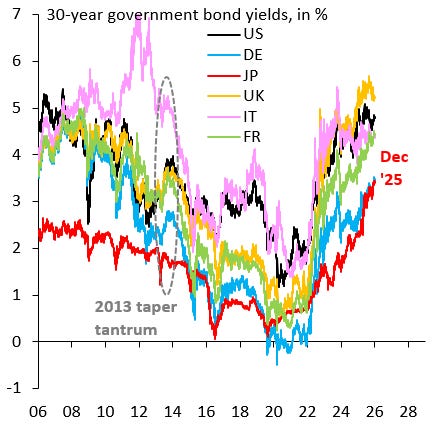
    Long-term government bond yields have risen very sharply in Japan this year. Indeed, the 30-year yield is at its highest level EVER, which is causing consternation because – at the same time – the Yen has fallen to all-time lows in trade-weighted terms against its G10 peers. There are many people who see this decoupling as a sign that the Yen is now “irrationally” weak, including Japan’s government, which recently put markets on notice that it might intervene to strengthen the Yen.

    I don’t think this is right. The key point to recognize is that Japanese long-term yields – while they have risen a lot – are still way below where they would be if markets were able to freely set them. At the current juncture, the Bank of Japan (BoJ) remains a very large buyer of government bonds in gross terms, which means that longer-term yields are capped in practice. Rising risk of a debt crisis, which would ordinarily drive yields higher, can’t get priced in the bond market and thus gets priced into the Yen instead. This is what’s weighing on the Yen and means that the currency – not yields – is what to watch when it comes to gauging Japan’s fiscal risk.

    The chart above shows 30-year government bond yields for key advanced economies around the world. The red line shows Japan’s 30-year yield has risen to all-time highs, which makes it natural to think that Japanese yields should be supportive for the Yen. That’s not the case as the chart below shows. The scatter plot has gross government debt in 2024 on the horizontal axis and yesterday’s 30-year government bond yield on the vertical axis. Even through gross debt in Japan is substantially above Germany, its yield is the same. This is the best illustration of how distorted Japan’s bond yields are. They’re nowhere near high enough given Japan’s towering debt burden.

    The key question is what market price is a better reflection of reality: long-term yields or the Yen? As the scatter plot above shows pretty clearly, Japanese government bond yields are far below where they should be. BoJ bond buying prevents markets from pricing a proper risk premium, which instead gets expressed in a beaten down Yen. This means that the unprecedented decoupling between long-term rate differentials and the Yen – shown in the chart below – is meaningless. The weak Yen is the signal to watch and it’s signaling mounting risk of a debt crisis in Japan.

    Continue Reading

  • WTI gains momentum above $57.50 amid increasing geopolitical tensions

    WTI gains momentum above $57.50 amid increasing geopolitical tensions

    West Texas Intermediate (WTI), the US crude oil benchmark, is trading around $57.85 during the early European trading hours on Tuesday. The WTI price extends the rally amid the lack of a breakthrough on a peace deal in Ukraine and geopolitical risks. 

    US President Donald Trump said on Sunday that he made “a lot of progress” in talks with Ukrainian President Volodymyr Zelenskiy over a possible peace deal. Nonetheless, Trump stated that there’s no apparent breakthrough on the flashpoint issue of territory, and it might take a few weeks to get it done.

    Russia accused Ukraine of launching a drone strike on the Russian presidential residence in northern Russia, prompting Moscow to reconsider its stance in peace negotiations, per Reuters. Ukraine dismissed Russian statements about the drone attack, and its foreign minister said Moscow was seeking “false justifications” for further strikes against its neighbor. Dented peace hopes in Ukraine could provide some support to the WTI price in the near term. 

    On the other hand, concerns about a global supply glut could weigh on the WTI price. The Organization of the Petroleum Exporting Countries and its allies (OPEC+) agreed to a modest production hike of 137,000 barrels per day (bpd) for December. 

    Traders will take more cues from the release of the American Petroleum Institute (API) crude oil stockpiles report, which will be released later on Tuesday. A larger-than-expected crude oil inventory draw indicates stronger demand and could boost the WTI price, while a bigger build than estimated signals weaker demand or excess supply, which might drag the WTI price lower. 

    WTI Oil FAQs

    WTI Oil is a type of Crude Oil sold on international markets. The WTI stands for West Texas Intermediate, one of three major types including Brent and Dubai Crude. WTI is also referred to as “light” and “sweet” because of its relatively low gravity and sulfur content respectively. It is considered a high quality Oil that is easily refined. It is sourced in the United States and distributed via the Cushing hub, which is considered “The Pipeline Crossroads of the World”. It is a benchmark for the Oil market and WTI price is frequently quoted in the media.

    Like all assets, supply and demand are the key drivers of WTI Oil price. As such, global growth can be a driver of increased demand and vice versa for weak global growth. Political instability, wars, and sanctions can disrupt supply and impact prices. The decisions of OPEC, a group of major Oil-producing countries, is another key driver of price. The value of the US Dollar influences the price of WTI Crude Oil, since Oil is predominantly traded in US Dollars, thus a weaker US Dollar can make Oil more affordable and vice versa.

    The weekly Oil inventory reports published by the American Petroleum Institute (API) and the Energy Information Agency (EIA) impact the price of WTI Oil. Changes in inventories reflect fluctuating supply and demand. If the data shows a drop in inventories it can indicate increased demand, pushing up Oil price. Higher inventories can reflect increased supply, pushing down prices. API’s report is published every Tuesday and EIA’s the day after. Their results are usually similar, falling within 1% of each other 75% of the time. The EIA data is considered more reliable, since it is a government agency.

    OPEC (Organization of the Petroleum Exporting Countries) is a group of 12 Oil-producing nations who collectively decide production quotas for member countries at twice-yearly meetings. Their decisions often impact WTI Oil prices. When OPEC decides to lower quotas, it can tighten supply, pushing up Oil prices. When OPEC increases production, it has the opposite effect. OPEC+ refers to an expanded group that includes ten extra non-OPEC members, the most notable of which is Russia.

    Continue Reading

  • Nikkei Marks Record Year-End Finish above 50,000

    Nikkei Marks Record Year-End Finish above 50,000

    Economy

    Tokyo, Dec. 30 (Jiji Press)–The benchmark Nikkei 225 stock average closed above 50,000 on the Tokyo Stock Exchange on Tuesday, the final market day of 2025, marking its highest year-end finish.

    The Nikkei shed 187.44 points, or 0.37 pct, from Monday to finish at 50,339.48. The index soared 10,444.94 points, or 26.18 pct, from the 2024 close of 39,894.54.

    The broader TOPIX index lost 17.55 points, or 0.51 pct, to close at 3,408.97, also hitting a record year-end high. In 2025, it gained 624.05 points, or 22.41 pct.

    On Tuesday, the Tokyo market was quiet due to a dearth of fresh incentives during the year-end period. The Nikkei was dragged down by some heavyweight components including SoftBank Group, as well as nonferrous metal producers, reflecting commodity market falls.

    In 2025, the stock market was supported by growing expectations for the artificial intelligence-related market.

    [Copyright The Jiji Press, Ltd.]

    Jiji Press

    Continue Reading