Category: 3. Business

  • China’s First Domestic Anti-CTLA-4 Monoclonal Antibody, Innovent’s TABOSUN® (Ipilimumab N01 Injection) Received NMPA Approval

    • TABOSUN® (ipilimumab N01 injection) has been approved in combination with TYVYT® (sintilimab injection) for the neoadjuvant treatment of patients with stage IIB-III resectable microsatellite instability-high or mismatch repair deficient (MSI-H/dMMR) colon cancer.
    • The TABOSUN® and TYVYT® combination therapy significantly improved pathological complete response (pCR) rates and enabled most patients to avoid the burden of postoperative adjuvant chemotherapy.
    • This therapy is the first and only dual-IO regimen approved globally for neoadjuvant treatment of colon cancer[i], filling a critical gap in neoadjuvant treatment of colon cancer and benefiting more patients with MSI-H/dMMR colon cancer.

    SAN FRANCISCO and SUZHOU, China, Dec. 25, 2025 /PRNewswire/ — Innovent Biologics, Inc. (“Innovent”) (HKEX: 01801), a world-class biopharmaceutical company that develops, manufactures and commercializes high quality medicines for the treatment of oncology, cardiovascular and metabolic, autoimmune, ophthalmology and other major diseases, announces that the New Drug Application (NDA) for TABOSUN® (ipilimumab N01 injection; R&D Code: IBI310), the first domestic cytotoxic lymphocyte-associated antigen-4 (CTLA-4) monoclonal antibody (mAb), has been approved by China’s National Medical Products Administration (NMPA), in combination with sintilimab as neoadjuvant treatment for stage IIB-III resectable microsatellite instability-high (MSI-H) or mismatch repair deficient (dMMR) colon cancer. TABOSUN® (ipilimumab N01 injection) is the world’s first approved CTLA-4 mAb for neoadjuvant treatment of colon cancer. Short-term neoadjuvant treatment with the ipilimumab N01 and sintilimab combination demonstrated a substantial improvement in pathological complete response, offering the potential to benefit a broader population of patients with MSI-H/dMMR colon cancer.

    Resectable MSI-H/dMMR colon cancer urgently requires effective neoadjuvant therapies to improve prognosis

    MSI-H/dMMR colon cancer accounts for around 15% of all resectable colon cancer cases[ii]. Due to its unique biological characteristics, this class of tumor shows limited sensitivity to chemotherapy and generally responds poorly[iii]. In recent years, immune checkpoint inhibitors have demonstrated significant efficacy in advanced MSI-H/dMMR colon cancer, but a gap remains in the neoadjuvant setting. For locally advanced MSI-H/dMMR colon cancer, the current standard of care is direct surgery followed by adjuvant chemotherapy. Under this regimen, approximately 10%-30% of patients experience disease recurrence or metastasis after surgery, while chemotherapy-related toxicities may negatively affect quality of life[iv]. Thus in the neoadjuvant setting, there remains an urgent need for more effective therapies to improve outcomes for patients with locally advanced MSI-H/dMMR colon cancer.

    The worlds first dual-IO neoadjuvant therapy: TABOSUN® (ipilimumab N01 injection) combined with TYVYT® (sintilimab injection) markedly enhances pathological complete response rates

    Immune checkpoint blockade (ICB) therapy targeting PD-1 and CTLA-4 has transformed cancer treatment. The combination of DABOSUN® (ipilimumab N01 injection) and TYVYT® (sintilimab injection) as neoadjuvant therapy can significantly improve pathological complete response(pCR) rates and allow the majority of patients to avoid adjuvant chemotherapy.

    Previously, results from a randomized, controlled Phase 1b trial evaluating ipilimumab N01 plus sintilimab as neoadjuvant treatment for MSI-H/dMMR colon cancer were published in the top-tier journal Cancer Cell[i].

    • As of June 17, 2025, 101 patients were enrolled and randomized to receive ipilimumab N01 plus sintilimab (n=52) or sintilimab alone (n=49).
    • In the per-protocol population, the pCR rate in the ipilimumab N01-plus-sintilimab arm was significantly higher than in the sintilimab-alone arm (80.0% vs 47.7%, p=0.0007).
    • With median follow-up of 21.4 months, no patient experienced disease recurrence.

    Approval is based on results from the randomized, controlled, multicenter, pivotal Phase 3 clinical trial (NeoShot, NCT05890742), which evaluated the safety and efficacy of ipilimumab N01 combined with sintilimab as neoadjuvant therapy compared with direct radical surgery for MSI-H/dMMR colon cancer. The primary endpoints are pCR rate and event-free survival (EFS). Interim analysis by the Independent Data Monitoring Committee (IDMC) confirmed that the NeoShot trial met its primary endpoint.

    • As of November 28, 2024, among the first 50 patients in the treatment arm, 41 achieved pathological complete response after neoadjuvant treatment, yielding a pCR rate of 82%.
    • Neoadjuvant treatment with ipilimumab N01 combined with sintilimab did not significantly increase safety risks compared with direct surgery.

    Detailed results will be presented at future academic conferences or published in academic journals.

    The Principal Investigator of the NeoShot study, Academician of the Chinese Academy of Engineering, Prof. Ruihua Xu from Sun Yat-sen University Cancer Center, stated: “Achieving R0 resection remains challenging for certain patients with locally advanced colon cancer, who also face substantial surgical trauma and poor prognosis. Results from the FOxTROT study indicated that neoadjuvant chemotherapy provides limited benefit in MSI-H/dMMR colon cancer, with a pCR rate of only around 5%[v]. The NeoShot trial is the first randomized, controlled Phase 3 clinical trial to show promising efficacy of dual checkpoint inhibition as neoadjuvant therapy in MSI-H/dMMR colon cancer. Interim analysis suggests that ipilimumab N01 with sintilimab as short-term neoadjuvant treatment can lead to pathological complete response in 82% of treated patients. In addition, NeoShot Ph1b and Ph3 interim results both show the R0 resection under this regimen could reach 100% and spare patients from adjuvant chemotherapy. In NeoShot-1b, the dual-immunotherapy neoadjuvant regimen combining ipilimumab N01 and sintilimab significantly improved the pCR rate, which serves as a surrogate endpoint for long-term prognosis. Based on the existing data, this regimen shows promising potential to reduce recurrence risk and improve long-term survival outcomes. We look forward to observing continued reductions in recurrence with longer-term follow-up. The approval of this dual-immunotherapy regimen is expected to change clinical practice, fill a critical gap in neoadjuvant treatment of colon cancer and benefit more patients with MSI-H/dMMR colon cancer.”

    Dr. Hui Zhou, Chief R&D Officer (Oncology) of Innovent, stated: “There remains a substantial unmet clinical need for neoadjuvant therapies for stage IIB-III resectable MSI-H/dMMR colon cancer in China. Interim analysis has shown that the NeoShot trial met its primary endpoint. Through Innovent’s efficient and high-quality clinical development, ipilimumab N01 has become China’s first domestically developed innovative CTLA-4 inhibitor approved by the NMPA, offering a new treatment option for patients in China with stage IIB-III resectable MSI-H/dMMR colon cancer.”

    About Ipilimumab N01

    Ipilimumab N01 (R&D code: IBI310) is a fully human monoclonal antibody injection independently developed by Innovent. Ipilimumab N01 specifically binds cytotoxic T lymphocyte-associated antigen 4 (CTLA-4), thereby blocking CTLA-4-mediated inhibition of T cell activity, promoting T cell activation and proliferation, improving tumor immune response, and achieving anti-tumor effects. [vi]

    The NDA for ipilimumab N01 in combination with sintilimab as neoadjuvant treatment for stage IIB-III resectable microsatellite instability-high (MSI-H) or mismatch repair deficient (dMMR) colon cancer has recently been approved by the NMPA.

    About Sintilimab

    Sintilimab, marketed as TYVYT® (sintilimab injection) in China, is a PD-1 immunoglobulin G4 monoclonal antibody co-developed by Innovent and Eli Lilly and Company. Sintilimab is a type of immunoglobulin G4 monoclonal antibody, which binds to PD-1 molecules on the surface of T-cells, blocks the PD-1 / PD-Ligand 1 (PD-L1) pathway, and reactivates T-cells to kill cancer cells.[vii]

    In China, sintilimab has been approved and included in the updated NRDL for eight indications. The updated NRDL reimbursement scope for TYVYT® (sintilimab injection) includes:

    • For the treatment of relapsed or refractory classic Hodgkin’s lymphoma after two lines or later of systemic chemotherapy;
    • For the first-line treatment of unresectable locally advanced or metastatic non-squamous non-small cell lung cancer lacking EGFR or ALK driver gene mutations;
    • For the treatment of patients with EGFR-mutated locally advanced or metastatic non-squamous non-small cell lung cancer who progressed after EGFR-TKI therapy;
    • For the first-line treatment of unresectable locally advanced or metastatic squamous non-small cell lung cancer;
    • For the first-line treatment of unresectable or metastatic hepatocellular carcinoma with no prior systematic treatment;
    • For the first-line treatment of unresectable locally advanced, recurrent or metastatic esophageal squamous cell carcinoma;
    • For the first-line treatment of unresectable locally advanced, recurrent or metastatic gastric or gastroesophageal junction adenocarcinoma; and
    • In combination with fruquintinib for the treatment of patients with advanced endometrial cancer with pMMR tumors that have failed prior systemic therapy and are not candidates for curative surgery or radiation.

    The NDA for sintilimab’s ninth indication, in combination with ipilimumab N01 as neoadjuvant treatment for stage IIB-III resectable MSI-H/dMMR colon cancer is recently approved by the NMPA.

    The NDA for sintilimab’s tenth indication, in combination with fruquintinib for the treatment of locally advanced or metastatic renal cell carcinoma who previously failed systematic treatment, has been accepted by the Center for Drug Evaluation (CDE) of NMPA.

    In addition, two clinical studies of sintilimab have met their primary endpoints:

    • Phase 2 study of sintilimab monotherapy as second-line treatment of esophageal squamous cell carcinoma; and
    • Phase 3 study of sintilimab monotherapy as second-line treatment for squamous non-small cell lung cancer with disease progression following platinum-based chemotherapy.

    About Innovent

    Innovent is a leading biopharmaceutical company founded in 2011 with the mission to empower patients worldwide with affordable, high-quality biopharmaceuticals. The company discovers, develops, manufactures and commercializes innovative medicines that target some of the most intractable diseases. Its pioneering therapies treat cancer, cardiovascular and metabolic, autoimmune and eye diseases. Innovent has launched 18 products in the market. It has 4 assets in Phase 3 or pivotal clinical trials and 15 more molecules in early clinical stage. Innovent partners with over 30 global healthcare companies, including Lilly, Sanofi, Incyte, LG Chem and MD Anderson Cancer Center.

    Guided by the motto, “Start with Integrity, Succeed through Action” Innovent maintains the highest standard of industry practices and works collaboratively to advance the biopharmaceutical industry so that first-rate pharmaceutical drugs can become widely accessible. For more information, visit www.innoventbio.com, or follow Innovent on Facebook and LinkedIn.

    Disclaimer: Innovent does not recommend any off-label usage.

    Forward-Looking Statements

    This news release may contain certain forward-looking statements that are, by their nature, subject to significant risks and uncertainties. The words “anticipate”, “believe”, “estimate”, “expect”, “intend” and similar expressions, as they relate to Innovent, are intended to identify certain of such forward-looking statements. Innovent does not intend to update these forward-looking statements regularly.

    These forward-looking statements are based on the existing beliefs, assumptions, expectations, estimates, projections and understandings of the management of Innovent with respect to future events at the time these statements are made. These statements are not a guarantee of future developments and are subject to risks, uncertainties and other factors, some of which are beyond Innovent’s control and are difficult to predict. Consequently, actual results may differ materially from information contained in the forward-looking statements as a result of future changes or developments in our business, Innovent’s competitive environment and political, economic, legal and social conditions.

    Reference:

    i. Wang F,et al. Neoadjuvant treatment of IBI310 plus sintilimab in locally advanced MSI-H/dMMR colon cancer: A randomized phase 1b study. Cancer Cell. 2025 Oct 2:S1535-6108(25)00396-4. doi: 10.1016/j.ccell.2025.09.004.

    ii. Gutierrez C, et al. The Prevalence and Prognosis of Microsatellite Instability-High/Mismatch Repair-Deficient Colorectal Adenocarcinomas in the United States. JCO Precis Oncol. 2023;7:e2200179. doi:10.1200/PO.22.00179

    iii. Sargent DJ, et al. Defective mismatch repair as a predictive marker for lack of efficacy of fluorouracil-based adjuvant therapy in colon cancer. J Clin Oncol. 2010;28(20):3219-3226. doi:10.1200/JCO.2009.27.1825

    iv. André T, et al. Adjuvant Fluorouracil, Leucovorin, and Oxaliplatin in Stage II to III Colon Cancer: Updated 10-Year Survival and Outcomes According to BRAF Mutation and Mismatch Repair Status of the MOSAIC Study. J Clin Oncol. 2015;33(35):4176-4187. doi:10.1200/JCO.2015.63.4238

    v. Morton D, et al; FOxTROT Collaborative Group. Preoperative Chemotherapy for Operable Colon Cancer: Mature Results of an International Randomized Controlled Trial. J Clin Oncol. 2023 Mar 10;41(8):1541-1552. doi:10.1200/JCO.22.00046.

    vi. Wolchok JD, Saenger Y. The mechanism of anti-CTLA-4 activity and the negative regulation of T-cell activation. Oncologist. 2008;13 Suppl 4:2-9. doi:10.1634/theoncologist.13-S4-2

    vii. Wang J, et al. Durable blockade of PD-1 signaling links preclinical efficacy of sintilimab to its clinical benefit. mAbs 2019;11(8): 1443-1451. doi:10.1080/19420862.2019.1654303

    SOURCE Innovent Biologics

    Continue Reading

  • Chinese shares close higher Thursday – Xinhua

    1. Chinese shares close higher Thursday  Xinhua
    2. Shanghai stocks ends higher to record longest winning streak since July  Business Recorder
    3. The Shangai Composite Index Closes 0.49% Higher  TradingView — Track All Markets
    4. Update: Chinese shares close higher Wednesday  Macau Business
    5. China’s central bank will maintain ample liquidity that aligns with growth, price targets  bastillepost.com

    Continue Reading

  • Shrewsbury cafe owner bringing Christmas Day cheer

    Shrewsbury cafe owner bringing Christmas Day cheer

    A cafe in Shropshire is preparing dozens of free Christmas dinners and gifts for anyone in the community who might otherwise be alone on Christmas Day.

    Fred Bilgic, owner of The Ploughboy in Shrewsbury, has been doing it for 11 years after his wife had the idea, and said it was the family’s way of giving back.

    In total, the cafe expects to serve about 200 people with turkey, beef and chicken meals and will be taking food to homeless people in the town.

    “Loads of people are lonely,” Mr Bilgic said, “we’re just happy to help make their Christmas Day.”

    Continue Reading

  • Why is the Japanese Yen falling?

    Why is the Japanese Yen falling?

    Back when I worked at Goldman, I remember one particular Fed meeting when the central bank had hiked but – to my complete consternation – the Dollar fell. I asked the head of currency trading at the time how this could have possibly happened. He looked me straight in the eye and said: “there were more sellers than buyers.”

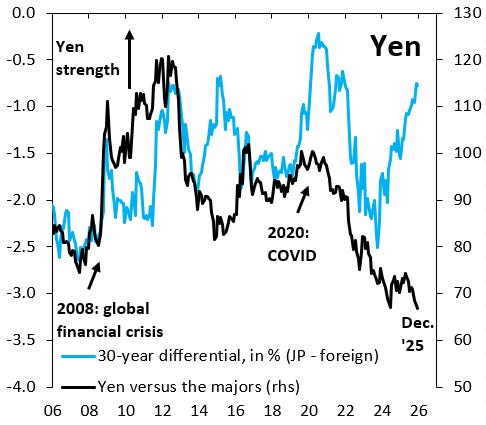
    That’s pretty much what’s going on with the Yen right now. The Bank of Japan (BoJ) is hiking, but the Yen is down to its lowest level in over 20 years, tumbling below the low it made mid-2024 when Japanese interest rates were much lower. It might sound trite to attribute this to there being “more sellers than buyers,” but there’s a lot more wisdom in this comment than you might think. This post explains what’s going on.

    The black line in the chart above shows the trade-weighted Yen against the majors, where I use the same weights as the BoJ to average up bilateral currency pairs. The blue line shows the analogous interest rate differential based on 30-year government bond yields. As I’ve noted in many previous posts, longer-term Japanese yields have risen very sharply this year, which has moved the 30-year differential sharply in favor of the Yen. That should make it more attractive for global capital markets to invest in Japan and should therefore cause the Yen to appreciate. That isn’t happening, which might seem like a puzzle but it really isn’t.

    The vertical axis in the chart above shows the 30-year government bond yields that go into the rate differential in the first chart. The horizontal axis plots gross government debt in percent of GDP. While it’s true that the interest differential has moved a lot in favor of the Yen, it’s also true that – given Japan’s monstrous level of government debt – longer-term yields are still much too low relative to where they would be if the BoJ weren’t still a massive buyer of government debt. This bond buying is keeping yields artificially low, which should really be much higher due to risk premia. Because these risk premia aren’t allowed to show up in the bond market, they show up in the Yen instead, which is the reason it keeps falling.

    Here’s the uncomfortable truth: Japan’s longer-term yields have been rising, but – on a risk-adjusted basis – that rise isn’t nearly enough to stabilize the Yen. Another way to say this: markets think risk of a debt crisis is rising sharply. Yen depreciation won’t stop until yields are allowed to rise far more, forcing the government to pursue fiscal consolidation and bring down debt. Japan needs to stop being in denial.

    Continue Reading

  • A Powerball player in Arkansas has won a $1.817 billion lottery jackpot : NPR

    A Powerball player in Arkansas has won a $1.817 billion lottery jackpot : NPR

    The jackpot for the Powerball lottery game is displayed outside Ted’s State Line Mobil station, Wednesday, Dec. 24, 2025, in Methuen, Mass.

    Charles Krupa/AP


    hide caption

    toggle caption

    Charles Krupa/AP

    A Powerball player in Arkansas won a $1.817 billion jackpot in Wednesday’s Christmas Eve drawing, ending the lottery game’s three-month stretch without a top-prize winner.

    The winning numbers were 04, 25, 31, 52 and 59, with the Powerball number being 19.

    Final ticket sales pushed the jackpot higher than previous expected, making it the second-largest in U.S. history and the largest Powerball prize of 2025, according to www.powerball.com. The jackpot had a lump sum cash payment option of $834.9 million.

    “Congratulations to the newest Powerball jackpot winner! This is truly an extraordinary, life-changing prize,” Matt Strawn, Powerball Product Group Chair and Iowa Lottery CEO, was quoted as saying by the website. “We also want to thank all the players who joined in this jackpot streak — every ticket purchased helps support public programs and services across the country.”

    The prize followed 46 consecutive drawings in which no one matched all six numbers.

    The last drawing with a jackpot winner was Sept. 6, when players in Missouri and Texas won $1.787 billion.

    Organizers said it is the second time the Powerball jackpot has been won by a ticket sold in Arkansas. It first happened in 2010.

    The last time someone won a Powerball jackpot on Christmas Eve was in 2011, Powerball said. The company added that the sweepstakes also has been won on Christmas Day four times, most recently in 2013.

    Powerball’s odds of 1 in 292.2 million are designed to generate big jackpots, with prizes growing as they roll over when no one wins. Lottery officials note that the odds are far better for the game’s many smaller prizes.

    “With the prize so high, I just bought one kind of impulsively. Why not?” Indianapolis glass artist Chris Winters said Wednesday.

    Tickets cost $2, and the game is offered in 45 states plus Washington, D.C., Puerto Rico and the U.S. Virgin Islands.

    Continue Reading

  • Dalian iron ore extends gains on easier home buying in Beijing – Business Recorder

    1. Dalian iron ore extends gains on easier home buying in Beijing  Business Recorder
    2. MMi Daily Iron Ore Report (December 24)  Shanghai Metals Market
    3. Iron Ore Holds Rebound from 5-Month Low  TradingView — Track All Markets
    4. Dalian iron ore extends gains on tight BHP supply, firmer hot metal production  Mining.com
    5. Iron ore futures slip  Business Recorder

    Continue Reading

  • Bezek, L. B. et al. Effect of part size, displacement rate, and aging on compressive properties of elastomeric parts of different unit cell topologies formed by vat photopolymerization additive manufacturing. Polymers 16, 3166 (2024).

    Google Scholar 

  • Yang, L. et al. Additive manufacturing of metal cellular structures: design and fabrication. Jom 67, 608–615 (2015).

    Google Scholar 

  • Lin, H. et al. 3d printing of porous ceramics for enhanced thermal insulation properties. Adv. Sci. 12, 2412554 (2025).

    Google Scholar 

  • Schaedler, T. A. et al. Designing metallic microlattices for energy absorber applications. Adv. Eng. Mater. 16, 276–283 (2014).

    Google Scholar 

  • Schaedler, T. A. & Carter, W. B. Architected cellular materials. Annual Rev. Mater. Res. 46, 187–210 (2016).

    Google Scholar 

  • Boursier Niutta, C., Ciardiello, R. & Tridello, A. Experimental and numerical investigation of a lattice structure for energy absorption: application to the design of an automotive crash absorber. Polymers 14, 1116 (2022).

    Google Scholar 

  • Mohsenizadeh, M., Gasbarri, F., Munther, M., Beheshti, A. & Davami, K. Additively-manufactured lightweight metamaterials for energy absorption. Mater. Des. 139, 521–530 (2018).

    Google Scholar 

  • Uribe-Lam, E., Treviño-Quintanilla, C. D., Cuan-Urquizo, E. & Olvera-Silva, O. Use of additive manufacturing for the fabrication of cellular and lattice materials: a review. Mater. Manuf. Process. 36, 257–280 (2021).

    Google Scholar 

  • Mueller, J., Raney, J. R., Shea, K. & Lewis, J. A. Architected lattices with high stiffness and toughness via multicore-shell 3d printing. Adv.Mater. 30, 1705001 (2018).

    Google Scholar 

  • Lei, H. et al. Evaluation of compressive properties of slm-fabricated multi-layer lattice structures by experimental test and \(\mu\)-ct-based finite element analysis. Materi. Des. 169, 107685 (2019).

    Google Scholar 

  • Kumar, A., Collini, L., Daurel, A. & Jeng, J.-Y. Design and additive manufacturing of closed cells from supportless lattice structure. Additive Manuf. 33, 101168 (2020).

    Google Scholar 

  • Nakarmi, S. et al. The role of unit cell topology in modulating the compaction response of additively manufactured cellular materials using simulations and validation experiments. Model. Simul. Mater. Sci. Eng. 32, 055029 (2024).

    Google Scholar 

  • Nakarmi, S. et al. Mesoscale simulations and validation experiments of polymer foam compaction-volume density effects. Mater. Lett. 382, 137864 (2025).

    Google Scholar 

  • Xia, L. & Breitkopf, P. Design of materials using topology optimization and energy-based homogenization approach in matlab. Struct. Multidisciplinary Optim. 52, 1229–1241 (2015).

    Google Scholar 

  • Radman, A., Huang, X. & Xie, Y. Topology optimization of functionally graded cellular materials. J. Mater. Sci. 48, 1503–1510 (2013).

    Google Scholar 

  • Bauer, J., Hengsbach, S., Tesari, I., Schwaiger, R. & Kraft, O. High-strength cellular ceramic composites with 3d microarchitecture. Procd. National Acad. Sci. 111, 2453–2458 (2014).

    Google Scholar 

  • Nguyen, J., Park, S.-I. & Rosen, D. Heuristic optimization method for cellular structure design of light weight components. Int. J. Precision Eng. Manuf. 14, 1071–1078 (2013).

    Google Scholar 

  • Meier, T. et al. Obtaining auxetic and isotropic metamaterials in counterintuitive design spaces: an automated optimization approach and experimental characterization. npj Comput. Mater. 10, 3 (2024).

    Google Scholar 

  • Vangelatos, Z. et al. Strength through defects: A novel bayesian approach for the optimization of architected materials. Sci. Adv. 7, eabk2218 (2021).

    Google Scholar 

  • Ramesh, A. et al. Zero-shot text-to-image generation. In International conference on machine learning, 8821–8831 (Pmlr, 2021).

  • Ramesh, A., Dhariwal, P., Nichol, A., Chu, C. & Chen, M. Hierarchical text-conditional image generation with clip latents. arXiv preprint arXiv:2204.061251, 3 (2022).

  • Yao, Z. et al. Inverse design of nanoporous crystalline reticular materials with deep generative models. Nat. Mach. Intell. 3, 76–86 (2021).

    Google Scholar 

  • Sanchez-Lengeling, B. & Aspuru-Guzik, A. Inverse molecular design using machine learning: Generative models for matter engineering. Science 361, 360–365 (2018).

    Google Scholar 

  • Zhavoronkov, A. et al. Deep learning enables rapid identification of potent ddr1 kinase inhibitors. Nat. Biotechnol. 37, 1038–1040 (2019).

    Google Scholar 

  • Liao, W., Lu, X., Fei, Y., Gu, Y. & Huang, Y. Generative ai design for building structures. Autom. Construct. 157, 105187 (2024).

    Google Scholar 

  • Kingma, D. P., Welling, M. et al. Auto-encoding variational bayes (2013).

  • Goodfellow, I. J. et al. Generative adversarial nets. Adv. Neural Inf. Process. Syst. 27 (2014).

  • Ho, J., Jain, A. & Abbeel, P. Denoising diffusion probabilistic models. Adv. Neural Inf. Process. Syst. 33, 6840–6851 (2020).

    Google Scholar 

  • Sohn, K., Lee, H. & Yan, X. Learning structured output representation using deep conditional generative models. Adv. Neural Inf. Process. Syst. 28 (2015).

  • Mirza, M. & Osindero, S. Conditional generative adversarial nets. arXiv preprint arXiv:1411.1784 (2014).

  • Dhariwal, P. & Nichol, A. Diffusion models beat gans on image synthesis. Adv. Neural Inf. Process. Syst. 34, 8780–8794 (2021).

    Google Scholar 

  • Lee, D., Chen, W., Wang, L., Chan, Y.-C. & Chen, W. Data-driven design for metamaterials and multiscale systems: a review. Adv. Mater. 36, 2305254 (2024).

    Google Scholar 

  • Zheng, X., Zhang, X., Chen, T.-T. & Watanabe, I. Deep learning in mechanical metamaterials: from prediction and generation to inverse design. Adv. Mater. 35, 2302530 (2023).

    Google Scholar 

  • Wang, L. et al. Deep generative modeling for mechanistic-based learning and design of metamaterial systems. Comput. Methods App. Mech. Eng. 372, 113377 (2020).

    Google Scholar 

  • Zheng, L., Karapiperis, K., Kumar, S. & Kochmann, D. M. Unifying the design space and optimizing linear and nonlinear truss metamaterials by generative modeling. Nat. Commun. 14, 7563 (2023).

    Google Scholar 

  • Tian, J., Tang, K., Chen, X. & Wang, X. Machine learning-based prediction and inverse design of 2d metamaterial structures with tunable deformation-dependent poisson’s ratio. Nanoscale 14, 12677–12691 (2022).

    Google Scholar 

  • Zheng, X., Chen, T.-T., Guo, X., Samitsu, S. & Watanabe, I. Controllable inverse design of auxetic metamaterials using deep learning. Mater. Des. 211, 110178 (2021).

    Google Scholar 

  • Challapalli, A., Patel, D. & Li, G. Inverse machine learning framework for optimizing lightweight metamaterials. Materi. Des. 208, 109937 (2021).

    Google Scholar 

  • Vlassis, N. N. & Sun, W. Denoising diffusion algorithm for inverse design of microstructures with fine-tuned nonlinear material properties. Comput. Methods Appl. Mech. Eng. 413, 116126 (2023).

    Google Scholar 

  • Bastek, J.-H. & Kochmann, D. M. Inverse design of nonlinear mechanical metamaterials via video denoising diffusion models. Nat. Mach. Intell. 5, 1466–1475 (2023).

    Google Scholar 

  • Meier, T. et al. Scalable phononic metamaterials: Tunable bandgap design and multi-scale experimental validation. Mater. Des. 252, 113778 (2025).

    Google Scholar 

  • Kumar, S., Tan, S., Zheng, L. & Kochmann, D. M. Inverse-designed spinodoid metamaterials. npj Comput. Mater. 6, 73 (2020).

    Google Scholar 

  • Nakarmi, S., Leiding, J. A., Lee, K.-S. & Daphalapurkar, N. P. Predicting non-linear stress-strain response of mesostructured cellular materials using supervised autoencoder. Comput. Methods Appl. Mech. Eng. 432, 117372 (2024).

    Google Scholar 

  • McNeel, R. et al. Grasshopper-algorithmic modeling for rhino. http://www.grasshopper3d.com (2013).

  • Dassault Systèmes. Abaqus Analysis User’s Manual, Version 2020 (2020).

  • Mooney, M. A theory of large elastic deformation. J. Appl. Phys. 11, 582–592 (1940).

    Google Scholar 

  • Rivlin, R. Large elastic deformations of isotropic materials. i. fundamental concepts. Philosophical Trans. Royal Soc. London. Series A, Math. Phys. Sci. 240, 459–490 (1948).

    Google Scholar 

  • Abdi, H. & Williams, L. J. Principal component analysis. Wiley Interdisciplinary Rev. Comput. Statist. 2, 433–459 (2010).

    Google Scholar 

  • Yang, C., Kim, Y., Ryu, S. & Gu, G. X. Prediction of composite microstructure stress-strain curves using convolutional neural networks. Mater. Des. 189, 108509 (2020).

    Google Scholar 

  • Ioffe, S. & Szegedy, C. Batch normalization: Accelerating deep network training by reducing internal covariate shift. In Int. Conference Mach. Learn., 448–456 (pmlr, 2015).

  • Li, X., Chen, S., Hu, X. & Yang, J. Understanding the disharmony between dropout and batch normalization by variance shift. In Proceedings of the IEEE/CVF Conference on Computer Vision and Pattern Recognition, 2682–2690 (2019).

  • Kullback, S. & Leibler, R. A. On information and sufficiency. Annals Math. Statist. 22, 79–86 (1951).

    Google Scholar 

  • Higgins, I. et al. Early visual concept learning with unsupervised deep learning. arXiv preprint arXiv:1606.05579 (2016).

  • Fu, H. et al. Cyclical annealing schedule: A simple approach to mitigating kl vanishing. arXiv preprint arXiv:1903.10145 (2019).

  • Smith, S. L., Kindermans, P.-J., Ying, C. & Le, Q. V. Don’t decay the learning rate, increase the batch size. arXiv preprint arXiv:1711.00489 (2017).

  • Liu, Y., Neophytou, A., Sengupta, S. & Sommerlade, E. Relighting images in the wild with a self-supervised siamese auto-encoder. In Proceedings of the IEEE/CVF Winter Conference on Applications of Computer Vision, 32–40 (2021).

  • Wang, Z., Bovik, A. C., Sheikh, H. R. & Simoncelli, E. P. Image quality assessment: from error visibility to structural similarity. IEEE Trans. Image Process. 13, 600–612 (2004).

    Google Scholar 

  • Dice, L. R. Measures of the amount of ecologic association between species. Ecology 26, 297–302 (1945).

    Google Scholar 

  • Zhao, F., Huang, Q. & Gao, W. Image matching by normalized cross-correlation. In 2006 IEEE International Conference on Acoustics Speech and Signal Processing Proceedings, vol. 2, II–II (IEEE, 2006).

Continue Reading

  • Systematic hyperparameter analysis of GRU and LSTM across demand pattern types: a demand-characteristic-driven meta-learning framework for rapid optimization

  • Soto-Ferrari, M., Bhattacharyya, K., Schikora, P. & POST-BaLSTM: A bagged LSTM forecasting ensemble embedded with a postponement framework to target the semiconductor shortage in the automotive industry. Comput. Ind. Eng. 185, 109602 (2023).

    Google Scholar 

  • Lee, K. H., Abdollahian, M., Schreider, S. & Taheri, S. Supply chain demand forecasting and price optimisation models with substitution effect. Mathematics 11, 1–28 (2023).

    Google Scholar 

  • Wang, C. H. & Chen, T. Y. Combining biased regression with machine learning to conduct supply chain forecasting and analytics for printing circuit board. Int. J. Syst. Sci. Oper. Logist. 9, 143–154 (2022).

    Google Scholar 

  • Huber, J. & Stuckenschmidt, H. Daily retail demand forecasting using machine learning with emphasis on calendric special days. Int. J. Forecast. 36, 1420–1438 (2020).

    Google Scholar 

  • Weng, T., Liu, W. & Xiao, J. Supply chain sales forecasting based on LightGBM and LSTM combination model. Ind. Manag Data Syst. 120, 265–279 (2020).

    Google Scholar 

  • Omar, H., Klibi, W., Babai, M. Z. & Ducq, Y. Basket data-driven approach for omnichannel demand forecasting. Int. J. Prod. Econ. 257, 108748 (2023).

    Google Scholar 

  • Panda, S. K. & Mohanty, S. N. Time series forecasting and modeling of food demand supply chain based on regressors analysis. IEEE Access. 11, 42679–42700 (2023).

    Google Scholar 

  • Noh, J., Park, H. J., Kim, J. S. & Hwang, S. J. Gated recurrent unit with genetic algorithm for product demand forecasting in supply chain management. Mathematics 8, (2020).

  • Li, K. et al. Capacity and output power Estimation approach of individual behind-the-meter distributed photovoltaic system for demand response baseline Estimation. Appl. Energy. 253, 113595 (2019).

    Google Scholar 

  • Li, G. & Zhong, X. Parking demand forecasting based on improved complete ensemble empirical mode decomposition and GRU model. Eng. Appl. Artif. Intell. 119, 105717 (2023).

    Google Scholar 

  • Kim, Y. & Park, K. Outlier-Aware demand prediction using recurrent neural Network-Based models and statistical approach. IEEE Access. 11, 129285–129299 (2023).

    Google Scholar 

  • Chung, J., Gulcehre, C., Cho, K. & Bengio, Y. Empirical Evaluation of Gated Recurrent Neural Networks on Sequence Modeling. 1–9. At http://arxiv.org/abs/1412.3555 (2014)

  • Saeed, N., Nguyen, S., Cullinane, K., Gekara, V. & Chhetri, P. Forecasting container freight rates using the prophet forecasting method. Transp. Policy. 133, 86–107 (2023).

    Google Scholar 

  • Bommidi, B. S., Teeparthi, K. & Kosana, V. Hybrid wind speed forecasting using ICEEMDAN and transformer model with novel loss function. Energy 265, 126383 (2023).

    Google Scholar 

  • Tian, Z., Liu, W., Jiang, W. & Wu, C. CNNs-Transformer based day-ahead probabilistic load forecasting for weekends with limited data availability. Energy 293, 127019 (2024).

    Google Scholar 

  • Zhou, H. et al. Beyond Efficient Transformer for Long Sequence Time-Series Forecasting. (2021).

  • Zhou, T., Wen, Q., Wang, X., Sun, L. & Jin, R. FEDformer: Frequency Enhanced Decomposed Transformer for Long-term Series Forecasting. (2022).

  • Fan, H. Enhancing Long-Term time series forecasting via hybrid DLinear-PatchTST ensemble framework. Appl. Comput. Eng. 0, 145–150 (2025).

    Google Scholar 

  • Lin, P. et al. Multi-timescale short-term urban water demand forecasting based on an improved PatchTST model. J. Hydrol. 651, 132599 (2025).

    Google Scholar 

  • Ghimire, S., Deo, R. C. & Casillas-pérez, D. Salcedo-sanz, S. Electricity demand uncertainty modeling with Temporal Convolution neural network models. Renew. Sustain. Energy Rev. 209, 115097 (2025).

    Google Scholar 

  • Sun, Y., Ding, J., Liu, Z. & Wang, J. Combined forecasting tool for renewable energy management in sustainable supply chains. Comput. Ind. Eng. 179, 109237 (2023).

    Google Scholar 

  • Bischl, B. et al. Hyperparameter optimization: Foundations, algorithms, best practices, and open challenges. Wiley Interdiscip Rev. Data Min. Knowl. Discov. 13, 1–43 (2023).

    Google Scholar 

  • Wojciuk, M., Swiderska-Chadaj, Z., Siwek, K. & Gertych, A. Improving classification accuracy of fine-tuned CNN models: impact of hyperparameter optimization. Heliyon 10, e26586 (2024).

    Google Scholar 

  • Valencia, C. H., Vellasco, M. M. B. R. & Figueiredo, K. Echo state networks: novel reservoir selection and hyperparameter optimization model for time series forecasting. Neurocomputing 545, 126317 (2023).

    Google Scholar 

  • Dhake, H., Kashyap, Y. & Kosmopoulos, P. Algorithms for hyperparameter tuning of LSTMs for time series forecasting. Remote Sens. 15, 1–17 (2023).

    Google Scholar 

  • Wu, X. et al. AutoCTS+: Joint Neural Architecture and Hyperparameter Search for Correlated Time Series Forecasting. Proc. ACM Manag. Data 1Association for Computing Machinery, (2023).

  • Pranolo, A., Mao, Y., Wibawa, A. P., Utama, A. B. P. & Dwiyanto, F. A. Robust LSTM with Tuned-PSO and Bifold-Attention mechanism for analyzing multivariate Time-Series. IEEE Access. 10, 78423–78434 (2022).

    Google Scholar 

  • Chen, X. et al. A novel loss function of deep learning in wind speed forecasting. Energy 238, 121808 (2022).

    Google Scholar 

  • Nussipova, F., Rysbekov, S., Abdiakhmetova, Z. & Kartbayev, A. Optimizing loss functions for improved energy demand prediction in smart power grids. Int. J. Electr. Comput. Eng. 14, 3415–3426 (2024).

    Google Scholar 

  • Kenaka, S. P., Cakravastia, A., Ma’ruf, A. & Cahyono, R. T. Enhancing intermittent spare part demand forecasting: A novel ensemble approach with focal loss and SMOTE. Logistics 9, 1–25 (2025).

    Google Scholar 

  • Syntetos, A. A., Boylan, J. E. & Croston, J. D. On the categorization of demand patterns. J. Oper. Res. Soc. 56, 495–503 (2005).

    Google Scholar 

  • Rožanec, J. M., Kaži, B., Škrjanc, M., Fortuna, B. Automotive-OEM-demand-forecasting-A-comparative-study-of-forecasting-algorithms-and-strategiesApplied-Sciences-Switzerland (1).pdf (2021).

  • Szilagyi, E. et al. Cost-effective energy management of an islanded microgrid. Energy Rep. 10, 4516–4537 (2023).

    Google Scholar 

  • Huskova, K. & Dyntar, J. Increasing efficiency in inventory control of products with sporadic demand using simulation. Acta Inf. Pragensia. 11, 254–264 (2022).

    Google Scholar 

  • Hasan, N., Ahmed, N. & Ali, S. M. Improving sporadic demand forecasting using a modified k-nearest neighbor framework. Eng. Appl. Artif. Intell. 129, 107900 (2024).

    Google Scholar 

  • Zhang, Q. & Zhou, X. Assessing peak-to-mean ratios of odour intensity in the atmosphere near swine operations. Atmosphere (Basel). 11, 1102 (2020).

    Google Scholar 

  • Barry, P. J. A note on peak-to-mean concentration ratios. Boundary-Layer Meteorol. 2, 122–126 (1971).

    Google Scholar 

  • Wunderlich, A. & Sanders, A. The expected Peak-to-Average power ratio of white Gaussian noise in sampled I/Q data. IEEE Trans. Instrum. Meas. 74, 1–8 (2025).

    Google Scholar 

  • Ahmad, T. & Chen, H. Deep learning for multi-scale smart energy forecasting. Energy 175, 98–112 (2019).

    Google Scholar 

  • Shen, Q. et al. Short-Term load forecasting based on Multi-Scale ensemble deep learning neural network. IEEE Access. 11, 111963–111975 (2023).

    Google Scholar 

  • Fang, X. & Yuan, Z. Performance enhancing techniques for deep learning models in time series forecasting. Eng. Appl. Artif. Intell. 85, 533–542 (2019).

    Google Scholar 

  • Ham, Y. G., Kim, J. H. & Luo, J. J. Deep learning for multi-year ENSO forecasts. Nature 573, 568–572 (2019).

    Google Scholar 

  • Cheng, M., Fang, F., Kinouchi, T., Navon, I. M. & Pain, C. C. Long lead-time daily and monthly streamflow forecasting using machine learning methods. J. Hydrol. 590, 125376 (2020).

    Google Scholar 

  • Papacharalampous, G. A., Tyralis, H. & Koutsoyiannis, D. Comparison of stochastic and machine learning methods for multi-step ahead forecasting of hydrological processes introduction 1. 1 time series forecasting in hydrology and beyond. Eur. Water. 59, 161–168 (2017).

    Google Scholar 

  • Niu, T., Wang, J., Lu, H., Yang, W. & Du, P. Developing a deep learning framework with two-stage feature selection for multivariate financial time series forecasting. Expert Syst. Appl. 148, 113237 (2020).

    Google Scholar 

  • Zhang, X. et al. Multi-period learning for financial time series forecasting. 2848–2859 (2025). https://doi.org/10.1145/3690624.3709422

  • Livieris, I. E., Stavroyiannis, S., Pintelas, E. & Pintelas, P. A novel validation framework to enhance deep learning models in time-series forecasting. Neural Comput. Appl. 32, 17149–17167 (2020).

    Google Scholar 

  • Fang, J. et al. An attention-based deep learning model for multi-horizon time series forecasting by considering periodic characteristic. Comput. Ind. Eng. 185, 109667 (2023).

    Google Scholar 

  • Kolassa, S. & Schütz, W. Advantages of the MAD/Mean ratio over the MAPE. Foresight Int. J. Appl. Forecast. 6, 40–43 (2007).

    Google Scholar 

  • Makridakis, S., Spiliotis, E. & Assimakopoulos, V. The M4 competition: 100,000 time series and 61 forecasting methods. Int. J. Forecast. 36, 54–74 (2020).

    Google Scholar 

  • Makridakis, S., Spiliotis, E. & Assimakopoulos, V. The M5 competition: Background, organization, and implementation. Int. J. Forecast. 38, 1325–1336 (2022).

    Google Scholar 

  • Continue Reading

  • China’s offshore yuan breaks major benchmark as appreciation momentum builds

    China’s offshore yuan breaks major benchmark as appreciation momentum builds

    China’s offshore yuan strengthened further on Thursday, dipping below the benchmark rate of seven against the US dollar – another sign of the currency’s continued appreciation after a brief breach of the same threshold on Wednesday evening.

    The recent fluctuations mark the currency’s first appreciation past the major psychological marker in 15 months, suggesting a change in market sentiment and providing more support for the global investors and economists who have argued the currency has been undervalued.

    The offshore yuan’s exchange rate reached a high of 6.9960 on Thursday morning, according to figures from Chinese financial data provider Wind, after briefly moving to 6.9999 on Wednesday. The onshore yuan, meanwhile, hit 7.01 against the US dollar on Thursday. Both rates were reached for the first time since September 2024.

    Market optimism for the Chinese currency continues to rise, with analysts predicting the yuan will appreciate further, though small and medium-sized exporters may have concerns over the pressures a stronger yuan could exert on their operations.

    The yuan’s recent strengthening reflects both a weaker US dollar and shifts in the supply and demand of foreign exchange, analysts said.

    Sustained trade surpluses and concentrated settlement of foreign exchange among companies have provided a temporary boost in demand for China’s currency, compounded by investor concerns related to the sustainability of US government debt.

    Continue Reading

  • Essex man invites strangers to pubs at Christmas

    Essex man invites strangers to pubs at Christmas

    Mr Perryman said he was usually “super allergic” to social media, but had been sharing videos as part of his campaign to his 40,000 followers.

    He is familiar with getting strangers to meet up; for his day job, he organises events for singletons.

    Mr Perryman, who now lives in Stratford in east London, said he had a “real mix” and a “lovely bunch” of people coming to his scheduled meet-ups. He hopes to keep in touch with his new friends.

    “I don’t want to put myself out there and then disappear after people have had the courage to come out and see me on my own in the pub; I’m not going to leave them behind.

    “Sometimes a four-hour conversation like that is a deeper conversation than you might have with a friend that you only see once every four months or whatever, and it’s really nice.”

    Continue Reading