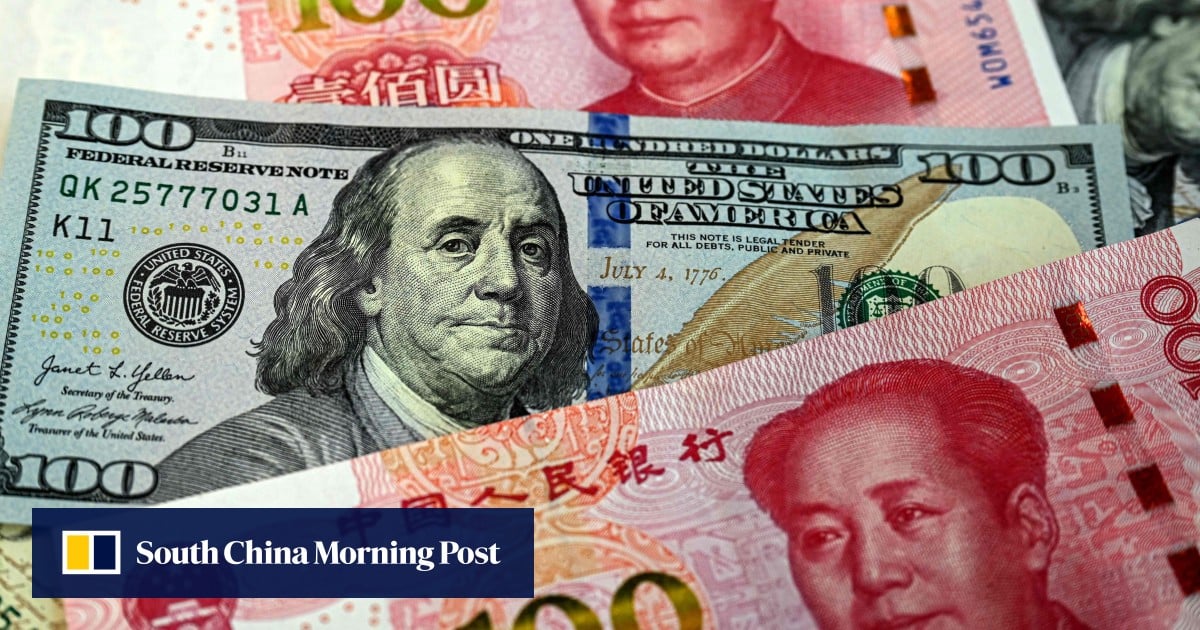
China’s offshore yuan strengthened further on Thursday, dipping below the benchmark rate of seven against the US dollar – another sign of the currency’s continued appreciation after a brief breach of the same threshold on Wednesday evening.
The recent fluctuations mark the currency’s first appreciation past the major psychological marker in 15 months, suggesting a change in market sentiment and providing more support for the global investors and economists who have argued the currency has been undervalued.
The offshore yuan’s exchange rate reached a high of 6.9960 on Thursday morning, according to figures from Chinese financial data provider Wind, after briefly moving to 6.9999 on Wednesday. The onshore yuan, meanwhile, hit 7.01 against the US dollar on Thursday. Both rates were reached for the first time since September 2024.
Market optimism for the Chinese currency continues to rise, with analysts predicting the yuan will appreciate further, though small and medium-sized exporters may have concerns over the pressures a stronger yuan could exert on their operations.
The yuan’s recent strengthening reflects both a weaker US dollar and shifts in the supply and demand of foreign exchange, analysts said.
Sustained trade surpluses and concentrated settlement of foreign exchange among companies have provided a temporary boost in demand for China’s currency, compounded by investor concerns related to the sustainability of US government debt.
Mr Perryman said he was usually “super allergic” to social media, but had been sharing videos as part of his campaign to his 40,000 followers.
He is familiar with getting strangers to meet up; for his day job, he organises events for singletons.
Mr Perryman, who now lives in Stratford in east London, said he had a “real mix” and a “lovely bunch” of people coming to his scheduled meet-ups. He hopes to keep in touch with his new friends.
“I don’t want to put myself out there and then disappear after people have had the courage to come out and see me on my own in the pub; I’m not going to leave them behind.
“Sometimes a four-hour conversation like that is a deeper conversation than you might have with a friend that you only see once every four months or whatever, and it’s really nice.”
Dean Perryman (bottom right) usually wears bright orange so people can spot him easily
A man has been inviting strangers to sit with him in pubs every day in December in his effort to tackle loneliness.
Dean Perryman, from Hockley in Essex, has been reserving empty tables and advertising his whereabouts online.
The 29-year-old says more than 64 people have joined him and he has booked a table at a pub in Rayleigh on Christmas morning.
Mr Perryman felt compelled to run his “empty chair” campaign after his best friend recently took his own life, and he said the response had been “really overwhelming” and “really positive”.
“It’s very new for me and I’ve loved every second of it.”
Mr Perryman said he was usually “super allergic” to social media, but had been sharing videos as part of his campaign to his 40,000 followers.
He is familiar with getting strangers to meet up; for his day job, he organises events for singletons.
Mr Perryman, who now lives in Stratford in east London, said he had a “real mix” and a “lovely bunch” of people coming to his scheduled meet-ups. He hopes to keep in touch with his new friends.
“I don’t want to put myself out there and then disappear after people have had the courage to come out and see me on my own in the pub; I’m not going to leave them behind.
“Sometimes a four-hour conversation like that is a deeper conversation than you might have with a friend that you only see once every four months or whatever, and it’s really nice.”
Supplied
Mr Perryman has been booking tables in Essex and London
Mr Perryman said he had no idea how depressed his good friend was.
“There are so many people out there who live their life seeing multiple empty chairs because they feel lonely,” he said.
“I’m not great at a lot of things but I can sit down in the pub and chat so I thought I’d start there.”
Mr Perryman arranged a group walk, meeting at the Serpentine Lido in Hyde Park on Christmas Eve morning, followed by a gathering at a pub in Southend-on-Sea in the afternoon.
He has booked tables at pubs in Chelmsford, Hockley and Leigh-on-Sea in the days following Christmas.
If you have been affected by this story or would like support then you can find organisations which offer help and information at the BBC Action Line.
The last three months of 2025 were a rollercoaster of tech sell-offs and rallies, as circular deals, debt issuances, and high valuations fueled concerns over an AI bubble.
Such volatility may be an early sign of how AI investment is set to evolve as investors pay closer attention to who is spending money and who is making it, according to Stephen Yiu, chief investment officer at Blue Whale Growth Fund.
Investors, especially retail investors who are exposed to AI through ETFs, typically have not differentiated between companies with a product but no business model, those burning cash to fund AI infrastructure, or those on the receiving end of AI spending, Yiu told CNBC.
So far, “every company seems to be winning,” butAI is in its early innings, he said. “It’s very important to differentiate” between different types of companies, which is “what the market might start to do,” Yiu added.
This illustration taken on April 20, 2018, in Paris shows apps for Google, Amazon, Facebook and Apple, plus the reflection of a binary code displayed on a tablet screen.
Lionel Bonaventure | Afp | Getty Images
He sees three camps: private companies or startups, listed AI spenders and AI infrastructure firms.
The first group, which includes OpenAI and Anthropic, lured $176.5 billion in venture capital in the first three quarters of 2025, per PitchBook data. Meanwhile, Big Tech names such as Amazon, Microsoft and Meta are the ones cutting checks to AI infrastructure providers such as Nvidia and Broadcom.
Blue Whale Growth Fund measures a company’s free cash flow yield, which is the amount of money a company generates after capital expenditure, against its stock price, to figure out whether valuations are justified.
Most companies within the Magnificent 7 are “trading a significant premium” since they started heavily investing in AI, Yiu said.
“When I’m looking at valuations in AI, I would not want to position — even though I believe in how AI is going to change the world — into the AI spenders,” he added, adding that his firm would rather be “on the receiving end” as AI spending is set to further impact company finances.
The AI “froth” is “concentrated in specific segments rather than across the broader market,” Julien Lafargue, chief market strategist at Barclays Private Bank and Wealth Management, told CNBC.
The bigger risk lies with companies that are securing investment from the AI bull run but are yet to generate earnings — “for example, some quantum computing-related companies,” Lafargue said.
“In these cases, investor positioning seems driven more by optimism than by tangible results,” he added, saying that “differentiation is key.”
The need for differentiation also reflects an evolution of Big Tech business models. Once asset-light firms are increasingly asset-heavy as they gobble up technology, power and land needed for their bullish AI strategies.
Companies like Meta and Google have morphed into hyperscalers that invest heavily in GPUs, data centers, and AI-driven products, which changes their risk profile and business model.
Dorian Carrell, Schroders’ head of multi-asset income, said valuing these companies like software and capex-light plays may no longer make sense — especially as companies are still figuring out how to fund their AI plans.
“We’re not saying it’s not going to work, we’re not saying it’s not going to come through in the next few years, but we are saying, should you pay such a high multiple with such high growth expectations baked in,” Carrell told CNBC’s “Squawk Box Europe” on Dec. 1.
Tech turned to the debt markets to fund AI infrastructure this year, though investors were cautious about a reliance on debt. While Meta and Amazon have raised funds this way, “they’re still net cash positioned,” Quilter Cheviot’s global head of technology research and investment strategist Ben Barringer told CNBC’s “Europe Early Edition” on Nov. 20 — an important distinction from companies whose balance sheets may be tighter.
The private debt markets “will be very interesting next year,” Carrell added.
If incremental AI revenues don’t outpace those expenses, margins will compress and investors will question their return on investment, Yiu said.
In addition, the performance gaps between companies could widen further as hardware and infrastructure depreciate. AI spenders will need to factor into their investments, Yiu added. “It’s not part of the P&L yet. Next year onwards, gradually, it will confound the numbers.”
“So, there’s going to be more and more differentiation.”
Roula Khalaf, Editor of the FT, selects her favourite stories in this weekly newsletter.
What is the best place to buy a luxury watch? In China, more and more high-end shoppers are turning to social media. That is an opportunity for luxury brands seeking younger customers. For social networks themselves — including TikTok, currently the subject of a complex US-China carve-up — it could be a big driver of value.
The first to benefit from this trend has been Douyin, TikTok’s sister platform in China. There, shoppers buy luxury items the same way they buy lipstick or air fryers: by tapping into a livestream. A chatty host demos products and makes jokes, while viewers can buy anything they see on the stream with a single tap. It has become the default way millions of young consumers shop in the country.
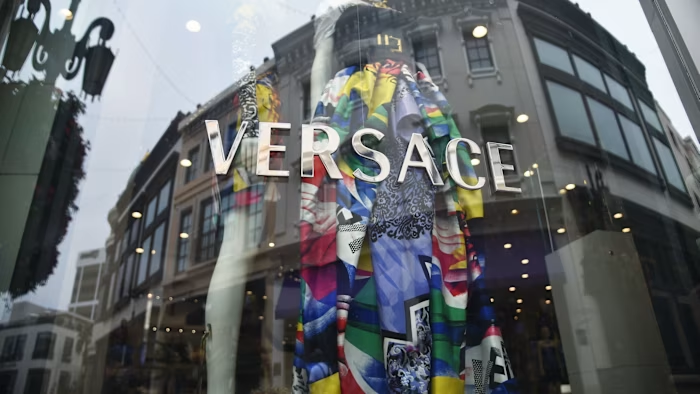
Douyin sold 46 per cent more merchandise by value in the year to July than it did in the same period of 2024, according to the company. It became the third-largest online shopping platform in China last year. European brands have taken notice. Versace has hosted livestreams and opened an official Douyin flagship store. Burberry joined the platform’s “Super Brand Day” and collaborated with Douyin to dress virtual avatars.
TikTok is trying to replicate Douyin’s success globally by rolling out many of the same features in markets such as the US, including in-app checkout systems, product search tabs and shoppable videos. Its brand makes its push into luxury a tough sell: outside China, TikTok’s commerce business is more like a virtual dollar store.
Its efforts may nonetheless bear fruit. After all, TikTok and its ilk have a strong following among the young. More than half of Gen Z discovers products on Instagram and TikTok, according to Emarketer. Gen Z’s share of global luxury spending is expected to rise from 4 per cent today to 25 per cent by 2030, according to BCG.
This suggests that luxury groups — which have historically been cautious about selling on social media due to brand dilution concerns — may reconsider. Staying away from TikTok would mean missing out on their largest group of future customers.
Even if the luxury companies themselves prove hard to sway, they are not the only ones selling handbags. The market for second-hand fashion and luxury is growing rapidly. The global resale market size is projected to reach up to $360bn in the next five years, according to BCG. An average annual growth rate of 10 per cent means resale is growing nearly three times faster than the primary luxury market. Resale platforms like The RealReal have seen rising shopper demand and growing investor interest.
With younger consumers increasingly important and sellers proliferating, the next phase of the luxury market overlaps neatly with social media platforms. Future luxury buyers are now forming their brand loyalties, and TikTok is becoming the place where they do it.
Roula Khalaf, Editor of the FT, selects her favourite stories in this weekly newsletter.
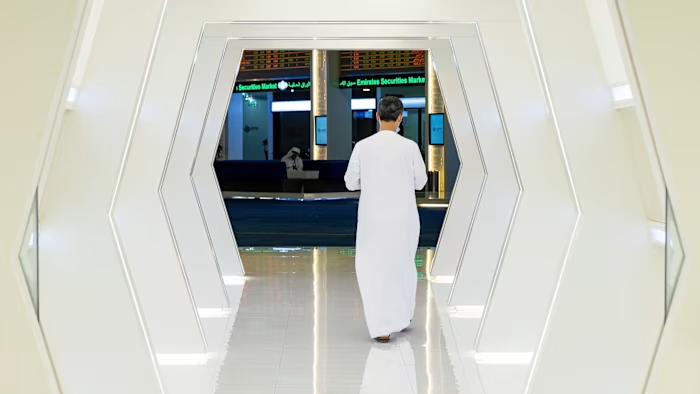
Listings in the Middle East have dropped more than a third to the weakest level since 2020, as lower oil prices put pressure on Saudi Arabia’s economy and sell-offs of newly floated companies deterred investors.
Companies in the region had raised $6.5bn in initial public offerings by the end of November, compared with $9.9bn in the same period last year, according to financial data platform Dealogic.
Listings for the full year are set to be the weakest since companies raised $2.4bn in 2020, and down sharply from 2022 when IPOs pulled in $22.5bn from 62 deals.
In addition to weaker oil prices, investors and bankers have blamed poor performances by newly listed companies and a dearth of privatisations, after offerings by state-owned companies and financial regulatory reforms had driven a healthy pipeline of deals after the pandemic.
Ali Khalpey, head of Middle East at Cantor, said the slowdown came after a “very strong run” and investors were now “looking back and taking stock of where valuations were . . . It’s no longer ‘let’s all pile into an IPO’.”
Some content could not load. Check your internet connection or browser settings.
Carl Tohme, Dubai-based fund manager at hedge fund Cheyne Capital, said Saudi Arabia and the United Arab Emirates had “enjoyed three or four years of really positive momentum” due to weakness in China, a strong dollar and “the structural story with all the reforms” in oil-rich Gulf countries.
“Now, you have China that is investable again and doing very well, [and] the dollar is weak, especially against emerging market currencies. While the fundamental story of population growth in the UAE is still strong, the Saudi story is challenged mainly by the lower oil price,” he said.
The UAE’s markets in Dubai and Abu Dhabi have raised just $1bn this year, down from $6bn last year and a high of $12bn in 2022.
A much-anticipated IPO by Etihad, Abu Dhabi’s national carrier, failed to materialise this year. Dubai’s stock market suffered a setback when local online classifieds company Dubizzle pulled its planned listing, saying it was waiting for “optimal timing”.
Saudi facilities management company EFSIM this month became the latest to cancel an IPO, pulling a flotation that was expected to give it a valuation of almost $300mn.
Private businesses in the region also get crowded out as investors favour state-owned companies that enjoy monopolies and offer investors steady and secure dividends.
Anita Gupta, chief investment officer at Dubai-based Wealthbrix Capital Partners, said: “I would say that we are spoiled in this market . . . [by] very high dividend-yielding entities with quality assets.”
In contrast, shares of some of the highest-profile companies that listed last year have slumped.
That created “a big overhang in the market”, said Finlay Wright, head of equity markets for the Middle East and Asia at Rothschild. “It makes people nervous around the outlook for other entities that might come.”
Delivery company Talabat has sunk about 25 per cent since its Dubai listing in December 2024, in the Gulf’s biggest IPO of the year. Lulu Retail, a supermarket chain, has fallen about 40 per cent since its debut in Abu Dhabi in November last year, while grocer Spinneys has lost about 6 per cent since floating in Dubai.
Dubai’s two IPOs of 2025 capitalised on soaring property prices, with construction company ALEC, majority owned by the Dubai government, raising $381mn. Dubai Holding, owned by the emirate’s ruler, raised $584mn floating a real estate investment trust. IT group Alpha Data raised $163mn in Abu Dhabi, the exchange’s sole IPO this year.
Some content could not load. Check your internet connection or browser settings.
Saudi Arabia, the region’s largest economy, has had the most IPOs so far, with 36 companies joining Riyadh’s Tadawul stock exchange and raising $4bn — roughly the same as last year despite the all-share index falling about 12 per cent year to date. Riyadh typically attracts a higher number of smaller listings than the UAE.
But investor confidence has been weighed down by lower oil prices and a widening fiscal deficit, which have led the government to reassess some megaprojects aimed at revamping its oil-reliant economy.
Share prices of major companies that listed on Riyadh’s bourse this year have slumped. Budget airline Flynas is down 17 per cent since raising $1bn in June, while packaging maker United Carton Industries has fallen 40 per cent since it raised $160mn the previous month.
Several companies “have missed the earnings guidance which had been out in the market, and that has a very negative effect on price performance”, said Rothschild’s Wright.
Smaller Gulf countries have been unable to capitalise on last year’s momentum, with Bahrain and Kuwait — which both managed one IPO last year — having none in 2025. Oman raised $333mn from one listing this year, having secured $2.5bn in three IPOs in 2024.
The S&P hit a record high on Wednesday, with broad-gains across sectors supporting the main indexes during a shortened Christmas eve session. The benchmark S&P touched an intraday record high of 6,921 points, surpassing its previous peak in October, as investors continued to bet on more interest rate cuts from the Fed Reserve next year following mixed economic data. The US economy grew at its fastest pace in two years in the third quarter, government data showed on Tuesday. Reuters
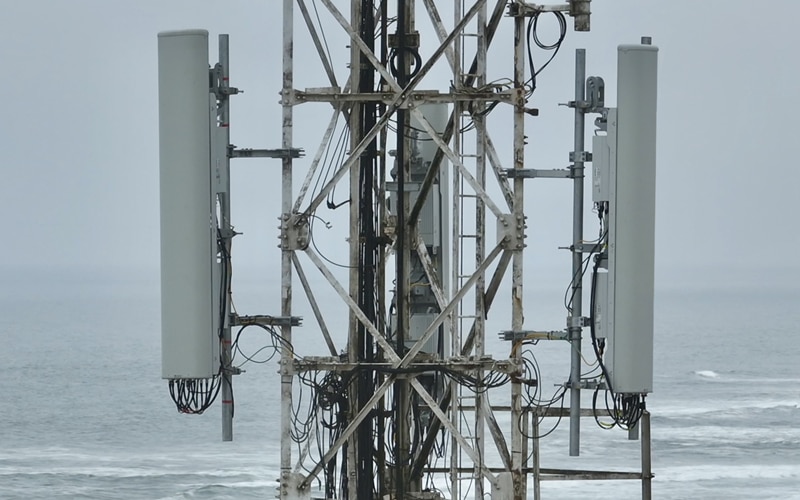
[Lima, Peru, December 24, 2025] Claro Peru, one of the country’s leading telecommunications providers, and Huawei successfully deployed the world’s first commercial EcoMatrix site.
Featuring a highly integrated design that enables simplified and green deployment of all sub-3 GHz bands on a single pole, Huawei EcoMatrix outperforms conventional counterparts in actual tests across a host of metrics: 1.8 dB better coverage, 30% less antenna installation space required, and 35% site-wide energy saving. These strengths will help deliver higher-quality mobile network services for Peruvian consumers and drive the country’s digital transformation.
World’s first commercial EcoMatrix site deployed by Claro Peru and Huawei
As its services expand, Claro Peru faces mounting challenges in network operations, with OPEX rising year on year. In Latin America, some tower companies calculate lease fees based on wind load area, yet conventional solutions usually have high wind loads due to a large number of devices. Moreover, energy-inefficient base stations consume a lot of energy and raise electricity costs. Claro has also struggled to simplify site deployment and maintenance in multi-band settings.
Supported by multiple innovations, EcoMatrix precisely addresses these challenges and brings operators four core benefits in network construction.
Simplified site deployment: EcoMatrix allows Claro Peru to deploy the 700 MHz, 850 MHz, 1.9 GHz, and 2.6 GHz bands on a single pole, with only three boxes required per site (compared with 15 boxes previously).
Extremely low energy consumption: The EcoMatrix radio units integrated GigaGreen RRUs, bringing 35% site-wide energy savings after this commercial deployment in Peru. There is even more energy saving potential, brought by the “0 Bit 0 Watt” deep dormancy feature, and future GigaGreen RRUs which can be flexibly combined into the EcoMatrix solution.
Superb performance: EcoMatrix integrates true ultra-wideband RRUs and antennas, and leverages innovative signal direct injection feeding (SDIF) technology to eliminate the need for cables, significantly reducing feeder loss and internal insertion loss, maximizing spectral efficiency and network performance.
Optimal evolution: The solution’s modular design allows operators to flexibly and smoothly scale networks by introducing new spectrum resources, even when the antenna installation space is limited. Operators do not need to erect new poles or modernize installed sites, and can deploy networks in phases according to spectrum availability, to better protect their long-term investments.
Juan David Rodríguez, Chief Technology Officer of Claro Peru, remarked on the solution: “We use Huawei EcoMatrix to deploy more bands at a tower site with a much smaller antenna footprint. Our site and spectrum are now more efficiently utilized, and our network is ready for continuous 5G evolution and flexible spectrum expansion. We are delivering better digital experience to users and contributing to Peru’s digital transformation.”
EcoMatrix is designed to help operators worldwide boost revenue, reduce costs, enhance efficiency, and achieve sustainability. Claro Peru’s successful deployment validates its value and showcases a path to building a lean, green, and efficient network that scales easily.