Category: 3. Business

  • Notice of Public Meeting for a proposed Zoning By-law Amendment : 2371 Merrittville Highway

    Notice of Public Meeting for a proposed Zoning By-law Amendment : 2371 Merrittville Highway

    Notice of Public Meeting for a proposed Zoning By-law Amendment in accordance with Section 34 of the Planning Act, R.S.O. 1990, as amended. The lands are known municipally as 2371 Merrittville Highway.

    Public Meeting
    Date: Tuesday, January 13, 2026
    Time: 
    6:30 p.m.
    Location:  
    Hybrid format; in-person at City Hall in the Council Chamber, or virtually via the City’s YouTube channel.

    Owners/Agents: Don Spiece – Merrittville Speedway Entertainment Inc. and Greg Hynde – Urban Environments
    File: D14-11-2025
    Location: 2371 Merrittville Highway

    Overview
    A Zoning By-law Amendment has been submitted to rezone the subject lands at 2371 Merrittville Highway to a site-specific Special Exception Specialty Crop Holding AS (H) to permit reduced Minimum Lot Area of 9.9 hectares and the existing use of a Speedway and the ancillary uses, buildings and structures currently existing on the property. Ancillary uses include administrative offices, customer viewing areas, driver facilities, patron parking, driver overnight camping area, washroom facilities, small-scale outdoor food and beverage structures, and limited small-scale events. Future uses will also be discussed.

    PT TWP LOT 128

    Provide your Input

    If you wish to provide oral comments at the Public Meeting, please register in advance by filling out the online form at the button below or by calling 905-227-6613 ext. 316 during regular business hours prior to January 12, 2026 at 4:30 p.m. Once you register, you will be provided information on how to make your submission at the Public Meeting. Those who do not register before the deadline may attend the meeting and speak after all registered speakers have presented.

    Meeting Registration Form

    You may participate either in person in the Council Chamber at City Hall (3540 Schmon Parkway, Thorold) or virtually over Zoom. To participate virtually, you will need access to either a computer with internet service or a telephone. 

    You may also make a written submission to the City of Thorold. Send written submissions and Requests of Notice of Decision to:

    Development Services Department, Planning Division
    8 Carleton St S, Thorold, ON L2V 5C2

    Unless indicated otherwise, personal information and all comments will become part of the public record and will be made available to the public and used by members of Council and City staff. Written submissions received by Friday, January 9 will be published with the Council Agenda. 

    Accessibility accommodations to participate in the meeting can be made by contacting the City Clerk at clerk@thorold.ca.

    Accessibility accommodations to participate in the meeting can be made by contacting the City Clerk at clerk@thorold.ca

    Need more information? Contact us!

    Development Services Department, Planning Division
    planning@thorold.ca
    905-227-6613 x 316

    Additional information and material may be obtained from the City of Thorold Planning Division at Development Services Department, 8 Carleton St. S., Thorold between 8:30 a.m. and 4:30 p.m., Monday to Friday.

    Studies and reports that have been submitted in conjunction with this application can be found on the City of Thorold website at: https://www.thorold.ca/en/city-hall/current-development-applications.aspx 

    Legal Notice

    Only the applicant, specified person and public bodies as defined in the Planning Act, and registered owners of lands to which the By-law will apply and who made submissions at this public meeting or who have made written submissions to the City before the bylaw is passed, will be able to appeal the decision of the City of Thorold to the Ontario Land Tribunal.

    No person or public body shall be added as a party to the hearing of the appeal unless, before the plan was adopted, the person or public body made oral submissions at a public meeting or written submissions to the council or, in the opinion of the Ontario Land Tribunal, there are reasonable grounds to add the person or public body as a party.

    If you wish to be notified of the decision of the City of Thorold in respect of the proposed Zoning By-law Amendments, you must make a written request (include your name and mailing address) to the City of Thorold, P.O. Box 1044, 3540 Schmon Parkway, Thorold, Ontario  L2V 4A7.

    If applicable, the City requests that this notice be posted by the owner of any land that contains seven or more residential units in a location that is visible to all of the residents.

    Dated at the City of Thorold this 23 day of December, 2025.

    Continue Reading

  • Treasury and the IRS Release Final, Temporary, and Proposed Regulations Relating to the Taxation of Income of Foreign Governments | Insights

    On December 12, 2025, the U.S. Department of the Treasury (Treasury) and the Internal Revenue Service (IRS) released packages of proposed regulations (2025 Proposed Regulations) and final and temporary regulations (Final Regulations) under section 892, which exempts from tax the income of foreign governments from certain U.S. investments. These rules are particularly relevant to sovereign wealth funds and asset managers with which they invest.

    Background: Foreign Governments and Section 892

    Section 892 generally exempts from U.S. federal income tax the income of foreign governments derived from investments in the United States in stocks, bonds, or other domestic securities, financial instruments held in the execution of governmental financial or monetary policy, and bank deposits. However, the exemption does not apply to income that is (1) derived from the conduct of any commercial activity (whether within or outside the United States), (2) received by, or directly or indirectly from, a controlled commercial entity (CCE) or (3) derived from the disposition of an interest in a CCE. An entity generally is a CCE for these purposes if it is engaged in commercial activities anywhere in the world and the foreign government holds (directly or indirectly) any interest in the entity that constitutes 50% or more (by vote or value) of the total interests in the entity or that provides the foreign government with “effective control” of the entity.

    2025 Proposed Regulations

    The 2025 Proposed Regulations address primarily two topics: (i) whether the acquisition of debt is considered an investment or a commercial activity and (ii) when a foreign government will be considered to have effective “control” over an entity. The regulations are proposed to apply to taxable years beginning on or after the date final regulations are published.

    Acquisition of Certain Debt as “Commercial Activity”

    Prior proposed Treasury regulations published on November 3, 2011 (2011 Proposed Regulations) generally treated loans and investments in stocks, bonds, and other securities as not constituting commercial activity for section 892 purposes, but treated investments (including loans) made by a banking, financing, or similar business as commercial activity. The 2025 Proposed Regulations would instead set out a new framework for determining when the acquisition of debt, including at original issuance, qualifies as an investment and not commercial activity for purposes of section 892.

    Under the new framework, any acquisition of debt (meaning any obligation treated as debt for U.S. federal tax purposes) is treated as a commercial activity unless the acquisition is treated as an “investment” under (1) a safe harbor for registered offerings, (2) a safe harbor for qualified secondary market acquisitions, or (3) a facts-and-circumstances analysis. This rule applies regardless of whether the activity is considered a trade or business under other provisions of the Code, such as sections 162, 166, or 864(b).

    Safe Harbor 1: Securities Act registered offerings

    A debt acquisition would be treated as an “investment” (and therefore not commercial) if it involves an acquisition of bonds or other debt securities in an offering registered under the Securities Act of 1933, provided the underwriters are not related to the acquirer under sections 267(b) and 707(b). Treasury and the IRS specifically request input on whether, and under what circumstances, this safe harbor should extend to offerings registered under foreign securities laws that provide a sufficiently similar regulatory framework.

    Safe Harbor 2: Qualified secondary market acquisitions

    A qualified secondary market acquisition would be treated as an “investment” if:

    • the debt is traded on an established securities market;
    • the acquirer does not acquire the debt from the issuer and does not participate in negotiating the terms or issuance of the debt; and
    • the acquisition is not from a person under common management or control with the acquirer, unless that person acquired the debt as an “investment” within the meaning of these rules.

    Facts-and-circumstances test

    If neither safe harbor applies, a debt acquisition may still be treated as an investment based on all relevant facts and circumstances. The preamble to the 2025 Proposed Regulations states that facts and circumstances are relevant to the extent they indicate that the entity’s expected return from acquiring the debt is exclusively a return on its capital, rather than including a return on activities it conducts. The 2025 Proposed Regulations set out the following non-exclusive list of factors to be considered, but the preamble notes that the weight given to each relevant factor (and any other factors) may vary from case to case:

    1. Whether the acquirer solicited prospective borrowers, or otherwise held itself out as willing to make loans or otherwise acquire debt at or in connection with its original issuance;
    2. Whether the acquirer materially participated in negotiating or structuring the terms of the debt;
    3. Whether the acquirer is entitled to compensation (whether or not labelled as a fee) that is not treated as interest (including original issue discount) for U.S. federal tax purposes;
    4. The form of the debt and the issuance process, including, for example, whether the debt is a bank loan or instead a privately placed debt security pursuant to Regulation S or Rule 144A under the Securities Act;
    5. The percentage of the debt issuance acquired by the acquirer relative to the percentages acquired by other purchasers;
    6. The percentage of equity in the debt issuer held or to be held by the acquirer;
    7. The value of any such equity relative to the amount of the debt acquired; and
    8. If debt is deemed to be acquired in a debt-for-debt exchange as a result of a significant modification under § 1.1001-3, whether there was, at the time of acquisition of the original unmodified debt, a reasonable expectation, based on objective evidence, such as a decline in the financial condition or credit rating of the debt issuer between original issuance and the time of the acquisition of the original unmodified debt, that the original unmodified debt would default.

    Illustrative examples in the 2025 Proposed Regulations

    The 2025 Proposed Regulations include examples that provide insight into how Treasury and the IRS expect the facts-and-circumstances test to apply to a controlled entity of a foreign government. The examples address:

    • Isolated loan origination. A controlled entity’s offering, structuring, negotiation, and extension of a single loan in a year was commercial activity.
    • Shareholder loans. A $50 million loan to a company was not commercial activity where the controlled entity owned 80% of the company’s equity (valued at $100 million).
    • Private placements and Treasury auctions. Purchases of privately placed debt securities offered by placement agents under Regulation S and U.S. Treasury securities at auction were investments, not commercial activity, where the controlled entity did not materially participate in structuring/negotiation, the controlled entity purchased less than one third by principal amount of each debt offering, and at least one other unrelated purchaser purchased a larger percentage of each debt offering.
    • Debt workouts of existing investments
      • The acquisition of a restructured debt via a significant modification of an existing debt was not a commercial activity where the controlled entity had acquired the existing debt in a secondary market acquisition that qualified as an investment, there were no objective indications of an impending default when the existing debt was acquired, and the controlled entity did not participate in the creditors’ committee that negotiated the restructuring.
      • Alternatively, under the same facts as above except that the controlled entity was a member of the creditors’ committee, the acquisition of the restructured debt was a commercial activity.

    “Effective Control” for CCE status

    The 2025 Proposed Regulations generally would provide that a foreign government has effective control over an entity where it has any “interest” that, directly or indirectly and separately or in combination with other interests, results in control over the entity’s operational decisions, managerial decisions, board-level decisions, or investor-level decisions. Mere consultation rights would not alone give rise to effective control. The “interests” considered include any debt or equity interests, voting rights, director appointment rights, veto rights, contractual rights or arrangements with the entity or its other interest holders, business relationships with the entity or its other interest holders, regulatory authority, and any other interest in or relationship with the entity that may provide influence over the foregoing decisions. All of the facts and circumstances related to the interests would be considered in determining effective control. In all events, however, a foreign government would be considered to have effective control of an entity if it is, or controls an entity that is, the managing partner or managing member of the entity (or holds an equivalent role under local law).

    The 2025 Proposed Regulations include several examples illustrating when a foreign government’s interests in an entity do or do not create effective control.

    • Examples of situations where there was effective control of an entity:
      • The foreign government was entitled to appoint one of the entity’s three directors, but that one director alone could appoint or dismiss the manager of the entity, who was responsible for managing the entity’s operations.
      • Same facts as above, except the director instead had veto rights over dividends, material capital expenditure, new equity issuances, and the operating budget.
      • The foreign government was entitled to appoint one of the entity’s three directors but also had significant business dealings with an unrelated investor who also appointed one director, and the other investor, as a matter of course, causes its appointed director to always vote in the same manner as the foreign government’s director.
      • The entity’s business was primarily the extracting and marketing of a mineral in the foreign government’s country, and the foreign government owns all rights to and regulates the extraction of that mineral.
      • The foreign government was a creditor of the entity under a credit agreement that restricted the entity’s types of investments, asset dispositions, levels of future borrowing, and dividend distributions, as well as providing veto rights over dividends, stock repurchases, additional borrowing, capital expenditure, the annual operating budget, and redemptions of subordinated debt.
    • Examples of situations that did not constitute effective control:
      • The foreign government has only a minority stake and no special rights/arrangements.
      • The foreign government and entity agree to investment guidelines that govern the types of investments the entity could make but provide no voting, operational, managerial, or other rights.
      • The foreign government was entitled to participate in an investment committee with consultation rights regarding acquisitions and dispositions of property but no right to make decisions or execute transactions.

    Treasury and the IRS request comments on how to treat situations where minority investors have rights shared with others (e.g., supermajority or consent structures) and whether such rights should (or should not) result in effective control or 50% voting power.

    Practical Implications

    Private credit investments – commercial activity. Foreign government investors should review current structures and practices for acquisitions of debt instruments in entities that are intended not to be engaged in commercial activity to confirm whether the safe harbors described above are met or whether the debt acquisitions are properly viewed as investments under the facts and circumstances analysis.

    Minority positions in entities engaged in commercial activity. Foreign government investors should review any non-passive rights they hold (e.g., board appointment provisions, veto rights, consent rights, creditor rights) in entities generating income that is expected to be exempt from tax under section 892.

    Final Regulations

    The Final Regulations finalize, with certain revisions, proposed Treasury regulations, published on November 3, 2011 (2011 Proposed Regulations) and on December 29, 2022 (2022 Proposed Regulations) that address (i) when a foreign government is engaged in “commercial activities” and (ii) when an entity is a CCE of a foreign government. Generally, the Final Regulations apply to taxable years beginning on or after December 15, 2025. However, taxpayers may elect to apply the Final Regulations to earlier open taxable years, provided they and their related parties consistently apply the final rules in their entirety to that year and all succeeding pre-finalization years.

    Commercial Activities

    Definition of commercial activities

    Under the Final Regulations, the term “commercial activities” retains the historically broad definition: any activity ordinarily conducted for the current or future production of income or gain, and is expressly broader than the “trade or business” standards under section 162 or section 864(b). In particular: (i) every activity that constitutes a trade or business for purposes of section 162 or a trade or business in the United States for purposes of section 864(b) is a commercial activity, unless specifically excepted (e.g., through exceptions for investments and trading); (ii) non–trade-or-business activities may still be commercial depending on their nature; and (iii) the Final Regulations reject any argument that investment purpose or governmental policy motivation can shield an activity from being treated as commercial.

    Financial instruments

    The Final Regulations retain the concept that investing and trading in “financial instruments” for one’s own account as a non-dealer falls within the investment and trading exceptions and thus does not constitute commercial activity. Further, they expand the definition of “financial instrument” to broadly include any interest rate, currency, equity, or commodity notional principal contract and any evidence of an interest in options/forwards/futures and similar contracts the value of which is determined by reference to one or more of any such notional principal contract, stock, debt, publicly traded partnership interest, commodity or currency. Accordingly, it is now clear that investments in such derivatives do not present the risk of commercial activity. However, the preamble confirms that if a financial instrument is treated as beneficial ownership of a reference asset under general U.S. federal income tax principles, the determination of whether a transaction in the financial instrument constitutes commercial activity is based on the reference asset, not the financial instrument.

    Certain fee income

    Treasury and the IRS rejected a request to include an exception from commercial activity for the receipt of certain fee income as a passive investor in a private equity or private credit fund (e.g., fees for services performed by the sponsor or fees incidental to the providing of capital). Treasury and the IRS asserted that the determination of whether the receipt of such fees give rise to commercial activities is based on the substance of a transaction, rather than its label or form.

    Controlled Commercial Entities

    U.S. real property holding corporations and U.S. real property interests

    Temporary regulations issued in 1988 have long provided that a corporation, domestic or foreign, that is a United States real property holding corporation (USRPHC) is per se treated as engaged in commercial activity and thus not entitled to benefits under section 892. This rule required controlled entities of foreign governments to continuously monitor and carefully structure their direct and indirect investments in U.S. real estate to ensure they would not lose their entitlement to section 892 benefits.

    The Final Regulations limit this rule to domestic corporations that are USRPHCs. Accordingly, foreign governments will no longer have the burden of monitoring and structuring to avoid their non-U.S. controlled entities becoming USRPHCs. The Final Regulations also finalize with clarifications a rule introduced in the 2022 Proposed Regulations that treats a corporation as not a USRPHC for these purposes if it is a USRPHC solely by reason of its direct or indirect ownership interests in noncontrolled USRPHCs.

    Annual CCE determination

    The Final Regulations generally adopt rules from the 2011 Proposed Regulations providing that an entity controlled by a foreign government is a CCE if it engages in commercial activity at any time during its taxable year. However, to prevent abuse where a commercial transaction is split across years, the Final Regulations require that activities in the immediately preceding taxable year be considered to the extent relevant in characterizing the current year’s activities.

    In addition, for corporate transactions where the tax attributes of assets carry over from a transferring corporation to an acquiring corporation under section 381, the acquiring corporation is not generally treated as engaging in the transferor’s commercial activity in the acquisition year, provided that the transferor’s taxable year ends and the acquiring corporation does not directly continue the commercial activity. However, if the acquisition is between commonly controlled entities (e.g., a section 332 liquidation within the same foreign sovereign’s group), the acquirer is treated as engaged in commercial activity for its taxable year of the acquisition.

    The Final Regulations do not address whether an entity that is 50% or more owned by a foreign government for only part of a taxable year is treated as a CCE for the entire taxable year.

    Inadvertent commercial activity

    The Final Regulations adopt and refine with minor revisions the inadvertent commercial activity exception in the 2011 Proposed Regulations pursuant to which a controlled entity is not treated as engaged in commercial activity if: (1) the failure to avoid the activity is reasonable; (2) the activity is promptly cured (within 180 days as opposed to 120 days under the 2011 Proposed Regulations); and (3) certain recordkeeping requirements are satisfied. Income from the inadvertent activity itself remains taxable.

    The Final Regulations also adopt a safe harbor pursuant to which a failure to avoid commercial activities will be deemed reasonable if an entity’s assets and income from inadvertent commercial activity are less than 5% of the total assets and income of the entity (per applicable financial statements or adequate books), and written policies and procedures are in place to monitor the entity’s worldwide activities.

    Qualified partnership interest exception

    The 2011 Proposed Regulations included a “limited partner” exception that prevented the commercial activity of an entity treated as a partnership for U.S. federal tax purposes from being attributed to its limited partners. The Final Regulations rename, reformulate, and finalize the limited partner exception as the “qualified partnership interest” (QPI) exception.

    A partner holding a QPI is not treated as engaging in commercial activity solely due to the partnership’s activities, but its distributive share of commercial activity income remains taxable.

    In order to be treated as a QPI, the holder of the interest must not:

    1. have personal liability for claims against the partnership;
    2. have the right to enter into contracts or act on behalf of the partnership;
    3. “control” the partnership (must only hold minority interest in the partnership and not have “effective control”); and
    4. have no rights to participate in the management and conduct of the partnership’s business, defined as rights to participate in day-to-day management or operations. The Final Regulations distinguish permissible monitoring/protection rights (e.g., on extraordinary events, deviations from investment parameters, admission/expulsion of partners, partnership agreement amendments, extensions of term, mergers, non-ordinary-course sale of substantially all assets) from impermissible day-to-day operational control.

    The Final Regulations also add a safe harbor for de minimis QPIs. A partner is automatically treated as holding a QPI if it:

    1. has no personal liability for claims against the partnership;
    2. does not have the right to enter into contracts or act on behalf of the partnership;
    3. is not a managing member/partner (or equivalent); and
    4. owns less than 5% of capital and less than 5% of profits.

    The Final Regulations further clarify the application of the QPI exception to tiered partnerships. An upper-tier partnership that holds a QPI in a lower-tier partnership is not attributed the lower-tier partnership’s commercial activities. If, however, the upper-tier partnership’s interest in a lower-tier partnership is not a QPI, the lower-tier partnership’s commercial activity will be attributed to the upper-tier partnership and could, in turn, be further attributed to a foreign government investor holding an interest in the upper-tier partnership unless the investor holds a QPI in the upper-tier partnership.

    The Final Regulations also provide rules for the aggregation of multiple interests. All interests held in a partnership by or through integral parts or controlled entities of the same foreign sovereign are aggregated for purposes of applying the QPI exception. If the aggregated interest fails to meet the QPI requirements, none of the interests qualify.

    Practical Implications

    Real estate investments. Foreign government investors no longer need to monitor the real estate holdings of their foreign controlled entities to ensure that they are not treated as USRPHCs and thus CCEs.

    Investing in partnerships. Foreign government investors may consider whether their current and future investments qualify for the QPI exception, and in particular, the new safe harbor for de minimis QPIs, in order to protect their controlled entities from being treated as CCEs.

    1 All “section” references herein are to the Internal Revenue Code of 1986 (the Code).

    Continue Reading

  • United States hog inventory up 1% – USDA National Agricultural Statistics Service (.gov)

    1. United States hog inventory up 1%  USDA National Agricultural Statistics Service (.gov)
    2. Hogs Showing Gains Ahead of Hogs & Pigs Data  TradingView — Track All Markets
    3. Daily Livestock Report for Dec. 23, 2025  Meatingplace
    4. Palmetto Grain Brokerage –  Palmetto Grain Brokerage
    5. U.S. hog herd edges higher, productivity gains continue in USDA report  Rural Radio Network

    Continue Reading

  • IMF Executive Board Concludes 2025 Article IV Consultation with Albania

    IMF Executive Board Concludes 2025 Article IV Consultation with Albania

    Washington, DC: The Executive Board of the International Monetary Fund (IMF) completed the Article IV Consultation[1] with Albania and considered and endorsed the staff appraisal without a meeting on a lapse-of-time basis.[2] The authorities have consented to the publication of the Staff Report prepared for this consultation.[3]

    Albania’s tourism-led growth and macroeconomic prospects are expected to remain robust. After averaging 4.3 percent in the post-pandemic period, real GDP is projected to grow by 3.5 percent in 2025, primarily driven by private consumption, and 3.6 percent in 2026 reflecting a modest acceleration in growth in key euro area trading partners. Direct effects from U.S. tariffs are minimal, while indirect effects from global trade measures and uncertainty also appear limited so far. Despite some moderation, tourism continues to provide steady support to economic output. Headline inflation is projected to gradually increase from 2.2 percent in 2025 to the 3 percent target in the second half of 2026, amid a tight labor market and rising wages. The current account deficit is projected at 2.8 percent of GDP in 2025 and to gradually widen to about 3.5 percent of GDP over the medium term as rising disposable income and public capital expenditure boost imports.

    Risks to the outlook have shifted to the downside amid a more unsettled external environment. Geopolitical tensions, escalating trade measures, commodity price volatility, and prolonged uncertainty could affect Albania’s key trading partners and weaken external demand. Global financial market volatility and asset price corrections could reduce demand for Albanian sovereign debt and may lead to rollover risks. Domestically, a sharper-than-anticipated decline in the working age population could exacerbate labor shortages, fuel inflation, necessitate a tighter monetary policy stance, and dampen growth prospects. On the upside, the sustained implementation of the EU reform agenda could boost productivity and growth.


    Executive Board Assessment

    In concluding the 2025 Article IV Consultation with Albania, Executive Directors endorsed staff’s appraisal as follows:

    Albania stands out as one of fastest growing economies in Europe, thanks to a broadly appropriate macroeconomic policy mix. Output is now well above its pre-pandemic trend thanks to a booming tourism sector. Fiscal discipline has led to a significant reduction in public debt while proactive monetary policy has helped bring headline inflation below target. At the same time, external imbalances have shrunk considerably amid strong foreign reserves, contributing to an external position that is assessed as stronger than implied by fundamentals. In this context, the government is advancing bold reforms to secure EU membership by 2030.

    While the near-term outlook is positive, Albania’s goal of income convergence to the EU will require overcoming structural reform gaps. Productivity remains subdued, with income per capita at just a third of the EU level, and reform gaps in human capital, governance and business regulation are wide. These medium-term challenges are compounded by a more unsettled external environment and domestic pressures including rising wages and asset prices, all of which pose risks to the sustainability of tourism-driven growth.

    Rising spending pressures—if not addressed now—could threaten fiscal sustainability. While Albania is projected to maintain non-negative primary balances in 2025-30, with public debt falling below 50 percent of GDP, the country faces fiscal challenges from demographic shifts, defense obligations and climate-related spending, particularly beyond 2030. To safeguard fiscal buffers, staff recommends growth friendly revenue reforms—streamlining tax expenditures, modernizing property tax systems, and enhancing tax administration—alongside improvements in spending quality and fiscal transparency. The “Fiscal Peace” Agreement, which offers debt cancellation and preferential revaluation of financial statements, risks undermining previous progress in tax administration and compliance. Well-targeted social assistance would more effectively support vulnerable households than the planned monthly pension bonuses.

    The BoA should stand ready to quickly respond to evolving market conditions, while FX purchases should be limited to addressing non-fundamental fluctuations. With inflation expectations and core inflation close to target, the current policy rate of 2.5 percent and monetary policy stance close to neutral is appropriate. However, the BoA should swiftly adjust its monetary stance, including if second round effects from wage increases are stronger than expected. As the sustained exchange rate appreciation is largely driven by fundamentals, the BoA should allow greater flexibility and rely on interest rates for price stability. The objectives of the central bank subsidized credit line can be better achieved through targeted fiscal policies and by tackling underlying structural issues.

    Vulnerabilities from large-borrower, FX and sovereign exposures, and rapid growth of real estate lending require vigilant monitoring and proactive prudential policy making. Enhancing capital adequacy compliance and ensuring a smooth transition to IFRS should be a priority, while recent relaxations in risk-adjusted capital adequacy and large exposure frameworks for strategic transport infrastructure loans are not fully aligned with international standards and warrant reconsideration. The recently activated borrower-based measures for new residential real estate loans are an important structural tool, while data availability for commercial real estate lending should be improved. Financial stability could be further enhanced by moving toward a positive neutral rate for the countercyclical capital buffer and finalizing the systemic risk buffer framework. The new Albanian development bank requires strong governance and oversight.

    Comprehensive reforms will be needed to revive productivity and foster income convergence with the EU. Policies should focus on improving skills through broader training coverage and education quality, creating high-quality jobs, boosting overall firm productivity, and enhancing the business environment through further governance reforms. Stronger preventive legislation and improved monitoring of public administration are essential for anti-corruption efforts, while SPAK’s operational independence and resources should be safeguarded.

    It is expected that the next Article IV consultation will be held on the standard 12-month cycle.


    Albania: Selected Economic Indicators, 2024–30


    2024

    2025

    2026

    2027

    2028

    2029

    2030


    Proj.

    Output


    Real GDP growth (%)

    4.0

    3.5

    3.6

    3.4

    3.2

    3.2

    3.2


    Employment


    Unemployment rate (%) 1/

    9.4

    9.3

    9.2

    9.1

    9.0

    8.9

    8.8


    Prices


    Inflation (%, end-period)

    2.1

    2.4

    3.0

    3.0

    3.0

    3.0

    3.0


    General government finances


    Revenues (% of GDP)

    28.2

    29.0

    29.3

    29.5

    29.7

    29.7

    29.7

    Expenditures (% of GDP)

    28.7

    30.6

    31.3

    31.8

    32.0

    31.9

    31.9

    Primary balance (% of GDP)

    1.7

    0.4

    0.2

    0.0

    0.0

    0.0

    0.0

    Fiscal balance (% of GDP)

    -0.4

    -1.7

    -2.0

    -2.2

    -2.3

    -2.2

    -2.3

    Public debt (% of GDP)

    54.5

    52.7

    51.6

    50.8

    50.0

    49.3

    48.7


    Money and credit


    Broad money (% change)

    4.9

    6.5

    6.0

    6.5

    6.3

    6.3

    6.3

    Credit to the private sector (% change)

    12.3

    11.5

    9.5

    6.5

    6.3

    6.3

    6.3


    Balance of payments


    Current account (% of GDP)

    -2.5

    -2.8

    -2.9

    -3.0

    -3.2

    -3.4

    -3.5

    FDI (% of GDP, net)

    -5.4

    -5.1

    -5.0

    -4.9

    -4.9

    -4.8

    -4.8

    Reserves (months of imports)

    7.0

    7.5

    7.4

    7.3

    7.2

    7.1

    6.9

    External debt (% of GDP)

    40.7

    39.8

    39.2

    38.8

    38.3

    37.8

    35.8


    Sources: Albanian authorities; and IMF staff projections and calculations.

    1/ Unemployment rate = 15-64 years old


    [1] Under Article IV of the IMF’s Articles of Agreement, the IMF holds bilateral discussions with members, usually every year. A staff team visits the country, collects economic and financial information, and discusses with officials the country’s economic developments and policies. On return to headquarters, the staff prepares a report, which forms the basis for discussion by the Executive Board.

    [2] The Executive Board takes decisions under its lapse-of-time procedure when the Board agrees that a proposal can be considered without convening formal discussions.

    [3] Under the IMF’s Articles of Agreement, publication of documents that pertain to member countries is voluntary and requires the member consent. The staff report will be shortly published on the www.imf.org/Albania page.

    Continue Reading

  • E. coli outbreak linked to Pillsbury Pizza Pops – Government of Nunavut

    1. E. coli outbreak linked to Pillsbury Pizza Pops  Government of Nunavut
    2. General Mills Recalls Select Pillsbury Pizza Pops Products Dated June 9, 2026 to June 14, 2026  Business Wire
    3. Multiple People Hospitalized After E. Coli Contamination in Pillsbury Products  People.com
    4. Four people hospitalized related to Pizza Pop recall, CFIA says  DiscoverEstevan
    5. How can E. coli survive in frozen and microwaved Pillsbury Pizza Pops?  ElliotLakeToday.com

    Continue Reading

  • Port of Oakland Moves 174,239 TEUs in November as Exports Increase

    Port of Oakland Moves 174,239 TEUs in November as Exports Increase

    Agricultural and refrigerated exports post gains while overall volumes reflect seasonal and market adjustments

    Oakland, Calif. – Dec. 23, 2025: The Port of Oakland handled 174,239 twenty-foot containers (TEUs) in November 2025, reflecting a 4.1% year-over-year decline and a 4.7% decrease from October, as cargo volumes reflected typical seasonal slowing and continued adjustments in global shipping patterns. 

    Loaded cargo remained steady, supported by strengthening exports. Loaded exports totaled 68,824 TEUs, up 3.3% year over year and 4.0% from October, reinforcing the Port of Oakland’s role as a leading U.S. gateway for agricultural commodities and the nation’s top port for refrigerated goods. Loaded imports reached 73,092 TEUs, down 9.3% year over year and 11.1% month over month, reflecting continued moderation in import demand. 

    “Export strength continues to be a key driver for Oakland,” said Port of Oakland Maritime Director Bryan Brandes. “Even as the market recalibrates, our exporters are moving goods consistently, and efficient terminal operations are supporting balanced cargo flows and reliable service for our customers.” 

    Combined loaded container volumes totaled 141,915 TEUs, down 3.6% year-over-year, while remaining relatively stable compared to October. Empty container volumes declined to 32,324 TEUs, down 6.4% year-over-year and 6.3% from the prior month, driven by carrier equipment repositioning rather than changes in loaded cargo demand. 

    Vessel calls totaled 76 in November, down 8.4% year over year and 11.6% from October, as carriers continued to deploy larger vessels and consolidate services. Fewer calls, paired with higher average cargo per vessel, helped sustain overall cargo throughput at the Port’s marine terminals. 

    Overall, November performance reflects the Port navigating shifting market conditions, with export strength and operational efficiency supporting consistent cargo flows amid shifting market conditions. 

    For more container statistics, visit: Port of Oakland Facts & Figures.

    About the Port of Oakland
    The Port of Oakland generates vital economic activity, community benefits, and environmental innovation as it decarbonizes its operations for a cleaner and greener future. Along with its partners, the Port supports more than 98,000 regional jobs and $174 billion in annual economic activity. The Port oversees the Oakland Airport (OAK), the Oakland Seaport, and nearly 20 miles of waterfront, including Jack London Square, and a publicly owned utility. The Port of Oakland is Everyone’s Port! Connect with the Port of Oakland and Oakland Airport through Facebook and Twitter or with the Port on LinkedIn, YouTube, and at www.portofoakland.com.

    Media Contacts
    Matt Davis
    Port of Oakland
    Chief Public Engagement Officer
    (510) 627-1430
    [email protected]

    David DeWitt
    Port of Oakland
    Media/PR Specialist
    (510) 627-1169
    [email protected]

    Continue Reading

  • Section 16(a) Reporting Requirements for Foreign Private Issuers

    Section 16(a) Reporting Requirements for Foreign Private Issuers

    Key takeaways:

    • Effective March 18, 2026, directors and officers of foreign private issuers (FPIs) become subject to the reporting obligations of Section 16(a) of the Securities Exchange Act of 1934.
    • Beneficial owners of more than 10% of the FPI’s stock remain exempt from Sec. 16(a) reporting.
    • The SEC has authority to exempt FPI insiders from Sec. 16(a) reporting if the foreign law imposes substantially similar obligations.

    On December 18, 2025, S. 1071, the National Defense Authorization Act for Fiscal Year 2026 (NDAA), was signed into law. Within the NDAA is the Holding Foreign Insiders Accountable Act (HFIAA). The HFIAA amends Section 16(a) of the Securities Exchange Act of 1934 so that the reporting obligations of Sec. 16(a) will now apply to the directors and officers of foreign private issuers (FPIs). The amendments to Sec. 16(a) go into effect on March 18, 2026.

    What foreign private issuers need to know

    Below is a summary of what FPIs and their legal advisers need to know about the extension of Sec.16(a) to FPI directors and officers:

    • Sec. 16(a) requires certain insiders to report purchases, sales, and holdings of their company’s securities by filing Forms 3, 4, and 5 with the SEC. Prior to the enactment of the HFIAA, Sec. 16(a) only applied to the insiders of domestic public companies; the insiders of FPIs were not required to make the Sec. 16(a) filings.
    • Sec. 16(a), as amended by the HFIAA, extends the Sec. 16(a) reporting obligations to every person who is a director or officer of a foreign private issuer.
    • In the case of domestic public companies, the owners of more than 10% of the company’s stock also are required to make the 16(a) filings. However, the beneficial owners of more than 10% of an FPI’s stock are not required to file Forms 3, 4, and 5.
    • Sec. 16(a) reporting consists of the following:
      • Form 3: Filed by an insider subject to Sec. 16(a) reporting to initially disclose their ownership in their company’s securities. Form 3 is filed within 10 days after the person becomes an insider subject to Sec. 16(a) reporting or, in the case of an IPO, when the IPO becomes effective.
      • Form 4: Filed to report changes in their ownership of the company’s stock that they reported on Form 3. Form 4 must be filed within 2 business days following the transaction that resulted in the change.
      • Form 5: Filed when at least one transaction was not reported during the year due to an exemption or failure to report previously. Form 5 is due no later than 45 days after the company’s fiscal year ends.
    • Forms 3, 4, and 5 must filed electronically through the SEC’s EDGAR system and must be in English.
    • The SEC has authority to exempt any person, security or transaction, or any class or classes of persons, securities, or transactions, from having to make the filings of Sec. 16(a) if the SEC determines that the laws of the foreign jurisdiction apply substantially similar requirements to that person, security, or transaction.
    • The HFIAA does not amend Sec. 16(b) (requiring disgorgement of short swing profits) or Sec. 16(c) (prohibiting short sales of the company’s stock). Therefore, insiders of FPIs (directors, officers, and over 10% beneficial owners) are not subject to those subsections.
    • A failure to make a timely filing is a violation of the securities law, and the SEC has the authority to impose fines and other penalties.
    • The amendments to Sec. 16(a) are effective March 18, 2026.

    Next steps

    FPIs should begin preparing for the effective date of March 18, 2026, including by determining which directors and officers will be required to file the Sec. 16(a) reports, obtaining proper EDGAR credentials, and in general preparing to assist their directors and officers with the filing of the required reports.

    Learn more
    If you have questions or need assistance, please contact us for expert guidance.

    Continue Reading

  • Office for Health Data, Outcomes, and Engagement Strategy (HDOES) | Mount Sinai

    The Office for Health Data, Outcomes, and Engagement Strategy (HDOES) aims to promote health equity and fair opportunities for both our patients and within the culture of the Mount Sinai Health System (MSHS).

    Our Mission 

    To support the Mount Sinai Health System to advance and uphold health equity, promote cultural awareness, and establish best practices, policies, and procedures which reduce harm and create fair opportunities for all. 

    Our Vision 

    To foster a culture that embraces innovative thinking, emphasizes fairness, and empowers and uplifts the many communities we serve to allow all to thrive. 

    What We Do 

    • We serve as consultants and subject matter experts to teams across the organization. 
    • We provide education, tools, and resources to utilize data-informed strategies to identify opportunities to eliminate barriers, enhance health care outcomes, and strengthen the financial status of the health system. 
    • We engage with faculty, staff, and students to encourage and facilitate brave conversations to promote a culture of fairness and well-being. 

    Special Initiatives 

    Community Outreach Event Hub (COEH) 

    The COEH serves as a platform to understand and evaluate the Mount Sinai Health System’s community outreach initiatives. The information we gather through the COEH allows the Health System to advance community health and health equity by leveraging opportunities to address the needs of the communities we serve and build an extensive network of resources. We encourage all faculty, staff, and trainees who coordinate community events to visit the Hub and learn more so you can contribute to our ongoing efforts. To learn more or to access the COEH, email Community.Tracker@mountsinai.org.  

    Health Equity Data Assessment (HEDA) Hub 

    The Health Equity Data Assessment Hub serves as Mount Sinai’s systemwide source for equity-focused data, analytics, research, and interventions. Through the HEDA Hub, we share insights, best practices, and opportunities to strengthen equity across clinical outcomes, patient care, workforce experience, and community engagement. HEDA committee members support leaders and teams in applying an equity lens to data collection, analysis, and decision-making—empowering our Health System to advance high-quality, equitable care for all patients and communities we serve. To learn more or to access the HEDA Hub, email HEDA@mountsinai.org. 

    Let’s Connect 

    Let’s Connect sessions are a platform for engaging discussions and events hosted by The Office for Health Data, Outcomes, and Engagement Strategy (also referred to as HealthDOES or HDOES), site engagement councils, and Employee Resource Groups (ERGs). These sessions cover a wide range of topics to foster health equity through connection, collaboration, and learning across our Health System. For questions on upcoming events or to join our list serv, email Lets.Connect@mountsinai.org. 

    Ways to Get Involved 

    We encourage faculty, staff, trainees, and students to engage and participate in our efforts in the following ways: 

    Contact HealthDOES@mountsinai.org for more information or to get involved. All are welcome. 

    Continue Reading

  • William Ryan Named Acting Director of the PCAOB’s Division of Enforcement and Investigations

    The Public Company Accounting Oversight Board (PCAOB) today announced that William Ryan has been named Acting Director of the PCAOB’s Division of Enforcement and Investigations. In this role, he will oversee and direct the PCAOB’s investigations and enforcement of violations of its rules, professional standards, and other applicable securities regulations. Mr. Ryan will assume the role following current PCAOB Enforcement Director Robert E. Rice’s retirement on December 31, 2025.

    Before his appointment as the division’s Acting Director, Mr. Ryan was the Enforcement Division’s Chief Counsel, a role to which he was named in 2023. Mr. Ryan joined the PCAOB in January 2007 and was promoted to become a division Deputy Director in 2012. Prior to joining the PCAOB, Mr. Ryan served for eight years as an Assistant Director and trial attorney in the Commercial Litigation Branch of the Department of Justice’s Civil Division. Mr. Ryan also has worked as a teaching fellow at Columbia Law School and as a law clerk for U.S. District Court Judge Nathaniel M. Gorton. He holds a B.A. from Tufts University and a J.D. and LL.M. from Columbia Law School.

    “Enforcement is integral to the PCAOB fulfilling its mission to protect investors by holding firms and individuals accountable for compliance with the PCAOB’s standards, rules, and applicable laws, and deterring misconduct,” said PCAOB Acting Chair George R. Botic. “Throughout his many years at the PCAOB, Bill has done outstanding work to advance the PCAOB’s enforcement efforts, and we are fortunate that we can call on him now to step in as DEI’s Acting Director.”

    Mr. Rice joined the PCAOB as Enforcement Director in March 2023. During his tenure, the PCAOB took enforcement action on a wide range of matters and issues posing risk to investors in U.S. markets, including the organization’s first settled orders involving mainland China and Hong Kong auditors attributable to the access the PCAOB secured in 2022 to inspect and investigate firms headquartered in mainland China and Hong Kong.

    “We thank Bob for his notable service at the PCAOB and wish him well in his retirement and future endeavors,” said Acting Chair Botic.

    Learn more about the PCAOB’s enforcement program on the PCAOB website

    *****

    About the PCAOB

    The PCAOB is a nonprofit corporation established by Congress to oversee the audits of public companies in order to protect investors and further the public interest in the preparation of informative, accurate, and independent audit reports. The PCAOB also oversees the audits of brokers and dealers registered with the Securities and Exchange Commission, including compliance reports filed pursuant to federal securities laws.

    Continue Reading

  • Detour – Simcoe Street Closure_ Pulse 901 and N2

    Detour – Simcoe Street Closure_ Pulse 901 and N2

    When: Monday, January 12, 2026, to Thursday, December 30, 2027

    Routes: Pulse 901 and N2

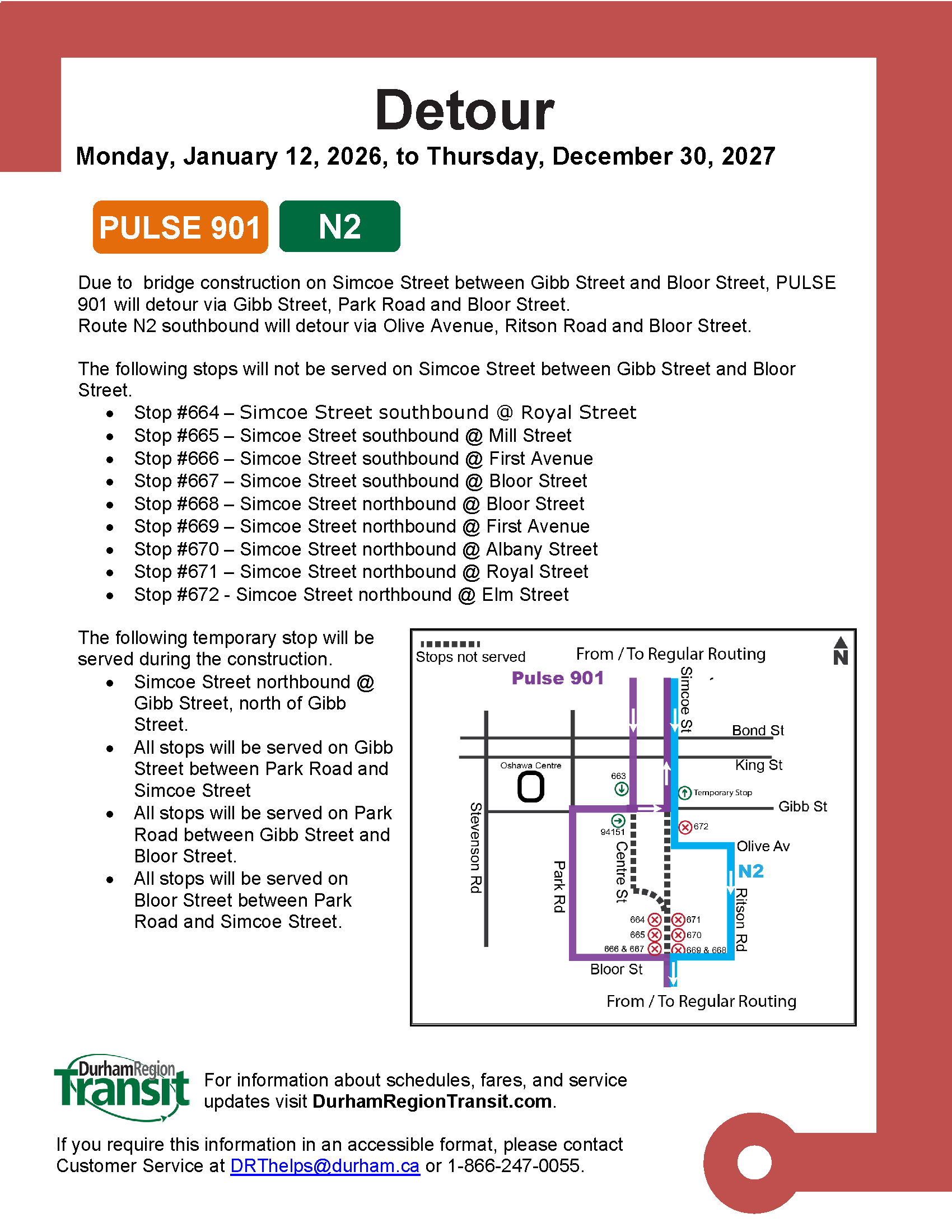
    Due to  bridge construction on Simcoe Street between Gibb Street and Bloor Street, PULSE 901 will detour via Gibb Street, Park Road and Bloor Street.

    Route N2 southbound will detour via Olive Avenue, Ritson Road and Bloor Street.

     The following stops will not be served on Simcoe Street between Gibb Street and Bloor Street.

    • Stop #664 – Simcoe Street southbound @ Royal Street
    • Stop #665 – Simcoe Street southbound @ Mill Street
    • Stop #666 – Simcoe Street southbound @ First Avenue
    • Stop #667 – Simcoe Street southbound @ Bloor Street
    • Stop #668 – Simcoe Street northbound @ Bloor Street
    • Stop #669 – Simcoe Street northbound @ First Avenue
    • Stop #670 – Simcoe Street northbound @ Albany Street
    • Stop #671 – Simcoe Street northbound @ Royal Street
    • Stop #672 – Simcoe Street northbound @ Elm Street

     The following temporary stop will be served during the construction.

    • Simcoe Street northbound @ Gibb Street, north of Gibb Street.
    • All stops will be served on Gibb Street between Park Road and Simcoe Street
    • All stops will be served on Park Road between Gibb Street and Bloor Street.
    • All stops will be served on Bloor Street between Park Road and Simcoe Street.


    Continue Reading