Category: 3. Business

  • MHI Group to Accelerate Development of Digital Talent– Achieving Value Creation and High Profitability Through AI and Digital Utilization —

    MHI Group to Accelerate Development of Digital Talent– Achieving Value Creation and High Profitability Through AI and Digital Utilization —

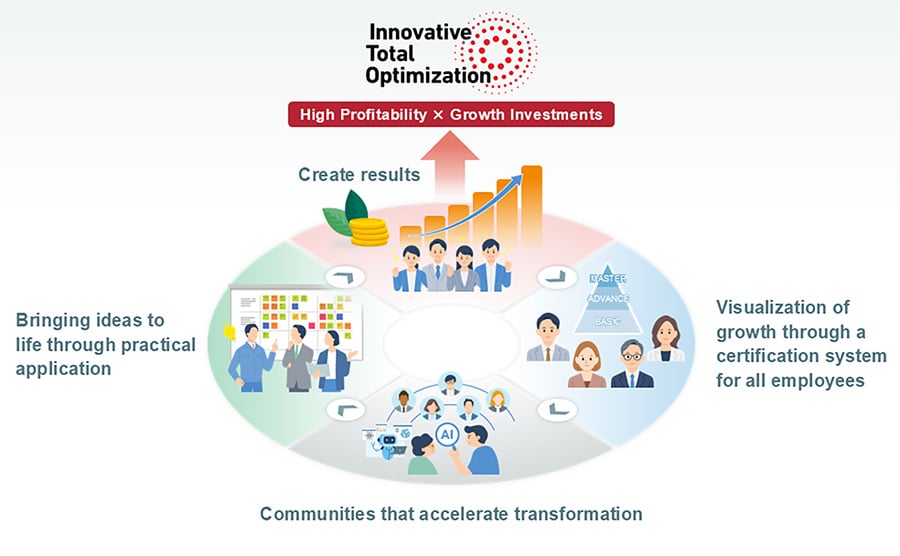
    Tokyo, December 22, 2025 – Mitsubishi Heavy Industries (MHI) Group has set the corporate strategy of Innovative Total Optimization (ITO), which consists of two pillars: “Group-wide optimization” and “scope expansion,” aimed at achieving a “virtuous cycle of high profitability and growth investments.” (Note1) To realize this, MHI Group is accelerating the development of digital innovation (DI) talent to drive its digital transformation (DX).

    From DI Talent Development to Result Creation Cycle

    DI development program for all employees
    MHI Group comprises approximately 300 companies in Japan and overseas, encompassing a wide range of businesses from design, manufacturing, and construction, to sales, after-sales service, and general services. For such diverse businesses to grow sustainably, it is essential for MHI to strengthen its competitiveness by utilizing AI and other digital technologies.

    Accordingly, MHI Group is implementing a systematic program for DI talent development encompassing all employees at group companies in Japan and overseas, from general employees to senior executives. Furthermore, MHI is actively promoting open innovation by collaborating with external partners and startups to incorporate the world’s leading-edge technologies and expertise. These initiatives will facilitate the formation of a global talent network and contribute to the development of highly skilled personnel.

    Developing DI-Proficient Personnel

    Tiered certification system to visualize growth
    To put this into practice, MHI has established the DI talent Certification System. Based on the Digital Skill Standards established by Japan’s Ministry of Economy, Trade and Industry (METI), MHI regularly updates the corporate group’s own human resource model to keep pace with the rapid advancements in digital technology and ensure that it always reflects the latest requirements.

    There are three levels of certification: Basic, Advanced, and Master. The levels reflect a comprehensive evaluation of each employee’s record of training programs completed, status of qualifications, and project experience. In particular, the Master certification is awarded only after a rigorous review by evaluators established by the Digital Innovation Headquarters.(Note2)

    Communities that accelerate transformation
    To accelerate DX promotion, MHI has developed communities where employees share knowledge on AI and digital utilization. Specifically, the “Global IT Conference” promotes the use of AI and digital technologies in cooperation with overseas sites; the “AI Salon” holds monthly lectures by experts on AI utilization; and an idea contest gathers innovative business improvement ideas and implements outstanding proposals. As a result, AI and digital utilization are penetrating throughout the company, generating improvement ideas from all business locations.

    Putting ideas into practice
    Through these community activities, initiatives where employees independently identify issues and shape solutions using digital technologies are expanding. Employees take the lead and work in collaboration with digital specialist organizations to implement an integrated process from problem identification to use case creation, system implementation, and effectiveness verification. Through practice, employees refine their skills and mindset, producing tangible results such as improved operational efficiency and the creation of new business models.

    MHI Group is accelerating digital talent development for all employees and building a virtuous cycle of DX promotion and value creation through the certification system, education, communities, and practice. Looking ahead, the company aims for the developed DI talent to become the core of DX promotion across the group, driving new value creation and business transformation.

    • 1 Based on MHI Group’s corporate mission of “Combine cutting-edge technology with many years of expertise to provide solutions to the evolving challenges facing the world while enriching people’s lives.”
    • 2 MHI Group established the Digital Innovation Headquarters to further accelerate digital innovation to create and provide new value through “smart connections” among its product groups and digital technologies. For more information, see the following press release.
      https://www.mhi.com/news/22062001.html


    Related Information

    Continue Reading

  • Joint initiative safeguards pharmacies following ADHD medicine price change

    Joint initiative safeguards pharmacies following ADHD medicine price change

    Under the agreed rebate arrangements, pharmacies can claim reimbursement for eligible Vyvanse® stock held prior to the price change, with claims processed through their preferred CSO-accredited wholesaler.

    The approach will ensure continuity of patient care while recognising the vital role wholesalers play in Australia’s medicines supply chain.

    Pharmacies are advised to contact their preferred wholesaler by 31 December 2025 to confirm stock on hand as of 30 November 2025 for rebate eligibility.

    The Guild’s Health Economics and Policy Committee Chair, Anthony Tassone said the outcome reflected constructive engagement focused on fairness and sustainability.

    “The Guild appreciates Takeda’s willingness to work with us and acknowledge the real-world impact PBS price reductions can have on pharmacies, particularly when stock is held in good faith to support patients during ongoing ADHD medicine shortages,” Mr Tassone said.

    Takeda General Manager for Australia and New Zealand, Dave Peace, reaffirmed the company’s commitment to supporting community pharmacy.

    “Takeda values the critical role community pharmacists play in patient care. We recognise concerns raised following the 1 December list price change for Vyvanse® (lisdexamfetamine dimesilate) and are committed to ensuring pharmacies are not out of pocket,” Mr Peace said.

    Tassone continued, “We’ve seen great support from Takeda in addressing this issue for community pharmacies across the country and we welcome continued collaboration with manufacturers and wholesalers to support patient access and pharmacy sustainability – this agreement sets a new standard going forward.

    “This situation was avoidable. We need better notice periods and better supply chain impact assessments for future PBS pricing changes and policy decisions – and we will continue to advocate for them.”

    Continue Reading

  • Batemans Bay childcare closed for three months due to serious health and safety concerns

    Batemans Bay childcare closed for three months due to serious health and safety concerns

    A Batemans Bay childcare centre has been forced to shut its doors until March after the NSW regulator found there were serious concerns for children’s health, safety and wellbeing.

    In an email seen by the ABC, the NSW Early Learning Commission contacted families on December 17 to let them know that the service approval for Surfside Kidz had been immediately suspended as part of an ongoing investigation.

    On its website, Surfside Kidz is described as a licensed 46-place early learning centre that is a “welcoming and inclusive space” for children aged six weeks to six years.

    In the email, the regulator said there was no current evidence of specific incidents that had caused children direct harm, but that there were “immediate concerns” about the level of risk that children were exposed to. 

    These concerns include poor supervision and staffing, maintenance issues and poor cleanliness.

    “Based on the evidence available to us, we consider our decision to be appropriate and proportionate,” the regulator wrote.

    Surfside Kidz is one of five regional childcare centres operated by Kidz Childcare Group. (ABC South East NSW: Toby Hemmings)

    Surfside Kidz is one of five childcare centres listed as part of the Kidz Childcare Group, with other centres in Nowra, Singleton and Orange.

    In May this year, Surfside Kidz was issued a compliance notice by the regulator due to failing to display prescribed information, failing to notify the regulator of certain circumstances and operating without a nominated supervisor. 

    Surfside Kidz and Kidz Childcare Group did not respond to multiple requests for comment.

    Christmas cancelled at centre

    A local mother, who wished to remain anonymous, was getting ready for her three-year-old daughter’s Christmas party at the childcare centre the next day when the email landed in her inbox. 

    “Santa was arranged to come, so that’s why it felt so out of the blue,” she said.

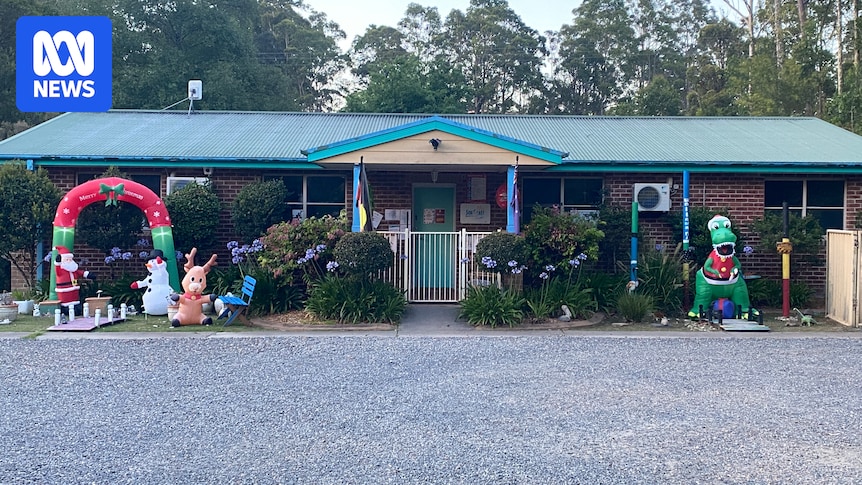
    A red brick house with blue roof and Christmas decorations, blown up santa, snowman and a red and green arch.

    Christmas decorations were left up outside the closed childcare centre. (ABC South East NSW: Toby Hemmings)

    The seriousness of the email left her feeling shaken and like she was a “terrible parent”.

    “You get mum guilt at the best of times, but this felt like we’d put our children at risk without actually being informed by the centre,”

    she said.

    No response from management

    The local mother said the lack of response from centre management, other than one “very blunt message”, had left her feeling “shocked and disgusted.”

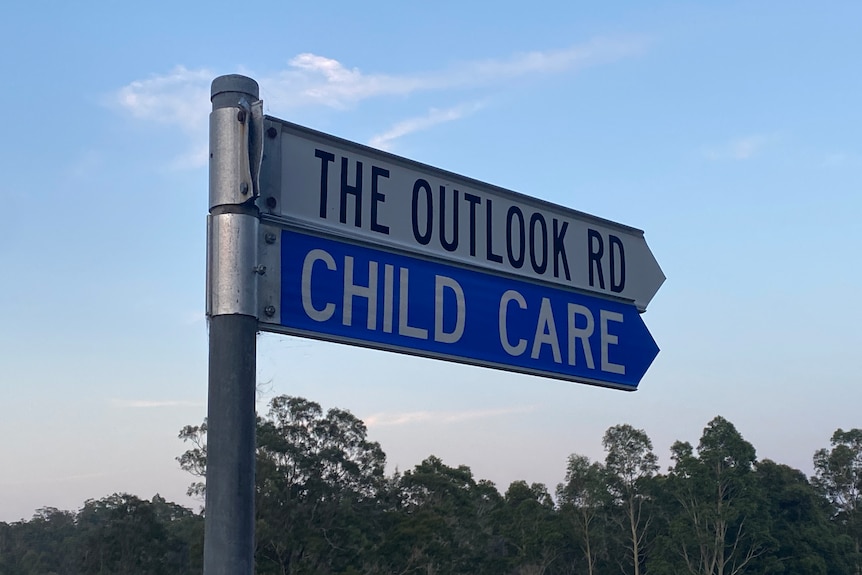
    A road sign with to signposts, the outlook road and childcare.

    Parents and caregivers have been asked to find alternative care arrangements. (ABC South East NSW: Toby Hemmings)

    “There’s been no communication,” she said.

    Because her daughter only spends two days a week at Surfside Kidz, the mother has been able to arrange additional days at her daughter’s other childcare provider.

    “A lot of working parents wouldn’t be in my position,” she said. 

    In a statement, a spokesperson for the NSW Early Learning Commission said they understood the impact service closures had on families.

    “However, the safety of children is paramount and we will not compromise on this,”

    they said.

    While she would not be sending her daughter back to Surfside Kidz, the local mother still wanted an explanation from the centre.

    “Just tell us what the issue is so we can sleep easy,” she said.

    Continue Reading

  • 3rd Quarter of FY March 2026 Performance Briefing

    3rd Quarter of FY March 2026 Performance Briefing

    [ Cautionary Statements with Respect of Forward-Looking Statements ]

    This material contains forward-looking statements, including projections, plans, policies, management strategies, targets, schedules, understandings and evaluations, about TDK or its group companies (TDK Group). These forward-looking statements are based on the current forecasts, estimates, assumptions, plans, beliefs and evaluations of TDK Group in light of information currently available to it, and contain known and unknown risks, uncertainties and other factors. TDK Group therefore wishes to caution readers that, being subject to risks, uncertainties and other factors, TDK Group’s actual results, performance, achievements or financial position could be materially different from any future results, performance, achievements or financial position expressed or implied by these forward-looking statements, and TDK Group undertakes no obligation to publicly update or revise any forward-looking statements after the issue of this material except as provided for in applicable laws and ordinances.

    The electronics markets in which TDK Group operates are highly susceptible to rapid changes. Risks, uncertainties and other factors that can have significant effects on TDK Group include, but are not limited to, shifts in technology, fluctuations in demand, prices, interest and foreign exchange rates, and changes in economic environments, conditions of competition, laws and regulations.

    Continue Reading

  • JGBs Fall Amid Japan’s Fiscal Policy Risks – The Wall Street Journal

    1. JGBs Fall Amid Japan’s Fiscal Policy Risks  The Wall Street Journal
    2. Japan’s Yen Debasement  Robin J Brooks | Substack
    3. Bank of Japan raises rates to 30-year high, signals more hikes  Reuters
    4. Nikkei gains, JGB futures rise ahead of expected BoJ rate hike  Business Recorder
    5. Bitcoin (BTC) Rebounds as BoJ Calms Yen Fears Despite ETF Outflows  FXEmpire

    Continue Reading

  • ATO clarifies GST position on key issues in power industry – Technical update

    The Australian Taxation Office (ATO) has released updated web guidance addressing the GST treatment of several key arrangements commonly encountered in the energy sector. The new guidance, released in December 2025, addresses three areas that have been the subject of ongoing industry enquiry and ATO compliance activity.

    • Bundled Power Purchase Agreements (BPPAs); 
    • Connection services – Gifted Assets; and
    • Connection services – Agency arrangements (including Div 153-B).

    Below, we summarise the key aspects of the new guidance and outline the practical implications for industry participants.

    Commissioner’s View on GST treatment and attribution in BPPAs

    (see full details)

    Overview

    1. The ATO has published guidance on BPPAs, consistent with the position previously communicated with MinterEllison and covered in the website article New ATO position on Bundled Power Purchase Agreements.

    2. Specifically, the subset of power purchase agreements where a Generator ‘bundles’ the supply of green products (such as large-scale generation certificates) with the Contract for Difference (CfD), without receiving specific consideration for the green products in return.

    3. As a preliminary point, the ATO’s guidance is based on specific private rulings issued on particular BPPA arrangements. The ATO acknowledges that there may be other types of BPPAs where the consideration for the green products is not received upfront. If the analysis of the agreement indicates separate consideration is payable, other than the entry into the CfD for the green products, the attribution of the GST payable on the supply of the green products may be different to what is described below.  The guidance requests that taxpayers further engage with the ATO on variations to BPPA arrangements.

    4. The Commissioner’s position on the GST treatment of these standard BPPA arrangements can be summarised as follows:

    Nature of the supplies

    5. Under the BPPAs considered by the ATO, the:

    a. Generator supplies:

    i. a derivative when entering into the CfD; and

    ii. green products (in return for non-monetary consideration from the Off-taker, being their entry into the CfD).

    b. Off-taker supplies a corresponding derivative when they enter into the CfD.

    6. The ATO considers the supply of the CfD is a derivative, and therefore an input-taxed financial supply, whilst the supply of green products is a taxable supply (where the Generator and Off-taker are located in Australia).

    Attribution of GST

    7. The attribution of the GST payable on the Generator’s taxable supply of green products is triggered in full, upfront, when the non-monetary consideration is received (being the initial entry into the CfD by the Off-taker).

    8. Practically speaking, this means the Generator should issue a single tax invoice for the supply of all the green products expected to be transferred over the life of the BPPA upfront, and not include a GST component in any further invoices for either the CfD payments or the actual transfer of green products each month/period.

    Valuation considerations

    9. Valuing the CfD non-monetary consideration may be difficult. The ATO notes that you may choose to value the green products instead, although this may also be difficult given the quantum to be supplied over the contract period is unknown. When the parties are unrelated, the Generator may use a reasonable method that is agreed to with the Off-taker in determining the GST-inclusive market value of the green products, including valuation methodologies that are consistent with professional guidelines.

    Limitations on claiming input tax credits under BPPAs

    10. The ATO notes that an Off-taker generally has only 4 years after attribution to claim back any GST (as an input tax credit) on the supply of green products under the BPPA. This means that input tax credits may not be available for green products acquired more than 4 years after the BPPA was executed.

    Recommendation

    11. We recommend reviewing the GST treatment of any existing BPPA arrangements to ensure consistency with the ATO’s new guidance, and to confirm that the 4-year limitation period for claiming input tax credits will not adversely affect your position.

    Connection Services – Gifted assets

    (see full details)

    Overview

    12. The ATO has also published guidance on how GST applies to electricity connection services, with the aim of clarifying common misunderstandings observed during justified trust reviews.

    13. In the course of providing electricity distribution services, Distributors are required to connect new Customers to the electricity network upon request from a Customer. For business Customers, there can be significant construction work required in order to connect the Customer’s business premises to the Distributor’s electricity grid network. While there are certain connection works that are required to be carried out by the Distributor for safety purposes, other works can be carried out / arranged by either the Distributor or the Customer, at the Customer’s discretion.

    14. If the Customer chooses to arrange construction of the asset by a third party, notwithstanding that the Customer has incurred the cost for the construction of the relevant electricity assets required for the connection, the ownership of those assets is generally required by the relevant jurisdiction’s regulatory framework to be “gifted” to the Distributor for the purposes of safety and good asset management.

    Implications for Distributors

    15. Distributor may be liable for additional GST where they receive gifted assets from a Customer (in additional to monetary connection fees). The tax invoice issued by the Distributor should reflect both the monetary and non-monetary consideration (the gifted assets) received for the connection services.

    Implications for Customers

    16. GST-registered Customers may be liable for GST when they transfer gifted assets to a Distributor. The Distributor may request a tax invoice for the supply of the gifted assets made to them. The consideration for this supply will be the GST-inclusive value of the portion of the connection services for which no monetary consideration was provided.

    Recommendation

    17. Parties who transfer or receive gifted assets should ensure that GST has been properly accounted for on these transactions.

    Connection Services – Agency arrangements

    (see full details)

    Overview

    18. In most Australian jurisdictions, regulations ensure that electricity Customers have a contract governing a Distributor’s supply of network connection services with the relevant Distributor. These typically take the form of “deemed’ contract which automatically arise by law when a Customer takes a supply of electricity. These are in addition to the contracts entered by Customers with their nominated electricity Retailer.  Retailers often collect the connection services charges from the Customers on the Distributor’s behalf, as they have an existing billing arrangement with Customers.

    19. From a GST perspective, the connection service is a supply made by the Distributor to the Customer – the Retailer is not making this supply, and is not liable for the associated GST. Rather, any GST included by the Retailer on their invoice to the Customer for the connection services should be passed on to the Distributor, and reported by the Distributor on their BAS.

    20. Noting the administrative difficulties in implementing this in practice, subdivision 153-B of the GST Act can simplify the GST obligations for the Distributor and Retailer by allowing them to enter into an arrangement where the Distributor is treated as if they had made a supply of connection services to the Retailer, and the Retailer is treated as if they have made a supply of connection services to the Customer.

    Recommendation

    21. Distributors and Retailers seeking to rely on subdivision 153-B should ensure that a written agreement is in place to support the arrangement.


    If you have any questions about how this new ATO guidance may affect your business, or require assistance reviewing your existing arrangements, please contact a member of our Energy or Tax team.

    Continue Reading

  • ‘Doppelgänger’ economies don’t capture Brexit reality

    ‘Doppelgänger’ economies don’t capture Brexit reality

    Martin Wolf (“How to get the UK out of its economic hole”, Opinion, November 24) quotes a recent US National Bureau of Economic Research working paper in support of his view that Brexit damaged the economy. Yet he and it miss the whole point of Brexit which was to restore full UK self-government after 40-odd years of EU trade protectionism and over-prescriptive regulation.

    This would obviously cause short-term disruption as the NBER authors’ business panel of companies confirms. If you examine UK data behaviour from 2016, evidence of this disruption is predictably found linked to the dates of the Brexit referendum and final EU-departure. The evidence also suggests it has steadily disappeared, as one would expect — see my Journal of Forecasting piece in February 2024; and on the trade issue, National Institute of Economic and Social Research authors in winter 2022.

    The use of a variety of comparator country-groups or “doppelgängers” to compare UK performance over the past decade on GDP per capita etc is invalid as a way of linking the UK’s supposed weak performance to Brexit. The comparison is primarily the effect of combining a bizarre group of countries such that its average performance happened to be close to the UK’s before 2016, but most of which have no basic similarity to the UK economically (Estonia and Greece for example). As the UK’s relative behaviour since 2016 could be due to numerous differential factors at work both here and elsewhere, there is simply no identifying link to Brexit.

    The UK has performed quite similarly to truly similar economies like France and Germany since Brexit, as noted by Julian Jessop in a recent Substack piece and in his letter to the FT on December 3 (“Analysis that Brexit was a disaster fails the smell test”).

    So swapping countries on this method can give you virtually any “Brexit effect” you want, revealing its identification failure. The UK is in fact sui generis and has to be explained by its own acts and shocks.

    Its growth slowed sharply after the 2008 financial crisis, well before Brexit. Poor UK policies from both Conservative and now Labour governments have failed to restore it to its previous trend of over 2 per cent.

    But these policies can be improved in the long term; that improvement can be boosted by moving more quickly on the path to free trade and pragmatic UK common law regulation, which Brexit has made possible.

    Patrick Minford
    Professor of Economics, Cardiff Business School, Cardiff University, Wales, UK

    Continue Reading

  • Whale oil or fossil fuels — both are catastrophes

    Whale oil or fossil fuels — both are catastrophes

    The comparison of whale oil use decline with today’s projected petroleum oil demand reductions, in Michael Haigh’s guest column, neglects to factor in the devastating effects and subsequent costs of unabated burning of hydrocarbons (“Whale oil’s slow decline carries lessons for today”, Markets Insight, December 12).

    Continuing the convenient use of whale oil to keep the parlour lamps lit reduced whale populations and perhaps altered ocean ecology. A bad outcome, but nothing like the catastrophes to come with another 50 years of burning.

    In that timeframe, the already frequently flooded city of Jakarta (the most populous settlement on the planet) must be either elevated or relocated.

    Where is that cost factored into this economic prediction?

    Thomas Paino
    Hudson (a former whale oil capital), NY, US

    Continue Reading

  • Substitutions approved for shortage of Catapres (clonidine) 150 mcg tablets

    Pharmaceutical company Clinect has told us that Catapres (clonidine) 150 microgram (mcg) tablets will be in shortage from December 2025 to April 2026 due to manufacturing issues.

    Catapres is the only brand of clonidine 150 mcg tablets supplied in Australia. However, we expect the following 3 brands of 100 mcg clonidine tablets to remain available during the shortage of Catapres 150 mcg tablets:

    • Catapres 100 mcg
    • APO Clonidine 100 mcg
    • Clonidine Lupin 100 mcg.

    To help patients have continuous access to the medicine, especially considering the holiday season, we have made a Serious Scarcity Substitution Instrument (SSSI) that starts on 22 December 2025 and ends on 28 April 2026. The SSSI allows a pharmacist to dispense an equivalent quantity of clonidine 100 mcg tablets, if appropriate, without a new prescription.

    Clonidine tablets are used for essential hypertension and renal hypertension. The 100 mcg tablets are also used for menopausal flushing and migraine prophylaxis. Clonidine is also used off-label for various conditions including attention deficit hyperactivity disorder (ADHD), chronic pain and cancer pain.

    For detailed information about the shortage, the SSSI and important factors when considering a substitution, visit About the shortage of Catapres (clonidine) 150 mcg tablets.

    For more information about SSSIs see Substituting scarce medicines and Serious Scarcity Substitution Instruments (SSSIs).

    Continue Reading

  • Government confirms plans for gas reservation on east coast

    Government confirms plans for gas reservation on east coast

    Gas producers on Australia’s east coast will have to reserve a portion for domestic use to shore up supply and put “downward pressure” on prices, the federal government has confirmed.

    The long-awaited move was signed off by cabinet in Canberra on Monday and will now be subject to a period of consultation.

    After much deliberation about the best model for a reservation scheme, Energy Minister Chris Bowen and Industry Minister Tim Ayres said cabinet had settled on a permit scheme.

    That would see exports limited until producers ensured that between 15 and 25 per cent of extracted gas was reserved for local use.

    Mr Bowen said the scheme would start operating in 2027 but would apply to any new contracts entered into from today.

    “Most Australians think that Australians should have first rights to what’s under Australian soil … and Australians are right about that,” Mr Bowen said.

    Loading

    Continue Reading