Category: 3. Business

  • 50 years of innovation in composites

    50 years of innovation in composites

    “For five decades, CCM has not only advanced research but also trained generations of engineers who now lead in industry, government and academia,” added Suresh Advani, the Unidel Pierre S. du Pont Chair of Engineering and former associate director of CCM. “That combination of research excellence and workforce development sets us apart.”

    CCM’s reputation for excellence is built on decades of discoveries that have improved how composites are designed and manufactured.

    Improving processes

    Composites are typically made by placing strong fibers into a mold and adding resin, which quickly gels and hardens to lock everything into shape. But if the fibers are not fully coated with resin, the material develops weak spots and cannot be used.

    CCM researchers developed a computer simulation that maps where resin travels inside a closed mold containing dry fibers, helping manufacturers avoid dry spots and voids. Airbus and Boeing have applied the technology to make composite aircraft parts, and it can be adapted for many other uses.

    Promoting sustainability

    Many composites rely on nonrenewable resources, such as petroleum-based resins, and energy-intensive manufacturing processes. CCM has long pursued greener alternatives.

    In the 1990s, the late Richard Wool, former CCM Director, partnered with John Deere to produce a composite hay bailer door using a resin based on soybean oil, proving that it is possible to make durable, high-performance composites using plant oils. Wool went on to become a leader in developing strong, high-performance materials from renewable ingredients like vegetable oils, flax and chicken feathers, for which he was honored with a Presidential Green Chemistry Challenge Award in 2013. Producing these materials requires less water and energy and yields less hazardous waste than petroleum-based processes.

    That commitment to sustainable materials continues today. Pilla was honored with the 2021 Presidential Green Chemistry Challenge Award for developing the first nonisocyanate polyurethane foam, an innovation he achieved prior to joining UD. This foam replaces potentially cancer-causing diisocyanates with lignin, a natural polymer from pulp and paper waste, creating a recyclable, safer alternative.

    More recently, CCM collaborated with Clemson University and Honda to design and create a lightweight door for the Acura MDX. With funding from the Department of Energy (DOE), the researchers created a door from thermoplastic composites, which are light and environmentally friendly. Because they could not change the door’s size or shape, they combined the inner panel and trim into a single piece. The result was a door 45% lighter than steel and fully recyclable. It exceeded expectations in crash tests, though it is still years away from hitting the market. 

    Continue Reading

  • Recall of a batch of The Galway Kitchen Classic Houmous

    Recall of a batch of The Galway Kitchen Classic Houmous


    Recall of a batch of The Galway Kitchen Classic Houmous due to an incorrect use-by date


    Friday, 19 December 2025


    Alert Summary
    Category 1: For Action
    Alert Notification: 2025.72
    Product Identification: The Galway Kitchen Classic Houmous; pack size: 200g
    Batch Code Use-by 19/01/2026
    Country Of Origin: Ireland


    Message:
    The above batch of The Galway Kitchen Classic Houmous is being recalled due to an incorrect use-by date. If consumed after the 24th of December 2025, this may pose a microbiological risk which may make the batch unsafe to eat. Recall notices will be displayed at point-of-sale. 


    Action Required:

    Manufacturers, wholesalers, distributors, caterers & retailers:
    Retailers are requested to remove the implicated batch from sale and display recall notices at point-of-sale.

    Consumers:
    Consumers are advised not to eat the implicated batch after the 24th December 2025.


    Continue Reading

  • Goldman Sachs quietly revamps gold price target for 2026 – thestreet.com

    1. Goldman Sachs quietly revamps gold price target for 2026  thestreet.com
    2. Goldman sees gold at $4,900 by December 2026, projects oil price decline; copper remains favored industrial metal  Reuters
    3. GF Securities: Driven by the triple factors of macro narrative, fundamentals, and capital flow, gold remains bullish in the long term.  富途牛牛
    4. Has gold become a barometer of a global monetary earthquake?  نورنیوز
    5. Gold Prices Soar to Best Gains Since 1979: What Lies Ahead?  Analytics Insight

    Continue Reading

  • Smartphone And PC Prices Set To Surge As Memory Shortage Bites – Forbes

    1. Smartphone And PC Prices Set To Surge As Memory Shortage Bites  Forbes
    2. 2026 Smartphone Shipment Forecasts Revised Down as Memory Shortage Drives BoM Costs Up  Counterpoint Research
    3. RAM prices are out of control. When should Apple users start worrying?  Macworld
    4. Fears Kiwis may pay more for electronics as chip shortages loom  1News
    5. Smart devices may become pricier as AI demand grows  KNDU

    Continue Reading

  • US Department of Labor investigation finds California restaurant denied workers overtime, operated invalid tip pools

    US Department of Labor investigation finds California restaurant denied workers overtime, operated invalid tip pools

    Naya Ding Inc. to pay back wages, penalties

    ROWLAND HEIGHTS, CA – The U.S. Department of Labor has recovered $17,311 in back wages from a Rowland Heights restaurant for nine workers who were denied proper overtime and earned tips, in violation of federal wage laws.

    The department’s Wage and Hour Division found that Naya Ding Inc., operating as Ma’s Kitchen, ran an unlawful tip pool arrangement, directing supervisors to only distribute a portion of earned tips to servers. The owners of the restaurant retained a percentage of the tips. The employer also failed to pay some employees the full, time-and-one-half rate of pay for hours worked over 40 in a workweek, both violations of the Fair Labor Standards Act.

    The division also found Ma’s Kitchen failed to keep accurate time records and payroll records of tips and cash paid to employees, FLSA recordkeeping violations. The employer faces a $2,985 civil money penalty for the willful nature of the violations.

    “Burdening employees with business expenses takes hard-earned wages out of workers’ pockets,” said Wage and Hour Division Assistant District Director Rafael Valles in West Covina, California. “That’s why the U.S. Department of Labor is committed to ensuring employers pay workers their fully earned wages in compliance with federal law, and its Wage and Hour Division will use every enforcement tool necessary to resolve cases like this.”

    Employers and workers alike can contact the Wage and Hour Division with questions and requests for compliance assistance at its toll-free number, 1-866-4-US-WAGE (487-9243). Learn more about the Wage and Hour Division, including a fact sheet on Fair Labor Standards Act overtime requirements.

    Employers are encouraged to use the agency’s industry-specific compliance assistance toolkits to learn about their responsibilities under the laws enforced by the division. The agency’s PAID program offers employers an opportunity to self-report and resolve potential minimum wage and overtime violations under the Fair Labor Standards Act, as well as certain potential violations under the Family and Medical Leave Act.

    Workers and employers can also track hours worked and pay by downloading the department’s free timesheet app for iOS and Android devices.

    Continue Reading

  • Single currency: Council agrees position on the digital euro and on strengthening the role of cash – consilium.europa.eu

    1. Single currency: Council agrees position on the digital euro and on strengthening the role of cash  consilium.europa.eu
    2. ECB says digital euro is ready, urges EU to act  CoinDesk
    3. Two Sides of the Same Coin: ECB’s CBDC Initiatives and the Ambition for Autonomy and Influence  TRENDS Research & Advisory
    4. European Central Bank President: The Digital Euro has now become an immediate priority for both the Governing Council and the Parliament.  Bitget
    5. Lagarde comments at ECB press conference  StreetInsider

    Continue Reading

  • European Single Access Point (ESAP)

    Background

    Today’s public information on companies and financial products is scattered across many different places (e.g., issuer websites, national or EU public registers). With ESAP, all this information will be centrally accessible in one single place, searchable based on common criteria.

    The “ESAP Regulation” gave ESMA the mandate to establish and operate the EU’s public portal, providing easier access to all publicly available information. ESAP will give companies greater visibility towards investors, which is particularly important for small businesses in small capital markets to attract EU and international investment. ESAP will also contain sustainability-related information published by companies to support the objectives of the European Green Deal. 

    The ESAP is a two-tier system: information is first collected from reporting entities by a  “Collection Body” (which may be the NCA, another national body or register, or an EU body such as one of the ESAs) and then submitted to ESAP, so that the information can then be provided to the public on the ESMA-operated portal.

    Continue Reading

  • Europe’s next solid propellant rocket motor passes review

    Europe’s next solid propellant rocket motor passes review

    Enabling & Support

    19/12/2025
    892 views
    15 likes

    In brief

    • The P160C solid propellant rocket motor passed its ground qualification review
    • The upgraded rocket motor will increase performance and competitiveness for the Ariane and Vega rockets
    • Teams are working on the first four flight units and on industrial ramp-up production to 35 or more motors a year

    In-depth

    After firing up on ground at Europe’s Spaceport during a hot-fire test in April, the P160C solid propellant rocket motor has been thoroughly analysed, with a qualification review confirming its use for flight.

    This review concludes over three years of intense development work involving engineers in continental Europe and French Guiana.

    Europe’s largest solid-propellant rocket motors

    The P160C is an upgrade of the P120C motor developed jointly by ArianeGroup and Avio through their 50/50 joint-venture Europropulsion, and it is one of the world’s largest carbon-fibre one-piece solid-propellant rocket motors. The development programme is managed and funded by the European Space Agency.

    The P120C is currently used as a booster for the Ariane 6 rocket, and as the first stage for the Vega-C launcher. The upgraded P160C carries over 14 tonnes more solid fuel, increasing both rockets’ performance, increasing their payload capacity and competitiveness.

    “Passing the qualification review is always a huge milestone in space design: independent teams have assessed the data packages, analysed the technical files and confirmed our design is robust,” says Alessandro Ciucci, ESA’s Programme Manager for both P120C and P160C.”

    First flight and increased production

    Ariane 6 evolutions

    The first time P160C will be used is on Ariane 6, in a four-booster configuration providing the most powerful liftoff for Ariane 6 so far and scheduled for next year.  The first four P160C solid-propellant rocket motors will now be integrated into four Ariane 6 boosters, ready for its flight.

    Vega, Vega-C and Vega-E comparison

    Its debut on the Vega-C rocket is currently planned in 2028 with Space Rider.

    With more launches foreseen, the ramp-up of production is building up to an industrial capacity of making 35 or more of the solid-propellant rocket motors a year.

    P160C solid-propellant rocket motor test fire

    The P160C has three main components. The first is the composite structure, manufactured by Avio in Colleferro, near Rome in Italy, obtained by filament winding and automated layup of carbon and epoxy pre-preg fibres. The second is the nozzle manufactured by ArianeGroup at its Le Haillan site near Bordeaux in France. It is made of composites materials, allowing the motor’s extremely hot gases – 3000°C –to be ejected at very high speed providing thrust. The nozzle is gimballed to control the flight of the launcher. Propellant loading and final motor integration are carried out by Avio and ArianeGroup joint subsidiaries in French Guiana (Regulus and Europropulsion).

    The third element of P160C is the carbon-fibre composite igniter that ensures proper ignition of the motor. They are manufactured by Nammo in Raufoss, Norway, under Avio responsibility.

    P160C solid-propellant rocket motor rolls out to its test stand

    Continue Reading

  • – West of England Combined Authority

    – West of England Combined Authority

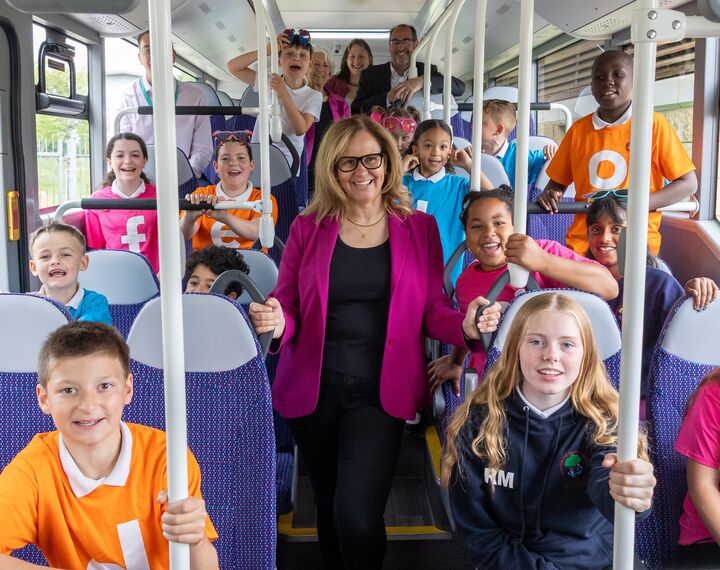
    From tomorrow, Saturday 20 December, Kids Go Free returns on the region’s buses.

    This week, Bristol-based celebrity chef and presenter Briony May Williams (2018 The Great British Bake Off semi-finalist and 2019 The Great Christmas Bake Off winner, Food Unwrapped and Escape to the Country presenter) joined the Mayor for a Love Actually inspired video on social media to promote the scheme.

    Around 150,000 kids in Bath & North East Somerset, Bristol, North Somerset, and South Gloucestershire aged from 5-15 years old can benefit from free bus travel again this winter – just by hopping on board, with no bus pass or registration required. The return of the popular initiative, which runs from 20 December to 4 January, was announced earlier this month by regional political and tourism leaders at Bath’s world-famous Christmas Markets, which celebrate their 25th anniversary this year with more than 250 stalls.

    Over the seven weeks of the summer holidays, more than 910,000 free journeys saw almost £1 million was put back into the pockets of parents and carers through Kids Go Free. The top word used by people to describe the scheme was “money-saving”. Children’s journeys increased by 32% compared to 2024, with parents and carers across the region sharing how the scheme helped them do things they otherwise would not have been able to afford. For families usually unable to travel at all, this opened the door to the brilliant things that our region offers – in some cases for the first time ever.

    Local visitor attractions and retail centres saw an uplift in footfall during that time. Radstock (+16.1%), Bath (+15.8%) Midsomer Norton (+14.4%), Yate and Chipping Sodbury (+12.2%) saw the largest increases in spending, and all also performed above the UK-average for August. Bristol BID data shows that non-essential spend (entertainment, hospitality etc) increased by 3.5% (almost £100,000) year-on-year, above the national average; Visit West-surveyed attractions in the city enjoyed their busiest post-pandemic July and almost got back to their 2021 peak level for August.

    The return of Kids Go Free follows the publication of the region’s first child poverty action plan on Thursday (18 December). The Brigstow Institute at the University of Bristol and Room 13 Hareclive, who have long campaigned for free bus travel for children, are currently working with schools and youth groups, including in Hartcliffe and Barton Hill, to further understand the impact of Kids Go Free in more deprived communities. Short surveys are running over the festive period, for parents/carers, secondary-school-age, and primary-school-age children to share their experiences.

    Kids Go Free is being funded using some of the £13.5 million Bus Grant funding secured from the Department for Transport by the West of England Mayoral Combined Authority.

    Helen Godwin, Mayor of the West of England, said:

    Kids Go Free is back! After 910,000 free journeys for under-16s this summer, putting almost £1 million back in people’s pockets, the return of our regional initiative will spread some Christmas cheer and help families at what’s often an expensive time of year.

    “Working with local councils and bus operators, using devolved funding from government, we hope to see more children using the West’s buses once again – opening up more of our wonderful region for more of our young people.

    Transport Secretary Heidi Alexander said:

    I’m delighted to see the return of Kids Go Free across the West of England this Christmas, building on the huge success of the summer scheme which delivered hundreds of thousands of free journeys and saved families almost £1 million – all thanks to Government funding.

    “By making bus travel free for young people, we’re creating better-connected communities and supporting families with the cost of living. We’re not only easing the burden on households during an expensive time of year, but we’re also encouraging the next generation to use the bus.

    Councillor Kevin Guy, Deputy Mayor and Leader of Bath & North East Somerset Council, said:

    Kids Go Free has been a huge success here in Bath & North East Somerset and the wider region, helping families save money and making it easier for children and young people to get out and enjoy everything our area has to offer. Over the summer, we saw thousands of extra journeys on local buses, reducing car use and cutting emissions while supporting our high streets and attractions. This initiative demonstrates how sustainable travel can deliver real benefits for residents, businesses and the environment.

    Councillor Tony Dyer, Leader of Bristol City Council, said:

    I’m delighted to see the Kids Go Free initiative return in time for the winter break, especially after its hugely successful launch over the summer holidays.

    This scheme isn’t just about free travel; it’s about giving children and young people the freedom to discover more of their city and region over the busy festive season.

    We’re proud to work once again with the Mayoral Combined Authority and our regional partners to bring this programme to life and look forward to seeing children and families make the most of this fantastic offer.

    Councillor Mike Bell, Leader of North Somerset Council, said:

    We want to make it easier for families to choose the bus, especially at Christmas when the roads are busiest and budgets are tight. By offering free bus travel for children during the festive season, we’re helping families save money, reduce congestion, and enjoy a more relaxed, shared journey experience. I hope this encourages more people to give the bus a try this Christmas and discover how convenient it can be.

    Councillor Maggie Tyrrell, Leader of South Gloucestershire Council, said:

    We are delighted to see the Kids Go Free offer return for Christmas. The festive period can be an expensive time, so it’s great that this initiative can ease the pressure for families and help them enjoy all that the region has to offer. It also supports our shared ambition to make sustainable public transport accessible to everyone.

    Kathryn Davis, CEO of Visit West, said:

    We are delighted that the Kids Go Free offer will return for the festive season to enable local people to make the most of the exciting Christmas events and experiences taking place across the region. We encourage people to check out everything that’s happening at the Visit Bristol and Visit Bath social channels and websites to make the most of this special time of the year.

    Rob Pymm, Commercial Director of First Bus in the West of England, said:

    This is a brilliant way for under 16s to get around during the festive period, helping families to save money and build bus travel habits as we head into the new year.

    We’re delighted to be supporting the scheme again and look forward to welcoming everyone on board.

    Jason Freeman, Operations Manager Bristol, Bath & The West of England at the Big Lemon, said:

    The Big Lemon are very happy to support Mayor Helen Godwin in this initiative. It is important that young people are encouraged to make use of public transport.

    The Christmas offer runs on all registered commercial and supported bus services starting in Bath & North East Somerset, Bristol, North Somerset and South Gloucestershire, with limited exemptions set out on the Travelwest website – e.g. for airport services.

    Outside of the offer period, child fares in the West remain among the cheapest in country: capped at £1. Children under five years of age already travel for free on the majority of services in the West of England.

    Continue Reading

  • AMI-SeCo sets out 2030 roadmap to improve data flows in Europe’s financial markets

    AMI-SeCo sets out 2030 roadmap to improve data flows in Europe’s financial markets

    19 December 2025

    The Eurosystem’s Advisory Group on Market Infrastructures for Securities and Collateral (AMI-SeCo) has today published a collective 2030 roadmap to harmonise data and communication across Europe’s financial ecosystem. By migrating corporate events and triparty collateral management processes to ISO 20022 and the Single Collateral Management Rulebook for Europe, AMI-SeCo aims to reduce the current fragmentation and support more transparent, timely and automated information flows between issuers, central securities depositories (CSDs), triparty agents (TPAs) and market participants.

    The roadmap has been established to further automate the information flows among participants in the financial ecosystem and ensure that Europe makes a coordinated transition to the ISO 20022 standards. Once implemented, it will improve data transparency and accuracy, timeliness and process automation. Better information flows between issuers and investors will also support the savings and investment union.

    Implementation will take place over three phases:

    1. The CSDs and TPAs, as well as the Eurosystem and its counterparties, already started migrating after the Eurosystem Collateral Management System was launched in June 2025.

    2. By the end of 2028, participants will be able to leverage the new data and communication standards upon request.

    3. Full participant onboarding will take place towards the end of 2030.

    Throughout these phases, AMI-SeCo will collaborate with national and international stakeholders to ensure continuous alignment.

    AMI-SeCo is the Eurosystem’s advisory body through which the Eurosystem aims to support and catalyse post-trade market integration. It does so by creating and monitoring compliance with market standards and by publishing reports that provide input to EU lawmakers on matters pertinent to post-trade integration. This body is comprised of market participants in Europe (i.e. the European Economic Area, Switzerland and the United Kingdom).

    Continue Reading