Category: 3. Business

  • ST Engineering and Safran Forge Stronger Alliance for Integrated Defence Solutions

    ST Engineering and Safran Forge Stronger Alliance for Integrated Defence Solutions

    Singapore, 10 December 2025 – Safran Electronics & Defence and ST Engineering have expanded their global cooperation into the defence domain through the signing of a Memorandum of Understanding (MOU). With the growth in the global defence market, the MOU will strengthen both partners’ cooperation across several areas including joint business development, technology integration, lifecycle support and sustainment services in order to meet customers’ operational requirements. This expanded partnership brings together complementary capabilities to deliver integrated and mission-critical solutions in the land, air, sea and space domains in Asia Pacific and worldwide. 

    A key focus will be the integration of Safran’s core expertise in optronics, avionics and PNT (Positioning, Navigation and Timing) electronics with ST Engineering’s domain expertise in integrated defence solutions to deliver high-performance solutions that address the global demand for technology-driven defence modernisation.

    “As ST Engineering grows its international defence business, strengthening partnerships with international counterparts is aligned with our commitment to deliver advanced, mission-ready solutions to our customers. Such partnerships reinforce our position as a trusted partner of choice in the global defence industry. This MOU with Safran builds upon the strength of our existing collaboration and leverages the complementary technical expertise that both sides will bring to drive innovation and excellence across multiple domains,” said Mervyn Tan, President, Defence & Public Security, ST Engineering. 

    “ST Engineering and Safran Electronics & Defense have established a robust and reliable partnership in the worldwide aviation market. This MOU marks a significant expansion of this collaboration into the defence sector, demonstrating our strong commitment to mutual growth in this field . By combining our technological and industrial capabilities, we will jointly enhance innovation, operational readiness and lifecycle support thereby creating greater value and long-term capability for our customers,” said Alexandre Ziegler, Head of Defence Global Business Unit, Safran Electronics & Defense.

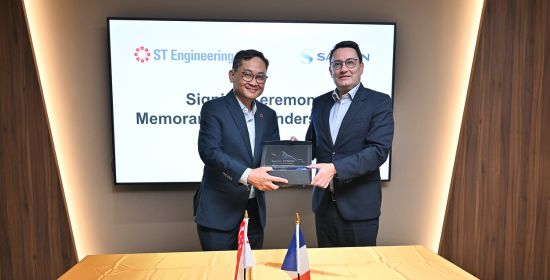
    Annex: Photo of the MOU Signing Ceremony

    Mervyn Tan, President, Defence & Public Security, ST Engineering (left) and Alexandre Ziegler, Executive Vice President, GBU Defense, Safran Electronics & Defense (right) marking the completion of the MOU signing with the presentation of a commemorative plaque.

    *****

    For media enquiries, please contact news@stengg.com.


    Continue Reading

  • India orders IndiGo to cut 10% of flights as airline says operations ‘normalised’

    India orders IndiGo to cut 10% of flights as airline says operations ‘normalised’

    India’s largest airline, IndiGo, says it has “normalised” operations after cancelling more than 3,000 flights last week due to what officials described as poor pilot roster planning, a crisis that left thousands of passengers stranded.

    This came as authorities ordered IndiGo to cut 10% of its winter schedule – double the reduction first announced – a move that could see more than 200 daily flights cancelled.

    Federal Aviation Minister Ram Mohan Naidu said the ministry “considers it necessary to curtail the overall IndiGo routes” to help restore stability.

    He added that despite the 10% cut, “IndiGo will continue to cover all its destinations as before”.

    The airline has also been ordered to submit its revised flight schedule to the regulator by Wednesday.

    IndiGo operates over 2,200 flights daily and controls more than 60% of India’s domestic market.

    Aviation analysts told the BBC slashing 10% of IndiGo’s daily capacity may worsen India’s aviation crisis in the weeks to come, as other airlines like Air India or SpiceJet do not have spare capacity.

    “The government’s move may benefit passengers in the long term but for now they might have to pay more,” Sanat Kaul, an analyst, told the BBC.

    India’s aviation ministry summoned IndiGo CEO Peter Elbers on Tuesday to explain how the airline was addressing the crisis and handling passenger complaints.

    In a video note posted on X on Tuesday, Mr Elbers said that the airline has “fully stabilised” its operations.

    IndiGo’s shares have lost 15% since 1 December as investors fear rising costs from operational disruptions and higher crew expenses under the new rules.

    Aviation Analyst Mark Martin said he expects IndiGo to face “more penalties for its actions” in the days ahead.

    The carrier has been instructed to cap fares, expedite refunds and quicken baggage handover to affected customers.

    Follow BBC News India on Instagram, YouTube, X and Facebook.


    Continue Reading

  • Oil-rich UAE turns to AI to grease economy

    Oil-rich UAE turns to AI to grease economy

    The UAE is hoping that AI can help fill the gap when oil demand inevitably wanes (Giuseppe CACACE)

    Deep in the Abu Dhabi desert, a vast AI campus a quarter the size of Paris is starting to emerge, the oil-rich UAE’s boldest bet yet on technology it hopes will help transform its economy.

    Towering cranes clank as long, low buildings take shape below, the eventual home of data centres powered by five gigawatts of electricity — the biggest such facility outside the United States.

    The campus will provide storage and computing capacity over a 3,200-kilometre (1990-mile) radius covering up to four billion people, said Johan Nilerud, chief strategy officer of Khazna Data Centers, a subsidiary of Emirati AI giant G42, which is spearheading the project.

    Since the 1960s, oil has fuelled the United Arab Emirates’ rise from a desert outpost of nomadic tribes to a Middle East economic and diplomatic powerhouse.

    Now, the UAE is hoping that AI can help fill the gap when oil demand inevitably wanes.

    “The UAE is punching above its weight because it’s a very small country that really wants to be at the forefront,” said Nilerud.

    “The idea is obviously to bring in international partners… to be this AI-native nation,” he added.

    Phase one of the AI campus — the G42-built, one-gigawatt Stargate UAE cluster — will be operated by OpenAI and is backed by other US tech giants such as Oracle, Cisco and Nvidia.

    And last month, Microsoft announced more than $15.2 billion in investments in the UAE by 2029, after injecting $1.5 billion last year into G42.

    – Core subject –

    The UAE has been betting heavily on AI since 2017, when it named the world’s first AI minister and became the second country after Canada to unveil a national AI strategy.

    A year later, G42 was founded with backing from Abu Dhabi-based sovereign wealth fund Mubadala. Chaired by the UAE president’s brother, Sheikh Tahnoon bin Zayed Al Nahyan, it offers a range of AI products and employs more than 23,000 people.

    The UAE said it has pumped more than $147 billion into AI since 2024, including up to 50 billion euros ($58 billion) in a one-gigawatt AI data centre in France.

    “AI, like oil, is a transversal sector, which can potentially have a leverage effect and an impact on different activities,” said professor Jean-Francois Gagne of the University of Montreal.

    In 2019, Abu Dhabi opened Mohamed bin Zayed University of Artificial Intelligence (MBZUAI), the world’s first AI-dedicated university. Last August, AI became a core subject in the country’s public schools from kindergarten up.

    MBZUAI and Abu Dhabi’s Technology Innovation Institute (TII) have since launched generative AI models including Falcon, which compared favourably with industry leaders and now has an Arabic version.

    Keen to cut reliance on imported hardware and expertise, the UAE has made large investments in research, development and homegrown programmes.

    TII opened a research lab with Nvidia to “push the boundaries” of generative AI models and develop robotics systems, said CEO Najwa Aaraj.

    “Sovereignty and self-sustainability and domestic customisation of technology to local needs are all very, very important,” Eric Xing, president of MBZUAI, told AFP.

    “And also difficult to achieve if you solely rely on importing and external… technical transfer.”

    – Chips ahoy –

    In the race for AI market share, the UAE is in the chasing pack behind the US and China, the clear leaders. But the small, desert country has its advantages, chiefly money and energy.

    With oil, gas and year-round sun for solar power, it can quickly build electricity stations to feed data centres — a major obstacle elsewhere.

    Deep pockets and unquestioned royal rule give it the freedom to plough billions into AI development and infrastructure.

    And as the region’s business hub, with a population that is nearly 90 percent expatriate, the UAE has the edge on neighbour and AI rival Saudi Arabia in attracting talent.

    All the while, the UAE has engaged in a balancing act between the US and China as it seeks imports vital for AI, including the specialist chips that make data centres work.

    Last month, intense lobbying bore fruit when the US approved the export of advanced Nvidia chips to both the UAE and Saudi Arabia.

    “They (UAE) clearly don’t want to be dependent on China, but that doesn’t mean they want to depend on the US either,” said Gagne.

    But despite its progress and years of heavy investment, success in this complex, ever-changing sector is far from guaranteed.

    “Right now, we don’t know what the right strategy is, or who the good players are,” Gagne said.

    “Everyone is betting on different players, but some will lose and some will win.”

    saa/th/aya/smw

    Continue Reading

  • EU to fast-track power grids projects in race to curb energy prices – Reuters

    1. EU to fast-track power grids projects in race to curb energy prices  Reuters
    2. EU will step in to unblock power grid bottlenecks, draft shows  Reuters
    3. Commission to unveil €1.2tr plan to revamp EU power grid, leak shows  Euronews.com
    4. How Brussels hopes to fast-track eight ‘urgent’ energy projects  Euractiv
    5. Money on the line: scaling electricity interconnection for Europe’s energy future  ember-energy.org

    Continue Reading

  • Private equity may regret inviting in mom and dad

    Private equity may regret inviting in mom and dad

    Ludovic Phalippou is professor of financial economics at the University of Oxford’s Saïd Business School. William Magnuson is a law professor at Texas A&M University.

    In August, a White House executive order quietly triggered a major shift in US financial markets. It called on agencies to “democratise” access to private equity, private credit and digital assets (including Bitcoin) for 401(k) retirement savers.

    While barely registering in the broader news cycle, this marks a significant departure from long-standing regulatory practice and accelerates a trend more than a decade in the making: the migration of private equity from institutional capital pools into the savings of everyday investors. Moreover, it could come back to bite the industry that lobbied for it.

    For nearly a century, securities regulation rested on a clear divide. Public companies, because they raise money from ordinary people, must follow strict disclosure, reporting and governance rules. Private companies, which raise money only from institutions and wealthy individuals, operate under far lighter oversight. And private equity has flourished on the light touch regulatory side of the divide. It could use valuation methods, fee practices and contractual structures that would be difficult to defend in public markets, because its investors were assumed to be sophisticated and legally equipped to protect themselves.

    Once retail investors enter the picture, that assumption becomes untenable. And with it, the legal equilibrium the industry has relied on begins to unravel.

    A shift with legal consequences

    As private equity expands from institutional clients to household savers, it enters a fundamentally different legal environment. Institutional investors routinely tolerate problematic practices because open disputes can jeopardise access to future funds, strain professional relationships or undermine career aspirations. Retail investors face none of these pressures. They have no reason to resolve concerns quietly and no commercial interest in preserving relationships with fund managers. When they believe they were not adequately informed, they are far more willing to pursue formal claims.

    The tobacco cases from the 1990s revealed something important: even when risks are widely known by experts, courts may still conclude that consumers are not properly informed about them.

    Against that backdrop, the retailisation of private equity stands out. Investors are being shown performance numbers that do not behave like returns, fee structures whose economic impact is far larger than the headline figures suggest and liquidity provisions that function very differently from how they sound. Class actions have been rare in private markets, but the gap between representation and reality here is large enough that a tobacco-style challenge is no longer far-fetched.

    Performance metrics that do not behave as advertised

    The internal rate of return, or IRR, dominates private equity performance reporting. It is almost universally read as an annual rate of return, yet it is nothing of the kind. IRR is simply the discount rate that makes a series of cash flows sum to zero; it says little about how an investor’s wealth actually accumulates over time.

    Worse, because IRR is highly sensitive to early cash flows, a fund can report a very high IRR even when long-run performance is modest. In addition, the IRR becomes almost immovable, giving the illusion of stable and high performance across business cycles.

    A plaintiff’s lawyer will have little difficulty arguing that presenting IRR as an annualised return metric is misleading to average investors. Courts have repeatedly held that disclosures must be judged from the standpoint of a reasonable investor. Once the investor base shifts, so does the legal standard.

    Valuations that shape fees, liquidity and outcomes

    Private equity valuations create similar vulnerabilities. Because portfolio companies are illiquid, managers set their own estimates of “fair value,” which in turn affect reported performance and the prices at which semi-liquid vehicles admit or redeem investors.

    An accounting quirk has long permitted funds to buy secondary stakes in PE funds at a discount to net asset value and then immediately mark them up to NAV, recording outsized gains. This is maybe understandable in a world of consenting institutional investing adults. But this game has recently moved to retail-oriented funds.

    Retail investors who transact at inflated prices are exposed to direct financial loss. When valuations diverge materially from observable market levels, the potential for litigation becomes difficult to ignore.

    Fees whose true magnitude is difficult to discern

    Fees present a similar problem. They are typically described to investors in the familiar shorthand of “two and twenty with an eight per cent hurdle.” But in most cases, there is also a provision known as a catch-up clause. Once returns exceed roughly ten per cent, the manager receives the same compensation as if the hurdle had been set at zero. In other words, a feature presented as investor protection often has little practical effect. This is only one example among many in which terms that appear straightforward can be deeply misleading. In an institutional setting, these conventions are likely to be understood; for retail investors, the odds are different.

    Liquidity aligns poorly with expectations

    Semi-liquid private equity products are frequently described in terms that resemble mutual funds. In practice, redemptions are often capped at low percentages of net asset value and remain subject to manager discretion. In times of financial stress, precisely when most investors are most likely to need their funds, they could face delays of five years or more to be able to withdraw their money.

    Nothing about this structure is inherently problematic for investors who understand it. But if savers are sold “semi-liquid” products without understanding that liquidity is conditional and very limited, then claims of misrepresentation become plausible.

    A coming wave

    For decades, private equity has operated in a legal environment defined by deference: deference to contract, to sophistication and to private ordering. That environment is changing. As retail capital flows into the industry, the legal framework shifts from one based on negotiated expectations to one based on statutory protections and judicial interpretation. Contract law, consumer-protection law, tort principles and fiduciary doctrines all provide routes to challenge practices that were previously insulated.

    The irony is clear. In seeking access to public capital without accepting public-company obligations, private equity may have exposed itself to a much more demanding form of accountability. Regulators may hesitate to intervene, but courts do not face the same constraints. Once a critical mass of retail investors experiences losses or mismatches between marketing and reality, class actions are likely to follow.

    For years, the industry has equated “democratisation” with access to more assets and more fees. It may soon realise that what has actually been democratised is legal risk.

    Further reading:

    — The delusion of private equity IRRs (FTAV)

    — Another problem with IRRs (FTAV)

    — The volatility laundering, return manipulation and ‘phoney happiness’ of private equity (FTAV)
    Continue Reading

  • Yen fragile, dollar firm in countdown to Fed – Reuters

    1. Yen fragile, dollar firm in countdown to Fed  Reuters
    2. Yen weak, dollar steady in countdown to Fed  Business Recorder
    3. Japanese Yen rebounds vs USD amid BoJ rate hike bets and Fed outlook  FXStreet
    4. The USDJPY is attacking our expected target-Analysis-10-12-2025  Economies.com
    5. USD/JPY Forecast 10/12: Rallies Ahead of Fed (Video)  DailyForex

    Continue Reading

  • Amazon to invest over $35 billion in India on AI, exports – Reuters

    1. Amazon to invest over $35 billion in India on AI, exports  Reuters
    2. How Amazon’s $35 Billion India Plan Supports Atmanirbhar Bharat Explained  Menafn
    3. Amazon to invest USD 35 billion in India by 2030 to power Atmanirbhar Bharat vision  Babushahi.com
    4. Amazon – set a goal of enabling $80 billion in cumulative ecommerce exports from India by 2030  marketscreener.com
    5. Amazon plans 10 lakh new India jobs by 2030 after firing 14,000 employees globally  India Today

    Continue Reading

  • Ad hoc – Temenos Announces New Share Buyback Program of up to CHF 100m

    Ad hoc – Temenos Announces New Share Buyback Program of up to CHF 100m

    Ad hoc announcement pursuant to Art. 53 LR

    GRAND-LANCY, Switzerland, December 10, 2025 – Temenos AG (SIX: TEMN), a global leader in banking technology, today announces a new share buyback program of up to CHF 100m, which will commence on December 11, 2025 and last until December 30, 2026 at the latest.

    The shares will be repurchased through the ordinary trading line and will be used for general business purposes, including employee equity incentive plans and/or the financing of potential acquisitions.

    The share buyback is supported by Temenos’ strong free cash flow generation. The company expects its leverage to be within the target range of 1.0 to 1.5x net debt to non-IFRS EBITDA by year-end 2026.

    Further details of the share buyback will be made available here.

    Continue Reading

  • LMS Hosting Services joins Moodle’s network of Certified Partners

    LMS Hosting Services joins Moodle’s network of Certified Partners

    Moodle today announced that LMS Hosting Services has joined the Moodle Certified Partner network. Based in Perth, Western Australia (the birthplace and home of Moodle), this partnership marks a strategic milestone in delivering high-quality, scalable eLearning solutions to the education, government, and corporate sectors across Australia and the wider Asia Pacific (APAC) region.

    “For us, becoming a Moodle Certified Partner was about more than recognition,” said Michael Claydon, Managing Director of LMS Hosting Services. “We wanted to demonstrate our unwavering dedication to excellence, innovation, and reliability in the digital learning space. This partnership allows us to deepen our contribution to the global Moodle community while ensuring our clients receive support and services that meet the most rigorous industry standards.”

    The announcement comes at a time when the demand for high-quality online learning in the APAC region is accelerating. Organisations are rapidly expanding their digital training capabilities but often face challenges related to varying levels of digital maturity and a lack of in-house technical expertise. LMS Hosting Services aims to bridge this gap by offering deep support and training to ensure successful adoption. By providing modern cloud infrastructure and customised learning environments, they position themselves as a vital resource for clients who rely on eLearning to drive productivity and compliance in a competitive market.

    Claydon added, “Partnering with Moodle ensures every client we work with gains not just a provider, but a trusted expert aligned with Moodle’s vision, roadmap, and best practices. Our goal has always been to empower organisations to create meaningful and impactful learning experiences, and this certification strengthens our ability to do exactly that.”

    LMS Hosting Services promotes a fully managed Moodle service designed to eliminate technical complexity for its clients. Their comprehensive offering includes high-performance hosting, full site installations, and custom theme development to ensure platforms are secure, fast, and brand-aligned. Beyond technical setup, the organisation provides extensive ongoing support, including unlimited staff training, course-building assistance, and consultancy. They specialise in optimising Moodle environments to streamline workflows and build effective, scalable learning experiences.

    A prime example of LMS Hosting Services’ technical capability and innovation is their creation of an API for PowerPro, a Student Management System built specifically for modern Registered Training Organisations (RTOs). Fully compliant with the 2025 RTO Standards, AQF, and AVETMISS 8.0, PowerPro integrates seamlessly with Moodle platforms. This solution demonstrates LMS Hosting Services’ ability to extend the Moodle ecosystem, offering clients a powerful API for customisation and a system that delivers complete capability without complexity, backed by real-time support from their locally based team.

    As the newest Moodle Certified Partner, LMS Hosting Services guarantees access to world-class expertise and essential support, ensuring their digital learning initiatives are built upon robust, reliable, and highly functional Moodle foundations.

    Continue Reading

  • First Patient With RDEB Treated With New Gene Therapy – Medscape

    1. First Patient With RDEB Treated With New Gene Therapy  Medscape
    2. Celebrating a Year of Growth and Research  Dermatology Times
    3. Abeona Therapeutics® Announces First Patient Treatment with ZEVASKYN® Gene Therapy  GlobeNewswire
    4. 2025 FDA dermatology approvals: A new gene therapy and two targeted therapies  Managed Healthcare Executive
    5. Abeona Therapeutics (ABEO) Begins First Commercial Use of ZEVASK  GuruFocus

    Continue Reading