Category: 3. Business

  • TD Cowen Raises Applied Materials (AMAT) PT to $315, Maintains Buy Rating Citing Intersection of Strong DRAM, Leading-Edge Foundry Market Uptrends

    TD Cowen Raises Applied Materials (AMAT) PT to $315, Maintains Buy Rating Citing Intersection of Strong DRAM, Leading-Edge Foundry Market Uptrends

    Applied Materials Inc. (NASDAQ:AMAT) is one of the most profitable tech stocks to buy. On December 4, TD Cowen analyst Krish Sankar raised the firm’s price target on Applied Materials to $315 from $260 and maintained a Buy rating on the shares. The firm believes the company is currently at the intersection of two major market uptrends: one in the DRAM sector and another in leading-edge Foundry.

    Earlier in its Q4 2025 earnings report, the company disclosed achieving a revenue of $28.4 billion for the full year 2025, representing a 4% increase from 2024. The Non-GAAP EPS increased by 9% year-over-year. The revenue growth was broad-based across the company’s segments. Semiconductor Systems revenue was up 4%, setting a record for both foundry systems revenue and DRAM sales outside China. Applied Global Services revenue grew 3% to a record $6.4 billion. Display revenue rose by 20%.

    TD Cowen Raises Applied Materials (AMAT) PT to $315, Maintains Buy Rating Citing Intersection of Strong DRAM, Leading-Edge Foundry Market Uptrends

    For FQ1 2026, Applied Materials anticipates a revenue of ~$6.85 billion and Non-GAAP EPS of ~$2.18. The company is positioned to benefit from the AI computing boom, which is driving investment in advanced semiconductors and wafer fab equipment/WFE. Applied Materials is confident in its ability to capture more than 50% of its served market in these segments, supported by deep co-innovation relationships that provide visibility into future technology nodes, sometimes extending to over 2 years.

    Applied Materials Inc. (NASDAQ:AMAT) provides manufacturing equipment, services, and software to the semiconductor, display, and related industries. The company operates through three segments: Semiconductor Systems, Applied Global Services, and Display.

    While we acknowledge the potential of AMAT as an investment, we believe certain AI stocks offer greater upside potential and carry less downside risk. If you’re looking for an extremely undervalued AI stock that also stands to benefit significantly from Trump-era tariffs and the onshoring trend, see our free report on the best short-term AI stock.

    READ NEXT: 30 Stocks That Should Double in 3 Years and 11 Hidden AI Stocks to Buy Right Now.

    Disclosure: None. This article is originally published at Insider Monkey.

    Continue Reading

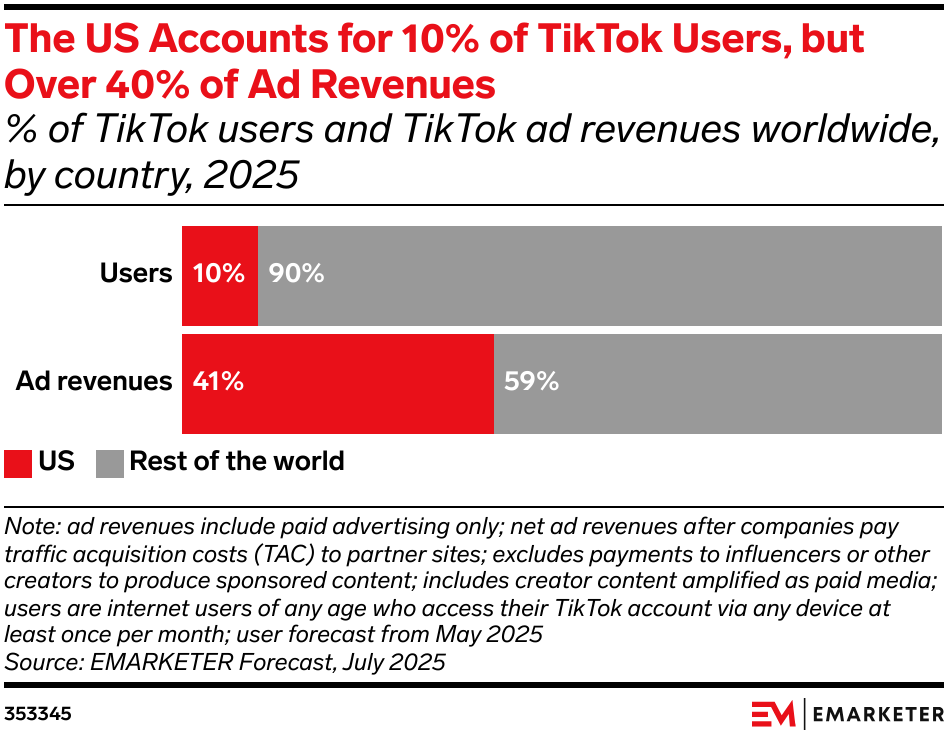
  • US TikTok users are worth 4x more to advertisers than the global average

    US TikTok users are worth 4x more to advertisers than the global average

    Key stat: The US accounts for just 10% of TikTok users but generates 41% of the platform’s ad revenue worldwide, according to a July forecast from EMARKETER.

    Beyond the chart:

    • TikTok’s US audience is highly responsive to advertising. In fact, 83% of weekly US TikTok users ages 13 and older have taken action after seeing an ad on the platform, including making a purchase (43%), according to a December Edison Research report.
    • Meanwhile, the platform’s US user base is expanding beyond its Gen Z core. TikTok adoption among users 45 and older has grown 1,200% between 2019 and 2025, according to an August survey from CivicScience.

    Use this chart: Drop this into any deck questioning TikTok’s role in your media mix. Even with the app’s future uncertain, this chart makes the case for why the US market still commands attention and budget. Use it to defend domestic TikTok investment despite regulatory headwinds.

    Related EMARKETER reports:

    Methodology: Estimates are based on the analysis of various elements related to the ad spending market, including macro-level economic conditions, historical trends of the advertising market, historical trends of each medium in relation to other media, reported revenues of major ad publishers, estimates from other research firms, data from benchmark sources, consumer media consumption trends, consumer device usage trends, and EMARKETER interviews with executives at ad agencies, brands, media publishers, and other industry leaders.

    Continue Reading

  • Surge AI CEO Says That Companies Are Optimizing for ‘AI Slop’

    Surge AI CEO Says That Companies Are Optimizing for ‘AI Slop’

    AI companies are prioritizing flash over substance, says Surge AI’s CEO.

    “I’m worried that instead of building AI that will actually advance us as a species, curing cancer, solving poverty, understanding universal, all these big grand questions, we are optimizing for AI slop instead,” Edwin Chen said in an episode of “Lenny’s” podcast published on Sunday.

    “We’re basically teaching our models to chase dopamine instead of truth,” he added.

    Chen founded AI training startup Surge in 2020 after working at Twitter, Google, and Meta. Surge runs the gig platform Data Annotation, which says it pays one million freelancers to train AI models. Surge competes with data labeling startups like Scale AI and Mercor and counts Anthropic as a customer.

    On Sunday’s podcast, Chen said that companies are prioritizing AI slop because of industry leaderboards.

    “Right now, the industry is played by these terrible leaderboards like LMArena,” he said, referring to a popular online leaderboard where people can vote on which AI response is better.

    “They’re not carefully reading or fact-checking,” he said. “They’re skimming these responses for two seconds and picking whatever looks flashiest.”

    He added: “It’s literally optimizing your models for the types of people who buy tabloids at the grocery store.”

    Still, the Surge CEO said that AI labs have to pay attention to these leaderboards because they can be asked about their rankings during sales meetings.

    Like Chen, research scientists have criticized benchmarks for overvaluing superficial traits.

    In a March blog post, Dean Valentine, the cofounder and CEO of AI security startup ZeroPath, said that “Recent AI model progress feels mostly like bullshit.”

    Valentine said that he and his team had been evaluating the performance of different models claiming to have “some sort of improvement” since the release of Anthropic’s 3.5 Sonnet in June 2024. None of the new models his team tried had made a “significant difference” in his company’s internal benchmarks or in developers’ abilities to find new bugs, he said.

    They might have been “more fun to talk to,” but they were “not reflective of economic usefulness or generality.”

    In a February paper titled “Can we trust AI Benchmarks?” researchers at the European Commission’s Joint Research Center concluded that major issues exist in today’s evaluation approach.

    The researchers said benchmarking is “fundamentally shaped by cultural, commercial and competitive dynamics that often prioritize state-of-the-art performance at the expense of broader societal concerns.”

    Companies have also come under fire for “gaming” these benchmarks.

    In April, Meta released two new models in its Llama family that it said delivered “better results” than comparably sized models from Google and French AI lab Mistral. It then faced accusations that it had gamed a benchmark.

    LMArena said that Meta “should have made it clearer” that it had submitted a version of Llama 4 Maverick that had been “customized” to perform better for its testing format.

    “Meta’s interpretation of our policy did not match what we expect from model providers,” LMArena said in an X post.


    Continue Reading

  • Media Buying Briefing: Overheard at DPMS — How agencies grapple with AI in programmatic

    Media Buying Briefing: Overheard at DPMS — How agencies grapple with AI in programmatic

    It can sometimes be a fine line between a promise and a threat — but that’s where generative AI stands in its application to the media agency world today. At least that’s the biggest takeaway from a Town Hall discussion at last week’s Programmatic Marketing Summit, held in New Orleans as the last of Digiday’s events for the year 2025. 

    Held under Chatham House rules, which provide anonymity and the freedom to speak freely for the media agency people attending, the Town Hall conversation highlighted the confusion and complexity surrounding the intersection of programmatic advertising and agentic AI. 

    There were differing opinions over to what extent AI and agentic technologies are already part of programmatic workflows (and there seemed to be no consensus definition for what qualifies as agentic). What the agency executives did seem to agree on, though, was that AI agents are best kept away from the actual point of transaction between media buyers and sellers. 

    Instead they should be relegated to pre- and post-transaction tasks, like helping to plan campaign parameters and to organize post-campaign performance data. But even that level of AI involvement will require enhanced training of agency employees not just on AI tools (and their limitations) but also on the fundamentals of programmatic advertising workflows for the human employees to better supervise their AI counterparts.

    The following has been edited for space and clarity.

    Setting the stage

    “I think we all know that machine learning AI … from a buying standpoint is already very integrated. But I think what is new is the gen AI, right? And that’s what’s exciting. The agent idea, and this idea of ideation creating autonomy is where it’s evolving. But I don’t think we all know what we’re talking about, just because it is already integrated within buying across Meta, Google, etc. But from a gen AI aspect, I think that’s what’s really exciting. Where we’ve seen efficiencies in terms of our AI that we’re using is helping with media mix models planning. That really helps with efficiencies, as well as automation in general, in terms of administrative tasks, analytics, and aggregating data.”

    AI used as a smoke screen

    “Every agency has some level of machine learning being used in their algorithms and optimizations. We’re not afraid of that, but it isn’t very transparent by nature. One of the challenges we face in this industry is now we’re being fed AI as a cover for more opaqueness in pricing, more opaqueness in performance optimizations. Whether it’s [The Trade Desk’s] Kokai’s new algorithms all trying to do stuff for you and saying ‘Just trust us.’ That, I think scares us, because we know it’s not LLMs, but we also know they’re using it as a smoke screen, and we’re not all equipped to poke holes in their theories and push back. I think that might be where a lot of the fear is, because we just see more opaqueness and us having less and less control.”

    “We have not gotten there yet, but one of the things that we’re working on on our agency is, how do we use the agentic AI to help us explain what AI is doing in our campaigns? But how do we get it to explain stuff? Because if a person makes an optimization, you can say, Why did you make that optimization? What do you think it was going to do? And what did it do? AI doesn’t do that — it just makes the optimization and has a result or doesn’t have a result.”

    Careful with that agent, Eugene

    “Agents are built for fetching and gathering. That’s what they do good. They don’t think. You just asked why — they don’t do that. They’re all probabilistic anyway. Technically agents are [Las] Vegas on all the things you’re looking to track, and it tries to get to a better result based on what it’s seen in the past. So if you’re doing something new right now with the agent, don’t do that. They’re not really good at that yet, because they’re working on odds. I feel like we’re probably three or four years away from trusting any of these things.”

    “AI can be really good for things with defined parameters. But as an industry, we’re kind of lumping in a lot of AI together. For, say, a programmatic media plan, it’s going to potentially hallucinate because things like outdated information aren’t being taken down from the web, and it’s taking that into consideration. If you just let it to its own devices, you’re not going to get best results. But if you use a very clean data set to find parameters of how things should be evaluated, I think it can be very beneficial.”

    What’s to come? 

    “From the strategist side, some of the programmatic partners actually have tools that will build your whole media plan, right? But what I haven’t seen is the integration being there. I think their dream of it is, click the one button that builds the plan for you and optimizes the plan. I don’t think that’s upon us yet, but I think that’s what may be coming for us.”

    “All of us are being told that’s what people want — let’s do that. But then you have legal compliance, and your finance team. All it takes is for the AI to hallucinate one zero, and you’re in big trouble. And that’s one mistake that’s going to cost you potentially a client, or could cost you your job. Because LLMs will never NOT hallucinate — their underlying architecture design has that flaw. I don’t know how many trillions of dollars have been invested in this, but they haven’t fixed this problem. They’re like a very smart intern — we’re going to give it information. It’s going to be able to do a lot of tasks that are menial and take a lot of time, and do it fast. But before we do action, we’re going to put it through some of the older models, or sometimes trust the older models to do the actual heavy lifting, because they have experience. We know they work, and we know they can work and they can do it better.”

    “You were saying smart intern — it’s a six year old. Think of it as your six year old child who will give you an answer whether it’s right or not, because they want to prove to you that they think what you said is important. That’s AI right now. It’ll be different later, but right now, it’s a six year old.”

    “We’re using AI in pre- and in post-production. Your whole planning team is pre-production. Your analytics team is post production, giving reports back. That is a lot of the day to day job, so that can save us a ton of time. The actual production part is actually a small percentage of our time. We set up the campaign, we run it, the optimizations come from post analytics, and then we go and make the changes. A lot of the lead up is a lot of time that AI can save us.”

    Accountability

    “Accountability comes with management not allowing people to use, ‘Well, that’s what the AI gave me’ as an excuse. They have to be accountable to their work no matter how it’s been generated. And I think that’s how we have to move forward. Because if we allow everyone to use that as an excuse, that we’re going tons of errors.”

    “My concern is on [the 25-year-old media planner’s] over-reliance on AI for doing a lot of these things. Is that going to impact overall foundational knowledge that allows them to make these strategic decisions creatively and out of the box? Because they’ve been brought up [thinking] ‘Well, I can just do all of these things by throwing it in here.’ They don’t understand the why behind it, and then it snowballs 20 years from now.”

    How to train your AI

    “How would you train the AI better? The best way I can describe it is, it’s like good barbecue — low and slow. Use older data that’s very specific. It probably comes in slower than what you’re getting from signal-based data, or real-time data and all the rest of that. Not necessarily because it’s better, but because it has less garbage in it.”

    Color by numbers

    Does the need to market as aggressively as possible during the holidays offer an opportunity for retail media networks and challenger social platforms to capture more holiday and 2026 ad dollars? The answer is yes — if they can close the measurement and trust gap, according to new research from Kantar. Some supporting stats: 

    • Retailers see building in-store/omnichannel capabilities (82%) and off-site data monetization (45%) as key ways to compete with Amazon. 
    • 87% of brands would be more likely to trust and invest in retail media networks accredited for standardized measurement, but only 24% of retailers are fully aligned with such standards. 
    • 67% of brands are ready to invest more if in-store impact can be proved. 
    • 80% of brands say unified in-store/online measurement is essential or important.  

    Takeoff & landing

    • The closure of Omnicom’s acquisition of Interpublic Group resulted into the planned layoffs of about 4,000 staffers, leading to a wave of publicly aired bitter feelings over social media. It also resulted in the shuttering of IPG’s Magna media investment and business intelligence unit, along with the departure of Eileen Kiernan, the highest ranking media executive in IPG’s fold. 
    • Havas made two different acquisitions last week: U.K. experiential agency Bearded Kitten, which will be folded into Havas Play, and, earlier in the week Unnest, a French data consulting and engineering firm, to support Havas Media Network’s tech and data abilities. It declined to identify purchase prices for either. 
    • Personnel moves: Dentsu named Kara Osborne Gladwell its global product architect officer for Media, and brought back Tia Castagno to become Global Innovation President. Both are newly created global positions and report to Will Swayne, global practice president, Media … Monks hired Thiago Correa to be svp of media for the EMEA region, coming from Publicis where was global client lead for H&M  … Creator marketing agency Influencer hired Ryan Fitzpatrick as CFO, coming over from a similar post at VaynerX.

    Direct quote

    “This merger is a reminder that scale doesn’t fix fragmentation. AI only works when the underlying customer data is unified, governed, and understood. The organizations that win in the next phase of marketing won’t be the ones with the most tools — they’ll be the ones with the clearest picture of their customers.”

    —Tony Owens, CEO of customer data cloud Amperity, on Omnicom’s acquisition of IPG. 

    Speed reading

    Continue Reading

  • MHIET U.S. Subsidiary’s Franklin Plant Celebrates 10th Anniversary– Cumulative production of 6.5 million automotive turbochargers —

    MHIET U.S. Subsidiary’s Franklin Plant Celebrates 10th Anniversary– Cumulative production of 6.5 million automotive turbochargers —

    Tokyo, December 08, 2025 – Mitsubishi Heavy Industries Engine & Turbocharger, Ltd. (MHIET), a part of Mitsubishi Heavy Industries (MHI) Group, held a ceremony on November 7 to commemorate the 10th anniversary of the opening of the Franklin, Indiana (USA) plant of Mitsubishi Turbocharger and Engine America, Inc. (MTEA), headquartered in Itasca, Illinois, MHIET’s production base for automotive turbochargers in the United States. The Franklin plant has manufactured a cumulative total of 6.5 million turbochargers over the last 10 years, and expects to reach 10 million units by 2030.

    The commemorative ceremony was attended by Franklin Mayor Steve Barnett and other city officials, as well as Kenji Mori, General Manager of MHIET’s Turbo Division, and other company executives. Mayor Barnett said, “MHIET’s commitment to excellence, teamwork and respect reflects the best of the Japanese culture that has truly left their mark in Franklin.”

    The demand for turbocharger is expected to remain strong, owing to the current proactive development of gasoline-fueled turbo engines in North America. With automobile manufacturers, who are the main customers for these devices, increasingly demanding shorter timeframes for development and delivery, the Franklin plant has established a mass production system that can respond flexibly while maintaining high quality.

    Specifically, the plant produces turbochargers on automated assembly lines, with quality rigorously controlled by an advanced traceability system. The factory adheres strictly to the “5S” workplace organization method (Sort, Straighten, Shine, Standardize, Sustain). In addition, the plant is located close to engine assembly plants of its main customers.

    This production system and nearby location allow the plant to quickly and steadily supply high-quality turbochargers, which is highly regarded by customers. In 2024, MTEA received the “Supplier of the Year” award from U.S. automaker General Motors (GM) for the third time. The company has also received the “Excellence in Quality and Delivery” award from American Honda Motor multiple times.

    At the same time, reflecting the rise of protectionism and intensifying trade friction, customers are increasingly requesting compliance with the USMCA (United States-Mexico-Canada Agreement). The Franklin plant meets the Labor Value Content (LVC) requirement of the USMCA Rules of Origin. MTEA is also taking steps to develop and build a supply chain in North America to meet the Regional Value Content (RVC) requirements of the USMCA Rules of Origin.

    Going forward, MHIET will continue production of high-quality turbochargers at the Franklin plant and maintain a flexible supply system, while aiming to bolster its supply chain and expand its North American operations.


    ■Overview of MTEA

    Mitsubishi Turbocharger and Engine America, Inc.

    【Head office Address】

    Two Pierce Place, 11th Floor, Itasca, IL 60143, U.S.A.

    1200 North Mitsubishi Parkway, Franklin, IN 46131, U.S.A.

    【Main lines of business】

    Sales of industrial engines, production and sales of turbochargers, service and parts supply for both products

    • 【Milestones】
      April 1985 Mitsubishi Engine North America, Inc. (MENA) established and started operations as a sales and service base for engines and turbochargers in North America
      April 2010 Established a sales and design office in Michigan, USA
      May 2015 Opened Franklin plant in the U.S. and started production of turbochargers
      June 2016 Corporate name changed from MENA to Mitsubishi Turbocharger and Engine America, Inc. (MTEA)
      April 2022 Cumulative turbocharger production reaches 5 million units

    Continue Reading

  • Public companies account for 62% of Chin Hin Group Property Berhad’s (KLSE:CHGP) ownership, while individual investors account for 22%

    Public companies account for 62% of Chin Hin Group Property Berhad’s (KLSE:CHGP) ownership, while individual investors account for 22%

    Trump has pledged to “unleash” American oil and gas and these 15 US stocks have developments that are poised to benefit.

    To get a sense of who is truly in control of Chin Hin Group Property Berhad (KLSE:CHGP), it is important to understand the ownership structure of the business. The group holding the most number of shares in the company, around 62% to be precise, is public companies. Put another way, the group faces the maximum upside potential (or downside risk).

    Individual investors, on the other hand, account for 22% of the company’s stockholders.

    Let’s delve deeper into each type of owner of Chin Hin Group Property Berhad, beginning with the chart below.

    View our latest analysis for Chin Hin Group Property Berhad

    KLSE:CHGP Ownership Breakdown December 8th 2025

    Small companies that are not very actively traded often lack institutional investors, but it’s less common to see large companies without them.

    There are many reasons why a company might not have any institutions on the share registry. It may be hard for institutions to buy large amounts of shares, if liquidity (the amount of shares traded each day) is low. If the company has not needed to raise capital, institutions might lack the opportunity to build a position. Alternatively, there might be something about the company that has kept institutional investors away. Chin Hin Group Property Berhad’s earnings and revenue track record (below) may not be compelling to institutional investors — or they simply might not have looked at the business closely.

    earnings-and-revenue-growth
    KLSE:CHGP Earnings and Revenue Growth December 8th 2025

    We note that hedge funds don’t have a meaningful investment in Chin Hin Group Property Berhad. Chin Hin Group Berhad is currently the company’s largest shareholder with 62% of shares outstanding. With such a huge stake in the ownership, we infer that they have significant control of the future of the company. With 2.5% and 2.4% of the shares outstanding respectively, Kumpulan Wang Bersama and Human Resources Development Fund are the second and third largest shareholders.

    While it makes sense to study institutional ownership data for a company, it also makes sense to study analyst sentiments to know which way the wind is blowing. We’re not picking up on any analyst coverage of the stock at the moment, so the company is unlikely to be widely held.

    Continue Reading

  • Baidu Shares Rise as It Assesses Chip Unit Spinoff

    Baidu Shares Rise as It Assesses Chip Unit Spinoff

    By Tracy Qu

    Baidu shares rose after the company said it is considering spinning off its AI chip unit.

    The Beijing-based company is assessing a possible spinoff and listing for Kunlunxin (Beijing) Technology, according to a filing with the Hong Kong bourse on Sunday.

    Baidu said the proposed spinoff and listing will be subject to regulatory approval processes and added that there is no assurance that the spinoff and listing will proceed. The news was first reported by Reuters on Friday.

    The stock rose 4% to HK$126.40, equivalent to US$16.24, in morning trade on Monday, after climbing 5% on Friday. Baidu's gains outperformed the Hang Seng Tech Index, which was recently 0.1% lower.

    The news comes as a number of Chinese chip companies have pursued domestic listings amid Beijing's push to end reliance on foreign technology.

    Moore Threads, a domestic graphics processing unit designer, began trading in Shanghai last week. Its shares surged more than fivefold on Friday. Meanwhile, chip company MetaX plans to raise the equivalent of more than $550 million in Shanghai.

    Baidu, once China's dominant internet search engine provider, has sought new growth drivers beyond its core business in recent years. The company has been investing in artificial intelligence, chip design, as well as autonomous-driving technologies.

    Write to Tracy Qu at tracy.qu@wsj.com

    (END) Dow Jones Newswires

    December 07, 2025 23:05 ET (04:05 GMT)

    Copyright (c) 2025 Dow Jones & Company, Inc.

    Continue Reading

  • China’s Weak Currency Is Powering Its Exports, Drawing Criticism – The New York Times

    1. China’s Weak Currency Is Powering Its Exports, Drawing Criticism  The New York Times
    2. Exclusive: China state-owned banks soak up dollars to slow yuan gains, sources say  Reuters
    3. USD/CNH put fly  FXStreet
    4. China Central Bank sets lowest RMB reference rate since 2022  chinaeconomicreview.com
    5. Why China needs to let the renminbi rise  Hoover Institution

    Continue Reading

  • Stocks, bonds cautiously hopeful for Fed rate relief – Reuters

    1. Stocks, bonds cautiously hopeful for Fed rate relief  Reuters
    2. The Week That Was, The Week Ahead: Macro & Markets, Dec. 7  TipRanks
    3. Sentiment improving, but watch for political risk  bangkokpost.com
    4. The Stock Market Keeps Shrugging Off Every Obstacle  Inc.com
    5. Market Calm Settles In as Wall Street Awaits Fed Decision  TradeAlgo

    Continue Reading

  • China's November exports top expectations, imports underperform – Reuters

    1. China’s November exports top expectations, imports underperform  Reuters
    2. China’s exports rebound in November, massively beating expectations after U.S. trade truce  CNBC
    3. US tariffs prompt surge in Chinese exports to south-east Asia  Financial Times
    4. China Exports Rise More than Expected  TradingView
    5. China Shakes Off Tariff Scare to Stick With Export-Driven Growth  Bloomberg.com

    Continue Reading