Category: 3. Business

  • Headwater Exploration (TSX:HWX) Valuation After 2026 Growth Plan, Dividend Commitment and Capital Discipline Update

    Headwater Exploration (TSX:HWX) Valuation After 2026 Growth Plan, Dividend Commitment and Capital Discipline Update

    Headwater Exploration (TSX:HWX) just laid out its initial 2026 game plan, targeting 8% production per share growth while funding a CA$0.44 dividend and still keeping exit working capital in the black.

    See our latest analysis for Headwater Exploration.

    The guidance has landed against a strong backdrop, with the share price now at CA$9.49 after a 30 day share price return of 26.53% and a five year total shareholder return of 383.28%. This suggests that momentum and confidence are building rather than fading.

    If this kind of disciplined growth story appeals to you, it could be a good moment to look beyond energy and discover fast growing stocks with high insider ownership.

    Yet with the shares already up sharply and trading only slightly below analyst targets despite an implied discount to intrinsic value, the key question now is whether Headwater is still mispriced or if the market has already priced in its next leg of growth.

    On a headline basis, Headwater Exploration trades at a 13.1x price to earnings ratio, which makes the stock look reasonably valued rather than obviously cheap.

    The price to earnings multiple compares the current share price to the company’s earnings per share, so it effectively captures what investors are willing to pay for each dollar of profit. For an oil and gas producer like Headwater, this is a core yardstick because earnings can swing with commodity prices, capital spending, and operating efficiency.

    Against that backdrop, the picture is mixed. Headwater screens as good value versus peers and the broader Canadian oil and gas industry, with its 13.1x multiple sitting below both the industry average 15.3x and the peer average 20.6x. However, that same 13.1x looks expensive when compared with the estimated fair price to earnings ratio of 10.1x, a level the market could migrate toward if sentiment or earnings expectations cool.

    Explore the SWS fair ratio for Headwater Exploration

    Result: Price-to-Earnings of 13.1x (ABOUT RIGHT)

    However, investors should watch for weaker earnings trends and a cooldown in oil prices, which could compress multiples and challenge the current growth narrative.

    Find out about the key risks to this Headwater Exploration narrative.

    While the 13.1x earnings multiple suggests Headwater is roughly fairly priced, our DCF model indicates a very different picture. It suggests fair value near CA$19.93, which is around 52% above the current CA$9.49 price. Is the market underestimating the cash flow runway here?

    Look into how the SWS DCF model arrives at its fair value.

    HWX Discounted Cash Flow as at Dec 2025

    Simply Wall St performs a discounted cash flow (DCF) on every stock in the world every day (check out Headwater Exploration for example). We show the entire calculation in full. You can track the result in your watchlist or portfolio and be alerted when this changes, or use our stock screener to discover 906 undervalued stocks based on their cash flows. If you save a screener we even alert you when new companies match – so you never miss a potential opportunity.

    If you see things differently or prefer to dive into the numbers yourself, you can build a fresh perspective in just a few minutes: Do it your way.

    A great starting point for your Headwater Exploration research is our analysis highlighting 1 key reward and 2 important warning signs that could impact your investment decision.

    Do not stop with one opportunity; use the Simply Wall Street Screener to uncover fresh, data driven stock ideas tailored to the way you like to invest.

    This article by Simply Wall St is general in nature. We provide commentary based on historical data and analyst forecasts only using an unbiased methodology and our articles are not intended to be financial advice. It does not constitute a recommendation to buy or sell any stock, and does not take account of your objectives, or your financial situation. We aim to bring you long-term focused analysis driven by fundamental data. Note that our analysis may not factor in the latest price-sensitive company announcements or qualitative material. Simply Wall St has no position in any stocks mentioned.

    Companies discussed in this article include HWX.TO.

    Have feedback on this article? Concerned about the content? Get in touch with us directly. Alternatively, email editorial-team@simplywallst.com

    Continue Reading

  • Scaling sustainable business operations with agentic AI

    Scaling sustainable business operations with agentic AI

    Facing tomorrow’s challenges today.

    To respond effectively to today’s uncertain business conditions, organizations need solutions to tackle current and future challenges, while continuing to drive innovation and competitiveness. Agentic artificial intelligence (AI) represents just such a solution. This advanced form of AI is focused on autonomous decision-making and action, promising greater benefits than traditional AI.

    In our latest point of view developed in collaboration with Microsoft, we lay out how agentic AI can help organizations reduce waste, optimize processes, and embed sustainability in operations at scale.

    A breakthrough in efficiency

    Agentic AI can actively drive better business outcomes, thanks to its ability to process information, learn across interactions, and act autonomously to achieve objectives. When implemented across end-to-end workflows, agentic AI enables better resource allocation, automated sustainability reporting, and real-time emissions tracking.

    By effectively leveraging these capabilities, organizations can promote resilience and optimize operations, while strengthening governance structures and social responsibility commitments.

    New sustainability ambitions

    Although organizations across sectors are eager to leverage the benefits of AI, they are concerned about its potential environmental impacts. However, agentic AI can actually strengthen organizations’ sustainability ambitions. Through better resource allocation, it can enable greater efficiency, productivity, and environmental performance. With key partnerships and a comprehensive human-AI framework, agentic AI can help organizations reimagine core operations, benefiting both business outcomes and the environment.

    Continue Reading

  • Le Traon, P. Y. et al. From observation to information and users: The Copernicus Marine Service perspective. Front. Mar. Sci. 6, 234 (2019).

    Google Scholar 

  • Sun, R. et al. SKRIPS v1.0: A regional coupled ocean-atmosphere modeling framework (MITgcm-WRF) using ESMF/NUOPC, description and preliminary results for the Red Sea. Geosci. Model Dev. 12, 4221–4244 (2019).

    Google Scholar 

  • Sakamoto, K. et al. Development of a 2-km resolution ocean model covering the coastal seas around Japan for operational application. Ocean Dyn. 69, 1181–1202 (2019).

    Google Scholar 

  • Ciliberti, S. A. et al. Monitoring and forecasting the ocean state and biogeochemical processes in the Black Sea: Recent developments in the Copernicus Marine Service. J. Mar. Sci. Eng. 9, 1146 (2021).

    Google Scholar 

  • Kärnä, T. et al. Operational marine forecast model for the Baltic Sea. Nemo-Nordic 2.0. Geosci. Model Dev. 14, 5731–5749 (2021).

  • Zhu, X. et al. Improvements in the regional South China Sea operational oceanography forecasting system (SCSOFSv2). Geosci. Model Dev. 15, 995–1015 (2022).

    Google Scholar 

  • Bruschi, A. et al. Indexes for the assessment of bacterial pollution in bathing waters from point sources: The northern Adriatic Sea CADEAU service. J. Environ. Manag. 293, 112878 (2021).

    Google Scholar 

  • Liubartseva, S. et al. Modeling chronic oil pollution from ships. Mar. Pollut. Bull. (2023).

  • Mannarini, G., Salinas, M. L., Carelli, L., Petacco, N. & Orović, J. VISIR-2: Ship weather routing in Python. Geosci. Model Dev. 17, 4355–4382 (2024).

    Google Scholar 

  • Coppini, G. et al. The Mediterranean forecasting system-Part 1: Evolution and performance. Ocean Sci. 19, 1483–1516 (2023).

    Google Scholar 

  • Bi, K. et al. Accurate medium-range global weather forecasting with 3D neural networks. Nature 619, 533–538 (2023).

    Google Scholar 

  • Nguyen, T. et al. Scaling transformer neural networks for skillful and reliable medium-range weather forecasting. Adv. Neural Inf. Process. Syst. 37, 68740–68771 (2024).

    Google Scholar 

  • Pathak, J. et al. FourCastNet: A global data-driven high-resolution weather model using adaptive Fourier neural operators. arXiv preprint arXiv:2202.11214 (2022).

  • Keisler, R. Forecasting global weather with graph neural networks. arXiv preprint arXiv:2202.07575 (2022).

  • Lam, R. et al. Learning skillful medium-range global weather forecasting. Science 382, 1416–1421 (2023).

    Google Scholar 

  • Oskarsson, J., Landelius, T., Deisenroth, M. & Lindsten, F. Probabilistic weather forecasting with hierarchical graph neural networks. Adv. Neural Inf. Process. Syst. 37, 41577–41648 (2024).

    Google Scholar 

  • Dheeshjith, S. et al. Samudra: An AI global ocean emulator for climate. Geophys. Res. Lett. 52(10), e2024GL114318 (2025).

    Google Scholar 

  • Wang, C. et al. Coupled ocean-atmosphere dynamics in a machine learning Earth system model. arXiv preprint arXiv:2406.08632 (2024).

  • Guo, Z. et al. Data-driven global ocean modeling for seasonal to decadal prediction. arXiv preprint arXiv:2405.15412 (2024).

  • Wang, X. et al. XiHe: A data-driven model for global ocean eddy-resolving forecasting. arXiv preprint arXiv:2402.02995 (2024).

  • Aouni, A. E. et al. GLONET: Mercator’s end-to-end neural forecasting system. arXiv preprint arXiv:2412.05454 (2024).

  • Cui, Y. et al. Forecasting the eddying ocean with a deep neural network. Nat. Commun. 16, 2268 (2025).

    Google Scholar 

  • Andersson, T. R. et al. Seasonal Arctic sea ice forecasting with probabilistic deep learning. Nat. Commun. 12, 5124 (2021).

    Google Scholar 

  • Chattopadhyay, A., Gray, M., Wu, T., Lowe, A. B. & He, R. OceanNet: A principled neural operator-based digital twin for regional oceans. Sci. Rep. 14, 21181 (2024).

    Google Scholar 

  • Subel, A. & Zanna, L. Building ocean climate emulators. arXiv preprint arXiv:2402.04342 (2024).

  • Sanchez-Gonzalez, A. et al. Learning to simulate complex physics with graph networks. In International Conference on Machine Learning. 8459–8468 (2020).

  • Marchesiello, P., McWilliams, J. C. & Shchepetkin, A. Open boundary conditions for long-term integration of regional oceanic models. Ocean Model. 3, 1–20 (2001).

    Google Scholar 

  • Escudier, R. et al. A high resolution reanalysis for the Mediterranean Sea. Front. Earth Sci. 9, 702285 (2021).

    Google Scholar 

  • Hersbach, H. et al. ERA5 monthly averaged data on single levels from 1940 to present. In Copernicus Climate Change Service (C3S) Climate Data Store (CDS) (2023).

  • Molteni, F., Buizza, R., Palmer, T. N. & Petroliagis, T. The ECMWF ensemble prediction system: Methodology and validation. Q. J. R. Meteorol. Soc. 122, 73–119 (1996).

    Google Scholar 

  • Lang, S. et al. AIFS – ECMWF’s data-driven forecasting system. arXiv preprint arXiv:2406.01465 (2024).

  • ECMWF. Plans for high resolution forecast (HRES) and ensemble forecast (ENS). In focus (2024). https://www.ecmwf.int/en/about/media-centre/focus/2024/plans-high-resolution-forecast-hres-and-ensemble-forecast-ens.

  • Nardelli, B. B., Tronconi, C., Pisano, A. & Santoleri, R. High and ultra-high resolution processing of satellite sea surface temperature data over southern European seas in the framework of MyOcean project. Remote Sens. Environ. 129, 1–16 (2013).

    Google Scholar 

  • Hobday, A. J. et al. A hierarchical approach to defining marine heatwaves. Prog. Oceanogr. 141, 227–238 (2016).

    Google Scholar 

  • Kochkov, D. et al. Neural general circulation models for weather and climate. Nature 632, 1060–1066 (2024).

    Google Scholar 

  • Marshall, J. & Schott, F. Open-ocean convection: Observations, theory, and models. Rev. Geophys. 37, 1–64 (1999).

    Google Scholar 

  • Large, W. G., McWilliams, J. C. & Doney, S. C. Oceanic vertical mixing: A review and a model with a nonlocal boundary layer parameterization. Rev. Geophys. 32, 363–403 (1994).

    Google Scholar 

  • Wunsch, C. & Stammer, D. Atmospheric loading and the oceanic inverted barometer effect. Rev. Geophys. 35, 79–107 (1997).

    Google Scholar 

  • Gill, A. E. Atmosphere–Ocean Dynamics (Academic Press, 1982).

  • Clementi, E. et al. Coupling hydrodynamic and wave models: first step and sensitivity experiments in the Mediterranean Sea. Ocean Dyn. 67, 1293–1312 (2017).

    Google Scholar 

  • McDonagh, B., Clementi, E., Goglio, A. C. & Pinardi, N. The characteristics of tides and their effects on the general circulation of the Mediterranean Sea. Ocean Sci. 20, 1051–1066 (2024).

    Google Scholar 

  • Rühling Cachay, S., Zhao, B., Joren, H. & Yu, R. Dyffusion: A dynamics-informed diffusion model for spatiotemporal forecasting. Adv. Neural Inf. Process. Syst. 36, 45259–45287 (2023).

    Google Scholar 

  • Andrae, M., Landelius, T., Oskarsson, J. & Lindsten, F. Continuous ensemble weather forecasting with diffusion models. In International Conference on Learning Representations (2025).

  • Nipen, T. N. et al. Regional data-driven weather modeling with a global stretched-grid. arXiv preprint arXiv:2409.02891 (2024).

  • Adamov, S. et al. Building machine learning limited area models: Kilometer-scale weather forecasting in realistic settings. arXiv preprint arXiv:2504.09340 (2025).

  • Nguyen, T., Brandstetter, J., Kapoor, A., Gupta, J. K. & Grover, A. ClimaX: A foundation model for weather and climate. In International Conference on Machine Learning (2023).

  • Bodnar, C. et al. A foundation model for the Earth system. Nature 1–8 (2025).

  • Price, I. et al. Probabilistic weather forecasting with machine learning. Nature 637, 84–90 (2025).

    Google Scholar 

  • Larsson, E., Oskarsson, J., Landelius, T. & Lindsten, F. Diffusion-LAM: Probabilistic limited area weather forecasting with diffusion. arXiv preprint arXiv:2502.07532 (2025).

  • Fortunato, M., Pfaff, T., Wirnsberger, P., Pritzel, A. & Battaglia, P. Multiscale meshgraphnets. arXiv preprint arXiv:2210.00612 (2022).

  • Battaglia, P., Pascanu, R., Lai, M., Jimenez Rezende, D. et al. Interaction networks for learning about objects, relations and physics. Adv. Neural Inf. Process. Syst. 29 (2016).

  • Ramachandran, P., Zoph, B. & Le, Q. V. Searching for activation functions. arXiv preprint arXiv:1710.05941 (2017).

  • Ba, J., Kiros, J. & Hinton, G. Layer normalization. arXiv preprint arXiv:1607.06450 (2016).

  • Loshchilov, I. & Hutter, F. Decoupled weight decay regularization. In International Conference on Learning Representations (2019).

  • Madec, G. et al. NEMO ocean engine. In Scientific Notes of Climate Modelling Center. Vol. 27 (2017).

  • WAVEWATCH III Development Group (WW3DG). User Manual and System Documentation of WAVEWATCH III Version 6.07. In Technical Note 333, NOAA/NWS/NCEP/MMAB, College Park, MD, USA (2019).

  • Dobricic, S. & Pinardi, N. An oceanographic three-dimensional variational data assimilation scheme. Ocean Model. 22, 89–105 (2008).

    Google Scholar 

  • Weatherall, P. et al. A new digital bathymetric model of the world’s oceans. Earth Sp. Sci. 2, 331–345 (2015).

    Google Scholar 

  • Hellerman, S. & Rosenstein, M. Normal monthly wind stress over the world ocean with error estimates. J. Phys. Oceanogr. 13, 1093–1104 (1983).

    Google Scholar 

Continue Reading

  • Which Artificial Intelligence (AI) Stocks Are Billionaires Buying the Most?

    Which Artificial Intelligence (AI) Stocks Are Billionaires Buying the Most?

    • Several billionaires loaded up on Broadcom, Meta Platforms, and Microsoft stocks in Q3.

    • However, Alphabet and Nvidia were the most popular AI stocks with billionaire investors during the quarter.

    • Both stocks should have tremendous growth prospects over the next several years.

    • These 10 stocks could mint the next wave of millionaires ›

    The phrase “follow the money” gained widespread attention thanks to the 1976 movie, All the President’s Men. While the quote and the movie were about the Watergate scandal, following the money has become a popular approach for many investors who track the stocks bought by billionaires.

    As you might expect, quite a few billionaires have invested heavily in artificial intelligence (AI) stocks. But which AI stocks are they buying the most?

    Image source: Getty Images.

    To answer that question, I examined the 13F filings for the third quarter of 2025 of companies, family offices, and hedge funds run by 10 prominent billionaire investors:

    • Bill Ackman

    • Warren Buffett

    • Chase Coleman

    • Stanley Druckenmiller

    • Israel “Izzy” Englander

    • Ken Griffin

    • Carl Icahn

    • Paul Tudor Jones

    • George Soros

    • David Tepper

    Each of these billionaires, except for Ackman and Icahn, bought at least one AI stock in Q3. Three AI stocks didn’t rank at the top of the list, but deserve honorable mentions: Broadcom (NASDAQ: AVGO), Meta Platforms (NASDAQ: META), and Microsoft (NASDAQ: MSFT).

    Jones’ Tudor Investment hedge fund initiated new positions in Broadcom and Meta in Q3. Druckenmiller’s Duquesne Family Office also initiated a new position in Meta during the quarter.

    Coleman’s Tiger Global Management increased its position in Broadcom in Q3. Englander’s Millennium Management and Griffin’s Citadel Advisors each bought additional shares of Broadcom, Meta, and Microsoft. Soros Fund Management more than tripled its position in Microsoft in Q3.

    However, two other AI stocks stood out as most popular with billionaire investors. Half of the billionaires on the list bought either Alphabet (NASDAQ: GOOG) (NASDAQ: GOOGL) or Nvidia (NASDAQ: NVDA) in Q3.

    Buffett surprised some observers by initiating a significant new position in Alphabet for Berkshire Hathaway (NYSE: BRK.A) (NYSE: BRK.B) during the quarter. This purchase was a long time in the making. The legendary investor revealed in an interview with CNBC in 2017 that he regretted not buying shares of Google’s parent company earlier.

    Druckenmiller also opened a new position in Alphabet in Q3. Meanwhile, Englander, Griffin, and Soros added to their hedge fund’s stakes in the tech giant. Griffin’s Citadel even bought more of both of Alphabet’s share classes.

    Continue Reading

  • Evaluating Valuation After New Growth Initiatives and Automation Plans Unveiled

    Evaluating Valuation After New Growth Initiatives and Automation Plans Unveiled

    Recent remarks from MarketAxess Holdings (MKTX) at the Barclays Financial Services Conference put a spotlight on its next phase of growth, including deeper automation, non U.S. credit expansion and emerging markets opportunities.

    See our latest analysis for MarketAxess Holdings.

    Even with these growth levers, the 1 year total shareholder return of negative 29.18 percent and 3 year total shareholder return of negative 38.11 percent show longer term momentum has faded, despite a modest recent recovery in the 30 day share price return of 3.88 percent from a last close of 167.24 dollars.

    If you like the MarketAxess story but want more ideas in financial technology, this could be a good moment to explore fast growing stocks with high insider ownership.

    With revenues and profits still growing, but the share price languishing well below past highs and roughly 20 percent under the average analyst target, is MarketAxess now a mispriced compounder, or is the market correctly discounting its future growth?

    With MarketAxess last closing at 167.24 dollars, the most followed narrative points to a materially higher fair value anchored around future earnings power.

    The analysts have a consensus price target of 218.833 dollars for MarketAxess Holdings based on their expectations of its future earnings growth, profit margins and other risk factors. However, there is a degree of disagreement amongst analysts, with the most bullish reporting a price target of 274.0 dollars, and the most bearish reporting a price target of just 168.0 dollars.

    Read the complete narrative.

    Curious how a steady revenue glide path, rising margins and a premium earnings multiple combine into that fair value? The narrative lifts the lid on those projections, but keeps the boldest assumptions just out of view until you dive in.

    Result: Fair Value of $200.90 (UNDERVALUED)

    Have a read of the narrative in full and understand what’s behind the forecasts.

    However, that upside case could unravel if competitive pressure intensifies and high grade block trades remain stubbornly phone based, limiting electronic share gains.

    Find out about the key risks to this MarketAxess Holdings narrative.

    Step away from analyst targets and the picture looks quite different. On a price to earnings basis of 28.3 times versus a fair ratio of 14.9 times, and above both industry and peer averages, MarketAxess screens as expensive. Is the market overpaying for quality, or just pricing in reality?

    See what the numbers say about this price — find out in our valuation breakdown.

    NasdaqGS:MKTX PE Ratio as at Dec 2025

    If you are unconvinced by these conclusions or prefer to dig into the numbers yourself, you can craft a personalized view in minutes with Do it your way.

    A great starting point for your MarketAxess Holdings research is our analysis highlighting 3 key rewards and 1 important warning sign that could impact your investment decision.

    Before you move on, put your research momentum to work by scanning targeted stock ideas on Simply Wall Street, or you could miss your next winner.

    This article by Simply Wall St is general in nature. We provide commentary based on historical data and analyst forecasts only using an unbiased methodology and our articles are not intended to be financial advice. It does not constitute a recommendation to buy or sell any stock, and does not take account of your objectives, or your financial situation. We aim to bring you long-term focused analysis driven by fundamental data. Note that our analysis may not factor in the latest price-sensitive company announcements or qualitative material. Simply Wall St has no position in any stocks mentioned.

    Companies discussed in this article include MKTX.

    Have feedback on this article? Concerned about the content? Get in touch with us directly. Alternatively, email editorial-team@simplywallst.com

    Continue Reading

  • Vietnam’s trade turnover earns nearly 840 bln USD in first 11 months

    HANOI, Dec. 6 (Xinhua) — Vietnam’s total import-export turnover reached 839.75 billion U.S. dollars in the first 11 months of 2025, up 17.2 percent year on year, the National Statistics Office reported Saturday.

    During the period, exports totaled 430.14 billion U.S. dollars, rising 16.1 percent, while imports climbed 18.4 percent to 409.61 billion dollars.

    The Southeast Asian country posted a trade surplus of 20.53 billion U.S. dollars, the data showed. Enditem

    Continue Reading

  • A novel two-stage deep learning approach for lung cancer using enhanced ResNet50 segmentation and LungSwarmNet classification

  • Šarić, M., Russo, M., Stella, M. & Sikora, M. (2019). CNN-based method for lung cancer detection in whole slide histopathology images. In 2019 4th International Conference on Smart and Sustainable Technologies (SpliTech) (pp. 1–4). IEEE.

  • Pang, S., Zhang, Y., Ding, M., Wang, X. & Xie, X. A deep model for lung cancer type identification by densely connected convolutional networks and adaptive boosting. IEEE Access 8, 4799–4805 (2019).

    Google Scholar 

  • Damayanti, N. P., Ananda, M. N. D. & Nugraha, F. W. Lung cancer classification using convolutional neural network and DenseNet. J. Soft Comput. Explor. 4(3), 133–141 (2023).

    Google Scholar 

  • Kanakaraddi, S. G., Handur, V. S., Jalannavar, A., Chikaraddi, A. & Giraddi, S. Segmentation and classification of lung cancer using deep learning techniques. Procedia Comput. Sci. 235, 3226–3235 (2024).

    Google Scholar 

  • Chen, W. et al. HSN: Hybrid segmentation network for small cell lung cancer segmentation. IEEE Access 7, 75591–75603 (2019).

    Google Scholar 

  • Da Silva, G. L. F., Valente, T. L. A., Silva, A. C., De Paiva, A. C. & Gattass, M. Convolutional neural network-based PSO for lung nodule false positive reduction on CT images. Comput. Methods Programs Biomed. 162, 109–118 (2018).

    Google Scholar 

  • Sandag, G. A. & Kabo, D. T. Comparative analysis of lung cancer classification models using EfficientNet and ResNet on CT-scan lung images. CogITo Smart J. 10(1), 259–270 (2024).

    Google Scholar 

  • Cao, H. et al. Dual-branch residual network for lung nodule segmentation. Appl. Soft Comput. 86, 105934 (2020).

    Google Scholar 

  • Mohite, A. Application of transfer learning technique for detection and classification of lung cancer using CT images. Int. J. Sci. Res. Manag. 9(11), 621–634 (2021).

    Google Scholar 

  • Liu, X., Li, K. W., Yang, R. & Geng, L. S. Review of deep learning based automatic segmentation for lung cancer radiotherapy. Front. Oncol. 11, 717039 (2021).

    Google Scholar 

  • Uddin, J. Attention-based DenseNet for lung cancer classification using CT scan and histopathological images. Designs 8(2), 27 (2024).

    Google Scholar 

  • Chen, Y. et al. Classification of lungs infected COVID-19 images based on inception-ResNet. Comput. Methods Prog. Biomed. 225, 107053 (2022).

    Google Scholar 

  • Abedalla, A., Abdullah, M., Al-Ayyoub, M. & Benkhelifa, E. Chest X-ray pneumothorax segmentation using U-Net with EfficientNet and ResNet architectures. PeerJ Comput. Sci. 7, e607 (2021).

    Google Scholar 

  • WahabSait, A. R. Lung cancer detection model using deep learning technique. Appl. Sci. 13(22), 12510 (2023).

    Google Scholar 

  • Qayyum, A., Ang, C. K., Sridevi, S., Khan, M. A., Hong, L. W., Mazher, M. & Chung, T. D. (2020). Hybrid 3D-ResNet deep learning model for automatic segmentation of thoracic organs at risk in CT images. In 2020 International Conference on Industrial Engineering, Applications and Manufacturing (ICIEAM) (pp. 1–5). IEEE.

  • Arthi, T., Premkumar, S., Sivakumar, S. & Partheeban, N. (2023). Leveraging DenseNet and Genetic Algorithms for Lung Cancer Severity Classification. In 2023 1st International Conference on Optimization Techniques for Learning (ICOTL) (pp. 1–6). IEEE.

  • Mienye, I. D., Sun, Y. & Wang, Z. Improved predictive sparse decomposition method with densenet for prediction of lung cancer. Int. J. Comput. 1, 533–541 (2020).

    Google Scholar 

  • Raghuvanshi, S. S., Arya, K. V. & Patel, V. PSbBO-Net: A hybrid particle swarm and bayesian optimization-based DenseNet for lung cancer detection using histopathological and CT images. Int. J. Electr. Electron. Res. 12(3), 1074–1086 (2024).

    Google Scholar 

  • Kalaivani, N., Manimaran, N., Sophia, S. & Devi, D. D. (2020). Deep learning based lung cancer detection and classification. In IOP conference series: materials science and engineering (Vol. 994, No. 1, p. 012026). IOP Publishing.

  • Biyyala, V. (2023). Lung image segmentation: Custom U-Net with ResNet encoder architecture.

  • Asuntha, A., Singh, N. & Srinivasan, A. PSO, genetic optimization and SVM algorithm used for lung cancer detection. J. Chem. Pharm. Res. 8(6), 351–359 (2016).

    Google Scholar 

  • Lyu, J., Bi, X. & Ling, S. H. Multi-level cross residual network for lung nodule classification. Sensors 20(10), 2837 (2020).

    Google Scholar 

  • Jalali, Y., Fateh, M., Rezvani, M., Abolghasemi, V. & Anisi, M. H. ResBCDU-Net: A deep learning framework for lung CT image segmentation. Sensors 21(1), 268 (2021).

    Google Scholar 

  • Xiao, Z., Liu, B., Geng, L., Zhang, F. & Liu, Y. Segmentation of lung nodules using improved 3D-UNet neural network. Symmetry 12(11), 1787 (2020).

    Google Scholar 

  • Zhang, F., Wang, Q. & Li, H. Automatic segmentation of the gross target volume in non-small cell lung cancer using a modified version of ResNet. Technol. Cancer Res. Treat. 19, 1533033820947484 (2020).

    Google Scholar 

  • Chavan, M., Varadarajan, V., Gite, S. & Kotecha, K. Deep neural network for lung image segmentation on chest x-ray. Technologies 10(5), 105 (2022).

    Google Scholar 

  • Zhang, G., Lin, L. & Wang, J. (2021). Lung nodule classification in CT images using 3D DenseNet. In Journal of Physics: Conference Series (Vol. 1827, No. 1, p. 012155). IOP Publishing.

  • Continue Reading

  • EU plans strategic overhaul to fix energy grid bottlenecks

    EU plans strategic overhaul to fix energy grid bottlenecks

    Stay informed with free updates

    The EU will take a new top-down approach to building its cross-border energy grid, as the bloc’s energy chief warned of billions lost from bottlenecks and a failure to match supply with demand.

    Brussels will develop a central plan to identify where investment is needed and will find projects to fill those gaps, in order to push EU countries to better co-ordinate energy infrastructure across borders and sectors.

    Dan Jørgensen, the EU commissioner for energy, told the Financial Times that the “biggest danger” to the bloc’s decarbonisation and energy security goals was the slow construction of its power grid.

    “In Europe, it’s a huge problem and we lose billions every year in lost value because of curtailment and bottlenecks,” he said.

    ⁠Costs from grid congestion reached €5.2bn in 2022, and could rise to €26bn by 2030, according to figures from the EU energy regulator ACER.

    The European Commission would work with member states and transmission system operators to find where investment was most needed, said Jørgensen, who insisted the new method would not constitute a power grab by Brussels.

    “This is not a zero-sum game where the EU gets more power, thereby the member states get less power. Actually, by giving the EU new competences here, we will also empower member states to do more and better,” he said, adding that it marked a “paradigm shift” in infrastructure planning.

    The EU, which was originally founded as a steel and coal union, has consistently struggled to improve its internal market for energy. An “energy union” that was first proposed in 2015 has yet to be completed.

    Dan Jørgensen: ‘It is a bit of a paradox that we have an internal market that works better for selling tomatoes or toothpaste than it does for energy’ © Nicolas Tucat/AFP/Getty Images

    “It is a bit of a paradox that we have an internal market that works better for selling tomatoes or toothpaste than it does for energy, since energy clearly is so important right now for our competitiveness, for our security and, of course, everybody wants to fight climate change,” Jørgensen said.

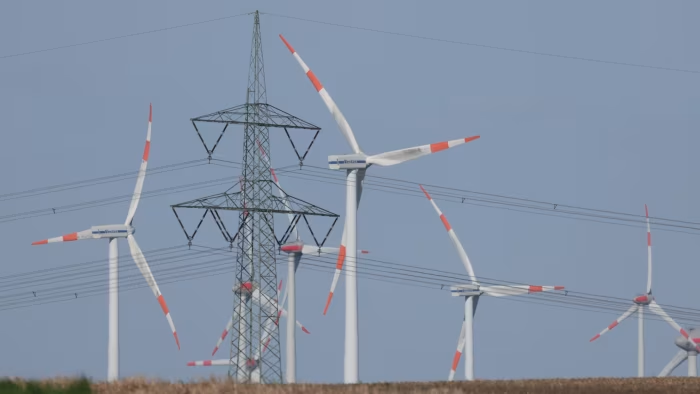
    The rapid build-out of renewables such as wind and solar, which are far more volatile and dispersed power sources than gas or coal power plants, means there is an even greater need to upgrade and improve the grid.

    The commission will develop “a comprehensive central EU scenario” for energy infrastructure planning, according to a draft document due to be presented next Wednesday.

    Brussels would also undertake a “gap-filling” process, it said, that would “propose projects to address unmatched needs” in energy grids.

    According to a report last month by the German think-tank Agora Energiewende, the EU could save more than €560bn between 2030 and 2050 if EU countries co-ordinated their energy infrastructure planning across sectors.

    “A top-down approach to scenario-building would help identify areas where investment is needed,” the report said.

    A major blackout on the Iberian peninsula in April and electricity price spikes in Greece last summer have strengthened the argument for more intervention from Brussels, officials have said.

    Brussels will also establish an EU-level effort to simplify and speed up permitting procedures, which can take several years at present and hamper projects with a hefty administrative burden.

    But Nicolás González Casares, a Spanish socialist lawmaker who led negotiations on the EU’s electricity market last year, said he was “particularly worried” that the commission’s new approach risked overriding environmental protections and creating legal uncertainty by assuming tacit approval for projects in order to speed up construction timelines. “The energy transition will only succeed if it is fast, but also fair and sustainable,” he said.

    The first test of the new approach will be on eight proposed “energy highways”, which include interconnectors across the Pyrenees, cables linking Cyprus to mainland Europe and pipelines for hydrogen in south and south-west Europe.

    The commission will also publish guidance for member states on prioritising critical projects for grid connection in an effort to reduce queues that are in some cases years long and have led to power-rationing in some countries.

    Continue Reading

  • Glencore’s copper pitch: buy in or buy me – Financial Times

    Glencore’s copper pitch: buy in or buy me – Financial Times

    1. Glencore’s copper pitch: buy in or buy me  Financial Times
    2. Glencore’s Copper Promises Demand Blind Faith From Investors  Bloomberg.com
    3. Key facts: Glencore’s stock hits 10-month high; 1,000 roles eliminated; layoffs in chrome venture  TradingView
    4. Swiss commodities trader Glencore cuts 1,000 jobs  SWI swissinfo.ch
    5. Glencore to restart production at Alumbrera copper mine in Argentina  WKZO

    Continue Reading

  • Hans-Jörg Rudloff, banker, 1940-2025

    Hans-Jörg Rudloff, banker, 1940-2025

    Unlock the Editor’s Digest for free

    Few bankers are as closely associated with a single financial product as Hans-Jörg Rudloff. The Swiss-German banker might not have invented the eurobond, but he presided over its greatest period of growth — the 1980s — and dominated the hard-charging entrepreneurial firm that most embodied its spirit: Credit Suisse First Boston.

    In some ways Rudloff, who has died at the age of 85, was an enigma. Despite spending his entire career in an industry often derided as cynical and greedy, he was also a visionary, believing sincerely in the power of finance to drive growth and improve people’s lives. “Capital markets have steered capital to all corners of this world and lifted billions of people out of poverty,” he said. It was a credo first formed on Wall Street in the late 1960s when, as a young bond salesman at Kidder Peabody, he witnessed the vigour and efficiency of New York’s financial markets, which he associated with the prosperity of American life.

    This was a time when the US government, amid concerns about widening deficits during the Vietnam war, had slapped restrictions on exports of dollars. One unintended consequence was to spark into life a market centred in London but outside any national regulatory or tax control that shuffled offshore dollar deposits from investors into the hands of international corporations.

    Rudloff moved back to Europe, keen to participate in this development, and in 1980 was recruited to a senior role at CSFB, then a new joint venture between Credit Suisse and the US investment bank First Boston. It was a propitious moment: the market was exploding, propelled by ever faster communications and the Thatcher-Reagan era rolling-back of currency controls.

    Rudloff thrived in this highly competitive environment. For much of the 1980s, CSFB topped the league tables for eurobond issues. He acquired the sobriquet “king of the Euromarkets” for the invention of the “bought deal”. Instead of surveying the appetite of prospective investors before launching an issue, the underwriter would buy it outright, hoping to resell the bonds for a profit. Rudloff’s advantage, he once said, “was that I had permission to underwrite at 10 o’clock at night, whereas every other firm had to go to ten bloody committees to get any permission to underwrite anything”. It was a freedom he freely indulged, reportedly signing contracts over champagne at Annabel’s — a London nightclub of which he was an enthusiastic patron.

    The one certainty in banking is that advantages conferred by innovation get whittled away, and by the end of the 1980s CSFB lost its lead to giant Japanese banks. The firm descended into infighting, some of it blamed on Rudloff’s confrontational style (he cheerfully described himself as “a bit more ruthless than other people”). Rudloff responded by leaving Credit Suisse and reinventing himself as an emerging markets banker, setting out to bring the benefits of capital markets to the newly freed countries beyond the Berlin Wall at a time when few investment banks dared to go there.

    It was an adventure that catapulted him into the cockpit of Russian business in the era of Vladimir Putin, sitting on the board of the oil company Rosneft right until the outbreak of the Ukraine war. Rudloff continued to believe that in financing the reconstruction of eastern Europe, investment banking had “proved its worth, just as it did in 19th-century America”. But by the end of his life, he was dismayed to see the liberal, open world in which he believed was strongly in retreat.

    Rudloff was born in wartime Cologne in 1940 to a German industrialist father and a Swiss mother. His dual nationality made him an outsider in the conservative world of Swiss finance, and perhaps impelled him to look beyond its borders. Small, bustling and intense, he always competed to the utmost. Unable to ski until later in life, Rudloff set out to rectify the situation, engaging a “crazy but enormously talented ski coach”, according to friend Bob Loverd, and systematically acquiring the skills of a pro. “If he decided to do something, he put everything he had into it,” Loverd recalled.

    Rudloff could be polarising: his manner was often abrupt — even if the barbs were delivered with a twinkle. But to those he gave his friendship he was enormously loyal, and liked nothing more than to help those in whom he saw flashes of his younger self. “While he pushed you hard, he could be very kind,” said Charles Harman, a colleague at CSFB. “He would come round the floor at 8.30 in the evening and say: ‘Who wants dinner?’ to the juniors who were there. How many City bosses do that?” Rudloff’s last wish was to throw a party for his many friends.

    Continue Reading