Category: 3. Business

  • Court releases audio of 911 call that led to Luigi Mangione’s arrest | New York

    Court releases audio of 911 call that led to Luigi Mangione’s arrest | New York

    An audio recording of a 911 call that led to Luigi Mangione’s arrest has been made public after the press advocated for its release.

    The audio recording was played in Manhattan state court this week during a proceeding about evidence gathered during Mangione’s arrest over the murder of senior United HealthCare executive Brian Thompson a year ago. Mangione was arrested at a McDonald’s in Altoona, Pennsylvania in December last year after the restaurant’s manager called 911.

    “I have a customer here that some other customers were suspicious of, that he looks like the CEO shooter from New York,” the manager could be heard saying in audio of the call that was played in court on Monday.“They’re just really upset and they’re like coming to me, and I was like, ‘Well, I can’t approach him.’”

    Audio recording of 911 call that led to Luigi Mangione’s arrest released by court – video

    She told the 911 operator that the man who drew suspicion was wearing a black jacket, medical mask, and a khaki-colored beanie.

    “He has his beanie pulled down, so the only thing you can see is his eyebrows,” the manager said when pressed on more details about his description. The manager told the operator that she “tried to Google it” in an effort “to calm them down a little bit, and I’m like, ‘Guys, it’s kind of hard to tell with his eyes and his eyebrows … ”

    The 911 call played a pivotal role in police interdicting Mangione, who is facing state and federal charges in Thompson’s murder. Mangione has pleaded not guilty to all counts.

    Joseph Detwiler, the Altoona police officer who first approached Mangione and arrested him, testified on Tuesday that he knew who the manager referred to in her 911 call, on account of the mask.

    “We don’t wear masks,” Detwiler said when asked about mask culture in Altoona. “We have antibodies.”

    As “no one wears masks” in Altoona, Detwiler said, it was clear that the man spurred suspicion.

    “He had a mask on,” Detwiler also said. “So he had to be the person we were called there for.”

    This release of evidence marked a shift from Tuesday, when Judge Gregory Carro sided with Mangione’s defense in sealing materials until the trial. A reporter was ejected from the courtroom after she stood, requesting to be heard on sealing.

    Members of the press in New York routinely stand and request to be heard in state and federal courts. Legal precedent makes clear that journalists have the right to be heard on access matters.

    One New York state court decision, for example, states: “The court must adhere strictly to the procedures set forth in the controlling case law including affording a full opportunity by any interested members of the press to be heard, and making specific findings to support its determination without revealing the subject or issue, before closing the courtroom or sealing exhibits.”

    At least one member of the press, Matthew Lee, of Inner City Press, wrote to Carro requesting that exhibits be unsealed. In announcing that some documents would be unsealed on Thursday, Carro reportedly said: “For those of you who are interested … a number of the exhibits will be made available on the DA’s Dropbox shortly.”

    Carro did not make any mention of the journalist’s ejection from court, according to Molly Crane-Newman of the New York Daily News. The evidence released does not include everything that was played in court.

    Continue Reading

  • China Monthly Tax Brief: November 2025

    China Monthly Tax Brief: November 2025

    In this China Monthly Tax Brief for November 2025, we highlight key taxation developments relevant to businesses.


    November saw several significant tax and regulatory developments that continue to shape China’s broader efforts to refine enforcement practices, improve administrative predictability, and strengthen support for businesses, particularly foreign-invested enterprises. Recent measures issued by national and local authorities reflect a clear policy direction: tightening compliance standards while enhancing service transparency and clarifying long-standing procedural ambiguities.

    Find Business Support

    This month’s brief highlights five notable updates. These include the Ministry of Finance (MOF) and the State Taxation Administration (STA)’s clarification of resource tax enforcement standards, a joint announcement by the STA and the Supreme People’s Court on handling tax matters in corporate bankruptcy, the issuance of a full-cycle tax service guide for foreign-invested projects, the new disciplinary rules for tax officials, and Shanghai’s refined procedures for non-profit organizations seeking tax-exempt qualification. Taken together, these developments signal continued progress toward a more unified, rule-based, and service-oriented tax administration environment.

    Explore vital economic, geographic, and regulatory insights for business investors, managers, or expats to navigate China’s business landscape. Our Online Business Guides offer explainer articles, news, useful tools, and videos from on-the-ground advisors who contribute to the Doing Business in China knowledge.
    Start exploring

    MOF and STA clarified resource tax enforcement standards

    To fully implement the Resource Tax Law of the People’s Republic of China, the MOF and STA recently issued the Announcement on Clarifying the Enforcement Standards for Resource Tax Policies (MOF STA Announcement [2025] No. 12).

    This announcement does not introduce a new resource tax regime. Instead, it provides systematic and targeted refinements to address ambiguities, contentious points, and practical challenges encountered during the enforcement of the existing Resource Tax Law and its supporting policies. The primary objective is to unify enforcement standards nationwide, reduce uncertainty in policy implementation, close loopholes in tax collection, and ensure that tax policies are applied fairly, transparently, and efficiently.

    What the rules do

    Clearer tax base rules

    The announcement refines how companies determine sales revenue for tax purposes, especially where no output VAT is generated at the final production stage. It also confirms that freight deductions and purchase deductions must exclude VAT.

    For companies mixing purchased and self-produced products, the new rules tighten how deductions are calculated. If a company engages in both mixed sales and mixed processing, it must account for each separately. If this is impossible, mixed-sales rules apply by default. For companies engaged solely in mixed sales or mixed processing, a simplified method applies: the entire deductible amount for purchased products can be claimed in the purchase period, with any unused portion carried forward to subsequent periods.

    Stronger scrutiny of related-party pricing

    One of the most consequential changes for foreign-invested groups is the strengthened approach to abnormally low related-party prices. Tax authorities may adjust taxable revenue if a company sells products to a related entity at an unreasonably low price without justification. Acceptable justifications center on commercial logic: government-guided pricing, reasonable profit margins, or separate freight charges.

    A notable rule: if raw ore is sold to a related party and later processed, authorities may reconstruct the price based on the final sale price of the processed ore minus reasonable processing costs and profit.

    More precise product classifications

    For businesses handling coal, salt, or rare earths, the update provides sharper definitions of what counts as raw ore versus processed ore. For example:

    These definitions directly affect tax rates.

    Updated rules on non-taxable

    The announcement expands non-taxable scenarios, such as:

    • Taxable products confiscated by authorities
    • Sand, gravel, and clay extracted on approved construction sites and used for backfilling

    It also sharpens the definition of “continuous production” to clarify when internal transfers of materials remain non-taxable.

    More detailed administration of reductions and exemptions

    Existing statutory reductions remain unchanged, but the announcement provides more detailed standards for:

    • Depleted mine eligibility
    • How reductions are calculated
    • What documentation companies must retain
    • How backfill-mining quantities should be measured

    For foreign companies operating mature or declining mining assets, this added clarity reduces uncertainty around long-term tax planning.

    Why this matters for businesses

    The overall message is that China is shifting toward tighter, more uniform enforcement. For foreign-invested resource companies, especially those involved in joint ventures, multi-province operations, or related-party transactions, this clarity reduces interpretive room but also strengthens predictability.

    The focus on related-party pricing and product classification signals that regulators want greater transparency and cleaner cost-allocation structures. Companies relying heavily on internal transfers or cross-border valuation policies should take note.

    The update also emphasizes documentation and record-keeping. In practice, this means more pressure on internal systems and accounting teams to ensure production data, freight records, and mixed-product calculations can withstand audit review.

    What should companies do now?

    Find Business Support

    First, businesses should reassess their compliance posture under the updated resource tax framework. This includes verifying that product classifications, particularly for coal, rare earths, and salt, are consistent with the revised definitions in MOF STA Announcement [2025] No. 12.

    Companies should also review related-party pricing policies to ensure they reflect reasonable commercial substance and comply with strengthened transfer pricing rules. In addition, enterprises need to examine their accounting treatment for mixed sales and processing activities, confirming that deduction methods for purchased and self-produced taxable products meet the clarified requirements.

    Meanwhile, it is essential to optimize internal management and accounting practices. Businesses should maintain accurate production records for raw ore, processed ore, and self-use quantities. Separate accounting for tax reduction items is critical to ensure exempt or reduced-tax projects can be independently and accurately calculated.

    Furthermore, companies must prepare and archive all supporting documentation for tax benefits in line with the new compliance standards, as these materials will be key for audits and verification.

    Finally, enterprises should update systems and strengthen communication with tax authorities. Financial systems and internal tax manuals should be upgraded to incorporate compliance requirements. At the same time, proactive engagement with local tax bureaus is recommended, particularly on complex issues such as related-party pricing or mixed business scenarios, to secure clarity and reduce compliance risks.

    STA and the Supreme Court clarified tax matters in bankruptcy proceedings

    To implement the central government’s directives on improving corporate bankruptcy mechanisms and market exit systems, and to advance tax administration reform, the STA and the Supreme People’s Court jointly issued Announcement [2025] No. 24.

    What the rules do

    This landmark guidance aims to standardize the handling of tax-related matters in bankruptcy proceedings, enhance enforcement certainty and consistency, and strike a balance between safeguarding state tax interests and protecting taxpayers’ lawful rights.

    Key provisions include:

    • Scope and categories of tax claims: Tax authorities, as creditors, must declare unpaid taxes (including education surcharges), late payment surcharges, fines, special tax adjustment interest; social insurance contributions and surcharges; and non-tax revenues collected by tax authorities with clear responsibility. Tax and social insurance contributions are declared separately under the Enterprise Bankruptcy Law, while surcharges, interest, and fines are treated as ordinary bankruptcy claims.
    • Determination of tax claims: Tax claims are calculated up to the date the court accepts the bankruptcy application. Taxes arising after acceptance, such as those related to asset disposal or continued operations, are treated as bankruptcy expenses or common benefit debts and must be settled promptly. Importantly, even if the statutory filing deadline has not arrived, any tax obligation incurred before acceptance is deemed due.
    • Administrator’s tax responsibilities: The bankruptcy administrator must fulfill tax obligations on behalf of the debtor, including filing returns, withholding taxes, and issuing invoices. Administrators may use their official seal for tax matters, and tax authorities must verify their identity information. Tax authorities are also required to cooperate with courts and administrators in accessing tax data and lift enforcement measures upon receiving the court’s acceptance ruling.
    • Handling pre-bankruptcy tax violations: Tax authorities should issue penalty decisions and declare related claims before the end of the claim declaration period. If penalties are imposed later, they must be declared before the first creditors’ meeting votes on distribution or restructuring plans. For enterprises in abnormal tax status, overdue filings must be completed, penalties imposed, and status restored promptly.
    • Support for restructuring and credit repair: In restructuring or settlement, unpaid surcharges, fines, and interest under the plan do not affect the enterprise’s eligibility for tax credit restoration or subsequent deregistration. For liquidated enterprises, tax authorities must issue clearance certificates and write off uncollectible debts upon receiving the court’s termination ruling.
    • Implementation: Effective immediately, the announcement applies to all ongoing bankruptcy cases not yet concluded.

    Why this matters for businesses

    This announcement addresses long-standing pain points in tax administration during bankruptcy, such as unclear claim priorities, inconsistent enforcement, and operational uncertainty. By defining the scope and sequence of tax claims, clarifying the administrator’s role, and introducing mechanisms for credit repair, it provides a predictable framework for both tax authorities and businesses. Notably, its emphasis on facilitating corporate restructuring and restoring credit signals a strong policy orientation toward business revitalization and a market-oriented, rule-of-law business environment. For enterprises, this means greater clarity in compliance obligations during insolvency and improved prospects for post-restructuring recovery.

    STA released a comprehensive tax service guide for foreign-invested projects

    To systematically support the development of foreign-invested enterprises (FIEs) in China, the STA has released the Full-Cycle Tax Service Guide for Foreign-Invested Projects, a flagship achievement under the Tax Road service brand. This guide is the first to adopt a full lifecycle approach, integrating tax policies, service measures, and risk alerts into a single operational manual. It provides FIEs with a practical framework for tax planning, preferential policy application, and risk prevention throughout their investment journey in China.

    What the rules do

    The guide consolidates scattered tax rules and service channels into a unified roadmap, covering every stage of an enterprise’s lifecycle, including investment, construction, operation, and exit. It places special emphasis on preferential policies extended or newly introduced during 2024–2027.

    Key benefits include:

    • Strategic tax planning: Guidance on deferral policies for reinvested profits and technology-for-equity arrangements.
    • Clear application pathways: Such as procedures for claiming R&D super deductions and high-tech enterprise status.
    • Risk identification: Alerts on common pitfalls such as permanent establishment (PE) recognition and outbound payment compliance.
    • Enhanced service access: Details on dedicated project managers, cross-border e-tax solutions, and multilingual consultation channels.
    Key Tax Incentives (Sample)
    Stage Key policy Applicable entities Policy highlights
    Investment stage Deferral of withholding tax on reinvested profits Foreign investors Eligible investors may enjoy direct deferral of withholding tax on reinvested profits.
    Tax deferral for equity investment made through technology contributions Enterprises/individuals Tax payment may be deferred until the equity is transferred.
    Construction stage One-off deduction for equipment and appliances (below RMB 5 million) All enterprises Equipment purchased from 2024 to 2027 can be fully deducted for tax purposes in the year of purchase.
    VAT credit refund General VAT taxpayers Eligible taxpayers may apply for a refund of excess VAT credit.
    Production stage R&D super deduction (100% / 120%) Eligible resident enterprises

    Integrated circuit and industrial machine-tool enterprises may claim a 120 percent super deduction.

    15 percent CIT rate for high-tech enterprises Certified high-tech enterprises Must meet requirements on IP ownership, R&D personnel ratio, and revenue composition.
    Tax-favored allowances for foreign individuals Foreign individuals meeting resident criteria May choose between tax-exempt allowances or standard special additional deductions (one option only).
    Exit stage Special tax treatment for equity transfers Enterprise restructuring that meets relevant conditions Deferral available if conditions such as a controlling relationship and commitment period are met.
    CIT exemption and reduction for technology transfer income Resident enterprises Income up to RMB 5 million is exempt; excess amount is taxed at half rate.


    Meanwhile, the guide provides some service innovations, such as:

    • “Project manager” system: Dedicated tax liaison for major foreign-invested projects.
    • Cross-border e-tax: Remote filing and payment for non-resident enterprises via the electronic tax bureau.
    • Multilingual hotline (12366): Support in nine languages, including English, Japanese, and Korean etc.
    • Direct system integration: Optional API connection for automated invoicing and filing.

    In addition, the guide also summarizes key risk areas, common pitfalls, and recommended actions to help businesses strengthen compliance and reduce exposure.

    Key Tax Risk Areas for FIEs

    Risk area Specific risks Recommended actions
    Permanent establishment (PE) determination Overseas companies’ activities in China may constitute a PE, triggering corporate income tax obligations Carefully assess China business activities and operating models to avoid unintentionally creating a PE
    Treaty benefit entitlement Failure to meet the “beneficial owner” requirement or incomplete documentation may result in ineligibility for treaty benefits Self-assess compliance, retain all supporting documents for future review
    Related-party transaction filing Incorrect reporting of transaction types, lack of contemporaneous documentation, or non-compliant transfer pricing Complete related-party filings on time, prepare contemporaneous documentation, and use a transfer pricing benchmarking study to ensure arm’s-length pricing
    Outbound payment filing Failure to file or withhold taxes for outbound payments may lead to late payment surcharges and penalties Fulfill withholding obligations when outbound payments occur; for any single payment equivalent to US$50,000 or above, complete the required payment registration for service trade and similar transactions

    Why this matters for businesses

    Find Business Support

    This guide is more than a compliance tool – it is a strategic resource for foreign investors navigating China’s complex tax landscape. By providing structured pathways for preferential policy access and risk mitigation, it empowers enterprises to optimize tax efficiency while maintaining regulatory integrity. For CFOs and tax managers, the guide serves as a blueprint for investment structuring, operational compliance, and exit planning, reducing uncertainty and enhancing predictability in cross-border operations.

    Enterprises should integrate the guide into internal tax governance frameworks, transforming its content into actionable workflows, checklists, and training modules. This approach ensures alignment between policy understanding, compliance execution, and risk control, supporting sustainable growth in China’s evolving business environment.

    STA released new disciplinary rules for tax officials

    On November 24, 2025, the STA issued Order No. 60, releasing the Provisions on Disciplinary Actions for Tax Officials’ Misconduct in Tax Administration. Although the regulation is designed to govern tax officials’ conduct, it has important implications for taxpayers by clarifying the boundaries of lawful tax enforcement.

    What the rules do

    The provisions explicitly prohibit and punish several types of improper enforcement practices, including:

    • Over-collection of taxes and fees, such as imposing taxes beyond what is legally required.
    • Issuing decisions that conflict with tax laws or exceed officials’ authority,
      such as imposing unlawful conditions, denying policy benefits without a basis, or requiring documents not prescribed by law.
    • Improperly adjusting invoice quotas or quantities, preventing businesses from obtaining or using invoices without legal justification.
    • Colluding with local governments for improper investment solicitation, such as promising unauthorized tax incentives to attract investment.

    Why this matters for businesses

    By defining and penalizing these behaviors, the regulation effectively sets rigid boundaries for tax enforcement. This helps:

    • Reduce uncertainty related to inconsistent or discretionary practices at the local level.
    • Increase predictability in tax-enterprise interactions, especially in regions where enforcement varies.
    • Improve transparency in how tax policies are applied.

    In short, the rules aim to curb enforcement “flexibility” that sometimes resulted in undue burdens or compliance risks for businesses.

    What taxpayers should take note of

    While the regulation reduces risks arising from improper enforcement, it also raises expectations on taxpayers:

    • Substantive compliance becomes more important: tax positions must be well-supported and commercially grounded.
    • Stronger internal controls are needed, as clearer enforcement boundaries mean authorities may focus more strictly on taxpayers’ own documentation, transactions, and factual substance.

    Overall, Order No. 60 signals the STA’s push toward more standardized, rule-based, and accountable tax administration, providing businesses with both stronger protection and higher compliance expectations

    Shanghai refines and unifies the exemption qualification process for non-profit organizations

    On November 5, 2025, the Shanghai Municipal Finance Bureau and Taxation Bureau jointly released the Notice on Improving the Administration of Tax-Exempt Qualification for Non-Profit Organizations in Shanghai (Hu Caishui [2025] No. 72). The notice refines and unifies the city’s management procedures for determining tax-exempt eligibility. It introduces a two-tier review mechanism, municipal and district level, based on the registration authority responsible for each non-profit organization, with both levels required to publish approved lists separately.

    First-time applicants must submit their materials by the end of the month following the end of the quarter in which the organization is established or registered. Late submissions will not result in retrospective recognition for prior years. For renewals, organizations must file for re-examination within six months after the expiry of their exemption period (that is, by June 30 of the following year). The notice takes effect on December 1, 2025, and affected organizations should plan ahead and prepare their applications accordingly.

    About Us

    China Briefing is one of five regional Asia Briefing publications. It is supported by Dezan Shira & Associates, a pan-Asia, multi-disciplinary professional services firm that assists foreign investors throughout Asia, including through offices in Beijing, Tianjin, Dalian, Qingdao, Shanghai, Hangzhou, Ningbo, Suzhou, Guangzhou, Haikou, Zhongshan, Shenzhen, and Hong Kong in China. Dezan Shira & Associates also maintains offices or has alliance partners assisting foreign investors in Vietnam, Indonesia, Singapore, India, Malaysia, Mongolia, Dubai (UAE), Japan, South Korea, Nepal, The Philippines, Sri Lanka, Thailand, Italy, Germany, Bangladesh, Australia, United States, and United Kingdom and Ireland.

    For a complimentary subscription to China Briefing’s content products, please click here. For support with establishing a business in China or for assistance in analyzing and entering markets, please contact the firm at china@dezshira.com or visit our website at www.dezshira.com.


     

    Continue Reading

  • Bristol Myers Squibb’s Breyanzi Approved by the U.S. FDA as the First and Only CAR T Cell Therapy for Adults with Relapsed or Refractory Marginal Zone Lymphoma (MZL) – Bristol Myers Squibb

    1. Bristol Myers Squibb’s Breyanzi Approved by the U.S. FDA as the First and Only CAR T Cell Therapy for Adults with Relapsed or Refractory Marginal Zone Lymphoma (MZL)  Bristol Myers Squibb
    2. FDA Approves Liso-Cel in Pretreated R/R Marginal Zone Lymphoma  Oncology Nursing News
    3. FDA Approves Breyanzi in Relapsed/Refractory Marginal Zone Lymphoma  Cure Today
    4. BMS’s Breyanzi is first CAR-T approved in US for rare lymphoma  FirstWord Pharma
    5. FDA Approves Liso-Cel in Marginal Zone Lymphoma After 2 Lines of Therapy  CancerNetwork

    Continue Reading

  • Pakistan denies claims of use of Israeli spyware – Newspaper

    Pakistan denies claims of use of Israeli spyware – Newspaper

    KARACHI: Pakistan on Thursday refuted claims published in an Amnesty International report on Thursday that a spyware product, manufactured by an Israeli company, was actively being used in the country.

    According to a senior intelligence officer, who spoke to Dawn on condition of anonymity, the report was an “an attempt to malign Pakistan”.

    “There is not an iota of truth in it,” he stressed.

    The official was referring to a claim made in the Amnesty International investigation, titled “Intellexa Leaks”, which described the story of a human rights lawyer based in Pakistan.

    The lawyer, according to the report, had approached Amnesty International in the summer of 2025 after receiving a suspicious link on WhatsApp from an unknown number.

    Amnesty’s Security Lab investigated the link and identified it as a Predator spyware attack attempt based on the technical behaviour of the infection server.

    Predator is highly invasive spyware manufactured by the Israeli company Intellexa.

    According to Amnesty International, the investigation was based on a combina-tion of highly sensitive documents and other material leaked from the company, including internal company documents, sales and marketing materials, and training videos.

    The months-long investigation was published in collaboration with Inside Story in Greece, Haaretz in Israel, and WAV Research Collective in Switzerland.

    In 2023, Intellexa was fined by the Greek Data Protection Authority for failing to comply with its investigations into the company.

    Google started sending spyware threat notifications to several hundred of its users across various countries, including Pakistan. The accounts were identified as Predator spyware targets.

    Published in Dawn, December 5th, 2025

    Continue Reading

  • Stocks manage modest gains in volatile trade – Newspaper

    Stocks manage modest gains in volatile trade – Newspaper

    KARACHI: The stock market on Thursday managed to reverse its downturn on the back of mid-session value-hunting in selective sectors as the announcement of bidding date for the divestment of national flag-carrier boosted investor sentiment, helping the benchmark KSE 100 index to stage a mild recovery.

    According to Topline Securities, the investor confidence strengthened after the prime minister announced that the bidding process for the privatisation of Pakistan Inte­rnational Airlines (PIA) will be broadcast live on Dec 23. This development sparked notable investor interest in PIA Holding Company Ltd, which traded with healthy volumes throughout the day.

    After a heavy spell of overnight institutional selling, the PSX staged a welcome recovery, noted the brokerage. The benchmark index touched an intraday high of 691 points before closing at 166,283, up 138 points or 0.08pc, reflecting renewed buying interest and improved intraday sentiment.

    Meanwhile, Lalpir Power Ltd from the power sector surfaced as one of the session’s most actively traded stocks, with over 108 million shares exch­a­n­ging hands. The surge aligns with the company’s ongoing share buyback programme that comme­n­ced on Nov 28, as disclosed in its exchange notice.

    Market sentiment remained broadly positive, supported by strong performance by Services Industries, Pioneer Cement, Pakistan Telecommunication, Engro Holdings and Pakistan Petroleum, which collectively added approximately 298 points to the benchmark.

    Ali Najib, Deputy Head of Trading at Arif Habib Ltd, PSX extended its consolidation phase as throughout the session the benchmark moved in both directions within a narrow 951-point band.

    Service Industries surged to its upper circuit after announcing a board meeting other than financial results scheduled for tomorrow at 10am.

    Meanwhile, Fatima Fer­tiliser notified PSX that its subsidiary, Fatima Petroleum, has partnered with Mari Energies and Turkish Petroleum to cover two offshore blocks.Market activity remained moderate as the trading volume rose 2.48pc to 607.79 million shares. However, the traded value plunged by 29.71pc Rs31bn from the previous session.

    Published in Dawn, December 5th, 2025

    Continue Reading

  • BHP and Rio Tinto welcome first Caterpillar battery-electric haul trucks to the Pilbara

    BHP and Rio Tinto welcome first Caterpillar battery-electric haul trucks to the Pilbara

    PERTH, Australia–(BUSINESS WIRE)–
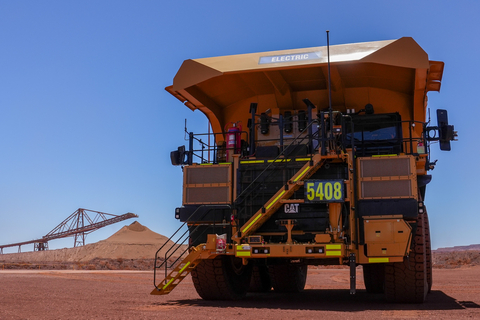
    Australia’s first Cat® 793 XE Early Learner battery-electric haul trucks have arrived at BHP’s Jimblebar iron ore mine in the Pilbara, marking the start of on-site testing, in collaboration with Rio Tinto, of Caterpillar’s battery-electric heavy haulage technology in the region that powers the nation’s economy.

    This press release features multimedia. View the full release here: https://www.businesswire.com/news/home/20251204183951/en/

    The two Early Learner trucks, delivered through an industry-first collaboration between BHP, Rio Tinto and Caterpillar represent a major step toward a more sustainable future in mining, designed to deliver zero exhaust emissions while maintaining productivity and performance.

    Once safely commissioned, the trials will begin to test the viability of battery-electric technology as an alternative to diesel usage in large-scale iron ore mining operations. The trials will help inform the development of technology, processes, infrastructure and people required to support lower greenhouse gas emissions machines and mine sites of the future.

    Decarbonisation of Pilbara iron ore operations will rely on technology advancements and breakthroughs in research and development, which is why BHP and Rio Tinto are working closely with Caterpillar, supported by WesTrac, to accelerate development and transition their fleets as soon as commercially and operationally viable.

    Following the joint trial, BHP and Rio Tinto will independently determine progress towards scaled trials within their respective operational environments.

    BHP Western Australia Iron Ore Asset President Tim Day said: “Powering up our first battery-electric haul trucks in the Pilbara is an important step forward on the mining industry’s road to decarbonisation.

    “Replacing diesel isn’t just about changing energy sources, it’s about reimagining how we operate and creating the technologies, infrastructure and supply chains to transform mining operations. These trials will help us understand how all the pieces of the puzzle fit together: the battery technologies, generation and charging infrastructure, power management, as well as the supply chains to potentially deliver this at scale.

    “A significant shift like this demands a strong commitment to research and development, coupled with collaboration across the industry. This is going to take time to get right, which is why trials like this one with Rio Tinto and Caterpillar are so critical.

    “These trials are a critical part of this work as we bring the testing to the reality of the Pilbara. We’re excited about what we’ll learn about how best to deliver the breakthroughs required to accelerate this transition.”

    Rio Tinto Iron Ore Pilbara Mines Managing Director Andrew Wilson said: “Decarbonising Rio Tinto’s fleet across our 18 Pilbara mines is a significant challenge. By exploring solutions like this to reduce emissions, we hope that, over time, we will be able to move away from diesel.

    “No single company can achieve zero emissions haulage on its own. It takes the whole industry working together. That’s why we’re working with BHP and Caterpillar to develop new solutions that will reduce emissions in mining and help us reach our net zero commitments.

    “Through this industry-first collaboration to test Cat 793 XE Early Learner battery-electric haul trucks in Pilbara conditions, we hope to meet our shared goals as quickly and efficiently as we can.”

    Caterpillar Inc. Resource Industries Sales Services and Technology Senior Vice President Marc Cameron said: “The arrival of the Early Learner trucks in the Pilbara marks a significant milestone in the journey toward a more sustainable future.

    “By working side by side with our customers, we’re delivering solutions to help them solve their toughest challenges while learning together each step of the way. This collaboration is key to accelerating innovation and shaping the next generation of mining technology, and we’re excited to be on this journey together with our Early Learner customers.”

    Ongoing testing and development throughout this trial will enable learning toward future deployment. This will inform the approach for testing a larger number of haul trucks and the potential integration of battery-electric haul truck fleets into each company’s operations.

    The collaboration reflects the shared ambitions of BHP, Rio Tinto and Caterpillar to support BHP’s and Rio Tinto’s respective net zero operational greenhouse gas emissions goals by 2050.

    Please direct all enquiries to media.enquiries@riotinto.com

    Media Relations,

    United Kingdom

    Matthew Klar

    M +44 7796 630 637

    David Outhwaite

    M +44 7787 597 493

    Media Relations,

    Australia

    Matt Chambers

    M +61 433 525 739

    Alyesha Anderson

    M
    +61 434 868 118

    Rachel Pupazzoni

    M +61 438 875 469

    Bruce Tobin

    M +61 419 103 454

    Media Relations,

    Canada

    Simon Letendre

    M +1 514 796 4973

    Malika Cherry

    M +1 418 592 7293

    Vanessa Damha

    M +1 514 715 2152

    Media Relations,

    US & Latin America

    Jesse Riseborough

    M +1 202 394 9480

    Investor Relations,

    United Kingdom

    Rachel Arellano

    M
    +44 7584 609 644

    David Ovington

    M +44 7920 010 978

    Laura Brooks

    M +44 7826 942 797

    Weiwei Hu

    M +44 7825 907 230

    Investor Relations,

    Australia

    Tom Gallop

    M +61 439 353 948

    Eddie Gan-Och

    M
    +976 95 091 237

    Rio Tinto plc

    6 St James’s Square

    London SW1Y 4AD

    United Kingdom

    T +44 20 7781 2000

    Registered in England

    No. 719885

    Rio Tinto Limited

    Level 43, 120 Collins Street

    Melbourne 3000

    Australia

    T +61 3 9283 3333

    Registered in Australia

    ABN 96 004 458 404

    riotinto.com

    Category: Pilbara

    Source: Rio Tinto


    Continue Reading

  • Dollar hovers near five-week low on Fed rate cut bets – Reuters

    1. Dollar hovers near five-week low on Fed rate cut bets  Reuters
    2. FX Daily Snapshot  MUFG Research
    3. US Dollar Shows Signs of Stability Into PCE Inflation: USD/JPY, USD/CHF  FOREX.com
    4. The US Dollar is under pressure due to diverging expectations for Federal Reserve policy and politics  VT Markets
    5. Dollar’s downside momentum stalls  FXStreet

    Continue Reading

  • BHP and Rio Tinto welcome first Caterpillar battery-electric haul trucks to the Pilbara

    BHP and Rio Tinto welcome first Caterpillar battery-electric haul trucks to the Pilbara

    Australia’s first Cat® 793 XE Early Learner battery-electric haul trucks have arrived at BHP’s Jimblebar iron ore mine in the Pilbara, marking the start of on-site testing, in collaboration with Rio Tinto, of Caterpillar’s battery-electric heavy haulage technology in the region that powers the nation’s economy. 

    The two Early Learner trucks, delivered through an industry-first collaboration between BHP, Rio Tinto and Caterpillar represent a major step toward a more sustainable future in mining, designed to deliver zero exhaust emissions while maintaining productivity and performance. 

    Once safely commissioned, the trials will begin to test the viability of battery-electric technology as an alternative to diesel usage in large-scale iron ore mining operations. The trials will help inform the development of technology, processes, infrastructure and people required to support lower greenhouse gas emissions machines and mine sites of the future.  

    Decarbonisation of Pilbara iron ore operations will rely on technology advancements and breakthroughs in research and development, which is why BHP and Rio Tinto are working closely with Caterpillar, supported by WesTrac, to accelerate development and transition their fleets as soon as commercially and operationally viable. 

    Following the joint trial, BHP and Rio Tinto will independently determine progress towards scaled trials within their respective operational environments. 

    Tim Day, Western Australia Iron Ore Asset President, said: 

    “Powering up our first battery-electric haul trucks in the Pilbara is an important step forward on the mining industry’s road to decarbonisation. 

    “Replacing diesel isn’t just about changing energy sources, it’s about reimagining how we operate and creating the technologies, infrastructure and supply chains to transform mining operations. These trials will help us understand how all the pieces of the puzzle fit together: the battery technologies, generation and charging infrastructure, power management, as well as the supply chains to potentially deliver this at scale. 

    “A significant shift like this demands a strong commitment to research and development, coupled with collaboration across the industry. This is going to take time to get right, which is why trials like this one with Rio Tinto and Caterpillar are so critical. 

    “These trials are a critical part of this work as we bring the testing to the reality of the Pilbara. We’re excited about what we’ll learn about how best to deliver the breakthroughs required to accelerate this transition.” 

     Andrew Wilson, Rio Tinto Iron Ore Managing Director Pilbara Mines, said: 

    “Decarbonising Rio Tinto’s fleet across our 18 Pilbara mines is a significant challenge. By exploring solutions like this to reduce emissions, we hope that, over time, we will be able to move away from diesel. 

    “No single company can achieve zero emissions haulage on its own. It takes the whole industry working together. That’s why we’re working with BHP and Caterpillar to develop new solutions that will reduce emissions in mining and help us reach our net zero commitments. 

    “Through this industry-first collaboration to test Cat 793 XE Early Learner battery-electric haul trucks in Pilbara conditions, we hope to meet our shared goals as quickly and efficiently as we can.” 

    Marc Cameron, Senior Vice President, Resource Industries Sales, Services and Technology, Caterpillar Inc:  

    “The arrival of the Early Learner trucks in the Pilbara marks a significant milestone in the journey toward a more sustainable future. By working side by side with our customers, we’re delivering solutions to help them solve their toughest challenges while learning together each step of the way. This collaboration is key to accelerating innovation and shaping the next generation of mining technology, and we’re excited to be on this journey together with our Early Learner customers.”  

    Ongoing testing and development throughout this trial will enable learning toward future deployment.  This will inform the approach for testing a larger number of haul trucks and the potential integration of battery-electric haul truck fleets into each company’s operations. 

    The collaboration reflects the shared ambitions of BHP, Rio Tinto and Caterpillar to support BHP’s and Rio Tinto’s respective net zero operational greenhouse gas emissions goals by 2050. 


    Continue Reading

  • PSX recovers on live PIA bidding report

    PSX recovers on live PIA bidding report


    KARACHI:

    Following a session marked by institutional profit-taking a day earlier, the Pakistan Stock Exchange (PSX) witnessed a measured rebound on Thursday as renewed buying helped the benchmark KSE-100 index claw back some lost ground.

    The market briefly surged around 700 points during intra-day trade before settling with a modest uptick of around 140 points, reflecting cautious optimism and selective re-entry by investors.

    Sentiment strengthened after Prime Minister Shehbaz Sharif announced that bidding for Pakistan International Airlines (PIA) would be broadcast live on December 23, 2025, a development that fuelled interest in PIA Holding Company, which was actively traded throughout the session.

    At the close of trading, the benchmark KSE-100 index posted a mild gain of 138.20 points, or 0.08%, settling at 166,283.55.

    Arif Habib Limited (AHL) reported a largely flat session following two consecutive days of decline, with market breadth evenly balanced as 50 stocks advanced while 49 retreated. Index support came primarily from Service Industries (+10%), Pioneer Cement (+3.84%) and PTCL (+4.95%). On the downside, Fauji Fertiliser Company (-0.86%), Pakistan Services (-6.7%) and Mari Energies (-0.62%) were the biggest drags, it said.

    In sector developments, the telecom regulator granted conditional approval for the acquisition of Telenor Pakistan by PTCL. Meanwhile, Bank Alfalah (+0.18%) accepted a non-bidding offer from Ghazanfar Bank to acquire its Afghanistan business, pending satisfactory due diligence. With key support near 164,000, the KSE-100 remains 0.24% down while heading into the final session of the week, AHL said.

    “It was a market recovery as investors re-entered,” noted Topline Securities in its review. After a heavy spell of institutional selling in Wednesday’s session, the bourse staged a welcome recovery on Thursday. The benchmark index touched the intra-day high of 691 points before closing at 166,284, up 138 points, reflecting renewed buying interest and improved intra-day sentiment.

    On the news front, it said, confidence strengthened after the prime minister announced that the bidding process for the privatisation of PIA would be broadcast live on national television on December 23. This development sparked notable investor interest in PIA Holding Company, which saw healthy volumes.

    Meanwhile, Lalpir Power emerged as one of the most actively traded stocks, with over 108 million shares changing hands. The surge aligns with the company’s ongoing share buyback programme that commenced on November 28.

    Market sentiment remained broadly positive, supported by strong performance in key heavyweights such as Service Industries, Pioneer Cement, PTCL, Engro Holdings and Pakistan Petroleum, which added 298 points to the index, Topline said.

    Mubashir Anis Naviwala of JS Global wrote that the PSX closed slightly positive as the KSE-100 settled at 166,284, up 138 points. The market witnessed choppy trading earlier in the day but it later stabilised with selective buying near support levels. Volumes remained moderate at 608 million shares, reflecting cautious sentiment. A close above 166k indicates underlying support, though momentum remains soft, he said.

    Overall trading volumes were recorded at 608 million shares compared with the previous session’s tally of 593 million. The value of shares traded during the day was Rs31.2 billion.

    Shares of a total of 477 companies were traded. Out of these, 203 closed in the green, 223 ended lower, while 51 remained unchanged.

    Lalpir Power led the volumes with 108.9 million shares, shedding Rs1.57 to close at Rs24.33. It was followed by PIA Holding Company with trading in 37.8 million shares, gaining Rs3.62 to settle at Rs41.61, while PTCL recorded trading in 34.5 million shares, gaining Rs2.07 to close at Rs43.92. Foreign investors sold shares worth Rs1.8 billion, the National Clearing Company reported.

    Continue Reading

  • Saluda Medical shares plummet on Australian market debut – Reuters

    1. Saluda Medical shares plummet on Australian market debut  Reuters
    2. Biocurious: Saluda Medical’s IPO tackles the $35-billion-a-year chronic pain market  Stockhead
    3. Saluda Medical the latest Aussie-founded medtech set for an ASX debut after raising $231m  Business News Australia
    4. Saluda to expand spinal cord stimulation market in AU$231M IPO  BioWorld MedTech
    5. Johson Winter Slattery advises Saluda Medical, Inc. (ASX:SLD) on its IPO and ASX Listing  Johnson Winter Slattery

    Continue Reading