The fair value target for Watches of Switzerland Group stock has recently been increased from £4.35 to £4.75, signaling greater optimism among analysts. This upward adjustment highlights a strengthened outlook, driven by expectations of improved revenue growth and positive momentum in key markets. Stay tuned to discover how you can keep informed as these analyst perspectives and company fundamentals continue to evolve.
Analyst Price Targets don’t always capture the full story. Head over to our Company Report to find new ways to value Watches of Switzerland Group.
Analyst sentiment toward Watches of Switzerland Group has reflected a shift in outlook, as seen in recent research updates.
🐂 Bullish Takeaways
Deutsche Bank has upgraded Watches of Switzerland to Buy from Hold, indicating greater confidence in the company’s growth potential.
The price target was raised to 450 GBp, highlighting strengthened expectations around improved execution and revenue momentum.
Analysts have cited effective cost management and strategic market positioning as key strengths, contributing to positive sentiment around the stock.
🐻 Bearish Takeaways
Despite the upgrade, some concerns persist regarding valuation levels, with a portion of the upside potentially already reflected in the current share price.
Analysts continue to monitor near-term risks, including market volatility, which could affect overall performance.
These analyst perspectives highlight the importance of execution and growth momentum for Watches of Switzerland Group, while also noting ongoing scrutiny around valuation and market risks.
Do your thoughts align with the Bull or Bear Analysts? Perhaps you think there’s more to the story. Head to the Simply Wall St Community to discover more perspectives or begin writing your own Narrative!
LSE:WOSG Community Fair Values as at Nov 2025
Watches of Switzerland Group and Roberto Coin are expanding their strategic partnership with the launch of exclusive Roberto Coin boutiques in high-profile U.S. locations, including Hudson Yards in New York City and The Forum Shops at Caesars Palace in Las Vegas.
The new Hudson Yards boutique showcases Venetian-inspired artistry, featuring a Murano glass chandelier and Roberto Coin’s trademark hidden ruby. This offers customers a unique luxury shopping experience.
This expansion introduces acclaimed Roberto Coin collections such as Venetian Princess and Love in Verona, along with limited-edition releases to a broader North American audience.
The boutique openings coincide with Roberto Coin’s global campaign starring brand ambassador Dakota Johnson. This marks a significant step in increasing both brands’ presence and influence in the luxury jewelry market.
Fair Value Target has increased from £4.35 to £4.75, reflecting a more optimistic valuation outlook.
Discount Rate has declined slightly from 10.30% to 10.19%, signaling modestly reduced perceived risk in future cash flows.
Revenue Growth Projection has risen from 5.68% to 6.18%. This indicates improved growth expectations for the company.
Net Profit Margin estimate has edged higher from 5.33% to 5.35%. This suggests steady profit improvements.
Future P/E Ratio has increased from 13.3x to 14.2x, indicating a higher valuation multiple applied to expected earnings.
Narratives are a smarter, story-driven way to invest. They let you combine real numbers, such as fair value, revenue, and earnings forecasts, with your own perspective on a company’s future. Each Narrative ties together a company’s story, financial forecasts, and fair value in a simple, accessible format right on Simply Wall St’s Community page. Narratives help you decide when to buy or sell by comparing Fair Value to the current Price and update automatically when new insights or news emerge.
Discover the full story in the original Watches of Switzerland Group Narrative and follow along to stay ahead on:
How U.S. expansion and strategic acquisitions could drive revenue growth and market share.
The impact of new luxury jewelry offerings and showroom upgrades on earnings and margins.
Key risks, from slowing UK growth and rising costs to changes in tax policy, that could alter the company’s outlook.
This article by Simply Wall St is general in nature. We provide commentary based on historical data and analyst forecasts only using an unbiased methodology and our articles are not intended to be financial advice. It does not constitute a recommendation to buy or sell any stock, and does not take account of your objectives, or your financial situation. We aim to bring you long-term focused analysis driven by fundamental data. Note that our analysis may not factor in the latest price-sensitive company announcements or qualitative material. Simply Wall St has no position in any stocks mentioned.
Companies discussed in this article include WOSG.L.
Have feedback on this article? Concerned about the content? Get in touch with us directly. Alternatively, email editorial-team@simplywallst.com
With entry-level jobs declining as employers continue to deploy AI, Coursera’s CEO has shared his top tips for graduates to stay competitive in the job market and stand out in interviews.
Greg Hart, former technical advisor to Jeff Bezos at Amazon, became president and CEO of online learning platform Coursera in February 2025. He told CNBC Make It that in the age of AI, it’s important for young people to pursue additional learning alongside a degree.
“The advice that I give to my sons… is one of the best things that you can do is to augment your university degree with micro credentials specifically,” he said in the interview.
Micro credentials are short courses that provide a certification for a specific skill or knowledge and they take less time to complete than a traditional degree or diploma. It’s become increasingly important to supplement degrees with additional certifications, as graduate jobs are at risk of being replaced by AI, Hart said.
Major firms have been laying off staff this year and have cited AI as part of the reason, from Amazon making 14,000 workers redundant as it bets on AI to Salesforce slashing 4,000 customer support roles saying AI can do 40% of the tasks at the company.
“Say you’re a young person in university right now, you are generally going to get hired into your first job based primarily on the traits that they see in you.”
Greg Hart
President and CEO of Coursera
Meanwhile, 62% of U.K. employers anticipate that junior, clerical, managerial and administrative roles will be the most likely be lost to AI, according to a recent survey of 2,019 senior HR professionals and decision makers by the Chartered Institute of Personnel and Development (CIPD.)
Additionally, the U.K.’s Institute for Student Employers found in its annual Student Recruitment Survey that 1.2 million applications were submitted for just 17,000 graduate roles, highlighting the intense competition and the limited positions available to young people.
“They [micro credentials] demonstrate to employers that not only did you get whatever university degree you’re studying, but you augmented that with something that is generally much more workforce focused,” Coursera’s Hart added.
As AI dominates, many workers are pursuing upskilling opportunities with LinkedIn’s Skills on the Rise report, earlier this year finding that AI literacy was the most popular skill that people were adding to their profiles.
‘Hiring you for your traits’
Hart explained that fresh graduates going into job interviews should highlight their personality and character traits alongside their experience.
“Say you’re a young person in university right now, you are generally going to get hired into your first job based primarily on the traits that they see in you,” Hart said.
“They’re going to be assessing your mindset and your traits as a human being more than your experience, because by definition, you really don’t have much experience and so they’re not really hiring you for your experience, they’re hiring you for your… personality traits.”
Hart outlined that “one of the most important traits” that employers want to hire for are “people who are proactive and hard working and take initiative, who prove to be ready, learners.”
The best way to show these traits is having micro credentials alongside your degree, especially ones that are tailored to your field. For example, Hart encouraged his son, who is a finance major, to take an additional course on AI for finance.
You’ve just been laid off because of AI — here’s what to do next
In fact, experts previously told CNBC Make It that workers who have been laid off as a result of AI should train themselves up on new skills including increasing AI literacy via short courses, rather than pursuing a new degree which would be more costly and time consuming.
Having the dedication to pursue additional learning demonstrates that you will also bring those traits to the job, they told CNBC.
The good news for rail travel between Manchester and London is that a morning train will continue to link England’s biggest cities in under two hours. The bad news: passengers will no longer be able to get onboard.
The rail regulator has axed one of Britain’s fastest and most lucrative intercity services, the 7am Avanti West Coast from Manchester Piccadilly to London Euston, as part of a timetable shake-up that will take effect in mid-December.
What will heap on frustration for passengers, as well as the operator, is that the exact same train service will continue to run between the stations from 7am each weekday: crewed, fast and empty.
The train and staff still need to travel from Manchester as they are rostered to operate subsequent services out of Euston on the new December timetable, under rail’s complex planning.
The bizarre situation is expected to continue for five months or more until the next timetable change in May, meaning the service could run empty more than 100 times. The move has left rail insiders fuming at the decision by the Office of Rail and Road (ORR).
Business travellers from the north may mourn the end of the express train, non-stop after Stockport in Greater Manchester and timed conveniently to arrive in the capital just before 9am. Revenue collectors even more so: current single fares on the peak-time service are priced at £193, rising to £290 for first class.
The industry expert and rail writer Tony Miles said: “It will be on the platform – people will be able to see it, touch it, watch it leave. But they won’t be able to get on. The taxpayer will be paying five days a week for empty trains.”
Passengers board an Avanti West Coast service at Manchester Piccadilly railway station. Photograph: Christopher Thomond/The Guardian
The service began in 2008 when Virgin Trains ran intercity trains on the west coast mainline but was suspended during the coronavirus pandemic and Avanti’s subsequent troubles, and reinstated when Avanti returned to a full timetable in 2024.
As the only service completing the journey so quickly, at one hour 59 minutes, it has long been a major marketing asset, allowing operators to advertise trains running between England’s capital and the northern city in less than two hours.
Network Rail, as well as Avanti, supported the continuation of the service with passengers, arguing the train would be “using capacity regardless” on the network.
A senior industry source said: “People paid a lot of money to get on that train. If we ever need justification for a guiding mind in the railway, this is the example.”
The train has been removed as the regulator tries to ensure the overall reliability of the railway in the new timetable on 15 December. The new schedule will mainly affect the UK’s other major rail artery, the east coast mainline, but the industry is wary of any potential disruption after the widespread cancellations and delays sparked by the last comparable overhaul, the May 2018 timetable fiasco.
The ORR said the service was no longer feasible in the new timetable as new open access train services, run by First Group’s Lumo to Stirling in Scotland, were due to start. Fare revenue will go to the private operator rather than the Department for Transport, as is the case under the Avanti contract.
skip past newsletter promotion
after newsletter promotion
Avanti will be running more services to the north-west overall under the new timetable, the ORR said. Photograph: Christopher Thomond/The Guardian
An Avanti spokesperson confirmed that its fastest service would still run with crew, but no passengers. They said: “We are disappointed with the Office of Rail and Road’s decision not to grant access rights from December for four weekday services that we currently operate, including the 07.00 from Manchester to London fast service, as well as requiring a Sunday service which currently runs from Holyhead to London to terminate at Crewe. This will clearly impact those customers who already use these services.”
The ORR said: “Our decision on the Manchester-London service was based on robust evidence provided by Network Rail that adding services within firebreak paths on the west coast mainline would have a detrimental impact on performance. We identified that this service would run in one of those paths.
“If Avanti operates the service as empty coaching stock, [it] can be run more flexibly – delayed or rerouted – than a booked passenger service. This can assist with performance management and service recovery during disruption.”
Firebreak paths are planned gaps or unused time in the timetable to allow for disruption to services.
Avanti will be running more services to the north-west overall under the new timetable, and other applications from open access companies on the line had been declined, the ORR said.
The fastest trains linking Manchester and London will now take about 2 hours 15 minutes, with those wishing to arrive in the capital by 9am having to catch a 6.29am train.
Northern business leaders hit out at the decision. Henri Murison, the chief executive of the Northern Powerhouse Partnership, said the ORR in backing open access was “denying business people in Manchester access to London on a vital fast peak service” and sacrificing revenue, adding: “Great British Railways’ future finances are being undermined by a regulator disregarding the interests of taxpayers, who will pick up the bill for this poor decision in the name of competition.”
Waiting two decades for another chance to snaffle a prized business acquisition is a luxury not afforded to many executives. The Rothermere family, however, takes a more relaxed approach to time.
While most business boards draw up five-year plans, the Rothermeres, having compiled a feared media empire over more than a century, are used to thinking in terms of generations.
It was in the summer of 2004 that Jonathan Harold Esmond Vere Harmsworth, 4th Viscount Rothermere, the tall, curly haired and immaculately turned out proprietor of the Daily Mail, failed in his bid to acquire the Daily Telegraph and Sunday Telegraph.
By Rothermere’s assessment, the failure delighted Rupert Murdoch because it would have created a stable of rightwing newspapers powerful enough to rival the “unique political leverage” of Murdoch’s own titles, then comprising the Times, Sunday Times, the Sun and News of the World.
The softly spoken Rothermere, however, was able to play a longer game. The Telegraph titles were again put up for sale in 2023. Since then, two prospective owners have come and gone, both after internal Telegraph revolts over their suitability. Rothermere has now swooped.
In the process, the 57-year-old has reaffirmed his family’s obsession with British newspapers, after his forebears bought, sold and smashed together some of the biggest titles of their day.
“Lord Rothermere has got a business head, but he’s not sharply business minded,” said Alex DeGroote, a media analyst who has previously worked closely with Daily Mail and General Trust (DMGT). “This sounds a bit cheesy, but he’s genuinely passionate about journalism. I suspect internally, they’ve wanted to unite media businesses that serve centre-right audiences for decades.”
Lord and Lady Rothermere, for whom media acquisitions are a family affair. Photograph: Finnbarr Webster/PA
Huge issues remain before the hereditary peer’s DMGT group can clinch the titles. Alongside the competition and media plurality concerns, Telegraph insiders are asking how he will stump up the £500m valuation. However, Rothermere’s hopes of creating a conservative media powerhouse have been rekindled.
It was a bold bid for a proprietor who prides himself on staying behind the scenes, often noting his willingness to let the pugnacious and often brutal views of the Daily Mail contradict his own gentler, more pro-European conservatism.
With the Rothermeres, however, media acquisitions are a family affair. A portrait of Alfred Harmsworth, his great-great-uncle who founded the Daily Mail in 1896, dominates Rothermere’s office. One of his earliest memories was of his father, Vere, taking him to the hot-metal newspaper presses.
A young Jonathan would be included in conversations about the difficult start for the Mail on Sunday in 1982. He remembers the stress of the vicious battle in 1987 between the London Daily News and his family’s Evening Standard, which he later sold.
Rothermere himself flirted with journalism, working as a subeditor and reporter on the Sunday Mail in Scotland, before concentrating on the business side of his family’s group. When his father died of a heart attack in 1998, Rothermere is said to have had about 20 minutes upon returning home from the hospital before company calls began, in effect starting his chairing of DMGT, aged 30.
He has previously sold off profitable parts of the business to refocus on the Mail and other newspaper assets. The Telegraph bid is the latest sign of his keenness to reaffirm the family’s media stronghold. “This is a 20-year plus target acquisition,” said a former DMGT executive. “He doesn’t want the Mail as the only newspaper asset he leaves for his son Vere.”
Lord Rothermere looks on as the then Tory leader, David Cameron, looks at a copy of the Evening Standard while visiting a printing plant in Didcot, Oxfordshire, in 2008. Photograph: Jamie Wiseman/Daily Mail/Rex/Shutterstock
Rothermere’s decision to take DMGT private in 2021 has also made the Telegraph pursuit easier. “I don’t have to justify myself to anybody,” he said shortly after the decision.
The long pursuit of the Telegraph does not change the fact that the Mail will always be his first love. Favoured figures from the title are invited to his country estate. “He’s a Mail man, through and through,” said an acquaintance.
So what does this Mail man want with the Telegraph, whose rightwing politics have, to some critics, increasingly become even more astringent than those of the Mail? Radical surgery is not on the cards in the short term. “I would not have turned it tabloid,” Rothermere said, in a rare public reflection on his failed 2004 purchase. “The Telegraph is not the Daily Mail.”
He is targeting growth for both titles in the US, where the Wall Street Journal is relatively unopposed as a national title on the centre right. He also believes the Mail, still primarily driven by advertising and the newsstand, can learn from the Telegraph’s more subscription-based model.
In fact, the family’s involvement in the Telegraph has already begun; Rothermere’s daughter is a business reporter at the title.
It also hosts an extended Daily Mail family. Chris Evans, the Telegraph’s editor, is a former Mail executive. He is one of a series of editors across the British media who learned at the knee of Paul Dacre, the uncompromising former Mail editor who worked with Rothermere and his father.
With British politics seemingly sliding to the right, there are inevitable political concerns about uniting the Mail and Telegraph. Photograph: Vuk Valcic/Zuma Press Wire/Shutterstock
Intervening to change the Telegraph’s politics would be out of character. Dacre, still editor-in-chief at DMG Media, told the Guardian that neither Rothermere nor his father interfered editorially.
“That is the main reason why I turned down very enticing offers to edit the Times and the Telegraph,” he said. “Frankly, I simply didn’t believe that Rupert Murdoch or [the former Telegraph proprietor] Conrad Black would give me that freedom. It’s difficult to overstate how valuable that freedom is to an editor.
“Fleet Street is littered with the corpses of sacked editors who, amid crashing circulations, tried to please their proprietors rather than their readers. The Rothermeres have always understood that. It’s a sacred principle for them that editors are given total editorial autonomy, with the brutally clear understanding that they are dismissed if they produce poor papers.”
Dacre said the hands-off approach came at a cost for Rothermere. “It’s no secret that his own political views were, and are, sometimes at odds with the Mail’s,” he said. “Columnists, news stories, diary items and the paper’s sometimes controversial editorial position would not infrequently cause him embarrassment with his friends and social circle. He never once complained and I cannot tell you how much I admired such fortitude.
“Despite this, he has always enjoyed the company of journalists and counts some as friends. And, yes, he has this extraordinary passion for newspapers which I believe you need if you want to own them because they are irrational beasts that defy normal business logic.
“After the launches of the Mail on Sunday, Metro and MailOnline, the Rothermeres lost countless millions over many years before turning a shilling. And of course, the company lost eye-watering sums on the Standard before reluctantly selling it.”
Rothermere and Paul Dacre (right) in 2007. The former Mail editor said: ‘It’s a sacred principle for them [the Rothermeres] that editors are given total editorial autonomy.’ Photograph: Alan Davidson/Silverhub/Rex/Shutterstock
Another former national newspaper editor was more cynical: “It’s easy not to interfere with the editor if you largely agree with what they put out,” they said.
Rothermere’s light touch approach is perhaps again informed by family history. They have been dogged by criticism over his great-grandfather’s support for fascism and Oswald Mosley’s Blackshirts movement in the pages of the Daily Mail in the 1930s.
As for who would edit the Telegraph under his ownership, Rothermere has explicitly praised Evans in a statement on the Telegraph takeover. While that may signal Evans is a sure thing to stay in post, it is also an understandable gesture, given that the guns of the Telegraph’s newsroom have been turned on previous suitors.
With British politics seemingly sliding to the right, there are inevitable political concerns about uniting the Mail and Telegraph at a time when both have been boosting coverage of Nigel Farage’s Reform UK party.
Many liberal politicians believe the Mail’s abrasive style has become even starker in recent times, pointing to its championing of talking points pushed by Farage on immigration and the “woke” agenda. Some believe the Telegraph has undergone an even more radical shift, often running radical-right opinion pieces that go beyond those of the Mail.
Tim Walker, a former Telegraph diarist, contrasted its current guise with the staid, establishment-friendly paper overseen by the editor Bill Deedes in the 1970s and 80s. “The Telegraph is now less interested in news and more interested in comment,” he said. “It’s become a very shouty paper. Perhaps Dacre, as a news man, might change that.”
Bill Deedes in his office at the Daily Telegraph in 2015. As editor his paper was more staid and establishment-friendly than it is in its current guise. Photograph: Suki Dhanda/The Observer
Senior Labour figures are concerned, along with the Liberal Democrats. “Concentrating so much agenda-setting power in the hands of so few would set a deeply concerning precedent,” said Anna Sabine, the Lib Dem culture spokesperson. The former Conservative cabinet minister David Davis is also opposed.
Dacre argued that Rothermere’s papers were already more diverse than most realise. “Remember, the Standard’s readers were upmarket, liberal and metropolitan and espoused views that were diametrically opposed to the Daily Mail’s,” he said.
“For their part, the Mail and Mail on Sunday backed different sides in the Brexit referendum. The Metro was deliberately designed to be apolitical in order to appeal to the young and the i Paper, whose editorial budget was increased by Jonathan after he bought it, couldn’t be more different from the Mail.
“Today, the British media landscape is unrecognisable from a decade ago. British journalism is in a sad and parlous state. The regional and local press is dying. Several Fleet Street papers are a shadow of what they were. And it’s my hope, indeed my prayer, that the regulators now understand and recognise this.”
There are numerous questions about how someone even with Rothermere’s resources has the cash. Most media analysts believe that a more representative price tag for the titles is in the region of £350m, but Rothermere is willing to pay a premium.
DMGT does not have a ready £500m, the price apparently insisted upon by RedBird IMI as it seeks to recoup the loan that gained it control of the titles two years ago.
A video screengrab showing Lord Rothermere along with Donald Trump in Doha in May. Photograph: Sky News
Rothermere’s previous potential bid for the Telegraph in 2023 involved backers from Qatar. He has developed links in the Middle East, where his events business is performing strongly. In May, he was spotted among delegates with Donald Trump on a visit to Doha.
However, his company has said there will be “no foreign state investment or capital” in the deal, to head off any potential investigation ordered by the culture secretary, Lisa Nandy, under the new laws limiting foreign state ownership. It is understood the plan is to own the Telegraph outright, rather than lead a consortium.
Telegraph staff have numerous other questions. Will RedBird, the fund involved in previous bids, have a role? Will loans lined up for those bids be deployed? Is Rothermere actually paying £500m?
Waiting 20 years has helped Rothermere in some respects. The digital revolution means his team will tell regulators the new group will not be competing with other newspapers, but with the likes of Meta and Google. Meanwhile, the Labour government is pressuring regulators to act in a more “pro-growth” manner.
“Go back five or 10 years and a Mail/Telegraph deal would have been unlikely to go through, and you wouldn’t have seen Comcast [the owner of Sky] look to try and buy ITV’s broadcasting business,” said Becket McGrath, a partner at the law firm Euclid Law. “But deals that historically would not have got through are being done. The [Competition and Markets Authority] is still having a close look, but it is being more flexible with remedies and solutions.”
Some speculate Rothermere may have to offload other titles. That could be painful. He has a personal attachment to Metro. The idea for a London freesheet was first dreamed up by his father, who gave him the task of delivering it.
There have been recent cuts at Metro, which some staff fear is a precursor to a sale. The i Paper also underwent a recent restructure. DMGT figures still feel confident they have a good case for taking on the Telegraph without offloading other titles.
Rothermere has promised to keep the Telegraph and Mail titles editorially separate, regarding them as serving different audiences – broadsheet and mid-market. However, there are concerns inside both titles over cuts and the longer-term plans, given the state of the newspaper industry.
Rothermere’s personal attachment to Metro could make it painful for him if forced to offload it as part of the Telegraph deal. Photograph: Jill Mead/The Guardian
Again, the family has shown a willingness to take drastic action when required. When Rothermere’s father was trying to rescue an ailing Daily Mail in 1971, he merged it with the Daily Sketch, brutally sacking hundreds of journalists in the process. Among them was Barry Norman, subsequently the BBC’s film critic. Walter Terry, the Mail’s political correspondent, was asked to hand out the redundancy letters because everybody liked him.
The Mail made internal redundancies earlier this year, following greater integration of the paper and online product.
However, DeGroote said there were huge backroom savings to be found before newsrooms were touched. “I don’t think they’re going to slash and burn at all, because the journalism is quite different across the two brands. I don’t see there being huge personnel cuts. But the back end of any media organisation will have meaningful procurement benefits.”
Nandy has requested that DMGT and RedBird IMI submit the proposed deal to the government within three weeks, but the outstanding issues will ensure the saga rumbles on well into next year.
“A company that owns the Mail and the Telegraph would have the scale to give both papers a better chance of surviving,” said Dacre. “But, even then, such a company would be a pygmy compared to the giant internet platforms and the BBC from whom most people today get their news. And that news is indisputably, I would argue, presented through a liberal prism. Now that’s a monopoly the regulators would do well to address.”
Vere, 31, Rothermere’s eldest son, is already being groomed to take control of the family empire, holding a senior role in DMGT’s media business. Whether his responsibilities will include control of the Telegraph is the next great chapter in the Rothermere media saga.
BEIJING, Nov. 29 — Xi Jinping, general secretary of the Communist Party of China (CPC) Central Committee, has emphasized the importance of improving long-term mechanisms for cyberspace governance.
Presiding over a group study session of the Political Bureau of the CPC Central Committee on Friday, Xi called for sustained efforts to cultivate a clean, healthy and sound online environment.
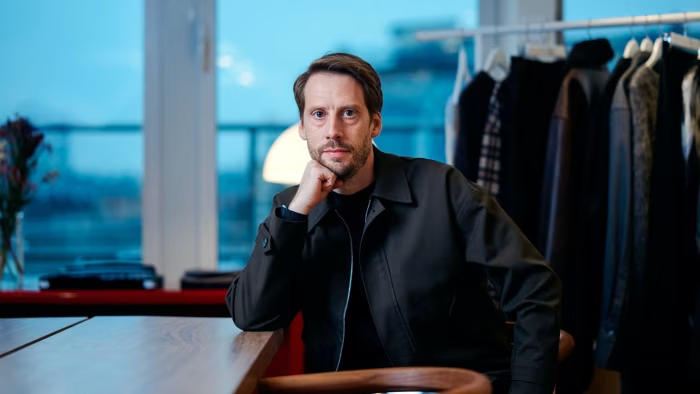
David Abrahamovitch averages four cups of coffee a day; a fitting dedication to caffeine as the founder of Grind (and the father of two young children). But, he confesses, he wasn’t always a coffee aficionado. The first Grind café, opened in 2011, came about after Abrahamovitch, then aged 25, inherited his father’s mobile phone shop on London’s Shoreditch roundabout.
On the advice of a friend, he transformed the phone shop — where he’d once worked as a teen — into a Melbourne-style café. It was a success, but real growth came a decade later, when Grind launched online sales of pods and beans during Covid.
Today, despite having 13 cafés — including its newest branch in Dubai airport — online sales make up the lion’s share of the company’s revenue.
The business was last valued at £150mn, with annual revenue at £30mn for the 2023-24 year. It employs 350 staff.
“A lot of people get into coffee because they love coffee,” Abrahamovitch says. “I got into coffee because I had a building.”
Lives: With wife Francesca of 15 years, and two daughters in east London
You grew up on the outskirts of east London. What was your family background like? My parents didn’t come from much at all, but both were smart and worked hard. In their generation, that was enough.
My mum was in the corporate world, and gave us stability. She was paying the mortgage and the school fees. My private education was amazing — it was cool to be clever there.
My dad was a classic entrepreneur, setting up shops across different industries. It was very much feast and famine, but it looked more fun than going to an office. My sister is also an entrepreneur now [running Dusk, the bar drinks app], so there’s a clear influence.
By the time I was born, my dad had moved into mobile phone repairs, spotting that it was going to become a big thing. From the age of 12, I would work all summer in the repair shop. I watched how to do sales calls, account management and customer engagement. I learned more from that about running a business than I did from my economics degree. I actually worked full-time during my final university year for a dispute resolution tech start-up, initially backed by [venture capital firm] Balderton.
I also did a few summer banking internships during my degree, but I knew immediately I had no interest in it as a career.
What inspired the first Grind store and how did you finance it? When dad died, I had to figure out what to do with the shop he’d left behind on Shoreditch roundabout. It was a long-term lease, and the rent was £8,000 a quarter. My mum paid the rent for a few quarters, and I got a small amount from selling off the customer base. The shop had been wasted as a mobile store — the area had really transformed and my dad had always talked about changing it. When I mentioned it to my friend Kaz, from Melbourne, he said: “Let me put some money in. Let’s do a café with proper coffee.”
I didn’t have enough money to fit out the first one. I thought we would be doing it for £50,000 and it ended up costing nearly £200,000 because we had to do so much to make it commercial. I magicked a quarter of it up myself from credit cards and stocks. The rest we really had to beg, borrow and steal. I remember filling out business bank pages to borrow £20,000 for coffee machines and ended up having to agree personal guarantees. We even did some of the work ourselves, such as sanding down the stools — it was the first and the last time I’ve done any DIY.
I called my mum the night before opening to ask for a few hundred pounds for the float. She literally came with a bank bag of £400 or £500 in five, 10 and 20 pence coins. That £500 really was the last of what we had. We budgeted for a loss in the few months, but, luckily, people came in. The flat white caught on.
For the first few years, I couldn’t afford to go full-time at Grind. I stayed working full-time at the Balderton-backed tech start-up. It nearly killed me getting the first one open. Then in January 2014, we raised £1mn. At that point, I thought I owed it to the investors to go all in. Plus, by then, we were making £15,000 a week, helped further once we got our late licence and could serve espresso martinis after 5pm.
When did the business really take off? In 2019, after we did a £3.5mn crowdfunding raise, we invested in building out a new direct-to-consumer arm. I wanted to make high-quality coffee pods without the sustainability issues, and we launched that in January 2020.
I thought maybe the new website could generate one store’s worth of revenue. But by April, during lockdown, we were doing crazy numbers. One minute I was telling all the staff they had to go home. Then my phone was exploding with Shopify notifications. We had £2mn in our account earmarked for two sites in Canary Wharf and the South Bank, but ended up putting it all into the direct-to-consumer part of the business.
We didn’t even have all the stuff we needed, but I was just like: “Do not stop, no one touch that website. I don’t care if we don’t have the stock. We’ll figure it out.”
There were moments when I thought we would lose the business completely because of Covid. It was crazy to go from that in March 2020 to 18 months later, the business being worth way more.
It was only after that point that Grind became a cohesive brand. Beforehand, it had just been Soho Grind or Shoreditch Grind and so on. We became a different entity [Kaz James was a co-founder for the first physical stores, but Abrahamovitch is the sole founder of the broader Grind entity].
What was Grind’s approach to cracking such a competitive sector? We knew from the start we didn’t want any other coffee brands sold at our cafés. A roaster took pity on us and was like, sure, I’ll give you 20 bags a week of your own white label blend!
In terms of flavour profile, we haven’t really changed much since. If you go to speciality grocery stores and get an espresso, it’ll be quite flowery and delicate. And coffee guys like that. But the reality is 95 per cent of the coffees we’re selling are flat whites and cappuccinos. And that [type of] coffee doesn’t work that well with milk. So it was about having something where you can still really taste the coffee coming through the milk, with a little bit of chocolate and nuts — that little bit of natural sweetness. Italians think their way is the best, with their dark, fast, $1 espressos. I love Italians’ obsession with food and drink, but I don’t necessarily agree.
How do you manage your personal finances now? The direct-to-consumer boom prompted us to bring in a big investor [Richard Koch, who co-founded LEK Consulting]. Since then, I’ve sold down my stake a little in various rounds to de-risk a bit. That’s allowed me to buy an amazing house and all the stuff that comes with having two kids.
Apart from my house, the vast majority of my money is invested in exchange traded funds, stocks and a pension. I also have seven or so angel investments. I mostly back founders I know.
On paper, 80 per cent of my wealth is still in the business. I think I’ll grow it faster there than in the stock market. But equally, I’ve got two kids and I want to make sure that if, for some reason I’m no longer here, there’s plenty to pay the school fees and have a nice life. Although my wife [Victoria Beckham’s make-up artist] is successful in her own right.
I subscribe to the American attitude that keeping founders poor doesn’t help anyone. They’re just more stressed about the day-to-day and won’t want to take risks in the same way. My lead investor has been super supportive in terms of allowing me to take money off the table.
What do you spend money on? My main splurge now is definitely holidays. I’m never going to be able to travel with a three- and a four-year-old again. Plus, they won’t want to go on holiday with me in another 10 years probably. When it comes to material things, it’s as everyone says — as soon as you can afford the stuff, you no longer want it.
H&M’s chief executive has urged European politicians to create a level playing field for fashion retailers in areas such as tax, chemical regulations, purchasing practices and workers’ rights to combat unfair competition from Chinese rivals such as Shein and Temu.
Daniel Ervér told the Financial Times that the Swedish fast-fashion retailer was on “a very long journey” towards increased profitability after ceding its crown as the world’s largest fashion chain to Zara’s Spanish owner in “an industry that is changing at a furious pace”.
He added: “I don’t think we have seen a level playing field. If you don’t pay taxes, if you don’t comply with chemical regulations, don’t adhere to purchasing practices, protect the social rights of workers, that’s not a responsible way of conducting business. There’s a responsibility for lawmakers to ensure there is a fair playing field, [otherwise] it will weaken our competitive strength as European companies.”
H&M has been increasingly squeezed from above by the likes of rivals Zara, and from below by cheaper rivals including Shein, Temu and Primark.
Zara has been pushing upmarket with tactics such as displaying limited-edition collections at high-profile events such as Paris Fashion Week and revamping stores designed by leading architects. H&M has followed its lead to some degree in a bid to set itself apart from cut-price online rivals such as Shein and Temu, which benefited from sales surges during the pandemic.
Ervér’s plan to turn around family-controlled H&M has focused on boosting profitability and putting the customer at the heart of its focus — both on display at the refitting of a central Stockholm store around the corner from its head office.
The store is airy for an H&M location, with more space between displays and fewer clothes on show, while items from its upmarket Studio and Atelier ranges as well as beauty products greet customers at the entrance. Shoppers can scan a code in the fitting room to ask an employee to bring them a different size or order anything out of stock for home delivery.
“Previously it was high-density but we wanted to break that. With the right product, we sell more with less. It becomes a more effective way of running the business,” said Johanna Klingspor, H&M’s head of creative development.
The revamp is already bearing some fruit as Ervér also targets cost control. Operating margins fell from more than 20 per cent in 2010 to just 3 per cent in 2022. They reached 8.6 per cent in the third quarter this year, up from 5.9 per cent a year earlier.
“What I recognised when stepping in is that this company has so much untapped potential . . . given how the competitive landscape has changed, we need to step up our game. We need to stop doing what doesn’t make a difference for the customer and really shift resources and money to what makes the difference,” said Ervér, who took over running H&M in February 2024.
Shareholders have given his plans a cautious welcome. Shares are up about 16 per cent this year, but were higher just before he took over as well as before the pandemic.
One top-10 shareholder said: “H&M were caught in between — not in Zara’s price point, and definitely not in Shein’s. They let the margins slide for too long.”
A fashion analyst added: “Ervér’s elevation strategy is taking the company in the right direction as it helps to reduce the H&M brand’s exposure to value fashion — the most competitive segment of the market and the most exposed to competition from not only the likes of Shein, but also second-hand platforms.”
But questions remain. H&M has historically sourced more of its clothes from Asia leaving it less nimble than Zara, which has more production closer to its biggest markets in Europe and the US. H&M’s need to discount some stock has led to volatility in both sales and gross margins.
“We need to continue to become quicker. Nearshoring is one piece of the puzzle, but there are many others,” Ervér said. His aim is to have some items on sale between six and 10 weeks after the initial idea.
The 44-year-old pointed to H&M presenting its latest collection at London Fashion Week for the first time in two decades. “That puts a lot of pressure on us to step up because you have the whole world, journalists, influencers, looking at you and assessing you.”
H&M is controlled by the family of Stefan Persson, son of the company’s founder, who owns shares carrying 83 per cent of voting rights. He has gradually increased his ownership in recent years and many observers in Stockholm expect him eventually to take the company private.
Ervér said he did not think it was “so provocative” to put customers ahead of investors. H&M had been “fortunate to have one large shareholder” and that satisfying all investors meant “being focused on the customer,” he added.
The retailer is also making a push into second-hand through its Sellpy platform. Some of its stores, such as the one in central Stockholm, have curated second-hand sections that attract younger shoppers. Ervér said: “We see it becoming an important part of the way that you express yourself and the way you shop second-hand becomes a complement to the existing business.”
Ervér disagrees with critics who say sustainability is incompatible with fast fashion: “To do fully sustainable collections for the richest people is not so difficult. The big challenge is to do it at scale.”
He is happy that H&M has broken the link between growth and emissions, going up in sales and down in greenhouse gases although he concedes “we are far from done”.
The Swedish group has a partnership with start-up Syre, a sister company to bankrupt battery maker Northvolt, to recycle polyester that recently expanded to include products from sporting goods group Nike.
Ervér said that few customers “want to pay more” for green products but that entrepreneurship, creativity and policy should drive the change because it “won’t happen organically”.
On competition, the H&M chief executive argued that the big disruption came a decade ago when digitalisation changed how people shop, as well lowering the barriers to entry in fashion. That opened up the market for a “completely new set of competitors” without physical stores.
“We need to make sure we leverage the strengths of having 500 in-house designers, the strength of curating the experience, and really facilitating the shopping experience,” Ervér added.
The U.S. dollar was heading for its worst weekly performance since late July on Friday as traders increased bets that the Federal Reserve will cut rates again next month.
The dollar has dropped this week as traders conclude that weakening labor data will lead to more rate cuts, even as many Fed policymakers express concern about still-elevated inflation.
“It feels like with the post-shutdown run of releases, it’s generally been soft … the data overall definitely leaned towards a cut,” said Eric Theoret, FX strategist at Scotiabank in Toronto.
The U.S. federal government is releasing a backlog of economic data after reopening from a record 43-day shutdown.
Fed funds futures traders are pricing in 87% odds of a cut at the conclusion of the Fed’s December 9-10 meeting, up from 71% a week ago, according to the CME Group’s FedWatch Tool.
Live Events
Fed officials will enter a blackout period on Saturday ahead of the meeting. The dollar index, which measures the greenback’s strength against a basket of six major peers, was last down 0.09% at 99.44, and on track for a 0.61% weekly loss, its largest since July 21. ANTICIPATION AHEAD OF BOJ MEETING
Bank of Japan Governor Kazuo Ueda is due to speak on Monday, and traders will focus on whether he signals a likely rate increase at the BOJ’s December meeting, which could continue to lift the currency.
“There’s obviously a lot of anticipation around the Bank of Japan meeting in December. Will they hike rates? Will they not hike rates? And up until now, Ueda has been reasonably non-committal/dovish and hasn’t really signaled a December hike yet,” said James Lord, head of FX and emerging market strategy at Morgan Stanley.
“But with dollar-yen at these levels and the fiscal package that has been announced by the government, there’s a possibility that we will see a rate hike in the December meeting,” Lord said. Japanese Prime Minister Sanae Takaichi’s government on Friday finalised a $117 billion supplementary budget for this financial year to fund a massive stimulus package, most of which will be financed through new debt issuance.
The Japanese yen strengthened 0.14% against the greenback to 156.09 per dollar.
FOREX TRADING CALM AFTER CME OUTAGE An overnight outage due to a cooling issue at CME Group’s CyrusOne data centres halted trade on its widely-used currency platform and in stock and commodity futures. By 1335 GMT, trading had resumed after having been knocked out for over 11 hours, according to LSEG data.
Currency markets appeared largely unfazed by the outage during U.S. hours, which came in already light trading volumes after Thursday’s U.S. Thanksgiving Day holiday.
“Liquidity remains thin given that most participants executed month-end trades ahead of yesterday’s Thanksgiving holiday, and most major pairs are seeing choppy, but range-bound trading action with technical levels holding firm,” said Karl Schamotta, chief market strategist at Corpay in Toronto.
The euro rose 0.06% to $1.1602.
Sterling was little changed at $1.3237 and heading for its best weekly performance since early August with a gain of 1.09%, after British Finance Minister Rachel Reeves revealed her long-awaited budget this week.
“Obviously (the budget) was garnering a lot of headlines, but it also felt like a lot of the bad news had been priced in. And overall, it feels like the market had a bit of a relief rally in the pound on Wednesday,” said Theoret.
Reeves fought back on Thursday against criticism of the government’s spending plans, which will fund extra welfare spending by raising the country’s tax burden to a post-World War Two high. The Canadian dollar extended gains after data showed that Canada’s economy grew at a much faster pace than expected in the third quarter as crude oil exports and government spending boosted economic activity. The loonie was last up 0.39% versus the greenback at C$1.398 per dollar.
In cryptocurrencies, bitcoin fell 0.38% to $91,052.
(Reporting by Karen Brettell; Additional reporting by Ozan Ergenay; Editing by Ros Russell, Rod Nickel)
TotalEnergies has seen its consensus analyst price target recently increase from $60.96 to $63.30. This signals a modest upward adjustment in analysts’ perceived fair value for the stock. The accompanying decline in the discount rate from 6.24% to 6.23% highlights a slightly more favorable risk outlook among market participants. Stay tuned to discover how you can track future shifts in sentiment and remain up to date on the evolving narrative surrounding TotalEnergies.
Analyst Price Targets don’t always capture the full story. Head over to our Company Report to find new ways to value TotalEnergies.
Analyst commentary on TotalEnergies has recently captured a spectrum of perspectives, reflecting both ongoing strengths and emerging reservations. The following summarizes the main themes from recent research coverage.
🐂 Bullish Takeaways
Piper Sandler’s Ryan Todd raised the firm’s price target to $70 from $69 and emphasized resilient free cash flow generation and strong headline growth as ongoing positives for TotalEnergies, even as near-term crude oil outlook remains muted. The firm also highlights structural cost savings that continue to lower the company’s breakeven.
JPMorgan’s Matthew Lofting increased the price target to EUR 61 from EUR 60 and maintained an Overweight rating, which signals confidence in the company’s positioning and execution within its sector.
Several analysts positively note the company’s ability to adapt through cost controls and strategic capex adjustments, rewarding ongoing discipline amid shifting market conditions.
🐻 Bearish Takeaways
RBC Capital’s Biraj Borkhataria lowered the price target to EUR 70 from EUR 75 and cited a cautious tone set by management at Capital Markets Day, with deliberate moves to brace for a weaker macro environment and notable capex cuts, particularly in the power segment.
BNP Paribas Exane’s Lucas Herrmann downgraded TotalEnergies to Neutral from Outperform with a price target of EUR 53, reflecting greater caution about the company’s short-term upside relative to its valuation and broader sector risks.
Scotiabank’s Paul Cheng, despite raising the price target to $67 from $65, described the revised estimates as disappointing compared to what industry margin indicators originally suggested, implying a tempered outlook despite the increase.
Overall, while recent analyst updates acknowledge TotalEnergies’ execution strengths and financial resilience, more cautious voices reflect growing attention to macro uncertainty, valuation, and the sustainability of near-term growth.
Do your thoughts align with the Bull or Bear Analysts? Perhaps you think there’s more to the story. Head to the Simply Wall St Community to discover more perspectives or begin writing your own Narrative!
ENXTPA:TTE Community Fair Values as at Nov 2025
OPEC+ is pausing planned oil output increases for January through March 2026, after an earlier addition of 137,000 barrels per day in December. This reflects adjustments for seasonal demand. (Financial Times)
TotalEnergies is seeking approval from Mozambique for a $4.5 billion increase in costs related to its LNG project. The company cites extra expenses incurred during the project’s closure. The restart of construction, which has been delayed since 2021, is contingent upon this approval. (Bloomberg)
OPEC has maintained its oil demand forecasts, signaling confidence in steady economic growth but emphasizing ongoing risks from fiscal pressures and trade uncertainties. (Wall Street Journal)
OPEC+ reached an agreement to modestly raise oil output in both October and November. Each month will see an additional 137,000 barrels per day in response to concerns about global supply and pricing. (Wall Street Journal and New York Times)
Consensus Analyst Price Target has increased from $60.96 to $63.30. This represents a modest upward adjustment in perceived fair value.
Discount Rate has edged down slightly, moving from 6.24% to 6.23%.
Revenue Growth expectations have declined notably from 4.32% to 2.92%.
Net Profit Margin is projected to rise from 7.62% to 7.93%, indicating improved profitability assumptions.
Future P/E ratio has increased from 10.0x to 11.1x, reflecting a greater premium for expected earnings.
A Narrative goes beyond the numbers; it’s your personal story on a company, connecting its business strategy and turning points to forecasts for revenue, profit, and fair value. Narratives on Simply Wall St let you easily link your view of TotalEnergies to financial outcomes, quickly compare Fair Value to Price, and see everything update as real news or results come in. Millions of investors use these dynamic Narratives every day to make smarter decisions on our Community page.
Discover the full story behind TotalEnergies, and follow along as key drivers develop in real time: Read the original Narrative on Simply Wall St
How growth in LNG and renewables, plus smart divestments, could position TotalEnergies to benefit from global energy transition trends and secure long-term revenue stability.
Why ongoing digitalization and operational efficiency, combined with disciplined capital allocation, aim to increase margins and strengthen shareholder returns even in volatile markets.
The biggest risks that could upset this positive scenario, including oil market cycles, transition headwinds, and geopolitical exposures, and how these could sway future fair value.
This article by Simply Wall St is general in nature. We provide commentary based on historical data and analyst forecasts only using an unbiased methodology and our articles are not intended to be financial advice. It does not constitute a recommendation to buy or sell any stock, and does not take account of your objectives, or your financial situation. We aim to bring you long-term focused analysis driven by fundamental data. Note that our analysis may not factor in the latest price-sensitive company announcements or qualitative material. Simply Wall St has no position in any stocks mentioned.
Companies discussed in this article include TTE.PA.
Have feedback on this article? Concerned about the content? Get in touch with us directly. Alternatively, email editorial-team@simplywallst.com