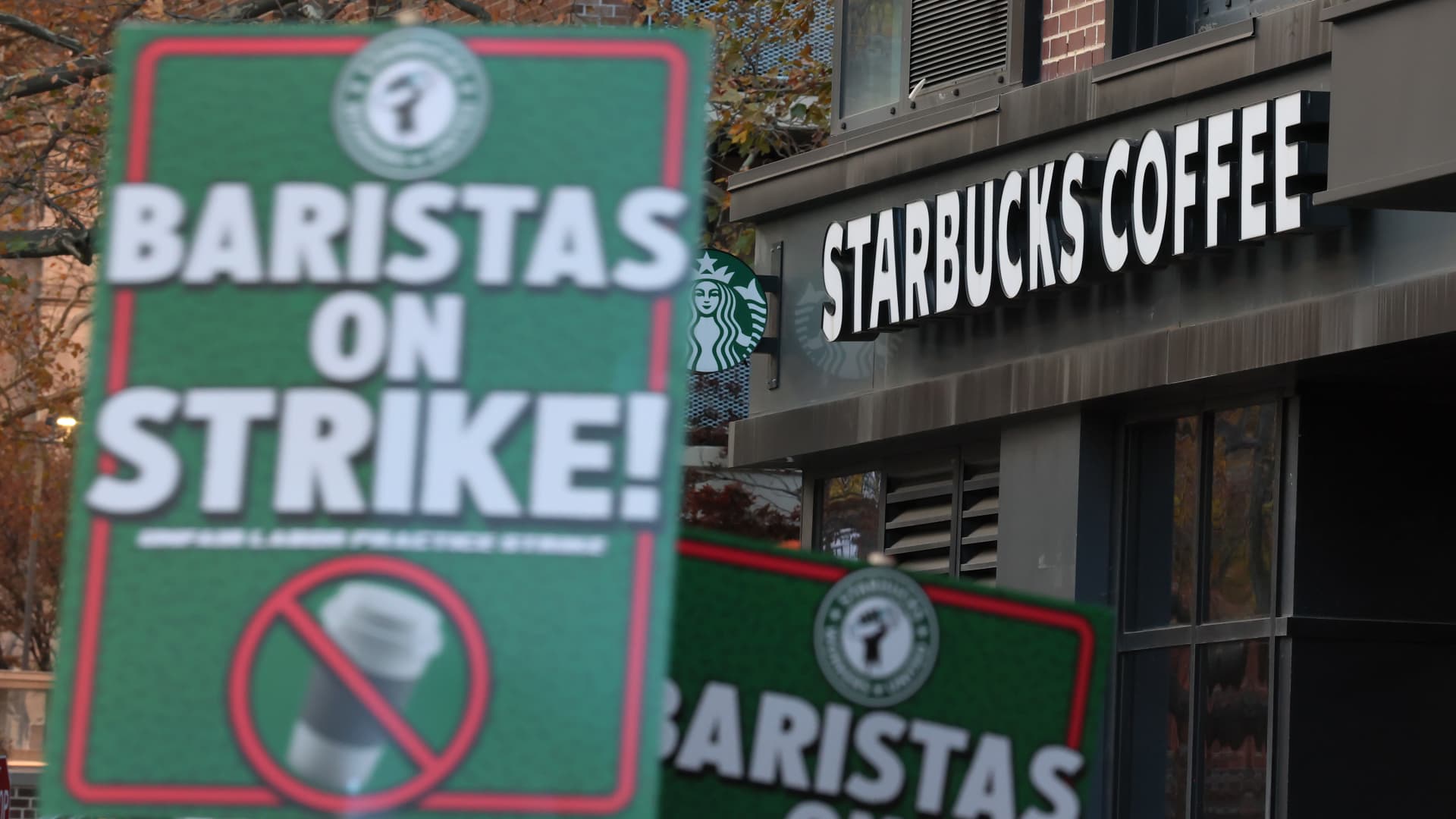
Starbucks workers walk a picket line as they go on strike outside a Starbucks store on Nov. 13, 2025 in the Clinton Hill neighborhood of the Brooklyn borough in New York City.
Michael M. Santiago | Getty Images
The Starbucks workers’ union said on Friday it is escalating an indefinite strike to more than 120 stores and 85 cities, demanding higher pay and staffing levels at the coffee chain.
The walkout, which is set to be the longest strike in the history of Starbucks, began on its Red Cup Day on November 13 with 65 stores and more than 40 cities.
The strike comes on Black Friday, the busiest time of the year for retailers when shoppers hunt for bargains on everything from food and groceries to apparel and appliances.
Workers also went on strike at Amazon warehouses in Germany on Black Friday, aiming to disrupt operations on a key sales day as they push for a collective bargaining agreement, with separate protests also planned outside Zara stores in Spain.
“It’s time for Brian Niccol and Starbucks executives to stop stalling and cut the excuses,” Michelle Eisen, Starbucks Workers United spokesperson, said.
Starbucks, which has more than 17,000 coffeehouses in the U.S., said that 99% of its locations in the country remain open.
“Regardless of the union’s plans, we do not anticipate any meaningful disruption. When the union is ready to return to the bargaining table, we’re ready to talk”, a spokesperson for Starbucks said.
Striking baristas are demanding higher wages, improved working hours and the resolution of hundreds of unfair labor practice charges for union busting.
Contract talks remain stalled despite mediation efforts in February, with both sides trading blame after delegates rejected Starbucks’ proposed package in April that guaranteed annual raises of at least 2%.
Workers United said it represents over 11,000 baristas and about 550 Starbucks stores.
Starbucks Workers United has repeatedly targeted the company’s busy holiday season and Red Cup Day, when Starbucks hands out reusable red holiday-themed cups to customers for free on coffee purchases.
Workers have staged one-day “Red Cup Rebellions” since 2022, and in December 2024, some employees walked off for a five-day strike over unresolved wage, staffing and scheduling issues.
The Food and Drug Administration is poised to kill a proposed rule that would require testing for toxic asbestos in talc-based cosmetics, a problem that has been linked to cancer.
Talc is widely used, including in cosmetics, food, medication and personal care products. The order was signed by health secretary Robert F Kennedy Jr, leader of the “Make America healthy again” (Maha) movement.
A stated cornerstone of the movement, which helped propel Donald Trump to office, is to help eliminate toxins like asbestos from food, medicine and personal care products. The move has shocked health campaigners
“Nothing could make America less healthy than having a cancer causing product in cosmetics,” said Scott Faber, vice-president of government affairs with the Environmental Working Group non-profit, which has lobbied for stricter regulations around talc. “It’s hard to understand why we would revoke a rule that simply requires companies to test for asbestos.”
The FDA did not immediately post a press release announcing the move, and did not immediately respond to a request for comment. But in a legal notice posted to the federal registry, the agency wrote that the decision was in response to comments it received about potential “unintended consequences” for companies that produce drugs, which suggests drugmakers were opposed to testing.
“Good cause exists to withdraw the proposed rule at this time,” the notice states.
Asbestos is a group of six naturally occurring fibrous minerals used to make products resist heat, fire and electricity. No safe level of exposure is considered safe, and it is banned in more than 50 countries. The substance is a known human carcinogen linked to an estimated 40,000 deaths annually.
Cosmetic companies have known since the 1950s that talc can be contaminated with asbestos, Faber said, but the public was not alerted in the early 1970s. Despite this, the industry persuaded the FDA to allow companies to rely on testing methods that can detect some, but not all, asbestos fibers.
Asbestos contamination has been regularly found in some talc-based cosmetics, including baby powder, which was disproportionately used by Black women. Personal care giant Johnson & Johnson discontinued US talc-based baby powder sales in 2020 amid mounting public pressure and nearly 38,000 lawsuits.
The company has so far paid out billions of dollars in settlements, and proposed another $6.5bn settlement for a class lawsuit alleging that it knowingly poisoned consumers. About 3,000 women in the UK last month took a case to the nation’s high court that alleges Johnson & Johnson poisoned them.
Despite its high toxicity, clear dangers and widespread use, regulating it has been a tortuous process. An initial 1989 EPA ban on its use in most products was quickly overturned by a court, and efforts to pass similar bans have failed over the decades.
Joe Biden’s EPA proposed a ban that was finalized late last year, but the Trump administration moved to withdraw it before reversing course in July.
The Cosmetics Modernization Act of 2022 included provisions that requires testing of talc-based cosmetics. The Biden administration began implementing the rule, but the Trump administration is now poised to kill it.
In its notice, the FDA said it was acting on Maha priorities in a complex area: “We are withdrawing the proposed rule to reconsider best means of addressing the issues covered by the proposed rule and broader principles to reduce exposure to asbestos, and to ensure that any standardized testing method requirements for detecting asbestos in talc-containing cosmetic products help protect users of talc-containing cosmetic products from harmful exposure to asbestos.”
Referring to RFK Jr, Faber said: “It’s tragic that a person who has used most of his career to protect people from cancer doing this.”
BEIJING, Nov. 28 — China reported 56.88 billion cross-regional passenger trips in the first 10 months of 2025, up 3.6 percent year on year, the Ministry of Transport said on Friday.
Freight volume also maintained growth momentum. From January to October, the country’s operational freight volume reached 48.29 billion tonnes, an increase of 3.5 percent from a year earlier.
Specifically, highway freight volume was 35.62 billion tonnes, up 3.6 percent year on year, while waterway freight volume was 8.29 billion tonnes, up 3.5 percent year on year.
Port container throughput saw rapid growth. From January to October, the port cargo throughput hit 15.13 billion tonnes, up 4.3 percent year on year. Of this total, domestic and foreign trade cargo throughput grew by 4.6 percent and 3.7 percent, respectively.
Fixed-asset investment in the transport sector totaled 2.95 trillion yuan (about 417 billion U.S. dollars) in the first 10 months of 2025.
As the holiday season looms into view with Black Friday, one category on people’s gift lists is causing increasing concern: products with artificial intelligence.
The development has raised new concerns about the dangers smart toys could pose to children, as consumer advocacy groups say AI could harm kids’ safety and development. The trend has prompted calls for increased testing of such products and governmental oversight.
“If we look into how these toys are marketed and how they perform and the fact that there is little to no research that shows that they are beneficial for children – and no regulation of AI toys – it raises a really big red flag,” said Rachel Franz, director of Young Children Thrive Offline, an initiative from Fairplay, which works to protect children from big tech.
Last week, those fears were given brutal justification when an AI-equipped teddy bear started discussing sexually explicit topics.
The product, FoloToy’s Kumma, ran on an OpenAI model and responded to questions about kink. It suggested bondage and roleplay as ways to enhance a relationship, according to a report from the Public Interest Research Group (Pirg), the consumer protection organization behind the study.
“It took very little effort to get it to go into all kinds of sexually sensitive topics and probably a lot of content that parents would not want their children to be exposed to,” said Teresa Murray, Pirg consumer watchdog director.
Products like the teddy bear are part of a global smart-toy market valued at $16.7bn in 2023, according to Allied Market Research.
The industry is particularly big in China, which has more than 1,500 AI toy companies, which are working to expand abroad, MIT Technology Review reports.
In addition to the Shanghai-based startup FoloToy, Curio, a California-based company, works with OpenAI and makes a stuffed toy, Grok, as in Elon Musk’s chatbot, voiced by the musician Grimes. In June, Mattel, which owns brands like Barbie and Hot Wheels, also announced a partnership with OpenAI to “support AI-powered products and experiences”.
Before the Pirg report on the creepy teddy bear, parents, technology researchers and lawmakers had already raised concerns about the impact of bots on minors’ mental health. In October, the chatbot company Character.AI announced that it would ban users under 18 following a lawsuit alleging that its bot exacerbated a teen’s depression and caused him to kill himself.
Murray said AI toys could be particularly dangerous because whereas earlier smart toys provided children-programmed responses, a bot can “have a free-flowing conversation with a child and there are no boundaries, as we found”.
That could not only lead to sexually explicit conversations, but children could become attached to a bot rather than a person or imaginary friend, which could hurt their development, said Jacqueline Woolley, director of the Children’s Research Center at the University of Texas at Austin.
For example, a child can benefit from having a disagreement with a friend and learning how to resolve it. That is less likely to happen with bots, which are often sycophantic, said Woolley, who consulted on the Pirg study.
“I worry about inappropriate bonding,” Woolley said.
Companies also use the AI toys to collect data from children and have not been transparent about what they are doing with that information, Franz, of Fairplay, said. That potentially puts users at risk because of a lack of security around such data, Franz said. Hackers have been able to take control of AI products.
“Because of the trust that the toys engender, I would say that children are more likely to tell their deepest thoughts to these toys,” Franz said. “The surveillance is unnecessary and inappropriate.”
Despite such concerns, Pirg is not calling for a ban on AI toys, which could have educational value, like helping children learn a second language or state capitals, Murray said.
“There is nothing wrong with having some kind of educational tool, but that same educational tool isn’t telling you that it’s your best friend, that you can tell me anything,” Murray said.
The organization is calling for additional regulation of these toys for children under 13 but has not made specific policy recommendations, Murray said.
There also needs to be more independent research conducted to ensure the products are safe for children and, until that is done, they should be pulled from shelves, Franz said.
“We need short-term and longitudinal independent research on the impacts of children interacting with AI toys, including their social-emotional development” and cognitive development, Franz said.
Following the Pirg report, OpenAI announced it was suspending FoloToy. That company’s CEO then told CNN that it was pulling the bear from the market and “conducting an internal safety audit”.
On Thursday, 80 organizations, including Fairplay, issued an advisory urging families not to buy AI toys this holiday season.
“AI toys are being marketed to families as safe and even beneficial to learning before their impact has been assessed by independent research,” the release states. “By contrast, offline teddy bears and toys have been proven to benefit children’s development with none of the risks of AI toys.”
Curio, maker of the Grok toy, told the Guardian in an email that after reviewing the Pirg report, “we are actively working with our team to address any concerns, while continuously overseeing content and interactions to ensure a safe and enjoyable experience for children”.
Mattel stated that its first products with OpenAI “will focus on families and older customers” and that “use of OpenAI APIs is not intended for users under 13”.
“AI complements–not replaces–traditional play, and we are emphasizing safety, privacy, creativity and responsible innovation,” the company stated.
Franz referred to past privacy concerns with Mattel’s smart products and said: “It’s good that Mattel is claiming that their AI products are not for young kids, but if we look at who plays with toys and who toys are marketed to, it’s young children.”
Franz added: “We’re very interested in learning the concrete steps Mattel will take to ensure their OpenAI products are not actually used by kids who will surely recognize and be attracted to the brands.”
You don’t have permission to access “http://www.afreximbank.com/afreximbank-successfully-closed-its-second-samurai-bond-transactions-raising-jpy-81-8-billion-approx-usd-527-million/” on this server.
Ryanair is shutting its frequent flyers members’ club after only eight months because customers exploited its benefits too much.
The budget airline said on Friday it was closing the scheme, which offered benefits including flight discounts, free reserved seating on up to 12 flights a year and travel insurance.
It said 55,000 passengers had signed up to Prime, generating €4.4m (£3.5m) in subscription fees but customers had received more than €6m in benefits, making it a lossmaker for the company.
Dara Brady, Ryanair’s chief marketing officer, said: “This trial has cost more money than it generates. This level of membership, or subscription revenue, does not justify the time and effort it takes to launch monthly exclusive Prime seat sales for our 55,000 Prime members.”
The company said it would return to offering discounts to “all our customers, and not this subset of 55,000 Prime members”.
Prime was launched in February at a cost of £79 and €79 a year to customers in the UK and the EU. With seat costs ranging from £4.50 to £38, the scheme could have saved between £54 and £456, the equivalent of several low-fare flights, for those making use of the maximum 12 flights a year.
The membership scheme was opened for a 12-month rolling basis with automatic renewal in February.
Ryanair said all members would continue to “enjoy exclusive low fare offers until October 2026 but no new members will be allowed to sign up after Friday, 28 November.
“We are grateful to our 55,000 Prime members who signed up to this Prime trial over the last eight months, and they can rest assured that they will continue to enjoy exclusive flight and seat savings for the remainder of their 12-month membership.”
Ryanair, the market leader in budget airlines, with more than 207 million passengers a year, made low fares its unique selling point but managed to claw back revenue on equally innovative charging for bags and seats, something unheard of 20 years ago.
skip past newsletter promotion
after newsletter promotion
It was the first to introduce fees for checked-in baggage in 2006, followed by check-in fees in 2009 for those who did not, in the pre-smartphone era, print out their boarding cards at home.
Earlier this year, Ryanair increased the bonuses airport staff receive for every noncompliant carry-on bag they take from passengers. Passengers whose cabin cases exceed the maximum dimensions for a small suitcase are charged fees of up to £75 and their luggage is taken into the hold.
Companies supplying data centers, chips, and “compute” processing power to OpenAI have taken on about $96 billion in debt to fund their operations, according to an analysis by the Financial Times. The news highlights the AI sector’s increasing reliance on debt and its growing dependence on loss-making AI startup OpenAI in particular.
Currently, the revenues being generated by AI companies and many of the data center operators that are rapidly expanding in order to serve them, are nowhere near big enough to cover their build-out costs.
OpenAI has made $1.4 trillion in commitments to procure the energy and computing power it needs to fuel its operations in the future. But it has previously disclosed that it expects to make only $20 billion in revenues this year. And a recent analysis by HSBC concluded that even if the company is making more than $200 billion by 2030, it will still need to find a further $207 billion in funding to stay in business.
Here’s the FT’s breakdown of the debt that OpenAI’s partners have taken on:
$30 billion already borrowed by SoftBank, Oracle, and CoreWeave.
$28 billion in loans taken by Blue Owl Capital and Crusoe.
$38 billion on the table in further talks with Oracle and Vantage and their banks.
$96 billion in total debt.
The increased use of debt to fund AI is a relatively new development—prior to this year most AI build-out was funded by cash straight from the balance sheets of big tech companies, such as Microsoft, Alphabet, Amazon, and Meta.
How CoreWeave services its debt will be of particular interest to investors. The company reported $3.7 billion in current debt, $10.3 billion in non-current debt, and $39.1 billion in future lease agreements for data centers, in its Q3 earnings report. The company said it expected to make only $5 billion in revenue this year.
All the companies were contacted for comment.
Separately, the big five hyperscalers—Amazon, Google, Meta, Microsoft, and Oracle—have taken on $121 billion in new debt this year to fund AI operations, according to Bank of America. That’s more than four times the average level of debt ($28 billion) issued by these companies over the previous five years.
All that extra investment-grade (IG) corporate debt is having a material effect on the credit markets, a recent research note from BofA analysts Yuri Seliger and Sohyun Marie Lee said.
“This week (the week prior to Thanksgiving) is typically the last week of the year with heavy IG supply. And 2025 supply is ending the year with a bang. We are tracking about $50bn for this week and about $220bn over the prior four weeks – about 70% higher than the typical volume for this time of year,” they said.
“This year … hyperscalers added another $63bn. This suggests the entire increase in supply this year is explained by [debt-funded M&A deals] and hyperscaler activity.”
The increased supply of debt from tech companies is moving “spreads”—the extra interest yield demanded by buyers of debt above the notional risk-free rate—in the credit default swap (CDS) market, according to Deutsche Bank. CDS act as a kind of insurance policy on corporate debt, paying the holders in the event the creditor defaults. If the yields on CDS increase, it signals that the market believes the likelihood of default has also gone up.
“The moves have been notable: Oracle’s 5yr CDS has widened by about +60bps to 104bps since late September and CoreWeave by roughly +280bps to around 640bps since September,” Deutsche’s Jim Reid said in a recent note.
“It’s hard to know yet whether this shift will have meaningful long-term implications, but the last few weeks clearly mark a new phase of the AI boom—one in which investors are increasingly looking to hedge their risk, and one where public credit markets are being called upon to fund growing capex needs. It’s not just the hyperscalers’ free cash flow anymore,” he said.
Water is essential for sustainability and closely interconnected with climate, biodiversity, and human well-being. Yet only 0.3% of the planet’s water is available for human use, making it increasingly scarce as climate change and economic growth intensify pressure on this limited resource. Despite its importance, water remains insufficiently addressed in corporate ESG strategies. A new study, Corporate Water Stewardship: Strategies and Practices in Asia Pacific, explores how leading companies in the region are managing and protecting this critical resource.
“It is essential to understand how companies engage with water and to evaluate the practices that support responsible water management. This means looking closely at their dependencies and impacts, while also identifying the risks and opportunities that arise from the way they use and manage this vital resource. Following our first joint report on nature-related corporate strategies in the Asia Pacific region, we are pleased to release this new case study, which highlights the importance of advancing water stewardship – a critical issue that still does not receive the attention it deserves,” said Marie-Claire Daveu, Chief Sustainability and Institutional Affairs Officer, Kering.
The study examines the self-reported water management practices of six major Asia-Pacific companies representing highly water-intensive sectors such as agriculture, fashion and beauty, and real estate. Using an EESG framework, it highlights the central role of governance in effective water stewardship and outlines corporate best practices. Most companies focus first on internal measures, including tracking water use, improving efficiency, reducing pollution, and meeting regulatory requirements.
However, the report finds that water strategies largely remain within company boundaries. While some firms are beginning to extend water initiatives beyond their operations, this is not yet common practice. Significant gaps persist, including limited investment in water initiatives, insufficient disclosure of financial metrics, weak supply-chain collaboration on sustainable sourcing, low consumer engagement, and the absence of context-specific water targets. The study concludes that true stewardship requires assessing water dependencies and impacts across the entire value chain, especially in upstream sourcing and raw material extraction.
“Mere compliance with water regulations is insufficient to tackle the growing range of water-related challenges. Much like climate action, effective water stewardship demands collaboration among corporations, suppliers, consumers, communities, and local governments. Water lies at the heart of the Water–Nature–Climate Nexus, meaning that threats to water inevitably affect other interconnected systems. Just as with climate, companies must act swiftly and collectively to address water challenges,” said Professor Lawrence Loh, Director, Centre for Governance and Sustainability, NUS Business School.
About Kering
Kering is a global, family-led luxury group, home to people whose passion and expertise nurture creative Houses across couture and ready-to-wear, leather goods, jewelry, eyewear and beauty: Gucci, Saint Laurent, Bottega Veneta, Balenciaga, McQueen, Brioni, Boucheron, Pomellato, Dodo, Qeelin, Ginori 1735, as well as Kering Eyewear and Kering Beauté. Inspired by their creative heritage, Kering Houses design and craft exceptional products and experiences that reflect the Group’s commitment to excellence, sustainability and culture. This vision is expressed in our signature: Creativity is our Legacy. In 2024, Kering employed 47,000 people and generated revenue of €17.2 billion.
About National University of Singapore (NUS)
The National University of Singapore (NUS) is Singapore’s flagship university, which offers a global approach to education, research and entrepreneurship, with a focus on Asian perspectives and expertise. We have 15 colleges, faculties and schools across three campuses in Singapore, with more than 40,000 students from 100 countries enriching our vibrant and diverse campus community. We have also established more than 20 NUS Overseas Colleges entrepreneurial hubs around the world.
Press contacts
Natalie LAW Assistant Manager, Corporate Communications NUS Business School National University of Singapore Tel: +65 6601-1206 Email: natalielaw@nus.edu.sg