Category: 3. Business

  • A&O Shearman advises Weinberg Capital Partners on sale of Sapian group to a continuation fund

    A&O Shearman advises Weinberg Capital Partners on sale of Sapian group to a continuation fund

    This transaction, which mobilizes a total of EUR115 million in equity, marks a new milestone in the partnership initiated in 2019 with the investment of WCP’s leveraged buyout (LBO) WCP#3 fund in Sapian.

    The continuation fund, dedicated to Sapian, will support the company’s ambitious growth strategy, particularly through future external growth operations. New investors, including Montana Capital Partners as lead investor, as well as several family offices, are joining the capital alongside existing investors. Weinberg Capital Partners also contributed to financing this transaction, which represents the sixth investment of WCP’s LBO Fund #4.

    Jules Lecoeur, partner at A&O Shearman, said: “Continuation funds have become an essential tool for private equity firms and a key driver of secondary transactions. This transaction demonstrates our ability to drive single asset GP-led transactions tailored to the needs of financial investors and management teams.”

    Founded in 2019 following the carve-out of the “Hygiene and Prevention” division of the ISS Group, Sapian now employs over 1,500 people across 41 branches in France and anticipates revenue exceeding EUR155m in 2025.

    A&O Shearman advised Weinberg Capital Partners on all transactional aspects with a team including partner Jules Lecoeur, associates Alexia Monne, Yasmine Benhmida, Fatima Ahamada and Aresse Chegra on M&A aspects; partner Thomas Roy, senior associate Jonas Brucker, associates Baudouin Harou and Maxime Silly on financing aspects; partner Charles del Valle, senior associate Ageu Pires and associate Ryan Ceglia on tax aspects; as well as partner Olivier Picquerey and associate Marie Chauvat on employment law aspects.

    Continue Reading

  • Ethan Tan wins at 2026 Lexology Client Choice Awards

    Ethan Tan wins at 2026 Lexology Client Choice Awards


    Partner, Ethan Tan has been recognised for his work in aviation as a recipient of the 2026 Lexology Index Client Choice Award. Winners will be celebrated at a special awards dinner in 2026. 

    The Client Choice Awards honour the world’s leading lawyers and consulting experts who excel in client care, with only 5% of ranked practitioners selected, as voted for by corporate counsel. This recognition is awarded to those who add real value to clients’ businesses above and beyond others in the market. 

    Ethan’s success is a testament to his dedication and deep understanding of the aviation industry, consistently delivering practical solutions and trusted advice to his clients. 


    Continue Reading

  • ECB monetary policy after the disinflation – CEPS

    ECB monetary policy after the disinflation – CEPS


    After the surge in inflation in 2021-2023, the return to price stability and a more challenging global environment have altered the monetary picture and present the ECB with new questions. In this paper, we discuss three of them: how to define an ‘equilibrium’ monetary stance; how to deal with divergent national inflation rates; and how to navigate the forces shaping global exchange rates, in particular the euro’s. We assess the current ECB monetary stance to be broadly adequate, but we see challenges both in the persistence of cross-country inflation rate differences and in the appreciation of the euro. 


    This paper was prepared at the request of the ECON Committee of the European Parliament. 

    Continue Reading

  • Brand Group Core: cross-brand steering model for production reaches implementation phase

    Brand Group Core: cross-brand steering model for production reaches implementation phase

    The Brand Group Core within the Volkswagen Group – the organizational unit including the volume brands Volkswagen, Škoda, SEAT&CUPRA and Volkswagen Commercial Vehicles – is strategically reorienting its production and establishing a high-performance regional production network.

    As a first step, André Kleb, to date Head of Planning and Production Technology of the Volkswagen brand, is to assume responsibility for the regional management of production and logistics as the Chief Production Officer for the Iberian Peninsula with effect from January 1, 2026. In the spirit of overall cross-brand responsibility, this newly created function will report to Christian Vollmer, Member of the Board of Management for Production & Logistics of the Volkswagen brand and member of the extended Group Executive Board, and also to Markus Haupt, CEO SEAT&CUPRA.

    The new structure for the Iberian Peninsula will include all the plants of the Volkswagen Group in Spain and Portugal. Overarching functions such as central planning, production steering, project and start-of-production management as well as logistics will be anchored within the regional management.

    In connection with the reorganization, Thomas Hegel Gunther, currently Managing Director and plant manager of Volkswagen Autoeuropa, is to succeed André Kleb as new Head of Planning and Production Technology of the Volkswagen Passenger Cars brand in Wolfsburg.

    Anabel Andión Lomero, to date the Head of the Pre-Series Center at SEAT&CUPRA in Spain, will become Managing Director and plant manager of Volkswagen Autoeuropa in Portugal with effect from March 1, 2026.

    Continue Reading

  • Monetary developments in the euro area: October 2025

    Monetary developments in the euro area: October 2025

    27 November 2025

    Components of the broad monetary aggregate M3

    The annual growth rate of the broad monetary aggregate M3 stood at 2.8% in October 2025, unchanged from the previous month, averaging 2.9% in the three months up to October. The components of M3 showed the following developments. The annual growth rate of the narrower aggregate M1, which comprises currency in circulation and overnight deposits, increased to 5.2% in October from 5.0% in September. The annual growth rate of short-term deposits other than overnight deposits (M2-M1) was -1.8% in October, compared with -2.1% in September. The annual growth rate of marketable instruments (M3-M2) decreased to 1.9% in October from 4.3% in September.

    Chart 1

    Monetary aggregates

    (annual growth rates)

    Data for monetary aggregates

    Looking at the components’ contributions to the annual growth rate of M3, the narrower aggregate M1 contributed 3.3 percentage points (up from 3.1 percentage points in September), short-term deposits other than overnight deposits (M2-M1) contributed -0.5 percentage points (up from -0.6 percentage points) and marketable instruments (M3-M2) contributed 0.1 percentage points (down from 0.3 percentage points).

    Among the holding sectors of deposits in M3, the annual growth rate of deposits placed by households decreased to 3.0% in October from 3.2% in September, while the annual growth rate of deposits placed by non-financial corporations increased to 3.5% in October from 3.1% in September. Finally, the annual growth rate of deposits placed by investment funds other than money market funds decreased to 2.1% in October from 7.1% in September.

    Counterparts of the broad monetary aggregate M3

    The annual growth rate of M3 in October 2025, as a reflection of changes in the items on the monetary financial institution (MFI) consolidated balance sheet other than M3 (counterparts of M3), can be broken down as follows: claims on the private sector contributed 2.8 percentage points (up from 2.6 percentage points in September), net external assets contributed 1.7 percentage points (down from 1.8 percentage points), claims on general government contributed 0.2 percentage points (as in the previous month), longer-term liabilities contributed -1.0 percentage points (as in the previous month), and the remaining counterparts of M3 contributed -0.9 percentage points (down from -0.8 percentage points).

    Chart 2

    Contribution of the M3 counterparts to the annual growth rate of M3

    (percentage points)

    Data for contribution of the M3 counterparts to the annual growth rate of M3

    Claims on euro area residents

    The annual growth rate of total claims on euro area residents increased to 2.3% in October 2025 from 2.1% in the previous month. The annual growth rate of claims on general government stood at 0.7% in October, compared with 0.6% in September, while the annual growth rate of claims on the private sector increased to 2.9% in October from 2.7% in September.

    The annual growth rate of adjusted loans to the private sector (i.e. adjusted for loan transfers and notional cash pooling) increased to 3.0% in October from 2.8% in September. Among the borrowing sectors, the annual growth rate of adjusted loans to households increased to 2.8% in October from 2.6% in September, while the annual growth rate of adjusted loans to non-financial corporations stood at 2.9% in October, unchanged from the previous month.

    Chart 3

    Adjusted loans to the private sector

    (annual growth rates)

    Data for adjusted loans to the private sector

    Notes:

    • Data in this press release are adjusted for seasonal and end-of-month calendar effects, unless stated otherwise.
    • “Private sector” refers to euro area non-MFIs excluding general government.
    • Hyperlinks lead to data that may change with subsequent releases as a result of revisions. Figures shown in annex tables are a snapshot of the data as at the time of the current release.

    Continue Reading

  • BIS residential property price statistics, Q2 2025

    BIS residential property price statistics, Q2 2025

    Key takeaways

    • Global house prices declined in real terms by 0.8% year on year (yoy) in Q2 2025, slightly less compared with the previous quarter (–1.0%).
    • In advanced economies (AEs), real house prices continued to increase, albeit at a slower pace (0.6%), while the price decline in emerging market economies (EMEs) moderated (to –1.9%).
    • Over 70% of AEs and 50% of EMEs experienced moderate residential property price growth (0–10%) in Q2 2025.
    • From a longer-term perspective, real house prices have more than doubled in Türkiye since the Great Financial Crisis (GFC) of 2007–09, while they remain below their 2010 levels in Italy, South Africa and China.
    • To access the full data set, visit Residential property prices – overview | BIS Data Portal.

    Summary of latest developments

    In the second quarter of 2025, aggregated house prices adjusted for consumer prices declined by 0.8% yoy, slightly less compared with the 1.0% decline registered in the previous quarter.1 Yet this marked the third consecutive year of falling property prices globally.

    Diverging trends remained between AEs and EMEs, although the gap narrowed somewhat. Real house prices in AEs rose by 0.6% yoy, furthering their increase observed since 2024, despite some recent weakening compared with Q1 2025 (1.1%). In contrast, EMEs experienced a 1.9% yoy decline (versus –2.5% in Q1 2025), extending their downward trend that started in 2022 (Graph 1).

    The decline in real house prices in EMEs (–1.9%) was primarily driven by Asia (–3.6%), while central and eastern Europe (3.0%) and Latin America (1.9%) recorded significant price growth. Turning to AEs, price increases occurred mainly in the euro area (3.1%) and other European countries (0.9%); in contrast, real prices fell moderately in non-European AEs (–0.8%) (Table 1).

    Regional developments in real residential property prices

    Despite the decline observed in real house prices in global aggregated terms, jurisdiction-level data show that over 70% of AEs and 50% of EMEs experienced positive price growth (0–10%) in Q2 2025. Moreover, a small but significant proportion of economies experienced price increases above 10% (Graph 2.B). Reflecting the above, the median growth among the 57 reporting jurisdictions has remained in positive territory since the beginning of 2024 (+1.7% yoy in Q2 2025; Graph 2.A).2

    Global developments in real residential property prices

    Graph 3 highlights the most significant changes observed across jurisdictions in Q2 2025: real prices rose sharply yoy in North Macedonia (16%), Portugal (15%) and Bulgaria (11%), while the biggest declines were observed in Hong Kong SAR (–8%), China (–6%) and Canada (–5%).

    Since the Covid-19 pandemic, global real residential property prices have increased by 3.5%. Among the G20 economies, they have risen by 112% in Türkiye and 20% in the United States and Mexico, and have decreased by 17% in China and 8% in South Africa.

    From a longer-term perspective, real global prices have grown by 20.6% since the GFC, ie compared with their 2010 levels. They have more than doubled in Türkiye and risen by over 50% in India, the United States and Mexico. But they remain well below their 2010 levels in Italy (–25%), South Africa (–12%) and China (–9%) (Graph 4).

    Countries with the largest increases and decreases of real residential property prices in Q2 2025
    Real residential property prices in selected G20 jurisdictions: developments since the Great Financial Crisis and the Covid-19 pandemic

    Advanced economies

    In aggregate, real residential property prices in AEs rose by 0.6% yoy in Q2 2025, continuing the upward trend observed since Q2 2024.

    Among this group, a significant increase was observed in Switzerland (5.0%), where real prices have risen steadily since 2024. The expansion has been more moderate in the euro area (3.1%), while developments have remained broadly flat in Japan (0.2%), the United Kingdom (–0.4%) and the United States (–0.8%). In contrast, real prices continued to fall markedly in Canada (–5.3%) (Graph 5).

    Real residential property prices in selected advanced economies

    In the euro area, real house prices grew by 3.1% in aggregate in Q2 2025, with some notable diversity among member jurisdictions. Portugal recorded the highest increase at 15% yoy, continuing a long-running trend, followed by Spain (10%), where prices have kept increasing for two consecutive years. Prices kept growing also in the Netherlands (6%) and Italy (2%). Germany saw the second consecutive quarter of moderate growth (1%) after an extended period of decline, and prices almost stabilised in France.

    Real residential property prices in selected euro area member states

    Emerging market economies

    Real residential property prices in EMEs fell by 1.9% yoy in Q2 2025, reflecting a sharp decline in emerging Asia (–3.6%), with significant declines in Hong Kong SAR (–8%), China (–6%) and, to a lesser extent, Korea (–2%). Prices remained almost stable in India (1%) and Indonesia (–1%) and have risen somewhat in Thailand (3%). The Philippines recorded the highest increase in the region, at 6% (Graph 7).

    Real residential property prices in selected Asian emerging market economies

    Real house prices in Latin America grew by 1.9% yoy, primarily driven by Mexico, which recorded a 4% increase for five consecutive quarters, while prices in Brazil were stable.

    In central and eastern Europe, prices increased by 3% yoy, with notable growth in North Macedonia (16%) and Bulgaria (11%). Prices slowed their decline in Türkiye (–2.5%).

    Prices were stable in the Middle East and Africa region (–0.1%) and in particular stabilised in South Africa for the first time since 2022 (Graph 8).

    Real residential property prices in selected other emerging market economies

    Annex A: Nominal house price developments

    Nominal residential property prices in selected advanced economies
    Nominal residential property prices in selected euro area member states
    Nominal residential property prices in selected Asian emerging market economies
    Nominal residential property prices in selected other emerging market economies

    Continue Reading

  • WIDE INDIA 550S Brisbane Omission Notice

    Due to the upcoming Christmas/Holiday and New Year period, and revised operating hours for vessel operations, receivals, and deliveries, please be advised of the following schedule update:

    The Eastern Australia Connect (EAC) vessel WIDE INDIA 550S will omit Brisbane on its southbound call.

    Updated Rotation:

    • Following the Singapore departure WIDE INDIA 550S will proceed directly through to the Sydney call, followed by a combined Brisbane call for discharge 550S / load 601N.

    The below contingency routings have been secured for affected cargo:

    • Cargo scheduled to discharge from the WIDE INDIA 550S at Brisbane will remain onboard the vessel through Sydney and will now discharge on the Brisbane northbound call, planned for 4th January.
    • Cargo scheduled to load WIDE INDIA 550S ex Brisbane to Sydney will be updated to load SANTA VIOLA 551S.
    • Cargo schedule to load WIDE INDIA 550S ex Sydney to Brisbane will be updated to load SANTA VIOLA 602N.

    Thank you for your continued support and trust in Maersk as your supply chain partner. Should you have any questions please contact our Customer Experience Team via our Live Chat channel.

    Continue Reading

  • SAP Unveils EU AI Cloud: A Unified Vision for Europe’s Sovereign AI and Cloud Future – SAP News Center

    1. SAP Unveils EU AI Cloud: A Unified Vision for Europe’s Sovereign AI and Cloud Future  SAP News Center
    2. Proximus NXT and Mistral AI: European artificial intelligence deployed at scale  MarketScreener
    3. A New Era of Sovereign AI: Dassault Systèmes and Mistral AI Deepen Their Partnership  Silicon Canals
    4. SAP touts Microsoft disaster recovery plan for Europe; Analysts doubt it will work  cio.com
    5. Capgemini deepens partnership with SAP to bolster Europe’s digital sovereignty and accelerate time to value for AI-powered enterprise innovation and transformation  Capgemini

    Continue Reading

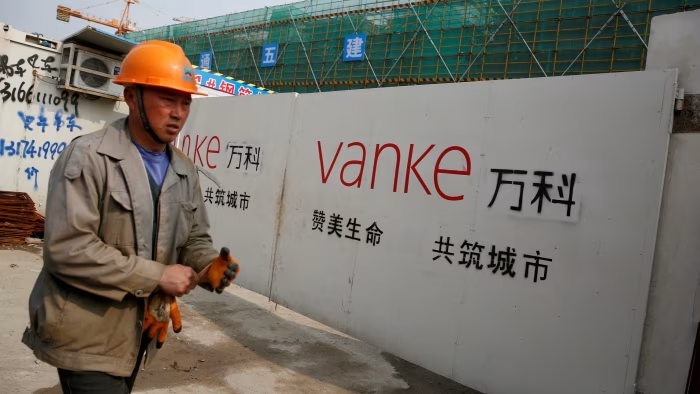
  • China Vanke’s bonds plunge on fears of waning state support

    China Vanke’s bonds plunge on fears of waning state support

    Unlock the Editor’s Digest for free

    China Vanke shares and bonds plunged on Thursday after it became the first state-backed property developer to request a delay on a bond payment, reigniting fears around the Chinese real estate sector’s financial health.

    Vanke, whose majority shareholder is Shenzhen Metro, disclosed late on Wednesday it had asked holders of a Rmb2bn ($280mn) onshore bond for a delay in a payment of principal due next month.

    The exchange filing sent its Shenzhen-listed shares down 7.1 per cent on Thursday to Rmb5.47, their lowest level in nearly two decades. An onshore renminbi bond maturing in 2027 with Rmb1.1bn outstanding dropped to 40 cents on the dollar on Wednesday, having traded at 86 cents at the start of the week.

    Vanke’s attempt to extend the payment deadline intensified market concerns that even developers with strong government ties could no longer count on unlimited official support.

    China has endured a years-long property slowdown that began with the default of Evergrande in 2021. A sector-wide cash crunch soon engulfed other developers including Country Garden and Vanke.

    Vanke received support in February, when Shenzhen Metro extended a Rmb2.8bn loan that had grown to Rmb33.8bn by the end of September. The state-owned shareholder also parachuted its own chair, Xin Jie, as Vanke’s chair.

    The steps helped international bonds recover from distressed levels of below 40 cents on the dollar, but the respite was short lived. Its shares are down nearly 90 per cent from their peak in early 2018, wiping out more than Rmb380bn in market capitalisation.

    Two dollar bonds — $7.1bn of notes due 2027 and $2.1bn due 2029 — trade at deeply distressed levels, with the 2027 issue quoted around 34.8 cents, down more than 50 per cent since the end of October.

    “Vanke’s situation today is significantly worse than at the start of the year,” said Pei Wu, founder of Shanghai-based Credit Castle Research. “With sales still in freefall, who will still be confident to bear the additional cost of continued support?”

    Vanke reported a Rmb28.2bn net loss in the first nine months of 2025, with sales plunging 43 per cent year on year to Rmb114.6bn.

    Shenzhen Metro booked a Rmb12bn investment loss in 2024 and a further Rmb7.3bn loss in the first three-quarters of 2025, explicitly citing its stake in Vanke. In October, Xin abruptly resigned from the Vanke chair position, citing “personal reasons”.

    “The sell-off in Vanke bonds highlights at least two uncertainties: a deteriorating fundamental outlook and an evolving policy stance on bailouts,” Pei said. “Any rescue involves a constant rebalancing of costs against benefits.”

    Vanke and Shenzhen Metro did not immediately respond to requests for comment.

    Additional contributions by Cheng Leng in Beijing

    Continue Reading

  • What Nutanix’s New Partnerships and 30% Price Drop Mean for Its 2025 Valuation

    What Nutanix’s New Partnerships and 30% Price Drop Mean for Its 2025 Valuation

    • Wondering whether Nutanix’s current share price is a bargain or a warning sign? If you’re curious about the true value behind the ticker, you’re not alone.

    • The stock recently tumbled, dropping 20% over the last week and over 30% in the past month. This could signal growing volatility or shifting market sentiment.

    • Analysts and investors have been buzzing after Nutanix confirmed new technology partnerships and announced an expanded lineup of cloud solutions. These developments help explain some of the intense recent price movements. Market watchers are closely following how these changes may unlock further growth or introduce fresh risks.

    • Our initial pass at valuation checks finds Nutanix scoring 3 out of 6. This suggests the company is undervalued by three measures but is not a simple story. Next, we’ll dig into how different valuation approaches view Nutanix, and why the best judgment might come from looking beyond just numbers.

    Find out why Nutanix’s -27.5% return over the last year is lagging behind its peers.

    A Discounted Cash Flow (DCF) model estimates a company’s true value by projecting its future free cash flows and discounting them back to today’s dollars. This approach helps investors understand what a business is fundamentally worth by focusing on its ability to generate cash over time.

    For Nutanix, the latest report puts annual Free Cash Flow at $773.8 Million. Analysts forecast a steady climb in the coming years, with projected Free Cash Flow reaching $1.05 Billion by 2028. While only the first five years of estimates come directly from analysts, further projections through 2035 are extrapolated. This provides a longer-term perspective on the company’s earning power.

    Based on this model, Nutanix’s intrinsic value comes out to $76.06 per share, which means the current share price is trading at a 36.4% discount. This suggests the market may be underestimating the company’s growth potential or overreacting to recent volatility.

    Result: UNDERVALUED

    Our Discounted Cash Flow (DCF) analysis suggests Nutanix is undervalued by 36.4%. Track this in your watchlist or portfolio, or discover 926 more undervalued stocks based on cash flows.

    NTNX Discounted Cash Flow as at Nov 2025

    Head to the Valuation section of our Company Report for more details on how we arrive at this Fair Value for Nutanix.

    For companies that are now profitable, the Price-to-Earnings (PE) ratio is one of the most fitting ways to compare valuation. This metric reveals how much investors are willing to pay for a dollar of current earnings, making it especially relevant for mature businesses generating consistent profits.

    However, what counts as a “normal” or “fair” PE ratio varies widely. Factors such as future earnings growth, business risk, and the strength of a company’s profit margins all influence where this number should fall. Higher-growth and lower-risk companies often command higher PE multiples, while companies facing more uncertainty trade at lower ratios.

    Nutanix’s current PE ratio stands at 59.35x, notably above the Software industry average of 29.19x and higher than its peer group, which sits at 37.96x. This might initially signal that the market expects Nutanix to continue delivering exceptional growth or that it is priced at a premium.

    To help cut through the noise, Simply Wall St has developed the “Fair Ratio,” a proprietary benchmark for the PE multiple that weighs Nutanix’s individual characteristics including its growth outlook, profitability, risk profile, industry trends, and market capitalization. Unlike a broad comparison to the average peer or sector, the Fair Ratio offers a tailored reference point and reflects Nutanix’s unique position.

    For Nutanix, the Fair Ratio is estimated at 47.71x. Since the company’s actual PE ratio is considerably higher, the stock appears to be trading above what its fundamentals might justify, even after accounting for its favorable characteristics.

    Result: OVERVALUED

    NasdaqGS:NTNX PE Ratio as at Nov 2025
    NasdaqGS:NTNX PE Ratio as at Nov 2025

    PE ratios tell one story, but what if the real opportunity lies elsewhere? Discover 1434 companies where insiders are betting big on explosive growth.

    Earlier we mentioned that there’s an even better way to understand valuation, so let’s introduce you to Narratives. A Narrative is your personal investment “story” for a company—your view of its future, paired with the numbers you believe matter most, such as fair value, future revenue, earnings, and profit margins. Narratives connect what’s happening at Nutanix to a real financial forecast, providing a clear link between events, price targets, and the company’s long-term outlook.

    On Simply Wall St’s Community page, Narratives are an easy-to-use tool trusted by millions of investors to express their outlook, compare it to others, and make smarter decisions. They help you decide when to buy or sell by matching your estimated fair value (and what you see as likely business outcomes) against today’s share price, without the need for complicated models or spreadsheets.

    Because Narratives update dynamically with every new earnings report, news headline, or partnership announcement, your perspective always stays relevant. For example, some investors currently believe Nutanix deserves a price as high as $95 based on dominant AI-driven growth and expanding market share, while the most skeptical peg fair value closer to $71 due to margin pressure and competitive headwinds. Your Narrative can reflect your own logic and help you act confidently, even when the market is divided.

    Do you think there’s more to the story for Nutanix? Head over to our Community to see what others are saying!

    NasdaqGS:NTNX Community Fair Values as at Nov 2025
    NasdaqGS:NTNX Community Fair Values as at Nov 2025

    This article by Simply Wall St is general in nature. We provide commentary based on historical data and analyst forecasts only using an unbiased methodology and our articles are not intended to be financial advice. It does not constitute a recommendation to buy or sell any stock, and does not take account of your objectives, or your financial situation. We aim to bring you long-term focused analysis driven by fundamental data. Note that our analysis may not factor in the latest price-sensitive company announcements or qualitative material. Simply Wall St has no position in any stocks mentioned.

    Companies discussed in this article include NTNX.

    Have feedback on this article? Concerned about the content? Get in touch with us directly. Alternatively, email editorial-team@simplywallst.com

    Continue Reading