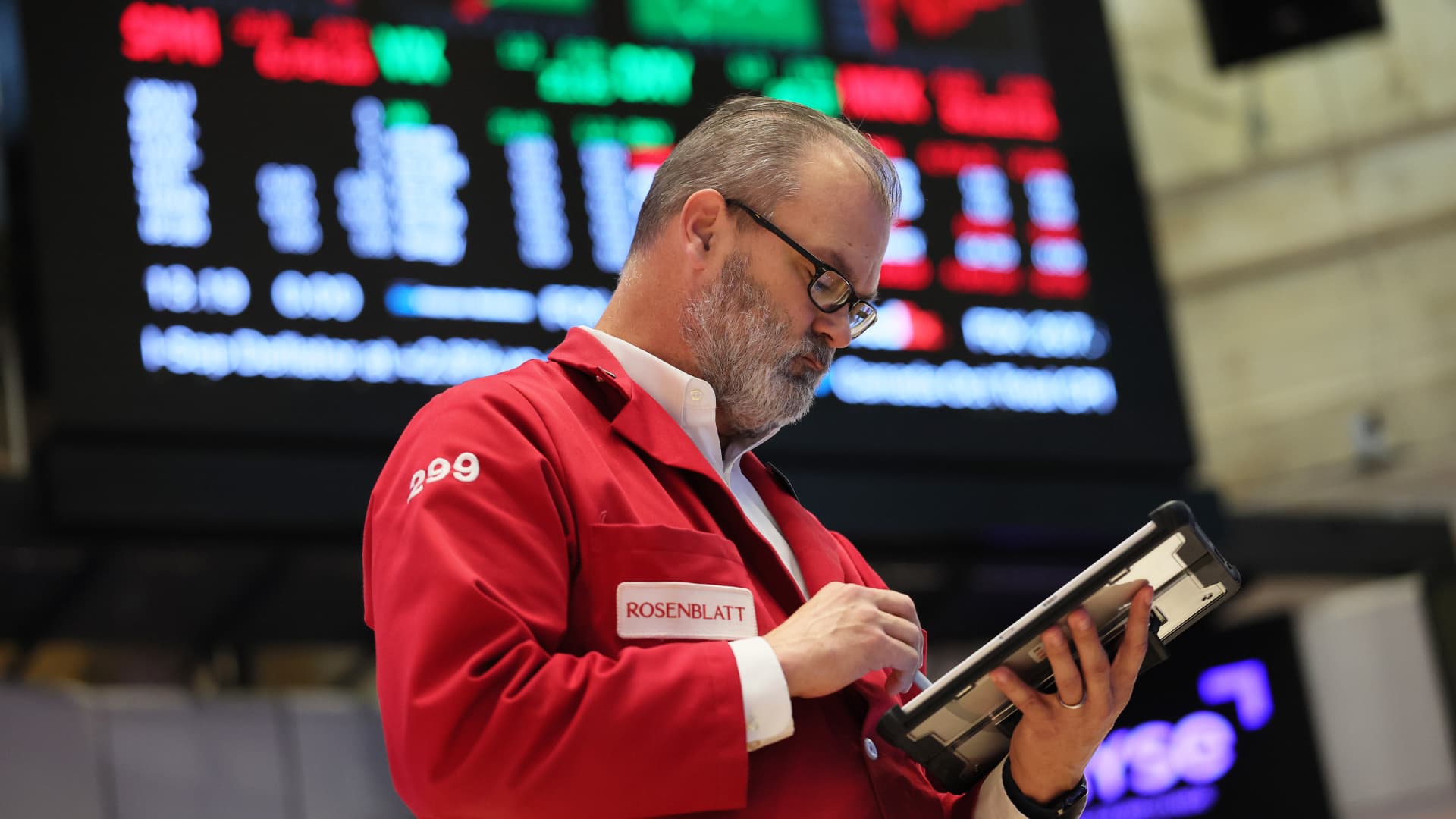
Stocks @ Night is a daily newsletter delivered after hours, giving you a first look at tomorrow and last look at today. Sign up for free to receive it directly in your inbox. Here’s what CNBC TV’s producers were watching on Tuesday and what’s on the radar for Wednesday’s session. Nvidia The earnings for the chip, tech, S & P, corporate American, global company of now are due out Wednesday after the bell. CNBC’s Kristina Partsinevelos will have the numbers and the instant stock reaction tomorrow afternoon. Shares are flat since last reporting three months ago. Nvidia ‘s been caught in this recent downturn, it is down 10% in November. The stock is 15% from its Oct. 29 high. NVDA 3M mountain Nvidia shares over the past three months Target The retail giant reports numbers Wednesday morning live on “Squawk Box” with Becky Quick, Joe Kernen and Andrew Ross Sorkin. Target stock is down almost 16% in three months. Shares have dropped 44% since last November’s 52-week high. Palo Alto Networks The cyber-defense company reports after the bell. CEO Nikesh Arora will join “Mad Money’s” Jim Cramer in the 6 p.m. ET hour on CNBC. Palo Alto stock is up 14% since last reporting three months ago. The stock is down 10% from its Oct. 28 high. PANW YTD mountain Palo Alto Networks shares year to date Goldman Sachs CEO David Solomon joins “Money Movers” with Sara Eisen and Carl Quintanilla on Wednesday in the 11 a.m. hour. Goldman Sachs stock is down 8% from its Nov. 12 high. The story is almost the exact same for JPMorgan , down 7% since Nov. 12. Morgan Stanley , also down 7% since Nov. 12. Bank of America and Wells Fargo are each more than 5% from their Nov. 12 highs. Citigroup is down nearly 7% from its September high. The data centers Cramer went through the downturn for the biggest artificial intelligence stocks Tuesday evening. Here’s a look at the big ETFs tracking the data centers. Real estate investment trust Digital Realty Trust (DLR) is down 19% from last November’s high. Pacer Data and Digital Revolution ETF (TRFK) is down 11% since its Oct. 29 high. iShares US Digital Infrastructure ETF (IDGT) is 6% from its Oct. 31 high. Global X Data Center ETF (DTCR) is down 10% since its Oct. 27 high. Three big after-hours movers La-Z-Boy increased its earnings forecast, sending the stock is up more than 8% in extended trading Tuesday evening. Shares are down 8% in a month. ON Semiconductor shares are up almost 3% after hours on a share repurchase authorization. The stock is down 13% over the past month. Constellation Energy is up 3% after hours after the Trump administration said it will give the company a $1 billion loan to restart the Three Mile Island nuclear plant. The stock is down 12% in a month. Thanks to the breaking news desk’s Brianna Bernath for keeping up on these. “Wake-Up Call” with Frank Holland will follow up on all three stories Wednesday morning. CEG 3M mountain Constellation Energy stock over the past three months
Category: 3. Business
-
Complex and Interconnected Risk: The BCI Horizon Scan 2025
The Business Continuity Institute (BCI) in association with Conducttr, has published its Horizon Scan report 2025, the eagerly anticipated annual study analyzing the top risks and threats that organizations have faced over the past 12 months, and those that are expected to sit at the top of the agenda over the coming years.
Organizations are facing risks and disruptions that are more complex and interconnected than ever before, spanning digital, environmental, operational, and human dimensions, often occurring simultaneously and compounding one another.
Along with cybersecurity threats, technological failures, climate-related events, and supply chain vulnerabilities these all have the potential to disrupt operations, affect service delivery, and erode stakeholder confidence.
The report examines these trends, combining findings from both quantitative survey data and qualitative interviews with practitioners on the front lines of business continuity and resilience. Their insights highlight that efforts towards improved response measures and better compliance should be considerate of the health and safety of the workforce.
Safety and IT
In the past 12 months safety incidents and IT-related disruptions rank very highly, a trend that has continued for the past five years. Safety incidents come top, closely followed by cyberattacks, fraud/attempted fraud, security incidents, and IT and telecom outages. Interestingly, extreme weather is the single largest cause of disruption over the past 12 months for the first time since 2017.
Looking at the next 12 months, the top five concerns also have a distinct technology flavour. In order, they are: cyberattacks, extreme weather events, IT and telecom outages, data breaches, and third-party failure / critical infrastructure failure.
This mix of disruptions have a broad impact, affecting operational performance, staff morale and customer experience. Consequences affect both internal and external stakeholders, with growing concerns over staff mental health.
The near future outlook
The future threat landscape is a complex combination of digital challenges, climate risk and geopolitical uncertainty. In many cases, the adoption of digital solutions represents both an opportunity and a potential risk for organizations. The top concerns for organizations over the next five to 10 years are cyber security: 63.6%, climate risk: 40.7%, the role of AI: 30.5%, geopolitical changes: 28.8%, and supply chain issues: 26.3%.
Trend analysis
Trend analysis remains a key tool for understanding emerging threats and guiding resilience planning. Just under half of organizations conduct trend analyses by a central corporate function (47.9%), with 23,5% having a decentralized approach across departments. A fifth (21.1%) don’t conduct these at all.
To conduct trend analysis, organizations rely on a combination of internal assessments and external insights to inform their risk landscape understanding. Interpersonal interaction remains a valuable option to practitioners. Internal risk and threat assessments came in at 87.2%, with external reports and industry insight (such as this report) a close second (75.2%). In the interpersonal interaction bucket come participation in industry events and conferences at (55.6%) and collaboration with peers at 52.1%.
The report also covers some of the legislation approaches – the relationship of BCM programmes to ISO 22301, the benefits of ISO 22301 Certification, and takes a look at investment levels in business continuity & resilience programmes.
Belen Santa-Olalla, Chief Creative Officer at Conductrr, commented, ‘We are proud to support the BCI Horizon Scan Report 2025. Its findings echo what we see every crisis: resilience depends on people, not paperwork. When pressure rises, it is human clarity, confidence, and connection that carry organizations through. That is why we focus on helping teams rehearse real situations in safe, authentic and realistic ways. This report is a reminder that preparation only becomes powerful when people are given space to practise, learn, and grow together.’
Download the report
More on
Continue Reading
-

UK pay settlements rise to highest in 2025, Brightmine says
LONDON, Nov 19 (Reuters) – Median pay settlements granted by British employers in the three months to the end of October rose to their highest so far this year at 3.3%, up from 3% in the three months to September.
Brightmine said the move reflected higher public sector pay deals which took effect in August and September.
Sign up here.
“Early indications suggest that 2026 pay awards are likely to remain steady – and potentially edge lower – as cost pressures continue to weigh on employers,” Brightmine manager Sheila Attwood said.
- Median public sector pay award 3.8% versus 3% in private sector
- 53% of pay awards were below 2024 levels, while 13% were above
- Survey based on 24 pay awards covering over 460,000 employees which took effect between August 1 and October 31
- 44% of employers said pay awards fell short of employees’ expectations
- The Bank of England is closely monitoring wage growth for signs of inflation pressure in the economy
Reporting by David Milliken; editing by Suban Abdulla
Our Standards: The Thomson Reuters Trust Principles.
Continue Reading
-
The request could not be satisfied
ERROR: The request could not be satisfied
The request could not be satisfied.
Request blocked.
We can’t connect to the server for this app or website at this time. There might be too much traffic or a configuration error. Try again later, or contact the app or website owner.
If you provide content to customers through CloudFront, you can find steps to troubleshoot and help prevent this error by reviewing the CloudFront documentation.
Generated by cloudfront (CloudFront)
Request ID: uBHgqv_idXmM99VUHVLiibLxWv1kFvtY7nd32GDNA_2F38bcZUQaKQ==
Continue Reading
-

Ultra-processed food linked to harm in every major human organ, study finds | Ultra-processed foods
Ultra-processed food (UPF) is linked to harm in every major organ system of the human body and poses a seismic threat to global health, according to the world’s largest review.
UPF is also rapidly displacing fresh food in the diets of children and adults on every continent, and is associated with an increased risk of a dozen health conditions, including obesity, type 2 diabetes, heart disease and depression.
The sharp rise in UPF intake worldwide is being spurred by profit-driven corporations using a range of aggressive tactics to drive consumption, skewer scientific debate and prevent regulation, the review of evidence suggests.
The findings, from a series of three papers published in the Lancet, come as millions of people increasingly consume UPF such as ready meals, cereals, protein bars, fizzy drinks and fast food.
In the UK and US, more than half the average diet now consists of UPF. For some, especially people who are younger, poorer or from disadvantaged areas, a diet comprising as much as 80% UPF is typical.
Evidence reviewed by 43 of the world’s leading experts suggests that diets high in UPF are linked to overeating, poor nutritional quality and higher exposure to harmful chemicals and additives.
A systematic review of 104 long-term studies conducted for the series found 92 reported greater associated risks of one or more chronic diseases, and early death from all causes.
One of the Lancet series authors, Prof Carlos Monteiro, professor of public health nutrition at the University of São Paulo, said the findings underlined why urgent action is needed to tackle UPF.
“The first paper in this Lancet series indicates that ultra-processed foods harm every major organ system in the human body. The evidence strongly suggests that humans are not biologically adapted to consume them.”
He and his colleagues in Brazil came up with the Nova classification system for foods. It groups them by level of processing, ranging from one – unprocessed or minimally processed foods, such as whole fruits and vegetables – to four: ultra-processed.
This category is made up of products that have been industrially manufactured, often using artificial flavours, emulsifiers and colouring. They include soft drinks and packaged snacks, and tend to be extremely palatable and high in calories but low in nutrients.
They are also designed and marketed to displace fresh food and traditional meals, while maximising corporate profits, Monteiro said.
Critics argue UPF is an ill-defined category and existing health policies, such as those aimed at reducing sugar and salt consumption, are sufficient to deal with the threat.
Monteiro and his co-authors acknowledged valid scientific critiques of Nova and UPF – such as lack of long-term clinical and community trials, an emerging understanding of mechanisms, and the existence of subgroups with different nutritional values.
However, they argued future research must not delay immediate action to tackle the scourge of UPF, which they say is justified by the current evidence.
“The growing consumption of ultra-processed foods is reshaping diets worldwide, displacing fresh and minimally processed foods and meals,” Monteiro warned.
“This change in what people eat is fuelled by powerful global corporations who generate huge profits by prioritising ultra-processed products, supported by extensive marketing and political lobbying to stop effective public health policies to support healthy eating.”
The second paper in the series proposes policies to regulate and reduce UPF production, marketing and consumption. Although some countries have brought in rules to reformulate foods and control UPF, “the global public health response is still nascent, akin to where the tobacco control movement was decades ago”, it said.
The third paper says that global corporations, not individual choices, are driving the rise of UPF. UPF is a leading cause of the “chronic disease pandemic” linked to diet, with food companies putting profit above all else, the authors said.
The main barrier to protecting health is “corporate political activities, coordinated transnationally through a global network of front groups, multi-stakeholder initiatives, and research partners, to counter opposition and block regulation”.
Series co-author Prof Barry Popkin, from the University of North Carolina, said: “We call for including ingredients that are markers of UPFs in front-of-package labels, alongside excessive saturated fat, sugar, and salt, to prevent unhealthy ingredient substitutions, and enable more effective regulation.”
The authors also proposed stronger marketing restrictions, especially for adverts aimed at children, as well as banning UPF in public places such as schools and hospitals and putting limits on UPF sales and shelf space in supermarkets.
One success story is Brazil’s national school food programme, which has eliminated most UPF and will require 90% of food to be fresh or minimally processed by 2026.
Scientists not involved in the series broadly welcomed the review of evidence but also called for more research into UPF, cautioning that association with health harm may not mean causation.
Continue Reading
-
Cloudflare outage briefly disrupts ChatGPT, X and dozens of apps – The Washington Post
- Cloudflare outage briefly disrupts ChatGPT, X and dozens of apps The Washington Post
- Cloudflare says fix implemented, issue resolved after global outage Dawn
- Cloudflare apologises for outage which took down X and ChatGPT BBC
- Cloudflare restores services after outage impacts thousands of internet users Reuters
- Cloudflare outage causes error messages across the internet The Guardian
Continue Reading
-

Why Apple’s stock is beating the market even as tech stocks sell off
By Emily Bary
Apple has been seen as an AI loser. That means its stock hasn’t gotten caught up in the heavy selling pressure on AI stocks.
Apple has been able to drive strong iPhone upgrades from people looking to replace much older devices.
What was once the biggest knock against Apple’s stock is now proving to be a positive as tech shares come under pressure.
Not only has Apple’s stock (AAPL) beaten the tech-heavy Nasdaq Composite Index COMP since the start of November, but it’s outperformed the more broad-based S&P 500 SPX as well. That partly owes to the fact that AI plays have been hard hit in recent sessions, but Apple isn’t seen as an AI stock.
“Apple shares have shown resilience compared to their mega-cap peers as they have significantly less exposure to the AI cycle,” D.A. Davidson analyst Gil Luria told MarketWatch in emailed comments.
Microsoft’s stock (MSFT) is getting close to joining Nvidia (NVDA), Amazon.com (AMZN) and Tesla (TSLA) shares in correction territory, which is defined as a 10% drop or more off a recent closing high. And Meta’s stock (META) is already in a bear market, meaning it’s off more than 20% from its recent closing high. But Apple and Alphabet (GOOG) (GOOGL) shares stand out, down less than 3% from their recent highs.
See more: Two more ‘Magnificent Seven’ stocks are now in correction territory as the AI trade unwinds
While people use their iPhones to access AI tools, “the current iPhone upgrade cycle is showing that [Apple] does not need AI in order to drive demand,” Luria continued. “An aging iPhone base is translating to the best upgrade cycle in years, which is helping deliver the current resilience.”
Apple has vastly underspent its Big Tech peers on its artificial-intelligence buildout, opting for more of a hybrid approach to data centers. FactSet data indicates Amazon spent approximately 10 times as much on capital expenditures in the September quarter than Apple did.
The iPhone maker’s more measured approach to AI spending has largely been perceived as a negative by Wall Street up until this point. Apple has been branded an AI laggard, and indeed the company has struggled to roll out the AI features it has teased. But now the market is getting more jittery about fellow tech giants’ rampant data-center spending, which has in some cases prompted debt financing despite uncertainties around the returns on these investments.
More from MarketWatch: Amazon and Microsoft shares could be in trouble due to AI’s destructive economics
Apple shares now rank in the middle of the pack among “Magnificent Seven” players this year. Up about 7%, they dramatically lag Alphabet shares, which are the group’s leader. But they’ve now beaten out shares of Meta, for instance, which have been dogged recently by concerns about AI overspending.
Jeffrey Favuzza, a tech, media and telecommunications strategist at Jefferies, said Apple’s recent outperformance has more to do with the fact that investors have underweighed the stock relative to others in the group.
There are still numerous questions facing Apple investors, he said, including whether a foldable phone will materialize and be a big driver of upgrades. Investors are also left to wonder who will succeed CEO Tim Cook, after the Financial Times recently reported that he may step down as soon as next year.
Plus, there’s been somewhat of a “brain drain” from Apple’s AI ecosystem, Favuzza added. And while Apple isn’t spending nearly as much as rivals on AI, its operating expenses moved higher in the latest quarter, casting some doubt around future earnings trends.
Don’t miss: Nvidia earnings have become crucial to the stock market – and this time even more so
-Emily Bary
This content was created by MarketWatch, which is operated by Dow Jones & Co. MarketWatch is published independently from Dow Jones Newswires and The Wall Street Journal.
(END) Dow Jones Newswires
11-18-25 1754ET
Copyright (c) 2025 Dow Jones & Company, Inc.
Continue Reading
-

HP seeking $1.7bn from Mike Lynch’s estate
Hewlett Packard (HP) is seeking $1.7bn (£1.3bn) from the estate of Mike Lynch – who died last year when his yacht sank – over HP’s acquisition of his firm Autonomy, the tech giant’s lawyers have told the High Court.
HP, now known as Hewlett-Packard Enterprise (HPE), bought Mr Lynch’s tech firm Autonomy in 2011, but it says Mr Lynch and Autonomy’s former chief financial officer, Sushovan Hussain, misrepresented the company’s finances.
In a 2019 trial, HPE had accused Mr Lynch of inflating Autonomy’s revenues which it said forced it to announce an $8.8bn write-down of the company’s worth.
Mr Justice Hildyard ruled in 2022 that HPE had “substantially succeeded” in its claim, but that it was likely to receive “substantially less” than the $5bn it sought in damages.
Earlier this year, he ruled that HPE suffered losses amounting to around £700m through the purchase of Autonomy.
Mr Lynch and his teenage daughter Hannah were among seven passengers and crew who died when the Bayesian went down off the coast of Sicily last August during a storm which caused the vessel to capsize and sink.
A hearing in London, which began on Tuesday, will now decide whether Mr Lynch’s estate can appeal against the 2022 and 2025 rulings.
In written submissions, Patrick Goodall, the barrister representing HPE, argued that Mr Lynch’s estate was liable to pay $1.7bn, which includes around $761m in interest.
He said that Mr Lynch had “not only perpetrated an enormous fraud, but lied about it at every stage”.
He said the claimants had spent almost £150m on the legal battle, and were seeking nearly £113m of their costs from Mr Lynch’s estate.
Mr Goodall also said that Mr Lynch’s estate should not be allowed to appeal against either the 2022 or 2025 rulings.
In written submissions, Richard Hill, the lawyer representing Mr Lynch’s estate, said that the $761m in interest sought by the claimants was an “excessive sum… based on a flawed analysis” and that the “legally and economically rational approach would provide for a materially lower figure”.
The claimants’ position that “they were the victors in this litigation” was “overly simplistic”, he added.
Mr Hill also said that Mr Lynch’s estate should be allowed to appeal against the two earlier rulings, claiming that the judge “erred in law” and that there was a “compelling reason for allowing the appeal to be heard”.
A spokesperson for the Lynch family said: “Today’s hearing addresses technical matters that change nothing about the underlying substance of the case.
“The core facts remain that HP’s claim was fundamentally flawed and a wild overstatement.”
In a separate case, Mr Lynch was extradited to the US in 2023 to face criminal charges, and he was cleared of fraud charges in 2024.
He was celebrating being acquitted on his yacht when it sank.
Continue Reading
-

Asian Stocks Eye Rebound as US Selloff Extends: Markets Wrap
(Bloomberg) — Asian stocks were mainly set for a positive open, even as Wall Street’s selloff deepened amid mounting concerns over lofty valuations in the artificial intelligence sector.
Equity-index futures pointed to gains in Japan and Hong Kong following three days of losses for both benchmarks, and a small decline for Australia. The S&P 500 index fell for a fourth day, the longest losing streak since August. A basket of the Magnificent Seven companies declined 1.8%. Nvidia Corp., at the center of the AI frenzy, slumped 2.8% ahead of its earnings report after Wednesday’s close.
Bitcoin climbed after briefly dropping below $90,000. The yield on 10-year Treasuries slid three basis points to 4.11%. The dollar wavered.
Wall Street has grown increasingly concerned that AI isn’t yet generating enough revenue or profits to justify the massive spending on infrastructure. Microsoft Corp. and Nvidia are committing to invest up to a combined $15 billion in Anthropic PBC, in a move that ties the AI developer closer to two of the biggest backers for its rival OpenAI.
“The question isn’t really whether we’re in a bubble,” said Sonu Varghese at Carson Group. “The real question is how long the current trend in AI spending will last and how bad the fallout will be when it ends.”
The S&P 500 is down more than 3% this month, on pace for its worst November since 2008. Volatility has roared back. Wall Street’s so-called fear gauge, the Cboe Volatility Index, topped 24 — above the key 20 level that causes concern for traders — and reached its highest in a month.
Also high on the list of worries are whether the Federal Reserve will cut interest rates next month. Traders have less conviction about another reduction in borrowing costs, with swaps now implying a less-than-50% likelihood of a December move. Several policymakers have recently cautioned against one, citing the risk of inflation, although Fed Governor Christopher Waller repeated his view in favor of lowering rates.
Treasuries are on course for their first back-to-back gains of the month, edging higher amid the selloff in stocks and fresh signs of weakness in the US labor market.
Jobless claims totaled 232,000 in the week ended Oct. 18, according to the Labor Department website showing historical data for claims. Companies shed 2,500 jobs per week on average in the four weeks ended Nov. 1, according to ADP Research.
The ADP snapshot of the labor market has helped bridge the gap with official employment data delayed by the longest government shutdown in history. While funding to official statistics agencies has been restored, it’s still unclear when October economic data will be issued.
“The stock market has started to doubt the Fed’s ability to cut rates in December, so should Thursday’s jobs report come in weaker than expected, it may clear the path for the Fed to cut in December and fuel the Santa Claus rally we anticipate, which could push the S&P 500 to 7,100 by year-end,” said James Demmert at Main Street Research.
Nvidia Reports
Nvidia, on a standalone basis, has grown larger than the energy, materials, and real-estate sectors combined and depending on the day, it even exceeds the combined weight including the utilities sector, according to Ryan Grabinski at Strategas. It’s also bigger than the entire industrials sector.
“The outcome is likely to send ripple effects through both US and international markets,” Grabinski said. “Although expectations for AI more broadly have cooled in recent weeks, this report has the potential to shift sentiment back to optimism. That said, the bar is undeniably high right now.”
Following Nvidia’s results, traders will then focus on the September US jobs report, scheduled to be released on Thursday after a lengthy delay.
In commodities, oil rose as hawkish rhetoric by the European Union’s top diplomat raised expectations that sanctions on Russia will tighten. Meanwhile, gold wavered.
Some of the main moves in markets:
Stocks
Hang Seng futures rose 0.5% as of 7:32 a.m. Tokyo time S&P/ASX 200 futures fell 0.2% Nikkei 225 futures rose 0.8% Currencies
The Bloomberg Dollar Spot Index was little changed The euro was little changed at $1.1580 The Japanese yen was little changed at 155.48 per dollar The offshore yuan was little changed at 7.1116 per dollar The Australian dollar was little changed at $0.6506 Cryptocurrencies
Bitcoin rose 0.9% to $93,271.57 Ether rose 0.9% to $3,124.01 Bonds
The yield on 10-year Treasuries declined three basis points to 4.11% Australia’s 10-year yield was little changed at 4.44% This story was produced with the assistance of Bloomberg Automation.
©2025 Bloomberg L.P.
Continue Reading
-
Oil settles up 1% on Russia sanctions, interviews for next US Fed chair – Reuters
- Oil settles up 1% on Russia sanctions, interviews for next US Fed chair Reuters
- Oil flat in choppy trade as investors weigh Russia sanctions, glut forecasts Business Recorder
- Crude Oil price today: WTI price bearish at European opening FXStreet
- Oil Prices Fall in Global Markets Caspian Post
- Oil Holds Ground With Stockpiles, Russia Sanction Risks in Focus Bloomberg.com
Continue Reading