Category: 3. Business

  • Boeing Company – Boeing: Middle East Airlines Enter New Era of Growth as Region’s Fleet Will More Than Double by 2044

    Boeing Company – Boeing: Middle East Airlines Enter New Era of Growth as Region’s Fleet Will More Than Double by 2044

    • Building on 10% of global traffic, Middle East demand for airplanes and services will surge with hub investment and tourism
    • Strong demand for new widebody passenger jets for long-haul carriers’ fleet growth and renewal
    • Freighter fleet serving specialty cargo to nearly triple, as low-cost carrier expansion drives single-aisle fleet to more than double

    DUBAI, UAE, Nov. 18, 2025 /PRNewswire/ — Middle East carriers are entering a new era of growth and modernization with the region’s airplane fleet expected to more than double over the next 20 years, Boeing [NYSE: BA] said today at the 2025 Dubai Airshow. By 2044, the region’s share of global passenger traffic will expand beyond 10% with growth fueled by tourism and trade, hub development and an expanding middle class.

    Capitalizing on modern hubs, which are well-located within an 8-hour flight from 80% of the world’s population, Middle East carriers will further connect people and economies in Europe, Africa and Asia. Boeing’s 2025 Commercial Market Outlook (CMO) projects the region’s airlines will need nearly 1,400 widebody passenger jets by 2044 – the largest share of new deliveries of all global regions – as they expand global connectivity with newer, more fuel-efficient fleets.

    “As passenger traffic in the Middle East continues to outpace global GDP growth, the region is reinforcing its position as a global connector and destination for global travelers,” said Darren Hulst, Boeing vice president of Commercial Marketing. “Carriers will need efficient, versatile airplanes to expand long-haul and regional networks while renewing their fleets for the decades ahead.”

    Middle Eastern carriers also continue to expand freight capacity and logistics to serve the world’s large and fast-growing cargo markets. Of the 185 freighter deliveries expected by 2044, about 75% will be large twin-engine jets designed for high-value, temperature-sensitive and time-critical cargo.

    The Middle East CMO also forecasts through 2044:

    • Low-cost carriers will expand to nearly 25% of Middle East seat capacity, serving middle-class and tourism demand within the region and to South Asia and reaching much of Europe.
    • The Middle East single-aisle fleet has nearly quadrupled over the last 25 years. Looking ahead, two-thirds of single-aisle deliveries will contribute to growth.
    • To sustain network expansion and fleet growth, there is demand for $455 billion in commercial aviation services and 234,000 new aviation personnel. The Middle East’s maintenance, repair and overhaul (MRO) capabilities are an important part of its services ecosystem supporting local fleets and global operators.


    New deliveries
    (2025-2044)

    Regional Jet

    30

    Single-Aisle

    1,430

    Widebody

    1,370

    Freighter

    120


    Total


    2,950

    Published annually since 1961, the CMO serves as a key resource for airlines, suppliers, and policymakers shaping the future of aviation. Learn more at cmo.boeing.com.

    A leading global aerospace company and top U.S. exporter, Boeing develops, manufactures and services commercial airplanes, defense products and space systems for customers in more than 150 countries. Our U.S. and global workforce and supplier base drive innovation, economic opportunity, sustainability and community impact. Boeing is committed to fostering a culture based on our core values of safety, quality and integrity. Boeing’s relationship with the Middle East extends back to 1945. Since then, Boeing has established offices across the region including in Riyadh, Dubai, Abu Dhabi, Doha and Kuwait.

    Contact
    Boeing Media Relations
    [email protected]

    Cision View original content to download multimedia:https://www.prnewswire.com/news-releases/boeing-middle-east-airlines-enter-new-era-of-growth-as-regions-fleet-will-more-than-double-by-2044-302618332.html

    SOURCE Boeing

    Continue Reading

  • Interview with Africa Infrastructure Investment Managers (AIIM)

    Interview with Africa Infrastructure Investment Managers (AIIM)

    Food security is an increasing priority for many countries and notably, in the Middle East. Does sovereign investment present a long-term opportunity for Africa? Is food security becoming an increasingly important benchmark for countries outside of Africa?

    It is important to first define what is “food security” from an investor’s perspective. AIIM’s investment thesis operates along three key themes: (i) digitization: which focuses on investments in digital infrastructure; (ii) energy transition, which is about developing accessible and clean energy through the continent; and (iii) what we call “mobility and logistics”. Mobility and logistics encompass two main focuses: (i) critical minerals, and (ii) food security.

    Looking at food security more precisely, AIIM is primarily interested in three areas:

    1. temperature-controlled logistics: we developed, through a buy-and-build strategy, one of the largest cold storage platforms in Africa (Commercial Cold Holdings). Commercial Cold Holdings has a capacity of approximately 160,000 pallets, 27,000 sqm of controlled warehousing and it is one of the top-25 cold storage businesses globally. This is a distinct strategy where we focus on both frozen and chilled products;
    2. port and back of port (inland) infrastructure, getting goods to and from Africa; and inland transportation, storage and distribution for a range of primary bulk food commodities such as wheat, fertilizer, and edible and vegetable oils.

    Going back to your question, we have found that those themes resonate with sovereign investors and we have been able to successfully attract sovereign wealth capital, including from the Middle East and Asia-Pacific.

    On a more ‘direct investment’ basis, the Middle East is generally looking to increase its footprint in arable land and water resources, whilst Africa has over 60 percent of the world’s uncultivated arable land (874 million hectares) but sometimes lack the depth of capital readily available in the Middle East. It is easy to see why a trade makes sense for both parties. You have capital flowing in and assets that have the ability to generate produce flowing out.

    A pertinent question to ask in this context is: What can governments do find the right balance between the “macro” (encouraging external investments) and the “micro” (protecting local farmers and trade?) From a holistic strategy, some of these elements need to be safeguarded when governments craft policies and, as responsible investors, this is something we look at as well.

    In terms of land rights, investors need a degree of confidence that the arrangements they are entering into will be beneficial to them, as you want it to be a stable and long-term investment in Africa that benefits both the investors and continent without volatility.

    Yes, that is exactly the point and a strong focus for us. To give a practical example, we have managed to secure long-term concessions in highly strategic areas for our cold storage business, along with our ports and logistics businesses. Investors are looking for property rights and clarity concerning concession terms (and termination rights, etc.).

    AIIM is an investment manager focused on private equity (PE) infrastructure investments. But, a number of AIIM’s investments relate to food security in Africa across the value chain (for example, Sodigaz – clean cooking, Commercial Cold Holdings – cold storage and Incorp – logistics). What role can PE and infrastructure investors play in improving food security in Africa? Does food security in Africa constitute a key objective of AIIM?

    It is one of the key themes that underpins our investment strategy.

    When we developed our investment approach , we identified a number of sectors with strong tailwinds where there was a mismatch between supply and demand, and importantly, where that mismatch could be filled by private stakeholders.

    Some of the lessons that we have learned over the past 10 to 15 years is that—particularly, after COVID—in a number of countries, private sector actors could help support the public sector in progressing infrastructure and societal needs, and food security, even more specifically, cold storage, falls within this.

    For example, with the acquisition of the bulk storage infrastructure of Oceana, a major fishing company headquartered in South Africa, to sell us their bulk storage infrastructure, we have with private capital created a leading bulk storage platform that operates efficiently and is competitive. Costs saved resulting from the efficiencies created passed through to the customers and ultimately to the end-consumers. The investment ultimately also lead to the set-up of a new platform to reinvest in more cold chain infrastructure.

    We replicated this model with another South African business, the Logistics Group. It was owned by a listed investment company, and we carved it out from this business, whilst re-positioning the platform to handle cargoes in two main areas: critical minerals and citrus exports. South Africa is one of the biggest exporters globally of citrus products and we have become quite adept at handling these products. Again, an example of private capital—through an existing investment portfolio company or a platform—growing and offering customers additional capacity at more competitive rates.

    In East Africa, we have also invested in =a ports business that handles a range of commodities including grain, fertilizer and vegetable oil. Our plan is to continue expanding the infrastructure, driving service efficiencies and ensuring that benefits flow through to the consumer.

    What criteria or metrics does AIIM consider when evaluating an investment related to food security in Africa? Are there specific ESG thresholds or impact benchmarks you consider (also for monitoring investments)?

    Although, like any fund we are ultimately focused on creating attractive returns for our investors, we are a fund that does not just look at financial return. We have important sustainability measures that we drive across each of our investments. It is about creating a baseline at the start, setting realistic targets and then actively monitoring improvements throughout the entire investment period. In the food security space, that is cold storage, for example.

    Cold storage is an energy-intensive business, and we therefore look at certain specific energy metrics across the portfolio, with the aim of reducing both costs and carbon intensity. We are also focused on gender initiatives to increase the representation of women in the workforce. Those are some of the key metrics we focus on in the food security space.

    Where is Africa today in terms of food security and infrastructure to support it? Are private capital and private investment critical to the development, either directly or indirectly, of infrastructure to support food security in Africa?

    Yes, I think that is absolutely critical and relevant across the entire spectrum of private capital, from venture capital and growth equity to infrastructure. Our focus as “infra” investors is on building and owning hard assets and providing a service on a long-term contracted basis, which plays a role in developing the backbone for some of the food transportation and distribution across the continent.

    With our investment in East Africa for example, the entire proposition is providing supply chain resilience in certain edible commodities to the Kenyan market. That includes grain, fertilizer and cooking oil. These are all commodities that are handled by the facility, and they play an important role in providing supply chain resilience for the Kenyan market.

    Regarding infrastructure in Africa, are there any particular areas that you see as real growth? Are there any areas of growth in infrastructure that are pressing and will become a reality in the next five to ten years?

    We have selected our themes primarily with this in mind, but we wanted subsectors with secular (or long-term) trends, not cyclical ones. The three mega-trends that are happening globally are also occurring in Africa but for different reasons.

    The first theme is the surge in data consumption. Globally, it is being driven lately by AI, but in Africa, it is still largely being driven by mobile data consumption. Smartphones are becoming more affordable, and the internet is being delivered primarily through the mobile phone. This creates the opportunity to construct the communications backbone. We are seeing this trend across fiber-optic, towers and data centres. With data centres, there are also more tailwinds to come with AI and related infrastructure that will need to be deployed.

    The second theme is what we are broadly calling energy transition. Here, the opportunity is shifting. We are seeing opportunities at scale in liberalised markets, where one can generate electricity, send it through a grid and sell it to private customers with relative ease from an administrative perspective. That is a phenomenon you can observe in South Africa, for example.

    We have seen serious increase of capital coming into the market. On the AIIM side, we have set-up—from scratch—a platform called Net Zero Africa, in South Africa and have committed over US$200 million of equity into that platform. That business owns its own energy generation assets (including wind, solar and batteries), trades energy, aggregates it with energy procured from third-party generators and then provides it all to private customers.

    That solution seems to be very commercially attractive to customers.

    The final theme is mobility and logistics, which focuses on smart ways to capitalize on the urbanization that is happening in Africa. Some studies say that, over the next 25 years, there will be more than 900 million people in Africa moving from rural to urban areas. Think about the infrastructure that is going to be required to support this.

    That isa mind-blowing statistic, isn’t it? And it underlines the importance of talking about food security in very general terms, such as food supply to these urban centres which is, of course, completely game-changing.

    Do any jurisdictions in Africa stand out for creating an investor-friendly environment, and are there particular countries or regions in Africa where you see the greatest opportunities or challenges for food security related to infrastructure investments? Similarly, are there any subsectors within the broader food value chain, such as cold storage, logistics, irrigation or agri-fintech, that you think present the best opportunities?

    Regarding geographical locations, AIIM focuses presently on six to eight core countries before potentially expanding into neighbouring economies. Whatever we do, we want to be strategic about it.

    We first need to consider what we do as an investor: We buy or build assets, grow them and, ultimately, we sell them. The ability to look for a successful exit is really driven by the quality of the assets but also where the assets are located. Key aspects when considering this are the depth of the market for liquidity and the track-record of the market for attracting global buyers. Not every market, regardless of size, has historically been attractive.

    Over the past ten years, one of the trends we have seen is macro-volatility, which includes currency, but also rates. For example, we have seen countries going through significant changes in interests rates and inflation, capital repatriation difficulties or currency crises.

    The past is not necessarily indicative of the future, but it is often the guide that investors will turn to.

    With respect to our current fund, we are clearly looking at the larger markets but also the markets that have a somewhat stable currency or the ability to hedge. We have also a key interest in markets that have demonstrated the ability to attract large trade buyers.

    I mentioned earlier the digital side with data centres. The towers opportunity today is a little different than it was 15 years ago. Back then, it was about acquiring portfolios, whereas today, we see more opportunities to develop new greenfield projects.

    Whether you can generate power and distribute it to large private sector clients at scale are important factors. Africa still has growth room to get to the level of scale required.

    In the mobility and logistics space, as well as in the areas of food security and critical minerals, being an integrated logistics provider is essential. In the critical minerals sector, it’s managing the logistics process from the pit (or mining site) to port. As investors, we want to own or be involved in the integrated infrastructure, which encompasses taking metals and minerals from the pit to owning the port infrastructure.

    Final thoughts ?

    We are excited about the investment opportunity in Africa. With our experience, we have developed a framework that is working well and we are confident there are still many places where we can bring our expertise.

    Regarding food security, this is a topic that is fundamentally tied to geopolitical trends across the world which means it is an exciting and constantly evolving environment with its challenges and opportunities.

    Supply chain resilience is becoming increasingly important, with food security as a critical component. When you combine that with the current needs for supply in Africa, a booming population and increasing urbanization, it creates not just a business opportunity but a business imperative.
    Private and public actors need to solve this issue. And we are glad to be playing our part in that.

    White & Case means the international legal practice comprising White & Case LLP, a New York State registered limited liability partnership, White & Case LLP, a limited liability partnership incorporated under English law and all other affiliated partnerships, companies and entities.

    This article is prepared for the general information of interested persons. It is not, and does not attempt to be, comprehensive in nature. Due to the general nature of its content, it should not be regarded as legal advice.

    © 2025 White & Case LLP

    Continue Reading

  • Gulf Air Increases Boeing 787 Dreamliner Order

    Gulf Air Increases Boeing 787 Dreamliner Order

    –  Bahrain flag carrier orders 15 787 jets, building on its July 2025 commitment  

    DUBAI, UAE, Nov. 18, 2025 /PRNewswire/ — Boeing [NYSE: BA] and Gulf Air announced today the airline has finalized a firm order for 15 787 Dreamliners with options for three more as the Bahrain-based carrier looks to further develop its international network.

    The order adds three Boeing 787s to the airline’s commitment this July and brings Gulf Air’s order book to 17 of the versatile widebody jets.

    The agreement was signed on the sidelines of the Dubai Airshow by Martin Gauss, chief executive officer of Gulf Air, and Brad McMullen, Boeing senior vice president of Commercial Sales and Marketing.

    “Today’s signing marks a significant advancement in Gulf Air’s long-term fleet development efforts. By confirming our acquisition of the Boeing 787 Dreamliners, we are accelerating our strategy to increase capacity, strengthen long-haul operations, and deliver an elevated, more sustainable travel experience to our passengers,” said Khalid Husain Taqi, chairman of Gulf Air Group. “This agreement also builds on the long-established relationship between Gulf Air and Boeing, a partnership that has supported our growth for decades.”

    The 787 Dreamliner, recognized for its fuel efficiency, range and passenger experience, is integral to Gulf Air’s long-haul operations connecting over 50 destinations. With 10 787 airplanes in service, the airline is well-positioned to grow its network, serving new and existing markets across Asia, Europe and the U.S.

    “Gulf Air is taking exciting steps to expand its global footprint and we are honored the airline has confirmed the Boeing 787 Dreamliner as the cornerstone of its fleet today and in the decades ahead. The 787’s superior efficiency and passenger comfort fit perfectly with Gulf Air’s commitment to sustainability and operational excellence,” said Stephanie Pope, president and CEO of Boeing Commercial Airplanes.

    As Gulf Air’s flagship airplane, the 787 features the largest windows of any widebody jet, air that is less dry and pressurized at a lower cabin altitude for greater comfort, and technology that senses and counters turbulence for a smoother ride.

    A leading global aerospace company and top U.S. exporter, Boeing develops, manufactures and services commercial airplanes, defense products and space systems for customers in more than 150 countries. Our U.S. and global workforce and supplier base drive innovation, economic opportunity, sustainability and community impact. Boeing is committed to fostering a culture based on our core values of safety, quality and integrity.  

    Contact
    Boeing Media Relations
    media@boeing.com


    SOURCE Boeing

    Continue Reading

  • Error Page

    Error PageSecurity Violation (503)

    newsroom.st.com | RBZ Access denied (403)

    Current session has been terminated.

    ALERT! You are entering into a secured area! Your IP, Login Time, Username has been noted and has been sent to the server administrator! This service is restricted to authorized users only. All activities on this system are logged. Unauthorized access will be fully investigated and reported to the appropriate law enforcement agencies.

    Ref: 87.118.116.236 1763458229

    Continue Reading

  • Ehrmann Cornish Dairy tackles waste with switch from plastic bottles

    Ehrmann Cornish Dairy tackles waste with switch from plastic bottles

    Ehrmann Cornish Dairy, home to the Trewithen brand, has taken a bold step against plastic waste, announcing it will switch three of its fresh cream products from traditional HDPE plastic bottles to beverage cartons. In partnership with Elopak, the dairy has installed a new filling line for Pure-Pak® cartons at its Glynn Valley site. This is part of a significant investment following its recent acquisition by the Ehrmann Group.

    The fresh Cornish whipping cream, double cream and buttermilk is available this autumn in 300, 500 and 1000 ml Pure-Pak® cartons. This strategic move has already secured listings for Trewithen in Tesco supermarkets across the UK, marking a breakthrough for the local favourite.

    Ehrmann acquisition drives sustainability ambitions

    Third generation family owned Ehrmann, renowned for over a century of dairy innovation, has acquired Trewithen, providing a launchpad for its branded desserts into the British market. The ongoing investment in the Cornish facility, set to wrap up in 2026, will also help drive Ehrmann Cornish Dairy’s green ambitions.

    “We are continually reviewing our packaging usage, reducing waste and reviewing all types of packaging,” said Mark Moody, Marketing Director for Trewithen Dairy and Ehrmann UK. “We have set out further targets in our five-year strategy to reduce waste and energy consumption. This includes ensuring our people are further trained and the culture of the business aligns to our sustainability goals.

    “However, changing consumer habits is not without its challenges adds Mark Moody. “Encouraging consumers to switch packaging formats can be challenging, as shopping habits are often deeply rooted. Yet, by introducing Pure-Pak® cartons to our market, we’re offering more than just reduced plastic waste. These cartons deliver practical everyday advantages and less waste.”

    A milestone for award-winning Cornish quality

    The introduction of Pure-Pak® cartons, replacing plastic packaging, is a major milestone for Trewithen products, which are all made exclusively from 100% Cornish Milk, sourced from regional family farms. Six of the farms that supply milk to the dairy are forefront of regenerative farming practices.

    Regenerative farming, an approach gaining momentum, focuses on enhancing soil health, biodiversity, water cycles, and overall ecosystem resilience. Mark Moody added. “These farms are leading the way in regenerative farming, for which we proudly achieved second place in the carbon positive category at the Cornwall Sustainability Awards.”

    The first product launched is the Trewithen Cornish Double Cream in 300ml cartons, available in 500 Tesco stores nationally, plus in regional stores from early November 2025.

    Continue Reading

  • Morocco orders ten Airbus H225M helicopters

    Morocco orders ten Airbus H225M helicopters

    Dubai, United Arab Emirates, 18 November 2025 – The Kingdom of Morocco has signed a contract with Airbus Helicopters for ten H225M helicopters. The H225Ms will be equipped for combat search and rescue operations and will be operated by the Royal Moroccan Air Force (Forces royales air). They will replace the current Pumas which have been in service for more than 40 years.

    “We are honoured that Morocco has chosen to replace its legacy Puma fleet with the H225M,” said Bruno Even, CEO of Airbus Helicopters. “This is another step in the partnership we have been building over the decades with the Kingdom of Morocco. The H225M is enjoying a strong momentum on the market. This aircraft is a reference for complex missions in tough environments. This order solidifies the H225M’s reputation as the helicopter of choice for combat search and rescue and special operations across the world.” 

    The Royal Moroccan Air Force H225Ms will be equipped with a double hoist installation, a searchlight and a Safran Euroflir 410 electro-optical system. They will be able to carry machine guns and an electronic warfare system for self-protection. 

    The contract with Airbus Helicopters also includes a support and service package with connected services. 

    There are more than 360 H225s and H225Ms in service around the world, totaling close to 980,000 flight hours. Military customers include France, the Netherlands, Hungary, Brazil, Mexico, Singapore,Thailand, Malaysia, Indonesia, Iraq and Kuwait.

    Airbus has had a presence in Morocco since 1951 through Airbus Atlantic, a wholly-owned Airbus subsidiary specialising in composite manufacturing, the assembly of complex metallic sub-assemblies, and the maintenance and support of avionics equipment.

    In 2024, Airbus Helicopters announced the creation of a customer centre in the Kingdom, providing support for the 60 Airbus helicopters in service with the Royal Moroccan Air Force, the Royal Navy, and the Royal Moroccan Gendarmerie. It will develop into a service centre for maintenance, repair, and overhaul (MRO) with new dedicated facilities and will become the regional centre for Airbus helicopters in West Africa.

    @AirbusHeli #H225M #DAS25

    Continue Reading

  • StubHub and Viagogo among eight firms investigated over pricing practices | Competition and Markets Authority

    StubHub and Viagogo among eight firms investigated over pricing practices | Competition and Markets Authority

    Britain’s competition watchdog has begun investigations into eight companies about their online pricing practices, expressing concern over additional fees and sales tactics such as “drip pricing” and “pressure selling”.

    The Competition and Markets Authority (CMA) said it was looking into the ticket sellers StubHub and Viagogo; AA Driving School and BSM Driving School; the US gym chain Gold’s Gym; and the retailers Wayfair, Appliances Direct and Marks Electrical.

    The investigations are the first launched by the CMA using its new consumer protection powers. The watchdog said it had concerns over practices including drip pricing – when consumers are shown an initial price and then face additional fees in the checkout process – and the use of misleading countdown timers, which are banned under the new regime.

    The investigations follow a cross-economy review by the CMA since April of more than 400 businesses in 19 sectors to assess their compliance with price transparency rules.

    The watchdog has also written advisory letters to 100 businesses across 14 sectors outlining concerns about their use of additional fees and sales tactics. It is publishing new guidance for businesses to help them comply with the law.

    The regulator’s new powers enable it to decide whether consumer laws have been broken, rather than having to go through the courts. If the CMA finds there has been an infringement of the law, it can order businesses to pay compensation to affected customers, and can fine companies up to 10% of global turnover.

    “It’s crucial that people are able to shop online with confidence, knowing that the price they see is the price they’ll pay, and any sales are genuine,” said the CMA chief executive, Sarah Cardell.

    “Whether you’re spending your hard-earned cash on concert tickets or driving lessons, joining a gym or buying furniture and appliances for your home, you deserve a fair deal. It’s our job to protect consumers from misleading prices and illegal pressure selling and today marks an important milestone.”

    The secondary ticketing sites StubHub and Viagogo are under review over the mandatory additional charges applied when consumers buy tickets, and whether or not these fees are included upfront.

    The AA Driving School and BSM Driving School are being investigated over whether their mandatory fees are included in the total price the consumer sees at the beginning of the purchase process.

    Gold’s Gym is under investigation over not including its one-off joining fee for its annual membership in advertised membership costs.

    The homeware retailers Wayfair, Appliances Direct and Marks Electrical are being investigated to determine whether their time-limited sales ended when they said they would, or whether customers were being automatically opted in to purchase additional services.

    skip past newsletter promotion

    Rocio Concha, the director of policy and advocacy at the consumer group Which?, which has exposed “dodgy business practices”, said: “It’s encouraging that the regulator is taking this action. It shouldn’t hesitate to use its new consumer enforcement powers to fine any firms that have broken the rules.

    “This action underlines the value of effective regulation in ensuring unscrupulous firms don’t get unfair advantages over companies that comply with the law.”

    The investigation piles further pressure on Viagogo and StubHub. The latter company’s shares fell nearly 14% on Monday after the Guardian revealed that reselling tickets for profit is to be outlawed, as the government goes ahead with a long-awaited crackdown on touts and resale platforms.

    AA Driving School said: “We are comfortable that the £3 booking fee for lessons is already transparent and in line with the CMA’s rules.”

    Viagogo said: “We have continually engaged constructively with the CMA and will be fully cooperating with their investigation.”

    The other companies were contacted for comment.

    Continue Reading

  • Sustainable Debt Plays Key Role in Scaling Climate Finance for Emerging Markets

    Sustainable Debt Plays Key Role in Scaling Climate Finance for Emerging Markets

    Issuer innovation and regulatory support can help grow sustainable debt in emerging markets, a critical tool to address the multi-trillion-dollar climate financing gap, according to a new BloombergNEF (BNEF) report, Scaling Sustainable Debt in Emerging Markets.

    The report, commissioned by the Dubai Financial Services Authority (DFSA) and the Hong Kong Monetary Authority (HKMA), finds that nearly half of all financing for low-carbon energy companies in the Middle East and North Africa (MENA) and emerging Asia Pacific (APAC) comes from labeled sustainable debt. These instruments are an important channel of capital to the energy transition and have a strong foundation for growth.

    Sustainable debt issuance stagnates in key emerging markets

    Labeled sustainable debt issuance across MENA and emerging APAC slowed in 2025, after a record 2024. Issuance globally is down amid shifting perceptions around the benefits of labeling debt instruments – including on price and reporting costs.

    Reduced pricing benefits may be holding issuers back. Among the bonds sampled by BNEF, the discounts issuers were receiving for labeling debt in 2020 have faded, with some issuers paying a premium for green issuance.

    Despite global headwinds, the sustainable finance market is still dynamic, with issuers experimenting with new structures and regulators exploring policy support. Labeled debt only accounts for 2.6% of the debt market in emerging economies today, highlighting clear growth opportunities.

    Regulators can help lower barriers for issuers

    As a key tool to drive climate finance in emerging markets, regulators and governments have a variety of solutions available to them to grow the labeled sustainable debt market and to help address climate and sustainability challenges.

    Government support to offset labeling costs and provide a clear regulatory environment for labeled issuance can ease challenges when issuers go to market. The Hong Kong government provides a good example, with a scheme providing subsidies for green and social issuers. As of mid-October 2025, subsidies were granted to over 620 sustainable debt instruments worth over $170 billion issued in Hong Kong.

    Regulators also can drive the market by providing guidance for issuing labeled debt, ideally encouraging issuers to label. Policy frameworks like the Association of Southeast Asian Nations’ sustainable finance taxonomy assists issuers in identifying green and transitional activities, which may help drive issuance.

    Issuers can innovate beyond conventional labels, tenors and structures

    Other avenues for growth include expanding past the green label and typical structures. Social debt represents a deal type with strong growth potential. Social instruments only account for 8% of total issuance since 2020 in these emerging markets. Regional neighbors like South Korea and Japan are among the largest social bond markets globally and could offer experience for success in the wider APAC region.

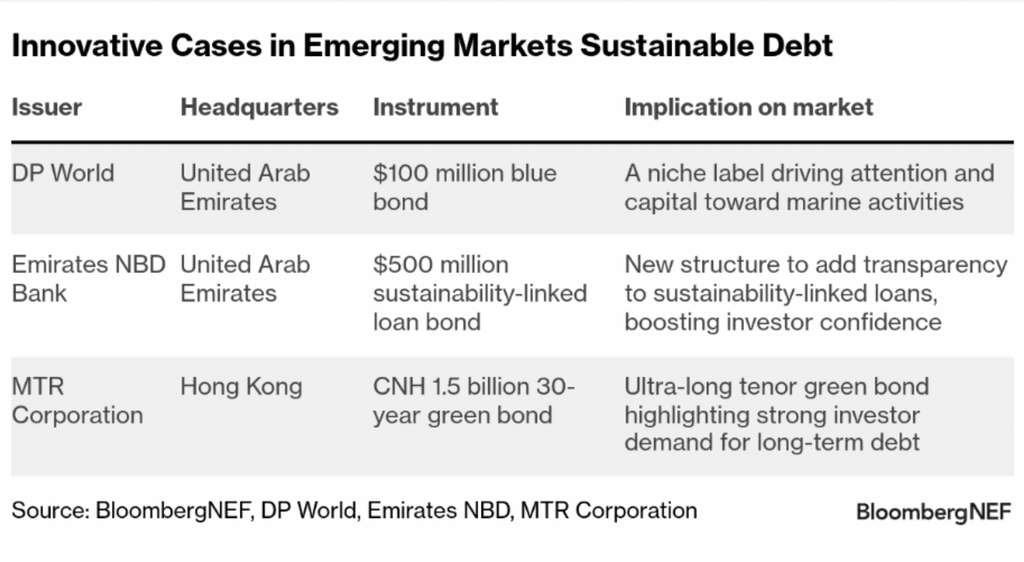
    Similarly, a blue bond from DP World, a UAE-based logistics and marine port operator, highlights the benefits of specificity when applying labels to help attract capital for underserved areas of sustainability, such as marine ecosystem conservation and restoration, and sustainable marine transportation.

    A sustainability-linked loan bond (SLLB) from Emirates NBD Bank also shows the added credibility that novel labeling structures can bring. Through robust selection criteria, the structure can help channel financing to the most impactful and robust sustainability-linked loans. The key to its success is transparency around the specific instruments financed by the SLLB.

    A green bond and green loan from Hong Kong’s MTR Corporation, a public transportation operator, demonstrated that there is strong investor demand for ultra-long tenors. As the company’s first green ultra-long tenor issuance, the novel 30-year green bond was well received by investors, as the instrument was 5.8 times oversubscribed.

    This report is part of the strategic partnership between Dubai Financial Services Authority (DFSA) and the Hong Kong Monetary Authority (HKMA) on sustainable finance.

    Mark Steward, Chief Executive of the DFSA, said: “This research provides valuable insight into how sustainable debt is evolving across the MENA and emerging APAC regions. The US$94 billion issuance record in 2024 reflects growing investor confidence and the resilience of our markets. Our focus remains on supporting all forms of sustainable and transition finance to ensure that the market within the DIFC, United Arab Emirates, and across the region remains robust and credible for the long term.”

    Eddie Yue, Chief Executive of the HKMA, said: “Sustainable debt is a promising tool for bridging the multi-trillion-dollar climate financing gap in emerging markets. Through this joint research, we aim to explore solutions to remove the barriers faced by issuers and identify opportunities for growth. As Asia’s leading sustainable finance hub that arranges 45% of the region’s international green bond issuances in 2024, Hong Kong is committed to leveraging our infrastructure and know-how to support emerging markets in reaching their sustainable development goals.”

    Jon Moore, Chief Executive of BloombergNEF, said: “Sustainable debt helps build trust and transparency in the financial market. The effort by HKMA and DFSA to drive the development of sustainable debt markets provides valuable support to scale up finance and investment for the energy transition. We hope this report and our industry-leading insights can help regulators and market participants navigate this transition and capture opportunities that advance global sustainability objectives.”

    The report is available at this link.

    Continue Reading

  • ComBox app: Evaluating measurement data at the touch button

    ComBox app: Evaluating measurement data at the touch button

    Drivers of development vehicles already have their hands full identifying, documenting and reporting technical abnormalities of new vehicle functions to the respective development departments during their test drives. “We welcome any simplification of our work, especially with regard to ADAS and drive issues, the validation of which is particularly time-consuming,” reports Jan Wörner, Project Manager in Data Driven Testing & Vehicle Functions at Porsche Engineering. “That’s exactly why we developed the ComBox app: It’s the engineer’s companion and serves as a kind of digital assistant during the testing. It also performs many calculations directly in the vehicle and identifies important scenarios in the measurement data without the driver having to intervene. This edge computing means we have to send significantly less data to the cloud for evaluation.”

    Six modes to choose from

    A commercially available high-end smartphone serves as the platform for the ComBox app. Most of the computing resources of this smartphone are available to the assistance software developed by Porsche Engineering. After launching the app, the user can select from six different modes: “Standard / Single” can be used to trigger measurement of vehicle control unit data at any time in order to record this measurement data and upload it to the cloud. “Scene Recognition” mode can record general traffic scenarios that are relevant for ADAS functions, for example.

    ADAS validation with the smartphone


    Porsche Engineering makes ADAS validation scalable.

    “Acoustic Detection” mode uses AI help to find distracting noises, while “Infotainment Recording” offers support with correcting display problems. “These four modes have one thing in common: After a manual or automatic trigger, they record patterns or errors and send the corresponding data to the cloud,” says Wörner. “Shift report” mode is used after the test drives and reduces the work involved in creating the log. “All modes reduce the manual workload, which increases efficiency and cuts human errors in the testing and fault elimination process,” explains Wörner.

    Access to the vehicle buses

    The prerequisite for this is that all modes have access to the relevant vehicle buses and data. The ComBox app obtains this data from a data logger in the test vehicle, such as Porsche Engineering’s Car Data Box. “The data logger has full access to all bus systems such as CAN, LIN, FlexRay, and Automotive Ethernet, which it uses to provide information about the current status of all vehicle systems,” explains Wörner. “It forwards this data to the smartphone with the ComBox app – either via cable using an Ethernet-to-USB adapter or via WiFi, if there is a wireless access point in the vehicle that is connected to the data logger.”  

    With the ComBox app’s Standard / Single service, the driver can trigger a measurement manually if any abnormality occurs. “This means that all measurement data from the vehicle is recorded within a defined timeframe around the trigger time and loaded into the cloud. The timeframe could be, for example, from three minutes before the trigger time to three minutes after it,” says Wörner. “The driver can also input a voice explanation into the smartphone, which is then automatically converted into text and sent to the cloud together with the measured data via a 5G network. With this method, detailed additional information can be recorded immediately and thereby be made available without delay for the downstream error analysis. The other modes also offer this option.“

    „Acoustic Detection” mode automatically identifies certain unwanted noises in the vehicle and, under certain framework conditions, provides support with identifying the cause. “The ComBox app uses the smartphone’s high-quality microphone to detect the  background noise. This makes reliable detection possible that is as cost-effective as it is space-saving—and without any additional equipment. However, those who wish to can still connect special microphone technology,” Wörner explains. “Artificial intelligence is used to analyze the audio recording directly in the vehicle: We use a neural network that we have trained with noise interference patterns.”

    Between the measurement technology and the cloud, Infographic, ComBox App, 2025, Porsche AG


    If the ComBox app detects an unwanted pattern, it automatically generates a message to this effect and loads it into the cloud together with the relevant audio 昀؀le. Other measurements such as the current speed of the vehicle, the gear engaged, and the engine speed are also transmitted. This extensive automation significantly reduces the workload required. For example, ”Acoustic Detection“ mode can automatically detect the signature howling noise of turbochargers, as well as certain intrusive wind noises. The list of automatically identifiable noise types will be expanded to include further noise categories in the future. In addition, the neural network has also learned how normal driving sounds as a reference. Using the ComBox app can significantly reduce the effort involved in detecting and analyzing acoustic issues.

    “In the past, there was often no suitable measuring equipment in the vehicle when such anomalies occurred,” reports Wörner. “We therefore first had to equip a vehicle with the measuring technology and then deliberately recreate the fault. This was very time-consuming and associated with high costs.” Abnormalities in the infotainment system can also be logged using the ComBox app. This is where “Infotainment Recording“ mode comes in. This mode records the content of the screens (driver, central, and passenger display) while the vehicle is moving. If the test driver notices a problem, a simple press of a button in the app will suffice to automatically upload a short video to the cloud. The video also contains the screen content from a few seconds before the function was triggered,” says Wörner. “Abnormalities such as misaligned text, an incorrectly placed icon in the navigation system or the wrong element being overlaid usually only appear for a few seconds, which is why we were often unable to record them in time in the past. ‘Infotainment Recording’ mode gives us a lot more room to identify and flag such issues.”

    Automatic scene recognition

    „Scene Recognition“ mode is still under development. It aims to automatically detect typical traffic scenarios that are relevant for testing a new ADAS function, such as being cut off by a vehicle in front—an incident that the ACC function, for example, may need to counter by braking. Such scenarios are described by the signals that occur in the vehicle and the order they occur in. These signals include the current speed, the brake pressure, and the distance to the road user in front. Edge computing directly within the app allows even complex scenarios and test cycles to be detected intelligently and automatically, without the driver having to intervene.

    Identifying corner cases

    Confident, even in borderline cases.

    “We can send a specific scenario pattern – containing the sequence of events and the combination of signals – from the cloud to all vehicles equipped with the ComBox app,” says Wörner. “As soon as the pattern you are looking for appears somewhere, the ComBox app sends the current measurement data to the cloud. This allows developers to see whether the new vehicle function has responded as desired.” The big advantage here is that, in the future, all vehicles in a test fleet that are running the ComBox app can be used to search for the relevant patterns – and not just those vehicles that are, for example, specifically on the road for ADAS testing purposes. “This saves a lot of time,” says Wörner, “because we no longer have to carry out certain dedicated test drives separately. They are done by other vehicles along the way, so to speak.”

    “Shift report” mode greatly facilitates the documentation of test drivers and measurement results. For quality assurance purposes, new vehicles undergo extensive endurance tests that include many repetitions – for example, opening the luggage compartment and sliding the sunroof several times or repeatedly charging the battery. This mode uses vehicle measurement signals to partially fill out the reports automatically—with data such as the number of repetitions performed. The reports need only to be checked after the journey and corrected if necessary. What’s more, the driver can record all errors that occur while driving directly in the ComBox app and add photos if necessary.

    “After each journey, the driver fills out a report and indicates how often they have carried out which action,” explains Wörner. “Completing these reports manually means a great deal of work and, as with any manual activity, errors can creep in. This is where the app effectively remedies the problem and we can increase the quality of the reports.” The six modes of the ComBox app have already proved themselves in practice and are constantly being enhanced. “The ComBox app thus serves as a reliable assistant for testing and, at the same time, functions as a central data interface,” Wörner sums up. “Another advantage is its ability to be used seamlessly and comprehensively for more or less all vehicle derivatives. In the future, Porsche Engineering plans to offer this tool, including the backend in the cloud, to its industrial customers as a self-contained product. The app’s different modes can be added on individually depending on customer requirements.

    Info

    Text first published in Porsche Engineering Magazine, issue 1/2025.

    Text: Christian Buck

    Copyright: All images, videos and audio files published in this article are subject to copyright. Reproduction in whole or in part is not permitted without the written consent of Dr. Ing. h.c. F. Porsche AG. Please contact magazin@porsche-engineering.de for further information.

    Continue Reading

  • flydubai signs for 150 A321neo

    flydubai signs for 150 A321neo

    Dubai, United Arab Emirates, 18 November 2025 – flydubai has signed a Memorandum of Understanding (MoU) with Airbus for 150 A321neo aircraft making the airline a new Airbus customer. The agreement underscores the carrier’s confidence in Dubai’s growth plans. 

    His Highness Sheikh Ahmed bin Saeed Al Maktoum, Chairman of flydubai, signed the MoU agreement with Christian Scherer, CEO Commercial Aircraft at Airbus, at the signing ceremony which was attended by Ghaith Al Ghaith, Chief Executive Officer at flydubai, on the second day of the Dubai Airshow 2025.

    We are pleased to announce a landmark agreement for 150 A321neo aircraft, representing another important milestone in flydubai’s journey. This new agreement is not only about adding aircraft. It supports the vision of His Highness Sheikh Mohammed bin Rashid Al Maktoum, Vice President and Prime Minister of the UAE and Ruler of Dubai and aligns with the Dubai Economic Agenda D33,” said His Highness Sheikh Ahmed bin Saeed Al Maktoum, Chairman and CEO of flydubai.

    “This strategic addition diversifies our narrow-body fleet and strengthens our long-term expansion plans. This will enable flydubai to play a key role in the success of Dubai World Central’s expansion plans, an airport we aim to become the largest airport in the world.”

    “The A321neos will support the next phase of our network development and enable us to meet rising demand across our markets. We look forward to establishing a strong and enduring partnership between flydubai and Airbus.” 

    The addition of the latest generation A321neo will support flydubai’s strategy to expand its network, offering customers access to new destinations with greater efficiency and comfort. 

    “We welcome flydubai, one of the Middle East’s most ambitious and fast-growing carriers, as a new Airbus customer,” said Christian Scherer, CEO Commercial Aircraft at Airbus. “The decision to invest in and introduce the A321neo into its fleet is another endorsement of the added value Airbus brings in terms of range, efficiency and passenger comfort. We look forward to supporting flydubai as it enables new growth and possibilities with our aircraft.” 

    The A321neo is part of the A320neo Family, incorporating the latest technologies including new generation engines, Sharklets and cabin efficiency enablers, which together deliver more than 20% fuel savings and CO₂ reduction compared to previous generation single-aisle aircraft. 

    At the end of October 2025, more than 7,200 A321neo aircraft have been ordered by nearly 100 customers across the globe.

    As with all Airbus aircraft, the A320 Family is already able to operate with up to 50% Sustainable Aviation Fuel (SAF), with Airbus targeting 100% SAF capability by 2030. 

    @Airbus @flydubai #A321neo

    Continue Reading