Category: 3. Business

  • Asia Set for Sluggish Open Ahead of Delayed Data: Markets Wrap

    Asia Set for Sluggish Open Ahead of Delayed Data: Markets Wrap

    (Bloomberg) — Asian markets looked set for a cautious start as investors braced for a barrage of US economic data amid lingering uncertainty over the Federal Reserve’s policy path. Bitcoin erased its gains for the year.

    Equity-index futures pointed to modest declines in Hong Kong and a slight gain for Japan, while Australian shares opened lower. The yen held steady ahead of third-quarter growth data. US shares closed little changed on Friday as investors stayed on the sidelines ahead of economic reports delayed by the government shutdown.

    After weeks of limited data, investors will finally get fresh signals on the health of the US economy as agencies begin releasing key indicators, including the September employment figures on Thursday. Traders are also navigating a mix of risks — from stretched valuations in AI-related stocks to renewed strains in relations between China and Japan. Risk appetite seemed to be fading, with Bitcoin sliding below $94,000 and wiping out its year-to-date advance.

    “November so far has seen a pretty wobbly ride for shares,” Shane Oliver, chief economist and head of investment strategy at AMP Ltd., wrote in a note to clients. “Share markets remain at risk of a correction given stretched valuations, risks around US tariffs and the softening US jobs market.”

    A slew of Fed officials have expressed skepticism over the need for a cut in December, or outright opposed one, less than a month after Chair Jerome Powell warned that a December cut is far from a “foregone conclusion.”

    Last week, futures traders pushed the odds of a quarter-point rate cut in December below 50% as some Fed officials indicated that such a move is far from a sure thing. That near-term uncertainty has driven up a gauge of expected bond-market volatility, which had been hovering around a four-year low.

    “While there will be questions about data quality, market participants will react to new information” and weigh the dollar, Commonwealth Bank of Australia strategists led by Joseph Capurso wrote in a note to clients. “We expect the non-farm payrolls report for September to underperform expectations of a 50,000 increase.”

    Meanwhile, the yen was steady in early trading ahead of Japanese third quarter growth data, which may provide justification for Prime Minister Sanae Takaichi compiling a hefty stimulus package. Japan’s real gross domestic product is forecast to contract by 2.4% in the three months through September on an annualized basis, the first decline in six quarters, according to economists’ estimates.

    The potential for stimulus and a reduction in rate hike expectations following Takaichi’s appointment has placed fresh pressure on the yen. The currency slid to its weakest in nine months last week, leading to official warnings that moves have become one-sided. Any further weakening may increase angst over possible government intervention with the currency near levels that previously drew authorities into the market.

    “Technically, USD/JPY is approaching levels where Japanese currency officials are expected to begin to verbally intervene more aggressively,” Tony Sycamore, a strategist at IG Markets, wrote in a note. “However, actual physical intervention is unlikely until the exchange rate reaches around 160 or higher, given the dovish stance of the new Japanese Prime Minister.”

    In commodities, oil started the week a touch lower while gold edged up. The precious metal has jumped more than 50% this year, putting it on course for its best annual gain since 1979.

    Attention is also on the cryptocurrencies market. Just a little more than a month after reaching an all-time high, Bitcoin has erased the more than 30% gain registered since the start of the year as the exuberance over the pro-crypto stance of the Trump administration fades.

    The dominant cryptocurrency fell below $93,714 on Sunday, pushing the price beneath the closing level reached at the end of last year, when financial markets were rallying following President Donald Trump’s election victory. Bitcoin soared to a record $126,251 on Oct. 6, only to begin tumbling four days later after unexpected comments on tariffs by Trump sent markets into a tailspin worldwide.

    Corporate News:

    Samsung Group and SK Group were among four of South Korea’s biggest companies that pledged to invest about $550 billion in the country after meeting with President Lee Jae Myung. A White House national security memo claimed Alibaba Group Holding Ltd. provided the Chinese military with technology support against targets in the US, the Financial Times reported. Boeing Co. said it will ensure its factories are ready to absorb a higher rate of aircraft output before lifting the tempo again next year. Some of the main moves in markets:

    Stocks

    S&P 500 futures rose 0.1% as of 8:26 a.m. Tokyo time Hang Seng futures fell 0.3% Australia’s S&P/ASX 200 fell 0.2% Currencies

    The Bloomberg Dollar Spot Index was little changed The euro was little changed at $1.1622 The Japanese yen was little changed at 154.54 per dollar The offshore yuan was little changed at 7.0978 per dollar The Australian dollar was little changed at $0.6534 Cryptocurrencies

    Bitcoin rose 0.9% to $94,271.23 Ether rose 0.7% to $3,094.2 Bonds

    Australia’s 10-year yield advanced three basis points to 4.47% Commodities

    West Texas Intermediate crude fell 1% to $59.48 a barrel Spot gold rose 0.5% to $4,106.23 an ounce This story was produced with the assistance of Bloomberg Automation.

    –With assistance from Masaki Kondo.

    ©2025 Bloomberg L.P.
    Continue Reading

  • Goldman Sachs unveils 10-year playbook, AI is at the heart of it

    Goldman Sachs unveils 10-year playbook, AI is at the heart of it

    Continue Reading

  • Stock market today: Live updates

    Stock market today: Live updates

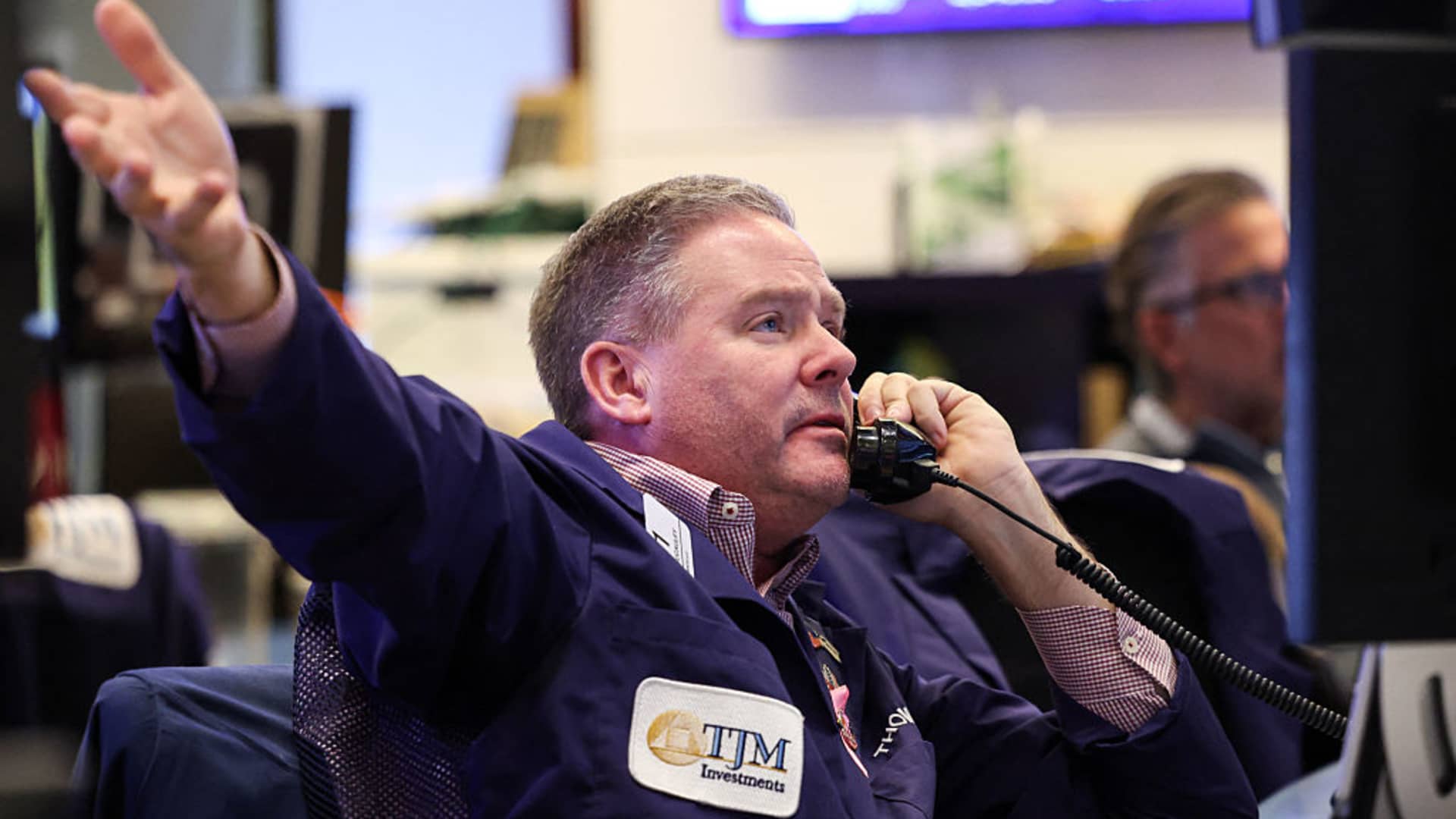
    Traders work on the floor of the New York Stock Exchange (NYSE) in New York on November 14, 2025.

    Charly Triballeau | Afp | Getty Images

    Stock futures were little changed on Sunday night following a choppy week in which valuation fears, a rotation within the market and a recalibration of Federal Reserve rate cut expectations pressured the artificial intelligence trade.

    Dow Jones Industrial Average futures slipped 58 points, or 0.1%. S&P 500 and Nasdaq-100 futures hovered around the flatline.

    The Nasdaq Composite ended last week down 0.5%, led by declines in Alphabet, Amazon, Broadcom and Meta Platforms. The Dow Jones Industrial Average and S&P 500 eked out small gains last week, though they suffered steep declines on Thursday.

    “We had expected the first couple weeks of November to be choppy, and it certainly looks like we are in the midst of the chop,” wrote Tom Lee, head of research at Fundstrat.

    “While some parts of the wall of worries, such as the government shutdown and the New York City mayoral race, have been resolved, other parts remain,” he said. “Nevertheless, we expect the current chop to ultimately give way to a rally and ultimately add roughly 200 points to take the S&P 500 over 7,000.”

    Investors will get more clues on the state of the AI trade this week, when Nvidia reports earnings on Wednesday. Wall Street will also get a look at the health of the consumer, with retail giants Walmart and Home Depot set to post their quarterly results.

    Continue Reading

  • Insider Stock Buying Reaches AU$1.01m On Marvel Gold

    Insider Stock Buying Reaches AU$1.01m On Marvel Gold

    It is usually uneventful when a single insider buys stock. However, When quite a few insiders buy shares, as it happened in Marvel Gold Limited’s (ASX:MVL) case, it’s fantastic news for shareholders.

    While insider transactions are not the most important thing when it comes to long-term investing, logic dictates you should pay some attention to whether insiders are buying or selling shares.

    AI is about to change healthcare. These 20 stocks are working on everything from early diagnostics to drug discovery. The best part – they are all under $10bn in marketcap – there is still time to get in early.

    In the last twelve months, the biggest single purchase by an insider was when Independent Non-Executive Chairman Stephen Dennis bought AU$500k worth of shares at a price of AU$0.08 per share. That means that even when the share price was higher than AU$0.016 (the recent price), an insider wanted to purchase shares. It’s very possible they regret the purchase, but it’s more likely they are bullish about the company. We always take careful note of the price insiders pay when purchasing shares. It is generally more encouraging if they paid above the current price, as it suggests they saw value, even at higher levels.

    Marvel Gold insiders may have bought shares in the last year, but they didn’t sell any. Their average price was about AU$0.052. These transactions suggest that insiders have considered the current price attractive. You can see the insider transactions (by companies and individuals) over the last year depicted in the chart below. By clicking on the graph below, you can see the precise details of each insider transaction!

    Check out our latest analysis for Marvel Gold

    ASX:MVL Insider Trading Volume November 16th 2025

    Marvel Gold is not the only stock that insiders are buying. For those who like to find small cap companies at attractive valuations, this free list of growing companies with recent insider purchasing, could be just the ticket.

    I like to look at how many shares insiders own in a company, to help inform my view of how aligned they are with insiders. I reckon it’s a good sign if insiders own a significant number of shares in the company. From our data, it seems that Marvel Gold insiders own 8.4% of the company, worth about AU$1.9m. However, it’s possible that insiders might have an indirect interest through a more complex structure. We do generally prefer see higher levels of insider ownership.

    The fact that there have been no Marvel Gold insider transactions recently certainly doesn’t bother us. But insiders have shown more of an appetite for the stock, over the last year. The transactions are fine but it’d be more encouraging if Marvel Gold insiders bought more shares in the company. So while it’s helpful to know what insiders are doing in terms of buying or selling, it’s also helpful to know the risks that a particular company is facing. Case in point: We’ve spotted 4 warning signs for Marvel Gold you should be aware of, and 2 of these can’t be ignored.

    Of course, you might find a fantastic investment by looking elsewhere. So take a peek at this free list of interesting companies.

    For the purposes of this article, insiders are those individuals who report their transactions to the relevant regulatory body. We currently account for open market transactions and private dispositions of direct interests only, but not derivative transactions or indirect interests.

    Have feedback on this article? Concerned about the content? Get in touch with us directly. Alternatively, email editorial-team (at) simplywallst.com.

    This article by Simply Wall St is general in nature. We provide commentary based on historical data and analyst forecasts only using an unbiased methodology and our articles are not intended to be financial advice. It does not constitute a recommendation to buy or sell any stock, and does not take account of your objectives, or your financial situation. We aim to bring you long-term focused analysis driven by fundamental data. Note that our analysis may not factor in the latest price-sensitive company announcements or qualitative material. Simply Wall St has no position in any stocks mentioned.

    Continue Reading

  • Asian Undervalued Small Caps With Insider Buying To Watch In November 2025

    Asian Undervalued Small Caps With Insider Buying To Watch In November 2025

    As global markets navigate a complex landscape marked by mixed performances in key indices and cautious monetary policies, the Asian market remains an area of interest for investors, particularly in the small-cap segment. With small-cap stocks often sensitive to economic shifts and interest rate movements, identifying those with potential value can be crucial; factors such as insider buying may offer additional insights into promising opportunities amidst these dynamic conditions.

    Name

    PE

    PS

    Discount to Fair Value

    Value Rating

    Security Bank

    4.2x

    0.9x

    25.14%

    ★★★★★★

    East West Banking

    3.1x

    0.7x

    18.75%

    ★★★★☆☆

    Civmec

    16.4x

    0.9x

    47.69%

    ★★★★☆☆

    Eureka Group Holdings

    10.5x

    4.6x

    26.80%

    ★★★★☆☆

    PSC

    9.8x

    0.4x

    20.28%

    ★★★★☆☆

    Hung Hing Printing Group

    NA

    0.4x

    44.03%

    ★★★★☆☆

    PolyNovo

    60.9x

    6.3x

    28.29%

    ★★★☆☆☆

    Nickel Asia

    12.0x

    1.8x

    17.78%

    ★★★☆☆☆

    Ever Sunshine Services Group

    7.0x

    0.4x

    -459.68%

    ★★★☆☆☆

    Chinasoft International

    23.0x

    0.7x

    -1253.99%

    ★★★☆☆☆

    Click here to see the full list of 43 stocks from our Undervalued Asian Small Caps With Insider Buying screener.

    Let’s uncover some gems from our specialized screener.

    Simply Wall St Value Rating: ★★★★☆☆

    Overview: Asia United Bank provides a range of financial services including branch, consumer, and commercial banking, as well as treasury operations, with a market capitalization of ₱35.76 billion.

    Operations: Asia United Bank’s primary revenue streams are derived from branch banking, treasury operations, and commercial banking. As of the latest data, the net income margin stands at 55.78%, indicating a strong profitability position. The company has experienced fluctuations in its operating expenses over time, which include significant contributions from general and administrative expenses.

    PE: 4.6x

    Asia United Bank, a smaller player in the Asian financial sector, shows potential for value appreciation. Insider confidence is evident with Ernesto Tan Uy purchasing 30,000 shares worth approximately ₱1.05 million in recent months, indicating belief in future performance. The bank’s strategic leadership changes include appointing Dennis Edmund E. Balagtas as Head of Trust and Investments Group from November 2025, bringing decades of experience to enhance trust banking operations. These developments suggest a focus on strengthening its market position amidst evolving industry dynamics.

    PSE:AUB Share price vs Value as at Nov 2025

    Simply Wall St Value Rating: ★★★★☆☆

    Continue Reading

  • Those who invested in Rivco Australia (ASX:RIV) three years ago are up 3.4%

    Those who invested in Rivco Australia (ASX:RIV) three years ago are up 3.4%

    As an investor its worth striving to ensure your overall portfolio beats the market average. But the risk of stock picking is that you will likely buy under-performing companies. Unfortunately, that’s been the case for longer term Rivco Australia Ltd (ASX:RIV) shareholders, since the share price is down 12% in the last three years, falling well short of the market return of around 33%.

    With that in mind, it’s worth seeing if the company’s underlying fundamentals have been the driver of long term performance, or if there are some discrepancies.

    We’ve found 21 US stocks that are forecast to pay a dividend yield of over 6% next year. See the full list for free.

    In his essay The Superinvestors of Graham-and-Doddsville Warren Buffett described how share prices do not always rationally reflect the value of a business. One imperfect but simple way to consider how the market perception of a company has shifted is to compare the change in the earnings per share (EPS) with the share price movement.

    Although the share price is down over three years, Rivco Australia actually managed to grow EPS by 21% per year in that time. Given the share price reaction, one might suspect that EPS is not a good guide to the business performance during the period (perhaps due to a one-off loss or gain). Or else the company was over-hyped in the past, and so its growth has disappointed.

    We’re actually a quite surprised to see the share price down while EPS have grown strongly. Therefore, we should look at some other metrics to try to understand why the market is disappointed.

    We note that the dividend seems healthy enough, so that probably doesn’t explain the share price drop. We like that Rivco Australia has actually grown its revenue over the last three years. But it’s not clear to us why the share price is down. It might be worth diving deeper into the fundamentals, lest an opportunity goes begging.

    The graphic below depicts how earnings and revenue have changed over time (unveil the exact values by clicking on the image).

    ASX:RIV Earnings and Revenue Growth November 16th 2025

    We know that Rivco Australia has improved its bottom line lately, but what does the future have in store? If you are thinking of buying or selling Rivco Australia stock, you should check out this free report showing analyst profit forecasts.

    When looking at investment returns, it is important to consider the difference between total shareholder return (TSR) and share price return. The TSR incorporates the value of any spin-offs or discounted capital raisings, along with any dividends, based on the assumption that the dividends are reinvested. Arguably, the TSR gives a more comprehensive picture of the return generated by a stock. In the case of Rivco Australia, it has a TSR of 3.4% for the last 3 years. That exceeds its share price return that we previously mentioned. This is largely a result of its dividend payments!

    Rivco Australia shareholders gained a total return of 6.6% during the year. But that was short of the market average. The silver lining is that the gain was actually better than the average annual return of 6% per year over five year. This suggests the company might be improving over time. It’s always interesting to track share price performance over the longer term. But to understand Rivco Australia better, we need to consider many other factors. Case in point: We’ve spotted 1 warning sign for Rivco Australia you should be aware of.

    If you like to buy stocks alongside management, then you might just love this free list of companies. (Hint: many of them are unnoticed AND have attractive valuation).

    Please note, the market returns quoted in this article reflect the market weighted average returns of stocks that currently trade on Australian exchanges.

    Have feedback on this article? Concerned about the content? Get in touch with us directly. Alternatively, email editorial-team (at) simplywallst.com.

    This article by Simply Wall St is general in nature. We provide commentary based on historical data and analyst forecasts only using an unbiased methodology and our articles are not intended to be financial advice. It does not constitute a recommendation to buy or sell any stock, and does not take account of your objectives, or your financial situation. We aim to bring you long-term focused analysis driven by fundamental data. Note that our analysis may not factor in the latest price-sensitive company announcements or qualitative material. Simply Wall St has no position in any stocks mentioned.

    Continue Reading

  • Tetra Tech (TTEK) Is Up 12.4% After Record Q4 Results and Robust Backlog Expansion—Has Investor Sentiment Shifted?

    Tetra Tech (TTEK) Is Up 12.4% After Record Q4 Results and Robust Backlog Expansion—Has Investor Sentiment Shifted?

    • Tetra Tech, Inc. recently announced record financial results for the fourth quarter of fiscal 2025, reporting quarterly sales of US$1,330.1 million and net income of US$127.75 million, along with the declaration of a quarterly dividend of US$0.065 per share payable on December 12, 2025.

    • Management highlighted a robust backlog of US$4.14 billion and strong demand for water and environmental services, underpinned by large new contract wins and guidance anticipating further earnings growth in 2026 despite sector funding shifts.

    • We’ll explore how Tetra Tech’s record operating margins and backlog expansion could reshape the company’s investment narrative for long-term investors.

    The latest GPUs need a type of rare earth metal called Neodymium and there are only 37 companies in the world exploring or producing it. Find the list for free.

    For investors considering Tetra Tech, the core thesis centers on the company’s ability to maintain strong earnings growth and margin expansion as it shifts focus to high-value water and environmental services contracts. The most recent record quarterly results and robust backlog reinforce the short-term catalyst of high-margin government service wins, but do little to address the growing risk around revenue concentration and the uncertainties created by lapsed USAID and Department of State contracts.

    Among the latest announcements, the $249 million contract award from the U.S. Army Corps of Engineers stands out as directly supporting future backlog and near-term revenue, tying in closely to the key catalyst of government infrastructure spending highlighted in company guidance. This new pipeline helps offset concerns about lower contributions from previous episodic disaster response work.

    However, investors should not overlook that, while government contract wins support revenue visibility, the company still faces the risk that shifts in federal funding priorities could result in…

    Read the full narrative on Tetra Tech (it’s free!)

    Tetra Tech’s narrative projects $4.7 billion in revenue and $559.6 million in earnings by 2028. This requires a 0.8% annual revenue decline and a $343.5 million earnings increase from current earnings of $216.1 million.

    Uncover how Tetra Tech’s forecasts yield a $42.60 fair value, a 18% upside to its current price.

    TTEK Community Fair Values as at Nov 2025

    Four individual fair value estimates from the Simply Wall St Community range from US$23.16 to US$42.60 per share. Despite renewed optimism from recent federal contract wins, some see continued risk around margin volatility and revenue concentration that could shape long-term outlooks.

    Explore 4 other fair value estimates on Tetra Tech – why the stock might be worth 36% less than the current price!

    Disagree with existing narratives? Create your own in under 3 minutes – extraordinary investment returns rarely come from following the herd.

    These stocks are moving-our analysis flagged them today. Act fast before the price catches up:

    This article by Simply Wall St is general in nature. We provide commentary based on historical data and analyst forecasts only using an unbiased methodology and our articles are not intended to be financial advice. It does not constitute a recommendation to buy or sell any stock, and does not take account of your objectives, or your financial situation. We aim to bring you long-term focused analysis driven by fundamental data. Note that our analysis may not factor in the latest price-sensitive company announcements or qualitative material. Simply Wall St has no position in any stocks mentioned.

    Companies discussed in this article include TTEK.

    Have feedback on this article? Concerned about the content? Get in touch with us directly. Alternatively, email editorial-team@simplywallst.com

    Continue Reading

  • Rio Tinto partners with Calix to test low-emissions steel making in Western Australia, pauses BioIron

    PERTH, Australia–(BUSINESS WIRE)–
    Rio Tinto has signed a Joint Development Agreement (JDA) with Australian environmental technology company Calix to support construction of Calix’s Zero Emissions Steel Technology (Zesty) demonstration plant in Western Australia, which could enable Pilbara iron ores to be used in lower-emissions steel making.

    If approved, the demonstration plant will be built at a site in Kwinana, south of Perth, that had been earmarked for Rio Tinto’s previously announced BioIron Research and Development Facility and associated pilot plant.

    Rio Tinto has determined that the current furnace design for BioIron requires additional development to minimise technical risks and optimise its performance.

    It remains committed to the long-term potential of BioIron technology, and research and development continues in partnership with the University of Nottingham and sustainable technology company, Metso.

    Rio Tinto will invest more than A$35 million, subject to project milestones and comprised of in-kind and financial contributions, to assist Calix with the Zesty Green Iron Demonstration Plant, which also has Australian Renewable Energy Agency (ARENA) support.

    The Zesty process is compatible with lower grade iron ore and uses electric heating and hydrogen reduction to produce reduced-emissions iron.

    Rio Tinto Iron Ore Chief Executive Matthew Holcz said: “The world needs low-emissions steel if it is going to decarbonise, and we continue to look at a range of ways Pilbara iron ores can help to do this as new technologies emerge.

    “We’re pleased to partner with Calix, an Australian technology company, to help progress the Zesty technology to be able to use Pilbara iron ores for lower-emissions steel making.

    “In parallel, we’ll keep progressing BioIron with our partners, the University of Nottingham and Metso, to further its potential. Both projects are part of our work to reduce emissions and support the future of iron ore in Australia and the communities that depend on it.”

    Western Australian Premier Roger Cook said: “Locally made green iron is a key part of my vision to become a renewable energy powerhouse and make more things here.

    “Coupled with my government’s recent announcement that government will take an “if not, why not” approach to green steel procurement on major government projects, the Zesty Green Iron Demonstration Plant will support our efforts to diversify WA’s economy so that it can remain the strongest in the nation.

    “I welcome this agreement between Calix and Rio Tinto, which will play an important role in growing this exciting new industry in WA.”

    The Kwinana location provides access to established utilities, ports and other infrastructure. It is also near the NeoSmelt1 facility for potential downstream processing of Direct Reduced Iron produced by the Zesty plant. Rio Tinto is one of five companies developing the NeoSmelt project, which earlier this year secured ARENA funding.

    Calix also has a A$44.9m ARENA grant, subject to conditions, for the Zesty Green Iron Demonstration Plant, as previously announced by the company.

    Calix Chief Executive Officer Phil Hodgson said: “The Joint Development Agreement with Rio Tinto is a major milestone in the commercialisation of Zesty. It provides cash and hands-on support, including industry leading resources, expertise and market reach to progress the Zesty Demonstration project.

    “This strong support from Rio Tinto provides further validation of the potential for deployment of the Zesty technology to the world’s largest minerals and metals market, its potential to help decarbonise a critical industry responsible for ~8% of global CO2 emissions, and the opportunity to help future-proof Australia’s largest source of export income. We look forward to working with Rio Tinto, further industry partners and other key stakeholders, and ARENA on this important Australian project.”

    Under the terms of the JDA, Rio Tinto will support the Zesty project to reach a Final Investment Decision (FID) through technical support, engineering services and advocacy.

    Subject to FID and successful project construction, Rio Tinto will supply up to 10,000 tonnes of a range of Pilbara iron ores for use in plant commissioning and the initial testing phase of the project, as well as introductions to potential customers for downstream use of the Zesty product.

    The partnership enables Rio Tinto to exercise a non-exclusive global and perpetual licence agreement for the potential commercial use of the Zesty technology, sub-licence the technology to its affiliates and customers, and act as a non-exclusive global marketing agent for the Zesty technology.

    Additional information

    About Calix and Zesty

    Calix Limited is an Australian technology company focused on industrial decarbonisation and sustainability.

    Calix’s Zesty technology uses a combination of electric heating and hydrogen reduction to produce green iron and ultimately, green steel. Zesty aims to provide lowest cost pathways to green iron and steel through minimal hydrogen consumption, flexible electric heating compatible with intermittent renewable energy sources, elimination of ore pelletisation, and enabling the use of fines and lower-grade iron ores. Zesty pilot-scale trials in collaboration with the Heavy-Industry Low-carbon Transitions Cooperative Research Centre (HILT CRC) and industry partners have proven the ability of the technology to produce green iron from a range of iron ore types and grades2.

    The Zesty Green Iron Demonstration Plant is designed to produce up to 30,000 tonnes per annum of hydrogen direct reduced iron (H2-DRI) or hot briquetted iron (HBI) from a range of iron ore sources. The Demonstration Plant intends to provide an industry-wide facility for the non-exclusive toll processing of iron ores into H2-DRI or HBI, with the aims of supporting the ongoing viability of Australian iron ore in a low emissions steel value chain and the development of a green iron industry in Australia. The Project is supported by a grant of up to $44.9m from the Australian Renewable Energy Agency, subject to matched funding being secured.

    The Zesty Demonstration Project has entered its detailed design engineering phase to help inform a FID, expected in 2026.

    About BioIron

    BioIron was invented by Rio Tinto’s steel decarbonisation team after a decade of extensive research. Electricity consumption in the BioIron process is about one-third of the electricity required by other steelmaking processes that rely on renewable hydrogen.

    BioIron uses raw biomass such as agricultural by-products like wheat straw, barley straw, sugarcane bagasse, rice stalks, and canola straw, instead of coal as the reducing agent.

    Footnotes

    1 No affiliation with NeoSmelt is implied.

    2 Calix ASX Announcement Zesty Deep dive presentation 31 July 2025.

    Please direct all enquiries to media.enquiries@riotinto.com

    Media Relations,

    United Kingdom

    Matthew Klar

    M +44 7796 630 637

    David Outhwaite

    M +44 7787 597 493

    Media Relations,

    Australia

    Matt Chambers

    M +61 433 525 739

    Alyesha Anderson

    M
    +61 434 868 118

    Rachel Pupazzoni

    M +61 438 875 469

    Bruce Tobin

    M +61 419 103 454

    Media Relations,

    Canada

    Simon Letendre

    M +1 514 796 4973

    Malika Cherry

    M +1 418 592 7293

    Vanessa Damha

    M +1 514 715 2152

    Media Relations,

    US & Latin America

    Jesse Riseborough

    M +1 202 394 9480

    Investor Relations,

    United Kingdom

    Rachel Arellano

    M +44 7584 609 644

    David Ovington

    M +44 7920 010 978

    Laura Brooks

    M +44 7826 942 797

    Weiwei Hu

    M +44 7825 907 230

    Investor Relations,

    Australia

    Tom Gallop

    M +61 439 353 948

    Eddie Gan-Och

    M +976 95 091 237

    Rio Tinto plc

    6 St James’s Square

    London SW1Y 4AD

    United Kingdom

    T +44 20 7781 2000

    Registered in England

    No. 719885

    Rio Tinto Limited

    Level 43, 120 Collins Street

    Melbourne 3000

    Australia

    T +61 3 9283 3333

    Registered in Australia

    ABN 96 004 458 404

    riotinto.com

    Category: Pilbara

    Source: Rio Tinto


    Continue Reading

  • Bitcoin Erases Year’s Gain as Crypto Bear Market Deepens

    Bitcoin Erases Year’s Gain as Crypto Bear Market Deepens

    Bitcoin fell below $93,714 on Sunday.

    Just a little more than a month after reaching an all-time high, Bitcoin has erased the more than 30% gain registered since the start of the year as the exuberance over the pro-crypto stance of the Trump administration fades and the recent cooling of high-flying technology stocks leads to a drop in overall risk appetite.

    Most Read from Bloomberg

    The dominant cryptocurrency fell below $93,714 on Sunday, pushing the price beneath the closing level reached at the end of last year, when financial markets were rallying following President Donald Trump’s election victory. Bitcoin soared to a record $126,251 on Oct. 6, only to begin tumbling four days later after unexpected comments on tariffs by Trump sent markets into a tailspin worldwide.

    “The general market is risk-off,” said Matthew Hougan, the San Francisco-based chief investment officer for Bitwise Asset Management. “Crypto was the canary in the coal mine for that, it was the first to flinch.”

    Over the past month, many of the biggest buyers — from exchange-traded fund allocators to corporate treasuries — have quietly stepped back, depriving the market of the flow-driven support that helped propel the token to records earlier this year.

    For much of the year, institutions were the backbone of Bitcoin’s legitimacy and its price. ETFs as a cohort took in more than $25 billion, according to Bloomberg data, pushing assets as high as roughly $169 billion. Their steady allocation flows helped reframe the asset as a portfolio diversifier — a hedge against inflation, monetary debasement and political disarray. But that narrative — always tenuous — is fraying afresh, leaving the market exposed to something quieter but no less destabilizing: disengagement.

    “The selloff is a confluence of profit-taking by LTHs, institutional outflows, macro uncertainty, and leveraged longs getting wiped out,” said Jake Kennis, senior research analyst at Nansen. “What is clear is that the market has temporarily chosen a downward direction after a long period of consolidation/ranging.”

    Michael SaylorPhotographer: Ronda Churchill/Bloomberg
    Michael SaylorPhotographer: Ronda Churchill/Bloomberg

    One of the starkest examples of a buying strike in the digital-asset community comes from Michael Saylor’s Strategy Inc., the software firm turned Bitcoin hoarder. Once the poster child for corporate treasury crypto plays, its stock is now flirting near parity to its Bitcoin stash — a sign that investors are no longer willing to pay a premium for Saylor’s high-conviction leverage model.

    Boom and bust cycles have been a constant since Bitcoin burst into the mainstream consciousness with a more than 13,000% surge in 2017, only to be followed by a plunge of almost 75% the following year.

    “The sentiment in crypto retail is pretty negative,” said Hougan, who sees the current pullback as a buying opportunity. “They don’t want to live through another 50% pullback. People are front-running that by stepping out of the market.”

    Bitcoin has whipsawed investors through the year, dropping to as low as $74,400 in April as Trump unveiled his tariffs, before rebounding to record highs ahead of the latest retreat. The original digital asset accounts for almost 60% of crypto’s roughly $3.2 trillion in market value.

    The market downturn has been even tougher on smaller, less liquid tokens that traders often gravitate toward because of their higher volatility and typical outperformance during rallies. A MarketVector index tracking the bottom half of the largest 100 digital assets is down around 60% this year.

    “The markets are always an ebb and flow, and cyclicality in crypto is nothing new,” said Chris Newhouse, director of research at Ergonia, a firm specializing in decentralized finance. But “amongst friends, Telegram chats, and at conferences, the general sentiment I’ve received shows skepticism around capital deployment, and no natural bullish catalysts.”

    –With assistance from Richard Henderson.

    (Updates with more details beginning in fifth paragraph.)

    Most Read from Bloomberg Businessweek

    ©2025 Bloomberg L.P.

    Continue Reading

  • Week Ahead for FX, Bonds: Investors Await U.S. Data After Shutdown Ends

    Week Ahead for FX, Bonds: Investors Await U.S. Data After Shutdown Ends

    By Dow Jones Newswires staff

    Below are the most important global events likely to affect FX and bond markets in the week starting Nov. 17.

    Now that the longest ever U.S. government shutdown has finally ended, attention is turning to when key data will be released following a string of delays as investors remain uncertain over whether the Federal Reserve will cut interest rates next month.

    Inflation data in the U.K. and Canada will be watched closely. In Asia, markets will closely monitor a range of economic data releases, with particular focus on key indicators from Japan, China and Australia.

    U.S.

    As the U.S. government reopens, investors will be looking out for announcements on which U.S. economic data are due to be released and when.

    The market's relief at the shutdown ending proved brief as investors turned cautious amid uncertainty about when key data, especially jobs figures, will be released and how reliable it will be. This leaves investors uncertain about whether or not the Federal Reserve will cut interest rates in December.

    Two major government reports on inflation and the labor market for October are "likely never" to be released, White House Press Secretary Karoline Leavitt said Wednesday.

    The Fed recently cut interest rates but Chair Jerome Powell said a December rate cut wasn't a foregone conclusion. Several Federal Reserve members have since suggested interest rates could stay unchanged next month, although there are still some calling for unchanged rates. U.S. money markets currently price a roughly equal chance of a rate cut in December versus unchanged rates, LSEG data show.

    It is "no secret that the Fed remains divided and cautious," FP Markets chief market analyst Aaron Hill said in a note.

    "Expectations for a Federal Reserve rate cut next month have been pared back significantly … which could provide some support to the currency and yields," Naga market analyst Frank Walbaum said in a note.

    Meanwhile, however, recent U.S. jobs data from ADP and Challenger were weak, raising concerns that the economy could be weakening and leaving the outlook uncertain.

    Policymakers' cautious tone and the upcoming flood of economic releases could still leave the dollar vulnerable to falls, with its direction likely to hinge on the strength or weakness of the data, Walbaum said.

    Minutes from the October Fed meeting on Wednesday will be closely scrutinized. Other data due include purchasing managers' figures and the University of Michigan final consumer confidence survey for November on Friday.

    Canada

    Canada releases its October inflation data on Monday.

    The minutes of the Bank of Canada's last meeting in October noted that inflation exceeded the central bank's expectations in September, rising to 2.4%. The BOC cut rates by 25 basis points to 2.25% at that meeting but some policymakers pushed to hold off on another cut until a later date so they could have a better gauge of inflation risks and labor market weakness, the minutes showed. That means upcoming data, including Monday's inflation report, will be key.

    Eurozone

    In a quiet week for data releases, flash estimate eurozone PMI data for France, Germany and the eurozone for November will be in focus.

    The European Commission's autumn economic forecast for the EU will also be released on Monday.

    German producer price index for October and eurozone flash consumer confidence indicator for November are due on Thursday, while France's monthly business survey and Spanish industrial orders data are due on Friday.

    "We see more scope for an improvement in the eurozone than in the U.K. as political uncertainty was dialed down in France at the same time as budget fears mounted in the U.K.," Investec's Sandra Horsfield said in a note. ""Longer-term, both countries face clear fiscal consolidation needs."

    Slovakia and Finland will hold bond auctions on Tuesday, followed by Greece on Wednesday and Spain and France on Thursday.

    U.K.

    Focus in the U.K. will center on any further commentary on possible measures at the U.K. budget on Nov. 26, as well as U.K. inflation data for October on Wednesday.

    The Financial Times reported that the Labour government has dropped plans to raise income taxes, causing gilt yields to rise and sterling to fall.

    "The decision to drop the income tax hike could be viewed as the Labour leadership prioritizing their popularity with the public and the stability of the Labour party over doing what is best to restore confidence in the public finances," MUFG Bank analyst Lee Hardman said in a note.

    As well as the budget, U.K. inflation data will be key as investors are looking for further evidence of whether the Bank of England will cut interest rates again next month after recent weak jobs and gross domestic product data.

    U.K. money markets are currently pricing an 84% chance that the BOE will cut rates next month, LSEG data show, though some analysts expect that rates won't be reduced until February.

    Producer price data for October are also due Wednesday, while flash estimate purchasing managers' surveys for November will be released Friday.

    The U.K. plans two sales by programmatic gilt tender in the coming week, one of a 2030 gilt on Tuesday and another of a 2052 gilt on Thursday. An auction of the October 2035 gilt will take place Wednesday.

    Hungary

    The Hungarian central bank announces a policy decision on Tuesday. The market is pricing in an 81% chance that interest rates will be held steady at 6.5%, LSEG data show.

    "Looking further ahead, we still do not anticipate any interest rate cuts this year or in the first half of next year, given that the Monetary Council remains focused on addressing high inflation expectations," ING economists said in a note.

    Furthermore, recent developments could increase inflation, they said. This includes the government raising its deficit targets for 2025 and 2026 to allow for increased spending ahead of April's parliamentary elections.

    Scandinavia

    The U.S. Treasury will sell $16 billion in 20-year bonds on Wednesday and $19 billion in 10-year inflation-protected TIPS on Thursday.

    South Africa

    The South African central bank will announce its policy decision on Thursday.

    Standard Chartered expects another 25 basis-point interest-rate cut to 6.75%. "Another benign set of inflation data in September reinforced the restrictiveness of current policy in real terms," Standard Chartered analyst Razia Khan said in a note.

    Citi analysts also expect a rate cut. "The budget deficit narrowed slightly, debt stabilization is still to be achieved this year and a significant issuance reduction is underway," they said in a note.

    Japan

    Japan's economy is expected to have contracted in the July-September quarter, with government data on Monday likely to show 0.6% quarter-over-quarter decline in real GDP, according to economists polled by data provider Quick. The contraction is partly attributed to the impact of higher U.S. tariffs.

    Market participants will also be focused on Friday's inflation data, which is expected to show consumer prices excluding fresh food rose by 2.9% in October, matching the pace from September and remaining above the Bank of Japan's 2% price target. This persistent inflation could reinforce expectations that the BOJ may soon resume tightening, especially after recent indications that the central bank may be preparing to shift its policy stance.

    Also on Wednesday, October trade data and September machinery orders are slated for release. These will provide further insights into the health of Japan's economy amid global uncertainties.

    The Bank of Japan is expected to make outright purchases of government bonds on Thursday, which could help support the domestic bond market. Meanwhile, the ministry of finance will auction about 250 billion yen of 10-year inflation-indexed bonds on Monday, followed by a 20-year JGB auction on Wednesday. Investor interest may be stronger for the 30-year debt sale, where higher yields are expected.

    China

    Markets will turn their attention to the People's Bank of China, which is set to announce the country's benchmark lending rate on Thursday.

    With China likely on track to meet its full-year growth target and banks' net interest margins near record lows, Citi economists expect the PBOC to leave rates unchanged in November. They forecast no further cuts for the remainder of the year, but anticipate a 20-basis-point cut in 2026.

    Investors will also be monitoring Monday's foreign direct investment data, which is expected to show a decline, reflecting ongoing challenges in the economy.

    Australia

    Australian bond traders will be looking for clues from the Reserve Bank of Australia regarding the economic outlook and potential rate cuts. Minutes from the RBA's October meeting, due Tuesday, are expected to highlight the central bank's concerns about inflation and confirm that conditions in the economy are robust enough to rule out further rate cuts for now.

    Recent data has shown strong economic momentum, with falling unemployment and a sharp rise in lending for new housing. Additionally, consumer confidence has surged, further reinforcing the RBA's cautious outlook. On Thursday, RBA's chief economist Sarah Hunter will speak, where she is expected to extend the hawkish message.

    Indonesia

    Bank Indonesia will announce its policy decision on Wednesday, with analysts widely expecting the central bank to hold rates steady to stabilize the rupiah. Citi analyst Helmi Arman thinks continued bond outflows, tight yield differentials and pressure on the currency may prompt BI to stand pat again rather than cut.

    While a soft growth print and contained inflation still support the case for easing, he expects rate cuts to be pushed to December and March, aligning more closely with the timing of Fed rate cuts and stronger reserves.

    Thailand

    (MORE TO FOLLOW) Dow Jones Newswires

    November 16, 2025 16:14 ET (21:14 GMT)

    Copyright (c) 2025 Dow Jones & Company, Inc.

    Continue Reading