Category: 3. Business

  • Shanghai unveils radical plan for new era of ‘AI dining’ and robot kitchens

    Shanghai unveils radical plan for new era of ‘AI dining’ and robot kitchens

    China’s premier metropolis has a vision for the future of dining – and it is one involving restaurants run by artificial intelligence, with automated kitchens, robot servers, data-driven menus and intelligent supply chains.

    The spread of automation in the catering sector has become a hot-button issue in China over recent months, but Shanghai appears committed to charging ahead with a plan to transform local eateries using smart technology.

    The city has set a target of becoming a “nationally leading, world-class” hub for smart restaurants by 2028 as part of a plan that analysts say could trigger a major shake-up in China’s vast food service sector: reshaping how meals are made and transforming the labour market.

    The action plan, released on Tuesday by Shanghai’s commerce commission and four other municipal bureaus, aims to push catering businesses across the city to overhaul their operations using new technologies over the next three years.

    “Across group dining, fast-food and drink chains, over 70 per cent of operations will incorporate smart technologies throughout their value chains, while the rate of intelligent application in key operations at full-service restaurants will exceed 50 per cent,” the document stated.

    Shanghai would also create a number of smart central kitchens, set up three to five “AI + dining” pilot projects, and nurture several leading smart solution providers for the catering industry, it added.

    Continue Reading

  • Jamie Dimon’s Stark Warning On US Economic Slowdown

    Jamie Dimon’s Stark Warning On US Economic Slowdown

    JPMorgan CEO Jamie Dimon has called for major reforms to fix the United States’ economy, failing which the nation could follow the path of Europe, which has been facing a long period of economic slowdown.

    “In 30 years, if we don’t fix these things, we are going the way of Europe,” he said, pointing out how over-regulation, weak investment and stalled innovation has left the continent with slow growth.

    Dimon made the remark at the America Business Forum in Miami, where he suggested that most of America’s modern-day economic problems are early signs of a system that is too ‘slow to respond’.

    “All these bad policies usually hurt the lower-paid people more,” he said, urging the US government and authorities to lower regulations that, according to him, stall construction and hurt small businesses.

    Dimon used Europe as a prime example and warned that the long period of slow growth could jeopardise the continent’s economy.

    “Europe used to have a GDP per person of about 90% of America,” he said. “It’s now 65% of America — and it’s on its way to 50%. And if they don’t fix it, it will jeopardise the health of Europe itself over time.”

    Dimon warned that many of the pressures that Europe faces now visible in the US, starting from housing shortages to sluggish permitting and uneven school outcomes.

    “You look at affordable housing, education, small business — it’s regulatory. You can’t build a multifamily building, you can’t put something here, you don’t have enough parking, you’re stuck in federal, state and local permitting. It’s terrible,” he said.

    “Good public policy is free,” he said. “We already spend the money. We just need to fix the system a little bit,” he added.

    Dimon went on to call for private sector to increase US competitiveness, pointing to JPMorgan’s plan to channel up to $500 billion over the next ten years into AI capabilities, defence and engineering.

    Continue Reading

  • The Bull Case For Affiliated Managers Group (AMG) Could Change Following Surge in Q3 Profit and Share Buyback Completion

    The Bull Case For Affiliated Managers Group (AMG) Could Change Following Surge in Q3 Profit and Share Buyback Completion

    • Affiliated Managers Group reported a strong third-quarter 2025 performance, posting US$528 million in sales and US$212.4 million in net income, while affirming a US$0.01 per share dividend and completing a sizeable share repurchase program.
    • The sharp increase in net income and earnings per share, along with ongoing capital returns to shareholders, highlights improved profitability and confidence in the company’s financial position.
    • We’ll explore how the surge in quarterly earnings and active share repurchases impact Affiliated Managers Group’s broader investment narrative.

    Trump has pledged to “unleash” American oil and gas and these 22 US stocks have developments that are poised to benefit.

    Affiliated Managers Group Investment Narrative Recap

    To be a shareholder in Affiliated Managers Group, you need to believe in the firm’s ability to keep growing its alternative asset base and deliver consistent earnings, despite industry shifts towards passive investing and competitive fee pressures. The latest earnings report brought a sharp rise in net income and EPS, but these solid results do not alter the most important short-term catalyst: sustained inflows to higher-fee alternative strategies. The main risk, ongoing outflows from traditional active equity, remains unchanged, and is not materially affected by this quarter’s numbers.

    Among recent announcements, the completion of a substantial share buyback program stands out. AMG repurchased 334,572 shares in the third quarter and has now bought back over 2 million shares since mid-2024, reducing the share count and increasing earnings per share just as profitability improved. This supports the near-term catalyst of compounding value for shareholders via capital returns.

    By contrast, investors should be aware of ongoing concentration risk among a few key affiliates, as stability depends on…

    Read the full narrative on Affiliated Managers Group (it’s free!)

    Affiliated Managers Group’s outlook anticipates revenues reaching $2.2 billion and earnings rising to $594.9 million by 2028. This implies a 2.7% annual revenue growth and a $152.5 million increase in earnings from current levels of $442.4 million.

    Uncover how Affiliated Managers Group’s forecasts yield a $308.00 fair value, a 19% upside to its current price.

    Exploring Other Perspectives

    AMG Earnings & Revenue Growth as at Nov 2025

    Simply Wall St Community members provided two fair value estimates for AMG, ranging from US$288.51 to US$308 per share. While these span a moderately tight range, the big catalyst remains AMG’s strong alternative AUM growth, with differing community and analyst views offering extra context.

    Explore 2 other fair value estimates on Affiliated Managers Group – why the stock might be worth just $288.51!

    Build Your Own Affiliated Managers Group Narrative

    Disagree with existing narratives? Create your own in under 3 minutes – extraordinary investment returns rarely come from following the herd.

    Seeking Other Investments?

    The market won’t wait. These fast-moving stocks are hot now. Grab the list before they run:

    This article by Simply Wall St is general in nature. We provide commentary based on historical data
    and analyst forecasts only using an unbiased methodology and our articles are not intended to be financial advice.
    It does not constitute a recommendation to buy or sell any stock, and does not take account of your objectives, or your
    financial situation. We aim to bring you long-term focused analysis driven by fundamental data.
    Note that our analysis may not factor in the latest price-sensitive company announcements or qualitative material.
    Simply Wall St has no position in any stocks mentioned.

    New: Manage All Your Stock Portfolios in One Place

    We’ve created the ultimate portfolio companion for stock investors, and it’s free.

    • Connect an unlimited number of Portfolios and see your total in one currency
    • Be alerted to new Warning Signs or Risks via email or mobile
    • Track the Fair Value of your stocks

    Try a Demo Portfolio for Free

    Have feedback on this article? Concerned about the content? Get in touch with us directly. Alternatively, email editorial-team@simplywallst.com

    Continue Reading

  • A Fresh Look at monday.com (MNDY) Valuation Following Strong Profit and Revenue Guidance

    A Fresh Look at monday.com (MNDY) Valuation Following Strong Profit and Revenue Guidance

    monday.com (MNDY) just released its third quarter earnings, showing a switch from a loss to a profit and stronger sales compared to last year. The company also shared upbeat revenue guidance for the rest of 2025.

    See our latest analysis for monday.com.

    Despite monday.com’s leap to profitability and strong revenue guidance, its share price momentum has faded this year, with a year-to-date share price return of -30.51%. However, long-term holders have still seen a three-year total shareholder return of nearly 66%, reflecting its persistent growth story even through recent volatility.

    If recent earnings surprises have you rethinking where the next breakout could come from, now is the perfect moment to discover fast growing stocks with high insider ownership

    With shares pulling back this year despite impressive earnings and bullish guidance, the key question is whether monday.com is now undervalued or if the market has already priced in its future growth potential.

    Most Popular Narrative: 39.7% Undervalued

    Compared to monday.com’s last close price, the most popular narrative sets a fair value much higher, pointing to significant upside potential. This perspective hinges on powerful growth levers and platform innovations that could reshape future earnings.

    “Ongoing global shift toward digital transformation, remote/hybrid work, and rising SaaS adoption continues fueling strong demand for cloud-based productivity and collaboration platforms like monday.com, supporting high double-digit revenue growth and future ARR expansion. Rapid integration of generative AI and low-code/no-code capabilities (e.g., Monday Magic, Vibe, Sidekick) enable broader automation and workflow customization. This strengthens platform differentiation and stickiness, which may improve customer retention, ARPU, and net margins as monetization scales.”

    Read the complete narrative.

    Want to know what powers monday.com’s premium narrative? The story weaves together bold revenue expansion and margin moves that could surprise even savvy investors. The path to this valuation is paved with a mix of disruptive tech launches and strong recurring revenue signals. Which assumptions really tip the scales? See what else drives this ambitious price target.

    Result: Fair Value of $266.33 (UNDERVALUED)

    Have a read of the narrative in full and understand what’s behind the forecasts.

    However, there are still risks to watch, such as slowing new customer growth and increased competition. These factors could temper even the most optimistic projections.

    Find out about the key risks to this monday.com narrative.

    Another View: Market-Based Multiples Tell a Different Story

    Looking through the lens of price-to-earnings, monday.com trades at a hefty 127.2x, far above the US Software industry average of 31.2x and the peer average of 37.5x. The fair ratio sits at 47.1x. This suggests the market has high expectations priced in. Does this signal risk, or could strong future growth close the gap?

    See what the numbers say about this price — find out in our valuation breakdown.

    NasdaqGS:MNDY PE Ratio as at Nov 2025

    Build Your Own monday.com Narrative

    If you see things differently or want to dive deeper into the numbers, you can craft your own story in just a few minutes. Do it your way.

    A good starting point is our analysis highlighting 4 key rewards investors are optimistic about regarding monday.com.

    Looking for More Investment Ideas?

    Smart investing is all about staying ahead of the curve. Great opportunities are out there right now, waiting for decisive investors. You just need to know where to look.

    • Tap into strong growth potential by following these 24 AI penny stocks making waves in artificial intelligence and transforming entire industries with their forward-thinking innovations.
    • Benefit from reliable income streams by checking out these 16 dividend stocks with yields > 3% that consistently deliver attractive yields above 3% and reward shareholders even in challenging markets.
    • Position yourself for tomorrow’s financial breakthroughs by tracking these 82 cryptocurrency and blockchain stocks at the forefront of blockchain advancements and new payment technologies.

    This article by Simply Wall St is general in nature. We provide commentary based on historical data
    and analyst forecasts only using an unbiased methodology and our articles are not intended to be financial advice.
    It does not constitute a recommendation to buy or sell any stock, and does not take account of your objectives, or your
    financial situation. We aim to bring you long-term focused analysis driven by fundamental data.
    Note that our analysis may not factor in the latest price-sensitive company announcements or qualitative material.
    Simply Wall St has no position in any stocks mentioned.

    New: AI Stock Screener & Alerts

    Our new AI Stock Screener scans the market every day to uncover opportunities.

    • Dividend Powerhouses (3%+ Yield)
    • Undervalued Small Caps with Insider Buying
    • High growth Tech and AI Companies

    Or build your own from over 50 metrics.

    Explore Now for Free

    Have feedback on this article? Concerned about the content? Get in touch with us directly. Alternatively, email editorial-team@simplywallst.com

    Continue Reading

  • Warm, elegant, effortless: Trendy woollen kurta sets to stay chic this winter season

    Warm, elegant, effortless: Trendy woollen kurta sets to stay chic this winter season

    When the temperature drops, our first instinct is to reach for bulky sweaters and puffer jackets, only to end up missing the charm of Indian wear. But winter weddings, family dinners, and festive get-togethers don’t pause for the cold. Enter woollen kurta sets: the perfect blend of style, warmth, and comfort. They keep you cozy without compromising on grace, basically, your answer to “how do I look festive without freezing?”

    Warm, elegant, effortless: Trendy woollen kurta sets to stay chic this winter(Pinterest)

    Here are the best woollen kurta sets that make winter dressing effortless, elegant, and oh-so-comfortable.

    Woollen kurta sets to stay snug and stylish:

    Loading...

    A go-to for anyone who loves traditional silhouettes with a soft touch of luxury. The wool-blend fabric feels plush against the skin, while the embroidery adds a subtle festive flair. The matching palazzo balances the look beautifully, making it ideal for family gatherings or temple visits in the colder months.

    Loading...

    This variation of the Rosary set brings together fine embroidery with practical comfort. Designed for warmth without bulk, it’s great for office wear, lunches, or festive get-togethers. The breathable wool ensures you stay comfortable indoors and outdoors alike.

    Loading...

    A classic reimagined for modern wardrobes, this embroidered set strikes the perfect balance between understated and elegant. The kurta’s detailed threadwork adds texture, while the flowy palazzo gives it a relaxed yet polished vibe. Pair with juttis and statement earrings for an instant winter-ready ethnic look.

    Loading...

    For those who prefer prints over embroidery, this INDAISY set delivers just the right amount of style and comfort. The printed woollen fabric feels warm yet lightweight, making it perfect for casual outings, travel, or daily wear. The bright patterns add a cheerful twist to dull winter days.

    Loading...

    Simple, sleek, and versatile, this wool blend kurta set works beautifully for both work and weekends. The tailored pants and soft woollen kurti create a clean silhouette that flatters all body types. Add a shawl or stole, and you’re set for a cosy, elegant winter ensemble.

    Loading...

    Warmth meets grace in this timeless set. With delicate embroidery and a snug woollen texture, this kurta-palazzo duo is perfect for light winter celebrations. It’s stylish enough to wear at a mehendi or festive dinner but comfortable enough for everyday wear.

    Loading...

    If you’re looking for a statement piece that doesn’t scream for attention, this one’s a winner. The embroidery adds richness without overdoing it, while the woollen fabric keeps you comfortably warm. A great pick for semi-formal occasions or when you want to dress up with minimal effort.

    Loading...

    The ultimate winter ethnic upgrade, this 3-piece set comes with a kurta, palazzo, and stole. The Karachi wool fabric feels plush yet breathable, while the mandarin collar and full sleeves give it a refined, structured look. Perfect for winter weddings, festive poojas, or even office events where you want to look traditional but feel cosy.

    These woollen kurta sets solve the classic winter fashion struggle, choosing between warmth and elegance. They’re cosy enough to skip layering, yet stylish enough for any occasion.

    Similar stories for you:

    Fast drape, full glam: Ready-to-wear sarees that make dressing up effortless

    Easy, breezy, and beautiful: Kurtis for women who want comfort with style

    Kurta sets for women: Your festive dressing shortcut for the wedding season

    Disclaimer: At Hindustan Times, we help you stay up-to-date with the latest trends and products. Hindustan Times has an affiliate partnership, so we may get a part of the revenue when you make a purchase. We shall not be liable for any claim under applicable laws, including but not limited to the Consumer Protection Act, 2019, concerning the products. The products listed in this article are in no particular order of priority.

    Continue Reading

  • Wall St reins in rate cut bets on inflation concerns

    Wall St reins in rate cut bets on inflation concerns

    Stay informed with free updates

    Wall Street has reined in bets on a third straight interest rate cut as the US Federal Reserve’s hawks voice concerns that inflation remains too high to justify lower borrowing costs.

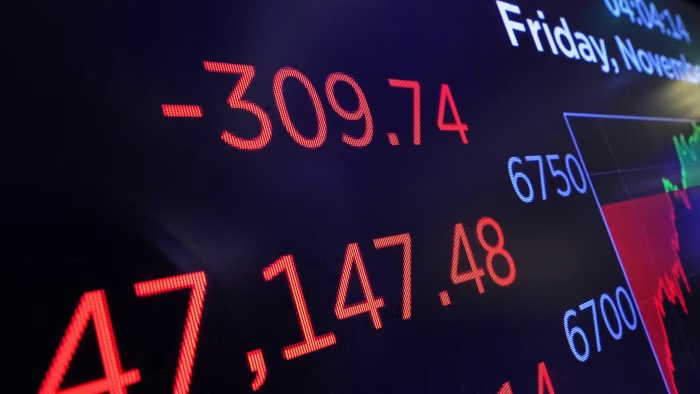
    The probability of another quarter point cut, implied by market prices, has fallen from nearly 70 per cent to 40 per cent over the past week after several members of the rate-setting Federal Open Market Committee made plain their lack of support for action at the next meeting on December 10.

    The shift — in which investors have also pared back expectations for more cuts in 2026 — contributed to a sell-off in equities and an uptick in two-year Treasury yields this week, amid investor jitters over valuations in AI stocks.

    “It is impossible to know which way this goes,” said Krishna Guha, vice-chair at Evercore ISI, on the December Fed vote.

    The Fed has lowered borrowing costs by a quarter point at each of its previous two policy meetings on the back of signs that the US labour market is weakening and President Donald Trump’s tariffs are having less impact on inflation than many feared.

    But the October vote saw a rare three-way split, with Fed governor and Trump ally Stephen Miran supporting the US president’s calls for lower rates by backing a 50 basis point cut, while Kansas City Fed president Jeff Schmid wanted rates held.

    Fed chair Jay Powell warned after the vote that a December cut was not a “foregone conclusion”, while several regional Fed officials without a vote said later that they disagreed with last month’s decision.

    “To our ear, the [December] meeting outcome is shaping up to be just as contentious as Powell portrayed in October’s press conference,” said Jonathan Millar, economist at Barclays.

    Schmid signalled on Friday that he would continue to support keeping the US central bank’s benchmark rate in a 3.75-4 per cent range, saying neither market nor economic conditions suggested rates were too high.

    Susan Collins, the Boston Fed head who is seen as closer to the centre of the FOMC, said earlier in the week that ​​it would “likely be appropriate to keep policy rates at the current level for some time”.

    Minneapolis Fed president Neel Kashkari, who — unlike Collins and Schmid — does not currently have a vote on Fed policy, on Thursday pivoted from supporting another cut, saying he would also probably argue in favour of a December hold.

    Diane Swonk, chief US economist at KPMG, said there had been “a lot of wishful hoping” among investors that the release of downbeat economic data would force the Fed to cut.

    The Bureau of Labor Statistics will publish the September jobs report next Thursday but it remains unclear whether figures on inflation and the labour market for October will be published at all.

    “What we’ve really seen is that there is a lot of reticence to cutting aggressively given all of the unknowns out there,” said Swonk. “There is also some inflation coming from the services sector that has just not been eradicated.”

    While September’s rise in the consumer price index was weaker than anticipated at 3 per cent year-on-year, price growth remains in excess of the Fed’s 2 per cent inflation goal.

    Minutes of the October vote, set for release on Wednesday, could reveal more about divisions within the FOMC.

    Whether or not the US central bank opts to end the year with a cut, some analysts say the Fed chair will face a tricky balancing act to minimise the number of dissents.

    Doves on the Fed’s board — Chris Waller, Michelle Bowman and Miran, all of whom were appointed by Trump — would probably vote against a decision to hold, raising the prospect of three governors dissenting for the first time since 1988.

    “Absent miraculous clarification from limited data, Powell is in a rough spot,” said Guha.

    Continue Reading

  • UBS Reaffirms Buy Rating on JPMorgan (JPM) as AI Drives Revenue Growth and Innovation

    UBS Reaffirms Buy Rating on JPMorgan (JPM) as AI Drives Revenue Growth and Innovation

    JPMorgan Chase & Co. (NYSE:JPM) ranks among the best financial stocks to buy according to billionaire Ken Fisher. Following an investor meeting with the bank’s Chief Data & Analytics Officer, UBS reaffirmed its Buy rating and $357 price target for JPMorgan Chase & Co. (NYSE:JPM) on November 12. The firm emphasized JPMorgan’s long-term lead in the practical use of AI, pointing out that the bank recently switched to generative AI for new applications.

    Supannee Hickman / Shutterstock.com

    According to the meeting, JPMorgan’s use of AI is boosting revenue rather than saving costs. Speaking on its conviction regarding artificial intelligence, JPMorgan management stated that AI capabilities will someday become “table stakes” for financial organizations, similar to basic technology requirements like personal computers or internet access.

    The LLM Suite, a proprietary platform driven by top third-party large language models (LLMs), is at the center of the bank’s AI revolution. The platform has automated several procedures and provided employees direct access to AI tools.

    JPMorgan Chase & Co. (NYSE:JPM) is a multinational financial services company that offers investment banking in addition to consumer and small business financial services. It also offers commercial banking, asset management, and financial transaction processing.

    While we acknowledge the potential of JPM as an investment, we believe certain AI stocks offer greater upside potential and carry less downside risk. If you’re looking for an extremely undervalued AI stock that also stands to benefit significantly from Trump-era tariffs and the onshoring trend, see our free report on the best short-term AI stock.

    READ NEXT: 10 Best Magic Formula Stocks for 2025 and 10 Best Retirement Stocks to Buy According to Hedge Funds.

    Disclosure: None. This article is originally published at Insider Monkey.

    Continue Reading

  • Foreign investors return to China’s stock market

    Foreign investors return to China’s stock market

    Unlock the Editor’s Digest for free

    Foreign purchases of Chinese equities have hit their highest level in four years, in a sign global investors are reassessing a market that until recently was considered “uninvestable”.

    Offshore inflows into China stocks from January to October this year totalled $50.6bn, up from $11.4bn in 2024, according to data from the Institute of International Finance, a trade body for the global banking industry.

    Chinese stocks listed on the mainland and in Hong Kong have risen strongly this year, driven by enthusiasm for artificial intelligence following the release of DeepSeek’s groundbreaking model and a strong run of listings in Asia’s financial hub.

    The gains follow years of dismal returns, as foreigners sold down their positions in response to mounting concerns over slowing economic growth and rising tensions between Washington and Beijing.

    “China still trades at a record discount to the rest of the world and yet they have some of the best companies in the tech space,” Jonathan Pines, head of Asia ex-Japan equity at Federated Hermes. “They’re the only realistic competitor to the US in some spaces.”

    This year’s foreign buying remains below the record full-year figure of $73.6bn reached in 2021, when China’s CSI 300 rebounded strongly from the initial shock of the coronavirus pandemic to hit an all-time high. However, it still marks a reversal after several years of falling investment from foreigners.

    “Two years ago China was uninvestable for a lot of people,” said Yan Wang, chief emerging markets and China strategist at Alpine Macro.

    Beijing stopped releasing daily data tracking investment in equities in mainland China via Hong Kong last year, making it harder to gauge levels of foreign flows. The IIF tracks changes in external portfolio liabilities and excludes Chinese companies listed in the US.

    There has been more buying of Chinese equities since the US unleashed its “liberation day” tariffs in April, according to Citi, with roughly 55 per cent buying versus 45 per cent selling across different client types.

    This year, foreign active managers have been net sellers of Chinese equities but that has been more than offset by inflows into passive funds, according to EPFR Global data tracking flows into exchange traded funds and mutual funds.

    Line chart of  showing Chinese stocks still trade at a discount

    The strong performance of Chinese stocks this year has primarily been driven by a rush of domestic money from retail investors, said Stuart Rumble, head of investment directing for the Asia Pacific at Fidelity International.

    Mainland China investors have poured HK$1.3tn (US$168.7bn) into Hong Kong’s stock market this year, a record high, and now account for about 20 per cent of turnover on the exchange.

    Foreigners’ caution on Chinese equities followed a property downturn, a crackdown on private business and an escalating US-China trade war, which together helped push the stock market down by nearly a half from its peak.

    “There was a point where people just didn’t want to talk about [China],” said Daniel Morris, chief market strategist at BNP Paribas Asset Management. “Now we do talk quite a bit.”

    Beijing’s crackdown on private business, exemplified by Alibaba founder Jack Ma’s fall from grace, is widely seen to have damaged confidence in the country. Regulators have since pushed a string of reforms designed to revive markets.

    “It was clear they wanted their capital markets to go up,” said Pines.

    This year’s uptick in equity inflows from foreign investors comes as many state pension funds in the US such as Texas and Indiana have divested from Chinese companies as a result of volatile US-China relations.

    Some investors are keen to gain exposure to innovative Chinese technology companies, in part as a way to diversify out of US markets trading near record highs. Stocks such as Alibaba remain off their peak valuations and trade at discounts to US counterparts.

    “You don’t want to put 100 per cent of your portfolio in Nasdaq,” said Morris.

    Continue Reading

  • Swiss chemicals group Clariant warns of more production leaving Europe

    Swiss chemicals group Clariant warns of more production leaving Europe

    Unlock the Editor’s Digest for free

    The head of Swiss chemicals producer Clariant said the company would expand capacity in China and warned of “more production shifting away from Europe” because of the continent’s higher energy and labour costs.

    Chief executive Conrad Keijzer said Clariant was targeting 14 per cent of its sales coming from China by 2027, up from 10 per cent at present, and that the country would account for more than half of global growth for chemicals over the next five years.

    The company has expanded two Chinese plants, which Keijzer said would allow Clariant to produce 70 per cent of the chemicals it sells in the country locally, up from about half.

    “Most of the growth by and large is coming from China,” Keijzer told the Financial Times this month after opening a SFr180mn ($226mn) expansion to two factories in Huizhou, southern China.

    “If we are static on it, then we’re long-term losing out,” he said. “It automatically means more production shifting away from Europe.”

    European companies have struggled to compete against Chinese rivals in a range of commodity chemicals, leading to plant closures across the continent. The industry has also been rattled by surging gas prices after Russia’s full-scale invasion of Ukraine and a slowdown in European manufacturing.

    Keijzer said Clariant’s China expansion was prompted by higher energy prices in Europe and rapid growth in Chinese demand for chemicals. While barriers to entry such as intellectual property rights have insulated the company’s speciality chemicals business, the move was also driven by rising competition from Chinese producers, he said.

    Labour costs were another factor, Keijzer said, citing an annual outlay of €100,000, including tax and other expenses, for an operator at a German plant versus €10,000 in some parts of China.

    The Muttenz-based company, which was spun off from Sandoz in the 1990s, produces speciality chemicals for industries ranging from cosmetics to agriculture in 68 plants around the world, nine of them in China. The company previously said it planned to cease production at its final Swiss site in Muttenz next year.

    The price of natural gas, the primary fuel source for boilers and crackers used in plants, remains elevated compared with levels before Russia’s full-scale invasion of Ukraine in 2022, Keijzer said.

    But he also blamed the EU’s carbon tax, “which was a great idea 10, 15 years ago when we thought the rest of the world would follow” but now made it difficult for producers to compete with global peers.

    “The reality of it is that Europe has lost a part of its chemical industry because of the structurally higher gas prices,” Keijzer said.

    Europe also exports a significantly larger portion of its chemicals than the US or China, but competing against Chinese companies, which have increased their own production, has become “much more difficult”, he said.

    The consultancy Roland Berger in September said China’s “unimaginable” chemicals output could fully meet western demand in certain sectors with surplus.

    UK chemicals producer Ineos this week said it was filing 10 anti-dumping cases against cheap imports into the EU, warning that “time is running out” to rescue the European sector.

    Ivy Sun, who leads China chemicals research at Roland Berger, said European companies could only compete by localising production or innovating on specialist products, but many had been slow to do so.

    “It’s a historical trend that is difficult to [turn back],” she said of the market shifting to China. “I can’t even name one European or US chemicals player who is performing very well on the market.”

    Keijzer said any further retreat of chemicals production would have a knock-on effect in other sectors.

    “If you have to import all your steel, if you have to import all your plastics, it will be very difficult to make a competitive electric vehicle in Europe,” he said. “This is not always understood by the European Commission.”

    Continue Reading

  • Vinted explores share sale at €8bn valuation

    Vinted explores share sale at €8bn valuation

    Unlock the Editor’s Digest for free

    Vinted is discussing a share sale that could value the European second-hand fashion start-up at roughly €8bn in a deal that would underscore the platform’s expansion while allowing some early investors to cash out.

    The fast-growing company is in preliminary discussions about selling existing shares in a transaction that could be worth several hundred million euros, according to people familiar with the matter.

    Any process would be likely to kick off early next year, they added, while cautioning that talks were still at an early stage and no valuation or size had yet been set.

    Lithuania-based Vinted last brought in new investors about a year ago at a €5bn valuation in a deal led by US investment group TPG that also included asset manager Baillie Gifford.

    Chief executive Thomas Plantenga said on Friday that revenues were set to rise about 40 per cent to more than €1bn this year, from €813mn in 2024, off sales of items on its platform with a gross merchandise value of €10bn. Net profits roughly quadrupled last year to €76.7mn.

    Founded in 2008 as a way for locals to swap clothes, Vinted in 2019 became Lithuania’s first $1bn technology start-up. Its previous backers include Accel, Insight Partners, EQT, Lightspeed and Sprints.

    The company is now pushing beyond clothing into categories such as electronics, books, toys and video games as it seeks to capture more of the booming market for used goods. Vinted is also focusing on efficient shipping and payments.

    “In the end, our vision is to make second-hand first choice . . . globally, and [for] any type of product you can imagine,” Plantenga told the Financial Times last year. “In the long term, we would try to go to other categories.”

    At the time, he also hinted that the group could soon look at expanding into the US after having established itself in most European countries.

    The company said on Friday it had started its first test to crack the US market by establishing a connection between London and New York that allows buyers and sellers in each location to trade with each other.

    “The US market is very immature,” Plantenga told Bloomberg TV. “All the players that are there are struggling and the penetration levels of second-hand are very low. So for us, that’s a huge opportunity.”

    Vinted could eventually pursue an initial public offering, Plantenga has said previously, although it does not have a set timetable.

    Vinted declined to comment.

    Continue Reading