0019 GMT — JGBs edge lower in early Tokyo trade, tracking this morning’s mild price declines in Treasurys amid signs that the U.S. government shutdown may end. Both JGBs and Treasurys tend to move in tandem. The U.S. Senate is weighing a possible Sunday evening vote to fund the federal government through January and end the shutdown. There may also be some negative sentiment arising from this morning’s release of the
BOJ’s Summary of Opinions from the October meeting, which included one showing it’s likely that conditions for taking a further step toward rate normalization have almost been met. The 10-year JGB yield is up 1.5 bps at 1.690%. (ronnie.harui@wsj.com)
Despite being just 66 miles from Austin-Bergstrom International Airport, San Antonio International Airport dominates its core catchment, achieving a 69% total market share. Unsurprisingly, of the passengers leaking from this area, Austin-Bergstrom captures 77%, followed by Houston George Bush Intercontinental Airport capturing 17%.
Interestingly, on the three routes where San Antonio is leaking the most passengers to Austin (to Los Angeles International Airport, New York Newark Liberty International Airport and San Francisco International Airport), a significant number of passengers are located close to San Antonio.
Resident passengers using Austin to travel to LAX, EWR and SFO in 2023
In Jul-2025, San Antonio Airport received a USD13.3 million grant from the US FAA under the Airport Infrastructure Grants (AIG) programme to support key elements of the airport’s new terminal development as it enters its fourth phase of construction.
The airport broke ground on the new terminal in Dec-2024, with the project to include over 800,000sqft of terminal space, 35,700sqft of concessions space and up to 17 gates.
The terminal is scheduled for completion in 2028 and forms the cornerstone of the airport’s USD2.5 billion Elevate/SAT expansion and capital improvements programme.
Catchment Analyzer data is helping airports stay on top of the changing passenger behaviour trends of their catchment area, uncovering underlying patterns rather than relying on pure volume metrics.
Recent CAPA News highlights for San Antonio International Airport
San Antonio International Airport secures USD13.3m AIG grant for terminal development project
San Antonio International Airport received (07-Jul-2025) a USD13.3 million grant from the US FAA under the Airport Infrastructure Grants (AIG) programme. Funding will support key elements of the airport’s new terminal development as it enters its fourth phase of construction, such as mass excavation, drilled piers and design assist work for mechanical, electrical and plumbing systems as well as baggage handling systems. The terminal project is the cornerstone of Elevate/SAT, a USD2.5 billion expansion and capital improvements programme.
San Antonio International Airport confirms parking structure, Ground Transportation Centre project
San Antonio International Airport announced (14-May-2025) it is moving forward with the design and construction of a new parking structure and Ground Transportation Centre. The project aims to provide expanded public parking for up to 2000 vehicles, as well as a central location for shuttles, rideshares, taxis and future mobility services. The structure will also be designed to accommodate future development of an eVTOL operations area.
Spirit Airlines launches Atlanta-San Antonio service
Atlanta Hartsfield-Jackson International Airport, via its official Twitter account, announced (10-Apr-2025) Spirit Airlines launched San Antonio service. The service operates daily with A320 equipment. Delta Air Lines, Frontier Airlines and Southwest Airlines also operate the route, according to OAG.
CLICK HERE to find out more about Catchment Analyzer and book your demo now.
The growth in global demand for “green” office buildings has slowed after Donald Trump’s assault on environmental protection policies caused a slump in interest in the US, according to a survey of construction industry professionals.
Building occupiers and investors across North America and South America expressed significantly lower growth in demand for green commercial buildings, a shift that “seems to be in response to a change in US policy focus”, according to a survey of members of the Royal Institution of Chartered Surveyors (Rics). Reported demand across the rest of the world also fell, albeit not as sharply.
Residential and commercial buildings together accounted for 34% of global carbon emissions in 2023, according to the UN Environment Programme. The majority of those emissions came from heating, cooling and powering buildings, although about a fifth came from construction.
The UN said there was a “critical need for accelerated action in the buildings sector to meet global climate goals”. However, the Rics survey suggested global construction industry professionals were experiencing slower growth in demand.
Green buildings can use a range of techniques to cut their environmental impact, ranging from using materials that reduce high-carbon concrete, to cutting water use, cutting heat lost through windows, and using renewable energy. Energy efficiency improvements in particular also help to cut operating costs.
Nicholas Maclean, Rics’s acting president, said: “It seems to me that what we’re seeing at the moment might be a blip.
“The people who are going to end up using these buildings want them to be sustainable. Everybody, frankly, knows this is the right thing to do.”
He added that green office buildings tend to have a “competitive advantage” in attracting higher rents, because of demand from large-scale corporate tenants, in particular.
There were still more US respondents to the survey who reported growth in interest in sustainable commercial buildings. However, the balance of building professionals across the continent reporting higher demand fell sharply, from 25% to 11%.
skip past newsletter promotion
after newsletter promotion
Outside North and South America, the balance reporting growth in demand was 40%, still down from 48% in 2021, the first year of the survey, but far above the US.
Kisa Zehra, Rics’s sustainability analyst, said government policy and regulations have a “huge impact on the confidence of the market”. The Trump administration has made a concerted effort to dismantle a huge range of environmental protections put in place by Republican and Democratic predecessors, undermining confidence in green standards.
Rics also highlighted a decline in the number of construction industry professionals who measured their projects’ embodied carbon, such as that emitted in making materials such as steel, glass and concrete, or in the construction process itself. Forty-six percent of construction professionals reported not measuring embodied carbon, up from 34% the year before. Only 16% of respondents said carbon measurement meaningfully informed material choices in project design.
This article picked by a teacher with suggested questions is part of the Financial Times free schools access programme. Details/registration here.
Specification:
Some current wealth and income statistics:
In 2025, the world’s 3,028 billionaires have a combined wealth of $16.1tn. This is a similar value to the world’s second-largest economy, China
The richest 1 per cent of the world’s population accounts for 43 per cent of the value of all global financial assets
The bottom 50 per cent of the world’s population owns just 2 per cent of the value of all global financial assets
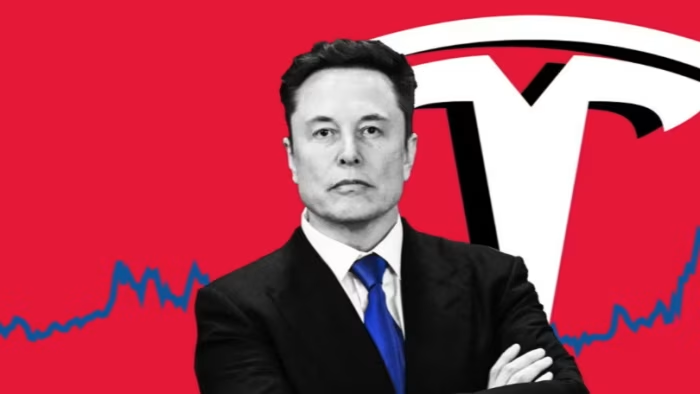
If Elon Musk achieved an asset value of $1tn, it would make his wealth the equivalent of the 20th largest economy in the world (above Belgium, Taiwan and Argentina)
The US Gini coefficient has increased from 0.43 in 1990 to 0.49 in 2024
Read the article and then answer the questions:
Elon Musk celebrates $1tn Tesla pay vote victory
Outline the difference between Elon Musk’s income and wealth [2]
Outline what Elon Musk has to achieve in terms of the value of Tesla to receive his $1tn income payment [2]
Using a diagram, explain the Lorenz curve [4]
Explain how the Gini coefficient can be used to measure income inequality [4]
Outline what an increase in the US’ Gini coefficient from 0.43 in 1990 to 0.49 in 2024 shows [2]
Explain two factors that might lead to an increase in income inequality in the US [4]
Explain two negative consequences of increasing income inequality in the US [4]
Explain two benefits of paying someone like Elon Musk, such as a large income [4]
A global wealth boom is fueling the creation of a record number of family offices. And that has come with a peculiar problem: imposters. Fundraisers and fraudsters are presenting themselves as family office representatives, seeking to dupe gullible investors — and then there are also imposters who are in it just for an “ego boost,” several industry veterans told CNBC “Fake family offices have been growing exponentially,” said Ronald Diamond, who runs Diamond Wealth and a co-investment syndicate of more than 100 families. “Right now, the family office space is where all the money is. So everyone, every bank, every law firm, every accountant firm, wants some [of that money]. So if you say you have a family office, everybody wants to talk to you,” he said. Last year, a Singapore resident was found guilty for masquerading as a representative of a prominent family office and running a $10 million scheme that duped people into investing in pre-IPO tech companies such as Airbnb . He impersonated Man Capital executives by creating fake email domains and online profiles, pretending to have ties to one of Egypt’s most prominent business families, lulling his victims into a false sense of security before defrauding them. Some people don’t do it for the money, but for their self esteem and self worth. They think if a bank takes them out for lunch and people court them, it means they’re loved. Prestel and Partner Family Office Conferences Tobias Prestel Genuine family offices largely do not raise money from the public or sell investment products, they only manage and invest their own family’s wealth, said experts. Not every imposter is looking to make a quick buck though. There are those who put on a charade not to defraud others, but to be recognized as important members of the society. They pretend to be a family office in order to gain a certain social status and respect. “So they say, oh I’m the founder of a family office, just to hang with a crowd and be somebody,” said Tobias Prestel, managing director at Prestel and Partner Family Office Conferences. “If you say, I’m a family office, then banks invite you for lunch and asset managers take you out for dinner, and everybody who wants to sell you something treats you nicely.” Industry experts said the rise in fakes is a natural by-product of money and attention flooding into the space. According to Deloitte’s most recent statistics, there were an estimated 8,030 single family offices worldwide as of 2024, up almost 31% over the last five years. The number is projected to rise by 12% to 9,030 by the end of 2025, and by 33% to 10,720 by 2030. Collectively, the funds they oversee are enormous — and continue to increase. In aggregate, family offices now manage about $3.1 trillion in assets under management and are expected to grow 73% to $5.4 trillion by 2030. “Right now, the family office space is where all the money is. So everyone, every bank, every law firm, every accountant firm, wants so if you say you have a family office, everybody wants to talk to you,” said Diamond. Why fakes — and how to spot them An information vacuum seems to have encouraged imposters. In many markets, genuine single family offices, or SFOs, are exempt from registering — they do not need to be on a public regulatory register or need a license for fund management — so long as they manage only family money. That privacy norm often makes verification hard, said industry experts. For example, in Dubai, SFOs don’t need a full financial license as long as they only manage money for one family. Similarly, family offices in the U.S. are usually exempt from registering with the Securities and Exchange Commission if they serve only one family and are wholly owned and controlled by family members. Single Family Offices are set up to manage family monies and should not be soliciting third party monies. Monetary Authority of Singapore “Investors should understand more about the background of their investment partners before committing to any investment,” said a spokesperson for Hong Kong’s Financial Services and Treasury Bureau, adding that the public can contact the SFC should there be any enquiries about the background of a family office. The Monetary Authority of Singapore said that parties who are approached by entities soliciting for funds should verify their identities and whether or not they hold the appropriate license. “Single Family Offices are set up to manage family monies and should not be soliciting third party monies. Any entity that solicits third party funds are required to hold a capital markets services license,” an MAS spokesperson told CNBC. When asked about what steps the country had taken to prevent family office-related frauds, the UK’s Financial Conduct Authority said that it continues to “work with partners to disrupt crime, including scams and illegal financial promotions.” The Dubai Financial Services Authority declined to comment, while the U.S. Securities and Exchange Commission, largely closed due to a government shutdown, did not respond. It also does not help that some wealthy individuals are generally very private, and have little to no information that can be accessed online. Diamond underscores the practical challenge: “It’s hard to do background checks on billionaires, right? Because they are so usually so private.” As such, family offices are increasingly relying on each other to compare notes. The industry vets one another through community references and proof of behavior. That is something investors too can try before putting money into any schemes suggested by some family office representative. Diamond said the fastest filter for him is to call a few established families within the geography and inquire. If no one has heard of them, that could be a potential red flag, warranting deeper research. Similarly, Ryan Lin from Bayfront Law, who liaises with Chinese family offices in Singapore, pointed to a strong family office association in the city-state, saying that representatives at times conduct checks through a WhatsApp group. “I mean, if I’ve not heard of this [family office] and they claim that they have been in Singapore for 30 years, then something is wrong,” he said. The alarm bells would be if someone comes up to me and goes: ‘hey, I’m a wealthy second generation from a family in Singapore.’ Then proceed to send me a brief of 400 to 500 words trying to prove this. CEO of Canopy Mu Chen Industry veterans suggested seeking information on past investments, co-investment partners, as well as trying to verify the source of wealth can help ascertain the genuineness of purported family offices. Overcompensatory behavior to prove legitimacy tends to raise alarm bells, too. Mu Chen, CEO of Canopy, who liaises with family offices setting up in Singapore, said that family offices generally do not tend to share too much information, and rarely lead with a product push — these people get courted often, and its’s not the other way around. “Genuine family offices have people come after them a lot,” he said. “The alarm bells would be [ringing] if someone comes up to me and goes: ‘hey, I’m a wealthy second generation from a family in Singapore.’ Then proceed to send me a brief of 400 to 500 words trying to prove this.”
Amdocs (DOX) shares edged up slightly after a week of moderate moves, catching the eye of investors tracking sector sentiment. The company’s recent 1% daily gain and 5% climb over the past month add some interest to its performance.
See our latest analysis for Amdocs.
While Amdocs has seen a modest uptick recently, it is worth noting that momentum has cooled compared to earlier in the year. The company’s latest share price of $84.57 puts its 1-year total shareholder return at -6%, suggesting investors remain cautious, even as the 5-year total shareholder return stands at a solid 46%. It appears that the stock’s long-term gains are intact, though sentiment has softened in the short run.
If you’re interested in broadening your search, now might be the perfect moment to discover fast growing stocks with high insider ownership.
With shares lagging over the past year yet trading at a meaningful discount to analyst targets, investors may wonder if Amdocs is undervalued at these levels, or if future growth is already factored into the price.
Amdocs recently closed at $84.57, while the most widely followed narrative pegs its fair value closer to $104.00. This suggests a notable gap, pointing to market skepticism or a disconnect with analyst expectations.
The accelerating adoption of cloud, automation, and AI/ML across telecom and media sectors is driving a multi-year wave of IT stack modernization. Amdocs is winning new large-scale modernization and migration deals in cloud, generative AI, and data services, which is expanding its total addressable market and supporting sustained topline revenue growth.
Read the complete narrative.
Want to know what propels this bullish case? The secret lies in aggressive profit margin expansion and growth that bucks the trend for most IT peers. Find out the ambitious assumptions underwriting this valuation and why some think Amdocs could shatter expectations.
Result: Fair Value of $104.00 (UNDERVALUED)
Have a read of the narrative in full and understand what’s behind the forecasts.
However, persistent macro uncertainty and heavy reliance on a handful of large telecom clients could pose challenges to Amdocs’s ability to deliver its anticipated growth.
Find out about the key risks to this Amdocs narrative.
If you think a different story is unfolding, or want to dig into the numbers yourself, you can craft your own view in just a few minutes. Do it your way.
A good starting point is our analysis highlighting 5 key rewards investors are optimistic about regarding Amdocs.
Seize the moment to stay ahead of the market. Fresh opportunities are waiting for smart investors who go beyond the obvious and act decisively.
This article by Simply Wall St is general in nature. We provide commentary based on historical data and analyst forecasts only using an unbiased methodology and our articles are not intended to be financial advice. It does not constitute a recommendation to buy or sell any stock, and does not take account of your objectives, or your financial situation. We aim to bring you long-term focused analysis driven by fundamental data. Note that our analysis may not factor in the latest price-sensitive company announcements or qualitative material. Simply Wall St has no position in any stocks mentioned.
Companies discussed in this article include DOX.
Have feedback on this article? Concerned about the content? Get in touch with us directly. Alternatively, email editorial-team@simplywallst.com