Northern Trust (NTRS) continues to draw interest, especially with its shares delivering a 27% total return over the past year. Investors are watching to see if recent momentum can be sustained as broader financial trends evolve.
See our latest analysis for Northern Trust.
Northern Trust’s 1-year total shareholder return of 27% stands out, with its share price now at $129.96 as momentum has clearly been building over recent months. The stock’s consistent upward movement suggests that investors are seeing renewed growth potential and perhaps reassessing the company’s long-term value, especially as the broader financial sector navigates a changing landscape.
If strong performance from names like Northern Trust has you curious about what else might be gathering steam, now is the perfect moment to broaden your scope and explore fast growing stocks with high insider ownership.
Yet with shares trading near recent highs and analysts’ price targets only a few dollars above current levels, investors have to wonder: is there still an opportunity here, or is the market already pricing in all the future growth?
Northern Trust’s most widely followed narrative suggests its fair value is $134.50, slightly ahead of the last close at $129.96. This close proximity hints at a market consensus that prices in moderate upside while balancing significant near-term and longer-term uncertainties.
Although recent growth in global wealth and institutional assets benefited Northern Trust’s AuM/AuA, the business remains highly exposed to low or volatile global interest rates. Any sustained decline is likely to weigh on net interest income and impair earnings momentum, especially given its reliance on spread income and current deposit mix trends.
Read the complete narrative.
Want insight on what is embedded in this narrative’s projected valuation? Discover the bold assumptions about profit margins, earnings, and future multiples that could make or break this fair value outlook. The full breakdown reveals the financial levers analysts are counting on. The real surprises lie in the future growth trajectory and margin shifts. Don’t miss the details that could shift sentiment next quarter.
Result: Fair Value of $134.50 (UNDERVALUED)
Have a read of the narrative in full and understand what’s behind the forecasts.
However, rapid growth in alternatives and ongoing automation could support earnings and margins. This may potentially challenge the more cautious consensus view on performance.
Find out about the key risks to this Northern Trust narrative.
While the current fair value narrative points to the stock being slightly undervalued, our SWS DCF model offers a more conservative outlook. Based on projected future cash flows, the DCF model values Northern Trust at $116.27. This is below today’s share price and implies overvaluation. Does this suggest optimism about future growth is running ahead of fundamentals?
Look into how the SWS DCF model arrives at its fair value.
NTRS Discounted Cash Flow as at Nov 2025
Simply Wall St performs a discounted cash flow (DCF) on every stock in the world every day (check out Northern Trust for example). We show the entire calculation in full. You can track the result in your watchlist or portfolio and be alerted when this changes, or use our stock screener to discover 874 undervalued stocks based on their cash flows. If you save a screener we even alert you when new companies match – so you never miss a potential opportunity.
If you have a different perspective or want to analyze the numbers your own way, it takes just a few minutes to craft a personalized view. Do it your way
A good starting point is our analysis highlighting 4 key rewards investors are optimistic about regarding Northern Trust.
Stay ahead by checking out these investment opportunities, handpicked to fuel your watchlist with stocks that could spark your next big move.
This article by Simply Wall St is general in nature. We provide commentary based on historical data and analyst forecasts only using an unbiased methodology and our articles are not intended to be financial advice. It does not constitute a recommendation to buy or sell any stock, and does not take account of your objectives, or your financial situation. We aim to bring you long-term focused analysis driven by fundamental data. Note that our analysis may not factor in the latest price-sensitive company announcements or qualitative material. Simply Wall St has no position in any stocks mentioned.
Companies discussed in this article include NTRS.
Have feedback on this article? Concerned about the content? Get in touch with us directly. Alternatively, email editorial-team@simplywallst.com
LONDON, Nov. 09, 2025 (GLOBE NEWSWIRE) — A new global report released today by Commerce & Contract Management Institute (CCM Institute) has found that up to 80 percent of organizations lack clear accountability for contracting performance, leaving businesses exposed to inefficiency and risk in a period of persistent uncertainty, and that organizations that have successfully made technological advances in their contracting processes, are significantly better equipped to navigate market uncertainty.
The report, titled Benchmark report 2025: The Race Is On – Navigating Uncertainty Through CCM Resilience, was produced in partnership with the World Commerce & Contracting (WorldCC), NCMA, and Sirion. It draws on global data from thousands of organizations across industries and regions to measure the maturity, capability, and resilience of contract and commercial management (CCM) functions.
According to the findings, 87 percent of organizations report operating under high and sustained levels of uncertainty, yet only a small proportion have established governance frameworks that clearly define responsibility for contracting outcomes. The absence of accountability, the report notes, continues to slow progress in operational performance, even as investment in digital tools and automation increases.
“This report is a clear mandate for immediate action,” said Sally Guyer, Chief Executive Officer of WorldCC. “For too long, organizations have treated commercial and contracting excellence as a complex, second-tier priority, and that has created a structural vulnerability we can no longer afford. The data is definitive: the organizations that will thrive in this ‘new normal’ are the ones who recognize that CCM is the catalyst for business resilience. We urge leaders to stop delaying this critical transformation and start addressing the foundational issues of accountability and leadership.”
The findings highlight a sharp decline in scepticism toward AI’s role in contracting, with over 80 percent expecting it to play a major role within the next two years. It underscores the accelerating presence and importance of AI in contracting. Beyond its established use in contract repositories, AI is increasingly being leveraged for contract creation and drafting, summary generation, and contract review. Obligation extraction has also emerged as a rapidly growing area of focus.
The benchmark highlights a growing divide between buy-side and sell-side organizations. Across all performance metrics, suppliers are outperforming buyers by more than 20%. This gap is attributed to differences in leadership alignment and organizational design, as well as levels of investment in full contract lifecycle technologies. While sell-side units tend to have clear commercial governance structures, buy-side teams are often fragmented, with many operating under procurement or finance functions that prioritize cost control over performance visibility.
The report also indicates that technology adoption alone is not closing the capability gap. The sell-side demonstrates a 37 percent technology advantage, averaging 8.41 digital capabilities per person compared with 6.52 on the buy-side. However, the data shows that digital systems deliver limited value without defined accountability and leadership oversight.
“Our research uncovers a fundamental governance failure,” said Tim Cummins, Executive Director of the CCM Institute. “When 70 to 80 percent of businesses lack a single point of clarity for contracting performance, it creates a system defined by inertia and risk. You cannot automate your way out of a governance crisis. The race for resilience will not be won by those who invest the most in new tools, but by those who first establish clear accountability, build adaptive leadership, and invest in the human talent needed for an AI-transformed future.”
The report identifies leadership, structure, and talent development as the key drivers of commercial resilience. Respondents citing high uncertainty ranked leadership quality (30 percent), unclear roles (27 percent), and organizational confusion (25–30 percent) among their most significant barriers to progress.
“Eighty-eight percent of enterprises now recognize that commercial and contract management excellence drives performance. The real question is: how do we turn that recognition into meaningful change?” said Ajay Agrawal, Founder and CEO of Sirion. “At Sirion, we see that evolution taking shape every day—as intelligence becomes part of the system itself, where data, context, and intent come together to guide every decision, every agreement, every action.”
The Benchmark Report 2025 concludes that while awareness of contracting’s strategic importance is high, structural change remains limited. The findings call for organizations to clarify ownership, strengthen leadership accountability, and align technology investments with measurable governance outcomes, much like the principles outlined in the Contract Management Standard (CMS). For leaders looking to close the accountability gap immediately, adopting the globally recognized CMS provides the necessary framework to establish this unified practice.
About the CCM Institute
The CCM Institute seeks to improve the world through higher standards in buying and selling. Its rigorous, practical research and insights, both relevant and useful, shape global policy and practice. The Institute helps society by driving up standards for the exchange of goods and services, resulting in better trading outcomes in both the private and public sectors. As a not-for-profit organization, it was founded and is supported by World Commerce & Contracting and NCMA.
About World Commerce & Contracting (WorldCC)
World Commerce & Contracting (WorldCC) is a global non-profit association dedicated to improving trading relationships and commercial effectiveness. With more than 80,000 members worldwide, WorldCC provides research, standards, training, and resources that enable organizations to achieve better commercial and contracting outcomes.
About Sirion
Sirion is the world’s leading AI-native CLM platform, pioneering the application of agentic AI to help enterprises transform the way they store, create, and manage contracts. By uniting an intuitive conversational experience with specialized AI agents, the platform has redefined enterprise contracting. The world’s most valuable brands trust Sirion to manage 7M+ contracts worth nearly $800B and relationships with 1M+ suppliers and customers in 100+ languages. For more information, visit www.sirion.ai.
About NCMA
The National Contract Management Association (NCMA) is the world’s leading professional association for contract management professionals. It provides certification, education, and research that elevate contracting standards and practices across industries and governments globally.
Contact Information
Kate Hodgins
Commerce & Contract Management Institute,
Email: info@ccm.institute
Website: https://ccm.institute/
A photo accompanying this announcement is available at https://www.globenewswire.com/NewsRoom/AttachmentNg/03b14c05-bcb4-47fd-b488-e7a2552d9a09
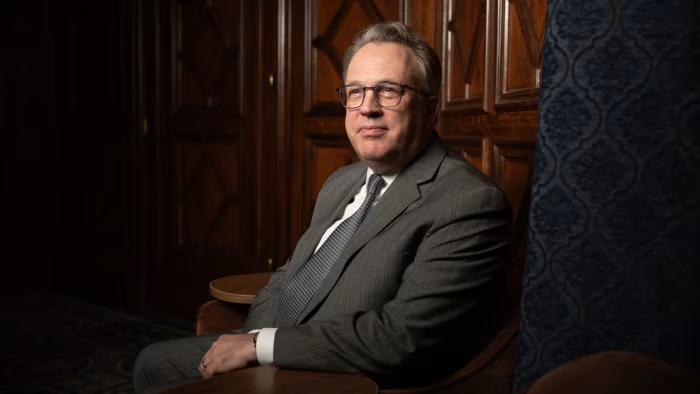
The mounting problems facing poorer Americans are leaving the world’s most important economy exposed to risks of a downturn, a top Federal Reserve official has warned, highlighting the “balancing act” facing central bankers as they consider whether to cut interest rates again in December.
John Williams, president of the New York Fed, said data and conversations with community leaders highlighted that many poorer households were facing an affordability crisis.
“There is quite a bit of evidence . . . that lower and moderate-income households are facing some constraints from an affordability point of view,” Williams told the Financial Times. “From the cost of living, the housing costs and basically many families living month to month.”
Meanwhile, wealthier Americans were benefiting from the stock market “booming near all-time highs”.
With the US jobs market cooling, Williams signalled that what he dubbed the “disaggregated” behaviour of US households could be a factor in determining whether or not he thinks the Fed should cut borrowing costs in December — a vote he described as a “balancing act”.
While US growth overall had proven much more resilient than many economists had anticipated and inflation remained above the Fed’s 2 per cent goal, the pain felt by more vulnerable households because of the high cost of living meant the US economy could be knocked off course.
“Something could happen that cuts into confidence, or consumer spending growth that we’re seeing at the aggregate level may not be as robust, if you will, as it would be otherwise, given that a lot of folks are really, again, living month to month,” said Williams, who is also vice-chair of the rate-setting Federal Open Market Committee.
Fed officials — including chair Jay Powell and influential governor Christopher Waller — have started to focus more on how a labour market which Williams described as lacking “a lot of strength and momentum” could affect the economic prospects of normal Americans.
Powell and Waller have noted strong consumer spending is being disproportionately driven by the highest earners.
The pain felt by poorer and middle-income American households is also affecting the political climate, propelling Zohran Mamdani to victory in the race for New York mayor, where he ran on a platform of lowering living costs.
The poor showing of candidates backed by US President Donald Trump in the city’s mayoral race and votes for the governorships of Virginia and New Jersey has also been linked to a crisis in affordability similar to that which plagued Joe Biden’s presidency.
The Fed has cut borrowing costs by a quarter-point at each of its past two policy votes because of evidence the US labour market was weakening.
Investors expected another move next month — up until late October when Powell said further cuts were far from a “foregone conclusion”.
“It’s really a balancing act,” the New York Fed president said in reference to the December vote. “These facts are fundamentally true — inflation is high, and it’s not showing signs of coming down right now. And at the same time, the economy is showing some resilience.”
While the US labour market was still “gradually cooling”, it was “not shifting more dramatically”. Unlike earlier in the year, “no one’s really talking about recession”, he said.
The US economy has performed better than many, including Williams, had feared. In April, he said Trump’s tariffs could drive inflation up as high as 4 per cent — and growth to “somewhat below 1 per cent”.
Much of the rebound in confidence has been down to gloom over trade tensions being replaced by optimism over a boom in artificial intelligence and AI-related investment.
Williams said projections that AI could substantially lift productivity growth were not “outlandish”, but reserved judgment on just how much impact he expected the technology to have.
While AI-related investments have spurred growth, soaring equity prices have sparked some concerns of a bubble.
“Is there going to be excessive investment? Are there going to be investments that company X succeeds or company Y doesn’t? Yes. But I think it’s happening because there’s something real going on, something fundamental going on,” he said. “And it doesn’t worry me, as long as it’s not highly leveraged, and a lot of it’s equity financed.”
At its October meeting, the Fed called time on its three-year quantitative tightening experiment — a policy which shrunk the central bank’s balance sheet by about $2tn — amid signs of funding strains in money markets.
Williams acknowledged funding pressures in the “past few weeks are definitely sending us pretty clear signals that the level of reserves have come down”.
However, he pushed back against some market calls to end QT ahead of the December 1 target set by the FOMC last week, saying allowing it to run through November “makes perfect sense”.
He also opposed Dallas Fed president Lorie Logan’s calls for the central bank to shift its benchmark interest rate from the federal funds target range to a rate more reflective of borrowing costs in repo markets.
“I’ve been on the FOMC a while now, so we’ve discussed this at length, I think, a few times, and we looked at it very carefully and thought about it carefully, and each time we have decided to stay with the federal funds rate as the policy rate,” he said.
The New York Fed president did not subscribe to Powell’s view that a lack of official economic data — the result of the continuing government shutdown — would make a cut less likely.
“We will get more information regardless of the state of the government shutdown,” Williams said. “We have developed over, I would say, over 100 years, a remarkable set of indicators and measures of this state of the US economy.”
Roula Khalaf, Editor of the FT, selects her favourite stories in this weekly newsletter.
An increasing number of wealthy Chinese people are trying to set up family offices and secure residency in the Gulf, a reflection of growing frustration with the increased difficulty of establishing themselves in Singapore, long a popular destination for rich Asians.
In the past year, there has been a rise in enquiries from Chinese nationals eager to relocate to Dubai and Abu Dhabi, according to private bankers and advisers to the ultra rich. Setting up family offices can ease the process of securing citizenship or residency.
“They are attracted [to the Gulf] by the ability to get residency status and live and enjoy stability,” said Mike Tan, Standard Chartered’s Singapore-based global head of wealth planning and family advisory, of those enquiring about setting up family offices in the Gulf.
Tan said the number of enquiries about Dubai that Standard Chartered had received from east Asian clients had surged in the past year, though the bank declined to provide numbers.
The UAE golden visa, which offers residency for 10 years and is available to investors, some family members and some high skilled workers, “is very attractive, and it is stable and benign from a tax perspective,” he said. Authorities in the United Arab Emirates said they issued nearly 80,000 golden visas in 2022 in a sharp increase from 47,000 the previous year, the latest figures to be made publicly available.
The number of family-related entities in Dubai’s offshore financial centre hit 1,000 at the end of the first half of this year, according to official figures, compared with 800 at the end of last year and 600 at the end of 2023. There is no breakdown on origin, but advisers say that much of the rise can be attributed to Chinese individuals.
Such is the influx of wealthy customers to the Gulf, said Prashant Tandon, managing director of wealth manager Lighthouse Canton’s UAE business, that there is a shortage of financial professionals who speak Chinese.
Tandon said he had seen the greatest movement towards the United Arab Emirates among those with assets of $50mn-200mn — “the mid-segment” of high net worth individuals — who are “a lot more entrepreneurial” and may be feeling business pressures in mainland China or Hong Kong.
“A lot of families have sold Singaporean real estate to reinvest in the UAE,” said Yann Mrazek, managing partner at M/HQ, which assists with setting up structures for fund managers and family offices in Dubai and Abu Dhabi. Harsh Covid lockdowns in places such as China and Singapore had first triggered the interest in Gulf hubs, he said.
“Singapore has very restrictive immigration rules — they want to ensure the right people come in,” said an adviser to wealthy families in the city-state. “It is relatively easy to set up a family office and get employment passes, but much harder to get residency and citizenship.”
But while Dubai’s family office market is growing fast, it has years of catching up to do with Singapore.
Government incentives prompted many wealthy foreigners to consider setting up family offices in Singapore in recent years as part of a pathway to becoming permanent residents. The number of family offices in Singapore rose by 43 per cent last year to more than 2,000.
“For a while, people were setting up family offices as a status symbol in Singapore — if your friend had one, you should have one too,” said Kevin Teng, chief executive of wealth manager Wrise Private Singapore. “But it meant a lot of these entities weren’t doing very much.”
Singapore granted an average of 33,000 permanent residencies and 21,300 citizenships a year over the past five years, according to the Immigration & Checkpoints Authority, which does not disclose the number of applicants. Immigration consultants report the approval rate can be as low as 8.25 per cent.
A money-laundering case, believed to be the city state’s largest, involving individuals linked to a gang from China’s Fujian province prompted greater scrutiny of individuals and flows.
More crypto entrepreneurs from China are also looking to set up in the Middle East, said Teng. There are now 39 cryptocurrency companies fully licensed by VARA, Dubai’s special regulator for the sector.
“In the crypto and digital asset space, they [Chinese clients] are looking at how friendly the local regulators are,” said Teng. “A lot of the time it can be down to how much risk appetite the different jurisdictions have and Singapore is being a bit more risk averse, certainly compared to Dubai.”
The Monetary Authority of Singapore has granted 36 licences for digital payment companies, though it began cracking down on unlicensed crypto exchanges this summer. “Clients are increasingly going to the Middle East,” said Teng. “That is definitely a growing business segment for us.”
Sophia Mendelsohn recalls her days as an intern when she had to photocopy electricity bills and highlight them in yellow, before typing the costs into a spreadsheet.
Now the chief sustainability officer and commercial officer at German multinational software group SAP, she is again tracking and documenting energy use and environmental information — although with rather more sophisticated AI systems.
Mendelsohn is one of the few executives in her position to remain vocal about the benefits of corporate sustainability, almost a year after US President Donald Trump came into office describing climate change as a “hoax” and started to reverse green policies.
She says the backlash has made justifying the commitment in commercial terms even more crucial for companies, and sees it as a “window of opportunity”.
“It’s the opportunity we’ve been building for over a decade — to show there is a business case for sustainability, to show there is either a cost curve going down or a profit margin going up,” she says.
SAP is one of a shrinking number of global companies sticking to a science-based plan to cut emissions by 90 per cent by 2030. Mendelsohn is blunt about the new pressures on her peers to deliver more accurate financial information about companies’ climate plans.
“[We’re] being asked and tasked to rise to the occasion with something much more fundamental,” says Mendelsohn. That means grappling with questions core to company strategy: how products or services generate growth, use natural resources and create unwanted costs and consequences.
Katy Jarratt, who oversees sustainability recruitment in the UK for Spencer Stuart, says chief sustainability officers were until recently often hired as “strategic storytellers” — generalists able to influence broad strategy, rather than as “technical experts”.
The change in the political climate has made those executives “ineffectual”, says Jarratt, and many have been let go. Instead, ESG teams that provide specific and essential reporting data are being merged with other functions, such as finance and audit, risk and compliance or investor relations.
“It kills two birds with one stone by ensuring audit-ready ESG metrics and messaging consistency,” Jarratt notes. “In cases where the CSO can ‘roll their sleeves up’ they are being kept on and the bulk of the ESG team let go. In cases where they can’t, the CSO is being let go.”
It is a swift halt to what was a rapid ascendance for sustainability careers in the boardroom. Just a few years ago, the existential crisis of Covid, rising awareness of climate change and threat of regulation meant the CSO role was considered key.
There are still rare instances of progression: the newly appointed chief executive of Hawaiian Airlines, for example, is the former head of sustainability for Alaska Airlines, Diana Birkitt Rakow. But many companies have fallen silent about the role and are reconsidering its positioning.
Financial Times’ analysis of more than 220 US companies with CSOs at the start of this year shows a marked change in the status of the role since Trump’s inauguration. Financial institutions, targeted by a group of Republican US states for restricting funding for fossil fuel companies, were among the first to downgrade or change reporting lines.
Wells Fargo did not replace its chief sustainability officer, Robyn Luhning, after she left the US bank last year. It instead promoted an existing staff member to the role of “head of sustainability” after an eight month gap.
HSBC has downgraded the role from board level and Standard Chartered cut the team led by its chief sustainability officer by more than a third.
Since 2023, the number of CSOs in the US reporting through a company’s legal function has doubled from 10 per cent to 21 per cent, according to the US specialist recruiter Weinreb Group. Many of these executives previously held legal roles, usually as general counsel, before becoming CSO.
This shift followed an increase in the risks of potential litigation, new compliance rules in the EU, and the fallout from rapidly changing US regulations and policies in the second Trump era.
Chipmaker Nvidia, for example, recruited Josh Parker as head of corporate sustainability from data storage company Western Digital, where he was assistant general counsel with a background in IP law and engineering.
Double-badging is also on the rise. In some cases, sustainability responsibilities have been added to the chief strategy or chief operating officer jobs, as environmental risks rise in prominence.
When UBS’s head of sustainability Michael Baldinger left this year, the bank gave the CSO role to Christian Leitz, who is also its corporate historian.
Unilever’s former CSO, Rebecca Marmot, has recently left, less than a year after her role was merged with the chief corporate affairs job.
Vicky Moffat, chief executive of climate-focused board network Chapter Zero, says the majority of company directors still recognise sustainability as central to their fiduciary duties. But she believes the function will be increasingly folded into other management roles.
In a new survey of Chapter Zero members, including FTSE 100 chairs and non-executive directors, about three quarters of boards still saw sustainability as a driver of innovation and growth, and part of core business strategy — but were not talking about it as much.
“[In future] sustainability may not actually exist as a function at executive level itself,” Moffat says.
A smaller group of C-suite executives are expected at the UN COP30 climate summit taking place in the South American country over the next fortnight — in part a result of the difficulties of the location at the gateway of the Amazon rainforest. Their topics of conversation are expected to be more about energy security and costs than the drivers of climate change.
Jarratt argues that less rhetoric around ESG does not mean there is less appetite for evidence. Large asset managers, she says, are explicitly requesting that ESG data is integrated into company strategy and reporting. “The CSOs who survive are those who from the very beginning can demonstrate they have explicitly created value,” she says.
SAP’s Mendelsohn, who held the CSO position at airline JetBlue and IT consulting group Cognizant before joining SAP in 2023, agrees, saying: “Before, the CSO was really tasked with two things: one, reduce the ‘bad’ for as cheap as possible, then two, put it in a pretty PDF report and make sure the board and the audit committee are happy.” Now, political and trade pressures show “why it is so important that sustainability data and product carbon footprint be based on ‘actuals’ — not estimates,” she adds.
She describes the contemporary CSO as not merely a consultant or policy architect, but a multitasker capable of influencing other senior officers and also gathering specific financial, operating and carbon footprint data at a localised level.
She says businesses are demanding details from suppliers to assess their own risks. Investors, too, are “ready for the details”. “They want to get into the nitty gritty . . . We have sometimes misinterpreted the lack of questions on a C-suite level as a lack of interest. The dialogue has shifted towards higher quality, and in different rooms.”
Climate Capital
Where climate change meets business, markets and politics. Explore the FT’s coverage here.
Are you curious about the FT’s environmental sustainability commitments? Find out more about our science-based targets here
Simply sign up to the Cryptocurrencies myFT Digest — delivered directly to your inbox.
Crypto investors worried about their tokens getting hacked are boosting demand for secure devices and wallets that keep customers’ tokens safely offline.
As hack attacks on companies and individuals have hit a record, Ledger, which sells hardware devices resembling USB drives that help investors securely store their cryptocurrencies, said it was having its best year yet.
Pascal Gauthier, chief executive of Ledger, founded in Paris in 2014, said revenues have hit triple-digit millions so far in 2025. “We’re being hacked more and more every day . . . hacking of your bank accounts, of your crypto, and it’s not going to get better next year and the year after that,” he told the Financial Times.
About $2.2bn worth of crypto was stolen in the first half of this year, according to data firm Chainalysis, more than was taken in the whole of 2024. About 23 per cent of hacks targeted individuals’ wallets, in what Chainalysis called an “increasingly significant” form of theft.
Hack attacks on both crypto companies and individuals are becoming increasingly common, especially as the price of bitcoin and other tokens has hit new record highs this year, propelled by Donald Trump championing the industry. North Korean hackers stole $1.5bn worth of crypto tokens from exchange Bybit in February, in the biggest heist ever.
“As we’ve seen a record-setting year in lawful crypto activity, we’ve also seen a record-setting year in unlawful crypto activity,” said Ari Redbord, global head of policy at blockchain intelligence company TRM Labs.
The jump in demand for Ledger’s devices comes ahead of the boost the company typically gets from Black Friday and Christmas sales, and Gauthier said Ledger will fundraise probably next year.
Smartphones and computers have been designed for communication and entertainment, not security, he said, adding that the company’s growth is coming from “the realisation that hackers are getting more aggressive and so you need to upgrade your security”.
Other companies such as Czech Republic-based Trezor and Switzerland-based Tangem also offer so-called cold storage wallets, allowing crypto holders alternatives to holding their tokens directly on an exchange such as Coinbase or Binance.
Redbord added that digital asset holders are rightfully looking for ways to safely hold their assets, and as the crypto industry grows, “people are going to have more and more need for these devices”.
Ledger secures about $100bn worth of bitcoin for its customers, and was valued at $1.5bn in 2023 after raising money from investors including 10T Holdings and Singapore’s True Global Ventures.
Gauthier is eyeing future fundraising, either a listing in New York, or a private round, and is boosting headcount in New York. “Me spending more time in New York is with the understanding that money is in New York today for crypto, it’s nowhere else in the world, it’s certainly not in Europe.”
Rising crypto prices has led to rising criminality around holders of the virtual currency. As well as crypto hacks, kidnappings are also prevalent as criminals try to physically seize traders’ funds. Ledger’s own co-founder and his wife were kidnapped in France earlier this year and criminals sought a ransom paid in crypto. The criminals were later arrested, and the funds traced and frozen. Chainalysis said that rising crypto prices will probably trigger “additional opportunistic physical attacks against known crypto holders”.
Tensions between the U.S. and China have escalated over the last few years.
Teh Eng Koon | AFP | Getty Images
China has suspended a ban on approving exports of “dual-use items” related to gallium, germanium, antimony and super-hard materials to the U.S., the commerce ministry said on Sunday.
The suspension takes effect from Sunday until Nov. 27, 2026, the ministry said in a statement. It did not give any further details.
The ministry announced the ban in December 2024.
China announced on Friday the suspension of other export controls imposed on October 9, including expanded curbs on certain rare earth materials and lithium battery materials.
President Xi Jinping and U.S. President Donald Trump had earlier agreed to reduce tariffs and pause other trade measures for a year.
China’s consumer prices returned to growth in October – though the near-zero figure still pointed to persistent deflationary pressures amid weak domestic demand and trade uncertainties – while factory-gate prices continued to fall.
The national consumer price index (CPI), a key gauge of inflation, rose 0.2 per cent year on year last month, according to data released by the National Bureau of Statistics on Sunday.
The reading beat market expectations after a poll by financial provider Wind forecast a 0.04 per cent drop. In September, the CPI was down 0.3 per cent year on year.
“Policies that aim at boosting domestic consumption showed an effect in October, in addition to the long holidays of National Day and Mid-Autumn Festival that helped drive demand,” said Dong Lijuan, a senior statistician at the bureau.
Premier Li Qiang has called for more efforts to unleash potential consumption by removing restrictions on spending and accelerating the development of new growth drivers such as service industries and new forms of consumption at a meeting of the State Council, China’s cabinet, in August.
The world’s second-largest economy is striving to meet its annual growth targets despite facing growing headwinds in the second half of the year.
“CPI inflation rose in October. It is a surprise to the market,” said Zhang Zhiwei, chief economist at Pinpoint Asset Management in Hong Kong, noting that “it is too early to conclude the deflation is over”.
At a time when AI software and applications have become commonplace in daily life and businesses around the globe, ChatGPT’s maker, OpenAI, has written a cautionary note on AI and how it might be progressing faster than expected.
OpenAI tries to distinguish between AI as conventional technology and the potential emergence of “superintelligence,” which OpenAI believes could pose a catastrophic risk. “The potential upsides are enormous; we treat the risks of superintelligent systems as potentially catastrophic,” OpenAI said.
In a detailed blog post, OpenAI’s artificial intelligence lab has argued that there is a significant gap in the way AI is perceived and its true, rapid advancements.
While the majority of the population can only utilise AI in the form of Chatbots, OpenAI has stated that its systems can already outperform humans in “challenging intellectual competitions.”
In order to mitigate any potential risks originating from AI, OpenAI’s artificial intelligence has called for new safeguards, urging frontier AI companies to agreed on a shared safety principle. This is quite similar to the way society developed building codes.
OpenAI also advocated for an “AI resilience ecosystem”, comparing the need to the creation of the cybersecurity field. It added that no “superintelligent systems” should be deployed without robust methods to align and control them.
Despite the cautionary note, however, OpenAI admitted that AI can be revolutionary in the fields of drug development, climate modelling, and personalised education.
“AI systems will help people understand their health, accelerate progress in fields like materials science, drug development, and climate modelling, and expand access to personalised education for students around the world,” the post read.
OpenAI’s cautionary note on AI comes at a time when the company is gearing up for its debut on the stock market, with the Silicon Valley giant already gobbling up a valuation of half a billion dollars.