Category: 3. Business

  • Starbucks workers hold strike vote and plan for pickets to force first contract | Starbucks

    Starbucks workers hold strike vote and plan for pickets to force first contract | Starbucks

    Unionized Starbucks workers across the US are casting their votes on whether to hold a strike amid anger over pay and conditions at the world’s largest coffee chain, and allegations it breached labor laws by engaging in bad faith bargaining.

    Starbucks has faced a rapid wave of mobilization since 2021. Starbucks Workers United, a union representing baristas at the chain, has won elections at more than 650 of its locations in 45 states and the District of Columbia, representing more than 12,000 workers.

    Butit has yet to obtain a contract. Starbucks Workers United claims company management started to “majorly stonewall” the union; Starbucks claims the union walked away from the bargaining table.

    A strike authorization vote called by Starbucks Workers United began last Friday, 24 October, and will continue until Sunday 2 November. About 70 pickets have been planned in 60 cities across the US.

    Many Starbucks baristas say they are struggling to make ends meet. Sabina Aguirre, a barista in Columbus, Ohio, said she made less than $16 an hour. “That’s not sustainable for a day-to-day life,” she said. “If I didn’t have help with my rent, I would be homeless right now. That’s the reality of my situation.

    “It’s also the reality of the situation for a majority of the people I work with. Most Starbucks workers that I talk to on a day-to-day basis are one or two paychecks away from homelessness, and that shouldn’t be the reality of people who are working at a job that claims to support their workers.”

    Late last year, Starbucks workers held five days of escalating strikes at stores across the US ahead of Christmas to demand finalizing a first union contract. But the action that workers are currently considering could pave the way for even larger strike actions, hitting more store locations nationwide.

    “All the way back in 2021, workers organized around issues like needing better wages, better take-home pay, better hours, so they can actually make their ends meet, access the benefits they need and have better staffing so the floor can run better,” said Silvia Baldwin, a Starbucks barista in Philadelphia. “Since then, the company has also egregiously violated labor law, so workers are organizing around the company to actually making right those violations and making workers whole. Those are still the main issues that workers are fired up about.”

    Baldwin, a bargaining delegate, said negotiating with Starbucks in 2024 for a period of months rendered some progress. Tentative agreements were reached covering 80-90% of the contract, she claimed, until they reached economic issues and settling unfair labor practice charges.

    “The company really started to take a turn into bad faith bargaining,” added Baldwin. “The CEO regime changed. Brian Niccol was brought in. And around that same time the presidential election took place, Trump came into office, and the company began to majorly stonewall our bargaining committee and put forward proposals that were just extremely unserious.”

    Unionized workers at Starbucks “are highly motivated, highly engaged, love doing their job and want it to be as good as it should be”, Baldwin said, and they can tell “the company exactly what it’s going to take to turn things around. If Brian Niccol wants to actually fix this company, you should listen to our union.”

    It would take less than one average day’s sales to finalize the contract, the union has claimed. Niccol, the CEO, had a total compensation over the past year of $97.8m, whereas the median annual salary for a Starbucks employee in 2024 was $14,674.

    The company has been under pressure for months, and announced earlier this year a slate of store closures around the US, including 59 union stores, as part of cost-cutting restructuring due to lagging sales.

    If authorized, the strike will be closely watched throughout the US labor movement.

    “It’s clear that bargaining has stalled. Thousands of Starbucks workers have voted to unionize, and they aren’t yet protected by a binding contract,” Rebecca Givan, a labor law professor at Rutgers University, said. “A strong showing in their strike-authorization vote will tell Starbucks management that these workers are serious about taking action if a contract isn’t agreed soon.

    “Demonstrating that this national, dispersed campaign can lead to first contracts will send a message to workers nationwide that they can organize and win material gains, backed up with an enforceable contract.”

    A spokesperson for Starbucks, Jaci Anderson, claimed the firm’s transformation campaign, known as Back to Starbucks, was working.

    “Workers United, which represents around 4% of our partners, chose to walk away from the bargaining table. If they’re ready to come back, we’re ready to talk. Any agreement needs to reflect the reality that Starbucks already offers the best job in retail,” Anderson wrote in an email. “Hourly partners earn more than $30 an hour on average in pay and benefits and we’re investing over $500m to put more partners in stores during busy times.

    “The facts show people like working at Starbucks. Partner engagement is up, turnover is nearly half the industry average and we get more than 1m job applications a year.”
    Continue Reading

  • Nvidia partners with South Korean government, companies to boost AI development

    Nvidia partners with South Korean government, companies to boost AI development

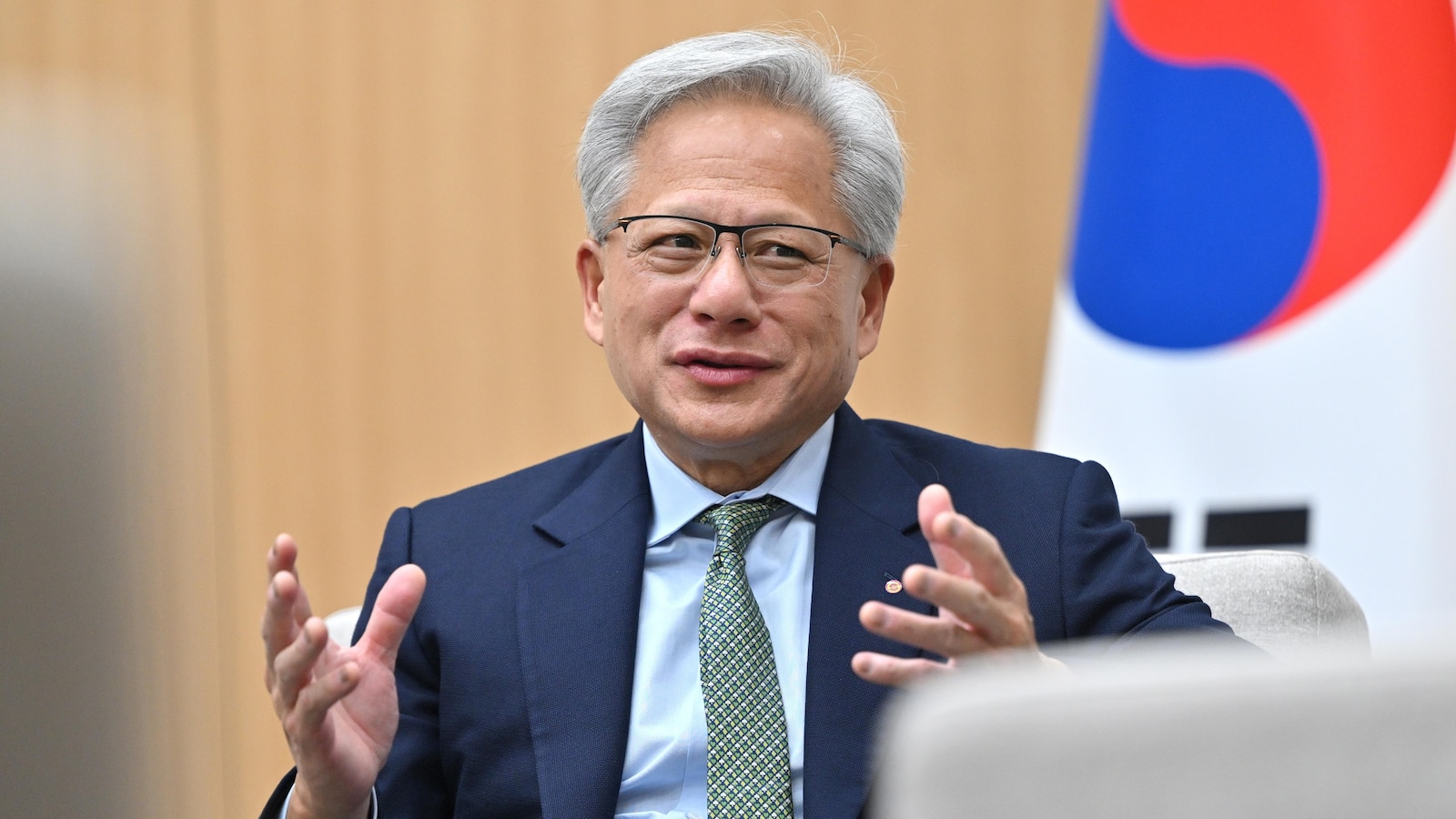
    GYEONGJU, South Korea — Silicon Valley chipmaker Nvidia plans to supply hundreds of thousands of its graphics processing units for projects with South Korean businesses and the government to advance the country’s artificial intelligence infrastructure and technologies.

    The plan was announced Friday by the government, Nvidia, and some of South Korea’s biggest companies, including chipmakers Samsung Electronics, SK Hynix and auto giant Hyundai Motor, after President Lee Jae Myung met with Nvidia CEO Jensen Huang.

    At a news conference, Huang said he hopes to export Nvidia’s most advanced AI chips to China, following U.S. President Donald Trump’s talks with Chinese President Xi Jinping on loosening U.S. chip restrictions as the two leaders pledged to reduce trade tensions.

    However, he acknowledged that it was up to Trump to decide, and said there were no current plans to sell the next generation Blackwell chips to China.

    Huang has gotten rockstar treatment reminiscent of Apple’s Steve Jobs since arriving in South Korea on Thursday to attend meetings of the Asia-Pacific Economic Cooperation forum in Gyeongju. As APEC host, South Korea is using the gathering of world leaders to showcase its ambitions in AI.

    According to Lee’s office and the companies, Nvidia will supply around 260,000 GPUs to support South Korea’s AI computing and manufacturing capabilities.

    About 50,000 of the GPUs will be used to support a government project to build a national cloud computing center for AI and Nvidia will provide the same number of GPUs each to Samsung and SK to help them enhance their manufacturing processes through AI and accelerate the development of advanced semiconductors.

    Hyundai and Nvidia said they plan to collaborate on developing technologies related to self-driving cars, smart factories and robotics, a process that will be powered by 50,000 of Nvidia’s advanced Blackwell GPUs.

    Speaking to business leaders, Huang highlighted how AI and advanced computing are driving a profound transformation across industries, adding to the need for more infrastructure and capacity. South Korea’s strengths in software, technical expertise and manufacturing give it an edge, he said.

    “When you combine software, AI technology, and manufacturing, you have the opportunity to really take advantage of robotics,” which is the future of AI, Huang said.

    Santa Clara-based Nvidia, whose GPU chips power much of the global AI industry, featured in talks Thursday between Trump and Xi in the South Korean city of Busan, where the leaders agreed to take steps to ease their escalating trade war.

    Following the meeting, Trump said he discussed sales of computer chips to China. Trump and former President Joe Biden have imposed restrictions on China’s access to the most advanced chips, including those used for AI. Trump said China will speak with Nvidia about purchasing their chips, but not the company’s latest Blackwell AI chips.

    Nvidia has argued that U.S. export controls hinder American competitiveness in one of the world’s largest technology markets and warned that such limits could push other countries toward China’s AI technology. Talking to reporters in South Korea, Huang said he hopes to eventually sell Blackwell chips to China, “but that’s a decision for the president to make.”

    “We’re always hoping to return to China,” Huang said. “It’s in the best interest of the United States, it’s in the best interests of China. And so I’m hopeful that both governments will arrive at a conclusion someday where Nvidia’s technology could be exported to China.”

    Huang acknowledged U.S. security concerns about Nvidia technology being used by China’s military but argued that China already has ample AI capabilities, making the use of Nvidia chips for military purposes largely unnecessary.

    In August, Trump announced a deal with Nvidia and AMD, another chipmaker, to lift export controls on sales of advanced chips to China in exchange for a 15% cut of the revenue, despite concerns among national security experts that such chips will end up in the hands of Chinese military and intelligence services.

    Nvidia earlier this week confirmed that it has become the first $5 trillion company, just three months after the company broke through the $4 trillion mark. The milestone underscores the upheaval driven by the AI craze, widely seen as the biggest technological shift since Apple co-founder Jobs unveiled the first iPhone 18 years ago.

    But there are also concerns over a potential AI bubble. Officials at the Bank of England warned earlier this month that tech stock prices fueled by the AI boom could collapse, and the head of the International Monetary Fund has issued a similar warning.

    Hundreds of people, including reporters, gathered at a restaurant in southern Seoul on Thursday as Huang, dressed casually in a black T-shirt just hours after arriving in South Korea, shared fried chicken and beer with Samsung Electronics Chairman Lee Jae-yong and Hyundai Motor Executive Chair Euisun Chung. The tech executives clinked glasses, took bomb shots, and at one point, Huang stepped outside to hand baskets of chicken and fried cheese to the crowd waiting outside.

    The three later took the stage before hundreds of cheering fans at a nearby gaming festival, where Huang said Korea’s gaming scene aided Nvidia’s early success back when it mainly made graphics cards for gamers.

    Continue Reading

  • boxed smartphone imports in Pakistan — choice vs protection

    boxed smartphone imports in Pakistan — choice vs protection

    Sealed Pixels, Nothing and gaming flagships arrive fast but buyers face PTA costs and shaky warranties

    A growing number of Pakistani buyers are sourcing smartphones outside official local launches. Sealed Google Pixels, Nothing phones, OnePlus flagships, ROG and Redmagic gaming devices, and boxed iPhones are being sold through parallel imports and specialist resellers. The result: faster access to niche models but greater exposure to regulatory, warranty and repair uncertainties.

    Many of these units arrive factory sealed. Sellers typically offer shop-backed warranties and PTA registration services, but levels of formal support differ by brand and batch.

    Sources: Pakistan Telecommunication Authority (DIRBS FAQ, IMEI registration rules); Federal Board of Revenue mobile device duty schedules; market pricing from Yellostone Pakistan, Cube Online, PhoneDroid, OLX listings, Hafeez Centre (Lahore)

    How the grey-imports economy affects buyers

    The grey-imports market lets buyers get desired models quickly, often before official launches, but that convenience carries clear costs. Sticker prices frequently rise once PTA registration, brokerage and customs duties are added, so the final out-the-door price can be much higher than advertised. Warranties on these units are usually shop promises rather than manufacturer guarantees, which limits recourse for hardware or software faults.

    Repairs often take longer because spare parts for region-specific variants are not stocked locally and must be imported. Some models also require firmware conversions or region adjustments that can block over-the-air updates or certain network features. Buyers may get novelty and early access, but they also accept higher hidden costs, longer downtime and greater uncertainty about long term support.

    The PTA tax gap: why sealed Pixel/OnePlus prices vary wildly

    Listings for boxed imports commonly separate non-PTA stock from PTA-approved batches. Non-PTA sticker prices can be low, but buyers often pay extra for DIRBS/PTA IMEI registration, customs duty and seller brokerage. Retailers frequently position PTA approval as an optional, paid add-on or advertise limited PTA-cleared stock at higher margins. The net effect is an opaque spread between advertised and out-the-door prices; for some flagships the difference runs into tens of thousands of rupees.

    Where buyers go when repairs are needed (and why this is risky)

    Most parallel imports lack manufacturer service centres in Pakistan. Repairs therefore rely on independent technicians or the selling shop. Region-specific variants — some Pixels and gaming models — often require parts ordered per case, extending turnaround and increasing costs. Seller warranties exist, but they are contractual promises from retailers, not manufacturer guarantees; enforcement and spare parts availability vary by location and vendor.

    How shops market ‘global variants’ and ‘PTA approved’ as premium add-ons

    Retailers use descriptors such as “global ROM,” “US box,” “factory unlocked” and “PTA ready” to segment stock and justify price tiers. Influencer reviews and overseas unboxings amplify demand for these variants; sellers monetise that demand with upsells: IMEI verification, PTA paperwork handling and extended shop warranties. These measures smooth purchase friction but do not replace manufacturer-level after-sales support.

    Where iPhone fits in

    iPhones circulate in both channels: PTA-approved boxed units sold via reseller networks, and cheaper grey imports offered on classifieds and in bazaars. Global warranty coverage is limited without an Apple authorised service presence in Pakistan; buyers instead rely on reseller warranties or third-party repair networks. Reports of an Apple authorised reseller arrangement persist; if confirmed, that could reduce ambiguity around warranty and servicing.

    A concrete example: Nothing’s partial formalisation

    The market is shifting in places. While speaking to The Express Tribune a Yellostone representative, confirmed that Yellostone is the official distributor for selected Nothing Phone models in Pakistan and provides local warranty support for those units. That formal channel applies only to specified models; other Nothing variants and many competing brands remain available mainly via parallel importers.

    A practical middle path

    Buyers who want niche, early or imported models should:

    1. Verify IMEI on the PTA DIRBS portal before purchase.

    2. Get a written seller or distributor warranty that specifies duration and covered faults.

    3. Confirm parts availability and typical repair turnaround with the seller.

    4. Compare PTA-inclusive final price — not just the sticker price.

    5. Prefer units sold via known distributors (for example, Yellostone for selected Nothing models) if warranty and parts are priorities.

    Boxed imports now form a structural feature of Pakistan’s smartphone market. They supply choice and early access but shift responsibility for post-purchase protection onto buyers. Whether this parallel channel contracts or becomes permanent will depend on clearer regulatory communication from PTA, expanded manufacturer distribution and stronger enforcement of consumer protection standards.c

    Continue Reading

  • InfraX and Ericsson sign MoU at GITEX Global 2025 to advance smart utilities in UAE – Ericsson

    1. InfraX and Ericsson sign MoU at GITEX Global 2025 to advance smart utilities in UAE  Ericsson
    2. InfraX and Ericsson Partner to Accelerate Digital Transformation of UAE’s Utility Sector  TechAfrica News
    3. InfraX and Huawei Formalize Strategic Alliance to Modernize Utility Networks and Drive UAE’s Sustainable Digital Growth  Biz Today

    Continue Reading

  • Gold prices surge in Pakistan as global market hits record levels – Business & Economy

    Gold prices surge in Pakistan as global market hits record levels – Business & Economy

    Gold prices increased in both domestic and global markets, with 10 grams of gold becoming Rs 4,544 more expensive, and per tola rising by Rs 5,300.

    Following the increase, the price of 10 grams of gold has reached Rs 363,650, while the per-tola price has climbed to Rs 424,162 in Pakistan.

    In the international market, the gold price rose by $53, reaching $4,018 per ounce.

    Continue Reading

  • As the guns fall silent, Gazans find newly reopened banks have no cash

    As the guns fall silent, Gazans find newly reopened banks have no cash

    The

    ceasefire in Gaza

    has eased the trauma of Israel’s air strikes and blockade, but a shortage of cash has left Palestinians unable to spend what little money they have without falling victim to wartime profiteers.

    Banks, many damaged or destroyed along with homes, schools and other institutions across Gaza during two years of war, began reopening on Oct 16, six days after the ceasefire was announced. Queues soon formed, but people came away disappointed.

    “There is no money, liquidity at the bank,” said father-of-six Wael Abu Fares, 61, standing outside the Bank of Palestine. “You just come and do paperwork transactions and leave.”

    People need cash for most everyday transactions in Gaza, whether to buy food in the market or pay utility bills, but Israel blocked transfers of banknotes, along with most other goods, following the attack and mass

    hostage-taking by Hamas-led militants in October 2023

    .

    “Banks are open, air-conditioning is on, but they are doing mostly electronic business – no deposits, no withdrawals of cash,” Gaza economist Mohammad Abu Jayyab told Reuters.

    “People go to some greedy merchants to cash their salaries and they give them cash for a huge fee, which ranges between 20 per cent and sometimes goes to 40 per cent.”

    Mother-of-seven Iman al-Ja’bari longed for a time when transactions at banks used to take less than an hour.

    “You need two or three days to go back and forth, back and forth, spending your whole life standing there,” she said. “And in the end, you only get 400 shekels (S$160) or 500 shekels. What can this (amount) buy with the incredibly high prices today that we can’t afford?”

    For a few Palestinians, the cash crunch has provided an opportunity to eke out a living. Ms Manal al-Saidi, 40, repairs damaged banknotes to cover some basic needs.

    “I work and I make 20, 30 shekels, and I leave with a loaf of bread, beans for dinner, falafel, anything, something simple,” she said, wiping notes.

    “Not that I can get (afford) vegetables or anything, no, just enough to get by.”

    Some people resort to electronic transfers through bank apps for even small items such as eggs or sugar, but sellers apply additional fees.

    The issue of cash supplies into Gaza was not included in

    US President Donald Trump’s 20-point peace plan

    , which also left the details of reconstruction and security to be decided.

    Cogat, the arm of the Israeli military that oversees aid flows into the Gaza Strip, did not immediately respond to a request for comment on whether or when banknotes may be allowed back in.

    The shortage of notes and coins has compounded the crisis for Gazans who have lost relatives, jobs and homes, used up their savings and sold their possessions to buy food, tents and medications. Some have resorted to barter to get by.

    Palestinian merchant Samir Namrouti, 53, has become used to banknotes that are almost unrecognisable through overuse.

    “What matters to me is its serial number. As long as its serial number is there, that’s it, I treat it as money,” he said. REUTERS

    Continue Reading

  • As the guns fall silent, Gazans find newly reopened banks have no cash

    As the guns fall silent, Gazans find newly reopened banks have no cash

    The

    ceasefire in Gaza

    has eased the trauma of Israel’s air strikes and blockade, but a shortage of cash has left Palestinians unable to spend what little money they have without falling victim to wartime profiteers.

    Banks, many damaged or destroyed along with homes, schools and other institutions across Gaza during two years of war, began reopening on Oct 16, six days after the ceasefire was announced. Queues soon formed, but people came away disappointed.

    “There is no money, liquidity at the bank,” said father-of-six Wael Abu Fares, 61, standing outside the Bank of Palestine. “You just come and do paperwork transactions and leave.”

    People need cash for most everyday transactions in Gaza, whether to buy food in the market or pay utility bills, but Israel blocked transfers of banknotes, along with most other goods, following the attack and mass

    hostage-taking by Hamas-led militants in October 2023

    .

    “Banks are open, air-conditioning is on, but they are doing mostly electronic business – no deposits, no withdrawals of cash,” Gaza economist Mohammad Abu Jayyab told Reuters.

    “People go to some greedy merchants to cash their salaries and they give them cash for a huge fee, which ranges between 20 per cent and sometimes goes to 40 per cent.”

    Mother-of-seven Iman al-Ja’bari longed for a time when transactions at banks used to take less than an hour.

    “You need two or three days to go back and forth, back and forth, spending your whole life standing there,” she said. “And in the end, you only get 400 shekels (S$160) or 500 shekels. What can this (amount) buy with the incredibly high prices today that we can’t afford?”

    For a few Palestinians, the cash crunch has provided an opportunity to eke out a living. Ms Manal al-Saidi, 40, repairs damaged banknotes to cover some basic needs.

    “I work and I make 20, 30 shekels, and I leave with a loaf of bread, beans for dinner, falafel, anything, something simple,” she said, wiping notes.

    “Not that I can get (afford) vegetables or anything, no, just enough to get by.”

    Some people resort to electronic transfers through bank apps for even small items such as eggs or sugar, but sellers apply additional fees.

    The issue of cash supplies into Gaza was not included in

    US President Donald Trump’s 20-point peace plan

    , which also left the details of reconstruction and security to be decided.

    Cogat, the arm of the Israeli military that oversees aid flows into the Gaza Strip, did not immediately respond to a request for comment on whether or when banknotes may be allowed back in.

    The shortage of notes and coins has compounded the crisis for Gazans who have lost relatives, jobs and homes, used up their savings and sold their possessions to buy food, tents and medications. Some have resorted to barter to get by.

    Palestinian merchant Samir Namrouti, 53, has become used to banknotes that are almost unrecognisable through overuse.

    “What matters to me is its serial number. As long as its serial number is there, that’s it, I treat it as money,” he said. REUTERS

    Continue Reading

  • NVIDIA and Hyundai Motor Group Team on AI Factory to Power AI-Driven Mobility Solutions

    NVIDIA and Hyundai Motor Group Team on AI Factory to Power AI-Driven Mobility Solutions

    Leading Global Automaker to Deploy NVIDIA Blackwell AI Infrastructure Across Manufacturing, Robotics and Autonomous Driving

    News Summary:

    • Hyundai Motor Group and NVIDIA will collaborate with the Korean government to develop Korea’s physical AI industry, including the establishment of an AI Application Center and AI Technology Center, while nurturing local AI talent to build a vibrant innovation ecosystem.
    • Hyundai Motor Group is building an NVIDIA AI supercomputer to accelerate model training, validation and deployment for in-vehicle AI, autonomous driving, smart factories and robotics.
    • Hyundai Motor Group is exploring using the NVIDIA Omniverse and Cosmos platforms on NVIDIA RTX PRO Servers to develop car factory digital twins and robots.
    • With NVIDIA Nemotron open models and the NVIDIA NeMo software, Hyundai Motor Group is speeding proprietary LLM and AI development.
    • Using NVIDIA DRIVE AGX Thor, running on the safety-certified NVIDIA DriveOS operating system, Hyundai Motor Group is developing advanced driver-assistance systems, next-generation safety features and in-vehicle intelligence for mobility solutions.


    APEC Summit—NVIDIA today announced it is deepening its collaboration with Hyundai Motor Group to accelerate innovation in autonomous vehicles (AVs), smart factories and robotics with a new NVIDIA Blackwell-powered AI factory.

    Building on their strategic collaboration, Hyundai Motor Group and NVIDIA are now entering a new phase of collaboration, shifting from strategic adoption of advanced software platforms and infrastructure to joint innovation of core physical AI technologies. Together, they will codevelop AI capabilities for mobility solutions, a next-generation smart factory and on-device semiconductor advancements to strengthen Hyundai Motor Group’s future capabilities.

    As part of this endeavor, Hyundai Motor Group and NVIDIA aim to enable integrated AI model training, validation and deployment using 50,000 NVIDIA Blackwell GPUs.

    In addition, in support of the Korean government’s initiative to build a national physical AI cluster, Hyundai Motor Group and NVIDIA will work closely with government stakeholders to accelerate ecosystem development. This will result in an approximately $3 billion investment to advance the physical AI landscape in Korea.

    Key efforts include the establishment of an NVIDIA AI Technology Center, Hyundai Motor Group’s Physical AI Application Center and regional data centers. This will also foster dynamic exchanges with NVIDIA’s engineers and technicians, helping cultivate Korea’s next generation of physical AI talent.

    “AI is revolutionizing every facet of every industry, and in transportation alone — from vehicle design and manufacturing to robotics and autonomous driving — NVIDIA’s AI and computing platforms are transforming how the world moves,” said Jensen Huang, founder and CEO of NVIDIA. “Together with Hyundai Motor Group — Korea’s industrial powerhouse and one of the world’s top mobility solutions providers — we’re building intelligent cars and factories that will shape the future of the multitrillion-dollar mobility industry.”

    “As we enter a new era of AI-powered mobility and smart factories, deepening our collaboration with NVIDIA marks a pivotal step forward,” said Euisun Chung, executive chair of Hyundai Motor Group. “Together, we are not only building advanced technologies but also laying the foundation for a robust AI ecosystem in Korea — one that fosters innovation, nurtures talent and positions us at the forefront of global AI leadership.”

    “For Korea to leap forward as a leading nation in AI, the advancement of physical AI is essential — a key initiative championed by the Ministry of Science and ICT. This inaugural step in public-private collaboration to foster physical AI is therefore incredibly significant,” said Bae Kyung-hoon, Deputy Prime Minister, and Minister of Science and ICT of the Republic of Korea. “Korea has a strong foundation in manufacturing. By combining Korea’s rich manufacturing data with NVIDIA’s cutting-edge AI infrastructure, we expect to build a win-win model through collaboration with domestic companies, thereby accelerating innovative AI transformation in manufacturing across industries.”

    Hyundai Motor Group Advances Automotive With NVIDIA AI Factory

    With its NVIDIA Blackwell-based AI factory, Hyundai Motor Group will deploy essential infrastructure for powering every phase of innovation — bringing together in-vehicle AI, autonomous driving, factory automation and robotics into one intelligent, interconnected ecosystem.

    NVIDIA offers the three AI compute platforms that serve as the infrastructure for physical AI and robotics:

    Together, these computing platforms form the backbone of AI and car factories, enabling the transportation industry to develop, validate and deploy advanced physical AI at scale.

    Building Smart Factories and Safe Cars of the Future

    As part of the expanded collaboration, unveiled earlier this year, Hyundai Motor Group will use the NVIDIA Omniverse Enterprise platform to create robust factory digital twins — virtual replicas of manufacturing environments that unify and manage factory data — as well as enable precision control, software- and hardware-in-the-loop validation, discrete event simulation and virtual commissioning.

    These physically accurate digital environments accelerate robot integration, optimize production, enable predictive maintenance and pave the way for fully autonomous, software-defined factories — reshaping how vehicles are designed and manufactured.

    NVIDIA Omniverse Enterprise also extends to humanoid and robotic systems using NVIDIA Issac Sim™, an open robotics reference framework built on NVIDIA Omniverse. This enables virtual validation of task assignments, motion planning and ergonomic safety before robot deployment on physical production lines, significantly accelerating robot integration and maximizing productivity.

    Hyundai Motor Group is also testing the use of the NVIDIA Omniverse and Cosmos platforms on NVIDIA RTX PRO Servers, with NVIDIA RTX PRO 6000 Blackwell Server Edition GPUs, to build digital twins of regional driving environments and conditions, incorporating extensive simulations to advance its development pipeline. These sophisticated capabilities place Hyundai Motor Group at the forefront of scalable, next-generation autonomous driving.

    Hyundai Motor Group is developing advanced AI models — built with the NVIDIA Nemotron™ open AI reasoning models and NVIDIA NeMo™ software — to enable over‑the‑air updates of capabilities and features across vehicles.

    In addition to autonomy capabilities, Hyundai Motor Group will use these advanced models to develop a range of innovative in‑vehicle AI features, from personalized digital assistants to intelligent infotainment and adaptive comfort systems. This transforms vehicles into continuously learning, evolving intelligent agents.

    Inside Hyundai Motor Group vehicles, NVIDIA DRIVE AGX Thor, accelerated compute running on safety-certified NVIDIA DriveOS™ operating system, is set to provide the AI compute power for advanced driver-assistance and next-generation safety features, as well as immersive in-vehicle AI experiences.

    With NVIDIA, Hyundai Motor Group is evolving its vehicles and factories from independent systems into a single, interconnected and intelligent ecosystem, setting a new standard for the future of the global automotive industry.

    Continue Reading

  • NVIDIA and SK Group Build AI Factory to Drive Korea’s Manufacturing and Digital Transformation

    NVIDIA and SK Group Build AI Factory to Drive Korea’s Manufacturing and Digital Transformation

    New AI Infrastructure With Over 50,000 NVIDIA GPUs to Boost Chip Design, Digital Twin, Robotics and AI Agent Development

    News Summary:

    • SK Group and NVIDIA are deepening their partnership to advance SK hynix HBM and future memory solutions for NVIDIA GPUs, chip manufacturing and telecommunications.
    • SK Group is building an NVIDIA AI factory featuring more than 50,000 NVIDIA GPUs.
    • SK hynix is advancing chip manufacturing with NVIDIA CUDA-X technologies, including through the NVIDIA PhysicsNeMo framework, tapping AI physics to significantly accelerate technology computer-aided design simulation.
    • SK hynix is developing semiconductor fab digital twins using NVIDIA Omniverse libraries and NVIDIA RTX PRO Servers to achieve faster production ramp-up, higher efficiency and progress toward robotic self-optimizing fabs.
    • SK hynix is deploying AI-powered agents with NVIDIA NIM microservices and NVIDIA AI Enterprise software to boost productivity for over 40,000 employees.
    • SK Telecom is launching an industrial cloud built on NVIDIA RTX PRO 6000 Blackwell GPUs in Asia, enabling startups, enterprises and government agencies to accelerate digital twin and robotics innovation.

    APEC Summit—NVIDIA today announced that it is working with SK Group to build an AI factory to advance semiconductor research, development and production, as well as cloud infrastructure to support digital twin and AI agent development.

    SK Group is building an AI factory featuring more than 50,000 NVIDIA GPUs, with the first phase planned for completion by late 2027. Once complete, the system is expected to be one of Korea’s largest AI factories.

    The new factory will serve SK subsidiaries — including SK hynix and SK Telecom (SKT) — as well as external organizations through a GPU-as-a-service model, accelerating digital transformation and industrial innovation for Korea’s industries.

    Further expanding the NVIDIA and SK Group partnership, the companies are collaborating on the development of SK hynix high-bandwidth memory (HBM) and next-generation advanced memory solutions for NVIDIA GPUs, semiconductor manufacturing and telecommunications infrastructure.

    “In the era of AI, a new kind of manufacturing plant has emerged: the AI factory,” said Jensen Huang, founder and CEO of NVIDIA. “SK Group is a vital memory technology partner, helping NVIDIA create the world’s most advanced GPU computing platforms that power global AI progress. We are delighted to partner with SK to build its AI foundation on NVIDIA accelerated computing and software, creating AI factories that will transform SK and energize Korea’s AI ecosystem.”

    “SK Group is working with NVIDIA to make AI the engine of a profound transformation that will enable industries across Korea to transcend traditional limits of scale, speed and precision,” said Chey Tae-Won, chairman of SK Group. “With the NVIDIA AI factory as our foundation, SK Group will forge the infrastructure that powers the next generation of memory, robotics, digital twins and intelligent AI agents.”

    The SK Group AI factory infrastructure will be available to sovereign model developers participating in the Korea government’s Sovereign AI Foundation Models project. SKT is also taking part in the program as a model developer to provide foundation models for enterprises, industries and researchers working on AI agent and application development.

    SK Telecom Advances Physical AI and Robotics With NVIDIA Omniverse

    NVIDIA Cloud Provider SKT plans to build an industrial AI cloud with NVIDIA RTX PRO™ 6000 Blackwell Server Edition GPUs in Asia, empowering the nation’s manufacturing leaders to advance physical AI and robotics development.

    The initial deployment will include over 2,000 NVIDIA RTX PRO 6000 Blackwell GPUs, and will run NVIDIA Omniverse™ workloads to support SK hynix’s semiconductor manufacturing, fab digital twins and internal AI agents.

    SK Hynix Boosts Productivity Through AI Physics, Digital Twins, Robotics and AI Agents

    SK hynix is using the accelerated cloud infrastructure from SKT to scale its operations.

    SK hynix is tapping NVIDIA CUDA-X™ technologies, including through the NVIDIA PhysicsNeMo™ framework, to accelerate chip design with AI physics. This accelerates technology computer-aided design simulations, enabling SK hynix to deliver next-generation semiconductor products faster and with greater precision. SK hynix is also testing opportunities to accelerate its current use of Synopsys software with NVIDIA Blackwell GPUs for technology computer-aided design and circuit simulation.

    To boost efficiency, SK hynix is building autonomous fab digital twins using NVIDIA Omniverse libraries and NVIDIA RTX PRO Servers with NVIDIA RTX PRO 6000 Blackwell GPUs. These digital twins enable real-time simulation, monitoring and optimization of fab operations, resulting in faster production ramp-up, improved operational agility and progress toward fully self-optimizing manufacturing facilities.

    SKT is developing a foundation model called A.X. that will power SK hynix’s AI agents, built with NVIDIA NIM™ microservices and the NVIDIA AI Enterprise software platform. These agents will help more than 40,000 employees, production staff and office workers collaborate and solve problems faster, accelerating productivity across chip development and fabrication.

    Learn more about these collaborations by joining the NVIDIA keynote and sessions at the SK AI Summit, running Nov. 3-4.

    Continue Reading

  • Nvidia to supply more than 260,000 Blackwell AI chips to South Korea – Reuters

    1. Nvidia to supply more than 260,000 Blackwell AI chips to South Korea  Reuters
    2. Nvidia to supply South Korea with more than 260,000 Blackwell AI chips  The Express Tribune
    3. Jensen Huang praises Korean fried chicken at high-profile Seoul dinner with Samsung, Hyundai leaders  The Korea Times
    4. NVIDIA and Hyundai Motor Group Team on AI Factory to Power AI-Driven Mobility Solutions  NVIDIA Newsroom
    5. Samsung, Nvidia Discussing HBM4, Next Level of Memory Chips  Asia Financial

    Continue Reading