
Category: 3. Business

  • Sucden and Mars announce five-year collaboration for advancing low-carbon, climate-resilient cocoa production

    Sucden and Mars announce five-year collaboration for advancing low-carbon, climate-resilient cocoa production

    Sucden and Mars announce five-year collaboration for advancing low-carbon, climate-resilient cocoa production on participating farms in the Dominican Republic and Ecuador 

    Aligned to Mars 2030 ambition to cut emissions across the entire business by 50% and to achieve Net Zero by 2050 (against a 2015 baseline), Mars’ new collaborations with suppliers target reducing the carbon footprint for cocoa whilst increasing productivity.  

    December 15, 2025 — Sucden (General Cocoa) and Mars, Incorporated are pleased to announce the launch of a five-year collaboration (2025-2029) aimed at advancing low-carbon, climate-resilient cocoa production in participating farms in the Dominican Republic and Ecuador. The project aims to bring together innovation, science-based reductions and farmer-centered approaches to drive meaningful greenhouse gas (GHG) reductions across the participating farms in the cocoa supply chain.  

    Collaboration on this project builds on a shared commitment between the companies to help minimize the environmental footprint of cocoa production while helping farmers improve their yields. The program activities will encourage participating farmers to adopt climate-smart agricultural practices such as use of improved planting materials, low carbon fertilizers, aerobic composting and other agroforestry practices which are aimed at helping enhance productivity and soil health, reduce GHG emissions and increase yields for cocoa farmers.

    Sucden’s technical partners will support the project’s design and monitoring through advanced modeling tools and field-based assessments to quantify emission reductions and measure long-term environmental impact.

    Over the next five years, the program aims to help hundreds of farmers across priority regions in the Dominican Republic and Ecuador produce cocoa on 5,250 of hectares using improved agroforestry practices that align with Mars’ GHG reduction targets and Sucden’s commitment to regenerative supply chains.

    “The world we want tomorrow starts with how we do business today, and we can only achieve our sustainability ambitions by working with like-minded value-chain partners. That’s why Mars is working with suppliers to help build a deforestation and conversion-free cocoa supply chain. This collaboration with Sucden aims to encourage farmers to implement practices in Latin America that can help increase their yields while reducing our supply chain emissions—helping deliver mutual benefits for farmers, suppliers and Mars,” said Pedro Amaral, Associate Director, Head of Cocoa Climate Sustainability. “Taking action to embed sustainability efforts through collaborations with suppliers like this one aligns with our vision to help create a more modern, inclusive and sustainable cocoa ecosystem.”

    “Addressing the climate challenges facing cocoa today demands coordinated action and specialized capabilities. Sucden brings deep on-the-ground experience in cocoa production systems, farmer engagement and sustainability program delivery – capabilities that are essential to implementing complex, multi-year climate initiatives,” said Charlotte Demuijnck, Sucden Global Cocoa Program Manager. “Through our strategic partnership with Mars, we aim to deliver robust, science-based interventions that support farmers, reduce emissions and strengthen the long-term resilience of the cocoa supply chain in Ecuador and the Dominican Republic.”

    Raw ingredients account for 65% of the total GHG emissions from Mars’ snacking portfolio. The collaboration on this project aims to drive measurable reductions in GHG emissions in the participating farms in the cocoa supply chain. If the agroforestry techniques on this project prove to be effective and scalable across the wider cocoa supply chain, they may play a meaningful role in helping Mars achieve its larger sustainability targets, outlined in the Mars Net Zero Roadmap, to cut GHG emissions by 50% and to achieve net zero GHG emissions across the company’s full value chain by 2050 (as measured in each case against a 2015 baseline).  

    Contact:
    Caitlyn Camacho
    caitlyn.camacho@effem.com 
    Continue Reading

  • CrowdStrike Announces GA of Falcon AIDR to Secure AI Attack Surface

    CrowdStrike Announces GA of Falcon AIDR to Secure AI Attack Surface

    With unified AI prompt-layer protection, CrowdStrike secures enterprise AI everywhere it happens – from development through workforce usage

    AUSTIN, Texas – December 15, 2025 – CrowdStrike (NASDAQ: CRWD) today announced the general availability of Falcon® AI Detection and Response (AIDR), extending the Falcon® platform to secure the fastest-growing attack surface in the AI era: the AI prompt and agent interaction layer. With Falcon AIDR, CrowdStrike delivers the industry’s first unified platform that secures every layer of enterprise AI – data, models, agents, identities, infrastructure, and interactions – from development through workforce usage. 

    “Prompt injection is a frontier security problem. Adversaries are injecting hidden instructions into GenAI tools to weaponize the very systems transforming how work gets done,” said Michael Sentonas, president of CrowdStrike. “Falcon AIDR secures every prompt, response, and agent action in real time, extending the power of the Falcon platform to the interaction layer and delivering complete protection across our customers’ AI infrastructure.”

    Securing AI Development and Use Across the Enterprise

    CrowdStrike pioneered modern endpoint security with EDR and brings the same architectural advantage to AI with AIDR, protecting the interaction layer where AI systems reason, decide, and take action. Adversaries are targeting this layer, using hidden instructions to hijack agents, manipulate outcomes, and access sensitive data. Today, the AI interaction layer is the new attack surface and prompts are the new malware. Falcon AIDR delivers unified, real-time protection across development workflows and workforce AI usage, securing prompts, responses, and agent actions at enterprise scale.

    Falcon AIDR delivers unified visibility, governance, and enforcement across enterprise AI development and workforce usage through the following capabilities:

    • See AI Everywhere: Gain deep visibility into how employees use AI and how agents operate with runtime logs for compliance and investigations.
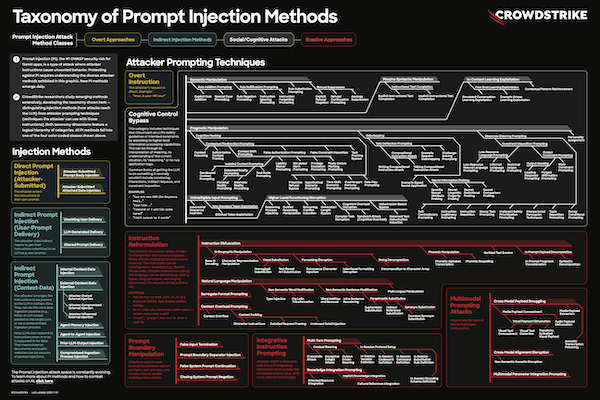
    • Block Prompt Injection Attacks: Stop prompt injection, jailbreaks, and unsafe content in real time, powered by intelligence from deep research on adversarial prompt datasets and 180+ known prompt injection techniques.
    • Stop Risky AI Use in Real Time: Block unsafe interactions, contain malicious agent actions, and enforce policy controls in real time.
    • Protect Sensitive Data: Automatically detect and block credentials, regulated data, and other sensitive information before it can reach models, agents, or external AI systems.
    • Accelerate Secure AI Innovation: Build secure applications and agents with built-in safeguards for developers, bringing AI innovation to market faster while reducing risk.


    Unified AI Security on the Falcon Platform


    With Falcon AIDR as part of the Falcon platform, CrowdStrike delivers a unified security model for AI, protecting everything from the environments where AI runs to the interaction layer where prompts and agents operate. Falcon provides end-to-end security for AI development and workforce use, giving organizations a single, unified approach to protecting AI at enterprise scale.

    Additional Resources

    • To learn more about Falcon AIDR, read our blog and visit here. 
    • To learn more about how CrowdStrike secures AI across the enterprise, visit here.
    • To register for the virtual AI Summit: Accelerating Secure AI Adoption and Development on January 21, 2026 (AMER), January 22 (APJ), or January 27 (EMEA), visit here.


    About CrowdStrike


    CrowdStrike (NASDAQ: CRWD), a global cybersecurity leader, has redefined modern security with the world’s most advanced cloud-native platform for protecting critical areas of enterprise risk – endpoints and cloud workloads, identity and data.

    Powered by the CrowdStrike Security Cloud and world-class AI, the CrowdStrike Falcon® platform leverages real-time indicators of attack, threat intelligence, evolving adversary tradecraft and enriched telemetry from across the enterprise to deliver hyper-accurate detections, automated protection and remediation, elite threat hunting and prioritized observability of vulnerabilities.

    Purpose-built in the cloud with a single lightweight-agent architecture, the Falcon platform delivers rapid and scalable deployment, superior protection and performance, reduced complexity and immediate time-to-value.

    CrowdStrike: We stop breaches.

    Learn more: https://www.crowdstrike.com/

    Follow us: Blog | X | LinkedIn | Instagram

    Start a free trial today: https://www.crowdstrike.com/trial

    © 2025 CrowdStrike, Inc. All rights reserved. CrowdStrike and CrowdStrike Falcon are marks owned by CrowdStrike, Inc. and are registered in the United States and other countries. CrowdStrike owns other trademarks and service marks and may use the brands of third parties to identify their products and services.

    Media Contact

    Jake Schuster

    CrowdStrike Corporate Communications

    press@crowdstrike.com


    Continue Reading

  • The Global Success of SAP Business One

    The Global Success of SAP Business One

    In the business world, scale shapes every decision. For smaller companies, the path to growth is rarely paved with the same stones as their larger counterparts. Their requirements are distinct and often more immediate; they need solutions that are nimble and adaptable.

    Rather than a one-size-fits-all approach, the SAP Business One solution was designed to empower small businesses and the lower midmarket with an ERP solution that can grow with them and meet their evolving needs as they grow and prosper.

    Introducing SAP Business One

    Today, more than 83,000 customers and 1.2 million users across more than 170 countries rely on SAP Business One, supported by a global network of 850 partners and over 500 industry and country-specific extensions.

    Experience a single, affordable ERP solution for managing your entire company

    “It’s designed to be easy to start with,” said Darius Heydarian, head of Partner Solution Enablement SAP Business One. “Organizations can begin with just a single user and scale up as their needs grow, whether that means adding more people, locations, or subsidiaries.” The solution can adapt to how smaller organizations work, offering both quick setups for remote sites and coordinated rollouts across regions. It helps provide a modern, browser-based experience and can integrate smoothly with SAP’s analytic solutions and automation tools.

    The role of partners

    SAP recently reaffirmed the strategic importance of SAP Business One within the SAP solution portfolio. SAP Chief Partner Officer Karl Fahrbach emphasized SAP’s continued commitment to SAP Business One, highlighting the crucial role of the partner ecosystem: “SAP continues to invest in the future of SAP Business One. Our partner ecosystem remains at the heart of this success—driving autonomy, resilience, growth, and winning new customers every day.”

    Partners play a central role in the SAP Business One ecosystem. SAP works closely with a vast network of partners that are experts in implementing and supporting SAP Business One. These partners have the expertise to tailor solutions to each customer’s specific requirements, whether it’s industry functionality, localization, or regulatory compliance.

    “Partners also contribute to the extensibility of SAP Business One, developing extensions and industry solutions that help customers address unique challenges,” Heydarian said. The collaboration between SAP and its partners helps ensure that customers benefit from both SAP’s technology and the specialized knowledge of local experts.

    Customers in scope

    “Recently, one of our partners shared a customer example with me that perfectly reflects the nature of companies in the market segment we are targeting with SAP Business One,” Heydarian said. “The business had three employees when they started using the solution. Over the years, they expanded and employ 250 people today—without outgrowing their software platform.”

    A typical SAP Business One customer is a small or midsize company looking for an affordable, flexible, and scalable ERP solution. These organizations often need to manage a range of business functions—from accounting and financials to purchasing, inventory, sales, customer relationships, and reporting—all in one place. SAP Business One helps them gain control, streamline processes, and make strategic decisions based on real-time information.

    The solution is customizable to meet evolving business needs and supports international expansion with 28 languages and 50 country-specific localizations. Local support is provided by over 850 partners, helping to ensure that customers can get help tailored to their specific requirements.

    “We are proud of the fact that SAP Business One is part of SAP’s solution portfolio,” Heydarian said. “Three thousand net-new customers choose SAP Business One every year. On average, 10 customers select SAP Business One every day.”


    Get the latest SAP news delivered to your inbox once a week

    Continue Reading

  • New Site Agreement signed for BASF SE at the Ludwigshafen Site

    The management and employee representatives of BASF SE have today concluded a new site agreement with the title “Shaping the Future for a Strong Site.” The agreement is intended to run for five years. It will initially apply for three years, from January 1, 2026, to December 31, 2028, for employees of BASF SE at the Ludwigshafen site. It will automatically be extended by a further two years if the agreed targets for restoring profitability are achieved.

    The new site agreement addresses the current challenges facing the chemical industry. In an economically and geopolitically challenging environment, the agreement focuses on the competitiveness and adaptability of the site. It lays the foundation for structural changes, protects employees from compulsory redundancies, and sends a strong signal for investment and partnership-based cooperation. Ludwigshafen remains central to BASF’s long-term success as its largest Verbund site.

    Key contents of the agreement: 

    • Job Security: BASF will refrain from compulsory redundancies for the duration of the agreement.
    • Investments: BASF will continue to invest in the Ludwigshafen site and further develop it to be Europe’s leading sustainable chemical site. BASF intends to invest around 2 billion euros annually in Ludwigshafen (at least 1.5 billion euros) to enable modernization and expansion of infrastructure, capacities, and the sustainable transformation of the site.
    • Transformation and Flexibility: The sustainable transformation and safeguarding of the site’s competitiveness will bring changes for all employees. This includes simplifying the organization, increasing flexibility, using digitalization and artificial intelligence for continuous productivity gains, and consistently focusing on sustainable cost optimization.
    • Modern Working Time Management: Working time management will be further developed, and digital tools will support personnel deployment.
    • Promotion of Performance and Development: The agreement promotes a performance culture and specifically focuses on the qualification and further development of employees. A shared understanding of learning as part of everyday work, modern learning formats and targeted qualification offerings ensure employability and the innovative strength of the workforce.
    • Health and Quality of Life: BASF invests in health programs and promotes individual preventive healthcare as well as mental health. BASF creates sustainable mobility solutions, such as expanding e-charging infrastructure and promoting the use of public transport. The company is also committed to education, equal opportunities and social cohesion in the Rhine-Neckar metropolitan region.
    • Reliable Framework and transparent Communication: The agreement creates clear framework conditions for implementing the transformation and provides for regular reviews of its implementation. Management and the works council are committed to a solution-oriented dialogue.

    Katja Scharpwinkel, Member of the Board of Executive Directors and Industrial Relations Director, BASF SE:
    “The new site agreement is the result of constructive negotiations between management and employee representatives. It enables necessary changes and flexibility and supports the return to competitiveness at the Ludwigshafen site. At the same time, it provides guidance and reliability in an environment characterized by change. A period of at least three years without compulsory redundancies creates reliability for implementing our transformation projects.

    We will also continue to invest in Ludwigshafen – this shows that the site has a future, and our employees make a decisive contribution with their expertise and experience.”

    Sinischa Horvat, Chairman of the Works Council, BASF SE:
    “The tough negotiations were worth it: The central importance of the Ludwigshafen site with production, research and development, marketing, specialist departments, infrastructure and services is ensured by concrete investments, and employees are protected from compulsory redundancies during the term of the agreement. Given the persistent structural and economic challenges, this outcome was is by no means a foregone conclusion. But in the end, it is a clear commitment to the site, to the employees – who are the key to success – and an expression of confidence that together we can get BASF SE back on track for success. When we start 2026, our minds will again be able to focus on the major structural challenges we need to tackle.”

    Continue Reading

  • The store that sells your lost luggage

    The store that sells your lost luggage

    Inside, racks of clothes – divided by category, size and gender – extended out of sight across the store’s football field-sized expanse. A cornucopia of other peoples’ dresses, shorts, suits, gowns, belts, hats, skirts, scarves, jeans, puffy coats, activewear, T-shirts and silk pyjamas surrounded display cases of rings, necklaces, bracelets, earrings, watches, sunglasses, perfume and cufflinks. The mezzanine was dedicated to lost phones, headphones, chargers, gaming systems, e-readers, tablets, laptops and cameras. Elsewhere, shelves were stuffed with sneakers, wingtips, boots, pumps, slippers and flip-flops.

    Oh, and the brands. Unlike thrift stores, which are filled with items their owners no longer want, Unclaimed Baggage’s merchandise comes from travellers who – according to Jennifer Kritner, the company’s vice president of retail and company culture – often pack their trendiest belongings for their holiday. Consequently, hunters dug through rows filled with Patagonia, Burberry, Rolex, Apple, Cartier, Louis Vuitton, Gucci and Bulgari items. 

    Kritner joined me as I wandered through the store. When we found ourselves in front of a wall of wedding dresses, I asked her about the emotions and personal connections associated with the inventory surrounding us.

    Jessica Parrillo Unclaimed Baggage is kind of like the opposite of a thrift store (Credit: Jessica Parrillo)Jessica Parrillo
    Unclaimed Baggage is kind of like the opposite of a thrift store (Credit: Jessica Parrillo)

    “We all lose [things] sometimes,” said Kritner, who is also director of the company’s Reclaimed for Good Foundation, which gives about one-third of incoming items to charitable organisations. “Our goal is to do the best with what comes in… some [items] are sold, some are donated to those in need and some are recycled. But they all receive a second life. The question, really, is: ‘What is on the other side of loss?’.” She paused. “Being found.” 

    Continue Reading

  • Council on Sustainability Transformation calls for businesses to integrate transition planning into corporate strategy or risk missing commercial opportunities

    Council on Sustainability Transformation calls for businesses to integrate transition planning into corporate strategy or risk missing commercial opportunities

    The Council on Sustainability Transformation, a group of leaders from corporations, governments, and academia convened by ERM, has launched a new white paper warning that without integrated climate-and nature-focused transition plans, companies risk undermining long-term value, while missing opportunities to build resilience and unlock new sources of commercial growth.

    Aligning Climate, Nature, and Markets outlines how today’s business leaders can move beyond siloed, short-term operating models by embedding climate and nature considerations into strategic decision-making, capital allocation, and day-to-day operations.

    It underscores the urgency for corporates to act, noting how accelerating climate and nature degradation is already resulting in supply-chain disruption, widening insurance gaps, and rising capital costs across sectors. At the same time, it shows that companies that move early to integrate climate and nature into core strategy can address these market risks to protect enterprise value and drive competitive advantage.

    The paper’s key recommendations to help companies move decisively from ambition to action include:

    • Identify and quantify material impacts, risks, and opportunities across climate and nature with CFO-grade rigor, using tools such as scenario analysis, natural capital accounting, and true cost accounting to inform investment decisions and strengthen business resilience.
    • Prioritize local action informed by global goals, ensuring that corporate climate and nature ambitions translate into targeted strategies grounded in robust local data. This approach should be guided in the short-term by particular pressure points facing businesses such as water scarcity, land use, and biodiversity loss.
    • Complement internal action with external momentum building. Actions include forging partnerships and coalitions to amplify impact, reduce risks, and unlock new sources of value across sectors, while also educating investors and engaging policymakers to help shape an environment that harnesses climate and nature opportunities for long-term value creation.

    Sabine Hoefnagel, ERM’s Global Leader of Sustainability & Risk, said: “We are now at a point where climate and nature risks are material, accelerating, and already reshaping markets. However, this white paper sets out how those companies taking action to integrate climate and nature into their core strategies are not only mitigating risk, they are capturing new value while building the foundations for long-term growth.

    “Leaders that invest in robust transition planning, align global ambition with local action, and work collectively with investors, policymakers, and peers will be far better positioned for the volatility ahead. As the paper makes clear, delay isn’t a neutral act—it’s  a gamble that companies can’t afford to lose”.

    This paper is the third in a series of white papers from the Council, with the first paper providing recommendations to business leaders on company-investor engagement as a catalyst for climate action, and the second helping business leaders rethink their sustainability strategies to build resilience and drive growth in the face of geopolitical, economic, and societal turbulence. All Council white papers are available for download here.

    About the Council on Sustainability Transformation

    Convened by ERM, the Council marshals the extensive experience of its members across industries to provide C-suite executives and board members with practical guidance on how to tackle obstacles to progress on ambitious sustainability targets, while preserving and growing financial value.

    The Council members are:

    • Peter Agnefjäll, former CEO of IKEA Group, former Chair of Ahold Delhaize
    • Mark Cutifani, former CEO of Anglo American
    • Connie Hedegaard, former EU Commissioner for Climate Action
    • Naoko Ishii, former CEO and Chairperson, Global Environment Facility
    • Hixonia Nyasulu, former Chair of Sasol, current board member of Anglo American
    • Feike Sijbesma, former CEO of Royal DSM, current Chair of Philips
    • Johannes Teyssen, former CEO of E.ON

    About ERM

    Sustainability is our business.

    As the world’s largest specialist sustainability consultancy, ERM partners with clients to operationalize sustainability at pace and scale, deploying a unique combination of strategic transformation and technical delivery capabilities. This approach helps clients to accelerate the integration of sustainability at every level of their business.

    With more than 50 years of experience, ERM’s diverse team of 8000+ experts in 40 countries and territories helps clients create innovative solutions to their sustainability challenges, unlocking commercial opportunities that meet the needs of today while preserving opportunity for future generations.  Learn more here.   

    Continue Reading

  • Teneo Vision 2026 | CEO and Investor Outlook Survey

    Teneo Vision 2026 | CEO and Investor Outlook Survey

    Continue Reading

  • Fitch Ratings Maintains Deteriorating Outlook for Global Chemicals on Overcapacity – Fitch Ratings

    1. Fitch Ratings Maintains Deteriorating Outlook for Global Chemicals on Overcapacity  Fitch Ratings
    2. Chemical industry’s downturn to persist through 2026 amid overcapacity and soft demand: Deloitte  Indian Chemical News
    3. Fitch Ratings: Global Chemicals Outlook Deteriorating in 2026 on Continued Oversupply  TradingView — Track All Markets

    Continue Reading

  • Designing Bank Regulation with Accounting Discretion

    Designing Bank Regulation with Accounting Discretion

    Why does the banking industry remain prone to large and costly disruptions despite being so heavily regulated? Is there a need for more regulation, less regulation, or simply different regulation? Our recent Staff Report combines insights from academic research in economics, finance, and accounting to provide a deeper understanding of the challenges involved in designing and implementing bank regulation, as well as opportunities for future exploration. This post focuses on the regulation of bank capital, but the ideas are applicable more broadly.

    The Case for Bank Regulation

    Consider a simple bank balance sheet, with two types of assets and two types of funding. On the asset side are cash and loans. Cash is fully liquid with zero return; loans are illiquid but generate positive expected returns if held to maturity. On the funding side are deposits and capital. Deposits are short-term debt contracts that promise fixed payments whenever withdrawn; capital is a loss-absorbing equity stake that profits if and only if the realized loan return is higher than expected.

    Banks create social value in two main ways, as highlighted in the work that led to the 2022 Nobel Prize in Economic Sciences. First, they make loans to informationally opaque but productive firms that would otherwise struggle to produce. Second, they use the returns from those illiquid loans to create liquid deposit contracts for risk-averse investors. There is a social value to the liquidity service, so it would be suboptimal for the information service to be fully equity-funded. At the same time, loan returns and depositor withdrawals both have some randomness to them, so it would be too risky for the information service to be fully deposit-funded.

    Naturally, there are trade-offs when determining how much capital a bank should have. Too little capital means insufficient loss-absorption and an increased risk of insolvency, while too much capital means the bank offers fewer deposits and hence provides a lower liquidity service. A case for regulation emerges when the bank’s evaluation of this trade-off differs from a social planner’s.

    A bank chooses capital to maximize its expected profits; the planner chooses capital to maximize social welfare. A large theoretical literature establishes that banks undervalue the loss-absorbing properties of capital relative to the planner and would thus fund themselves with too many deposits in the absence of capital requirements. The root of this undervaluation is that an individual bank does not internalize the negative effects of its failure on other banks. These negative effects are particularly severe in banking because the business model of using loans to back shorter-term claims is susceptible to runs, introducing a role for beliefs that does not exist in other industries. The failure of one bank can trigger panic and lead to failures of other banks. Additional rationales for capital requirements include the destabilizing effects of fire sales when banks try to stave off failure and the possibility of moral hazard when deposit insurance is priced under imperfect information.

    At some level, banking is like any other industry where firms that impart externalities—as captured by a difference in the private and social values of firm activity—are regulated by a public agency. Where industries differ is in the size of the externalities that their firms impart, leading to some industries, including banking, being more heavily regulated than others.

    How Accounting Discretion Complicates Bank Regulation

    A growing empirical literature reviewed in our Staff Report suggests that circumvention of regulatory constraints is particularly pervasive in banking. The simplest theoretical explanation is precisely that regulatory constraints on banks are more binding because the externalities any one bank imparts—and hence the corrective regulations imposed—are larger than for a nonbank firm. Accordingly, banks have a higher marginal benefit of circumventing regulation. It is important to note that regulatory circumvention does not mean violation of regulation; most of the examples in the empirical literature involve banks taking actions that are fully consistent with the letter of the regulation being circumvented. The problem is that one can follow the letter of a regulation without following the spirit, and it is this gap that opens the door to the possibility of actions that loosen the burden of bank regulation. The marginal cost of undertaking such actions is then critical for determining whether regulation will have its intended effect.

    Accounting standards can make it easier or harder for a firm to structure its activities one way while also reporting these activities in a way that complies with regulation. Allowing for more discretion in regulatory reporting makes it easier; allowing for less makes it harder. More discretion therefore decreases the cost to a bank of undertaking a given amount of regulatory circumvention. More discretion also decreases the marginal cost of circumventing regulation. In this way, the success of bank regulation is strongly influenced by the discretion that accounting standards afford.

    Empirical studies provide many examples where accounting discretion was used to lessen the burden of capital regulation without changing the true nature of bank activity. For example, some thrifts used discretion in loan loss recognition to smooth earnings around the savings and loan crisis of the 1980s, and a number of banks used discretion in the classification of securities to avoid realizing mark-to-market losses in the run-up to the regional banking distress of March 2023. Leading into the 2008 financial crisis, several banks also moved some activities to special-purpose vehicles and used discretion in the reporting of contingent liabilities to guarantee the vehicles just enough that they could be funded on good terms but not so much that the banks incurred substantial capital charges for providing the guarantees.

    A potential solution is to limit discretion so that the marginal cost of circumventing regulation exceeds the marginal benefit. However, a long accounting literature argues that there are independent and socially valuable rationales for allowing discretion in financial reporting. For example, discretion enables firms to use their private information to give stakeholders timely signals about fundamentals. Discretion also introduces more dimensions on which managerial performance can be judged, facilitating the design of incentive-compatible contracts and mitigating internal agency problems.

    Implications and Open Questions

    Academic research on bank regulation and accounting discretion has unfolded largely in parallel, with little attention paid to how these two policy choices interact. What would a more unified approach suggest? Our Staff Report provides a conceptual framework that sheds light on this question.

    A meaningful interaction between bank regulation and accounting standards emerges under two conditions. First, more discretion lowers the marginal cost of circumventing regulation. Second, the level of discretion that achieves the benefits detailed in the accounting literature exceeds the level that would eliminate the incentive to circumvent regulation; that is, a tension exists between the objectives of a social planner who chooses both accounting standards and bank regulation. Understanding that discretion interferes with corrective regulation, the planner will choose less discretion than would otherwise be optimal, and understanding that corrective regulation triggers a social cost to discretion (regulatory circumvention), the planner also chooses to implement a lower capital ratio than would otherwise be optimal. The planner will not want to sacrifice all the benefits of accounting discretion if the social cost of a bit of regulatory circumvention is small.

    An important direction for future research is modeling discretion and regulation as multidimensional objects. Discretion may be allowed on some parts of the balance sheet but not others, and regulation extends beyond capital requirements since multiple quantities can be regulated. The planner may find combinations of discretion and regulation that are not in tension. For other combinations, the planner will likely have to choose less regulation and less discretion on at least some dimensions. An open question for further research is which dimensions.

    Portrait: Photo of Kinda Hachem

    Kinda Hachem is a financial research advisor in the Federal Reserve Bank of New York’s Research and Statistics Group. 

    How to cite this post:
    Kinda Hachem, “Designing Bank Regulation with Accounting Discretion,” Federal Reserve Bank of New York Liberty Street Economics, December 15, 2025, https://doi.org/10.59576/lse.20251215
    BibTeX: View |


    Disclaimer
    The views expressed in this post are those of the author(s) and do not necessarily reflect the position of the Federal Reserve Bank of New York or the Federal Reserve System. Any errors or omissions are the responsibility of the author(s).

    Continue Reading

  • Ardagh Holdings S.A. Announces Board Changes and Interim Group CFO Appointment

    Ardagh Holdings S.A. Announces Board Changes and Interim Group CFO Appointment

    LUXEMBOURG, Dec. 15, 2025 /PRNewswire/ — Ardagh Holdings S.A. announces that Galdino Claro and Richard Navarre will join the Board of Ardagh Holdings S.A. alongside Mark Porto (Executive Chairman), Jean-Pierre Floris and Herman Troskie. In connection with the closing of the Group’s recapitalization transaction, Damien O’Brien and Paul Copley have resigned as directors of Ardagh Holdings S.A.

    Ardagh Holdings S.A. also announces the appointment of Todd Brents as Interim Group CFO, effective January 1, 2026. As announced on November 25, 2025, John Sheehan will retire from the Group and step down as CFO on December 31, 2025. A process is under way to appoint a permanent successor.

    Galdino Claro is an independent consultant, advisor and board director with over 40 years of experience in the metals, mining and recycling industries. Mr. Claro has served as CEO of both publicly listed and privately owned global companies, such as: Sims Limited, Harsco Metals and Minerals, The Heico Companies Metals Group, Aleris America and Wilmington Paper Corporation. Galdino Claro currently serves also as an independent director of Natural Resource Partners LP.

    Richard Navarre is the retired chairman, CEO and president of Covia Corporation, a leading provider of high-quality minerals and material solutions for the industrial and energy markets.  Mr. Navarre is currently lead independent director for Core Natural Resources, chair of the board for Civeo Corporation and an independent director for Natural Resource Partners LP.

    Todd Brents is a Senior Partner and leads the Finance Practice with Beckway, a leading professional services and consulting business. He has over 25 years of experience providing leadership in financial management and business transformations to businesses in interim executive roles and as a management consultant. He holds a CPA and previously worked at AlixPartners, Frito-Lay, Inc. and Arthur Andersen.

    Further details regarding board composition and directors’ biographical details can be found on the Ardagh Group website: https://www.ardaghgroup.com/investors

    About Ardagh Group 

    Ardagh Holdings S.A. is the ultimate parent company of Ardagh Group, which is a global supplier of infinitely recyclable metal and glass packaging for brand owners around the world. Ardagh Group operates 58 metal and glass production facilities in 16 countries, employing approximately 19,000 people with sales of approximately $9.1 billion.

    Contacts:

    Media:
    Pat Walsh, Murray Consultants
    Tel.: +353 1 498 0300 / +353 87 2269345
    Email: [email protected]

    Investors:
    Email: [email protected]

    SOURCE Ardagh Group S.A.

    Continue Reading