On 27 November 2025, Ontario’s Working for Workers Seven Act 2025 (Act) received Royal Assent, amending key workplace statutes.
The Act introduces job-seeking leave and extended layoff provisions under the Employment Standards Act 2000 (ESA), effective immediately.
From 1 January 2026, online job platforms must implement fraud-reporting mechanisms and maintain posting policies.
Occupational Health and Safety Act (OHSA) changes include defibrillator cost reimbursement and new administrative monetary penalties.
Workplace Safety and Insurance Act 1997 (WSIA) updates impose stricter penalties for false statements, premium non-compliance, and repeat offences.
On 27 November 2025, Bill 30, the Act received Royal Assent. The Act amends several Ontario workplace-related statutes, including ESA, OSHA, and WSIA. Below are the key takeaways for employers.
ESA
In force immediately
Job-seeking leave: When 50 or more employees at the same establishment receive working notice of termination (within a four-week window), any affected employee can take up to three unpaid days during the working notice period for activities relating to obtaining employment, including job searches, interviews, and training. Employees should give three days’ notice where possible, and employers may request evidence reasonable in the circumstances.
Extended layoffs: Employers and employees can agree to a statutorily authorised layoff that exceeds 35 weeks in a 52‑week period, so long as the layoff does not exceed 52 weeks in any 78‑week period and the employer has received approval from the Director of Employment Standards.
Effective 1 January 2026
Fraudulent publicly advertised job postings: Online job posting platforms must implement a user reporting mechanism for suspected fraudulent publicly advertised postings. These online job posting platforms will also be required to adopt and prominently post a written policy and retain obsolete policies for three years.
OSHA
In force immediately
Defibrillator reimbursement: Employers may seek a Workplace Safety and Insurance Board (WSIB) reimbursement for employer defibrillator costs. This mechanism may be repealed on a future date set by order of the Lieutenant Governor in Council.
Administrative monetary penalties (AMPs): Inspectors may issue AMPs for contraventions of the OHSA, regulations, inspector / Director orders, or Minister orders. Notices state the contravention and the penalty amount (set by regulation; ranges may apply with criteria). Recipients may request a review. On review, the penalties may be confirmed, varied, or set aside. The Minister may publish AMP information. If the AMP is paid, no OHSA charge will be laid for the same contravention.
WSIA
In force immediately
Prohibition on false or misleading statement: Employers are prohibited from making a false or misleading statement or representation to the WSIB in connection with any person’s claim for benefits under the insurance plan.
AMPs: Employers may face AMPs for failing to meet record‑keeping or premium‑apportionment duties or failing to pay premiums when due. These are in addition to other amounts or court‑imposed penalties.
Offence for non-compliance: Failure to comply with premium calculation and payment requirements, including underpayment or failure to pay penalty amounts, may constitute an offence.
New penalty: Persons convicted of two or more counts of the same offence in the same legal proceeding are liable to a maximum penalty of CAD750,000 for each conviction. Aggravating factors must be considered in setting these penalties.
If you are unsure about how you may be impacted by the Act, contact a member of our Employment and Labour Law team for guidance.
Imagine setting out to hike a vast mountain range. Your goal is clear: reach the summit. But without a map, you risk taking wrong turns and missing the best route. The same principle applies to corporate sustainability.
SAP’s goal is equally clear: enhancing our sustainability impact to help the world run better and improve people’s lives. The question is how do we navigate this complex terrain without losing our way?
Build a more compliant, sustainable, and resilient business and put sustainability at the core of your business with AI-driven solutions
The challenge: from sustainability metrics to actionable insights
Corporate sustainability reporting has evolved significantly in recent years. However, many organizations still face the fundamental challenge of translating complex environmental and social data into insights that drive strategic change.
Sustainability metrics such as “0.15 micrograms of fine dust per cubic meter” or “five liters of water consumed” are scientifically accurate but difficult to interpret, especially for decision-makers without deep sustainability expertise. Just as hikers need a reliable navigation system, businesses need a common language to translate diverse sustainability indicators into comparable, actionable insights.
This is where impact measurement and valuation (IMV) comes into play.
The approach: how IMV translates complexity into business-relevant insights
SAP’s IMV approach encompasses three steps.
Step one: A language everyone understands—translating societal impacts into monetary units
The IMV framework quantifies the costs and benefits of corporate activities to society and the environment. It builds on environmental, social, and governance (ESG) data that many companies already report and translates these into a single monetary metric, for example, Euros or U.S. dollars.
This is like moving from vague trail descriptions to precise GPS coordinates that everyone can understand. When sustainability indicators are expressed in a common unit, companies can clearly see where they stand, evaluate trade-offs between different sustainability dimensions, and compare them alongside financial impacts.
As a tangible example, the environmental impact of greenhouse gas (GHG) emissions can be monetized by multiplying a company’s reported emissions by the social cost of carbon, $244 per metric ton of CO₂e in 2025. This converts abstract data into a clear, actionable signal, allowing companies to compare impacts across different ESG and financial indicators. With this clarity, businesses can focus on the most impactful sustainability initiatives—those that deliver the greatest contribution to GHG reduction goals while evaluating both financial and sustainability return on investment.
Step two: Determining relative position—comparing performance to peers
Once you know your exact position, you need a reference point to understand how well you’re performing. It’s like trail runners who want not only to reach the summit, but also to understand their performance along the way. Your GPS shows you where you are, but to improve, you need to compare your data against other runners.
Impact benchmarks complement IMV by providing reference values that show how a company’s sustainability performance compares to industry peers. These benchmarks act like performance markers, helping businesses identify where they are ahead, behind, or on par—guiding decisions to improve toward maximum positive impact.
Step three: Identifying hotspots—focusing on maximum impact
The global sustainability agenda demands urgent, focused action. IMV and impact benchmarks together provide data-driven insights that pinpoint where a business has the greatest leverage to amplify positive and reduce negative impacts.
For example, in SAP’s human rights risk assessment and double materiality analysis, these insights helped narrow down the most material sustainability topics, critical value chain stages, and high-risk countries or industries. This approach uncovers opportunities where improved sustainability performance drives long-term competitive advantage and highlights risks such as supply chain vulnerabilities and regulatory exposure.
Navigating together: collaboration for sustainable impact
SAP has adopted this methodology as a founding member of the Value Balancing Alliance (VBA), a nonprofit coalition of multinational companies dedicated to establishing a globally accepted sustainability management accounting and steering system. In collaboration with the WifOR institute, a scientific research organization specializing in impact valuation, SAP has analyzed its societal impacts (step one), applied industry benchmarks to contextualize performance (step two), and integrated these insights into core reporting and steering processes (step three).
This collaborative approach ensures that the data guiding SAP’s sustainability strategy is independent, credible, and scientifically validated, enhancing both internal decision-making and transparency for investors and external stakeholders.
“Impact measurement and valuation provides the scientific foundation for sustainability steering, allowing organizations like SAP to understand their impacts holistically and prioritize decisions based on statistical evidence.”
Dr. Richard Scholz, Head of Impact Analysis at WifOR
The results: what SAP’s analysis reveals and how it drives strategic decision-making
The graphic below illustrates SAP’s sustainability performance compared to industry benchmarks, the result of step two. The analysis covers SAP’s entire supply chain from direct suppliers to sub-suppliers as well as SAP’s own operations. A methodology for quantifying downstream impacts, such as the effects of software in use, is currently under development.
The analysis identifies both positive and negative impacts. Areas where SAP shows a higher negative impact than the industry average are highlighted in red, indicating priority areas for mitigation. In contrast, smaller negative or larger positive impacts indicate stronger ESG performance.
Key findings
Social performance: Supply chain data reveal mixed results regarding living wages. While most supply chain workers earn above living wage thresholds, reflecting positive impacts, the analysis also identified risk hotspots, enabling SAP to take targeted action. In response, the Human Rights team at SAP partnered with procurement, suppliers, and multi-stakeholder initiatives to develop and implement risk mitigation strategies. IMV data allowed these efforts to focus on the countries, industries, and vendors with the highest risk, ensuring that improvements are driven where they matter most.
Environmental performance: GHG emissions results reflect strong progress toward SAP’s net-zero goal, with positive results across both direct operations and upstream activities. While water consumption is not considered material for SAP at the group level, we address identified local hotspots through local environmental management programs, including site-specific water management measures to ensure responsible resource use.
Leading by example
As a global technology company supporting the majority of the world’s business transactions, next to enabling our customers on their positive impact journey through our solutions, we want to lead by example.
Our corporate sustainability approach creates positive economic, social, and environmental impact while respecting planetary boundaries and human rights.
To achieve these goals, SAP relies on tools such as IMV that help us assess and prioritize the measures with the greatest leverage—maximizing positive impacts and minimizing negative ones.
“Sustainable transformation is only possible when we base our decisions on reliable data. With IMV, we make sustainability measurable, comparable, and actionable. This enables us to create transparency, set clear priorities, and take responsibility. By focusing on areas where we can achieve the greatest positive business and sustainability impact, we ensure that our actions are both meaningful and effective.”
Matthias Medert, Global Head of Sustainability at SAP
The journey ahead
The climb toward impact-based decision-making continues. Just as hikers rely on navigation tools to traverse challenging terrain, we use IMV as our guide to ensure every step brings us closer to our sustainability goals.
Looking ahead, we aim to expand the methodology, contribute to cross-industry standardization, and foster multi-stakeholder collaboration to accelerate the adoption of impact-based decision-making across global value chains. Through SAP cloud solutions for sustainable enterprises, we support our customers in their own impact management journeys.
Our climb is guided by more than metrics; it’s driven by purpose. Clear insights from IMV keep us on the right path toward a future where sustainability and business success go hand in hand.
Iris Konrad is a senior sustainability specialist at SAP.
Subscribe to the SAP News Center newsletter to get stories and highlights delivered straight to your inbox each week
The European Commission has launched the European Partnership for Virtual Worlds, bringing together industry, academia, research organisations and end-users to support research and innovation in this area.
The partnership is a key deliverable of the EU Strategy on Web 4.0 and Virtual Worlds. It aims to position the EU as a world leader in virtual worlds technologies. The partnership was signed yesterday by the Commission and the Virtual Worlds Association composed of 18 funding members. The partnership comes at a crucial time: the global market in virtual worlds is expected to grow from €27 billion in 2022 to more than €800 billion by 2030.
Henna Virkkunen, Executive Vice-President for Technological Sovereignty, Security and Democracy, said:
“I am delighted to have signed the European Partnership on Virtual Worlds. Europe has everything it takes to be a world leader in the industrial space of virtual worlds. With this partnership we will move to the next gear, fully embracing the opportunities virtual worlds offer us, both for promoting economic growth and tackling important societal challenges. We want to see virtual world environments built around EU values and centred around innovation.”
The partnership will boost research, innovation, standardisation and skills development, and encourage the adoption of virtual worlds. It will play a key part in strengthening Europe’s technological autonomy and ensuring that developments in virtual worlds reflect EU values and fundamental rights. By bringing together all actors of the value chain across domains of applications and virtual worlds technologies, the partnership will strengthen Europe’s ecosystem. The partnership is underpinned by financial support under Horizon Europe of €200 million between 2025-2027, to be complemented with at least €200 million by virtual worlds association members.
More on the European Partnership for Virtual Worlds
News release from Vestas Northen and Central Europe Hamburg, 11 December 2025
Vestas is proud to announce the following orders as part of our Q4 order intake:
Country
Region
Customer
Project name
MW
Turbine variant
Service agreement
Delivery & commissioning
Germany
EMEA
Uhl Windkraft
Schnabelwaid
79
11 x V172-7.2 MW
25-year AOM 5000 Service Agreement
Delivery planned to begin in Q1 2027; commissioning scheduled to begin in Q3 2027
Germany
EMEA
wpd GmbH
Reinstedt Repowering
80
11 x V162-6.2 MW, 2 x V150-6.0 MW
15-year AOM 4000 Service Agreement
Delivery planned to begin in Q2 2026; commissioning scheduled to begin in Q4 2026
Poland
EMEA
FW LUBIEŃ 1 SP. Z o.o. /Greenvolt Power Group Sp. z o.o.
Lubień
32
8 x V150-4.0 MW
20-year AOM 5000 Service Agreement
Delivery planned to begin in Q1 2027; commissioning scheduled to begin in Q2 2027
For more information, please contact: Yannick Kramm External Communications Specialist, Vestas Northern & Central Europe Mail: yankr@vestas.com Tel: +44 (0)77 9528 4694
About Vestas Vestas is the energy industry’s global partner on sustainable energy solutions. We design, manufacture, install, and service onshore and offshore wind turbines across the globe, and with more than 197 GW of wind turbines in 88 countries, we have installed more wind power than anyone else. Through our industry-leading smart data capabilities and unparalleled more than 159 GW of wind turbines under service, we use data to interpret, forecast, and exploit wind resources and deliver best-in-class wind power solutions. Together with our customers, Vestas’ more than 37,000 employees are bringing the world sustainable energy solutions to power a bright future.
For updated Vestas photographs and videos, please visit our media images page on: https://www.vestas.com/en/media/images.
We invite you to learn more about Vestas by visiting our website at www.vestas.com and following us on our social media channels:
Watson Farley & Williams (“WFW”) is proud to announce that London Assets and Structured Finance Partner Kavita Shah has been recognised among Lloyd’s List’s Top 10 Maritime Lawyers of 2025.
Kavita is honoured for her expertise in maritime asset finance—particularly creditor representation—and her advisory work on portfolio acquisitions, refinancings, and credit facilities.
Lloyd’s List is one of the world’s oldest continuously running journals, having provided weekly shipping news in London from as early as 1734. Its annual Top 10 Maritime Lawyers list spans private practice solicitors, in-house counsel and barristers worldwide.
WFW Global Maritime Sector Head George Macheras commented: “We’re thrilled to see Kavita named as one of Lloyd’s List’s Top 10 Maritime Lawyers of 2025. WFW has had a strong presence on this list over the years, reflecting the firm’s deep expertise in the maritime sector across all key service lines”.
Kavita added: “It’s an honour to be recognised by Lloyd’s List as one of their top maritime lawyers globally. Since joining WFW, I’ve had the privilege of working alongside colleagues previously featured on this list, which has helped me develop the skills and expertise to earn this accolade myself”.
M&A activity within the Gulf Cooperation Council (GCC, which comprises Saudi Arabia, the UAE, Qatar, Kuwait, Bahrain, and Oman) defied the global trend in 2025 as both deal value and deal transaction count to December 1 were higher than the totals for 2024 (USD72.7 billion over 554 transactions, up 170% and 2.6% respectively).
The UAE (USD60.4bn) and Saudi Arabia (USD8bn) were the two biggest markets, with both recording higher deal value in Q4 2025 compared with the previous quarter.
Some of the biggest transactions were inbound acquisitions in the energy and infrastructure sectors, including Aramco’s USD11bn lease and leaseback of its Jafurah gas processing business to a consortium of investors led by Global Infrastructure Partners. The region’s financial services sector has also seen number of in-market mergers, including Gulf Bank and Warba Bank (Kuwait), and other ongoing transactions across countries in the GCC.
Outbound M&A follows national objectives
Outbound M&A activity was high, with Middle Eastern sovereign wealth funds among the world’s most active cross-border investors. Their deals are driven by national governments’ desire to transition their economies away from fossil fuels, execute their policy objectives (for example by using acquisitions to scale domestic or regional champions, or consolidate companies in strategic sectors); strengthen ties with international allies; boost their soft power; and/or invest in the industries of the future.
SWFs pursue control positions
As their influence grows, SWFs are taking more control positions over minority stakes or passive investments. We are also seeing a marked uptick in international private equity and private credit funds investing in the region. These transactions often have a dual purpose, with the largest private capital firms increasingly looking to the Middle East for capital including anchor investments from SWFs.
The highest-profile SWF transaction of 2025 was the Saudi Public Investment Fund’s (PIF) USD55bn acquisition of videogame developer Electronic Arts alongside Silver Lake and Affinity Partners, the investment company founded by Jared Kushner, President Trump’s son-in-law.
U.S. policy shifts and access to technology
Since entering office, the Trump administration has sought to partner with governments in the region on a range of initiatives, from real estate projects to M&A transactions.
These deals have given Middle Eastern governments access to U.S. technologies such as AI and semiconductors in exchange for investments into “America First” priority sectors including data centers, energy, and manufacturing. Recent sales of advanced U.S. chips to the Middle East are the result of a significant policy shift in Washington. The U.S government has rescinded the Biden government’s AI Diffusion Rule, under which licensing requirements were imposed on technology transactions with a broad swathe of countries.
In November Saudi Prime Minister Mohammed bin Salman (MBS) visited the White House, where President Trump agreed to sell F35 fighter jets and tanks to the kingdom. MBS also pledged an additional USD400bn of investment into American technology and infrastructure, on top of the USD600bn promised earlier in the year. The two leaders also signed a nuclear energy partnership, critical minerals framework, and AI memorandum of understanding. In May, President Trump signed similar deals with the UAE and Qatar.
Governments use strategic neutrality as technological hedge
While relations with the U.S. have grown closer under President Trump, Middle Eastern governments are also leveraging their strategic neutrality to pursue M&A opportunities in the PRC (including through co-investments between regional SWFs and Asia-Pacific asset managers).
China has been building relationships across the Middle East for many years, and as early as 2020 had replaced the European Union as the GCC’s largest trading partner. China’s investments into the region span infrastructure (through its Belt and Road initiative and financial cooperation arrangements), while its Digital Silk Road program—as well as its national champions—have led the charge in the tech space.
Elsewhere, investment flows with India and Africa are strong, especially in sectors such as energy and minerals. India in particular has close social ties with the region thanks to the significant movement of human capital across the Arabian Sea.
Toulouse, France – 11 December 2025 – Airbus in partnership with Air France, Delta Air Lines, French bee, and Virgin Atlantic, and operations partners, AirNav Ireland, DSNA, EUROCONTROL and NATS, has successfully completed a new phase of trials for Airbus’ fello’fly project.
Fello’fly takes inspiration from migrating geese and showcases the power of collaboration by pairing flights to reduce fuel consumption. With this flying technique, the first aircraft creates an uplift that drives fuel efficiency for the following aircraft, called ‘wake energy retrieval’. Once operational, wake energy retrieval has the potential to make fuel savings of up to 5% on long-haul flights.
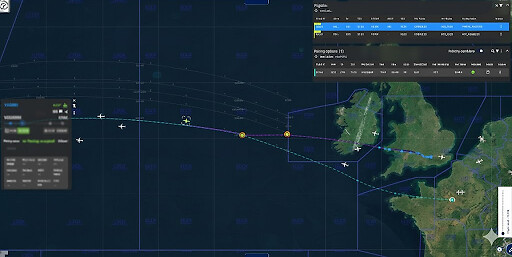
These trials, eight flights over the North Atlantic Ocean between September and October 2025, conducted in the frame of the SESAR Joint Undertaking GEESE project, aimed to show that the operational concept is a feasible and safe method to guide two aircraft to meet at a precise time and place (rendezvous process), while maintaining full vertical separation and remaining compliant with air traffic regulations. While the actual wake energy retrieval flights have not been tested yet on commercial flights, the successful completion of the rendezvous process is a crucial first step toward future efficiency gains.
Each trial required close coordination between the two airlines’ ground operational control centers, four air traffic control centers, and two flight crews. The active participation of AirNav Ireland, Air France, Delta Air Lines, DSNA, EUROCONTROL Network Manager, French bee, NATS, and Virgin Atlantic, using the EUROCONTROL Innovation hub interface, was key to proving the concept’s safety and practicality in real-world conditions.
Note to editors
Launched in 2019, fello’fly is a project inspired by nature (biomimicry). In 2023, the GEESE project, funded by SESAR’s Digital European Sky programme, was launched to support collaboration and testing in air traffic management. Additional project partners include Bulatsa, Indra, ENAC, CIRA, Boeing, Frequentis, UAB, Oro Navigacija, DLR, UCLouvain, and WaPT. Click here for more information about fello’fly and GEESE projects.
In 2025, the completed trials successfully validated a rigorous four-step process designed to manage the high-precision maneuvers required.
This process begins when the Airbus Pairing Assistance Tool (PAT) computes the new aircraft trajectories and shared rendezvous instructions in real-time.
Next, the airlines’ dispatcher, flight crew, and Air Traffic Control (ATC) assess the new trajectories to ensure operational acceptability. The EUROCONTROL Innovation Hub interface allows all stakeholders to have visibility of the decision status at any given moment.
The third step involves one of the participating flights changing its planned route to join the other.
Finally, both flight crews activate a cockpit function, committing the aircraft to arrive at the meeting point at an exact, predetermined time.
In the third quarter of 2025, 49.3% of net electricity generated in the EU came from renewable energy sources, an increase of 3.8% compared with the 47.5% registered in the same quarter of 2024.
Among EU countries, in the third quarter of 2025, Denmark, with 95.9%, had the highest share of renewables in net electricity generated, followed by Austria (93.3%) and Estonia (85.6%). The lowest shares of renewables were recorded in Malta (16.6%), Czechia (19.7%) and Slovakia (21.1%).
Source dataset: nrg_cb_pem
In 21 EU countries, the share of renewable energy sources in net electricity generation increased in the third quarter of 2025. The largest year-on-year increases were recorded in Estonia (+20.6 percentage points (pp)), Latvia (+18.9 pp) and Austria (+16.3 pp).
Most of the electricity generated from renewable sources came from solar (38.3%), wind (30.7%) and hydro (23.3%), followed by combustible renewable fuels (7.2%) and geothermal energy (0.5%).
Plus, degraded and poorly managed ocean ecosystems have altered the marine biophony. With the loss of kelp forests and coral reefs, melting glaciers, overfishing and underwater mining, essential habitats for sea life are stripped away – reducing the abundance of noise-producing animals.
AIMS/ Daneil Estcourt
Researchers from the Australian Institute of Marine Science sink beneath the waves to study the sounds of Ningaloo Reef, Australia (Credit: AIMS/ Daneil Estcourt)
According to Simpson, the sounds of today’s ocean are very different from those of preindustrial times. “The ocean soundscape used to be made up of the biophony – the animal sounds – and the geophony – the sounds of the Earth, rain, wind and currents. But now it’s the anthrophony as well, for example the sound of motorboats on coral reefs.”
Anthropogenic ocean noise – for example, from vessels or construction – can mask animal noises, preventing them from communicating with one another, just as it would above the surface. “It’s like being in a bar,” explains Parsons. “If there’s no one else in the bar, you can probably hear your friend. But if the bar is full of people, the distance over which you can hear each other is a lot smaller,” he says.
It’s not just the frequency or intensity of the noise, it’s also the unpredictability of the sound’s source that can be disruptive. “If we live in a city, we’re not surprised by traffic noise, but if you live in the ocean and a boat suddenly drives over the top of you, you wouldn’t be expecting it,” says Simpson.