Category: 3. Business
-
A Look at Otis (OTIS) Valuation Following Gen3 Core Elevator Upgrades and Market Expansion
Otis Worldwide (OTIS) has announced a significant upgrade to its Gen3 Core elevator lineup, now featuring larger door openings, increased load capacity, and smart digital enhancements. These additions are designed to better serve low-rise buildings across the U.S. and Canada.
See our latest analysis for Otis Worldwide.
These Gen3 Core enhancements arrive as Otis Worldwide’s share price has traded sideways recently, holding near $88.85. The company has achieved a long-term total shareholder return of 47% over five years, indicating steady value creation. While the year’s total return is down 12%, momentum is showing subtle signs of recovery with a modest 2.9% gain in the last three months. This suggests investors may be responding to product innovations and renewed growth prospects.
If news of Otis’s upgraded technology has you curious about what else might be out there, it could be the perfect time to discover fast growing stocks with high insider ownership
With these product upgrades and a modest recent rebound in share price, is Otis currently undervalued by the market and offering a compelling entry point, or is future growth already reflected in today’s price?
Otis Worldwide’s most widely followed narrative sees the stock trading well below an updated fair value estimate, with share price lagging advanced growth projections. This fair value suggests analysts are seeing upside potential from today’s $88.85 closing price.
The accelerating momentum in modernization orders, up 22% in the quarter and supported by a record-high backlog, positions Otis to benefit from the global trend of aging building infrastructure. This trend is expected to drive a multi-year growth cycle for modernization and associated high-margin service revenue, with a positive impact on both revenue and earnings.
Read the complete narrative.
Ready to see the big drivers behind Otis’s surge in fair value? Earnings projections, margin gains, and a play for future market share are at the core of this story. Analysts are betting on growth levers you might not expect. Discover how ambitious assumptions are shaping this price target.
Result: Fair Value of $103.25 (UNDERVALUED)
Have a read of the narrative in full and understand what’s behind the forecasts.
However, persistent weakness in China or a downturn in commercial real estate demand could quickly erode Otis’s growth outlook and undermine current analyst optimism.
Find out about the key risks to this Otis Worldwide narrative.
While fair value estimates signal Otis shares are undervalued, a look at the price-to-earnings ratio offers a different angle. Otis trades at 25.7 times earnings, slightly above the Machinery industry’s average of 24.8 but noticeably below the peer average of 33.9. The fair ratio our models suggest is 26.7, indicating that today’s pricing leaves little room for error if industry sentiment shifts. Could valuation risks outweigh the upside if growth fails to accelerate?
Continue Reading
-
Is Amneal Pharmaceuticals Still an Opportunity After 61% Price Surge in 2025?
-
Wondering if Amneal Pharmaceuticals is a hidden value or a stock that’s already run its course? You’re not alone, and plenty of investors are taking a close look at the numbers right now.
-
After an incredible 61.3% gain year-to-date and a remarkable 415.2% return over three years, the share price has caught serious momentum. This suggests growing optimism or changing risk perceptions around the company.
-
Much of the recent buzz traces back to industry developments and regulatory updates that have placed Amneal in the spotlight, sparking both excitement and debate among market watchers. Wider trends in generic pharmaceuticals and recent product approvals have fueled speculation about the company’s next moves.
-
Based on our valuation framework, Amneal scores 5 out of 6 on our valuation checks, which puts it ahead of most of its peers. Here is a closer look at what those metrics really mean, along with a fresh perspective on finding real value that goes beyond the basics.
Amneal Pharmaceuticals delivered 51.4% returns over the last year. See how this stacks up to the rest of the Pharmaceuticals industry.
The Discounted Cash Flow (DCF) model estimates a company’s intrinsic value by projecting future cash flows and then discounting them back to their present value. This approach helps investors understand what the company is truly worth today based on expected future performance.
For Amneal Pharmaceuticals, the DCF analysis uses a two-stage Free Cash Flow to Equity method. The latest reported Free Cash Flow is $245.66 Million, with analysts expecting robust growth ahead. By 2027, projections place annual Free Cash Flow at $500 Million. Extrapolations suggest that figure could reach over $1.1 Billion by 2035, reflecting continued future expansion. Analyst estimates provide inputs for the first five years, while longer-term numbers are modeled by Simply Wall St using industry growth trends.
Based on this model, the estimated intrinsic value of Amneal Pharmaceuticals is $69.18 per share. In comparison to its current share price, this result indicates the stock trades at a significant 81.9% discount relative to its calculated fair value, which suggests potential undervaluation.
Result: UNDERVALUED
Our Discounted Cash Flow (DCF) analysis suggests Amneal Pharmaceuticals is undervalued by 81.9%. Track this in your watchlist or portfolio, or discover 914 more undervalued stocks based on cash flows.
AMRX Discounted Cash Flow as at Nov 2025 Head to the Valuation section of our Company Report for more details on how we arrive at this Fair Value for Amneal Pharmaceuticals.
Continue Reading
-
-

Assessing Host Hotels & Resorts Value After Share Price Rises 9.6% on Travel Demand News
-
Ever wondered if Host Hotels & Resorts could be trading for less than it’s truly worth? You’re not alone, and today’s market gives us plenty of reasons to dig into the numbers.
-
After climbing 9.6% over the past month and returning 33.7% in five years, the stock has shown there is both growth potential and fresh investor interest bubbling beneath the surface.
-
New developments in the hospitality sector, such as increased travel demand and strategic acquisitions by competitors, have added some optimism and volatility to hotel REITs. Recent headlines point to shifting trends in business and leisure travel, which have also contributed to the latest movement in Host’s share price.
-
On our six-point valuation check, Host Hotels & Resorts scores a 4 out of 6 for being undervalued, making it a compelling candidate for deeper analysis. We will break down how that score is calculated and, more importantly, explore an even smarter approach to understanding the company’s real worth by the end of the article.
Host Hotels & Resorts delivered 1.2% returns over the last year. See how this stacks up to the rest of the Hotel and Resort REITs industry.
The Discounted Cash Flow (DCF) model projects a company’s future cash flows and discounts them back to today’s value, providing an estimate of what the business is fundamentally worth. For Host Hotels & Resorts, this approach uses adjusted funds from operations to forecast future free cash flow and then applies a discount rate to translate those future dollars into today’s terms.
Currently, Host Hotels & Resorts reports Free Cash Flow of $1.387 billion. While analysts provide reliable estimates for up to five years, Simpy Wall St extrapolates further, showing projected annual Free Cash Flows between $1.12 billion and nearly $1.2 billion over the next decade. The methodology accounts for both modest growth and periods of stability as typical in the hotel and resort REITs sector.
Using this conservative projection framework, the resulting intrinsic value per share is $28.46. Compared to the current market price, this indicates the stock is trading at a 38.1% discount to its estimated value.
Result: UNDERVALUED
Our Discounted Cash Flow (DCF) analysis suggests Host Hotels & Resorts is undervalued by 38.1%. Track this in your watchlist or portfolio, or discover 914 more undervalued stocks based on cash flows.
HST Discounted Cash Flow as at Nov 2025 Head to the Valuation section of our Company Report for more details on how we arrive at this Fair Value for Host Hotels & Resorts.
Continue Reading
-
-
‘The mouse built this house’
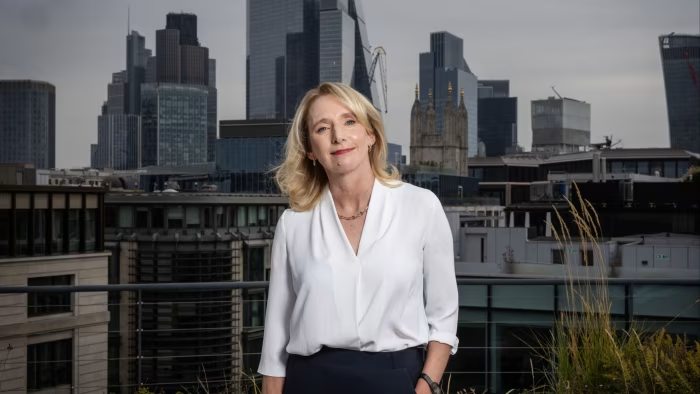
Before she joined Logitech two years ago, chief executive Hanneke Faber submitted herself to a boot camp: 48 hours of computer gaming, coached by her 20-something son in Detroit. “He gave me a test afterwards,” says Faber, “which I passed.”
Gamers are core customers of the Swiss technology hardware group. Its gaming brand, Logitech G, which has its own website, sells G Hub software and high-specification hardware, including specialised headsets, keyboards and a bewildering array of mice — the product the company is still best known for.
Founded in 1981 and headquartered in Lausanne, Switzerland, with offices and innovation centres from San Jose, in Silicon Valley, to Shanghai, Logitech has always aimed to “provide the connection between the human and the compute”, Faber says.
That now means catching the “huge tailwind” of artificial intelligence, as big technology companies start to look for hardware to support their latest products. This year, for example, the group launched an AI-enabled stylus for 3D drawing in physical space using Apple’s Vision Pro headsets. Faber, 56, describes Logitech as “the eyes, the ears and the hands of AI”, just as its mobile keyboards help users connect to tablets and smartphones, and the mouse still links brain and cursor.
“The mouse built this house” is a mantra at Logitech. Faber carries seven in her backpack and extols the recently launched MX Master 4, a programmable mouse that has attracted admiring reviews across the technology community. Click-happy users can tailor its functions with as many as 72 different shortcuts. It is one reason Logitech employs more software than hardware engineers and a source of astonishment for those desk drones who think of the mouse as a dumb “peripheral”.
Faber herself never uses the P-word. She points out that if you are a “software designer who needs to do 1,000 lines of code in three minutes” or “an Excel jockey” or financial analyst, a highly sophisticated mouse is indispensable and can, Logitech claims, make you up to 33 per cent faster.
A former Dutch champion high-diver who studied journalism on a sports scholarship in the US, Faber had no hesitation about applying for the job of chief executive. She had spent her career until then in fast-moving consumer goods and retail, first at Procter & Gamble, then Dutch retailer Ahold. For six years before joining Logitech she held senior positions at multinational Unilever, overseeing food brands such as Hellmann’s and Knorr.
She has a practised answer to the question of what, if anything, those jobs taught her about running a technology company: “Yes, two years ago I was selling mayonnaise. But you need to really understand that user of the mayonnaise and deliver great superior products for her. And that is the same with Logitech,” she says. At Ahold, she was responsible for ecommerce, while Unilever’s nutrition operation was 40 per cent business-to-business. Increasing Logitech’s B2B offering, by selling, for instance, more systems to enhance corporate video calling, is a big part of her strategy.
When she joined in December 2023, the company was coming down from a pandemic-era boom, which had supercharged demand for its video-collaboration tools and gaming accessories. “All of a sudden everyone was video conferencing, was gaming like there was no tomorrow. So it was a bit of a sugar high. The couple of years after Covid were not easy for Logitech and for the industry.” Pre-tax profit, which peaked at $1.15bn in the year to March 2021, was still on the decline. Logitech was also facing pressure from co-founder Daniel Borel, who owns a small stake and wanted to oust the company’s then chair, Wendy Becker.
In trying to set a new course, Faber put her journalism training to use as she met managers and staff. “Why are you doing that? What are you doing? Where are we doing it? Who’s doing it? All of those questions are important in business as well.”
Faber cut the number of her direct reports and drew up a working strategy, which, using start-up jargon, she described as a “minimum viable product”. “We did have to move fast because there was no formal strategy, the business had been in decline for about two years. We had an interim CEO [from June to December 2023] so there was some uncertainty.” In her first week, she gathered the leadership team and they drafted a statement on where and how to act, and some financial goals. Faber took this one-pager out to Logitech’s 7,400 staff, to “get the wisdom of the crowd”, before agreeing it with the board and shareholders. She claims the strategy “hasn’t materially changed since then”.
But the ex-diver’s entry was far from splashless. In an interview for The Verge’s Decoder podcast in July 2024 she chatted freely about the idea of a subscription-based “forever mouse”. The concept had emerged from internal brainstorming about the future of consumer electronics, based on the group’s deeply held commitment to “design for sustainability”, but the idea and her comparison of the device with a Rolex watch attracted ridicule. Logitech had to issue a statement that there was no plan for such a product. A few weeks later, Borel went public with a letter to shareholders criticising succession planning failures and a “toxic culture that [had] become ingrained”. “It must be hard [for founders] because . . . it is their baby,” says Faber. “It truly is like a child . . . When your child leaves the house, you’re not not going to care about your child.”
Becker stepped down this year and Faber has largely repaired relations with Borel. The day after this interview, she was set to meet him to mark the 44th anniversary of the company, and she hopes the co-founders will be part of 50th anniversary celebrations in 2031. “He’s a super-smart guy and he’s got all this experience,” she says, “so we would be crazy not to listen to him.” Contacted separately, Borel says Faber is a “good person” and that the pair now have a “positive and warm relationship”. He continues to push her to maintain the urgency and depth of research spending needed to keep up in a rapidly evolving sector.
Faber does appear to have steadied Logitech and restarted its growth. The shares, which traded at around SFr75 (about $90) when she joined are now worth nearer SFr90. She repeats several times her strategic goal to “play offence”, despite the volatile global environment. She expects to build on Logitech’s advantages, which include a strong balance sheet, a strong brand, which she is unifying around the Logitech name, and diversified manufacturing. Before the pandemic, Logitech built nearly all of its products in Chinese factories. Donald Trump’s tariffs accelerated plans to diversify its supply chain and, by the end of the year, Faber expects fewer than 10 per cent of products going into the US will come from China. At the same time, Logitech continues to sell into the important and highly competitive Chinese market, where its Swissness provides cover against any animus towards US companies.
As for the device with which the company is most closely associated, Faber is used to reading premature obituaries. Logitech is not dependent only on mice, she points out. “But I wouldn’t write the mouse off either.”
A day in the life of Hanneke Faber
We’re dual headquartered and dual listed. I’m based in our office in San Jose and I spend a lot of time in Lausanne.
When I’m in California, my first meeting is usually at 6am. When travelling I’ll get up at 6am, have a quick breakfast and read the FT and NOS.nl.
Here in London, I went for a quick jog along the Thames and around the Tower of London. I try to do exercise that reflects my pace of work — this life is not a marathon, it’s more like high-intensity interval training.
When I’m in California I’m a little more office-based. I spend a lot more time with engineers and product people and partners when I’m there or in Switzerland or in Asia. When I’m out and about, I spend more time with customers and our commercial team, as well as investors.
On a recent morning, I visited and opened our brand new London office and spent time with a very large customer. I then walked over to Logi Work London, where we hosted hundreds of customers, partners and media. This is our annual immersive event to talk about the future of work and to launch a number of our new work products.
I then had a meeting with a partner before dinner with a number of B2B customers, and our friends from UK retailer Currys. I finally turned in at about 11pm.
Continue Reading
-
Companies drown in 3,000 hours of paperwork to tap EU climate funds
The EU has only paid out a fraction of the money it says it has committed for green technologies, as companies spend up to 3,000 hours and an average €85,000 to access funds from a flagship programme.
Of €7.1bn awarded from the bloc’s Innovation Fund since it was established in 2021, only 4.7 per cent has been paid out to companies because of the red tape required to access the money, according to European Commission figures.
The application process is also extremely lengthy and bureaucratic. In an internal presentation this month, seen by the Financial Times, the commission said that 77 per cent of those seeking funding had to subcontract parts of the application process to consultants because of the “high burden”.
Average administrative costs were €85,000 per application, it said, even higher than the average €32,000 spent to access the EU’s research grant scheme, Horizon Europe.
Less than 20 per cent of applications to the Innovation Fund are successful, according to the presentation. Of the projects that had been awarded grants, only 6 per cent were operational, while 15 to 20 per cent face delays.
The hold-ups in disbursing the funds are the latest example of how bureaucracy is stifling the EU’s competitiveness. In a major report last year, the former European Central Bank governor Mario Draghi said that administrative burdens were one of the main reasons for Europe’s “static industrial structure with few new companies rising up to disrupt existing industries or develop new growth engines”.
The Innovation Fund, which uses revenues generated from the bloc’s emissions trading system, is one of the world’s largest financing programmes “for the demonstration of innovative low-carbon technologies”, the commission claims.
It was touted as one of the main funding platforms to help the bloc compete with the US after former president Joe Biden announced $369bn of funding and tax credits for green technologies through the Inflation Reduction Act.
Victor van Hoorn, director of trade body Cleantech for Europe, said some businesses have reported spending 3,000 hours on applications to the Innovation Fund — if carried out by one person alone this would be equivalent to more than a year and a half based on the EU’s 36-hour average working week.
“The biggest challenge [we hear] is the amount of resources, the amount of documentation and all of that for a frankly very low success rate,” said van Hoorn.
Eoin Condren, executive director for corporate development at cement company Ecocem, said for its last application to the fund, it had an entire team dedicated to it for five months “costing hundreds of thousands of euros”.
“Large companies can absorb that, but smaller firms developing breakthrough technologies can’t,” he added.
Condren also noted that much of the money went to “big umbrella technologies like [carbon capture and storage] and green hydrogen . . . yet these large, often lossmaking projects are notoriously hard to finance, causing long delays in actually deploying funds”.
An EU official said the low payment rate reflected “the normal or expected implementation milestones for Innovation Fund projects”, adding that “first-of-a-kind projects generally also need more time to reach financial close, be built and enter into operation compared to, for example, research projects”.
“While the application process is demanding, it is also an opportunity to improve the project and the effort is commensurate with the size of the support that is offered,” the official added.
Another issue with the fund is that market conditions in Europe make it difficult even for companies that receive grants to establish themselves and turn a profit.
Vianode, a company making low-carbon synthetic graphite for electric vehicle batteries, was awarded a €90mn grant in 2023 but decided not to go through with its European facility because of the flood of cheap Chinese graphite into the market. It instead set up in Canada, where it secured an offtake agreement with General Motors.
“In the end it comes down to what price you can compete for and with the Chinese dominance, the European market is very, very challenging for us now. It’s different in North America: there the battery producers have an incentive to choose non-Chinese,” said Andreas Forfang, vice-president for sustainability and public affairs at Vianode.
Leon de Graaf of the Brussels-based consultancy Sustainable Public Affairs, said the Innovation Fund “clearly serves a purpose”. Its application rounds were often several times subscribed, he said, adding that “the way the money is currently given is not fit for purpose”.
The commission has estimated that about €40bn could flow from the ETS into the Innovation Fund by 2030.
But van Hoorn said the small proportion that had so far been paid out showed that “most money is just sitting there due to complex milestones” resulting in a “huge opportunity cost” for the EU.
Continue Reading
-
OpenAI’s lead under pressure as rivals start to close the gap
OpenAI’s huge early lead in the race to dominate artificial intelligence is under the greatest pressure since ChatGPT’s launch, as rivals Google and Anthropic gain ground in the cutting-edge technology.
Three years on from the debut of its popular chatbot, the $500bn start-up is grappling with the reality of soaring data centre costs, the technical challenges of remaining at the frontier of AI and the constant battle to retain key talent.
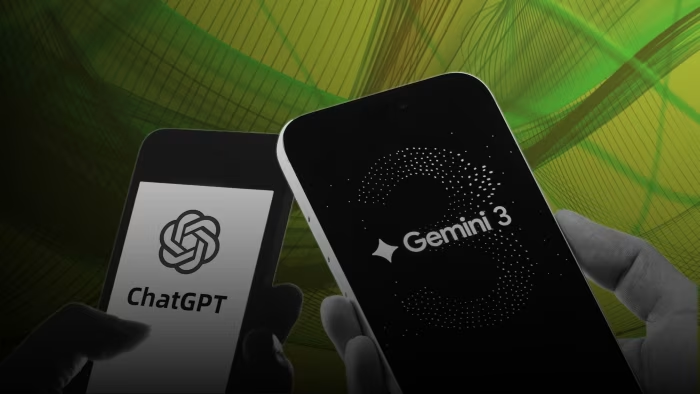
It is also facing a resurgent Google, with the release last week of Gemini 3, Google’s latest large language model, which is considered to have leapfrogged OpenAI’s GPT-5 and achieved gains from the model training process that have eluded OpenAI in recent months.
“It’s quite a strong difference with the world we had two years ago where OpenAI was leading ahead of everyone else,” said Thomas Wolf, co-founder and chief science officer of open-source start-up Hugging Face. “It’s a new world.”
Even before the launch of Gemini 3, OpenAI’s chief Sam Altman told staff in a memo last month that the company would “need to stay focused through short-term competitive pressure . . . expect the vibes out there to be rough for a bit”. The memo was first reported by The Information.
A year ago many had written off Google’s flailing efforts to narrow OpenAI’s colossal lead. Fears that its cash-cow search engine would be cannibalised by ChatGPT and other new AI powered search apps such as Perplexity left parent company Alphabet’s stock price lagging far behind its Big Tech rivals in the AI-driven rally through 2023 and 2024.
But Google’s turnaround began earlier this year, after a confident slate of updates at its IO developer conference in May and the viral popularity of its Nano Banana AI photo-editing tool this summer. This helped boost monthly users of the Gemini mobile app to 650mn, up from about 400mn in May.
The developments have seen Alphabet’s shares surge in recent months, with its market capitalisation now approaching $4tn for the first time, amid confidence on Wall Street that Google can combine its dominant positions in search, cloud infrastructure and smartphones to serve new AI capabilities to billions of existing users.
Koray Kavukcuoglu, Google’s AI architect and DeepMind’s chief technology officer, told the Financial Times that the Big Tech group had “pushed our performance quite significantly” by training its AI models using Google’s own bespoke chips.
“Being able to connect with consumers, customers, companies, at that scale is really something that we can do because of that full stack integrated approach that we have,” he added.

Koray Kavukcuoglu said Google had a ‘unique approach’ © Google That “full stack” includes its custom tensor processing unit chips, which allowed Google to train Gemini 3 without needing to rely on the costly Nvidia chips that most of the AI industry uses. “I think we have a unique approach there,” said Kavukcuoglu.
Google “always had these muscles to flex”, said Michael Nathanson, co-founder and analyst at MoffettNathanson, an equity research firm, adding that the IO event showed that “they really managed to find their product footing”.
“The pressure has definitely flipped to Sam Altman and his ability to monetise and keep all the plates spinning,” said Nathanson.
AI researchers and users have been quick to praise Google’s advancements. The model outperformed GPT-5 on several key benchmarks.
Marc Benioff, Salesforce chief executive, said in a post on X: “Holy shit. I’ve used ChatGPT every day for 3 years. Just spent 2 hours on Gemini 3. I’m not going back. The leap is insane . . . It feels like the world just changed, again.”

Publicly, OpenAI has welcomed the competition. “We’re always excited to see progress in the field — competition pushes the whole ecosystem forward,” said Mark Chen, OpenAI’s chief research officer.
“Our models continue to set the standard in performance, reliability, and real-world usefulness, and we will continue to release even more capable models,” he added.
But internally employees are feeling pressure to compete on multiple fronts with deep-pocketed rivals with tens of billions of dollars to throw at building AI. “The arc of any fast-growing start-up is not just going to be up and the right,” said one person close to the company.
Some experts say OpenAI has overextended itself in its pursuit of scale at all costs. The group has spent the past year pushing out new products at a breakneck pace, from automated computer programming tools to its viral video app Sora.
“OpenAI is getting spread too thin. It’s impossible for them to do it all well,” said a partner at a Silicon Valley venture capital firm that has backed several AI model developers but not OpenAI.
The San Francisco-based company has pledged to spend $1.4tn over the next eight years on computing power, striking huge deals with Nvidia, Oracle, AMD and Broadcom. That is orders of magnitude more than OpenAI’s current sales, requiring its partners to use debt to finance the build-out.
“That’s a really, really tremendously risky bet for any company to make,” said Sarah Myers West, co-executive director of the AI Now Institute, a non-profit.
OpenAI’s biggest challenge is finding a big enough revenue stream to sustain that extraordinary investment.
The company believes it can attract hundreds of millions of paying subscribers to ChatGPT in the coming years. But its near-term plan to spin up more revenue from advertising, something Altman has hinted it will explore with Sora, will take it into a market already saturated by big players such as Meta and Alphabet.
ChatGPT has yet to dent Google’s strong lead in the ad market, and the start-up is only just starting to integrate ads and shopping features into its chatbot.
Meanwhile Anthropic, which was founded in 2021 by former OpenAI staffers and is currently raising a new round that is expected to value the company at more than $300bn, has built a large and fast-growing enterprise business.
Anthropic’s Claude chatbot has been overshadowed by the massive consumer hit of ChatGPT. But its long-standing focus on AI safety has helped Anthropic create a more reliable tool for corporate customers, its backers argue, and its coding tools are widely seen as best-in-class.
With more than 800mn weekly users, OpenAI still has a hugely dominant market share in overall chatbot usage but people are now spending more time chatting with Gemini than ChatGPT, according to data from web analytics company Similarweb.
The launch of Gemini 3 pushed Google’s AI app higher in the US and UK iPhone app store rankings. Still, ChatGPT has held on as the top AI app, according to Sensor Tower, which tracks mobile usage.
Erik Brynjolfsson, author and professor at the Stanford Institute for Human-Centered AI, said that it was too soon to count OpenAI out, with its vast array of new applications a good way to find new revenue sources that will fund its core research capabilities.
“All these companies have a surplus of very profitable opportunities all around them,” he said. “There’s room for multiple companies to do extremely well because the opportunity is so large.”
Data visualisation by Clara Murray
Continue Reading
-

Morgan Stanley and Goldman dominate Hong Kong equity deals
Unlock the Editor’s Digest for free
Roula Khalaf, Editor of the FT, selects her favourite stories in this weekly newsletter.
Western banks have been the biggest beneficiaries of Hong Kong equity sales this year, shrugging off US-China tensions as dealmaking booms in Asia’s financial hub.
Morgan Stanley helped raise $11.6bn in equity offerings in the year to the end of November, according to data compiled by Bloomberg. Goldman Sachs was in second position after raising $7.4bn, followed by Chinese banks Citic and CICC and Switzerland’s UBS.
The data includes both initial public offerings and follow-on share sales by companies already listed in the territory, including a $4.6bn share sale by the world’s largest battery maker CATL and the IPO of mining company Zijin Gold.
Hong Kong’s capital markets have been revived by a wave of Chinese companies raising billions of dollars in the city, which is on track for a four-year high in IPO fundraising. Foreign investors are showing renewed interest in Chinese equities after years of shunning the market.
“For huge deals you still need these global brands,” said Alicia García Herrero, chief Asia-Pacific economist at Natixis. “The reason why they still need Goldman or Morgan Stanley is they want to attract foreign investment, especially into the big deals like BYD,” she said, referring to the Chinese electric vehicle and battery maker that had a $5.6bn share sale in March.
Hong Kong-listed ECM activity hit $73.1bn so far this year, up 232 per cent on the same period in 2024, according to data from LSEG.
“We’ve seen quite a strong turnaround with respect to equity issuance from Chinese companies in Hong Kong,” said Saurabh Dinakar, head of Asia Pacific global capital markets at Morgan Stanley.
Rising US-China tensions have put the banks’ operations in Hong Kong under more scrutiny. This month, a US congressional committee wrote to Morgan Stanley’s chief executive Ted Pick to request more information on the bank’s underwriting of Zijin Gold, the offshore arm of China’s Zijin Mining.
The committee alleged that Zijin Mining is associated with human rights abuses in the Xinjiang region of China and has “deep ties” to the communist party.
Morgan Stanley declined to comment on this matter.
Federico Bazzoni, executive chair of Eight Capital Partners, said Chinese companies “need these [western] banks to reach out to international investors”. He added: “Of course, you’ve got the trade war and political tension but I think the markets are opportunistic.”
Chinese banks have expanded in Hong Kong, with the goal of taking a larger share of advisory fees in the territory, where deals often have bigger fees compared with mainland China.
CICC, a prominent mainland investment bank, recently announced a plan to acquire two smaller brokerages.
“We are seeing Chinese securities firms expanding aggressively in Hong Kong,” said Rowena Chang, a director at rating agency Fitch. “Typically they want a US investment bank and a local investment bank as joint sponsors.”
Chinese banks CICC, Citic Securities and Huatai Securities top this year’s Hong Kong deal volume for IPOs alone.
They have established relationships with Chinese companies that are already listed on a mainland bourse, said Jean Thio, a partner in the capital markets group at law firm Clifford Chance, which has advised on 18 IPOs in Hong Kong this year.
Chinese banks are important partners for mainland companies seeking to list in Hong Kong because of their close channels of communication with regulators in Beijing such as the China Securities Regulatory Commission, which must give mainland companies approval before they list offshore.
“Communication with the CSRC is important and that’s where the PRC banks have strengths,” Thio added.
Data by Haohsiang Ko
Continue Reading