Category: 3. Business

  • Microsoft shares once again surpass $4 trillion valuation, joining Nvidia

    Microsoft shares once again surpass $4 trillion valuation, joining Nvidia

    Microsoft Corp. once again surpassed $4 trillion in valuation, joining artificial intelligence chipmaker Nvidia in the exclusive club that also briefly included Apple on Tuesday. The sky-high valuations highlight the investor frenzy around artificial intelligence.

    Earlier in the day, OpenAI said it has reorganized its ownership structure and converted its business into a public benefit corporation after two crucial regulators, the Delaware and California attorneys general, said they would not oppose the plan. It also said has signed a new agreement with its longtime backer Microsoft that gives the software giant a roughly 27% stake in OpenAI’s new for-profit corporation.

    The news gave Microsoft’s shares a boost as the stock closed up 2% at $542.07, valuing the technology giant at $4.04 trillion. Microsoft’s valuation previously passed $4 trillion in July, making it the second company after Nvidia to reach the milestone.

    Apple’s shares, meanwhile, crossed the $4 trillion line earlier Tuesday before closing up slightly at $269 and a total valuation of $3.99 trillion. Thanks to the iPhone’s success, Apple was the the first publicly traded company to valued at $1 trillion, $2 trillion and eventually, $3 trillion.

    Continue Reading

  • Solar boom eases Pak energy crisis

    Solar boom eases Pak energy crisis

    Solar panel. Photo: ANADOLU AGENCY


    KARACHI:

    The roof of a sprawling rice mill in the eastern district of Pakistan’s commercial capital Karachi is covered with sky blue solar panels soaking rays under the broiling midday sun.

    The mill is one of thousands of industrial units across Pakistan that have shifted to solar energy to counter rising electricity tariffs and frequent power outages in recent years.

    The South Asian country of around 255 million people has witnessed a solar uptake, particularly over the past two years, after an International Monetary Fund (IMF) bailout forced Pakistan to sharply raise power and gas tariffs to support struggling suppliers in the heavily indebted energy sector.

    From pharmaceuticals to cement manufacturers in Karachi, to textile units in Faisalabad, and from supermarkets to mosques in Lahore, solar panels paired with lithium batteries have been adopted as an alternative to electricity from the national grid.

    “We were left with no other choice but to go for solar energy, as the power bills had literally become unpayable for industrialists,” Rafique Suleman, the owner of the mill, told Anadolu.

    Suleman said that turning to solar has “really” helped him mitigate the tariff challenge, saving up to 50% of his monthly power-related expenses.

    “The current power tariffs and Pakistan’s industry cannot survive together. Solar energy is the only viable option that local industrialists have to run their businesses,” added Suleman, a former chairman of the country’s rice exporters association.

    Mehwish Salman Ali, chief executive officer of Data Vault Pakistan, a leading data provider and management solutions company, views solar solutions as a “game-changer” that helps the country tackle chronic energy deficits by providing affordable and reliable power to homes and businesses.

    “From crippling blackouts and insane sky-high bills, we’ve seen solar’s share in electricity generation triple to 14% by 2025, with rural areas hitting 25% in the early months alone, filling the gaps where the grid fails us,” Ali told Anadolu.

    Pakistan’s solar penetration ranks it among Asia’s leaders for solar-only share, surpassing nations like China (9%) and India (6%), according to Ember, a UK-based energy think tank.

    Environmental challenges

    Although solar solutions have contributed significantly to reducing energy gaps, environmentalists warn that electronic waste is adding to a long list of environmental challenges already plaguing the country.

    Pakistan ranks among the top 10 countries most affected by climate change.

    The country’s solar adoption has accelerated rapidly since 2015 due to rising electricity tariffs, frequent power shortages, falling panel prices, and net-metering incentives.

    Currently, Pakistan is estimated to have around 3 million consumers using solar systems, including off-grid, according to the Seventh Population & Housing Census 2023. China exported 16.6 gigawatts of solar capacity to Pakistan in 2024, about five times higher than in 2022.

    “While solar energy is a clean and renewable power source, the electronic waste (e-waste) generated from its components – particularly solar panels, inverters and batteries – is an emerging environmental challenge in Pakistan and worldwide,” Rafiul Haq, a Karachi-based environmentalist, told Anadolu.

    Most systems use lead-acid, lithium-ion, or gel batteries and panels with lifespans between 10 and 25 years. When these reach the end of their life, they become electronic waste, often unmanaged, Haq added.

    Endorsing the view, Ali said that without affordable solar options, the energy gap widens, increasing dependence on fossil fuels, which harms the environment and hinders progress toward sustainable development. A 2023 United Nations Development Program (UNDP) report estimated that over 80% of Pakistan’s lead-acid battery recycling is unregulated, exposing workers and nearby communities to neurotoxic lead.

    Pakistan currently has no dedicated solar or battery recycling facility, according to Haq.

    He said the first wave of solar panels installed between 2010 and 2015 is now approaching end-of-life. Without a recycling system, millions of panels could generate thousands of tons of e-waste annually over the next decade.

    “The solution lies in strong recycling legislation, formal waste collection systems, and producer responsibility frameworks – turning clean energy into a truly sustainable system,” Haq maintained, calling for the establishment of a “National Solar E-Waste Management Framework.”

    Mustafa Amjad, an Islamabad-based energy expert, said the existing power system “isn’t really ready for all of that solar. It does not mean it does not have to be ready. It will still have to make that journey, a bit earlier than initially thought out,” he told Anadolu.

    “And it would need new regulatory structures.”

    Social division

    Waqar Phulpoto, director general of the Sindh Environment Protection Authority (SEPA), contended that the electronic waste issue is not alarming for now.

    “This is a reality, and it is for sure going to be an environmental challenge. But at the moment, its extent is not huge, as Pakistan has logged a boom in solar adoption over the past five years,” Phulpoto told Anadolu.

    SEPA is considering introducing legislation and guidelines “soon” to tackle the electronic waste issue, he said, adding: “It will be done well before this issue (electronic waste) becomes an actual challenge,” Phulpoto said.

    Continue Reading

  • Nikkei 225, Nifty 50, CSI 300

    Nikkei 225, Nifty 50, CSI 300

    Mount Fuji and the Shinjuku skyline in Tokyo, Japan, on Friday, Feb. 14, 2025. Photographer: Kiyoshi Ota/Bloomberg via Getty Images

    Bloomberg | Bloomberg | Getty Images

    Asia-Pacific markets were set for a higher open Wednesday as investors awaited the Federal Reserve’s interest rate decision, widely believed to bring a second straight 25 basis point cut.

    Markets are assigning a nearly 100% probability that another quarter-point reduction, on the heels of September’s cut, would bring the federal funds rate to a range between 3.75%-4.00%.

    “If [Fed chair Jerome Powell] comes off dovish, bets for future Fed cuts will increase and provide more fuel to market momentum,” veteran investor Louis Navellier wrote in a daily note.

    The federal funds rate, set by the Federal Open Market Committee, is the interest rate banks charge each other for overnight loans. While it doesn’t directly affect consumers, the Fed’s moves often influence borrowing costs for mortgages, credit cards and other loans.

    Japan’s Nikkei 225 futures pointed to a stronger open, with the contract in Chicago at 50,745 and its counterpart in Osaka at 50,660, compared to the previous close of 50,219.18.

    Australia’s S&P/ASX 200 started the day flat.

    Hong Kong markets are closed for the holidays.

    Overnight in the U.S., all three major averages closed higher. The S&P 500 rose 0.23% to close at 6,890.89. It had surpassed the 6,900 level for the first time on an intraday basis earlier in the day.

    The Nasdaq Composite advanced 0.80% to finish at 23,827.49, while the Dow Jones Industrial Average gained 161.78 points, or 0.34%, to settle at 47,706.37. In addition to their closing highs, the tech-heavy Nasdaq and 30-stock Dow scored new all-time intraday highs alongside the broad market S&P 500.

    —CNBC’s Jeff Cox, Sean Conlon and Pia Singh contributed to this report.

    Continue Reading

  • More than mining, building generations of impact.

    More than mining, building generations of impact.

    Meet Fernanda Maldonado, Principal Planning & Technical in our Non-Operated Joint Ventures team. As a fourth-generation mining engineer, mining runs deep in her family – nearly 100 years of history. 

    Since joining BHP seven years ago, Fernanda has worked across regions from the Ecuadorian jungle to remote Canada, discovering the global impact of mining and the role BHP plays in shaping its future. 

    “I can only imagine my great-grandfather digging rocks in a remote polymetallic mine in Andean Peru back in the 20´s being told his great granddaughter was not only working in mining but also part of the biggest mining company in the world!”

    Fernanda is proud to be part of a company that provides resources to develop the world and the investments that help build communities around it.

    Our 140th anniversary is not just a celebration of the past; it’s a launchpad for the future. We’re investing in the resources, relationships, and innovations that will shape a more sustainable and inclusive world.

    Each chapter in the BHP story is driven by meeting the changing needs of the world.

    But it’s the character of our people that will continue to make all the difference.

    Continue Reading

  • Nvidia-supplier SK Hynix third-quarter profit jumps 62% to a record high

    Nvidia-supplier SK Hynix third-quarter profit jumps 62% to a record high

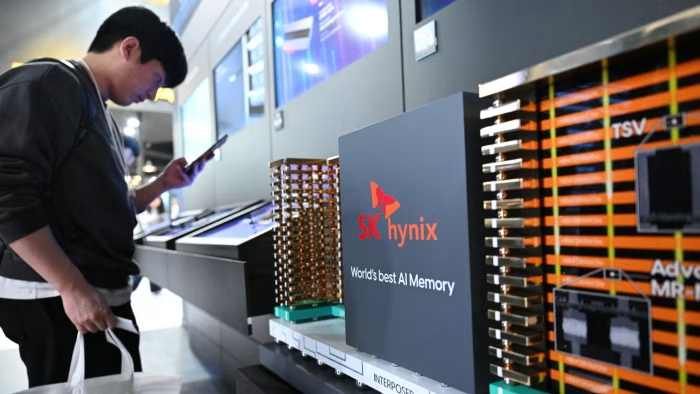
    A man walks past a logo of SK Hynix at the lobby of the company’s Bundang office in Seongnam on January 29, 2021.

    Jung Yeon-Je | AFP | Getty Images

    South Korea’s SK Hynix, one of the world’s largest memory chipmakers, on Wednesday posted record quarterly revenue and profit, boosted by a strong demand for its high bandwidth memory used in generative AI chipsets.

    Here are SK Hynix’s third-quarter results versus LSEG SmartEstimates, which are weighted toward forecasts from analysts who are more consistently accurate:

    • Revenue: 24.45 trillion won ($17.13 billion) vs. 24.73 trillion won
    • Operating profit: 11.38 trillion won vs. 11.39 trillion won

    Revenue rose about 39% in the September quarter compared with the same period a year earlier, while operating profit surged 62%, year on year.

    On a quarter-on-quarter basis, revenue was up 10%, while operating profit grew 24%.

    SK Hynix makes memory chips that are used to store data and can be found in everything from servers to consumer devices such as smartphones and laptops.

    The company has benefited from a boom in artificial intelligence as a key supplier of high-bandwidth memory or HBM chips used to power AI data center servers. 

    “As demand across the memory segment has soared due to customers’ expanding investments in AI infrastructure, SK Hynix once again surpassed the record-high performance of the previous quarter due to increased sales of high value-added products,” SK Hynix said in its earnings release. 

    HBM falls into the broader category of dynamic random access memory, or DRAM — a type of semiconductor memory used to store data and program code that can be found in PCs, workstations and servers.

    SK Hynix has set itself apart in the DRAM market by getting an early lead in HBM and establishing itself as the main supplier to the world’s leading AI chip designer, Nvidia

    However, its main competitors, U.S.-based Micron and South Korean-based tech giant Samsung, have been working to catch up in the space.

    “With the innovation of AI technology, the memory market has shifted to a new paradigm and demand has begun to spread to all product areas,” SK Hynix Chief Financial Officer Kim Woohyun said in the earnings release.

    “We will continue to strengthen our AI memory leadership by responding to customer demand through market-leading products and differentiated technological capabilities,” he added.

    The HBM market is expected to continue to boom over the next few years to around $43 billion by 2027, giving strong earnings leverage to memory manufacturers such as SK Hynix, MS Hwang, research director at Counterpoint Research, told CNBC.

    “[F]or SK Hynix to continue generating profits, it’ll be important for the company to maintain and enhance its competitive edge,” he added.

    Continue Reading

  • Celestica CEO explains the company’s role in the AI boom

    Celestica CEO explains the company’s role in the AI boom

    Celestica CEO Rob Mionis explained how his company designs and manufactures infrastructure that enables artificial intelligence in a Tuesday interview with CNBC’s Jim Cramer.

    “If AI is a speeding freight train, we’re laying the tracks ahead of the freight train,” Mionis said.

    He pushed back against the notion that the AI boom is a bubble, saying that the technology has gone from a “nice to have” to a “must have.”

    Celestica reported earnings Monday after close, managing to beat estimates and raise its full-year outlook. The stock hit a 52-week high during Tuesday’s session and closed up more than 8%. Celestica has had a huge run over the past several months, and shares are currently up 253.68% year-to-date.

    Mionis described some of Celestica’s business strategies, including how the Canadian outfit chose to move away from commodity markets and into design and manufacturing. He told Cramer that choice “has paid off in spades” for his company.

    Celestica’s focus on design and manufacturing enables the company to “consistently execute at scale,” he added.

    He detailed Celestica’s data center work, saying the company makes high-speed networking and storage system for hyperscalers, digital native companies and other enterprise names.

    Mionis praised the company’s partnership with semiconductor maker Broadcom, saying Celestica uses Broadcom’s silicon in a lot of its designs.

    “What it means for us is when they launch a new piece of silicon — so the Tomahawk 6 is their 1.6 terabyte silicon — when they launch that into the marketplace, they’ll work with us to develop products, and those products end up in the major hyperscalers.”

    Jim Cramer’s Guide to Investing

    Sign up now for the CNBC Investing Club to follow Jim Cramer’s every move in the market.

    Disclaimer The CNBC Investing Club Charitable Trust owns shares of Broadcom.

    Questions for Cramer?
    Call Cramer: 1-800-743-CNBC

    Want to take a deep dive into Cramer’s world? Hit him up!
    Mad Money TwitterJim Cramer Twitter – Facebook – Instagram

    Questions, comments, suggestions for the “Mad Money” website? madcap@cnbc.com


    Continue Reading

  • Honda Presents World Premiere of Super-ONE Prototype Compact EV at Japan Mobility Show 2025

    Honda Presents World Premiere of Super-ONE Prototype Compact EV at Japan Mobility Show 2025

    With the grand concept defined as “e: Dash BOOSTER,” the Super-ONE Prototype was developed as a compact EV designed to transform everyday mobility into an exciting and uplifting experience by adopting a variety of features that make the in-vehicle experience more enjoyable for customers. The name “Super-ONE” represents the aspiration of Honda to create a vehicle that transcends conventional norms and standards (“super”) and delivers customer value unique only to Honda (“one and only”).

    In addition to excellent environmental performance and usability for everyday use, the “fun of driving” characteristics unique to Honda were pursued for the Super-ONE Prototype. By adding features designed to stimulate all of the driver’s senses to the “joy of driving” realized by sporty driving only small EVs can achieve, the Super-ONE Prototype offers customers an exciting and uplifting driving experience.
    Leveraging the lightweight platform advanced for N Series models, the Super-ONE Prototype realizes sporty and nimble driving. In addition, its wide stance with extended tread, realized by prominently flared blister fenders, enables a stable and dynamic driving experience.

    Moreover, Boost Mode, developed exclusively for this model, increases the power output to enable the power unit to fully unleash its performance potential, while also synchronizing the simulated 7-speed transmission and the Active Sound Control system to generate powerful engine sound and sharp gearshift feel, as if driving an engine-powered vehicle with a traditional multi-gear transmission. In Boost Mode, the Super-ONE Prototype stimulates the driver’s senses — including visual and auditory senses, as well as a tactile sensation of acceleration and vibration — offering an uplifting EV driving experience.  

    The Super-ONE Prototype has undergone extensive testing on various road surfaces and under diverse climate conditions in Japan, the UK, and other countries across Asia to further enhance its driving performance. In July 2025, the Super EV Concept, the concept model that became the basis for the Super-ONE Prototype, was exhibited and took part in a dynamic run on the iconic hill climb course at the Goodwood Festival of Speed 2025, held in West Sussex, UK.  With its powerful driving performance, the Super EV Concept showcased to the world the new possibilities of a new joy of driving unique to Honda EVs.

    Honda is planning to launch the production model based on the Super-ONE Prototype in Japan starting in 2026, followed by other regions with strong demand for compact EVs, such as the U.K. and various Asian countries*.

    Continue Reading

  • What’s likely to move the market in the next trading session

    What’s likely to move the market in the next trading session

    Continue Reading

  • Saudi Arabia’s New Power Play Is Exporting A.I. to the World – The New York Times

    1. Saudi Arabia’s New Power Play Is Exporting A.I. to the World  The New York Times
    2. Blackstone, Saudi AI Firm Humain Ink $3 Billion Data Center Deal  Bloomberg.com
    3. Saudi Arabia to Become Hotspot for AI Data Centres  Data Centre Magazine
    4. Enterprise AI platform HUMAIN ONE launches with strategic partners EY, Groq and Replit  Consultancy-me.com
    5. Saudi AI firm Humain targets dual listing on Tadawul, NYSE in 4 years, says CEO  Arab News PK

    Continue Reading

  • Royal Caribbean sees cruise demand accelerate – but here’s why the stock is dropping

    Royal Caribbean sees cruise demand accelerate – but here’s why the stock is dropping

    By James Rogers

    Royal Caribbean beat profit expectations and raised its full-year outlook, but revenue missed the mark, as customers are still waiting until the last minute to book cruises

    Cruise operator Royal Caribbean Group reported third-quarter results before market open.

    Royal Caribbean Group shares fell Tuesday as the cruise operator’s revenue again came up short, despite better-than-expected quarterly profit and an improved full-year outlook.

    Consumers are still spending on affordable luxuries such as cruises, Royal Caribbean (RCL) said, noting that demand is accelerating. The company also saw higher-than-expected close-in demand during the third quarter, indicating that consumers waited till the last minute to make bookings.

    Last month, rival Carnival Corp.’s (CCL) third-quarter results broke several records amid strong cruise demand.

    In a statement, Royal Caribbean Chief Executive Jason Liberty highlighted the company’s “strong booked position,” which he said gives it confidence about 2026 and beyond.

    “Consumers continue to prioritize experiences and make room in their budgets for meaningful vacations,” Liberty said during a conference call to discuss the results. Citing Royal Caribbean’s research, the CEO added that roughly three-quarters of consumers intend to spend the same or more on vacations over the next 12 months, a level that has remained consistent for several quarters.

    Third-quarter revenue rose to $5.14 billion from $4.89 billion in the prior year’s quarter, but that was just below the average analyst revenue estimate compiled by FactSet of $5.17 billion. That marked the fifth straight quarterly revenue miss.

    Investors didn’t seem happy, as Royal Caribbean’s stock fell nearly 9% on Tuesday. Ahead of the results, the stock had already fallen 12.5% since it closed at a record $365.84 on Aug. 28.

    Within the company’s total revenue, passenger-ticket revenue rose 4.8% to $3.64 billion. Analysts surveyed by FactSet were looking for $3.66 billion. Onboard and other revenue rose 6.1% to $1.502 billion, just above the FactSet consensus estimate of $1.498 billion.

    Net yields, a measure of revenue per available cruise day, rose 2.8%, but that was below expectations for a 3.2% increase.

    Net income for the quarter rose to $1.58 billion from $1.11 billion in the prior year’s comparable quarter. Adjusted earnings per share, which excludes special items, rose to $5.75 from $5.20, beating the FactSet consensus estimate of $5.69.

    For 2025, Royal Caribbean raised its adjusted EPS outlook to a range of $15.58 to $15.63 from its prior guidance of a range of $15.41 to $15.55. The company maintained its full-year outlook for net yields, which are expected to increase 3.5% to 4%.

    For the fourth quarter, Royal Caribbean expects adjusted earnings between $2.74 and $2.79, below the FactSet consensus estimate of $2.90. Net yields are expected to increase 2.6% to 3.1%, driven by both ticket and onboard spending. Analysts surveyed by FactSet are looking for a 3.9% increase.

    The company’s results weighed on shares of rivals Carnival, which slid more than 5%, and Norwegian Cruise Line Holdings Ltd. (NCLH), which also fell about 5%.

    Royal Caribbean shares have risen 26.3% in 2025, outpacing the S&P 500 index’s SPX gain of 17%.

    -James Rogers

    This content was created by MarketWatch, which is operated by Dow Jones & Co. MarketWatch is published independently from Dow Jones Newswires and The Wall Street Journal.

    (END) Dow Jones Newswires

    10-28-25 1849ET

    Copyright (c) 2025 Dow Jones & Company, Inc.

    Continue Reading