Christopher Waller, governor of the US Federal Reserve, speaks during the C. Peter McColough Series on International Economics at the Council on Foreign Relations in New York, US, on Thursday, Oct. 16, 2025.
Michael Nagle | Bloomberg | Getty Images
Federal Reserve Governor Christopher Waller on Monday voiced support for another interest rate cut at the central bank’s December meeting, saying he’s grown concerned over a the labor market and the sharp slowdown in hiring.
In an increasingly divided Fed, Waller’s comments put him squarely in the came of those looking to ease monetary policy to head off further danger in the jobs picture. Others, including multiple regional presidents, have expressed opposition in recent days to more cuts as they view inflation is a persistent economic threat that could be reignited by additional easing.
“I am not worried about inflation accelerating or inflation expectations rising significantly,” Waller said in prepared remarks delivered to a group of economists in London. “My focus is on the labor market, and after months of weakening, it is unlikely that the September jobs report later this week or any other data in the next few weeks would change my view that another cut is in order.”
The rate-setting Federal Open Market Committee next meets Dec. 9-10. Markets are divided over which way the panel will swing following consecutive quarter percentage point, or 25 basis point, cuts at meetings in September and October.
Waller specified that he favors another quarter-point move. Governor Stephen Miran, who like Waller is an appointee of President Donald Trump, favored half-point moves at the prior two meetings.
While he has spoken out multiple times in recent months in favor cuts, Waller updated his comments to reflect recent developments. Absent government data during the recently ended shutdown, the policymaker cited a variety of other data points showing weak demand in the labor market and pressure on consumers.
At the same time, he said price data has indicated that tariffs will not have a long-lasting impact on inflation. Cutting rates again will be an exercise in “risk management,” a term Chair Jerome Powell also has been using.
“I worry that restrictive monetary policy is weighing on the economy, especially about how it is affecting lower-and middle-income consumers,” Waller said. “A December cut will provide additional insurance against an acceleration in the weakening of the labor market and move policy toward a more neutral setting.”
Waller rejected claims that the Fed has been “flying blind” on policy as the shutdown suspended almost all official government economic data.
“Despite the government shutdown, we have a wealth of private and some public-sector data that provide an imperfect but perfectly actionable picture of the U.S. economy,” he said.
The narrative surrounding the “resilient U.S. consumer,” which has been a major upside surprise in 2025, is now facing significant headwinds, according to the Global Investment Committee (GIC) at Morgan Stanley Wealth Management. While consumer spending has maintained a steady nominal growth rate of 5% to 6%, underpinning a bullish outlook for US equities in 2026, the GIC is expressing caution.
Lisa Shalett, chief investment officer and head of the GIC, warned that although the broader macroeconomic picture remains cautiously optimistic, the “K-shaped” economy demands greater scrutiny. Specifically, she wrote on Monday that she sees “genuine cracks for mid- to lower-end consumers,” a cohort critical to aggregate growth. They may only account for 40% of consumption in the economy, she noted, but they make up the bulk of marginal growth in the consumption that drives the national economy. Consumer spending, after all, is roughly two-thirds of national GDP, a relationship that has been challenged in 2025 by the massive surge in data-center spending.
Shalett cited Oxford Economics data in arguing that the marginal propensity to spend an incremental dollar of earnings is more than 6x higher for the lowest-income quintile compared to the wealthiest cohort, making the 2026 outlook “increasingly fragile” without their continued strength. In other words, the economy only really grows at a healthy rate the more money lower- and middle-income people have to spend, and that’s more and more endangered.
The Fragility of Consumption Growth
Consumer spending has sustained a solid three-year trend, Shalet pointed out, driven largely by positive wealth effects benefiting the top two income quintiles, who own 80% of stocks. However, the lower 60% of households by income are now facing rising pressure, potentially altering the outlook for 2026.
She wasn’t alone in voicing concern as two other top Wall Street analysts chimed in on Monday, David Kelly of JPMorgan Asset Management and Torsten Slok of Apollo Global Management. The K-shaped economy—and the crucial issue of affordability—remains a big question mark for the national economy.
Kelly argued in a separate note that while the economy is doing better for everyone, it just doesn’t feel that way. Likening the economy to the hands of a clock, he said the data shows a story of boring, consistent growth, with the wealthy doing better but with the vibes getting rougher.
“The reality of today’s economy is like thirteen minutes past one on an analog clock,” he wrote. “The little hand, representing the fortunes of the top 10%, points sharply upwards and to the right. The big hand, representing the progress of everyone else, is also pointing up, but only mildly so. However, it feels like a twenty past one recession, with the little hand still pointing up but the big hand pointing down.”
Kelly cited the September University of Michigan consumer sentiment survey, in which 45% said that they and their families were worse off than a year ago. “More Americans feel that they are going backwards in economic terms than believe they are moving forward.”
He wrote that JPMorgan believes the expansion is still happening, with real GDP likely growing at roughly a 3.0% annual pace in the third quarter and likely to keep growing in 2026, albeit with growth slowing close to 0% in the fourth quarter. That being said, he highlighted some groups experiencing significant economic stress: federal workers dealing with a “tide of downsizing since the start of the year,” younger Americans facing high housing costs and often significant student debt, and the roughly 24 million Americans on the ACA marketplace facing a doubling of insurance premiums in 2026.
Kelly estimated that 43 million Americans currently have federal student loan debt with an average balance of $39,000, “while the median age of first-time home-buyers is now an astonishing 40. Not coincidently, the median age of first marriage has increased from 22.1 years in 1974 to 29.4 years 50 years later.”
Slok, of Apollo Global Management, wrote in his Daily Spark on Monday that “it is a K-shaped economy for U.S. consumers,” noting that stock holdings and home prices have increased for wealthier Americans, while the cash flow received in fixed income, including private credit, is near the highest levels in decades. This strength in higher-income household balance sheets can be seen in stock prices, he noted, with consumer discretionary stocks outperforming consumer staples in recent months. In other words, the stuff the rich can buy is valued higher by Wall Street than the stuff people need to buy.
3 cracks to watch
According to Shalett, the risk of slowing GDP growth in 2026 hinges on whether the consumer begins to “wilt,” an outcome suggested by recent data. She added that the GIC is monitoring three key factors highlighting stress in the lower-income brackets.
1. Mounting Credit Stress and Delinquencies
Credit stress is beginning to “flash yellow” for this cohort. The overall savings rate has dipped significantly to 4.6%, resting well below the 40-year average of 6.4% and the 80-year average of 8.7%. Simultaneously, delinquencies are surging.
In auto lending, subprime 60-day delinquencies have reached 6.7%, marking the highest level since 1994. Although total household debt grew in line with real disposable income (about 4% in Q3 2025), credit card balances grew at twice that pace, hitting 8%. The latest data shows 30-day past-due credit card payments running at 5.3%, an 11-year high, alongside surging student debt defaults.
2. Affordability Crisis
Mid- to lower-income households are struggling with an “affordability crisis” catalyzed by persistently high price levels and a stable 3% inflation rate that conceals a “whack-a-mole” pattern of price spikes. These spikes have specifically impacted necessities like eggs, coffee, electricity, auto insurance, and health care. Compounding this issue, wage growth—as tracked by the Indeed Wage Tracker—slowed to 2.5% in September, diminishing consumers’ ability to outrun inflation.
3. Deteriorating Labor Sentiment
Employment-opportunity sentiment is weakening. Job openings have fallen to 7.2 million, returning to pre-COVID levels and establishing a 1:1 ratio of openings to job seekers. Furthermore, announced layoffs spiked in October, suggesting the worst year-to-date layoff trend since the Great Financial Crisis.
Consumer sentiment and job anxiety metrics have been particularly troubling. The University of Michigan’s monthly survey for November registered one of the lowest overall consumer confidence readings in the last 73 years, and expectations for employment one year from now saw the lowest reading since 1980. Anxiety linked to GenAI job replacement is clearly a factor, even among high-income workers.
The GIC advises investors that the premise of 2026 being a year where “a rising tide lifts all boats” cannot materialize without strength reaccelerating among the mid- to lower-end U.S. consumers. If the pressure on the lower 60% of households continues to rise, it could lead to slowing retail sales and real disposable income, presenting a material threat to aggregate spending growth.
TotalEnergies targets power trading boost with $6 billion Kretinsky gas plant deal Reuters
TotalEnergies accelerates its gas-to-power integration strategy in Europe by acquiring 50% of a portfolio of flexible power generation assets from EPH TotalEnergies.com
Royal Mail owner gets £4.5bn stake in French oil giant The Telegraph
Billionaire Kretinsky Sets Sights Beyond Europe With Total Deal Bloomberg.com
TTE: Acquisition of 50% in a 14 GW flexible power JV for EUR 5.1B accelerates European growth TradingView
The news:Jeff Bezos is returning to an operational role for the first time since stepping down as CEO from Amazon in 2021. His new startup—Project Prometheus—launched with $6.2 billion in funding, instantly making it one of the best-capitalized early-stage AI companies, per The New York Times.
Project Prometheus has hired almost 100 employees, including talent from OpenAI, DeepMind, and Meta. It’s focused on “physical AI”—where systems learn from real-world experimentation—for engineering and manufacturing across computers, humanoid robots, and aerospace and automotive industries.
Bezos is co-CEO of the company, marking a high-stakes return to building and scaling tech from the inside. The other CEO is Vik Bajaj, who previously led moonshot projects at Google X, including early work on Wing drones and Waymo self-driving cars.
Why it’s worth watching:Bezos fronting a new AI company outside of Amazon is a significant departure from his retail, cloud, and Amazon Web Services (AWS) infrastructure roots. Building it as a startup, rather than a subsidiary, doesn’t muddle Amazon’s bottom line and insulates Project Prometheus from investor expectations.
Project Prometheus solutions will feed into Bezos’ interests without directly competing with OpenAI, Meta, or Google AI releases.
AI shifts: Prometheus is leading a new wave of startups moving past large language models (LLMs) and into physical AI. Here are a couple of the other players:
Periodic Labs is building robot-driven research facilities with an investment of $300 million to pursue autonomous labs, smart robots, and AI-driven discovery to reshape physical science and accelerate R&D.
Thinking Machines Lab raised $2 billion to build scientific AI tools for research, engineering applications, and specialized business solutions rather than a one-size-fits-all mode.
Prometheus dwarfs both in funding—an early signal of its intent and expected scale of production for its AI tools.
What this means for brands: Companies like Project Prometheus will shorten product cycles, streamline supply chains, and accelerate breakthroughs in aerospace, automotive, and computing—delivering faster, cheaper results with clear ROIs.
Brands should watch how physical AI reshapes manufacturing and R&D. The next competitive edge will come from using AI to prototype new products, automate factory intelligence, and bring ideas to market with unprecedented speed.
This content is part of EMARKETER’s subscription Briefings, where we pair daily updates with data and analysis from forecasts and research reports. Our Briefings prepare you to start your day informed, to provide critical insights in an important meeting, and to understand the context of what’s happening in your industry. Non-clients can click here to get a demo of our full platform and coverage.
(PRO Views are exclusive to PRO subscribers, giving them insight on the news of the day direct from a real investing pro. See the full discussion above.) Nvidia’s quarterly report this week is the biggest catalyst to watch in the current “bend but don’t break kind of market,” New York Stock Exchange insider Jay Woods tells traders. Nvidia — set to report after the bell on Wednesday — is expected to inform Wall Street on the strength of the artificial intelligence trade moving forward, particularly with the tech-heavy Nasdaq Composite on track to snap a seven-month win streak. The chipmaker’s results come at a time when investors are questioning sky-high valuations tied to major technology stocks and wondering how long the AI-powered bull market rally will last. Questions about the depreciation cycles of Nvidia’s GPUs are also getting louder. “We all know one thing and one thing is only on traders’ mind this week and that’s one earnings — it’s Nvidia,” said Woods, chief market strategist at Freedom Capital Markets. “It’s not hyperbole, it is the most important earnings of the year. Why? Because it’s almost 8% of the S & P 500. It’s in the Dow Jones Industrial average. It’s part of the Nasdaq-100, roughly 10% … so, Nvidia’s gonna move markets.” Nvidia also holds a huge weight in big technology-focused exchange traded funds, the VanEck Semiconductor ETF (SMH) and the Technology Select Sector SPDR ETF (XLK) he noted. Woods is watching to see if Nvidia can hold above the $185 level. The stock last closed at $190.17 but traded around $186 per share on Monday. Shares of the company are up more than 38% year to date but have slid nearly 8% this month. “What do we want? We’re watching technically 185. This seems to be the level. We broke above it, ran to almost $212, and then we failed,” Woods said. “Everyone’s talking about AI, the spend, the valuations. Jensen Huang’s gonna give us a little peek as to how things are going. And as Nvidia goes, the rest of the market should go.” NVDA 1Y mountain Nvidia stock performance over the past year. (Watch full video above.) What else Woods is watching this week: September’s nonfarm payrolls report expected Thursday, which would be the first economic data release following the record-setting U.S. government shutdown This week’s Federal Reserve speeches, which entail Governor Stephen Miran on Wednesday and Governor Lisa Cook on Thursday, as traders’ rate cut expectations dial back Earnings from key retail companies, notably Home Depot and TJX Companies . Woods is watching Home Depot’s 200-day moving average to see if the stock can break above $380 per share. With TJX soaring to new highs last week, Woods is looking to see if the discount retailer’s rally can continue and hold above the $145 level in case a pullback occurs. (This weekly Monday video is exclusively for CNBC PRO subscribers.)
Simply sign up to the US financial regulation myFT Digest — delivered directly to your inbox.
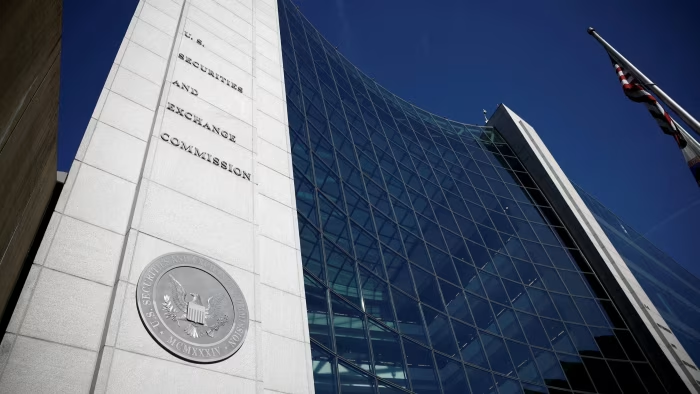
The US Securities and Exchange Commission on Monday said it would allow companies to exclude shareholder proposals from proxy materials, as Wall Street’s top regulator increasingly moves to limit investor activism.
Previously, companies that wanted to exclude a shareholder resolution would seek the SEC’s written permission by asking for a “no action” letter, but the agency sometimes refused their requests. Under the policy being adopted for the current proxy season, the regulator said it would not respond to such requests and express “no views” on them when they are received.
“The SEC has essentially announced that it will not enforce its own rules,” said Sanford Lewis, director and general counsel of Shareholder Rights Group, an investor advocacy association. “The ‘no action’ process and staff determinations regarding whether or not a proposal is excludable is a long-standing SEC rule.”
The move follows the regulator’s decision in February to rescind guidance issued by Joe Biden’s administration that made it easier for shareholders to submit environmental and social proposals. The withdrawal of that guidance resulted in a rise of omitted resolutions, contributing to a significant decline in shareholder proposals compared to the previous proxy season.
The policy could reshape the current proxy season by making it harder for shareholders to demand changes at companies.
The SEC in September allowed companies to limit the risk of shareholder lawsuits by allowing the disputes to be heard privately. The regulator also approved ExxonMobil’s plan to build an automated voting system for retail investors that will automate voting in line with board of director positions.
Shareholder advocates have objected to the moves. The International Corporate Governance Network, a group of global investors with assets under management of $90tn, warned in a letter to the regulator in October that the changes could lower governance standards in the US, thereby risking the “attractiveness of US capital markets”.
The SEC said companies that intend to exclude shareholder proposals from proxy materials must notify the commission, but there is “no requirement” that they must seek the staff’s view and that no response from the regulator is required. It cited a large volume of filings and current “resource and timing considerations” following the government shutdown in deciding it would express “no views” on a group’s decision to exclude resolutions.
Still, the new changes could make companies vulnerable to legal risk from shareholders. “There is a higher legal burden on the company side now because they don’t get to rely on the SEC,” said Ariane Marchis-Mouren, a senior researcher at The Conference Board’s ESG centre.
If a company wishes to receive a response for any proposal that it intends to exclude, the SEC will respond with a letter indicating that it will not object to the omission, the regulator said.
Under the surface, we are seeing breakdowns in high-beta stocks that had formerly been upside leadership for the market, even as the major indices hold up above initial support. A correction has been in place for high-flying stocks since mid-October, which has resulted in a one-month return of -11.7% for the ARK Innovation ETF (ARKK) , a high-growth technology stock proxy. We view the sell-off in ARKK as a risk-off indication for the broader market. The correction in ARKK looks poised to deepen over the next few weeks, at least. Intermediate-term momentum recently shifted to the downside per the weekly MACD, and the weekly stochastics have room to move into oversold territory. Next support on the chart is near $67, where the February high and the 200-day MA converge. The daily chart suggests that there is downside risk in the short term to the 200-day MA. ARKK broke down below cloud-based support late last week as a fresh bearish catalyst. The daily MACD shows that short-term momentum is strongly negative, and there are no signs of downside exhaustion yet. The ratio of ARKK to the SPX saw a steep run-up in September, reflective of a strong tape led by riskier assets. The ratio has since seen a significant retracement, indicating that the market is now avoiding risk. The underperformance has resulted in a downturn in the 50-day MA for the ratio, something we last saw in late February. The ratio also has room to move toward next support from its 200-day MA, supporting additional downside leadership from ARKK in the near term. In conclusion, the sell-off in ARKK is a risk-off indication for the broader market, which looks vulnerable to a deeper correction over the next few weeks. We would be quicker to reduce exposure to volatile technology stocks, which tend to get hit harder than the average stock during corrective phases. —Katie Stockton with Will Tamplin Access research from Fairlead Strategies for free here . DISCLOSURES: None. All opinions expressed by the CNBC Pro contributors are solely their opinions and do not reflect the opinions of CNBC, NBC UNIVERSAL, their parent company or affiliates, and may have been previously disseminated by them on television, radio, internet or another medium. THE ABOVE CONTENT IS SUBJECT TO OUR TERMS AND CONDITIONS AND PRIVACY POLICY . THIS CONTENT IS PROVIDED FOR INFORMATIONAL PURPOSES ONLY AND DOES NOT CONSITUTE FINANCIAL, INVESTMENT, TAX OR LEGAL ADVICE OR A RECOMMENDATION TO BUY ANY SECURITY OR OTHER FINANCIAL ASSET. THE CONTENT IS GENERAL IN NATURE AND DOES NOT REFLECT ANY INDIVIDUAL’S UNIQUE PERSONAL CIRCUMSTANCES. THE ABOVE CONTENT MIGHT NOT BE SUITABLE FOR YOUR PARTICULAR CIRCUMSTANCES. BEFORE MAKING ANY FINANCIAL DECISIONS, YOU SHOULD STRONGLY CONSIDER SEEKING ADVICE FROM YOUR OWN FINANCIAL OR INVESTMENT ADVISOR. Click here for the full disclaimer. Fairlead Strategies Disclaimer: This communication has been prepared by Fairlead Strategies LLC (“Fairlead Strategies”) for informational purposes only. This material is for illustration and discussion purposes and not intended to be, nor construed as, financial, legal, tax or investment advice. You should consult appropriate advisors concerning such matters. This material presents information through the date indicated, reflecting the author’s current expectations, and is subject to revision by the author, though the author is under no obligation to do so. This material may contain commentary on broad-based indices, market conditions, different types of securities, and cryptocurrencies, using the discipline of technical analysis, which evaluates the demand and supply based on market pricing. The views expressed herein are solely those of the author. This material should not be construed as a recommendation, or advice or an offer or solicitation with respect to the purchase or sale of any investment. The information is not intended to provide a basis on which you could make an investment decision on any particular security or its issuer. This document is intended for CNBC Pro subscribers only and is not for distribution to the general public. Certain information has been provided by and/or is based on third party sources and, although such information is believed to be reliable, no representation is made with respect to the accuracy, completeness, or timeliness of such information. This information may be subject to change without notice. Fairlead Strategies undertakes no obligation to maintain or update this material based on subsequent information and events or to provide you with any additional or supplemental information or any update to or correction of the information contained herein. Fairlead Strategies, its officers, employees, affiliates and partners shall not be liable to any person in any way whatsoever for any losses, costs, or claims for your reliance on this material. Nothing herein is, or shall be relied on as, a promise or representation as to future performance. PAST PERFORMANCE IS NOT INDICATIVE OF FUTURE RESULTS. Opinions expressed in this material may differ or be contrary to opinions expressed, or actions taken, by Fairlead Strategies or its affiliates, or their respective officers, directors, or employees. In addition, any opinions and assumptions expressed herein are made as of the date of this communication and are subject to change and/or withdrawal without notice. Fairlead Strategies or its affiliates may have positions in financial instruments mentioned, may have acquired such positions at prices no longer available, and may have interests different from or adverse to your interests or inconsistent with the advice herein. Any investments made are made under the same terms as nonaffiliated investors and do not constitute a controlling interest. No liability is accepted by Fairlead Strategies, its officers, employees, affiliates, or partners for any losses that may arise from any use of the information contained herein. Any financial instruments mentioned herein are speculative in nature and may involve risk to principal and interest. Any prices or levels shown are either historical or purely indicative. This material does not take into account the particular investment objectives or financial circumstances, objectives or needs of any specific investor, and are not intended as recommendations of particular securities, investment products, or other financial products or strategies to particular clients. Securities, investment products, other financial products or strategies discussed herein may not be suitable for all investors. The recipient of this information must make its own independent decisions regarding any securities, investment products or other financial products mentioned herein. The material should not be provided to any person in a jurisdiction where its provision or use would be contrary to local laws, rules, or regulations. This material is not to be reproduced or redistributed absent the written consent of Fairlead Strategies.