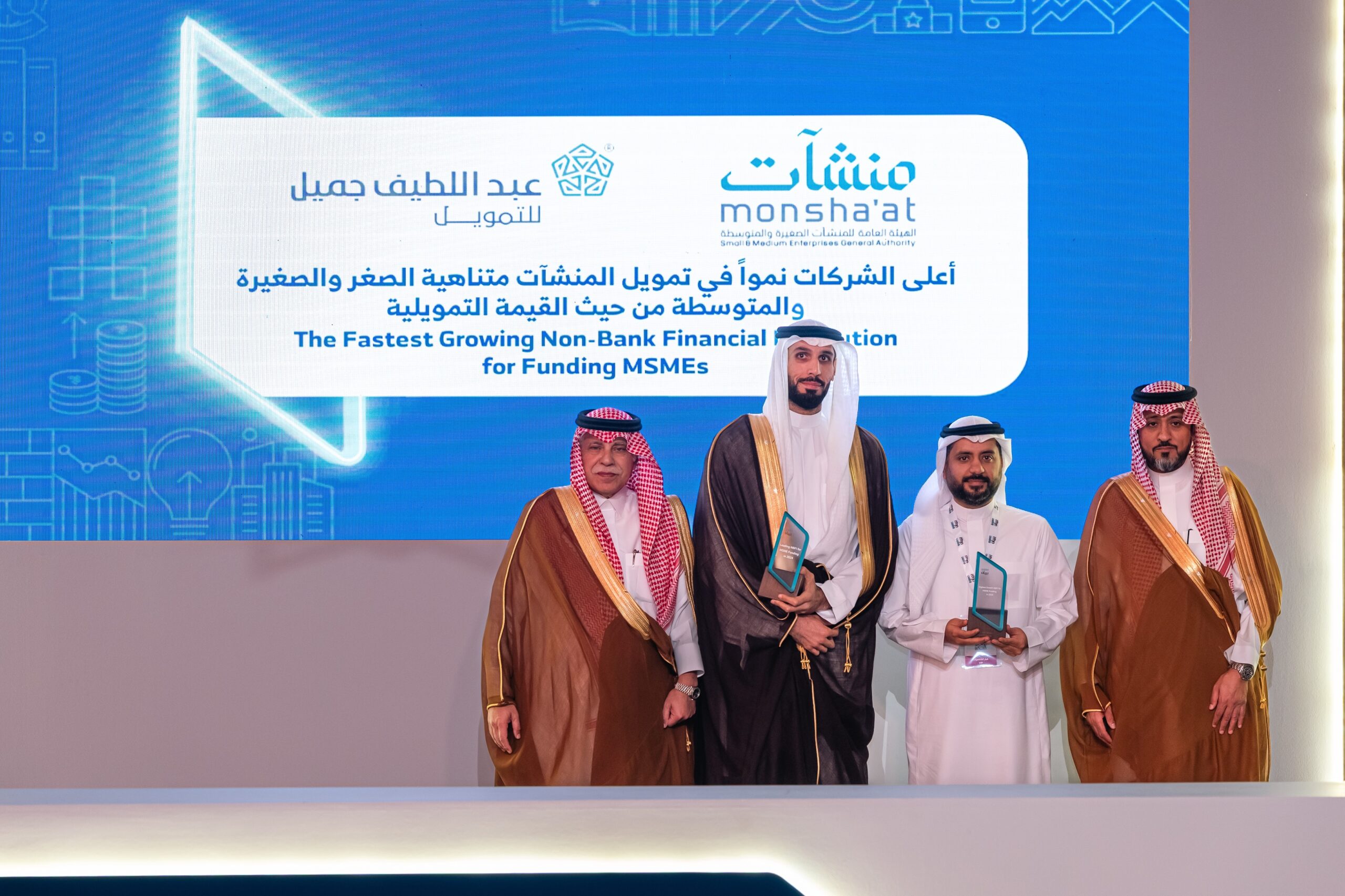
Abdul Latif Jameel Finance named “The Leading Non-Bank Financial Institution for MSME Funding in 2024” for the second consecutive year.
It was also awarded “The Highest Growing Non-Bank Financial Institution for MSME Funding in 2024”.
Recognition reflects Abdul Latif Jameel Finance’s commitment to empowering entrepreneurs and supporting Saudi Vision 2030’s goals of economic diversification and sustainable growth.
Abdul Latif Jameel Finance, a leader in innovative financing solutions and services that is regulated by the Saudi Central Bank (SAMA), has been honored with two awards at the Biban Forum 2025, held in Riyadh.
Presented by the General Authority for Small and Medium Enterprises (Monsha’at), Abdul Latif Jameel Finance was recognized as both the “The Leading Non-Bank Financial Institution for MSME Funding in 2024” for the second year in a row, and the “The Highest Growing Non-Bank Financial Institution for MSME Funding in 2024”.
The awards highlight Abdul Latif Jameel Finance’s leadership in advancing access to finance for micro, small, and medium enterprises across Saudi Arabia, and its ongoing contribution to driving entrepreneurship, financial inclusion, and sustainable economic development in line with Saudi Vision 2030.
Dr. Khalid Alsharif, CEO of Abdul Latif Jameel Finance, said: “We are deeply honored to receive two awards from Monsha’at recognizing our leadership and growth in MSME financing. This achievement reflects our unwavering commitment to empowering entrepreneurs, supporting business sustainability, and contributing to the Kingdom’s Vision 2030 objectives. We remain dedicated to developing innovative, responsible financial solutions that help Saudi businesses grow and thrive.”
To date, Abdul Latif Jameel Finance has funded more than 294,000 MSMEs, extending over SAR 4.2 billion in financing across key sectors including technology, tourism, entertainment, crafts, and production.
As a trusted partner in Saudi Arabia’s entrepreneurial ecosystem, Abdul Latif Jameel Finance continues to innovate tailored financing solutions that enable business growth, promote financial inclusion, and support the Kingdom’s ongoing economic transformation.
TDK Corporation (TSE:6762) announces that it has won the “Best IR Award” at the IR Excellent Companies Conference 2025, at the 2025 IR Award, organized by the Japan Investor Relations Association (JIRA). This marks the first time TDK has received this award in 20 years, the previous award win took place in 2005.
The IR Award is designed to recognize companies which have been highly accredited in the investment community for their understanding and promotion of IR activities. This year marks the 30th year since the first IR Award. Of the JIRA member companies, 371 publicly-traded companies applied for the 2025 IR Award and a total of 13 companies were selected and received awards: the “IR Grand Prix” was given to two companies, the “Best IR Awards” to six, the “IR Special Awards” to three, and the “Best IR Awards for Encouragement” to two.
Major Reasons TDK was Selected for the Award
In recent years, the company has expanded opportunities for dialogue between management and investors and has strengthened its IR activities
The company has worked to deepen investors’ understanding in various ways through hosting events including factory tours combined with business strategy briefings and meetings with outside directors
The company demonstrates a strong consciousness of cost of capital and stock price. By disclosing business-segment ROIC and explaining management policies derived by backcasting from its long-term vision, the company makes it easier for investors to understand its business-portfolio optimization and medium- to long-term projections
Through its Integrated Report and “Pre-Financial Capital Briefings,” the company is actively explaining how human capital and corporate culture contribute to enhancing its corporate value
TDK continues to place importance on active information disclosure and mutual communication with stakeholders to enhance its corporate value.
More details about the awards can be found at the website below: Japan Investor Relations Association https://www.jira.or.jp/english/
About TDK Corporation
TDK Corporation (TSE:6762) is a global technology company and innovation leader in the electronics industry, based in Tokyo, Japan. With the tagline “In Everything, Better” TDK aims to realize a better future across all aspects of life, industry, and society. For over 90 years, TDK has shaped the world from within; from the pioneering ferrite cores to cassette tapes that defined an era, to powering the digital age with advanced components, sensors, and batteries, leading the way towards a more sustainable future. United by TDK Venture Spirit, a start-up mentality built on visions, courage and mutual trust, TDK’s passionate team members around the globe pursue better—for ourselves, customers, partners, and the world. Today, the state-of-the-art technologies of TDK are in everything, from industrial applications, energy systems, electric vehicles, to smartphones and gaming, at the core of modern life. TDK’s comprehensive, innovative-driven portfolio includes cutting-edge passive components, sensors and sensor systems, power supplies, lithium-ion and solid-state batteries, magnetic heads, AI and enterprise software solutions, and more—featuring numerous market-leading products. These are marketed under the product brands TDK, EPCOS, InvenSense, Micronas, Tronics, TDK-Lambda, TDK SensEI, and ATL. Positioning the AI ecosystem as a key strategic area, TDK leverages its global network across the automotive, information and communication technology, and industrial equipment sectors to expand its business in a wide range of fields. In fiscal 2025, TDK posted total sales of USD 14.4 billion and employed about 105,000 people worldwide.
A bitter battle over the future of a Chinese-owned chipmaker in the Netherlands that threatened to cripple the global car industry is a “wake-up call to Europe and the west”, the minister at the heart of the row has warned.
The six-week standoff between the EU and Beijing over Nexperia and its vital supplies of automotive semiconductors has served up a sobering lesson to world leaders over their dependency on China, says Vincent Karremans.
The Dutch economy minister says he has no regrets about the tussle and would not change his actions even with the benefit of hindsight. “There’s a lot of interest in exactly what happened,” he says. “It’s like an economic thriller.”
Detailing for the first time how the trade war unfolded, he recalls high-level exchanges with his German counterpart, the car industry and the US, as well as conversations with critical intelligence that he claims showed Nexperia was moving parts of its physical operations in Hamburg to China.
The dispute started on 30 September when the Netherlands took supervisory control of Nexperia, alleging risks to “European economic security”. The decision to invoke a never-used-before cold war law had been taken two days earlier at the highest level of the Dutch government and was enacted after detailed legal checks.
Karremans says it had nothing to do with a US move on 29 September to put Nexperia on a list of companies facing import controls. “We were absolutely not pushed or pressurised or whatever by the Americans to take action on this,” he says.
“What we heard from the Americans was they were going into [government] shutdown and they wanted to ensure Nexperia was on the list.”
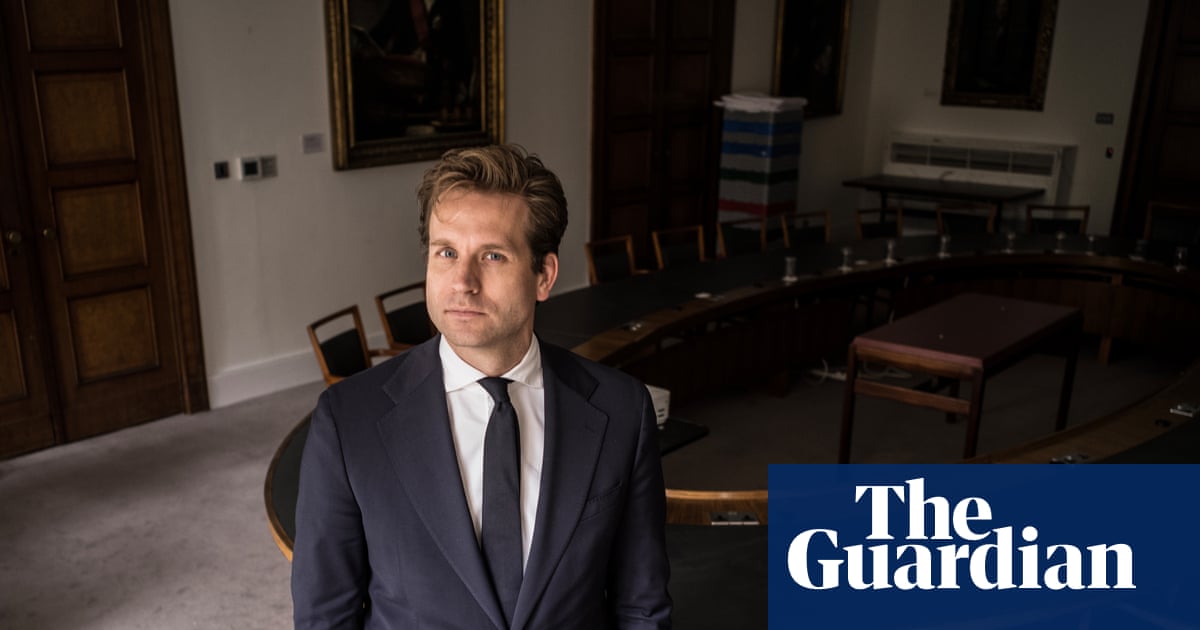
Vincent Karremans: ‘If I had been in the same position, with the knowledge I know now, I would have done the same thing again.’ Photograph: Koen van Weel/EPA
The Dutch intervention triggered a furious reaction from Beijing, which for four days banned the export of Nexperia’s chips from China, most of which are finished. That in turn threw carmakers’ supply chains in to chaos, leading to production pauses in Mexico and warnings from EU manufacturers that they were “days away” from stoppages.
After the deal between Donald Trump and Chinese president, Xi Jinping, in South Korea at the end of last month cleared the way for Beijing to resume chip supplies to Europe, the crisis appears to be over. For now.
“Now, for the short term, there’s a solution … and we’re very grateful for the steps that the Chinese authorities have taken on this.” However, Karremans stresses: “If I had been in the same position, with the knowledge I know now, I would have done the same thing again.”
The Dutch chipmaker, once part of the Philips electronics group, was bought by China’s Wingtech in 2018. Concerns about its future ability to export to the US emerged in 2023 when the US notified the Dutch that they were considering putting Wingtech on an “affiliate list” of companies that could pose a threat to national security.
“These restrictions were immense, so it was in our best interests to work with the American and Chinese governments and the Nexperia Chinese shareholder to work out a solution.”
The Dutch then entered a dialogue with Zhang Xuezheng, the founder of Wingtech and chief executive of Nexperia in the Netherlands, to ensure the company’s independence. Demands included the establishment of an independent supervisory board and a requirement that Zhang no longer act as both CEO and head of human resources.
“I spoke to Mr Zhang about this in the ministry last summer,” says Karremans. “It was one of the first meetings I had as minister for economic affairs. He was telling me they were very much on board. We had a list of measures to be taken and then we would engage with the Americans and say this is a Dutch company.”
But in September, things took a dramatic turn.
skip past newsletter promotion
after newsletter promotion
“I had people coming to my office saying: ‘Minister, we need to talk to you,’ and they told me what Zhang was doing. They said he was moving away intellectual property rights, they were firing people, and they were looking to relocate production from [Hamburg] to China.”
Asked who these people were, he says: “I can’t tell you who they were … but we have physical evidence that this [relocation] was happening.”
He argues that if Wingtech had moved its semiconductor wafer production to China, then “this interdependence that Europe had [with China] would have changed into a full dependency. That … would have been very dangerous for Europe.”
After the situation with the Chinese escalated in the aftermath of the Nexperia intervention, Karrenmans spoke to Germany’s economy minister, Katherina Reiche. “She supported our action. She was very concerned about what this meant, obviously, for the car industry.” Leaders in the EU, US, China, France and elsewhere around the world were also kept informed.
“We weren’t intending to go public on this. We wanted to solve this swiftly and silently,” Karremans says.
Beijing’s move to restore chip supplies at the weekend came after the US decided to pause sanctions for companies on its affiliate list. But the Dutch have yet to reverse out of Nexperia, with Karremans hinting nothing will happen until the first chips arrive on European shores.
“We are in direct touch with the German car industry and with other car manufacturers and clients of Nexperia. They will let us know when they receive the chips. And once the supply resumes and we are confident it will continue, then … we’ll take the appropriate steps that are needed by the Dutch government to resolve this issue.”
Karremans hopes this “will serve as a wake-up call” over the dangers of depending on one country for essential tech or raw materials. Although his VVD party finished third in last month’s general election, he will remain economy minister until a new government is formed, which could take a year.
When Wingtech was asked about the allegations that it was planning to move part of its physical production line in Hamburg to China, the company said it was pressing ahead with an investment rollout in Germany with 150 new jobs created, including 100 in R&D and 50 in production.
A spokesperson said: “Wingtech’s $200m investment plan for the Hamburg wafer fabrication facility, announced in 2024, is progressing steadily … As the new production lines start to ramp up, we were expecting to continue the expansion of our operational team, a development which has since been sidelined due to the Dutch government’s intervention.”
Air Liquide announced the successful start-up of the world’s first industrial-scale ammonia cracking pilot unit with a 30 tons per day ammonia to hydrogen conversion capacity at the Port of Antwerp-Bruges, Belgium. This groundbreaking innovation demonstrates a key missing technology brick to a viable pathway for converting ammonia into hydrogen, and unlocks challenges of transportation of hydrogen. This technology proven at the industrial scale for the development of world scale ammonia cracking plants enables access to low-carbon and renewable hydrogen for the decarbonization of industry and mobility.
The ability to efficiently transport hydrogen over long distances is a persistent challenge in developing a robust global hydrogen economy. Ammonia (NH3), formed by hydrogen and nitrogen molecules, emerges as a valuable hydrogen carrier. It can be cost-effectively produced in regions rich in renewable energy sources, such as solar, hydro, and wind or other low-carbon power. A well-established global infrastructure already exists for the large-scale production, transportation, and utilization of ammonia. This allows for the export of ammonia from energy-abundant regions to end-users worldwide, where it can then be “cracked” back into hydrogen, providing a crucial component for decarbonizing industry and mobility.
This new, proprietary ammonia cracking technologyexpands Air Liquide’s portfolio for low-carbon and renewable hydrogen production. As part of the successful development of this unit, key proprietary innovations were developed across critical areas including process safety, material testing, advanced catalysis for ammonia cracking, ammonia combustion, and efficient molecule separation. The project’s success showcases Air Liquide’s ability toscale up technologies from laboratory research to industrial applications and develop first-of-their-kind solutions for its clients.
Armelle Levieux, member of Air Liquide’s Executive Committee, notably supervising Innovation and Technology activities as well as Hydrogen Energy activities, stated:
“The commissioning of our ammonia cracking pilot unit in Antwerp is a key milestone. This is a world’s first which paves the way for new low-carbon hydrogen supply chains. By proving the viability of industrial-scale ammonia cracking, Air Liquide demonstrates its capacity to innovate and provide concrete solutions for its customers, and contributing to the Energy Transition. I am immensely proud of the work and commitment of all our teams who made this achievement possible.”
This industrial scale pilot plant has been supported by the Flemish Government through VLAIO (Flemish Agency for Innovation and Entrepreneurship).
World first: Air Liquide’s innovative technology converts Ammonia into Hydrogen at industrial scale, paving the way for new low-carbon supply chains
MANILA, Philippines — Asian shares traded mixed on Thursday after U.S. stocks drifted near their records.
U.S. futures edged higher, while oil prices declined.
Japan’s Nikkei 225 rose 0.2% to 51,139.48 as investors took heart as the U.S. government shutdown finally ended.
President Donald Trump signed a government funding bill Wednesday night, ending a record 43-day shutdown that caused financial stress for federal workers who went without paychecks, stranded scores of travelers at airports and generated long lines at some food banks.
“The shutdown had blocked not just spending, but also delayed a raft of federal economic data,” Stephen Innes of SPI Asset Management said in a commentary, adding that “for markets, the only line that matters is simple: the lights are coming back on.”
Hong Kong’s Hang Seng index fell 0.6% to 26,766.71, while the Shanghai Composite index edged up 0.4% to 4,016.24 as mainland stocks climbed ahead of updates on lending in China.
Australia’s S&P ASX 200 fell 1% to 8,715.00, falling for a third straight session as hopes for near-term interest rate cuts were quashed by strong jobs data that showed unemployment falling to 4.3% in October from 4.5% in September.
South Korea’s Kospi fluctuated between gains and losses, edging 0.1% higher to 4,154.03.
Taiwan’s Taiex index shed earlier gains, dropping 0.1%, while India’s BSE Sensex shed 0.2%.
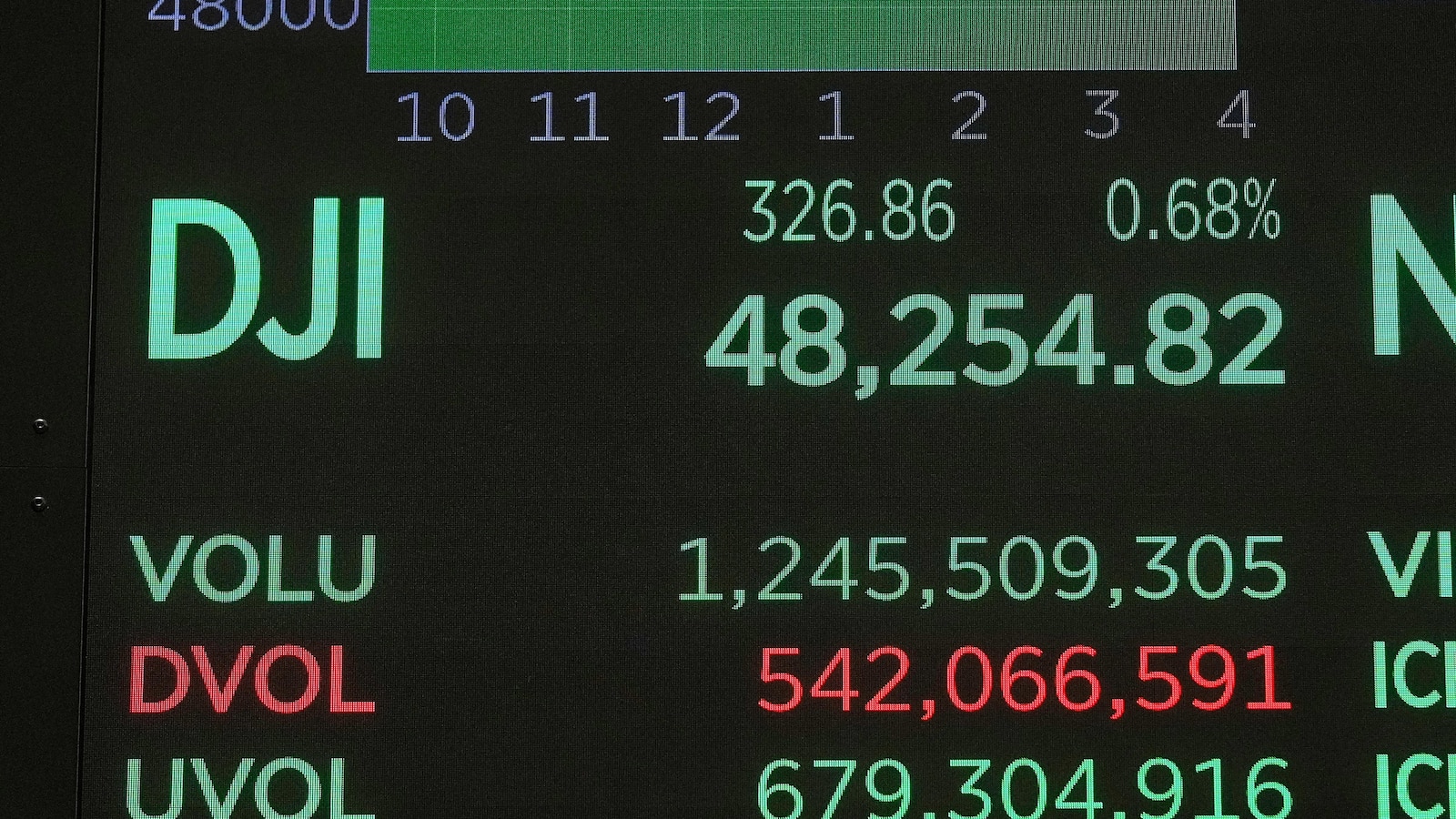
On Wednesday, the S&P 500 added 0.1% to 6,850.92, near its all-time high set a couple weeks ago. The Dow Jones Industrial Average jumped 0.7% to set a record for the second straight day, closing at 48,254.82. The Nasdaq composite slipped 0.3% to 23,406.46.
Advanced Micro Devices led the market, gaining 9% after its CEO, Lisa Su, said the chip company expects better than 35% of annual compounded revenue growth over the next three to five years. She credited “accelerating AI momentum.”
Stocks benefiting from the artificial-intelligence frenzy have been shaky recently, as investors question whether how much more they can add to already spectacular gains.
They are one of the top reasons the U.S. market has hit records despite a slowing job market and high inflation. Their prices have shot so high, though, that critics say they’re reminiscent of the 2000 dot-com bubble, which ultimately burst and dragged the S&P 500 down by nearly half.
Nvidia came into the day with a 4.6% drop for the month so far, for example, after its stock price more than doubled in four of the last five years. The biggest player in AI chips swung between gains and losses throughout Wednesday. Palantir Technologies, another AI darling, fell 3.6% for one of the day’s larger losses in the S&P 500.
Similar questions about priciness are dogging the of the U.S. market, though not as pointedly as for Big Tech and AI superstars.
In other dealings early Thursday, U.S. benchmark crude oil fell 6 cents to $58.43 per barrel. Brent crude, the international standard, shed 3 cents to $62.68 per barrel.
The U.S. dollar rose to 154.83 Japanese yen from 154.70 yen. The euro slipped to $1.1589 from $1.1594.
___
AP Business Writers Stan Choe and Matt Ott contributed.
In Civil Aerospace, demand remains strong with significant large engine orders including those from IndiGo, Malaysia Airlines, and Avolon so far in the second half of the year. We are also seeing growing demand for the Trent XWB-97 powered Airbus A350F, notably from customers in Greater China and the Asia Pacific region including Air China Cargo and Korean Air. Large engine flying hours for the 10 months to 31 October 2025 grew by 8% year on year to 109% of 2019 levels. Our strong operational delivery was recognised by Airbus with a supplier award in the ‘Ramp up and Operational Excellence’ category, the first time that an engine maker has received this award. Our time on wing initiatives are also progressing to plan. The upgraded Trent 1000 HPT blade, which was certified in June and more than doubles time on wing for this engine, is now being fitted to both new and existing engines in the MRO network. Maturity testing has been completed on the next phase of durability improvements for the Trent 1000 and Trent 7000. These improvements remain on track to be certified by the end of 2025 and will increase time on wing of these engines by a further 30%. In business aviation, the first Pearl 700 powered Gulfstream G800 was delivered in August, with the engine operating seamlessly in service.
In Defence, demand for our products and services remains robust. In September, the Global Combat Air Programme (GCAP) consortium announced an expansion of the partnership to accelerate the development of power and propulsion systems. In addition, as part of the GCAP programme, we successfully tested a combustor developed with enhanced additive layer manufacturing techniques that will result in an improved design and higher performance. In October, the Republic of Türkiye and the UK signed an agreement to export 20 Eurofighter Typhoon aircraft to Türkiye, with an option for more in the future, which will be powered by our EJ200 engines. Rolls-Royce’s contribution to Project Pele, the US Government’s transportable microreactor project, is progressing to plan. Project Pele is part of our growing collaboration in the US on nuclear energy, where defence could be one of the first applications of advanced microreactors. In July, the sale of the naval propulsors business to Fairbanks Morse Defense completed, as noted at our Half Year results.
In Power Systems, continued strong order intake and revenue growth was led by power generation, driven by data centres, and governmental. The development and testing of our next generation engine is continuing to progress well, with multiple engines tested in parallel in the period. This engine will enter service in 2028 and primarily targets the data centre backup power generation market, offering higher power density, lower emissions, and improved fuel consumption compared to its peers. In October, we launched a new fast-start gas generator product that will be available to customers from 2026. This engine will offer prime power for data centre customers who are awaiting grid connection and can later be switched to backup power generation once the data centre is connected to the grid. In marine, we successfully tested the first 100% methanol high-speed marine engine in the period, a major milestone for our CO2 neutral propulsion system.
In August, Rolls-Royce SMR advanced to the final stage of the Swedish competition to select a nuclear technology partner, with Vattenfall moving ahead with small nuclear options only. In the UK, where Rolls-Royce SMR was selected in June as the preferred technology provider by Great British Energy-Nuclear (GBE-N), commercial terms remain on track to be finalised later this year. Rolls-Royce SMR also entered the US regulatory process, a critical step to paving the way for additional jobs and investment potential in the US.
We remain committed to driving efficiency and simplification across Rolls-Royce. As part of our Group Business Services (GBS) strategy, we opened a global capability and innovation centre in Bengaluru, India, that will support key global corporate functions across the Group.
We are continuing to strengthen our balance sheet, enabled by a growing cash delivery. Our efforts have been recognised by the credit rating agencies, who all hold us at investment grade, with an upgrade to BBB+ by S&P Global in August. As planned, we repaid a $1bn bond that matured in October.
We are making good progress with our £1bn share buyback, having completed £0.9bn at the end of October.
Our 2025 Full Year results will be announced on 26 February 2026.