Any company that wants to compete in long-duration storage has to find materials and designs that make it dirt cheap to add hours of capacity. Traditional pumped hydro does this by filling a large reservoir with water. Sizable chose a double-walled membrane to fill with brine, which fits the cheap and scalable bill. Adding more vertical feet of plastic pipe is pretty inexpensive, too.
The power equipment costs less than 700 euros ($810) per kilowatt in the long term, competitive with pumped hydro, Aufiero said. Where the technology really shines is in the marginal cost of adding more storage duration: less than 20 euros ($23) per kilowatt-hour, at scale. That’s right on par with what Form Energy is targeting with its iron-air battery, an attempt at a mass-produced electrochemical battery for 100 hours of duration.
Sizable is shooting for eight hours to 24 and beyond. The economics improve at a larger scale: If you’ve got to install a mooring system and connect a marine cable to the grid, you might as well ship more power through it rather than less.
That’ll take some time to work up to. Sizable already built a kilowatt-scale proof of concept, which it floated at the Natural Ocean Engineering Laboratory in Reggio Calabria, Italy. In September, the company subjected its design to a bombardment of artificial waves in the gigantic pool at the Maritime Research Institute Netherlands, which vets the durability of marine engineering. The successful performance in those tests set the stage for the recent fundraising round.
With the cash infusion, the team is building a 1-megawatt device, which will sport a 50-meter (164-foot) radius and occupy up to 500 meters (1,640 feet) of ocean column off the coast of Reggio Calabria.
Sizable is funding this project itself, since it can’t yet show financiers the real-world performance data they need to underwrite investment. It will be fully functional, using scaled-down components because of its diminutive size, but it won’t connect to the grid. Sizable has already secured a 10-megawatt grid connection in southern Italy for its first truly commercial development.
Survive the ocean, but keep it simple
The unenviable challenge facing Aufiero is to fortify his invention against the torments of the sea, without spending so much money armoring it that it loses its low cost.
“Doing something in the ocean, it is a challenge, but it’s also an opportunity for massive scalability,” Aufiero said. He set out to design a “simple system that can be scaled without too many surprises.”
Wave action has literally sunk many hopeful ocean-energy pilot projects. But such devices in the past sought to harness the renewable power of the waves through direct contact. Sizable Energy only needs the ocean as a uniform space to operate in, so its technology tries to minimize wave contact as much as possible.
Two outer rings of plastic pipe were engineered to disrupt waves before they hit the floating reservoir. In the event that strong surf or heavy rain threatens to weigh down the reservoir, bilge pumps activate to clear out the liquid.
In Europe, people have been leasing seabed for energy projects at grand scale for decades. Sizable will apply to the same regulatory bodies that oversee offshore wind, but needs a much smaller footprint per megawatt.
In fact, offshore wind farms are an attractive potential site for the startup’s contraption, Aufiero said. By colocating, Sizable could share the export cables, and firm up the booms and busts of wind generation by storing it locally and distributing it to the grid as needed. Leak, the investor, likened this pairing to transforming an offshore wind plant into a nuclear power plant by converting variable generation into predictable, baseload clean energy.
For their part, the lead investors at Playground Global find the challenge of surviving Neptune’s wrath exhilarating.
“As engineers, we love things that are hard,” Leak told me. “If it’s a good idea that anybody can do, what’s your difference?”
{
if ($event.target.classList.contains(‘hs-richtext’)) {
if ($event.target.textContent === ‘+ more options’) {
$event.target.remove();
open = true;
}
}
}”
>
At Nokia, we create technology that helps the world act together.
As a B2B technology innovation leader, we are pioneering networks that sense, think and act by leveraging our work across mobile, fixed and cloud networks. In addition, we create value with intellectual property and long-term research, led by the award-winning Nokia Bell Labs, which is celebrating 100 years of innovation.
With truly open architectures that seamlessly integrate into any ecosystem, our high-performance networks create new opportunities for monetization and scale. Service providers, enterprises and partners worldwide trust Nokia to deliver secure, reliable and sustainable networks today – and work with us to create the digital services and applications of the future
Haleon said it appointed Vindi Banga as chair, succeeding Dave Lewis, who is set to become chief executive of U.K. drinks group Diageo.
The British consumer-health company said Monday that Lewis would step down as chair and director on Dec. 31, with Banga taking over from Jan. 1.
Banga served as Haleon's senior independent director since the company's listing in 2022.
"The board was unanimous in its appointment of Vindi given his wealth of global corporate and commercial leadership experience," the group said. He spent 33 years at Unilever, where he held a number of executive roles.
Banga is currently chair of U.K. Government Investments and a partner at private investment firm CD&R. He is also chair of council at Imperial College London and was previously senior independent director at GSK and Marks & Spencer.
Write to Andrea Figueras at andrea.figueras@wsj.com
Enhancing L-malate production of the M4-ΔiclR/pck strain
Our initial objective was to enhance L-malate production by utilizing metabolic engineering on the M4-ΔiclR/pck strain [27]. We hypothesized that glycerol uptake could be a bottleneck in the process. Glycerol enters the cell via facilitated diffusion through the glycerol transporter protein (GlpF), and is then assimilated into cellular metabolism through phosphorylation by the glycerol kinase enzyme (GlpK) [49]. To test our hypothesis, we tried to enhance glycerol uptake by overexpressing the E. coli glpK (Table S1) in the previously reported genetic background (M4-∆iclR/pck) and using pure glycerol in Erlenmeyer Flasks (Fig. 1). We found that L-malate production and molar yields significantly improved in the strain overexpressing the glpK gene (M4-∆iclR/pck–glpk strain), reaching 9.71 ± 0.46 g/L at 72 h, while the control M4-∆iclR/pck strain produced 4.69 g/L of L-malate, a value similar to that reporter by [27], and consequently half of the production of the strain that additionally overexpressed glpk (Fig. 1a). This improved performance is indeed related to the predicted rapid uptake and consumption of glycerol, as evidenced by the decrease in glycerol concentration in the culture, which fell from 13.06 ± 0.25 g/L in the inoculation medium to 4.72 ± 0.36 g/L after 24 h. This is almost half the amount observed in the reference strain (Fig. 1b). The pH decreased in line with the accumulation of L-malate in the culture medium, reaching 5.8 ± 0.1 in the M4-∆iclR/pck–glpk strain (Fig. 1c). The growth of the strain overexpressing GlpK was also higher at this point-time, but remained unchanged up to 72 h (Fig. 1d). Therefore, most of the glycerol consumed from 24 to 72 h was transformed into L-malate. Moreover, succinate (1.45 ± 0.18 g/L) and acetate (1.61 ± 0.12 g/L) were also produced from glycerol (Fig. 1e, f). The L-malate molar yield (mol/mol of consumed glycerol) after 72 h was also significantly higher (0.58 ± 0.05 mol/mol) than that of the control strain (0.31 mol/mol), and the total organic acids molar yield from consumed glycerol was 0.90 ± 0.05 (mol/mol) (Fig. 2).
Fig. 1
Comparative plots of the parameters analyzed during glycerol fermentation using the M4-∆iclR/pck control strain (n = 1), M4-∆iclR/pck-glpK (n = 3) at 0, 24, 48, and 72 h. Dot plots represent the average and standard deviation bars of: L-malate (a), glycerol (b), pH (c), biomass (d), succinate (e) in g/L, and acetate (f)
Fig. 2
Cumulative bar graphs of C4 metabolites and acetate molar yields (mol produced/mol glycerol consumed) at 72 h by the M4-∆iclR/pck strain n = 1 (a) and M4-∆iclR/pck-glpK (n = 3) (b). Standard deviations for all parameters were < 0.09
The increase in biomass and L-malate production in the M4∆iclR/pck-glpK strain can be explained by its higher glycerol uptake rate compared with the reference strain, which does not overexpress the GlpK enzyme. In the M4∆iclR/pck-glpK strain, the increase in glycerol consumption rate during the log phase was 0.46 g. L-1.h⁻¹, which is significantly higher than that of the reference strain (0.21 g L⁻¹ h⁻¹). This higher carbon uptake led to increased biomass and L-malate production as an end product of the linearized TCA cycle. Although the final glycerol uptake is similar in both strains, the higher L-malate production at 72 h indicates an increased CO₂ intake in the stationary phase due to the anaplerotic reaction catalyzed by Pck (PEP + CO₂ → OAA + ATP).
Optimizing L-malate production in the M4-∆iclR/pck-glpK strain
The optimization of culture conditions is critical to scale up a biotransformation process from Erlenmeyer Flasks to bioreactors. To this end, we used the Micromatrix microbioreactor platform (Applikon, Netherlands), which allows the simultaneous monitoring and control of temperature, oxygen, and pH using small working volumes (3 mL in our case). A full-factorial screening was designed for the identification of independent factors that significantly influenced the L-malate molar yield at 24 h as a response variable using the optimized strain M4-ΔiclR/pck-glpK (Fig. 3). The factors evaluated were inoculum biomass, DO, and glycerol concentration in the initial culture medium (Table S2). This full factorial screening (Supporting information, Table S2) was carried out using either pure or crude glycerol to investigate possible differences in influential factors when using the two grades of glycerol. The analysis revealed that the initial biomass had a significant positive impact on L-malate yield in both cases (Fig. 3), and therefore OD570 1.1 was selected as the inoculum biomass for further experimentation. Glycerol concentration was also a positive significant factor using crude glycerol within the analyzed concentration range (9 to 15 g/L) (Fig. 3a, b), but no statistical differences were found with pure glycerol (Fig. 3c, d). This effect is likely due to components other than glycerol in the crude glycerol extract. On the other hand, controlled DO at a range from 20% to 100% was not a significant factor using either crude or pure glycerol, and therefore, 20% DO was chosen for scaling up the process (Fig. 3). The inoculum biomass and crude glycerol concentration were also significant factors when pH and final biomass were set as response variables (data not shown).
Fig. 3
Pareto bar chart of the full-factorial screening for the identification of influential independent factors with L-malate yield as a response variable. The strain M4-∆iclR/pck–glpK was assayed using crude (a, b) or pure (c, d) glycerol. Initial glycerol concentration, biomass, and % dissolved oxygen were the response variables. Standardized (a, c) and principal (b, d) effects are shown. The vertical blue line represents the statistically significant value with a 95% confidence interval. The bars of components with a negative effect on malate yield are in blue, and those of components that have a positive effect on malate yield are shown in grey
Dark fermentation: scaling up the production of L-malate in a bioreactor and in silico metabolic modeling and flux balance analysis (FBA)
To scale up L-malate production, the mini-bioreactor system MiniBio (Applikon® Biotechnology) was used for monitoring and/or control of pH, temperature, and dissolved oxygen. Based on the results of the full-factorial screening previously described, the following parameters were set: DO controlled at 20% of air saturation, and an inoculum of induced bacteria at an OD570 of 1.1 (0.363 g CDW/L). The minimal medium was first supplemented with ∼12.5 g/L pure or crude glycerol as the only organic carbon source to test the scalability from Erlenmeyer flasks [27].
These assays showed that L-malate reached similar maximal concentrations in the bioreactor as in the Erlenmeyer flasks (9.55 g/L with crude glycerol and 8.89 g/L with pure glycerol), but with higher productivity, obtaining the maximum values at 24 and 48 h, respectively, versus 72 h in Erlenmeyer flasks (Fig. 4a, b). Almost all of the crude glycerol had been consumed by 24 h, concomitantly with the maximum production of L-malate (Fig. 4a). As previously reported by [27], once the glycerol had been consumed, the bacteria used up the L-malate and decreased in the culture medium. In contrast, pure glycerol was fully consumed by 48 h, coinciding with the maximum L-malate production. (Fig. 4b). This suggests that the composition of the crude glycerol extract is suitable not only for E. coli growth [42], but also for L-malate production. Regarding pH, similar trends were observed when using either type of glycerol. There was an increase over three hours concomitant with a decrease in biomass. This was followed by acidification alongside malate production (Fig. 4c, d). In these experiments, pH was monitored but not controlled. The main reason for this was to keep dark fermentation as simple as possible. Given that the L-malate yield was quite high (0.65 ± 0.13 mol/mol) when 13 g/L of crude glycerol was used, we reasoned that scaling up would be easier and cheaper without pH control.
Fig. 4
Comparative fermentation of pure and crude glycerol by the strain M4-∆iclR/pck–glpK strain in the Minibio bioreactor system (n = 1). Scatter plots showing the concentration of metabolites using crude (a) or pure (b) glycerol. Scatter plots of DO, pH, and biomass using crude (c) or pure (d) glycerol as a carbon source
Oxygen was consumed steadily at the set point until the carbon source was depleted. At this stage, oxygen consumption ceased, and its concentration in the culture medium increased (Fig. 4c, d). These results support the use of the engineered E. coli strain to consume crude glycerol from a biodiesel refinery and produce L-malate. This process is even more efficient than using pure glycerol.
In order to investigate the metabolic rewiring of the strains used in this work, the experimental data were applied to metabolic reconstructions and simulations. For this, an iterative constraint matrix approach was performed to evaluate extracellular compounds by calculating metabolic fluxes using a metabolic-based model to generate the final metabolic flux distribution inside the cell under different scenarios. This allowed us to predict some non-experimentally measured parameters [50]. The strategies of metabolic engineering, together with the optimization of the culture conditions (glycerol grade, reactor configuration, and DO), revealed that fluxes from glycerol assimilation towards L-malate production have been improved from E. coli M4-ΔiclR (with pure glycerol medium) to the final M4-ΔiclR/pck-glpK mutant (with crude glycerol medium) (Table 1). FBA calculations reveal that CO2 production (Ex_ CO2) lowers in each step of optimization, and actually, becomes a net uptake of 3.13 mmol/g CDW h in M4-ΔiclR/pck-glpK strain. This in silico model indicates that there must be a net carbon uptake in the optimized strain because it is necessary for the carbon closure value (1.05) (Table 1). In theory, this additional uptake could come from CO2 or HCO3− from crude glycerol, which were not experimentally measured. Regardless, the optimized metabolic phenotype displays minimized biomass, and maximized L-malate production and glycerol consumption. These differences are also apparent by examining the energetic metabolic pathways fluxes (mmol/g CDW in bracket): in the M4-ΔiclR/pck-glpK strain with crude glycerol, the source of ATP synthesis increased in glycolysis by phosphoglycerate kinase (PGK) (17.4), PCK (PPCK in Escher-map and CobraPy model) (13.2) when compared to the M4-ΔiclR strain with PGK (13.6) and PPCK (1.27). In contrast, the ATP Synthase (ATPS4r) activity diminished from 83.5 to 47.88 in the optimized strain (Table 1), which indicates that the oxidative phosphorylation is lower in this case. Flux variability analysis for ATP-related reactions shows that the flux range for PPCK in M4-ΔiclR was very low (1.27–3.48) and 0 in all of the strains overexpressing PPCK (Metabolic model results are available in Data availability statement). These results indicate that there is a unique pFBA solution for ATP synthesis in all of the constraints based-models for the strains overexpressing PPCK. In this strain, Pck is predicted to transform phosphoenolpyruvate (PEP) into oxalacetate (OAA), contributing to CO2 assimilation and ATP production. This is consistent with previous reports that E. coli overexpressing Pck with glucose in anaerobiosis had an intracellular ATP concentration that was approximately twice as high, increasing the ATP/ADP ratio via substrate phosphorylation rather than oxidative pathways, and this occurred concomitantly with CO₂ fixation [51, 52]. Our in silico analysis corroborates these results when using the optimized strain with crude glycerol in anaerobiosis, and also explains why a high O₂ concentration is not a significant factor, as was experimentally deduced from the full factorial design of experiment (Fig. 3). Regarding NADH production, GAPD fluxes increased from 13.8 to 17.4 and diminished in the NADH transhydrogenase (NADHTRHD) from 51.9 to 30.3 in the M4-iclR and M4-iclR/pck-glpK strains respectively (Table 1), confirming the NADH production is balanced with the malate dehydrogenase (MDH) activity.
Table 1 Metabolic flux (mmol/g CDW h) calculated by flux balance analysis (FBA) in the E. coli engineered strains, using pure or crude glycerol and in 50 mL-Flask or 150 mL-Bioreactor of metabolites and gases (O2 or CO2), ATP and NADH reactions
In summary, FBA analysis provides insight into metabolism, confirming that the engineered strain is a crucial step in optimizing crude glycerol fermentation. The model predicts a minimal O2 consumption by reducing metabolic energetic pathways, increasing the efficiency of C and energy utilization (avoiding fermentative end-products), and maximizing the C-flux towards L-malate. This optimized strain facilitates the scaling-up and the application of different bioprocess operations to increase L-malate production and productivity.
Effect of crude glycerol concentration on the production of L-malate in bioreactor and fed-batch fermentation
We continued to explore the optimization of the biotransformation in bioreactor comparing two different crude glycerol concentrations (12.91 ± 1.71 g/L and 19.12 ± 0.15 g/L) to set the optimum (Fig. 5). We found that L-malate production and yield at 24 h was higher using 19 g/L of glycerol (11.41 ± 2.88 g/L and 0.80 ± 0.09 molar yield), with no succinate or acetate production. To the best of our knowledge, this is the highest E. coli L-malate production using either pure or crude glycerol. However, almost half of the initial glycerol remained in the culture medium (Fig. 5c). On the other hand, when 12.9 g/L of glycerol was used, L-malate concentration and molar yield were slightly lower (8.94 ± 1.54 g/L and 0.65 ± 0.13 mol yield respectively), but 75% of glycerol was consumed (Fig. 5c). The pH evolution and oxygen intake were similar when using either concentration (Fig. 5a and b), with the highest L-malate concentration correlating with the lowest pH. Therefore, a better yield or L-malate concentration will depend on the initial glycerol concentration. Depending on the downstream application of the L-malate produced in the fermentation, either initial glycerol concentrations would be appropriate, since a lower concentration leads to a higher L-malate yield, and a higher concentration leads to a higher L-malate concentration.
Fig. 5
Fermentation of crude glycerol by the M4ΔiclR/pck-glpK strain. Dissolved oxygen and pH evolution using a culture medium supplemented with glycerol 12.5 g/L (a) or 19 g/L (b). (c) Bar diagram showing the concentrations of metabolites and biomass at 0 and 20 h (n = 3). (d) Dissolved oxygen and pH in a fed-batch fermentation (e) Bar diagram of the concentration of metabolites and biomass in the fed-batch fermentation. At 20 h 90% of the fermented culture was removed and refreshed with the same volume of the initial medium for a new batch
At an industrial scale, fed-batch fermentation is a usual strategy [43]. To test the applicability of this strategy, one fed-batch fermentation was also carried starting with 12.5 g/L of glycerol and removing 90% of the culture medium after 20 h the inoculation and adding the same volume of fresh M9 crude glycerol medium (Fig. 5d and e). In this assay, the pH increased slightly to 7.8, and then dropped to 5 between 24 and 48 h, showing a similar trend to that observed between 0 and 24 h. Oxygen consumption remained constant up to 48 h, after which it decreased (Fig. 5d). In the first step, production of L-malate was also similar to that previously obtained in the single batch fermentation, reaching 10.07 g/L (Fig. 4d). However, L-malate concentration after 20 h of the second batch was significantly lower (6.68 g/L) but increased up to 11.09 g/L at 40 h. The production rate was lower, although the final concentration was higher in this second batch. This difference in production rate was probably due to the initial biomass in the first (OD570 = 1.1) and second (OD570 = 0.6) batches. Further studies would be needed to adjust the optimal biomass concentration by, for instance, removing less than 90% of the culture medium in the second batch. This study therefore validates the scaling up of L-malate production in bioreactors using E. coli and crude glycerol.
Bio-H2 production by photofermentation using the L-malate-enriched culture medium from glycerol dark fermentation
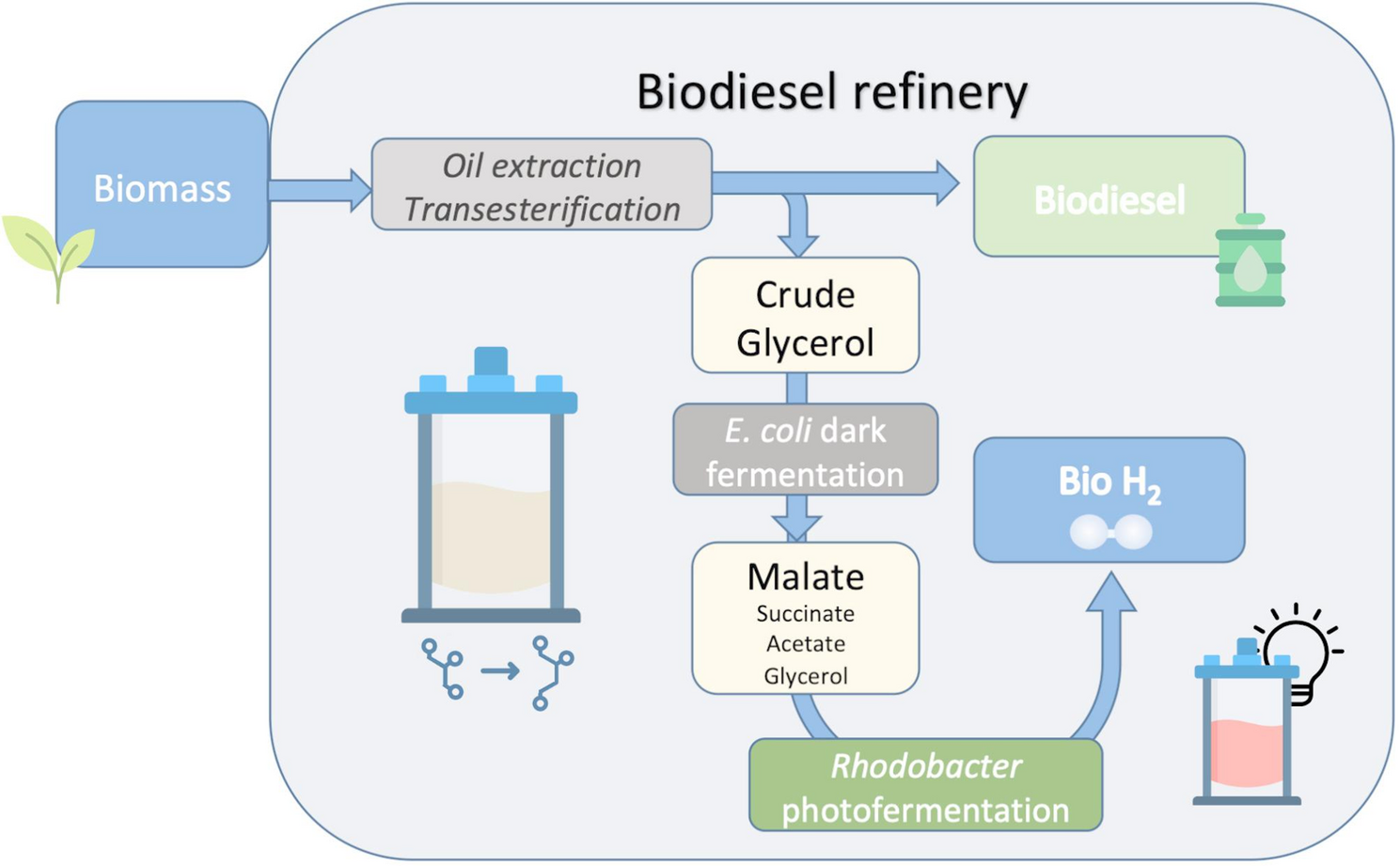
One of the drawbacks of biotechnological L-malate production is the purification and downstream processes required to obtain the highly purified extracts needed for certain industrial applications. Nevertheless, the fermented medium obtained from crude glycerol by DF in this study contains mainly L-malate, as well as small amounts of succinate, acetate, and non-consumed glycerol. This medium can be used in an additional fermentative process to produce an added-value product, such as bio-H2. This would be of particular interest in a biodiesel refinery, as it would transform a by-product into another clean energy source, creating an integrated process capable of producing two clean bioenergy sources from biomass: biodiesel and bio-H2. In this study, we propose a procedure that uses non-purified, crude glycerol to produce an L-malate-enriched medium. This medium is then used to formulate an RCV culture medium for producing bio-H₂ via photofermentation using the R. capsulatus S2 strain. To this end, we assayed increasing final concentrations of L-malate from 1 to 8 g/L in the RCV L-malate medium. We found that R. capsulatus grew and produced H₂ in all the conditions except when 6–8 g/L of L-malate was used, where H₂ production was negligible (< 5 mmol/L). The optimum was achieved using 3 g/L of L-malate with a H2 production of 55.14 ± 3.80 mmol/L and 62.97 ± 5.85 mmol H2/g CDW) (Fig. 6a). The analysis of the culture after photofermentation showed that the consumption of organic acids was almost 90% with 1 and 2 g/L L-malate in RCV medium, and 73% was consumed with 3 g/L L-malate. However, when higher L-malate concentrations were used, very low bio-H2 synthesis and growth were observed, probably due to an inhibition by the excess of L-malate or other components of the spent M9 culture medium. In this sense, although there was some L-malate consumption, most of the glycerol remained after photofermentation (Fig. 6a). In the 3 g/L L-malate – RCV medium, not only L-malate, but also acetate, succinate, and most of the glycerol content were consumed, which represents 87% of the carbon sources (Table 2). This means that the yield was around 1.5 mol H2/mol (C2-C4 consumed) and the productivities 0.6 mmol/L h and 0.7 mmol/g CDW h. To find out the optimum fermentation time point, the culture medium containing 3 g/L of L-malate was tested every 24 h from inoculation to 120 h. This analysis showed that 92 h was the optimal time point, at which 58.0 ± 6.0 mmol/L of bio-H₂ was achieved. Bio-H₂ dropped from 92 to 120 h (Fig. 6b), probably due to some remaining hydrogenase activity in the R. capsulatus strain used in this study. For example, it was reported that R. capsulatus B10 wild type uses 35 mM lactate and 7 mM sodium glutamate in a 1 L photo-bioreactor yielded 1.45 mol H2/mol lactate [53], which is very similar to the yield obtained in this work (1.48 mol H2/mol with a consumption of 36.5 mM C2-C4 compounds in this work) (Table 2). In terms of productivity [54], reported 0.56 mmol H2/L h using R. capsulatus DSM 1710 at 27.5 °C with light power 287 W/m2, which are similar conditions to those of this work (0.59 mmol H2/L h). Other R. capsulatus strain (KU002) produced 1264 mL H2/L, a similar value to that obtained in this work (1041 mL/L) but with higher productivity (XXX6.8 mL H2/L h). In this case, the author also used L-malate as a carbon source and improved the productivity by optimizing pH, temperature, and light intensity [53]. Recent publications have used several carbon sources (glucose, acetate, butyrate), obtaining variable productivity values (0.15–2.3 mmol/L h) [55, 56] reported a higher productivity (1.388 mmol H2/L h OD and 1500 mL/L culture) using the S2 strain and similar conditions to those of this work (RCV with 30 mM L-malate in diazotrophic conditions, 30 °C at 63 h). This difference is probably due to the higher light intensity (60 W) used by Barahona et al.
Fig. 6
H2 production by photofermentation with R. capsulatus using L-malate from dark fermentation with E. coli (a) Stacked bar chart of metabolites concentrations (Y left axis) before (BF) and after (AF) photofermentation at 96 h using RCV L-malate-medium supplemented with 1, 2, 3, 4, 5, 6 and 8 g/L of L-malate from E. coli fermentation (X axis). H2 produced after fermentation is also shown (Y right axis). (b) Dot and line plots of malate and glycerol concentrations (Y left axis) and H2 production (Y right axis) at 22, 48, 72, 96, and 120 h after inoculation (0 h)
Table 2 Concentrations and standard deviations of the data shown in Fig. 6b
Another widely used PNSB in hydrogen production is the R. sphaeroides species. This bacterium has been reported to produce hydrogen at a broad range of rates (0.29–8.7 mmol/L h) using different organic compounds (acetic, butyric, xylose, glucose, lactate, L-malate), or food wastes (oil palm, brewery effluent, restaurant effluent, etc.) [35]. The wide range of substrates, bioreactor configurations, and environmental conditions (including light intensity, temperature, pH, etc.) significantly affects H2 production and productivity, as also described for R. capsulatus and other PNSBs [55, 57]. Nevertheless, to the best of our knowledge, no publications have reported the consumption of glycerol and L-malate for H₂ production in R. capsulatus or other PNSBs. These evidences make this work very interesting in terms of productivity, reproducibility, and the scalability of photofermentative H2 process when a defined L-malate medium is used. The identification and construction of new PNSB strains by genetic engineering [58], together with bioprocess engineering studies, are promising strategies to improve H2 rates [41, 56, 58].
Tietoevry Care has entered into a partnership agreement with Finland’s leading private healthcare service providers – Aava and Pikkujätti, Mehiläinen, Pihlajalinna, and Terveystalo. The aim of the agreement is to develop jointly the entire DynamicHealth patient information system to be even more customer centric. The agreement is valid for three years with the possibility of extending it by another three years.
DynamicHealth is currently used by approximately 60 Tietoevry Care customers. It offers comprehensive tools tailored to the needs of private healthcare providers in Finland. More than 50,000 professionals use the system across roughly 1,000 units of Aava and Pikkujätti, Pihlajalinna, Mehiläinen, and Terveystalo. DynamicHealth covers key healthcare functions of private healthcare, from online appointment booking and patient data entry to reporting and accounting. With this agreement DynamicHealth will be further developed to be more efficient, user-oriented, and digitally advanced for all private healthcare customers. This supports high-quality care and enables smooth customer experience.
“Aava and Pikkujätti, Mehiläinen, Pihlajalinna, and Terveystalo are Tietoevry Care’s long-standing and significant customers. We are very pleased to continue and deepen our collaboration through this new agreement. Our goal is to build the next-generation system that enables high-quality and cost-effective services. Thanks to the DynamicHealth system, professionals can focus on what matters most: patient care, better decision-making, and impactful treatment,” says Tietoevry Care’s Managing Director Ari Järvelä.
According to Wille Komulainen, Chief Physician and Director of eHealth at Aava and Pikkujätti, the development work focuses especially on solutions that will support the daily work of healthcare professionals.
“The primary purpose of the renewed platform is to improve the user experience of healthcare professionals. In recent years, system development and increased regulation have brought along new requirements, which highlight the need for smooth and user-oriented tools. Going forward, our goal is to improve efficiency, support decision-making, and enable continuous care pathways,” says Komulainen.
According to Marko Honkanen, CIO/CDO at Aava and Pikkujätti, collaboration is key to successful system development.
“Collaboration with Tietoevry Care and other private sector service providers enables us to develop the system from both the customers’ and healthcare professionals’ perspective. Through this joint initiative, we are gaining a modern and fit-for-purpose platform that supports data flow, open interfaces, and data-driven management. This means we are able to provide even higher quality care for our customers,” Honkanen states.
“This close cooperation ensures a long lifecycle for the DynamicHealth system and enables its development in a more agile way in the future. Our goal is a technically modern and flexible platform that integrates seamlessly with our other services and thus best supports the work of our professionals,” Mehiläinen’s CIO Janne Jakola says.
“The partnership agreement with Tietoevry Care is a good step in the development of DynamicHealth system. Its modernization improves the user experience for healthcare professionals and enables the system to be integrated more seamlessly into Pihlajalinna’s overall solution in the future. This also enhances the service experience for our customers. The new collaboration model, in which we develop the system together with other Tietoevry Care customers, allows for cost-effective development and ensures that we are moving in the right direction,” says Pihlajalinna’s CIO Lauri Muhonen.
“We are pleased to have the opportunity to develop DynamicHealth in a joint initiative. Terveystalo has already taken pivotal steps in its digital agenda. Terveystalo Ella is an example of how a digital solution can significantly improve healthcare professionals’ daily work experience. The development of DynamicHealth supports this journey and ensures that smooth progress continues to be made. This development enables Terveystalo to establish a fundamental system architecture, while ensuring the continuity of the core system going forward,” says Sanna Huttunen, Director, Digital development at Terveystalo.
Tietoevry Care is a leading provider of health and social care software with strong Nordic roots and a growing European presence. Our smart, flexible, and collaborative Lifecare software supports the daily lives of more than 10 million citizens. With a data-driven approach, we enable care professionals to uncover critical insights and deliver the right support at the right time, ensuring a smoother and more personalized care experience for everyone.
We are part of Tietoevry, a leading technology company with annual revenue of approximately EUR 2 billion. Tietoevry’s shares are listed on the NASDAQ exchange in Helsinki and Stockholm, as well as on Oslo Børs. www.tietoevry.com
YTL Power International Berhad’s significant public companies ownership suggests that the key decisions are influenced by shareholders from the larger public
The largest shareholder of the company is YTL Corporation Berhad with a 52% stake
Institutions own 19% of YTL Power International Berhad
Trump has pledged to “unleash” American oil and gas and these 15 US stocks have developments that are poised to benefit.
Every investor in YTL Power International Berhad (KLSE:YTLPOWR) should be aware of the most powerful shareholder groups. With 52% stake, public companies possess the maximum shares in the company. That is, the group stands to benefit the most if the stock rises (or lose the most if there is a downturn).
Institutions, on the other hand, account for 19% of the company’s stockholders. Insiders often own a large chunk of younger, smaller, companies while huge companies tend to have institutions as shareholders.
In the chart below, we zoom in on the different ownership groups of YTL Power International Berhad.
See our latest analysis for YTL Power International Berhad
KLSE:YTLPOWR Ownership Breakdown November 10th 2025
Institutional investors commonly compare their own returns to the returns of a commonly followed index. So they generally do consider buying larger companies that are included in the relevant benchmark index.
As you can see, institutional investors have a fair amount of stake in YTL Power International Berhad. This implies the analysts working for those institutions have looked at the stock and they like it. But just like anyone else, they could be wrong. When multiple institutions own a stock, there’s always a risk that they are in a ‘crowded trade’. When such a trade goes wrong, multiple parties may compete to sell stock fast. This risk is higher in a company without a history of growth. You can see YTL Power International Berhad’s historic earnings and revenue below, but keep in mind there’s always more to the story.
KLSE:YTLPOWR Earnings and Revenue Growth November 10th 2025
Hedge funds don’t have many shares in YTL Power International Berhad. Our data shows that YTL Corporation Berhad is the largest shareholder with 52% of shares outstanding. This essentially means that they have extensive influence, if not outright control, over the future of the corporation. Meanwhile, the second and third largest shareholders, hold 11% and 9.5%, of the shares outstanding, respectively. In addition, we found that Seok Yeoh, the CEO has 2.0% of the shares allocated to their name.
While it makes sense to study institutional ownership data for a company, it also makes sense to study analyst sentiments to know which way the wind is blowing. Quite a few analysts cover the stock, so you could look into forecast growth quite easily.
The definition of an insider can differ slightly between different countries, but members of the board of directors always count. Management ultimately answers to the board. However, it is not uncommon for managers to be executive board members, especially if they are a founder or the CEO.
Insider ownership is positive when it signals leadership are thinking like the true owners of the company. However, high insider ownership can also give immense power to a small group within the company. This can be negative in some circumstances.
We can report that insiders do own shares in YTL Power International Berhad. Insiders own RM1.4b worth of shares (at current prices). It is good to see this level of investment. You can check here to see if those insiders have been buying recently.
The general public, who are usually individual investors, hold a 14% stake in YTL Power International Berhad. This size of ownership, while considerable, may not be enough to change company policy if the decision is not in sync with other large shareholders.
Our data indicates that Private Companies hold 10%, of the company’s shares. It’s hard to draw any conclusions from this fact alone, so its worth looking into who owns those private companies. Sometimes insiders or other related parties have an interest in shares in a public company through a separate private company.
It appears to us that public companies own 52% of YTL Power International Berhad. We can’t be certain but it is quite possible this is a strategic stake. The businesses may be similar, or work together.
While it is well worth considering the different groups that own a company, there are other factors that are even more important. Be aware that YTL Power International Berhad is showing 2 warning signs in our investment analysis , and 1 of those is a bit concerning…
But ultimately it is the future, not the past, that will determine how well the owners of this business will do. Therefore we think it advisable to take a look at this free report showing whether analysts are predicting a brighter future.
NB: Figures in this article are calculated using data from the last twelve months, which refer to the 12-month period ending on the last date of the month the financial statement is dated. This may not be consistent with full year annual report figures.
Have feedback on this article? Concerned about the content?Get in touch with us directly. Alternatively, email editorial-team (at) simplywallst.com.
This article by Simply Wall St is general in nature. We provide commentary based on historical data and analyst forecasts only using an unbiased methodology and our articles are not intended to be financial advice. It does not constitute a recommendation to buy or sell any stock, and does not take account of your objectives, or your financial situation. We aim to bring you long-term focused analysis driven by fundamental data. Note that our analysis may not factor in the latest price-sensitive company announcements or qualitative material. Simply Wall St has no position in any stocks mentioned.
HOOFDDORP, 11 November, 2025 — Federal Express Corporation, the world’s largest express transportation company, today unveiled insights from a new survey examining trade lane trends between Asia Pacific (APAC) and Europe, which highlights key enablers and barriers to cross-border trade.
Conducted in September 2025, the survey polled over 1,200 small- and medium-sized businesses (SMEs) across nine European markets, and 850 SMEs across 13 APAC markets, exploring business sentiment, readiness, and challenges for cross‑border expansion — both for APAC firms entering Europe and European firms trading internationally and pursuing opportunities in Asia Pacific.
The survey findings reveal a notable surge in European trade among APAC small and medium businesses, with 76% of respondents reporting increased export volumes over the past year. The United Kingdom (42%), Germany (40%), and France (38%) emerged as the top three markets driving business growth.
Confidence is equally strong among European SMEs trading with APAC, with 87% of businesses expecting to shift their trade balance in 2026 toward exports or maintaining current levels. This reciprocal optimism aligns with broader market trends. The Asia–Europe trade lane has recorded 30 consecutive months of growth as of August 2025, demonstrating remarkable momentum along this vital trade corridor for businesses of all sizes.
Asia Pacific Opportunity and Expansion Challenges:
Confidence in European markets is running high among APAC SMEs, with 85% planning to begin or expand trade within the next 12–24 months. This confidence in growth has been driven by heightened European demand, improved price competitiveness, and a need to diversify market strategy to build greater resilience in the face of a shifting trade landscape. In Europe, internationally trading Turkish SMEs have the highest proportion of their customers in APAC, with more than one in 10 (12%) coming from this region. They are followed by SMEs in Belgium (8.5%), the Netherlands (7.6%), France (7%), Italy (5.7%), Poland (5%), Germany (4.4%), the UK (4.3%), and Spain (3.6%).
Looking toward 2026, China (55%) is overwhelmingly seen as the APAC market offering the best opportunities to grow for European SMEs, followed by Japan (36%), India (26%), and South Korea (24%). Strategic expansion prospects, comprehensive logistics solutions, and favorable trade agreements are cited as critical factors in supporting increased trade with APAC.
To better support customer growth, FedEx has expanded its global network by adding five weekly flights connecting Asia to Europe this month. Additionally, FedEx enhanced connectivity between Vietnam to Europe resulting in a one day faster transit time. With increased frequencies between APAC and Europe, FedEx now operates 26 weekly flights connecting Europe shipments to APAC, delivering express shipments to major destinations in as little as 48 hours. Within APAC, businesses benefit from the company’s vast capabilities with four regional hubs serving 44 countries and territories, supported by over 28,000 team members.
Apart from the APAC region, the U.S. (48%) and the Middle East (34%) are the top intercontinental regions with which Europe’s SMEs are trading. The top European market trading with the U.S. was the UK, while for the Middle East and APAC it was Turkey.
Despite enthusiasm for cross‑border expansion, challenges remain. Regulatory shifts, complex customs procedures, and global market volatility have emerged as key concerns, with 86% of APAC SMEs and 78% of European SMEs reporting that these factors impact their ability to conduct business. “It’s clear that the Europe-APAC trade lane represents huge opportunities for SMEs across both regions,” says Wouter Roels, European President at FedEx.“This study also confirms that factors like support with trade complexity and supply chain visibility are critical to realising the full potential of the Europe-APAC corridor. With our physical networks and our vast amount of supply chain data, FedEx is ready to translate these opportunities into growth for our customers.”
Digital Innovation and Trade Expertise Essential for Cross-Border Trade Growth
As SMEs look for cross-border expansion, 30% of APAC and 41% of European businesses are calling for innovative digital tools to improve supply chain visibility, streamline shipping, and reduce delivery times. Meanwhile, 27% of APAC and 41% of European SMEs are also seeking greater customs expertise to navigate shifting regulations, avoid delays, and manage costs effectively.
FedEx is stepping up to meet evolving customer needs with an expanded portfolio of smart digital solutions and specialized trade expertise designed to simplify cross-border commerce. Its clearance and compliance teams help businesses navigate complex regulations — amongst others via customer webinars — to avoid customs delays, and minimize unexpected costs. Through tools like Electronic Trade Documents, customers can streamline customs declarations by uploading documents digitally to ensure timely delivery. To further support European SMEs who are expanding their global footprint, the FedEx SMB Hub provides multimedia resources, trade guidelines, and local market insights, equipping businesses with the knowledge and tools to confidently expand and compete across borders.
To learn more about how FedEx enables and expands global trade, visit fedex.com/trade.
About the SurveyThis online survey was conducted by Mortar Research in September 2025 across nine European markets including the United Kingdom, France, Spain, Turkey, the Netherlands, Poland, Italy, Belgium and Germany, and by Milieu Insights across 13 Asia Pacific markets including Australia, New Zealand, China, Hong Kong SAR, Indonesia, Japan, Malaysia, Philippines, Singapore, South Korea, Taiwan, Thailand, and Vietnam. The survey gathered insights from1,206 European SMEs engaged in international trade, alongside 850 Asia Pacific SMEs who actively trade with Europe. To access the full report click here.
About FedEx Corp. FedEx Corp. (NYSE: FDX) provides customers and businesses worldwide with a broad portfolio of transportation, e-commerce, and business services. With annual revenue of $89 billion, the company offers integrated business solutions utilizing its flexible, efficient, and intelligent global network. Consistently ranked among the world’s most admired and trusted employers, FedEx inspires its more than 500,000 employees to remain focused on safety, the highest ethical and professional standards, and the needs of their customers and communities. FedEx is committed to connecting people and possibilities around the world responsibly and resourcefully, with a goal to achieve carbon-neutral operations by 2040. To learn more, please visit fedex.com/about.
October 2025 ADV up 492% Year Over Year, A Testament to Tokenized Real Asset Settlement Growth
NEW YORK, Nov. 10, 2025 /PRNewswire/ — Broadridge Financial Solutions, Inc. (NYSE: BR), global Fintech leader, today announced record activity on its Distributed Ledger Repo (DLR) platform, which processed an average of $385 billion in daily repo transactions during October. The results mark a ~13% increase over September’s $339 billion daily average and a 492% increase year–over–year ($65 billion in 2024 vs. $385 billion in 2025), indicative of continued adoption of tokenized settlement.
According to its latest whitepaper based on the 2025 Broadridge Tokenization Survey, titled, Next-gen markets: The rise and reality of tokenization, tokenization is reshaping capital markets, improving operational efficiency, and enhancing transparency. As direct-to-investor distribution models gain momentum, tokenization is increasingly being recognized as a transformative force — with more than 80% of early adopters citing its potential to deepen client engagement and streamline operations.
Broadridge is an early leader in supporting tokenized trading. The DLR solution is the largest institutional platform for the settlement of tokenized real assets. Broadridge has committed to supporting the trading of digital assets across its industry-leading technology platforms and unlocking new opportunities across global capital markets as the industry moves toward a digital-first financial ecosystem.
Please visit Broadridge’s DLR platform for more information and to learn more on the 2025 Tokenization Survey, download the full report here.
About Broadridge:
Broadridge Financial Solutions (NYSE: BR) is a global technology leader with trusted expertise and transformative technology, helping clients and the financial services industry operate, innovate, and grow. We power investing, governance, and communications for our clients – driving operational resiliency, elevating business performance, and transforming investor experiences.
Our technology and operations platforms process and generate over 7 billion communications annually and underpin the daily average trading of over $15 trillion in equities, fixed income, and other securities globally. A certified Great Place to Work®, Broadridge is part of the S&P 500® Index, employing over 15,000 associates in 21 countries.
For more information about us, please visit www.broadridge.com.
SAN FRANCISCO, Nov. 10, 2025 (GLOBE NEWSWIRE) — Artificial intelligence is transforming industries worldwide. But for small and medium sized businesses (SMBs), the real challenge isn’t access to technology; it’s access to time. Today, Halper AI, founded by Eduard Gevorkyan, launches to address exactly that challenge, giving business owners back the hours they need to grow and thrive.
Halper AI
From Biotech to AI: The Journey of Eduard Gevorkyan
Eduard Gevorkyan’s career spans science, strategy, and large-scale innovation. With a background in biochemistry and biomedical engineering, he began at McKinsey & Company, followed by Google, where he honed his expertise in data-driven design.
In 2023, Eduard launched SoulsHub in Barcelona, a platform connecting users with AI-powered replicas of mentors, thought leaders, and business coaches. Within a year, the platform hosted over 200 AI personalities and was acquired in December 2024 by a Saudi Arabian technology group for an estimated €5–10 million.
Introducing Halper AI: Your Invisible Business Partner
Building on his experience with SoulsHub, Eduard focused on solving the daily challenges of small business owners. Halper AI is not another CRM or chatbot. It’s an AI Business Manager designed to quietly handle communication, bookings, invoicing, and follow-ups, integrating seamlessly with Instagram, WhatsApp, calendars.
Unlike traditional platforms designed to demand attention, Halper encourages peace of mind. “Please, don’t open Halper or open it once and close it,” Eduard explains. Halper runs invisibly in the background, ensuring clients are responded to, bookings stay full, and invoices go out, while users focus on what matters most.
Eduard calls this approach “freedom metrics.” While Silicon Valley measures success by daily active users, Halper measures it in peace and time spent with loved ones.
Why Halper Matters
For small business owners juggling multiple roles, Halper acts as a silent team member, enabling them to focus on creativity and service. From barbers perfecting their craft to yoga instructors scaling their studios, Halper AI offers less screen time and more real time, redefining what AI success looks like.
About Halper AI
Founded by Eduard Gevorkyan, Halper AI combines emotional intelligence with operational intelligence to create AI that serves humanity, not the other way around. By giving SMBs the gift of time, Halper AI is redefining productivity, efficiency, and the future of work.
Media Contact:
Company Name: Halper AI Contact Person: Alina Palii Email: hello@halper.ai Website: https://halper.ai
Disclaimer: This content is provided by Halper AI. The statements, views, and opinions expressed in this content are solely those of the content provider and do not necessarily reflect the views of this media platform or its publisher. We do not endorse, verify, or guarantee the accuracy, completeness, or reliability of any information presented. This content is for informational purposes only and should not be considered financial, investment, or business advice. All investments carry inherent risks, including the potential loss of capital. Readers are strongly encouraged to conduct their own due diligence and consult with a qualified financial advisor before making any investment decisions. Neither the media platform nor the publisher shall be held responsible for any inaccuracies, misrepresentations, or financial losses resulting from the use or reliance on the information in this press release. Speculate only with funds you can afford to lose. In the event of any legal claims or concerns regarding this article, we accept no liability or responsibility. Globenewswire does not endorse any content on this page.
Legal Disclaimer: This media platform provides the content of this article on an “as-is” basis, without warranties or representations of any kind, express or implied. We assume no responsibility or liability for the accuracy, content, images, videos, licenses, completeness, legality, or reliability of the information contained herein. Any complaints, copyright issues, or inquiries regarding this article should be directed to the content provider listed above.
A photo accompanying this announcement is available at https://www.globenewswire.com/NewsRoom/AttachmentNg/9f717d7f-a36e-4436-8670-14cc80d5f0ed