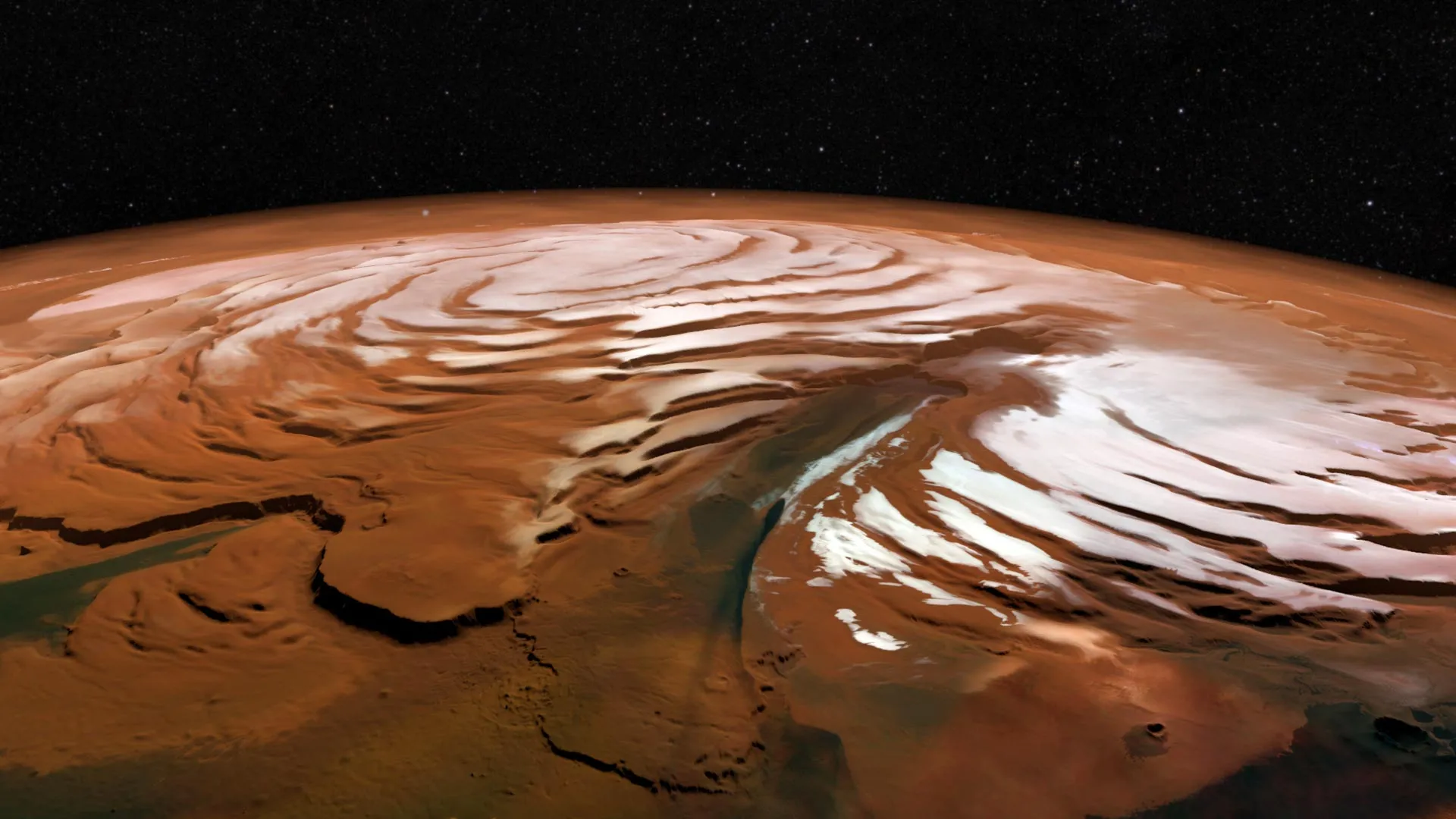
Mars wasn’t always the bone-dry world we see today. A new study reveals the Red Planet experienced a series of ice ages, much like Earth, but with a twist.
Instead of regaining water with each cycle, Mars steadily lost it. And now, clues…

Mars wasn’t always the bone-dry world we see today. A new study reveals the Red Planet experienced a series of ice ages, much like Earth, but with a twist.
Instead of regaining water with each cycle, Mars steadily lost it. And now, clues…

Two annual meteor streams are now active that have the potential to spawn dramatic fireballs in the weeks leading up to their November peaks.
As their names suggest, meteors from both the Southern Taurid and Northern Taurid meteor showers appear…

Hundreds of satellites may soon be flying in orbital regions that are already too packed to allow safe and long-term operations, a new study suggests.
The study found that, while in 2019 only 0.2% of satellites in Earth orbit were forced to…

About a year ago, a spacecraft named Hera took off with a huge task: help us figure out how to stop an asteroid from hitting Earth. It’s now roughly halfway to the Didymos asteroid system and, so far, the journey’s going better than…

Deep inside caves, water dripping from the ceiling creates one of nature’s most iconic formations: stalagmites. These pillars of calcite, ranging from centimeters to many meters in height, rise from the cave floor as drip after drip of…

Two tiny ingredients in ancient seawater – nickel and urea – may explain why oxygen arrived late on Earth. A team in Japan tested this idea and found a chemical choke point that held back early oxygen-making microbes.
The Great Oxidation Event…

The Great Oxidation Event, which occurred between 2.1 and 2.4 billion years ago, fundamentally transformed Earth’s atmosphere and made complex life possible. Before this period, oxygen producing cyanobacteria had evolved hundreds of…

SAVANNAH, Ga. (WSAV) — As we transition into fall and move closer to the winter months, you might start noticing something different when you look up. The sky appears a deeper, richer blue, but why does this happen?
Let’s talk about light,…
ANDREW LIMBONG, HOST:
The pachycephalosaurs were a unique group of dinosaurs with domed heads, but scientists haven’t known much about them because their fossils have been so incomplete until now. Science…

When it comes to saving Earth from a potential doomsday rock, knowing where to hit it and how it spins could make all the difference. Two new studies presented last month at the Europlanet Science Congress in Helsinki may have just given…