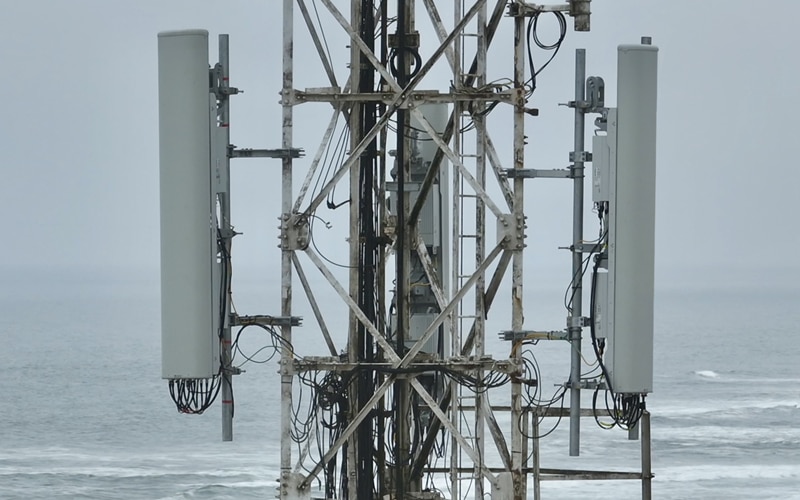
On February 3 2022, SpaceX shot 49 new Starlink satellites into orbit aboard a Falcon 9 rocket, which made up group 4-7 of the constellation. Following a successful insertion, the rocket returned to the droneship A Shortfall of Gravitas,…
Blog
-

Poco’s new flagship phone has a Bose subwoofer and a ‘denim’ option
Back in 2018, Xiami launched Poco as a sub-brand that specializes in mid-range smartphones. Now, Poco has launched its first premium flagship phone series, the F8 Ultra and the F8 Pro, at an event in Bali. Both devices will use Sound by Bose…
Continue Reading
-

Central banks are confronting the AI dilemma
Artificial intelligence is slowly entering the world of reserve management, but not in the way outsiders might assume. A new report by OMFIF’s Global Public Investor Working Group shows central banks approaching AI with caution shaped by years of market shocks, cybersecurity incidents and the hard lessons of operational risk. Behind the interest lies a simple tension. AI can make reserve management faster and more efficient, but it also expands the attack surface, accelerates market dynamics and exposes institutions to mistakes they cannot afford.
The working group, made up of BNY, Bridgewater and Capital Group, brought together 10 central banks through bilateral exchanges across Europe, Africa, Asia and Latin America. Their discussions revealed a pattern that cuts across mandates and regional tensions. The technology is coming, but central banks want control before capability. They are not willing to let algorithms set the pace.
Adoption is happening, but mostly at the edges
Most institutions are experimenting with AI only in low-risk processes: scanning market news, flagging anomalies and summarising reports. According to OMFIF’s Global Public Investor 2025 survey, 61% of central banks say AI is not yet supporting their operations in any meaningful way (Figure 1.1). Those dipping their toes in describe it as a practical convenience rather than a strategic tool.
A European participant of the working group discussions noted that AI can help unclog routine bottlenecks, easing the burden on small teams. Others see potential in automated data processing or environmental, social and governance data screening. AI may accelerate workflows, but it is not allowed near decisions that carry financial, reputational or political consequences.
Figure 1.1. Adoption of AI is limited
How is artificial intelligence supporting your operations? Share of respondents, %
Source: OMFIF Global Public Investor 2025 survey
Those furthest ahead are also the most uneasy
A striking insight from the working group conversations is that the institutions with the most advanced use of AI are also the most concerned about its risks. They understand the potential, but they also see the limitations. Model reliability remains a top worry, especially given how often AI tools misinterpret unusual scenarios. Central banks, whose work revolves around rare but disruptive shocks, have little tolerance for such risks.
Cybersecurity is the bigger fear. One policy-maker warned that a breach involving reserves data would not just be an operational problem but a political one. In their words, prudence is credibility. Central banks are keenly aware that adopting AI without airtight governance could endanger both.
AI may make accelerate crises
One of the most interesting working group exchanges came from a central bank already testing AI-driven analytics in market monitoring. Its concern was not about errors in calm times, but about what happens when markets are stressed. Broader use of AI in trading could accelerate how quickly liquidity disappears, turning crises that once unfolded over days into minutes.
This concern is grounded in how these systems are built. Models trained on comparable datasets often respond in similar ways, which can help steady markets during quiet periods, though it also raises questions about how they might behave when conditions turn volatile. For reserve managers who rely on liquidity to defend currencies or stabilise markets, this poses a profound challenge.
Figure 1.2. Central banks prioritising digital capacity
Are you looking to introduce or expand your use of the following digital technologies? Share of respondents, %

Source: OMFIF GPI 2025 survey
The working group’s conversations showed that the divide between central banks on AI is not about enthusiasm but about capability (Figure 1.2). Some institutions have in-house data scientists and secure enterprise environments. Others have small teams, limited budgets and governance structures that make experimentation slow.
A participant said: ‘We lag, but we cannot lag forever’. For these institutions, AI is less a choice and more an inevitability. But they need training, digital infrastructure and peer support before it becomes safe to bring AI closer to core functions.
The next phase will be about control
Central banks have no interest in outsourcing judgement to machines. The working group report makes clear that human oversight is the anchor. AI can summarise, filter and accelerate, but decisions remain with people.
The question is not whether AI will enter reserve management. The question is how central banks manage the risks it brings. The institutions that move carefully but deliberately by strengthening cybersecurity, investing in skills and building internal capacity will be best placed to employ the technology without being overwhelmed by it.
AI can sharpen decision-making. It can also destabilise markets. Navigating that tension is becoming one of the defining tasks of modern reserve management.
Yara Aziz is Senior Economist at OMFIF.
Download ‘Redefining resilience in reserve management’.

Interested in this topic? Subscribe to OMFIF’s newsletter for more.Continue Reading
-

Syed Modi International 2025 badminton: Unnati Hooda enters pre-quarters
Top seed Unnati Hooda registered a straight-game win to enter the women’s singles pre-quarterfinals of the Syed Modi International 2025 badminton tournament at the Babu Banarasi Das Indoor Stadium in Lucknow on Wednesday.
World No. 28 Unnati…
Continue Reading
-

Advancements in Screening and Diagnostic Techniques in ATTR-CM
The panel discusses how advances in imaging and biomarkers have transformed the diagnostic approach to ATTR-CM. Historically, diagnosis required invasive endomyocardial biopsy, but cardiac radionuclide scintigraphy with bone-avid tracers now…
Continue Reading
-
India says examining Bangladesh request for Hasina's extradition – Reuters
- India says examining Bangladesh request for Hasina’s extradition Reuters
- Dhaka again asks India for Hasina’s extradition Dawn
- The party is over: Why Hasina supporters didn’t protest deposed premier’s death sentence TRT World
- Bangladesh on…
Continue Reading
-
Insane NASA mission will launch rocket to stop huge telescope from crashing into Earth – LADbible
- Insane NASA mission will launch rocket to stop huge telescope from crashing into Earth LADbible
- Katalyst selects Pegasus to launch Swift reboost mission SpaceNews
- Bonkers NASA Mission Next Year Will Drop Rocket Out of Plane, Blast Off From…
Continue Reading
-

Olympic flame lit in Ancient Olympia as Milano Cortina 2026 Olympic Torch Relay begins
What is the story behind the Milano Cortina 2026 Olympic Torch Relay?
Each Olympic torch relay has its own narrative, with a theme and route that celebrate the host nation’s culture, history and people — bringing the spirit of the Games to…
Continue Reading
-

Lithium Reduces Risk of Suicide and Recurrent Episodes of Bipolar and Major Depressive Disorders
Patients treated for bipolar or major depressive disorder were less likely to have recurrent episodes of illness, suicidal ideation, or to attempt suicide in the 1-year after the addition of lithium than in the year before, in a within-subject,…
Continue Reading
-

Procter & Gamble becomes Official Partner of the Tour de France
Béatrice Dupuy, CEO of Procter & Gamble France and Benelux :
« Joining the Tour de France and the Tour de France Femmes avec Zwift is a source of immense pride. The Tour is one of those sporting events that brings together families, generations…Continue Reading