You don’t have permission to access “http://www.alvarezandmarsal.com/press-release/alvarez-marsal-adds-restructuring-managing-director-to-expand-offering-to-education-providers-and-funders” on this server.
Almost 340,000 Self Assessment filers have already paid their tax bill using the HMRC app.
It is quick and easy to pay via the HMRC app and set up payment reminders.
Taxpayers need to file their tax return and pay tax they owe by 31 January.
The number of people using the HMRC app to pay their Self Assessment tax bill has increased by nearly 65%. Almost 340,000 people have used the HMRC app to pay their Self Assessment tax since 6 April 2025, an increase of 132,788 people compared to the same period last year.
Self Assessment customers need to file their tax return online for the 2024 to 2025 tax year and pay any tax owed by 31 January 2026. HM Revenue and Customs (HMRC) is encouraging those yet to start theirs, to go to GOV.UK and do it now. Anyone who misses the deadline could be subject to an automatic £100 penalty.
Filing tax returns ahead of the deadline means knowing how much tax to pay sooner. It is quick and easy to pay via the HMRC app and set up payment reminders to make sure the deadline isn’t missed.
The Self Assessment deadline is less than one month away, and thousands of people have already paid their tax bill via the HMRC app. It is quick and easy to do, and you can also see your payment history. Search ‘download the HMRC app’ on GOV.UK to access the app and make your Self Assessment payment.
People who are unable to pay any tax owed in full may be able to set up a Time To Pay arrangement, if they meet the eligibility criteria and they owe less than £30,000.
Alternative options include paying directly through a bank account, direct debit or paying online via GOV.UK. A full list of payment options can be found on GOV.UK.
HMRC expects more than 12 million tax returns to be filed by the deadline. Those who miss the deadline will be issued with a penalty:
an initial £100 fixed penalty, which applies even if there is no tax to pay, or if the tax due is paid on time
after 3 months, additional daily penalties of £10 per day, up to a maximum of £900
after 6 months, a further penalty of 5% of the tax due or £300, whichever is greater
after 12 months, another 5% or £300 charge, whichever is greater
There are also additional penalties for paying late of 5% of the tax unpaid at 30 days, 6 months and 12 months. If tax remains unpaid after the deadline, interest will also be charged on the amount owed, in addition to the penalties above.
Customers who need assistance to complete their Self Assessment can access support and guidance online 24/7, including YouTube videos, webinars, digital assistant and step-by-step guidance covering different sections of a tax return. Most queries can be resolved online.
Customers who need to speak to an adviser can call HMRC, Monday to Friday, 8am to 6pm. Phone lines close on Friday 30 January and reopen on Monday 2 February – after the deadline. For full phone support, contact HMRC before Friday 30 January. On Saturday 31 January, HMRC will offer webchat support through its Online Services Helpdesk.
The new High Income Child Benefit Charge (HICBC) PAYE digital service means thousands of Child Benefit claimants who are only in Self Assessment to pay HICBC can choose to pay the charge back through their tax code.
Eligible customers can call HMRC before the filing deadline and tell HMRC that they want to be removed from Self Assessment to use the digital service. Where a tax return has already been filed, customers can choose to stop from the following tax year. HMRC will then amend their tax code and they will be registered to pay HICBC through PAYE.
Customers do not need to include their 2025 Winter Fuel Payment, or Pension Age Winter Heating payment in Scotland, on their tax return for the 2024 to 2025 tax year as payments received in Autumn 2025 will be recovered in the 2025 to 2026 tax return, due by 31 January 2027.
Self Assessment customers are sometimes targeted by criminals and should never share their HMRC login details with anyone, including a tax agent, if they have one. HMRC scams advice is available on GOV.UK.
Further Information
More information on Self Assessment
339,490 customers paid their Self Assessment tax bill via the HMRC app between 6 April 2025 and 4 January 2026, compared to 206,702 people between 6 April 2024 and 4 January 2025.
People who have sold assets such as shares after 30 October 2024 need to be aware of changed rates of Capital Gains Tax for the disposal of assets when completing their Self Assessment tax return as it won’t automatically calculate the correct amount of Capital Gains Tax due. Instead, they may need to work out an adjustment to the tax automatically calculated using the adjustment calculator on GOV.UK.
Sole traders and landlords with a turnover above £50,000 will be required to use Making Tax Digital (MTD) for Income Tax from 6 April 2026 and be required to submit quarterly summaries of their income and expenses to HMRC. HMRC is urging eligible customers to act now and sign up to Making Tax Digital as this is the best way to get ahead, giving you extra time to select software and familiarise yourself with the new service. Agents can also register their clients via GOV.UK.
HMRC wants to help you get your tax right. Lots of information and support is available which includes:
The reform seeks to modernize Luxembourg company law, ease operational constraints at incorporation (notably those related to AML/KYC checks), and align domestic practice with the flexibility observed in several neighboring jurisdictions.
The Draft Law proposes to amend the law of August 10, 1915 on commercial companies (the 1915 Law) to allow the deferral in time of the payment of the minimum share capital of a S.à r.l., set at EUR12,000 and currently fully payable upon incorporation. It draws lessons from a requirement dating from 1933 that has become ill-suited to contemporary realities, particularly the time needed to open bank accounts due to AML/KYC checks, which slows the setting up of vehicles and harms the market’s competitiveness when tight timelines apply.
1. Proposed mechanics: deferred payment (up to 12 months) of share capital
The Draft Law amends Article 710-6 of the 1915 Law to enshrine the following principle: the share capital must be fully subscribed upon incorporation, but its payment may be deferred for up to twelve months, in accordance with the terms set out in the articles of association; the same option applies to any share premium provided for at incorporation. Foundering shareholders will have a choice between full payment at incorporation and deferred payment, enabling, in particular, the bank account to be opened afterwards without delaying incorporation.
The articles of association must govern the procedures and triggers for capital calls and may provide mandatory due dates or authorize the managers to make calls based on cash needs. No minimum paid-up amount is required at incorporation.
The notary’s role is adjusted: the notary must verify full subscription and, where applicable, payments made on the date of incorporation, but is not required to check subsequent deferred payments.
2. Safeguards
Any amount contributed above the minimum share capital must be fully paid up at incorporation
Contributions in kind (and any related premiums) must be fully paid up at incorporation
Shares issued after incorporation (and any related premiums) must be fully paid up at the time of their issuance
3. Liability, transparency, and protection of third parties
The Draft Law transposes, mutatis mutandis, mechanisms inspired by the public limited liability company regime:
Joint and several liability of the founders for the portion of the capital not validly subscribed and for effective payment upon expiry of the twelve-month period.
Adjustment of the transferor’s liability in the event of a transfer of shares that are not fully paid up, with joint recourse against the transferee and its successors.
Suspension of the voting rights attached to shares in default of payment after a proper call for funds.
A transparency requirement is introduced: publication, following the balance sheet, of the list of shareholders who have not fully paid up their shares (and any premium) together with the amounts due. In addition, where corporate documents mention the capital, they must, where applicable, indicate the portion not yet paid and, in the case of an increase, the portion not yet subscribed.
4. Simplified S.à r.l. (S.à r.l.-S)
Article 720-4 of the 1915 Law is adapted to extend deferred payment to all capital subscribed at incorporation of S.à r.l.-S, where contributions are in cash.
5. Practical scope and next steps
The reform should speed up the incorporation of Luxembourg special purpose vehicles and strengthen the attractiveness of Luxembourg by aligning with European practices.
The new regime will apply to incorporations after the law enters into force. The text is at the very beginning of the legislative process and must obtain the required opinions, notably from the Council of State.
AML/CTF requirements remain unchanged and fully applicable at incorporation.
6. Points of attention for commercial companies
The reform requires precise drafting of the articles to precisely govern the timetable, modalities, and powers for capital calls, and to anticipate the consequences of any failure to pay, notably the suspension of voting rights and the disclosure of amounts due, as well as the implications in the event of a transfer of unpaid shares and the twelvemonth deadline weighing on the founders.
Join us for the third session in our exclusive Energy Transition Webinar Series as we explore the Energy & Infrastructure Legal Outlook 2026 and what it means for those shaping and investing in the energy transition.
On Tuesday 10 February, our panel of experts will explore the latest global developments across key markets, highlighting the legal and regulatory changes to watch in 2026 and beyond.
Copenhagen – With the start of the new year, Guillaume Sauzedde has assumed the role as Regional Managing Director for Europe Region. The French national with over 25 years’ experience in the logistics industry is no stranger to the employees and customers in Maersk’s largest Region. He joined Maersk in 2024 as Head of Logistics & Services for Europe Region after holding managing director roles for CEVA Logistics (Central & Eastern Europe Area MD and Regional MD Middle East & Africa) and Kühne + Nagel (Country MD Poland and SVP Contract Logistics in Central & Eastern Europe).
I am looking forward to continuing serving our customers together with the great Maersk teams I got to know over the past 16 months with the company. Over the past years, Maersk has established itself with an extensive logistics footprint across Europe including ownership and control of decisive assets and expertise across all parts of the supply chain. It’s exciting to have such a powerful and differentiating offering for our customers in these disruptive times and to deliver resilient, value adding end-to-end solutions to them.
Guillaume Sauzedde is succeeding former head of Europe Region, Aymeric Chandavoine, who has left Maersk end of the year to take on a new position outside the industry. Sauzedde lives in Warsaw and will be based in Maersk’s main office in the Polish capital while also commuting regularly to the Headquarters in Copenhagen.
About Maersk
A.P. Moller – Maersk is an integrated logistics company working to connect and simplify its customers’ supply chains. As a global leader in logistics services, the company operates in more than 130 countries and employs around 100,000 people. Maersk is aiming to reach net zero GHG emissions by 2040 across the entire business with new technologies, new vessels, and reduced GHG emissions fuels*.
*Maersk defines “reduced GHG emissions fuels” as fuels with at least 65% reductions in GHG emissions on a lifecycle basis compared to fossil of 94 g CO2e/MJ.
For further information, please contact:
Rainer Horn
Senior Media Relations Manager, Logistics & Services business
You don’t have permission to access “http://www.alvarezandmarsal.com/press-release/tom-parkinson-appointed-as-managing-director-in-london-to-strengthen-the-firm-s-carve-out-capabilities” on this server.
There may be up to 200 million one-person households in China by 2030, according to a report
A new bleak-sounding app has taken China by storm.
Named Are You Dead? the concept is simple. You need to check in with it every two days – clicking a large button – to confirm that you are alive. If not, it will get in touch with your appointed emergency contact and inform them that you may be in trouble.
It was launched in May last year to not much fanfare but attention around it has exploded in recent weeks with many young people, who live alone in Chinese cities, downloading it in droves.
This has propelled it to become the most downloaded paid app in the country.
According to research institutions, there may be up to 200 million one-person households in China by 2030, Chinese state media outlet Global Times reports.
And it’s those people that the app – which describes itself as a “safety company companion… whether you’re a solo office worker, a student living away from home, or anyone choosing a solitary lifestyle” – is trying to target.
“People who live alone at any stage of their life need something like this, as do introverts, those with depression, the unemployed and others in vulnerable situations,” said one user on Chinese social media.
“There is a fear that people living alone might die unnoticed, with no one to call for help. I sometimes wonder, if I died alone, who would collect my body?” said another.
Screenshot/Moonshot Technologies
The app requires you to click a large button daily to confirm that you are alive
Wilson Hou, 38, who lives around 100km (62 miles) from his family, says that is exactly why he downloaded the app.
He works in the capital Beijing. He returns home to his wife and child twice a week, but says he has to be away from them at the moment to work on a project and he mostly sleeps on site.
“I worry that if something happened to me, I could die alone in the place I rent and no-one would know,” he said. “That’s why I downloaded the app and I set my mum as my emergency contact.”
He also added that he downloaded the app quickly after its release, fearing it would be banned because of the negative connotations around it.
Some have been quick to bash the app’s less than cheery name – saying that signing up for it might bring ill fortune.
Others have called for it to be changed to something with a more positive spin, like “Are you ok?” or “How are you?”.
And though the success of this app must be, in part, because of its catchy-sounding name, the company behind the app, Moonscape Technologies, has said it is taking on board the criticism of the current title and weighing up a potential name change.
Screenshot/Moonshot Technologies
The app sends alerts like these to an appointed emergency contact
The app, which is listed internationally under the name Demumu, ranks in the top two in the US, Singapore and Hong Kong, and top four in Australia and Spain for paid utility apps – possibly driven by Chinese users living overseas.
The current name is a word play on a successful food delivery app called “Are you Hungry?”. In Chinese, “Si-le-ma” sounds like the name of the food app “E-le-ma”.
First launched as a free app, the app has now made its way into the paid category – albeit at the low price of 8 yuan ($1.15; £0.85).
Little is known about the founders of Are You Dead?, but they say they are three people who were born after 1995 who built the app from Zhengzhou in Henan with a small team.
It has certainly grown in value now. One of these men, who goes by the name Mr Guo, told Chinese media that they intended to raise money by selling 10% of the company for a million yuan. That is a lot more than the 1,000 yuan ($140) they say it cost to build the app.
And they’re also looking to grow their target audience – saying they are exploring the idea of a new product specifically designed for the elderly in a country where over one-fifth of its population is over the age of 60.
In an indication that it was seriously looking at this option, it posted over the weekend, “we would like to call on more people to pay attention to the elderly who are living at home, to give them more care and understanding. They have dreams, strive to live, and deserve to be seen, respected and protected.”
The company has not responded to questions from the BBC.
Household food waste collections are starting to roll out across parts of Lincolnshire in early 2026, bringing a new, simpler way for residents to recycle their food waste.
From January and February, residents in the first areas to receive the service will start to see deliveries of food waste caddies and a guidance leaflet arriving at their homes. The leaflet explains why the service is being introduced, how it works, and what can go into the caddies and when the first collections will start.
The new collections form part of the Government’s national Simpler Recycling changes, which aim to make recycling services more consistent across the country. Lincolnshire County Council is working with district councils to introduce the service in phases, meaning not all areas will start at the same time. Because of this phased approach, residents are encouraged to check their local district or borough council news channels for confirmed start dates in their area.
Cllr Danny Brookes, Chair of Lincolnshire Waste Partnership and Executive Member of Environment at Lincolnshire County Council, said: “Introducing food waste collections will help make recycling simpler and more consistent for households across Lincolnshire. Residents will receive clear guidance and everything they need to take part, and we encourage everyone to check their local council updates so they know when the service will begin in their area.”
How the food waste service works
Once the service begins in your area, residents will be able to put unavoidable food waste into their kitchen caddy using the liners supplied. The filled liners are then placed into the outdoor food waste caddy ready for collection day, instead of food waste going in the general rubbish.
Food waste collected through this service will be taken to a local anaerobic digestion facility, where it will be transformed into nutrient-rich fertiliser for farms and renewable energy to power homes and businesses.
What can go in your food waste caddy?
Your food waste caddy can be used for most types of food waste, including:
Fruit and vegetable peelings
Plate scrapings and leftovers
Meat and fish (including bones)
Dairy products
Bread, rice, pasta and cereals
Tea bags and coffee grounds
Full guidance will be included in your welcome pack and is also available online.
When will my area start?
Caddy and pack deliveries will begin from January and February 2026 in the areas rolling out first, with collections starting shortly afterwards. Other parts of Lincolnshire will follow later as the rollout continues.
Residents should regularly check updates from their local district or borough council, including council websites, newsletters and social media channels, where confirmed go-live dates and collection details will be shared. When your area is ready to roll out, look out for your caddy delivery and take a few minutes to read the information provided, so you are ready to take part when collections begin.
For the latest updates, general information and links to local councils, visit www.lincolnshire.gov.uk/foodwaste.
The world dedicates a Poland-sized area of land to liquid biofuels. Is there a more efficient way to generate energy?
Electric vehicles might be promoted as the key technological solution for low-carbon transport today, but they weren’t always the obvious option. Back in the early 2000s, it was biofuels.1 Rather than extracting and burning oil, we could grow crops like cereals and sugarcane, and turn them into viable fuels.
While we might expect biofuels to be a solution of the past due to the cost-competitiveness and rise of electric cars, the world produces more biofuels than ever. And this rise is expected to continue.
In this article, we give a sense of perspective on how much land is used to produce biofuels, and what the potential of that land could be if we used it for other forms of energy. We’ll focus on what would happen if we used that land for solar panels, and then how many electric vehicles could be powered as a result.
We’ll mostly focus on road transport, as that is where 99% of biofuels are currently used. The world generates small amounts of “biojet fuel” — used in aviation — but this accounts for only 1% of the total.2 While aviation biofuels will increase in the coming years, in the near-to-medium-term, they’ll still be small compared to fuel for cars and trucks. By 2028, the IEA projects that aviation might consume around 2% of global biofuels.
To be clear: we’re not proposing that we should replace all biofuel land with solar panels. There are many ways we could utilise this land, whether for food production, some biofuel production, or rewilding. Maybe some combination of all of the above. But to make informed decisions about how to use our land effectively, we need to get a perspective on the potential of each option. That’s what we aim to do here for solar power and electrified transport.
For this analysis, we draw on a range of sources and, at times, produce our own estimates. We’ve written a full methodological document that explains our assumptions and guides you through each calculation.
Before we get into the calculations, it’s worth a quick overview of where biofuels are produced today, and what their impacts are.
Some might imagine that biofuels have lost their relevance. But historical policies supporting them are still in place. As shown in the chart below, the world produces more biofuels than ever, and this trend is expected to continue. Global production is focused in a relatively small number of markets, with the United States, Brazil, and the European Union dominating. Since there are no signs of policies changing in these regions, we would not expect the rise of biofuels to end.
Most of the world’s biofuels come from sugarcane (mostly grown in Brazil), cereal crops such as corn (mostly grown in the United States and the European Union), and oil crops such as soybean and palm oil (which are grown in the US, Brazil, and Indonesia).
In the map below, you can get a view of where the world’s biofuels are grown.
Collectively, these biofuels produce around 4% of the world’s energy demand for transport. While that does push some oil from the energy mix, the climate benefits of biofuels are not always as clear as people might assume.
Once we consider the climate impact of growing the food and manufacturing the fuel, the carbon savings relative to petrol can be small for some crops.3 But more importantly, when the opportunity costs of the land used to grow those crops are taken into account, they might be worse for the climate.4 That’s because agricultural land use is not “free”. If we chose not to use it for agriculture, then it could be rewilded and reforested, which would sequester carbon from the atmosphere.
From a climate perspective, freeing up that cropland from biofuels would be one alternative. However, another option is to utilise it for another form of energy, which could offer a much greater climate benefit.
This should be easy to estimate. If you know how much land in the United States (or any other country) is used for corn, and what fraction of corn is for biofuels, you can calculate the amount of land used for biofuels.
What makes things complicated is that biofuels often produce co-products that are allocated to other uses, such as animal feed. Not all of the corn or soybeans turn into liquid that can be put in a car; some residues can then be fed to pigs and chickens. How you adjust this land used for biofuels and their co-products can lead to quite different results.
A recent analysis from researchers at Cerulogy estimated that biofuels are grown on 61 million hectares of land.5 But when they split this allocation between land for biofuels and land for animal feed, the land use for biofuels alone was 32 million hectares. The other 29 million hectares would be allocated for land use for animal feed.
There are much higher published figures. The Union for the Promotion of Oil and Protein Plants estimates that as much as 112 million hectares are “used to supply feedstock for biofuels”.6 By this definition, there is no adjustment for dual use of that land or the land use of co-products. That’s one of the reasons why the figures are much higher. Even taking this into account, the numbers are still higher, and the honest answer is that we don’t know why.
For this article, we’re going to assume a net land use of 32 million hectares. This is conservative, and that is deliberate. As we’ll soon see, the amount of solar power we could generate, or the number of electric vehicles we could power on this land, is extremely large. And that’s with us being fairly ungenerous about the amount of land available. Larger land use figures could also be credible; in that case, the potential would be even higher.
How large is 32 million hectares? Imagine an area like the one in the box below: 640 kilometers across, and 500 kilometers high. For context, that’s about the size of Germany, Poland, the Philippines, Finland, or Italy.
Could we use those 32 million hectares of land differently to produce even more energy than we currently get from biofuels?
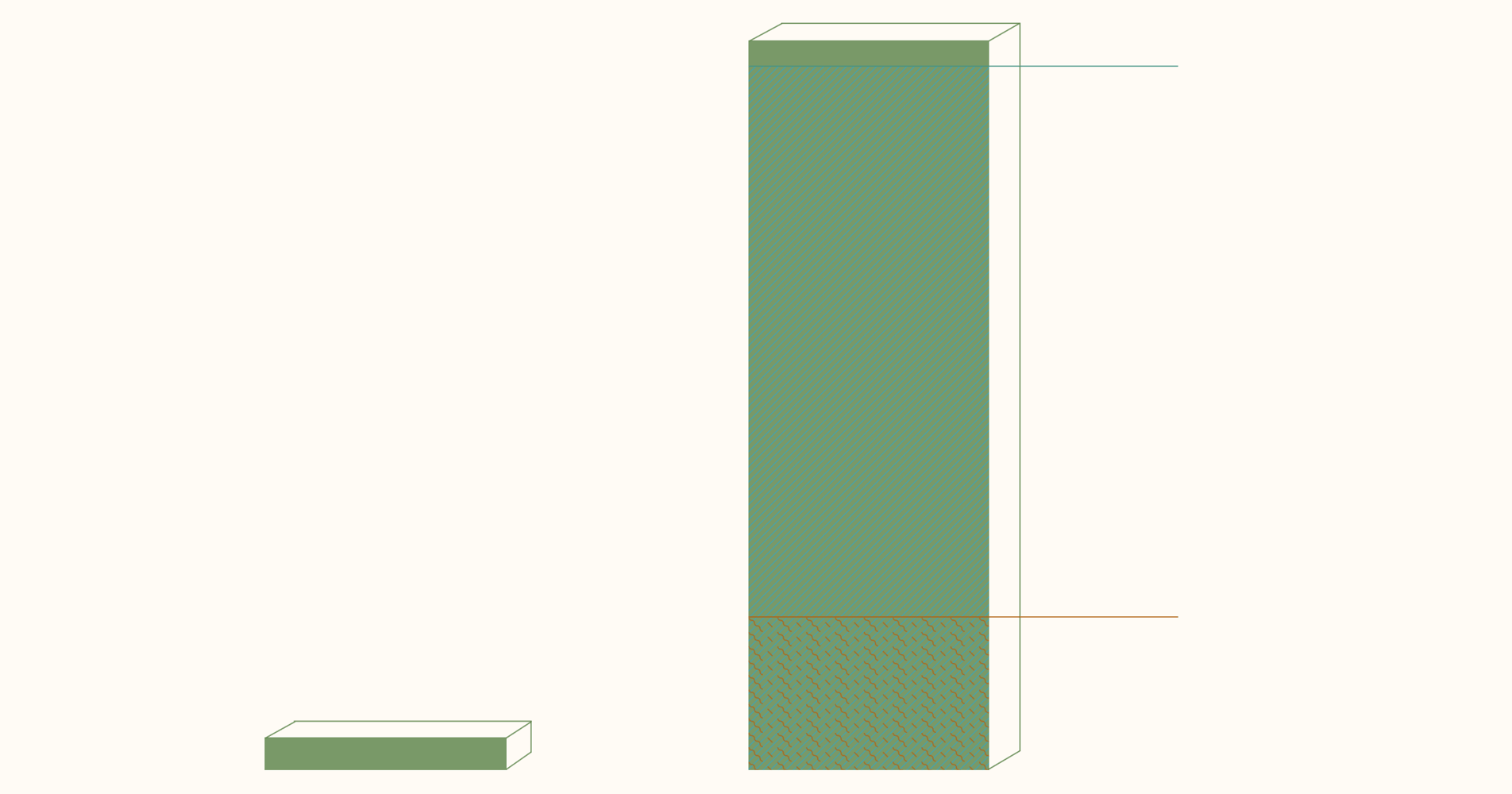
The answer is yes. If we put solar panels on that land, we could produce roughly 32,000 terawatt-hours of electricity each year.7 That’s 23 times more than the energy that is currently produced in the form of all liquid biofuels.8 You can see this comparison in the chart.
32,000 terawatt-hours is a big number. The world generated 31,000 TWh of electricity in 2024. So, these new solar panels would produce enough to meet the world’s current electricity demand.
Again, our proposal isn’t that we should cover all of this land in solar panels, or that it could easily power the world on its own. We don’t account for the fact that we’d need energy storage and other options to make sure that power is available where and when it’s needed (not just when the sun is shining). We’re just trying to get a sense of perspective for how much electricity could be produced by using that land in more efficient ways.
If we put solar panels on that land, we could produce roughly 32,000 terawatt-hours of electricity each year.
These comparisons might seem surprising at first. But they can be explained by the fact that growing crops is a very inefficient process. Plants convert less than 1% of sunlight into biomass through photosynthesis.9 Even more energy is then lost when we turn those plants into liquid fuels. Crops such as sugarcane tend to perform better than others, like maize or soybeans, but even they are still inefficient.
By comparison, solar panels convert 15% to 20% of sunlight into electricity, with some recent designs achieving as much as 25%.10 That means replacing crops with solar panels will generate a lot more energy.
Now, you might think that we’re comparing very different things here: energy from liquid biofuels meant to decarbonize transport, and solar, which could decarbonize electricity. But with the rise of affordable and high-quality electric vehicles, solar power can be a way to decarbonize transport, too.
Run the numbers, and we find that you could power all of the world’s cars and trucks on this solar energy if transport were electrified.
Of course, these vehicles would need to be electrified in the first place. This is happening — electric car sales are rising, and electric trucks are now starting to get some attention — but it will take time for most vehicles on the road to be electric. For now, we’ll imagine that they are.
We estimate that the total electricity needed to power all cars and trucks is around 7,000 TWh per year, comprising 3,500 TWh for cars and a similar amount for trucks. We’ve added this comparison to the chart.
You could power all of the world’s cars and trucks on this solar energy if transport were electrified.
That’s less than one-quarter of the 32,000 TWh that solar panels could produce on biofuel land. Consider those options. The world could meet 3% or 4% of transport demand with biofuels. Or it could meet all road transport demand on just one-quarter of that land. The other three-quarters could be used for other things, such as food production, biofuels for aviation, or it could be left alone to rewild.
It’s worth noting that in this scenario — unlike using solar for bulk electricity needs — we would need much less additional energy storage solutions, because every car and truck is essentially a big battery in itself.
The reason these comparisons are even more stark than biofuels versus solar is that most of the energy consumed in a petrol car is wasted; either as heat (if you put your hand over the bonnet, you will often notice that it’s extremely warm after driving) or from friction when braking. An electric car is much more efficient without a combustion engine, and thanks to regenerative braking (which uses braking energy to recharge the battery). That means that driving one mile in an electric car uses just one-third of the energy of driving one mile in a combustion engine car.
Put these two efficiencies together, and we find that you could drive 70 times as many miles in a solar-powered electric car as you could in one running on biofuels from the same amount of land.
We send two regular newsletters so you can stay up to date on our work and receive curated highlights from across Our World in Data.
Subscribe
Our point here is not that we should cover all of our biofuel land in solar panels. There are reasons why the comparisons above are simpler than the real world, and why dedicating all of that land to solar power would not be ideal.11
The world could meet 3% or 4% of transport demand with biofuels. Or it could meet all road transport demand on just one-quarter of that land.
What we do want to challenge is how we think and talk about land use. People rightly question the impact of solar or wind farms on landscapes, but rarely consider the land use of existing biofuel crops, which do very little to decarbonize our energy supplies. Whether we’ll run out of land for solar or wind is a common concern, but when we run the numbers, it’s clear that there is more than enough; we’re just using it for other things. Stacking up the comparative benefits of those other things allows us to make better choices, if they’re available.
In this article, we wanted to run the numbers and get some perspective on how we could use that Germany- or Poland-sized area of land in the most efficient way. What’s clear is that we could produce a huge amount of electricity from solar on just a fraction of that land. We could power an entire global electric car and truck fleet on just one-quarter of it.
Land use comes at a cost: for the climate, ecosystems, and other species we share the planet with. That means we should think carefully about how to use it well. That might mean a mix of biofuels for aviation, and solar power for road transport and electricity grids. It might mean going all-in on solar. Or it could mean using some of it for solar power, and leaving the rest alone. Sometimes, the most thoughtful option is not using land at all and letting it return to nature.
Acknowledgments
We would like to thank Max Roser and Edouard Mathieu for editorial feedback and comments on this article. We also thank Marwa Boukarim for help and support with the visualizations.
Continue reading on Our World in Data
Cite this work
Our articles and data visualizations rely on work from many different people and organizations. When citing this article, please also cite the underlying data sources. This article can be cited as:
Hannah Ritchie and Pablo Rosado (2026) - “Putting solar panels on land used for biofuels would produce enough electricity for all cars and trucks to go electric” Published online at OurWorldinData.org. Retrieved from: 'https://archive.ourworldindata.org/20260112-091056/biofuel-land-solar-electric-vehicles.html' [Online Resource] (archived on January 12, 2026).
BibTeX citation
@article{owid-biofuel-land-solar-electric-vehicles,
    author = {Hannah Ritchie and Pablo Rosado},
    title = {Putting solar panels on land used for biofuels would produce enough electricity for all cars and trucks to go electric},
    journal = {Our World in Data},
    year = {2026},
    note = {https://archive.ourworldindata.org/20260112-091056/biofuel-land-solar-electric-vehicles.html}
}
Reuse this work freely
All visualizations, data, and code produced by Our World in Data are completely open access under the Creative Commons BY license. You have the permission to use, distribute, and reproduce these in any medium, provided the source and authors are credited.
The data produced by third parties and made available by Our World in Data is subject to the license terms from the original third-party authors. We will always indicate the original source of the data in our documentation, so you should always check the license of any such third-party data before use and redistribution.
Munich. The MINI brand looks back on an extremely
successful 2025. With a total volume of 288,290 vehicles, MINI
achieved a significant sales increase of 17,7% compared to 2024
figures. Particularly impressive is the high demand for battery
electric vehicles (BEVs): with 105,535 fully electric MINIs delivered
in 2025 (+87,9%), the brand achieved a new record in electromobility,
resulting in more than every third MINI sold worldwide being electric.
In many markets, the share is significantly above 50%, such as
Netherlands, Turkey, Sweden and China.
Jean-Philippe Parain, Head of the MINI brand, emphasizes: “MINI
continuously increases the share of fully electric vehicles, thereby
demonstrating its innovative strength and future orientation. Our
strong volume growth across all regions in 2025 clearly reflects the
exceptional appeal of the MINI model family. The updated iconic
design, the sportiness, individuality and expanded electric offerings
of the MINI brand have met customer expectations all around the globe.
A growth driver was the largest MINI model in the product portfolio,
the MINI Countryman: with a 32,4 % share of the total MINI volume, it
underlines the brand’s SUV expertise. The Countryman combines typical
MINI driving pleasure with innovative design and high versatility –
ideal for any outdoor challenge. In 2025, 93,305 units were sold
worldwide (+15.2%); the fully electric Countryman achieved a sales
growth of 81.8% compared to 2024.
Sub-brand John Cooper Works reaches record numbers
The sporty John Cooper Works (JCW) sub-brand also set new standards
in 2025: with 25,630 units sold, MINI JCW increased the sales volume
by 59.5% and achieved a new sales record. The share of JCW vehicles
reached 8.9% of the total MINI volume. In some markets, such as UK,
Italy, Japan and Australia, the performance-enhanced MINI models
reached their highest sales figures to date.
The MINI Cooper family
The traditional MINI Cooper family, consisting of the MINI Cooper
3-Door, the MINI Cooper 5-Door and the MINI Convertible, recorded with
162,789 a sales increase of 10.3% compared to the previous year. The
new generation of the MINI Cooper Convertible, only introduced in
2025, rounded off the model family with unique features. With 22,491
units sold, a sales growth of 18.4% was achieved. The MINI Cooper
5-Door impresses with typical brand-specific driving fun, increased
space, and high functionality and recorded with 47,850 units a
significant growth of 26.5% compared to 2024.
2026 starts with the new MINI Paul Smith Edition
Starting in 2026, the MINI Cooper 3-Door, MINI Cooper 5-Door, and
MINI Cooper Convertible – both electric and combustion engine versions
– will be available in the new MINI Paul Smith Edition. This edition
combines the unmistakable style of the British designer Paul Smith
with the playful, optimistic and independent spirit of the MINI brand.
Following the successful collaborations “MINI STRIP” (2021) and “MINI
Recharged by Paul Smith” (2022), Paul Smith now brings his
world-famous design language “Classic with a twist” into the MINI
family once again.
In case of queries, please contact: Corporate Communications