Category: 3. Business

  • Down Arrow Button Icon

    Down Arrow Button Icon

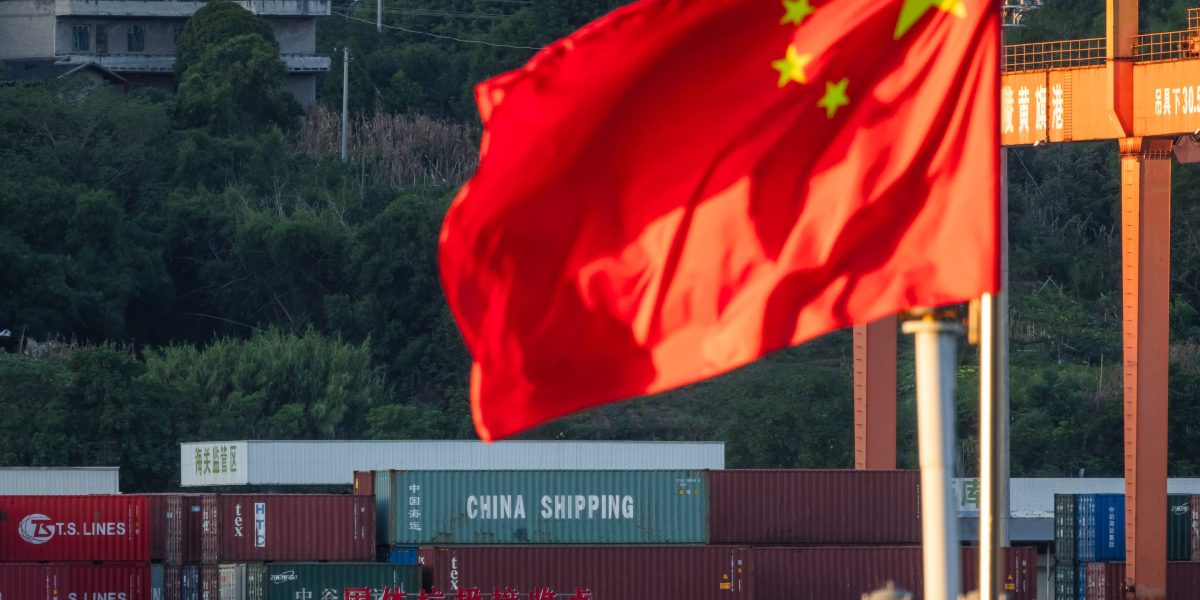
    The flood of Chinese exports around the world helped the economy blow past President Donald Trump’s massive tariff hikes, while Beijing touts successes in AI, EVs, robotics and other emerging technologies.

    But that strength masks ongoing weakness among consumers and the property sector.

    China’s trade surplus jumped 20% to $1.19 trillion in 2025, marking the world’s largest ever, as shipments surged to the European Union, Africa, Latin America and Southeast Asia.

    Exports climbed 5.5% and accounted for a third of economic growth in 2025, the highest level since 1997. Imports were virtually flat, reflecting weak domestic demand and Beijing’s push to become more self-sufficient.

    The record trade surplus helped GDP grow 5% last year, matching the government’s target, but the headline figure contrasted with mounting signs of broad weakness.

    Growth actually slowed toward the end of the year, with GDP up 4.5% in the fourth quarter on an annual basis versus a 4.8% gain in the third quarter.

    Retail sales in December inched up just 0.9%, down from 2.9% growth in October and 6.4% in May. Investment in fixed assets reversed sharply into an outright decline, collapsing 15% in December after spiking 15.7% in February.

    In fact, fixed-asset investment saw its first annual drop in data going back almost three decades. That’s largely due to China’s real estate crash, which sent property investment down 17.2% last year and offset heavy spending on high-tech industries that Beijing is trying to advance.

    Fitch Ratings expects China’s economy to run out of steam this year, predicting GDP growth will cool sharply to 4.1% from 5% in 2025.

    “We believe domestic demand will remain constrained by sluggish consumer confidence, deflationary pressures, and investment headwinds that have broadened beyond the property-sector correction and are amplified by the local-government debt overhang,” it said in a report on Jan. 22.

    But more than four years since China popped a construction bubble, about 80 million unsold or vacant homes continue to weigh on sales, prices, starts and completions.

    After tinkering with attempts to revive the property sector, China has signaled it’s pivoting to a new model of development, away from the emphasis on debt-fueled investment.

    “This marks the virtual abandonment of an industry that once accounted for about one-quarter of China’s gross domestic product and roughly 15% of the nonfarm workforce,” Jeremy Mark, an Atlantic Council scholar and former IMF official, wrote on Wednesday.

    Many other economic problems—such as weak retail spending, deflation, as well as low consumer and business confidence—can be traced back to the free-fall in real estate, which is the main repository of life savings for hundreds of millions of households, he pointed out.

    That’s as an estimated 85% of the price gains in real estate have been wiped out since 2021. As result, consumers hoard their money instead of spending it, forcing businesses to trim wages, staff and prices to remain afloat. In response, consumers pull back further.

    This feedback loop has kept consumer prices flat and producer prices in negative territory. China’s overcapacity and its support for manufacturers over consumers have also stoked excess supply that drags down prices. An economy-wide price gauge shows China has been suffering from deflation for three straight years, the longest such streak since its transition to a market economy in the late 1970s.

    The real estate crash is also rippling through China’s banks and local governments, as efforts to stave off more bankruptcies among developers have created “zombie” firms and mountains of debt, Mark warned.

    “Even if the shockwaves from China’s collapsed property bubble eventually recede, the task of rebuilding will be daunting,” he added. “It requires not only replacing a major pillar of Chinese economic dynamism, but also the revitalization of homeowners’ deeply damaged sense of financial security.”

    Export-led growth running out of room

    Economists have long urged China to rebalance its growth to a consumer-led model and away from an export- and investment-led model. President Xi Jinping’s industrial policies have even been flagged as a greater threat to the global economy than Trump’s trade war.

    But last year’s reliance on exports showed that the country’s leadership remains reluctant to make the switch. While Chinese businesses have flexed their muscle as global manufacturing powerhouses, their ability to prop up the rest of the economy is in doubt.

    “China’s growth model is becoming increasingly difficult to sustain,” Cornell professor Eswar Prasad wrote in a Financial Times op-ed in December.

    Weak growth in employment and wages, plus the property crash and lack of confidence in the government, have weighed on consumption, he added. With little domestic demand, the only option for China’s factories is to export their output.

    But Trump’s tariffs have forced exporters to look elsewhere, creating a backlash in other markets that could put up additional trade barriers and limit future growth, Prasad said.

    The EU and some other large economies like Indonesia and India have already imposed some targeted tariffs on certain Chinese goods.

    As the second-largest economy in the world, China is simply too big to generate much growth from exports, and continuing to depend on export-led growth risks furthering global trade tensions,” IMF Managing Director Kristalina Georgieva warned in December.

    Continue Reading

  • Freedom Capital Markets Upgrades Netflix, Inc. (NFLX) To Buy

    Freedom Capital Markets Upgrades Netflix, Inc. (NFLX) To Buy

    Netflix, Inc. (NASDAQ:NFLX) is among the 12 Most Profitable NASDAQ Stocks to Buy Right Now. On January 27, Freedom Capital Markets upgraded the stock to Buy from Hold, with a price target of $104.

    Freedom Capital Markets Upgrades Netflix, Inc. (NFLX) To Buy

    The adjustment followed the company’s fourth-quarter results, which beat Wall Street’s estimates for both revenue and earnings, driven mainly by an 8% increase in membership to 325 million subscribers from late 2024. Another highlight of the quarter was the streaming giant’s advertising revenue, which grew more than 2.5x to over $1.5 billion.

    Based on the recommendations of 40 analysts, the stock is a Moderate Buy with a one-year average share price target of $114.79, representing an upside of 37.49% as of the close on January 30.

    In other news, on January 20, Netflix, Inc. (NASDAQ:NFLX) announced that it had revised the agreement with Warner Bros. Discovery (WBD) for the latter’s pending acquisition to an all-cash transaction, as part of efforts to close the doors on Paramount’s rival offer. The takeover price would remain $27.75 per WBD share.

    Netflix, Inc. (NASDAQ:NFLX) is a global entertainment company offering TV series, documentaries, movies, and games across multiple languages and genres.

    While we acknowledge the potential of NFLX as an investment, we believe certain AI stocks offer greater upside potential and carry less downside risk. If you’re looking for an extremely undervalued AI stock that also stands to benefit significantly from Trump-era tariffs and the onshoring trend, see our free report on the best short-term AI stock.

    READ NEXT: 10 Best Defense Stocks to Buy in the S&P 500 and 14 Best Booming Stocks to Buy Right Now.

    Disclosure: None.

    Continue Reading

  • With attention on orbital data centers, the focus turns to economics

    With attention on orbital data centers, the focus turns to economics

    One of the biggest questions in the tech sector has been if AI is the future, where does all the infrastructure go?

    Some space industry leaders — including Elon Musk and Jeff Bezos — believe the answer could be in orbit, via space-based data centers.

    That idea has gained attention in recent weeks. Musk is reportedly considering a merger between SpaceX and his generative artificial AI company xAI ahead of his space firm’s planned IPO later this year. In addition, in a filing with the FCC late Jan. 30, SpaceX proposed an orbital data center constellation of up to 1 million satellites in low Earth orbit. 

    But industry analysts say that while the technological challenges can be surmounted, it’s not yet clear if the business case for data centers in space holds up. 

    Deep learning models built by frontier labs like OpenAI, Anthropic and xAI all depend on massive clusters of advanced processors operating in data centers. As more deep learning models are built and deployed, more processing power is required — last year companies invested $61 billion in building more data centers. That’s a new record, according to S&P Global, with real estate trackers expecting capacity to double by 2030.

    However, there are obstacles facing new data centers on Earth, including environmental permitting, access to electricity for power and water for cooling and community opposition. Microsoft, for example, expects its data center water usage to triple by 2030, according to the New York Times. Data center projects built by Amazon and Chile have been canceled over resource concerns like those. 

    “The biggest problems are cooling, security, power transmission — all those things can be solved if you just move it into space,” Chris Quilty, a space industry analyst, told SpaceNews. “The big question that has to be solved, can you do it economically?”

    Jeff Bezos, long an advocate of moving polluting industries off-world as CEO of Blue Origin, kick-started this discussion with remarks at last year’s International Astronautical Congress. 

    “We’re going to start building these giant gigawatt data centers in space,” Bezos said. “We will be able to beat the cost of terrestrial data centers in space in the next couple of decades.”

    Elon Musk and SpaceX are also onboard. Musk told audiences at the World Economic Forum that it will be cheaper to build data centers in space within three years — although that forecast depends on achieving full reusability for Starship, which Musk expects in 2026. 

    Meanwhile, start-ups like Starcloud are attempting to build companies around this business, while Google is collaborating with Earth observation firm Planet to launch its own data center pilot in 2027. Chinese companies like ADA Space and Beijing Astro-Future are plotting ambitious space compute architectures.

    “The rapidity with which the trend has taken hold has shocked me, even for an old hand,” Quilty said. ”It’s very similar to what happened with direct-to-device — everyone and their brother agreed it was a dumb idea right up until the moment that AST raised a round on the concept.”

    Still, much uncertainty remains. “Whether putting data centers in space makes sense or not, and what technologies are needed, depends on the business model,” Akhil Rao, a former NASA economist and managing partner at the frontier technology consultancy Rational Futures, told SpaceNews via email. ”I haven’t seen a business model articulated clearly enough to understand how the system architecture serves particular use cases well.”

    Andrew McCalip, the head of research and development at Varda Space Industries, built an online calculator that attempts a comparison of terrestrial and orbital data centers using publicly available data. Right now, it doesn’t pencil out, with orbital data centers costing about three times as much per watt of computing power under his base case. 

    “If you run the numbers honestly, the physics doesn’t immediately kill it, but the economics are savage,” McCalip wrote in his analysis of the calculator. “It only gets within striking distance under aggressive assumptions, and the list of organizations positioned to even try that is basically one.”

    That’s one reason why space data centers have taken a central role in SpaceX’s IPO narrative, which is reportedly planned for June 2026. Justifying a $1.5 trillion valuation is difficult based on the company’s current business lines and revenues, Quilty said, but the company has a record of surprising its doubters. When Starlink was proposed, few thought that phased array antennas could be manufactured at the required scale and cost, but now SpaceX is building them by the millions and selling them for a few hundred dollars a piece. 

    The latest announcement from Blue Origin may point at a middle ground for AI in space: On Jan. 21, the company announced TeraWave, a new satellite constellation that appears designed to provide new, high-bandwidth connections between terrestrial data centers. Compared to running models in orbit, offering connectivity is a proven way for space companies to dip into the AI surge. 

    And of course, there is the question of an AI bubble. Analysts have noted that justifying the investment in data centers will require significant increases in revenue — say $650 billion in annual consumer spending, per one JP Morgan analysis — for companies like OpenAI that currently lose tens of billions of dollars annually. AI boosters are confident that they will prove out the value of their software, but users, particularly at the enterprise level, are still figuring out how to generate returns using these tools. If they don’t meet expectations, demand for more processing power could prove elusive.

    Continue Reading

  • Price of consumer goods could surge as shipping costs soar, industry body says | Supply chain crisis

    Price of consumer goods could surge as shipping costs soar, industry body says | Supply chain crisis

    The price of consumer goods including computers, electrical machinery and transport equipment could surge this year as a result of soaring shipping costs, an industry body has said, adding that “cracks [are] forming in the global trading system”.

    The cost of transport, energy and raw materials continues to rise and prices remain volatile, which could feed through to businesses and consumers during 2026, according to a study by the Chartered Institute of Procurement and Supply (CIPS).

    Concerns about disruption to supply chains during the next three months reached the highest level in two years, suggesting growing worries among procurement teams. The concerns were reported in a survey conducted in late 2025 by CIPS, an international trade body that represents 64,000 member organisations in procurement and supply chains across 180 countries.

    Bosses responsible for procurement said they were often the first within companies to notice rising prices or problems getting hold of goods. They said uncertainty and price volatility risked becoming a permanent feature of international trade rather than a temporary disruption, as the turmoil unleashed by the pandemic has been followed by geopolitical tensions around the world.

    Shipping and logistics is the area most likely to see significant price rises in 2026, according to the procurement bosses surveyed, with 22% of respondents reporting cost increases of more than 10% by the end of 2025.

    Nearly a fifth (18%) said they had seen similar price increases for computers and peripheral equipment, while 15% reported cost rises for transport equipment and 14% for electrical machinery and apparatus.

    Chinese shipping containers at the Port of Los Angeles this month. The average spot shipping rate between Asia and the US west coast has soared. Photograph: Mike Blake/Reuters

    These price rises and continued volatility are fuelling expectations of more inflationary pressure for consumers during 2026. Shoppers had already seen increases for some computers late last year, with Lenovo and Dell reportedly hiking prices by about 15%. In December, the price of some Dell laptops rose between $130 (£95) and $765, depending on the model and memory size, Business Insider reported.

    The average spot shipping rate between Asia and the US west coast jumped by nearly 30% between late December and early January. The rate increased to $2,145 for a 40ft (12-metre) equivalent unit (FEU), a standard shipping container, up from $2,757, according to the Freightos Baltic Index.

    Prices on shipping routes between Asia and the US east coast and Europe have also climbed in recent weeks.

    Ben Farrell, the chief executive of CIPS, said: “Procurement professionals are often the first to see cracks forming in the global trading system.”

    He added: “Volatility is no longer an exception. When logistics costs can swing by 20%-30% in weeks, those pressures inevitably ripple through to businesses and consumers alike.”

    A man passes a mural depicting Iranian soldiers near an anti-US and Israel billboard in Tehran on Thursday. Photograph: Abedin Taherkenareh/EPA

    International freight shipping costs were already on the rise and climbed further after increased tensions, stoked by Donald Trump’s recent threats to take over Greenland and impose further tariffs on European allies as well as the possibility of war between the US and Iran, sending investors fleeing to traditional safe haven assets such as gold and the Swiss franc.

    US tariffs and protectionist policies were highlighted as important causes of price volatility by those surveyed, who said they were directly being affected by shifting trade rules and China-US tensions.

    Continue Reading

  • French tech giant Capgemini to sell US subsidiary working for ICE – BBC

    French tech giant Capgemini to sell US subsidiary working for ICE – BBC

    1. French tech giant Capgemini to sell US subsidiary working for ICE  BBC
    2. French MPs demand explanation over tech firm’s contract to help ICE in US  The Guardian
    3. Capgemini to sell unit linked to US immigration tracking  Financial Times
    4. French Firm to Sell Division That Helps ICE Track Immigrants  The Wall Street Journal
    5. French IT giant Capgemini to sell subsidiary working with US immigration agency ICE  Anadolu Ajansı

    Continue Reading

  • How Trump 2.0 is affecting investment in U.S. assets

    How Trump 2.0 is affecting investment in U.S. assets

    Continue Reading

  • OPEC+ agrees in principle to keep oil output pause for March: Reuters

    OPEC+ agrees in principle to keep oil output pause for March: Reuters

    Oil prices slipped on Tuesday, extending falls from the two previous sessions, as pressure from plans by OPEC to boost output offset optimism over a potential U.S.-China trade deal.

    Feifei Cui-paoluzzo | Moment | Getty Images

    OPEC+ has agreed in principle to keep its planned pause on oil output increases for March when it meets later on Sunday, ⁠according to three delegates and a draft statement seen by Reuters, even after crude prices hit six-month highs on concern ‍the U.S. could launch a ‍military strike on OPEC ‍member Iran.

    The meeting of eight OPEC+ members comes as Brent crude closed near $70 a barrel on Friday, close to the six-month high of $71.89 reached on Thursday, despite speculation that a supply glut in ‌2026 ‌would push prices down.

    The eight producers — Saudi Arabia, Russia, ​the United Arab Emirates, Kazakhstan, Kuwait, Iraq, Algeria and Oman — raised production quotas by about 2.9 million barrels per day from April through December 2025, roughly 3% of global demand.

    They then froze further planned increases for January through ⁠March 2026 because of seasonally weaker consumption.

    Trump weighing options on Iran

    On Friday, oil prices dipped amid tensions between the U.S. and Iran.

    Brent crude futures settled at $70.69 a barrel, down 2 cents or 0.03%. The March contract expired on Friday. U.S. West Texas Intermediate crude finished at $65.21 a barrel, down 21 cents or 0.32%.

    Sunday’s meeting is now due to start at 1400 GMT, two sources said. It is not expected to take any decisions for output policy beyond March, sources said on Friday.

    OPEC+ includes the Organization of the Petroleum Exporting Countries, plus Russia and other allies. The full OPEC+ pumps about half of the world’s oil.

    A separate OPEC+ panel called the Joint Ministerial Monitoring Committee is also scheduled to meet on Sunday once the eight-country meeting has concluded, delegates said. The JMMC does not have decision-making authority on production policy.

    The JMMC panel will stress the importance of achieving full compliance with OPEC+ output agreements, a second draft statement seen by Reuters showed.

    U.S. President Donald Trump is weighing options on Iran that include targeted strikes against ‍security forces and leaders, aiming to inspire protesters, multiple sources said on Thursday.

    Both sides signal willingness to tak

    Washington has imposed extensive sanctions on Tehran to choke off ⁠its oil revenue, a crucial source of state funding.

    Both the U.S. and Iran have since signalled willingness to engage in dialogue, but Tehran on Friday ‍said its defence capabilities should not be included in any talks.

    Oil prices have also been supported by supply losses in Kazakhstan, where the oil sector has suffered a series of disruptions in recent months. Kazakhstan said on Wednesday it was restarting the huge Tengiz oilfield in stages.

    The eight countries plan to hold their next meeting on March 1 and ⁠the JMMC on April 5, the draft ‌statements showed.

    Continue Reading

  • French tech company Capgemini to sell U.S. unit linked to ICE

    French tech company Capgemini to sell U.S. unit linked to ICE

    French IT company Capgemini will sell its U.S. subsidiary Capgemini Government Solutions, it said on Sunday, after coming under pressure to explain a contract the latter signed with U.S immigration enforcement agency ICE.

    French lawmakers, including Finance Minister Roland Lescure, had asked the company to shed light on the contract amid concern over the tactics used by ICE agents following the fatal shooting of two U.S. citizens in Minnesota last month.

    “Capgemini considered that the usual legal constraints imposed in the United States on contracting with federal entities conducting classified activities did not allow the Group to exercise appropriate control over certain aspects of this subsidiary’s operations in order to ensure alignment with the Group’s objectives,” it said in a statement.

    CapGemini said the process of divestment would be “initiated immediately” but did not say whether the sale was due to CGS’ contract with ICE.

    CGS accounts for 0.4% of Capgemini’s estimated revenue in 2025 and less than 2% of its revenue in the United States, the group said.

    Capgemini CEO Aiman Ezzat had said last week that the company had recently become aware of the nature of a contract awarded to CGS by the U.S. Department of Homeland Security’s Immigration and Customs Enforcement in December 2025.

    However, Capgemini did not have access to any classified information, classified contracts, or anything relating to the technical operations of CGS, as required by U.S. security regulations related to government contracts, he said.

    He added that the company would review the content and scope of this contract and CGS’ contracting procedures.

    Continue Reading

  • Iran rolls out 5 million-rial banknote, about $3.10 at market rate

    Iran rolls out 5 million-rial banknote, about $3.10 at market rate

    Iran is now enduring the country’s longest and most comprehensive internet disruption on record. Its impact has stretched far beyond blocked platforms and loading screens, pushing many businesses to a point of no return.

    Economists estimate Iran’s digital economy generates roughly 30 trillion rials (about $42 million) a day. While modest on paper, that figure represents the livelihoods of small and medium-sized enterprises that operate almost entirely online.

    The Tehran Chamber of Commerce estimates that at least 500,000 Instagram-based shops operate in Iran, supporting around one million jobs whose sales effectively drop to zero without internet access.

    The collapse began when the signal died

    Industry data reviewed by trade groups show daily losses running into billions of rials, with the Chamber reporting revenue declines of 50% to 90%. But some analysts say even those figures understate the damage.

    “Where does this figure even come from?” IT expert Amin Sabeti told Iran International. “These businesses operate on Instagram. When people have no access to Instagram, one hundred percent of their sales are gone.”

    Sabeti said the lack of precise data had itself become part of the crisis. “What we do know is that Instagram and WhatsApp are widely used by small businesses, and many have now lost customers completely,” he added. “For some people, their entire livelihood depended on these platforms.”

    In Iran, platforms such as Instagram, Telegram and WhatsApp function not only as messaging tools but as storefronts, marketing channels and payment gateways.

    Analysts estimate more than 40 million active users rely on them, making social media the backbone of e-commerce, especially for home-based businesses, informal retailers and women-led ventures.

    “In many cases, people have gone bankrupt because they had issued cheques that can no longer be covered,” Sabeti said. “The reality is that a large portion of online businesses that relied heavily on Instagram have been wiped out.”

    One Tehran-based online clothing seller told the news site Dideban Iran that her sales collapsed. After just one week of disruption, she laid off all her workers, shut down her workshop and sold her sewing machines. “I’m bankrupt,” she said.

    Another online seller said most digital businesses lack the reserves to survive even days without revenue. “When the internet goes,” the seller said, “whatever tiny capital we have disappears.”

    • Iranian Online Shop Building Sealed As Hijab Tensions Rise

    Silence from businesses

    Iran International contacted several large and small online businesses to ask about the impact of the blackout. None replied. Messages were not even seen — an absence that spoke louder than any quote.

    A few voices surfaced briefly on X. One user wrote that a friend who teaches languages online could no longer earn enough to cover monthly expenses. “Online business is not just online shops,” the post said. “Thousands of jobs depend on the internet, and they’ve been destroyed.”

    Another described producers already weakened by months of economic pressure. “In our industrial area, someone with 15 years of production experience is renting out his workshop as a spare-parts warehouse,” the post read. “Last year we had 13 workers. Now we have three.”

    Economists warn the damage will outlast restored connections. Prolonged shutdowns erode trust, deter investment and stall technological development. Many business owners say they have lost not only their capital but the will and the means to start again.

    Women, who make up a significant share of Iran’s home-based digital workforce, are among the most exposed. For many, online trade was the only viable entry into the economy. With that channel severed, unemployment follows quietly.

    “If this situation continues, it can really push the digital economy toward destruction,” said Reza Olfatnasab, head of the union of virtual businesses.

    • Crackdown On Online Businesses Intensifies In Iran

      Crackdown On Online Businesses Intensifies In Iran

    Numbers collide, blame follows

    As businesses slipped into silence, the argument over numbers intensified.

    Communications Minister Sattar Hashemi said recent outages were inflicting about 5,000 billion rials a day in direct losses on the core digital economy and nearly 50 trillion rials across the wider economy. Around 10 million people depend directly or indirectly on the sector, he said, adding that the average resilience of internet-based businesses is just 20 days.

    The hardline daily Kayhan dismissed those estimates as “fabricated figures,” accusing the communications ministry of deflecting responsibility and arguing that officials who failed to build a “secure and lawful” network should be held accountable.

    Industry bodies offered competing assessments. Analysts say the gap exposes a deeper problem than the shutdown itself: Iran lacks any transparent, standardized system to measure its digital economy.

    For many business owners, however, the debate over billions has already arrived too late. Their screens are dark, their messages unread and their income, whatever the final number, already gone.

    Continue Reading

  • Is Banco Bilbao Vizcaya Argentaria (BME:BBVA) Still Attractive After Doubling Over The Past Year?

    Is Banco Bilbao Vizcaya Argentaria (BME:BBVA) Still Attractive After Doubling Over The Past Year?

    Make better investment decisions with Simply Wall St’s easy, visual tools that give you a competitive edge.

    • If you are wondering whether Banco Bilbao Vizcaya Argentaria’s recent share price puts it at a premium or still leaves room for value, this article walks through what the numbers say about the stock.

    • The shares recently closed at €21.45, with returns of 1.8% over the last 7 days, 5.3% over the last 30 days, 5.3% year to date, 103.3% over 1 year and a very large gain over 5 years that is more than 5x.

    • Recent coverage of Banco Bilbao Vizcaya Argentaria has focused on its role in the European banking sector and on how investors are treating large banks in the region in light of changing interest rate expectations. This broader backdrop helps frame why some investors are reassessing both risk and potential upside in established lenders like BBVA.

    • On Simply Wall St’s 6 point valuation checklist, Banco Bilbao Vizcaya Argentaria currently scores 3 out of 6. Next, we will look at what traditional valuation methods say about that score, before finishing with a more comprehensive way to think about the company’s value.

    Find out why Banco Bilbao Vizcaya Argentaria’s 103.3% return over the last year is lagging behind its peers.

    The Excess Returns model looks at how much profit a bank generates over and above the return that shareholders typically require. Instead of focusing on cash flows, it starts with book value and earnings power, then measures how efficiently equity is being used.

    For Banco Bilbao Vizcaya Argentaria, the model uses a Book Value of €10.02 per share and a Stable EPS of €2.19 per share, based on weighted future Return on Equity estimates from 17 analysts. The Average Return on Equity is 19.50%, compared with a Cost of Equity of €1.02 per share, which results in an Excess Return of €1.18 per share. The Stable Book Value used in the model is €11.25 per share, based on estimates from 12 analysts.

    Using these inputs, the Excess Returns valuation points to an intrinsic value of about €28.95 per share. Relative to the recent share price of €21.45, this suggests the stock is 25.9% undervalued according to this framework.

    Result: UNDERVALUED

    Our Excess Returns analysis suggests Banco Bilbao Vizcaya Argentaria is undervalued by 25.9%. Track this in your watchlist or portfolio, or discover 875 more undervalued stocks based on cash flows.

    BBVA Discounted Cash Flow as at Feb 2026

    Head to the Valuation section of our Company Report for more details on how we arrive at this Fair Value for Banco Bilbao Vizcaya Argentaria.

    Continue Reading